
Search
Remove Ads
Advertisement

 This answer was generated by
 Search Results

Article
The Ancient Celtic Pantheon
The ancient Celtic pantheon consisted of over 400 gods and goddesses who represented everything from rivers to warfare. With perhaps the exception of Lugh, the Celtic gods were not universally worshipped across Iron Age Europe but were very...

Image
Kublai Khan Naming Phakpa Imperial Preceptor
Kublai (Qubilai) Khan Naming Phakpa Imperial Preceptor, c. 1270 CE; attributed to Khyentse Chenmo (flourished 1450s–1490s CE); Tibet; late 15th–16th century CE; pigments on cloth; 32 1/4 x 20 in. (82.6 x 50.8 cm); Art Gallery of Greater Victoria...
Image
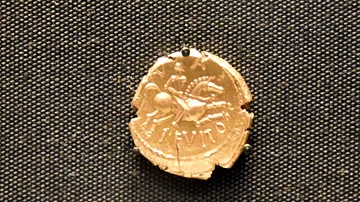
Gold Coin Naming a New King from Britian
This coin offers the first evidence for the existence of a local king called "Anarevito". He is not known either from other coin finds or Roman historical accounts. Coin inscriptions often provide the only reference to the kings and rulers...
Image
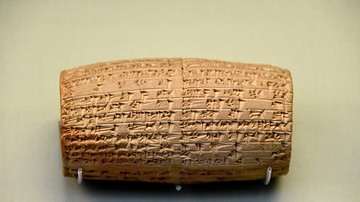
Mesopotamian Cylinder Naming Nabonidus & Sacred Buildings
Clay cylinder with Babylonian characters, recording the restoration of Sin's ziggurat at Ur and also asking him to protect Nabonidus and his son Belshazzar. From Ur, Southern Mesopotamia, modern-day Iraq. Neo-Babylonian Period, reign of Nabonidus...
Image
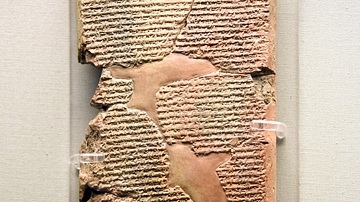
Clay Tablet Naming Gyges of Lydia
This clay tablet is inscribed in a cuneiform script. It is an account of the Egyptian campaigns of Ashurbanipal II, king of Assyria (reigned 668-627 BCE) and his reception of an embassy from Gyges, the first king of Lydia. From the library...

Image
Mesopotamian Tablet Naming Belshazzar
This adminsitrative document is dated to the "24th day of Kislimu in the 11th year Nabonidus, King of Babylon". It mentions "a slave of Bel-sharra-usur (Belshazzar),son of the king". Although Belshazzar is acting as regent, the formal date...

Definition
Roman Mythology
The ancient Romans had a rich mythology and, while much of it was derived from their neighbors and predecessors, the Greeks, it still defined the rich history of the Roman people as they eventually grew into an empire. Roman writers such...

Article
A Roman Trail in the Moselle Valley
The Moselle Valley is Germany's oldest winegrowing region. The Romans brought viticulture to this area and planted vines along the Moselle River 2000 years ago. After settling the region c. 50 BCE and establishing the city of Trier (Augusta...

Definition
Roman Army
The Roman army, famed for its discipline, organisation, and innovation in both weapons and tactics, allowed Rome to build and defend a huge empire which for centuries would dominate the Mediterranean world and beyond. Overview The Roman...

Definition
Roman Empire
The Roman Empire, at its height (c. 117), was the most extensive political and social structure in western civilization. Building upon the foundation laid by the Roman Republic, the empire became the largest and most powerful political and...
