
Search
Remove Ads
Advertisement

 This answer was generated by
 Search Results

Definition
Magnus Maximus
Magnus Maximus (c. 355 - August 28, 388 CE) was a Roman usurper and Western Roman Emperor from 383-388 CE. He was a prominent general in the Roman army, particularly in the province of Britain. In 383 CE he usurped the Western throne, rebelling...

Definition
Battle of Cannae
The Battle of Cannae (2 August 216 BCE) was the decisive victory of the Carthaginian army over Roman forces at Cannae, southeast Italy, during the Second Punic War (218-202 BCE). The Carthaginian general Hannibal Barca (l. 247-183 BCE), who...

Definition
Circus Maximus
The Circus Maximus was a chariot racetrack in Rome constructed in the 6th century BCE. Used for other events such as the Roman Games and gladiator fights, it last hosted chariot races in the 6th century. Partially excavated in the 20th century...

Definition
Hannibal
Hannibal (also known as Hannibal Barca, l. 247-183 BCE) was a Carthaginian general during the Second Punic War between Carthage and Rome (218-202 BCE). He is considered one of the greatest generals of antiquity and his tactics are still studied...

Article
The Price of Greed: Hannibal's Betrayal by Carthage
Hannibal Barca (l. 247-183 BCE), the brilliant Carthaginian general of the Second Punic War (218-202 BCE), had the military talent, expertise, and skill to have won the conflict but was denied the resources by his government. The Carthaginian...

Definition
Viriathus
Viriathus (c. 180-140 BCE) was the leader of the Lusitani in their war with Rome. In 150 Viriathus escaped the Roman massacre and enslavement of Lusitani who had surrendered peacefully. Viriathus continued to fight in the resistance and rose...

Definition
Punic Wars
The Punic Wars were a series of conflicts fought between Carthage and Rome between 264 BCE and 146 BCE. The name Punic comes from the word Phoenician (Phoinix in the Greek, Poenus from Punicus in Latin) as applied to the citizens of Carthage...
Image
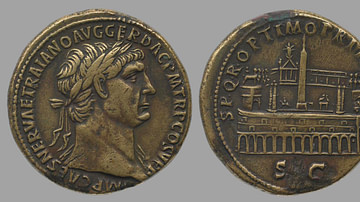
Sestertius Commemorating Trajan's Rebuilding of the Circus Maximus
Sestertius commemorating Trajan's rebuilding of the Circus Maximus, showing the Arch of Titus (not to be confused with the Arch of Titus built over the Via Sacra), which looks down from the upper left, quadrigae (four-horse chariots) surmounting...

Image
Circus Maximus Reconstruction
An illustration of what the Circus Maximus chariot track of Rome might have looked like. The Circus Maximus dates back to the 6th century BCE but was at its most splendid in the 1st century CE when it had a capacity for 250,000 spectators...

Image
Illustration of Circus Maximus, Rome
Illustration of the Circus Maximus in Rome, as it might have appeared in Antiquity by Rocío Espin. Courtesy of Ancient History Magazine / Karwansaray Publishers.
