
Search
Did you mean: Quran?

 This answer was generated by
 Search Results
Image
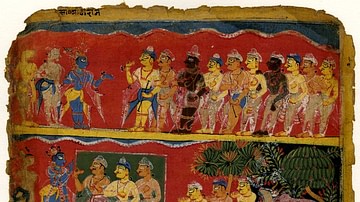
Bhagavata Purana
Page from a manuscript of the Bhagavata Purana. Three cowherds bring their cows to the river Yamuna to drink, then they ask Kṛṣṇa how to find food. Above, Kṛṣṇa tells a group of cowherds, all standing in a line to go and ask the brahmin ladies...

Definition
Nandi
Nandi (also Nandin) is the sacred bull calf, gatekeeper, and vehicle (vahana) of the Hindu god Shiva. Sculptures of Nandi are a common sight at Hindu temples dedicated to his master, and he is partly responsible for the Hindu reverence for...

Definition
Ganges - The Sacred Hindu River
The River Ganges, also known as the Ganga, flows 2,700 km from the Himalaya mountains to the Bay of Bengal in northern India and Bangladesh. Regarded as sacred by Hindus, the river is personified as the goddess Ganga in ancient texts and...

Definition
Vishnu
Vishnu is one of the most important gods in the Hindu pantheon. He is considered a member of the holy trinity (trimurti) of Hinduism with Brahma and Shiva. Vishnu is the Preserver and guardian of men, he protects the order of things (dharma...

Definition
Agni
Agni is the Hindu god of fire. He is regarded as the friend and protector of humanity, in particular, he safeguards the home. Various forms of fire are associated with Agni and include the sun, lightning, comets, sacrificial fire, domestic...

Article
Greco-Bactrian and Indo-Greek Kingdoms in Ancient Texts
The rarity of the appearance of Greco-Bactrian and Indo-Greek kingdoms in ancient literature is one of the reasons why those states are so little-known today. Indo-Greek literature did exist, but none has been found that speaks about the...

Definition
Gupta Empire
The Gupta Empire stretched across northern, central and parts of southern India between c. 320 and 550 CE. The period is noted for its achievements in the arts, architecture, sciences, religion, and philosophy. Chandragupta I (320 – 335 CE...
Definition
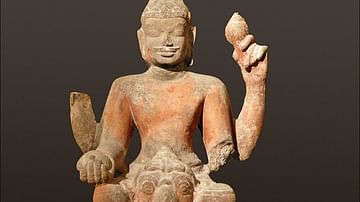
Garuda
Garuda is a bird creature from Hindu mythology that has a mix of eagle and human features. He is the vehicle (vahana) of Vishnu and appears on the god's banner. Garuda represents birth and heaven, and is the enemy of all snakes. In Indian...
Definition
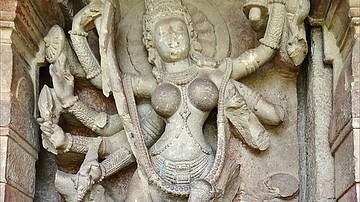
Devi
Devi, also known as Mahadevi or 'Great Goddess', is an all-embracing Mother Goddess first worshipped in India in Prehistoric times. In the Vedic period, she was assimilated into the Hindu pantheon and so came to represent the female energy...
Article
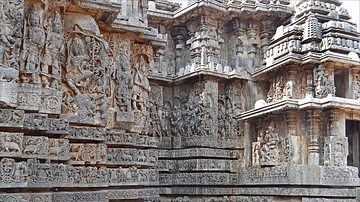
Hoysala Architecture
The Hoysala era (1026 CE – 1343 CE) was marked by illustrious achievements in art, architecture, and culture. The nucleus of this activity lay in the present day Hassan district of Karnataka, India. The most remarkable accomplishment of this...
