
Search
Remove Ads
Advertisement

 This answer was generated by
 Search Results

Article
Royal Women in the Mughal Empire
It was not only the Mughal emperors that left an indelible mark in the history of the Indian subcontinent but also the queens and princesses. The latter's contributions to art, architecture, literature, cuisine, refinement...

Article
Zengids & the Crusaders: Race for Egypt (1163-1169 CE)
In the aftermath of the failure of the Second Crusade (1147-1149 CE), which only managed to bring Damascus under Nur ad-Din's (sometimes also given as Nur al-Din, l. 1118-1174 CE) dominion, Egypt...
Image
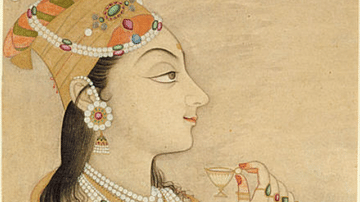
Portrait of Nur Jahan
A c. 1725 idealised portrait of Queen Nur Jahan (c. 1577-1645), wife of the Mughal Emperor Jahangir (r. 1605-1627). (Los Angeles County Museum of Art)
Image
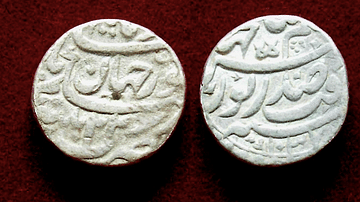
Mughal Coin of Nur Jahan
Silver Mughal coin bearing the name of Queen Nur Jahan (c. 1577-1645), wife of the Mughal Emperor Jahangir (r. 1605-1627).

Image
The Tomb of Nur Jahan
The Tomb of Empress Nur Jahan (1577-1645), constructed from red sandstone and elegantly decorated with pietra dura inlay in the mid-17th century in Shahdara Bagh, Lahore, Pakistan.

Video
Gardens in Indian Art - Jahangir and Prince Khurram with Nur Jahan
Tour this famous Indian Royal Garden as depicted in a 17th C. painting.

Article
Saladin & the Unification of the Muslim Front: 1169-1187 CE
Saladin (c. 1137 – 1193 CE), the Muslim ruler who crushed the mighty Crusader army at the Horns of Hattin (1187 CE) and re-took Jerusalem after 88 years of Crusader control, was born in a world...

Definition
Second Crusade
The Second Crusade (1147-1149) was a military campaign organised by the Pope and European nobles to recapture the city of Edessa in Mesopotamia which had fallen in 1144 to the Muslim Seljuk Turks. Despite an army of 60,000 and...
Image
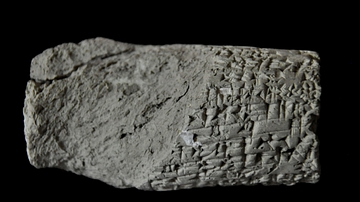
Tablet of King Nur-Adad
This partially broken document mentions the name of King Nur-Adad, king of Larsa, 1921-1905 BCE. (The Sulaimaniya Museum, Iraq).

Article
The Siege of Damascus, 1148 CE
The siege of Damascus in 1148 CE was the final act of the Second Crusade (1147-1149 CE). Lasting a mere four days from 24 to 28 July, the siege by a combined western European army was not successful, and the Crusade...
