
Search
Remove Ads
Advertisement

 This answer was generated by
 Search Results

Definition
Queen Himiko
Queen Himiko, also known as Pimiko or Pimiku (183? - 248 CE), was a 3rd-century CE ruler of the territory in ancient Japan known as Hsieh-ma-t'ai or Yamatai, later to be known as Yamato. Considered by the Chinese as the ruler of all of Japan...
Image
Queen Himiko
A modern artist's depiction of the legendary Japanese Queen Himiko, reign c. 189 CE to 248 CE.

Definition
Yayoi Period
The Yayoi Period is one of the oldest historical periods of Japan spanning from c. 300 BCE to c. 250 CE, preceded by the Jomon Period and followed by the Kofun Period. The name Yayoi comes from the district in Tokyo where the first artifacts...

Definition
Ancient Japan
Ancient Japan has made unique contributions to world culture which include the Shinto religion and its architecture, distinctive art objects such as haniwa figurines, the oldest pottery vessels in the world, the largest wooden buildings anywhere...

Definition
Amaterasu - Shinto's Greatest Goddess
Amaterasu Omikami ('the Great Divinity Illuminating Heaven') is the sun goddess and most important deity of the Shinto religion. Amaterasu is the ruler of Takama no Hara (the High Celestial Plain), the domain of the kami or spirits. The most...

Definition
Kofun Period
Following the Yayoi Period of Japan when farming and metalworking techniques were introduced from mainland Asia was the Kofun Period (c. 250 CE - 538 CE) where the religion of Shinto emerges from the beliefs of previous eras and the Yamato...

Article
Ancient Japanese & Chinese Relations
Relations between ancient Japan and China have a long history, and in certain periods the exchange of political, religious and cultural practices between the two was intense. China, the much older state and the more developed, passed on to...
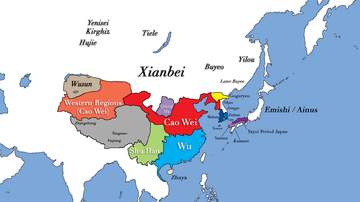
Image
Three Kingdoms Period of China and the Rise of Xianbei in the year 229 CE
This map depicts the boundaries of all major civilizations in East Asia at the beginning of the Three Kingdoms Period of China, with italics indicating nomadic bands and other tribal societies. Following the collapse of Han Dynasty in 220...
