
Search
Did you mean: Valerian?
Remove Ads
Advertisement

 This answer was generated by
 Search Results
Image
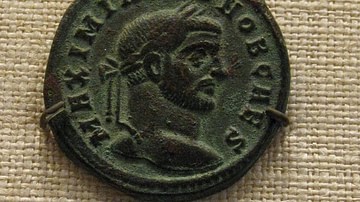
Galerius
A bronze nummus of Aquileia depicting Galerius, r. 305-311 CE (Metropolitan Museum of Art, New York).

Definition
Constantine I
Constantine I, aka Constantine the Great, was Roman emperor from 306 to 337 CE. Realizing that the Roman Empire was too large for one man to adequately rule, Emperor Diocletian (284-305 CE) split the empire into two, creating a...
Image
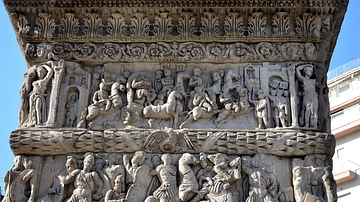
Relief Scenes, Arch of Galerius, Thessalonica
Relief scenes from the one of the pillars of Galerius' triumphal arch in Thessalonica. Erected in 298 CE the arch and sculpture commemorated the Roman victory over the Persians.

Image
Arch of Galerius, Thessalonica
The triumphal arch of Galerius, Roman emperor, who defeated the Persians in 298 CE. The pillars carry relief scenes from the campaign.

Definition
Diocletian
Diocletian was Roman emperor from 284 to 305 CE. After the defeat and death of the Roman emperor Philip the Arab in 249 CE, the empire endured over three decades of ineffective rulers. The glory days of Augustus, Vespasian, and Trajan...
Definition
Thessalonica
Thessalonica (also Thessalonike) was an ancient city of Macedon in northern Greece which today is the city of Thessaloniki. Made capital of the Roman province of Macedon, the city flourished due to its location on the major trade...

Article
Constantine’s Conversion to Christianity
Constantine I (Flavius Valerius Constantinus) was Roman emperor from 306-337 CE and is known to history as Constantine the Great for his conversion to Christianity in 312 CE and his subsequent Christianization...

Image
Map of the Diocletian's First Tetrarchy and the Roman Empire - Stability Through Division, Succession by Design
The First Tetrarchy (293–305 CE) was Emperor Diocletian's (reign 284–305 CE) solution to the political and military crises that had nearly destroyed the...
Image
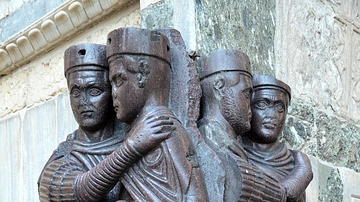
Portrait of the Four Tetrarchs
Porphyry sculpture portraying the four Tetrarchs (Diocletian, Maximianus, Galerius and Constantius Chlorus) embracing. It is dated to c. 300 CE and was sculpted in Asia Minor. It probably originally decorated two separate...

Definition
Byzantine Architecture
The architecture of the Byzantine Empire (4th - 15th century CE) continued its early Roman traditions but architects also added new structures to their already formidable repertoire, notably improved fortification walls and...
