
Search
Remove Ads
Advertisement

 This answer was generated by
 Search Results

Definition
Cambyses II
Cambyses II (r. 530-522 BCE) was the second king of the Achaemenid Empire. The Greek historian Herodotus portrays Cambyses as a mad king who committed many acts of sacrilege during his stay in Egypt, including the slaying of the sacred...

Definition
Late Period of Ancient Egypt - The End of Egyptian Rule of Egypt
The Late Period of Egypt (525-332 BCE) is the era following the Third Intermediate Period (1069-525) and preceding the brief Hellenistic period (332-323 BCE) when Egypt was ruled by the Argead...
Image
Cambyses II of Persia
Cambyses II of Persia after winning the battle of Pelusium on 525 BC, capturing Psamtik III of Egypt and conquering Egypt. Please accept this.
Image
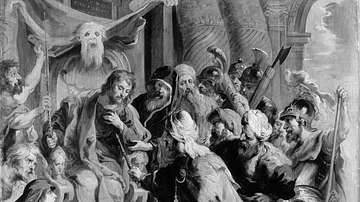
Cambyses Appointing Otanes Judge
Cambyses Appointing Otanes Judge, copy after Peter Paul Rubens, probably 18th century CE, Metropolitan Museum of Art, New York.

Definition
Behistun Inscription
The Behistun Inscription is a relief with accompanying text carved 330 feet (100 meters) up a cliff in Kermanshah Province, Western Iran. The work tells the story of the victory of the Persian king Darius I (the Great, r...

Article
The Battle of Pelusium: A Victory Decided by Cats
The ancient Egyptians had a great reverence for life in all its forms. Life had been given by the gods and reverence for it extended beyond human beings to all living things. Although the Egyptians did...
Image
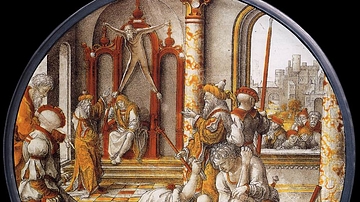
The Judgement of Cambyses, Vellert
Dirck Vellert, The Judgement of Cambyses, stained glass, 1542 CE, Rijsmuseum, Amsterdam. This panel shows a scene from Herodotus's Histories: Sisamnes, a corrupt judge, is ordered to be flayed alive by Cambyses...

Image
The Judgement of Cambyses, David
Gerard David, The Judgement of Cambyses, 1498 CE, Groeninge Museum, Bruges, Belgium. This diptych shows a scene from Herodotus's Histories: the arrest and flaying of the Persian judge Sisamnes, who was a corrupt judge...

Definition
Darius I
Darius I (l. c. 550-486 BCE, r. 522-486 BCE), also known as Darius the Great, was the third Persian King of the Achaemenid Empire. His reign lasted 36 years, from 522 to 486 BCE; during this time the Persian Empire reached its peak...

Definition
Apis
Apis was the most important and highly regarded bull deity of ancient Egypt. His original name in Egyptian was Api, Hapi, or Hep; Apis is the Greek name. He is not, however, associated with the god Hapi/Hep who was linked to the inundation...
