
Search
Did you mean: Writing?
Remove Ads
Advertisement

 This answer was generated by
Search Results
Image
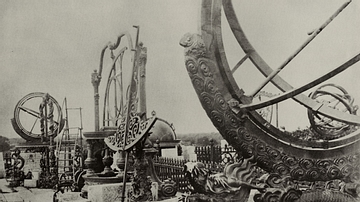
Beijing Observatory Instruments
A c. 1877 CE photograph of the remains of instruments at Beijing's Observatory. Astronomy evolved in 16th-17th century CE China as a result of the introduction of scientific ideas by Jesuit missionaries such as Ferdinand...
Image
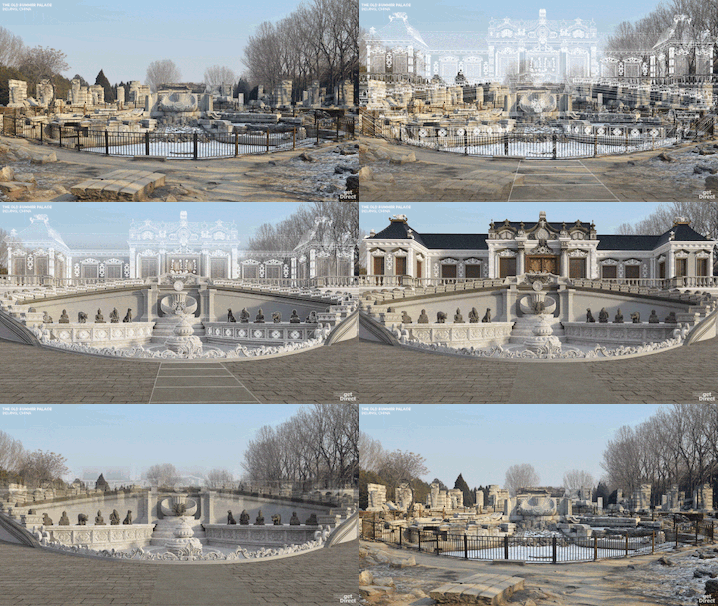
Reconstruction of the Old Summer Palace, Beijing
Digital reconstruction of the Yuanming Yuan palace complex, known in the Western World as the Old Summer Palace. This reconstruction depicts Haiyantang ("The Palace of Calm Seas"), a two-story western-style...
Definition
Ming Dynasty
The imperial Ming dynasty ruled China from 1368 to 1644. It replaced the Mongol Yuan dynasty which had been in power since the 13th century. Despite challenges from abroad and within, the Ming dynasty oversaw an unprecedented growth...

Definition
Yongle Emperor
The Yongle Emperor (aka Chengzu or Yung Lo, r. 1403-1424 CE) was the third ruler of the Chinese Ming Dynasty (1368-1644 CE). Inheriting a stable state thanks to the work of his father, the Hongwu Emperor (r. 1368-1398 CE), Yongle...

Article
Interview: Her Lotus Year. Wallis Simpson in China
Wallis Simpson (1896-1986) is often remembered as the wife of King Edward VIII, the Duke of Windsor. British monarch for less than a year in 1936, Edward preferred to abdicate the throne to be free...

Definition
Kublai Khan
Kublai Khan (Qubilai-Qan) was the ruler of the Mongol Empire from 1260 to 1294. His accomplishments include establishing Mongol rule in China under the name of the Yuan Dynasty (1271-1368), thus becoming the first non-Chinese to rule...

Image
An Example of a Hutong
Picture of a hutong in Beijing (2008). A hutong is a narrow street or alley, most commonly associated with Beijing.

Definition
Yuan Dynasty
The Yuan Dynasty was established by the Mongols and ruled China from 1271 to 1368. Their first emperor was Kublai Khan (r. 1260-1294) who finally defeated the Song Dynasty which had reigned in China since 960. Stability and peace...

Definition
Qilin (Chinese Unicorn)
The qilin (麒麟, or simply lin 麟) is a Chinese mythical creature, frequently translated as "Chinese unicorn." While this term may suggest a one-horned creature, the qilin is often depicted with two horns. However, like the...

Definition
Ögedei Khan
Ogedei Khan (aka Ogodei) ruled the Mongol Empire from 1229 to 1241. He was the third son of Genghis Khan (r. 1206-1227), the empire's founder. Ogedei's accomplishments included creating a new capital at Karakorum, establishing a system...
