
Search
Remove Ads
Advertisement

 This answer was generated by
 Search Results

Definition
Miklós Horthy
Miklós Horthy (1868-1957) was a Hungarian admiral and statesman who served as regent for the Kingdom of Hungary from 1920 until his forced abdication in 1944. During the interwar period and for most of World War II, Horthy played...

Article
Assassination of Archduke Franz Ferdinand - The Road to WWI
The assassination of Archduke Franz Ferdinand (1863-1914) in the Balkans in the summer of 1914 set off a chain of events that led to the First World War (1914-18). For over a decade before, imperialistic...
Definition
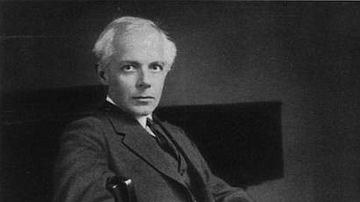
Béla Bartók
Béla Bartók (1881-1945) was an innovative Hungarian pianist and composer most famous for his classical works for piano and orchestra, string quartets, and songs, many of which present traditional Hungarian and other European folk...

Definition
Roman Empire
The Roman Empire, at its height (c. 117), was the most extensive political and social structure in western civilization. Building upon the foundation laid by the Roman Republic, the empire became the largest and most powerful political...

Definition
Western Roman Empire
The Western Roman Empire is the modern-day term for the western half of the Roman Empire after it was divided in two by the emperor Diocletian (r. 284-305 CE) in c. 285/286 CE. The Romans themselves did not use this term...

Definition
Empire of Nicaea
The Empire of Nicaea was a successor state to the Byzantine Empire, or rather a Byzantine Empire in exile lasting from 1204 to 1261 CE. The Empire of Nicaea was founded in the aftermath of the sacking of Constantinople during...

Definition
Ottoman Empire
The Ottoman Sultanate (1299-1922 as an empire; 1922-1924 as caliphate only), also referred to as the Ottoman Empire, written in Turkish as Osmanlı Devleti, was a Turkic imperial state that was conceived by and named after Osman...

Article
The Causes of WWI
The origins of the First World War (1914-18) are many and varied, with some even dating back several decades, but a political assassination in the Balkans in the summer of 1914 was the spark that blew up Europe's political powder...

Definition
Neo-Assyrian Empire
The Neo-Assyrian Empire (912-612 BCE) was the final stage of the Assyrian Empire, stretching throughout Mesopotamia, the Levant, Egypt, Anatolia, and into parts of Persia and Arabia. Beginning with the reign of Adad Nirari...

Image
Reich Chancellery with Nazi Swastikas and Hungarian Flags
Reich Chancellery with Nazi Swastikas and Hungarian Flags, Bundesarchiv, Berlin, August 1938. The Reich Chancellery (Die Reichskanzlei), built in 1878, was the official office of the German chancellor...
