
Search
Remove Ads
Advertisement

 This answer was generated by
 Search Results

Definition
Agora
The term agora (pronounced ah-go-RAH) is Greek for 'open place of assembly' and, early in the history of Greece, designated the area in a city where free-born citizens could gather to hear civic announcements, muster for military campaigns...

Definition
Ancient Greek Government
Ancient Greece witnessed a wide variety of government systems as people searched for the answers to such fundamental questions as who should rule and how? Should sovereignty lie in the rule of law, the constitution, officials, or the citizens...

Definition
Athens
Athens, Greece, with its famous Acropolis, has come to symbolize the whole of the country in the popular imagination, and not without cause. It not only has its iconic ruins and the famous port of Piraeus but, thanks to ancient writers, its...

Definition
Ares
Ares was the Greek god of war. He was perhaps the most unpopular of all the Olympian gods because of his quick temper, aggressiveness, and unquenchable thirst for conflict. Ares famously seduced Aphrodite, unsuccessfully fought with Hercules...

Definition
Pericles
Pericles (l. 495–429 BCE) was a prominent Greek statesman, orator, and general during the Golden Age of Athens. The period in which he led Athens, in fact, has been called the Age of Pericles due to his influence, not only on his city's fortunes...

Definition
Galatia
Galatia was a region in north-central Anatolia (modern-day Turkey) settled by the Celtic Gauls c. 278-277 BCE. The name comes from the Greek for "Gaul" which was repeated by Latin writers as Galli. The Celts were offered the region by the...

Definition
The Thirty Tyrants
The Thirty Tyrants (οἱ τριάκοντα τύραννοι) is a term first used by Polycrates in a speech praising Thrasybulus (Arist. Rhet. 1401a) to describe the brief 8-month oligarchy which governed Athens after the Peloponnesian War – roughly late-summer...
Definition
Atreus
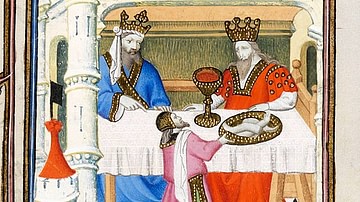
Atreus was the mythical Greek king of Mycenae. He is perhaps best known for being the father of Agamemnon and Menelaus, two heroes of the Trojan War, as well as for the terrible curse placed upon his family. This was a hereditary curse, plaguing...

Article
The Journeys of Paul the Apostle
The journeys of Paul the Apostle, as the New Testament relates in the Book of Acts, started with his conversion experience on the way to Damascus, after which instead of seeking to thwart the growing Christian movement, he helped spread it...

Article
Ten Noble and Notorious Women of Ancient Greece
Women in ancient Greece, outside of Sparta, had almost no rights and no political or legal power. Even so, some women broke through the social and cultural restrictions to make their mark on history. All of the women did so at great personal...
