
Featured

Article
Clothing in the Victorian Era - Getting the Right Balance of Fabric, Figure, and Flashiness
Striking silhouettes, sumptuous fabrics, bright colours, frills galore, and all manner of ornate accessories define the clothing...
Featured

Definition
Socrates
Socrates of Athens (l. c. 470/469-399 BCE) is among the most famous figures in world history for his contributions to the development of ancient Greek philosophy which provided the foundation...
Featured

Image
Map of the Spread of the Black Death, c. 1346–1353 - Trade, Transmission & the Second Plague Pandemic
The Black Death was the catastrophic first great wave of the Second Plague Pandemic, caused by the bacterium Yersinia...
Featured

Image
12 Women Rulers of the Ancient World - Queens, Regents & Empresses Who Exercised State Power
Political power in the ancient world rested on dynastic legitimacy, control of court and military institutions, religious authority...
Latest Content

Article
Ming Taxation & the Silver Economy
The rulers of China's Ming dynasty (1368-1644) acquired an insatiable desire for silver in the 16th century, largely to pay for huge prestige projects like building the Forbidden...

Article
U. S. Grant's Account of the Battle of Fort Donelson - Excerpts from the Official Action Report
Ulysses S. Grant's victory at the Battle of Fort Donelson (11-16 February 1862) during the American Civil War elevated him...

Curriculum Collection
AP World History Unit 5 - Revolutions (c. 1750–1900)
Two major revolutions remade the world between 1750 and 1900. The first was a revolution of the mind: thinkers of the Enlightenment argued that authority was...

Definition
Battle of Fort Donelson - The Victory that Might Have Won the War in the West
The Battle of Fort Donelson (11-16 February 1862) was a Union victory in the Western theater of the American Civil War on the Cumberland River...

Article
Paper Money in Song China
Paper money was invented in China and became widely used by merchants during the Song dynasty (960-1279), principally as proof of cash holdings in state treasuries and for larger...

Definition
Cheka - Lenin's Secret Police
The Cheka (Vecheka) Secret Police was created by Vladimir Lenin's Soviet government in December 1917 to ruthlessly stamp out all opposition to the Bolshevik Revolution. During...
Free for the World, Supported by You
World History Encyclopedia is a non-profit organization. Please support free history education for millions of learners worldwide for only $5 per month by becoming a member. Thank you!
World History Encyclopedia is a non-profit organization. Please support free history education for millions of learners worldwide for only $5 per month by becoming a member. Thank you!
Become a Member DonateMaps

Image
House of Hanover in Britain, 1714–1901 - From George I to Victoria: Monarchy, Reform & Empire
The House of Hanover was the royal dynasty that ruled Great Britain and later the United Kingdom from 1714 to 1901. Its accession...

Image
Map of Edmond Halley’s Scientific Voyages - Exploration, Astronomy & Navigation, 1676–1703
The travels of Edmond Halley (1656–1742) illustrate how the Scientific Revolution increasingly joined theoretical knowledge with...

Image
Map of Peter the Great and the Russian Empire, c. 1725 - War, Reform, and Russia’s Rise as a Great Power
The Russian Empire under Peter I (reign 1682–1725) emerged from an intensified process of military and state-building...
For You

Definition
Europe
Europe is a continent forming the westernmost part of the land mass of Eurasia and comprised of 49 sovereign states. Its name may come from the Greek myth of Europa, but human habitation of the...

Definition
Jezebel
Jezebel (d. c. 842 BCE) was the Phoenician Princess of Sidon who married Ahab, King of Israel (r. c. 871 - c. 852 BCE) according to the biblical books of I and II Kings, where she is portrayed...

Definition
Lao-Tzu
Lao-Tzu (l. c. 500 BCE, also known as Laozi or Lao-Tze) was a Chinese philosopher credited with founding the philosophical system of Taoism. He is best known as the author of the Laozi (later retitled...
Definition
Chiusi
Chiusi (Etruscan name: Clevsin, Roman: Clusium), located in central Italy, was an important Etruscan town from the 7th to 2nd century BCE. Relations with the Romans famously soured when the king...
Book Reviews

Book Review
The Army of Alexander the Great
The Army of Alexander the Great (2025) is a highly detailed and insightful examination of one of the most influential military forces in history. Rather than presenting Alexander...

Book Review
The Problem of Immigration in a Slaveholding Republic: Policing Mobility in the Nineteenth-Century United States
The present book, The Problem of Immigration in a Slaveholding Republic by Kevin Kenny, focuses on the period...
Book Review
Medieval Islamic Medicine
Something of a truth I find in most books is that the implied themes almost always impart the more powerful lessons, and it is definitely true of Medieval Islamic Medicine. The...
Statistics
| 2,988 | definitions |
| 1,757 | articles |
| 19,806 | illustrations |
| 2,641 | videos |
| 415 | 3D images |
| 16,107 | translations |
| 48 | languages |
| 1,334 | contributors |
| 15,514 | keywords |
| 58,333 | registered users |
Ancient Period

Definition
Cerberus
Cerberus (also spelt Kerberos) is a vicious three-headed dog in Greek mythology, who guards the entrance to the underworld. He allowed the souls of the dead to enter Hades but prevented the living...

Definition
Belisarius
Flavius Belisarius (l. 505-565 CE) was born in Illyria (the western part of the Balkan Peninsula) to poor parents and rose to become one of the greatest generals, if not the greatest, of the...

Interview
Interview: Ave Caesar! Romans, Gauls and Germanic tribes on the Banks of the Rhine
In ancient times, the Rhine was a major communications artery stretching right across Europe, allowing trade, contacts, and cultural...

Article
The Battle of Gaugamela, 331 BCE
After securing the eastern Mediterranean seaboard and Egypt, Alexander the Great pushed east into Mesopotamia with the intention of bringing Darius to battle. After crossing...

Definition
K'inich Janaab' Pakal
K'inich Janaab' Pakal (23 March 603 CE - 31 March 683 CE) was the Maya king of Palenque in the modern-day State of Chiapas, Mexico. Also known as Pacal (which means 'shield') and Pacal...

Article
Exploring Mount Nemrut - A Meeting Point Between East & West
Set within the Anti-Taurus mountain range in southeastern Turkey, beyond the borders of Adiyaman, is the archaeological wonder of Mount Nemrut. Forgotten...

Article
Julius Caesar: The Faults Behind the Myth
Last March marked the anniversary of Julius Caesar's assassination over 2,000 years ago, and after two millennia, his legendary achievements still linger in today's consciousness...

Article
Herodotus: On The Customs of the Persians
Although the Greek historian Herodotus (l. c. 484-425/413 BCE) is often criticized for inaccuracy in his Histories, his frequently-anthologized On the Customs of the...
Medieval Period

Definition
Romani
Romani is an umbrella term used to describe a diverse ethnolinguistic group of people with a historical presence in Europe and West Asia. The historically common term 'Gypsy' is based on the myth...

Article
The Layout of a Medieval Abbey
Abbeys were a striking feature of medieval urban and rural landscapes. Their layout and architecture reflected their purpose as cut-off monastic retreats which, conversely, also...

Definition
Abd al-Rahman III
Abd al-Rahman III was an Umayyad prince who reigned as Emir of Cordoba, and later Caliph of Cordoba, from 912 to 961 CE. His reign is remembered as a golden age of Muslim Spain and Umayyad...
Article
Visiting Glastonbury - the Town of Myths & Legends
The Somerset Levels is an area of the British Isles that captivates visitors with its stunning natural landscape and historical sites and monuments. Glastonbury...

Definition
Samurai
The samurai (also bushi) were a class of warriors that arose in the 10th century in Japan and which performed military service until the 19th century. Elite and highly-trained soldiers adept at...

Definition
Bjorn Ironside
Bjorn Ironside (also spelt Björn Ironside; Old Norse Bjǫrn Járnsíða) is a legendary Viking who in the stories surrounding him raids alongside his brothers and his father, the Viking chieftain...

Definition
Western Astrology
Western astrology refers to a form of divination based on the motion of astronomical objects such as stars or planets. The belief that astronomical objects are divine or influence events...

Article
Religious Responses to the Black Death
The Black Death of 1347-1352 CE is the most infamous plague outbreak of the medieval world, unprecedented and unequaled until the 1918-1919 CE flu pandemic in the modern...
Early Modern Period

Definition
Wyatt Rebellion
The Wyatt Rebellion of January-February 1554 CE saw Sir Thomas Wyatt the Younger lead a group of several thousand Kent rebels in a march on London with the primary aim of preventing Mary...

Definition
Storming of the Tuileries Palace
The Storming of the Tuileries Palace, also commonly known as the Insurrection of 10 August, was a defining moment in the French Revolution (1789-99) that saw the armed revolutionaries...

Definition
Vasco da Gama
Vasco da Gama (c. 1469-1524) was a Portuguese navigator who, in 1497-9, sailed around the Cape of Good Hope in southern Africa and arrived at Calicut (now Kozhikode) on the south-west coast...

Article
Wreck of the Batavia
The Batavia was a Dutch East India Company ship that foundered on the coral reefs of the Houtman Albrolhos Islands, 60 kilometres (37 mi) off the coast of Western Australia, just before...

Definition
Henry VIII of England
Henry VIII of England ruled as king from 1509 to 1547. The second Tudor king after his father Henry VII of England (r. 1485-1509), Henry had inherited a kingdom which enjoyed both unity...

Definition
Alexander Selkirk - The Inspiration For Robinson Crusoe
Alexander Selkirk (or Selcraig, 1676-1721) was a Scotsman famously marooned for four years and four months on a desert island in the Pacific Ocean until his...

Image Gallery
30 Statues of English Kings & Queens
This statue gallery covers 30 English kings and queens over 1400 years, from the early Anglo-Saxon rulers to Queen Elizabeth II (reign 1952-2022). The statues are primarily...

Definition
Reign of Terror
The Reign of Terror, or simply the Terror (la Terreur), was a climactic period of state-sanctioned violence during the French Revolution (1789-99), which saw the public executions and mass...
Modern Period

Article
The Wise Man of Chief Mountain
The Wise Man of Chief Mountain is an origin story of the Blackfeet nation explaining how they came to wear brightly colored clothing. Although Native American nations generally...
Article
The Difference Between the Mensheviks & Bolsheviks
The Mensheviks ('Minoritarians') and Bolsheviks ('Majoritarians') were two rival factions within the Russian Social Democratic Labour Party (RSDLP), also known...

Article
How the Hopi Indians Reached Their World
How the Hopi Indians Reached Their World is the creation story of the Native American Hopi nation (the Hopi tribe of Arizona) located today within the Navajo Nation reservation...

Definition
Battle of Britain
The Battle of Britain, dated 10 July to 31 October, 1940 by the UK Air Ministry, was an air battle between the German Luftwaffe and British Royal Air Force and allies during the Second...

Definition
Treaty of Versailles
The Treaty of Versailles, signed in June 1919, was an agreement between the victors of the First World War (1914-18) which redivided parts of Europe and imposed reparations, armament...

Article
Trade Goods of the East India Company
The English East India Company (EIC) was founded in 1600, and it came to control both trade and territories in India, as well as a trade monopoly with China. Goods the EIC...

Definition
Commission for Relief in Belgium
The Commission for Relief in Belgium (CRB) was an independent, international organization, sponsored by neutral governments and with the guarantees and assurances of the belligerents...

Article
The Red Army in WWII
The Red Army of the USSR began the Second World War (1939-45) with a series of shocking defeats, but from late 1942, it rallied and held on to key cities like the capital Moscow, Leningrad...
Prehistoric Period

Definition
Venus Figurine
The term Venus figurine is used to describe the more than 200 small statuettes of voluptuous female figures that have been found at Upper Paleolithic sites across Europe and some parts of...

Article
Dolmens of Ancient Korea
Dolmens (in Korean: koindol or chisongmyo) are simple structures made of monolithic stones erected during the late Neolithic period or Korean Bronze Age (1st millennium BCE). In ancient...

Definition
Migration Age
The Migration Period, also called the Barbarian Invasions or German: Völkerwanderung (wandering of the peoples), was a period of human migration that occurred roughly between 300 to 700 CE...

Image Gallery
Paleolithic Art
The first non-functional human-made objects that could be clearly classified as art date back to the Upper Paleolithic (c. 50,000 to c. 12,000 years ago) in Europe. Although Upper Paleolithic...
Definition
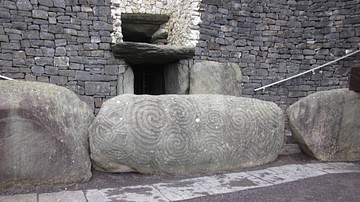
Newgrange
Newgrange is a Neolithic monument located in the region of Bru na Boinne, County Meath, Ireland. The name is fairly modern and comes from the 'newer' grange (farm) of the monks of Mellifont Abbey...
Definition
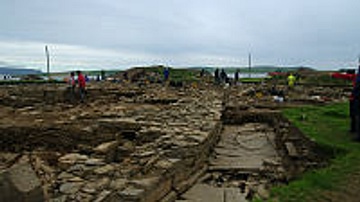
Ness of Brodgar
The Ness of Brodgar is a Neolithic Age site discovered in 2002 CE through a geophysical survey of the area of land in Stenness in Orkney, Scotland, which separates the salt water Stenness...
Article
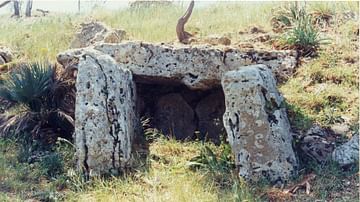
The Dolmens of Sicily
It is a well-known fact that Sicily, the largest island in the Mediterranean sea, went through a quite complex prehistoric period. So much so that it is difficult to navigate through...
Definition
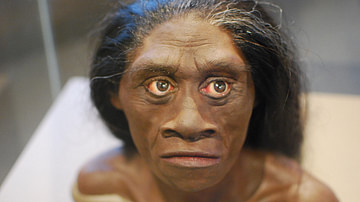
Homo Floresiensis
Homo floresiensis, nicknamed 'hobbit' because it only stood about 1 meter tall, is an extinct species of fossil human that lived on the island of Flores, Indonesia during the Pleistocene...
