---
title: Volsinii
author: Mark Cartwright
source: https://www.worldhistory.org/volsinii/
format: machine-readable-alternate
license: Creative Commons Attribution-NonCommercial-ShareAlike (https://creativecommons.org/licenses/by-nc-sa/4.0/)
updated: 1970-01-01
---
# Volsinii
_Authored by [Mark Cartwright](https://www.worldhistory.org/user/markzcartwright/)_
Volsinii (modern Orvieto), located in central [Italy](https://www.worldhistory.org/italy/), was an important [Etruscan](https://www.worldhistory.org/Etruscan_Civilization/) town from the 8th century BCE when it was known by the name of Velzna. Representatives of the Etruscan League met annually at the site in the most important Etruscan festival at the Fanum Voltumnae sanctuary. Volsinii was destroyed by the Romans in the 3rd century BCE, and the remaining population relocated to a new settlement nearby, modern Bolsena.
### Early Settlement
Volsinii was a Villanovan settlement of over 100 ha, making it amongst the biggest of the [Villanovan culture](https://www.worldhistory.org/Villanovan_Culture/) which was a precursor to the [Etruscans](https://www.worldhistory.org/Etruscan_Civilization/), flourishing between 1100 and 750 BCE during the [Iron Age](https://www.worldhistory.org/disambiguation/Iron_Age/) of central Italy. The settlement was split into two parts located at either end of the [acropolis](https://www.worldhistory.org/Acropolis/). The town prospered due to its fertile agricultural lands in the Paglia valley and proximity to the middle Tiber river allowing it to [trade](https://www.worldhistory.org/disambiguation/trade/) with neighbouring sites. Most of the cemeteries of this period were dug out and built over in later times so that little remains have been found besides [pottery](https://www.worldhistory.org/pottery/) sherds.
### A Thriving Etruscan Town
Volsinii continued to prosper from the 7th century BCE onwards as indicated by the large number of family tombs built at the site. [Black-figure pottery](https://www.worldhistory.org/Black_Figure_Pottery/) was produced at Volsinii but is of unremarkable quality. Sculptors worked using the local volcanic tufa stone, and several statues have been excavated at the site. Volsinii was a noted manufacturing centre for [bucchero](https://www.worldhistory.org/Bucchero/) pottery and [bronze](https://www.worldhistory.org/disambiguation/bronze/) works, notably tools and lamps, several examples of which have survived. Trade and cultural links with the wider [Mediterranean](https://www.worldhistory.org/disambiguation/mediterranean/) world are attested by imports, especially Attic pottery in the 6th and 5th century BCE. The town also produced its own [coinage](https://www.worldhistory.org/coinage/), stamped with the inscription *Velzna*. Finally, one more indicator of Volsinii's prosperity is the inscriptions which indicate the town founded several colonies in northern territories.
Despite the flourishing of the [city](https://www.worldhistory.org/city/), this period was not an entirely peaceful one as the construction of around 7 km of fortification walls illustrates. The Etruscan towns often fought each other as they grew larger and an increase in population required more resources. The 4th-century BCE [Francois Tomb](https://www.worldhistory.org/Francois_Tomb/) at [Vulci](https://www.worldhistory.org/Vulci/) has a celebrated [wall](https://www.worldhistory.org/wall/) painting showing men of that town in [battle](https://www.worldhistory.org/disambiguation/battle/) with fellow Etruscans from Volsinii and Sovana.
### The Fanum Voltumnae
Volsinii may have been a member of the Etruscan League, a loose confederacy of 12 (or perhaps 15) Etruscan towns. They included [Cerveteri](https://www.worldhistory.org/Cerveteri/), [Chiusi](https://www.worldhistory.org/Chiusi/), [Populonia](https://www.worldhistory.org/Populonia/), [Tarquinia](https://www.worldhistory.org/Tarquinia/), Vulci, and [Volterra](https://www.worldhistory.org/Volterra/). Very little is known of this league except that its members had common religious ties and that leaders met annually at the Fanum Voltumnae sanctuary to discuss policy and elect a president, the *sacerdos Etruriae*. The sanctuary was sacred to the [god](https://www.worldhistory.org/God/) or goddess Veltha (Voltumna), a deity connected to vegetation and [war](https://www.worldhistory.org/disambiguation/War/). The exact location of the sanctuary is not known, but most historians consider the area around Orvieto as the best candidate. The annual festival, which attracted visitors from [Etruria](https://www.worldhistory.org/Etruscan_Civilization/) and beyond, included games, [music](https://www.worldhistory.org/disambiguation/Music/), and a fair, but as most participants would have camped outside the city, the site location is unlikely to be ever determined with certainty.
[  Etruscan Civilization NormanEinstein (GNU FDL) ](https://www.worldhistory.org/image/119/etruscan-civilization/ "Etruscan Civilization")### Relations with [Rome](https://www.worldhistory.org/Rome/) & Decline
Volsinii's status as an important regional town was threatened by the growing stature of its southern neighbour Rome. Rome was on the warpath and made repeated incursions into Etruscan territory; [Veii](https://www.worldhistory.org/Veii/) was famously sacked in 396 BCE after a 10-year siege. Volsinii, not coming to the aid of her sister Etruscan [cities](https://www.worldhistory.org/city/), then inexplicably attacked Rome in 394 BCE, along with their ally Sappinum. The expedition was a disaster, and 8,000 Etruscan warriors were captured. Worse was to come a century later when the lands around Volsinii were ravaged. The town attempted to defend its interests but was badly defeated by a [Roman army](https://www.worldhistory.org/Roman_Army/) led by the [consul](https://www.worldhistory.org/Consul/) Lucius Postumius Megellus, with 2,800 Etruscan warriors killed. Rusellae (modern Roselle) was then sacked in 294 BCE, a stark warning of the futility of opposing Rome. According to [Livy](https://www.worldhistory.org/livy/), the Etruscan towns of Volsinii, Perusia, and [Arretium](https://www.worldhistory.org/arretium/) then negotiated a peace with Rome. The price for a 40-year truce was a huge 500,000 *asses* per city.
In the event, the truce did not last very long as, in 284 BCE, Volsinii took advantage of an invading army of Gauls to join them and attack Arezzo (Arretium), an Etruscan city loyal to Rome. A relieving [Roman](https://www.worldhistory.org/disambiguation/Roman/) army was defeated, but the next year the Romans, led by P. Cornelius Dolabella, won a decisive victory at the Battle of Lake Vadimo. Volsinii was attacked in 280 BCE, along with several other Etruscan cities. The Romans were proving insistent and lethal enemies.
[ 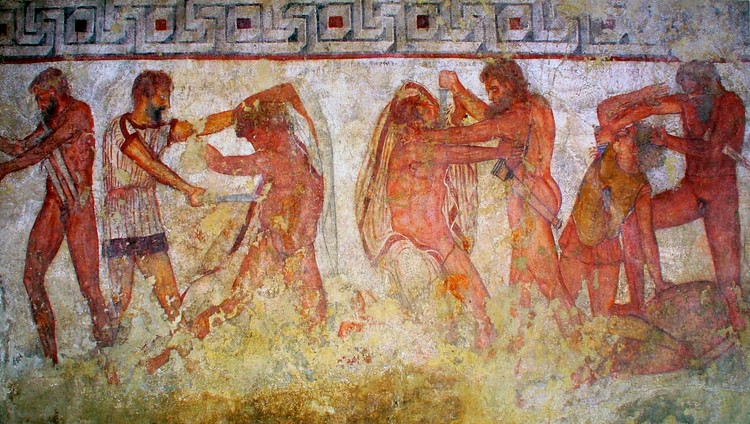 Battle Scene, Francois Tomb, Vulci Yann Forget (Public Domain) ](https://www.worldhistory.org/image/6258/battle-scene-francois-tomb-vulci/ "Battle Scene, Francois Tomb, Vulci")In 264 BCE, Volsinii became one of the last Etruscan cities to fall in the interminable wars with Rome. The aristocratic citizens of Volsinii called for Roman assistance in quashing an internal popular (and slave) revolt but got rather more than they bargained for when the Romans attacked and destroyed the town after a lengthy siege. Survivors were forcibly relocated to nearby Bolsena, a much less defensible location, which was then given the Roman name of Volsinii Novi. Roman writers describe the total destruction of Volsinii and the confiscation of over 2,000 bronze statues, to be melted down for coinage. Archaeological remains at Volsinii Novi include a forum and the foundations of several domestic houses. The original Volsinii would rise again, though. Indeed, its necropolis and associated sanctuary remained in use well into the Roman period, as did the Voltumnae Games, and Volsinii/Orvieto later became an important medieval town. It is the [architecture](https://www.worldhistory.org/disambiguation/architecture/) of this period which is visible at the site today, still impressively sited on the natural acropolis where Volsinii once stood.
### Archaeological Remains
Precisely because the Romans destroyed the settlement and the present town sits directly on top of it, there are scant archaeological remains dating to the Etruscan period. There are remains of the so-called Belvedere [Temple](https://www.worldhistory.org/temple/), a late 5th-century BCE temple to an unknown deity (although one inscribed votive offering suggests Tin, the supreme deity of the [Etruscan pantheon](https://www.worldhistory.org/article/1025/etruscan-pantheon/)). The building was constructed on a tufa block platform and had the typical design elements common to many Etruscan temples with a collonaded and extended front porch (with two rows of four columns), a three-room inner cella, and surrounding sacred enclosure. The temple measured 16.9 x 21.91 metres. Terracotta figures from the temple are on display in Orvieto's archaeological museum. Although fragmentary, one group, according to the historian N.J. Spivey, may represent [Greek](https://www.worldhistory.org/disambiguation/greek/) heroes drawing lots to see who would fight Hector during the [Trojan War](https://www.worldhistory.org/Trojan_War/).
There are remains of at least seven more temples at Volsinii. One of these, we know from Roman sources, was dedicated to Nortia, a deity linked with [Menerva](https://www.worldhistory.org/disambiguation/Menerva/) and possibly fate. A ritual at her temple was to annually hammer a nail into the building to fix the [fates](https://www.worldhistory.org/Fates/) for that year. Later, the custom was used to see off plagues and disasters.
[ 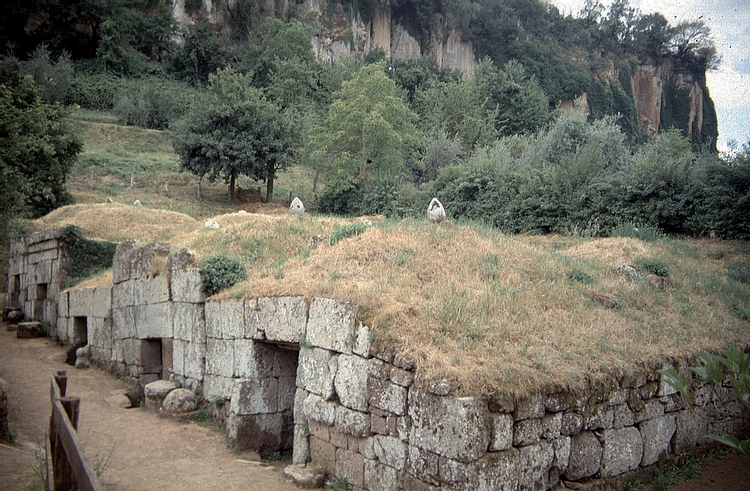 Etruscan Tombs, Volsinii AWIB-ISAW (CC BY) ](https://www.worldhistory.org/image/6403/etruscan-tombs-volsinii/ "Etruscan Tombs, Volsinii")Small square tombs with corbelled roofs were laid out in regular grid patterns along streets in the Crocifisso del Tufo necropolis. Each [tomb](https://www.worldhistory.org/tomb/) is topped by an earth mound (but not covered) and stone [grave](https://www.worldhistory.org/burial/) markers. Many tombs have an inscription on the lintel of their single doorways which indicate the tomb's principal occupant. From these inscriptions, historians estimate there were some 90 wealthy families at Volsinii in the latter half of the 6th and then 5th century BCE. Many names are of non-Etruscan origin (Umbrian, [Celt](https://www.worldhistory.org/celt/), Sabine, etc.) highlighting the cosmopolitan nature of the town at its height and its role as a hub of trade and cultural exchange. Some tombs have painted interiors showing scenes of daily life and especially banquets. A second and similar necropolis is under excavation to the south of the settlement at Cannicella and includes a 5th-century BCE square temple with two cellas.
Surviving Etruscan artworks from Volsinii include a half life-size statue of [Aphrodite](https://www.worldhistory.org/Aphrodite/) (?) from the sanctuary at the Cannicella necropolis. It dates to c. 520 BCE and once wore earrings, a necklace, and diadem, presumably in a precious [metal](https://www.worldhistory.org/disambiguation/metal/) but now lost. There is the 5th-century BCE bearded head of a god from the San Leonardo Temple, probably a representation of Tin. Finally, one of the finest surviving bronze figurines produced by the Etruscans, the [Mars](https://www.worldhistory.org/Mars/) of Todi, is attributed to Volsinii. Dating to the early 4th century BCE, the striking figure wears a cuirass and once held a lance. The figure is 142 cm tall and was discovered ritually buried in a stone-lined trench after having been struck by lightning. It is now on display in the Vatican Museums in Rome.
#### Editorial Review
This human-authored definition has been reviewed by our editorial team before publication to ensure accuracy, reliability and adherence to academic standards in accordance with our [editorial policy](https://www.worldhistory.org/static/editorial-policy/).
## Bibliography
- [Barker, G. *The Etruscans.* Wiley-Blackwell, 2000.](https://www.worldhistory.org/books/0631220380/)
- [Brendel, O.J. *Etruscan Art.* Yale University Press, 1995.](https://www.worldhistory.org/books/0300064462/)
- [Haynes, S. *Etruscan Civilization.* J. Paul Getty Museum, 2005.](https://www.worldhistory.org/books/0892366001/)
- [Heurgon, J. *Daily Life of the Etruscans.* Phoenix, 2002.](https://www.worldhistory.org/books/1842125923/)
- [Hornblower, S. *The Oxford Classical Dictionary.* Oxford University Press, 2012.](https://www.worldhistory.org/books/0199545561/)
- [Keller, W. *The Etruscans.* Random House Inc (T), 1974.](https://www.worldhistory.org/books/0394473019/)
- [Simon, E. *The Religion of the Etruscans.* University of Texas Press, 2006.](https://www.worldhistory.org/books/0292721463/)
- [Spivey, N. *Etruscan Italy.* B T Batsford Ltd, 1992.](https://www.worldhistory.org/books/0713465212/)
- [Spivey, N.J. *Etruscan Art.* Thames & Hudson, 1997.](https://www.worldhistory.org/books/0500203040/)
## About the Author
Mark is WHE’s Publishing Director and has an MA in Political Philosophy (University of York). He is a full-time researcher, writer, historian and editor. Special interests include art, architecture and discovering the ideas that all civilizations share.
## Timeline
- **c. 1100 BCE - 900 BCE**: Proto-[Villanovan culture](https://www.worldhistory.org/Villanovan_Culture/) in central [Italy](https://www.worldhistory.org/italy/).
- **c. 900 BCE - c. 750 BCE**: [Villanovan culture](https://www.worldhistory.org/Villanovan_Culture/) in central [Italy](https://www.worldhistory.org/italy/).
- **394 BCE**: [Etruscan](https://www.worldhistory.org/Etruscan_Civilization/) [Volsinii](https://www.worldhistory.org/volsinii/) and their ally Sappinum unsuccessfully attacks [Rome](https://www.worldhistory.org/Rome/).
- **294 BCE**: A [Roman army](https://www.worldhistory.org/Roman_Army/) led by L. Postimius Megellus defeats an army from [Etruscan](https://www.worldhistory.org/Etruscan_Civilization/) [Volsinii](https://www.worldhistory.org/volsinii/).
- **284 BCE**: [Etruscan](https://www.worldhistory.org/Etruscan_Civilization/) [Volsinii](https://www.worldhistory.org/volsinii/) with an army of Gauls attacks [Arretium](https://www.worldhistory.org/arretium/).
- **283 BCE**: Romans defeat the [Etruscans](https://www.worldhistory.org/Etruscan_Civilization/) and [Celts](https://www.worldhistory.org/celt/) at lake Vadimo.
- **280 BCE**: The Romans [conquer](https://www.worldhistory.org/warfare/) the [Etruscan](https://www.worldhistory.org/Etruscan_Civilization/) [cities](https://www.worldhistory.org/city/) of [Tarquinia](https://www.worldhistory.org/Tarquinia/), [Volsinii](https://www.worldhistory.org/volsinii/) and [Vulci](https://www.worldhistory.org/Vulci/).
- **264 BCE**: [Etruscan](https://www.worldhistory.org/Etruscan_Civilization/) [Volsinii](https://www.worldhistory.org/volsinii/) is sacked by the Romans and its residents relocated to Bolsena.
## Cite This Work
### APA
Cartwright, M. (2017, March 08). Volsinii. *World History Encyclopedia*.
### Chicago
Cartwright, Mark. "Volsinii." *World History Encyclopedia*, March 08, 2017. .
### MLA
Cartwright, Mark. "Volsinii." *World History Encyclopedia*, 08 Mar 2017, .
## License & Copyright
Submitted by [Mark Cartwright](https://www.worldhistory.org/user/markzcartwright/ "User Page: Mark Cartwright"), published on 08 March 2017. The copyright holder has published this content under the following license: [Creative Commons Attribution-NonCommercial-ShareAlike](https://creativecommons.org/licenses/by-nc-sa/4.0/deed.en). This license lets others remix, tweak, and build upon this content non-commercially, as long as they credit the author and license their new creations under the identical terms. When republishing on the web a hyperlink back to the original content source URL must be included. Please note that content linked from this page may have different licensing terms.