---
title: Virgil
author: Donald L. Wasson
source: https://www.worldhistory.org/virgil/
format: machine-readable-alternate
license: Creative Commons Attribution-NonCommercial-ShareAlike (https://creativecommons.org/licenses/by-nc-sa/4.0/)
updated: 2022-07-03
---
# Virgil
_Authored by [Donald L. Wasson](https://www.worldhistory.org/user/DWasson/)_
Publius Vergilius Maro (70-19 BCE), better known to most modern readers as Virgil, was one of the greatest poets of the early [Roman Empire](https://www.worldhistory.org/Roman_Empire/). His best-known work, the *[Aeneid](https://www.worldhistory.org/The_Aeneid/)*, told of a Trojan prince, [Aeneas](https://www.worldhistory.org/Aeneas/), who escaped the burning of [Troy](https://www.worldhistory.org/troy/) in the final days of the [Trojan War](https://www.worldhistory.org/Trojan_War/) to eventually make his way across the [Mediterranean](https://www.worldhistory.org/disambiguation/mediterranean/) Sea to [Italy](https://www.worldhistory.org/italy/) (Latium) where his descendants [Romulus and Remus](https://www.worldhistory.org/Romulus_and_Remus/) would ultimately found the [city](https://www.worldhistory.org/city/) of [Rome](https://www.worldhistory.org/Rome/). He was so highly regarded by those authors who followed him that the early 14th-century CE Italian author [Dante Alighieri](https://www.worldhistory.org/Dante_Alighieri/) chose Virgil as his guide through the nine levels of hell in *The Inferno*.
### Early Life
Virgil, sometimes spelled Vergil, was born on October 15, 70 BCE in Andes, a small village near Mantua north of the Po River in Cisalpine [Gaul](https://www.worldhistory.org/gaul/). The 5th-century CE author and statesman Macrobius maintained Virgil was born of country parents among the shrubs and woods; the passion for the rural life would remain with him throughout his adult life. He was described as having the appearance of a countryman being tall but bulky with a dark complexion, 'changeable health,' and eating and drinking little; his poor health kept him away from the civil [war](https://www.worldhistory.org/disambiguation/War/) that was brewing at the time. His father was a potter and courier who was lucky enough to marry the boss' daughter.
While his province of birth did not have citizenship rights (not until 51 BCE), his father, being of old Latin stock, was a citizen. Although some question his parents' financial status, most agree they were affluent enough to provide him with a solid education. The future poet acquired his early schooling in Cremona and Milan (Mediolanum) where he obtained his *toga virilis* —- a symbol of both manhood and citizenship. This early education garnered him an appreciation for both [Greek](https://www.worldhistory.org/disambiguation/greek/) and [Roman](https://www.worldhistory.org/disambiguation/Roman/) authors. He arrived in Rome with plans to study rhetoric (a subject he disliked) with Epidius whose school was where [Octavian](https://www.worldhistory.org/augustus/) and [Mark Antony](https://www.worldhistory.org/Mark_Antony/) would eventually study as well. Evidently, Virgil only spoke once in the [law](https://www.worldhistory.org/disambiguation/law/) courts, but without distinction; apparently, he was too shy. Virgil soon left the city to study [philosophy](https://www.worldhistory.org/philosophy/) at the Epicurean school of Siron in Naples. The love of philosophy that brought him to the Epicurean community enabled him to meet his fellow poet [Horace](https://www.worldhistory.org/Horace/).
When he was around 30 years old, the [Roman Republic](https://www.worldhistory.org/Roman_Republic/) was in crisis. [Julius Caesar](https://www.worldhistory.org/Julius_Caesar/) had been assassinated, and his adopted son and heir the future Emperor [Augustus](https://www.worldhistory.org/augustus/) (aka Octavian) was embroiled in a civil war. In 42 BCE, after the defeat of the tyrannicides at the [Battle](https://www.worldhistory.org/disambiguation/battle/) of [Philippi](https://www.worldhistory.org/Philippi/), attempts were made to settle army veterans on confiscated land, a subject for Virgil's early poems. Unluckily for his family, in 41 BCE his father's farm was seized. The young poet tried to use his influence in Rome to have it returned; however, there is no record whether or not he was successful.
### Eclogues
By this time Virgil had met a fellow author and patron of the arts Gaius Cilnius Maecenas. This wealthy Roman, a personal friend and advisor to Augustus, gathered around him a circle of young poets like Virgil and Horace. Through him, the young poet would eventually become close friends with the emperor. According to historian Anthony Everitt in his biography *Augustus*, Maecenas "cultivated the finest poets of the age, ensuring that so far as possible and without application of censorship, geniuses such as Virgil and Horace stayed on message" (205). It was also at this time, c. 39-38 BCE, that Virgil would publish his first collection of ten poems in Rome, *Eclogues*. Its success would make him the most celebrated poet of the day. He would be awarded with a house on Esquiline Hill near the home of his benefactor Maecenas. It should be noted that poets of this period needed benefactors such as Maecenas in order to have financial security.
[ 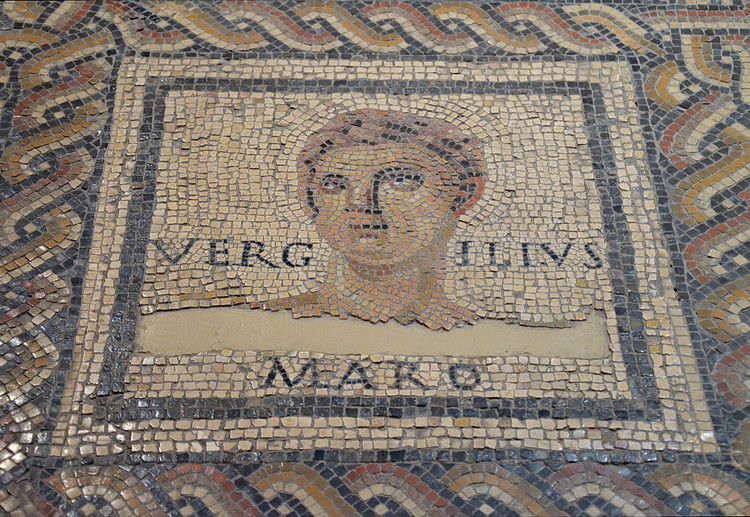 Portrait of Virgil Carole Raddato (CC BY-NC-SA) ](https://www.worldhistory.org/image/5836/portrait-of-virgil/ "Portrait of Virgil")Virgil would find a friend and sponsor not only in Maecenas but also in Augustus. As with Horace, the emperor would nurture the two poets, believing they would help restore the fledgling [empire](https://www.worldhistory.org/empire/) to the ideals of the past. The emperor believed that Rome was suffering from moral decay and wanted a return to the values of old. Although a successful poet and the talk of Rome with a home on the hill, Virgil left the city for the quiet of rural Campania where he would spend the next seven years working on his collection of poems entitled the *Georgics*. After completing the work in 30 BCE, he would spend the remainder of his life, until his [death](https://www.worldhistory.org/disambiguation/Death/) in 19 BCE, working on his epic work, the *Aeneid*.
According to historian Nigel Rodgers, Virgil, Horace, and the exiled [Ovid](https://www.worldhistory.org/ovid/) created a classical style of [writing](https://www.worldhistory.org/writing/) comparable to the great Greek authors. While he only produced three major works, Virgil stands above the others. His early works centered on his love of the rural life. His first collection *Eclogues* was set in an idealized Arcadia and depicts a shepherd's life and loves. However, it also turns political with a reference to the turmoil of the civil war. Unfortunately, this quiet life is threatened by Octavian's eviction notice after the Battle of Philippi. The poem makes reference to three individuals involved in the evictions and confiscation of land: the jurist and [consul](https://www.worldhistory.org/Consul/) Publius Varus, the author and consul Gaius Pollio, and the poet Gaius Gallus.
According to Rodgers, the poem also foretells of the birth of a divine child who will restore the golden age of Rome; many Christians interpret this to be a foretelling of [Jesus Christ](https://www.worldhistory.org/Jesus_Christ/). In *Eclogue IV*, Virgil wrote:
> Now the last age by Cumae's Sybil sung
> Has come and gone, and the majestic roll
> Of circling begins anew:
> Justice returns, returns old [Saturn](https://www.worldhistory.org/Saturn/)'s reign:
> With a new breed of men sent down from heaven
> Only do thou, at the boy's birth in whom
> The iron shall cease, the golden race arise.
> (Virgil, 14)
### Georgics
The next collection of poems, the *Georgics*, was written after Octavian's victory over [Mark](https://www.worldhistory.org/disambiguation/Mark/) Anthony and the [Egyptian](https://www.worldhistory.org/disambiguation/Egyptian/) queen [Cleopatra](https://www.worldhistory.org/disambiguation/cleopatra/) at the [Battle of Actium](https://www.worldhistory.org/Battle_of_Actium/) and was dedicated to Maecenas. The *Georgics*, like the previous *Eclogues*, praised the simple farm life, plowing, growing trees, tending cattle, and even keeping bees. In the opening lines to *Georgic I*, he wrote:
> What makes the cornfield smile; beneath what star
> Maecenas, it is meet to turn the sod
> Or marry elm with vine; how end the steer;
> What pains for cattle-keeping, or what proof
> Of patient trail serves for thrifty bees;
> Such are my themes.
> (Virgil, 37)
Besides the confiscation of the land, one of the negative effects of the wars on Italy and its provinces was depopulation; many farmers had to abandon their land to fight in the war. In his poems, Virgil made a plea for the restoration of land and return to the agricultural life. By the time of their publication, Virgil had fully entrenched himself into the inner circle at the imperial [palace](https://www.worldhistory.org/disambiguation/palace/). After *Georgics* was read to the emperor, the poet left the city. His mind was elsewhere, it was on the twelve books of his yet unwritten epic.
### Aeneid
According to historian Mary Beard in her *SPQR*, the theme of the *Aeneid* was the where, when, and why of the founding of Rome by [Romulus](https://www.worldhistory.org/Romulus_and_Remus/) and his brother Remus. The poem tells of the Trojan prince and son of the goddess [Venus](https://www.worldhistory.org/venus/), Aeneas, and his escape during the final moments of the Trojan War. Becoming aware of his destiny to found a grand city on the peninsula of Italy, the warrior and his family make their way across the sea - in a series of events similar to [Homer](https://www.worldhistory.org/homer/)'s *[Odyssey](https://www.worldhistory.org/Odyssey/) -* eventually landing in [Carthage](https://www.worldhistory.org/carthage/), where he falls in love with Queen [Dido](https://www.worldhistory.org/Dido/). Unfortunately for the queen, Aeneas is reminded of his destiny and leaves Carthage. The forsaken queen grieves for her lost love and commits suicide.
[  Fresco with Wounded Aeneas Carole Raddato (CC BY-SA) ](https://www.worldhistory.org/image/3854/fresco-with-wounded-aeneas/ "Fresco with Wounded Aeneas")Despite his desire to remain, Aeneas sails on to Latium, and he even makes a trip to the underworld where he meets his father and Queen Dido. Over time, his descendants would found Rome. He was the ideal model for the Roman way of life, both 'heroic' and 'Augustan.' Of course, one of the more confusing aspects of the poem is the time lapse between the supposed time of the Trojan War and the founding of Rome, the 12th century BCE to the 8th century BCE. In actuality, Aeneas does not actually fulfill his destiny and found Rome. That accomplishment was left to others. With the death of the queen, the poem also introduces the reader to the birth of the antagonism that developed between Rome and Carthage, a conflict that would evolve into the [Punic Wars](https://www.worldhistory.org/Punic_Wars/). The poem has, over the years, had its share of critics. Many are repelled by Aeneas' cruelty against a defeated enemy as well as the suicide of his beloved Dido.
Although Virgil was not pleased with the epic, Augustus, who claimed to be a descendant of Aeneas, was ecstatic. It could be that the emperor believed that the poem demonstrated a final fulfillment of Rome's destiny. Virgil himself believed that it was Rome's fate to forgive the conquered and defeat the proud in war. The opening lines of the poem speak of Aeneas' destiny:
> Of arms I sing, and of the man who first
> From Trojan shores beneath the ban of fate
> To Italy and coasts Lavinian came,
> Much tossed about on land and ocean he
> By violence of the gods above, to sate
> Relentless [Juno](https://www.worldhistory.org/Juno/)'s ever-rankling ire,
> In war, too, much enduring, till what time
> A city he might found him, and bear safe
> His gods to Latium, whence the Latin race
> And Alba's sires, and lofty-towering Rome.
> (Virgil, 103)
### [  Map of the Voyage of Aeneas and the Mythic Origins of Rome Simeon Netchev (CC BY-NC-ND) ](https://www.worldhistory.org/image/16056/map-of-the-voyage-of-aeneas-and-the-mythic-origins/ "Map of the Voyage of Aeneas and the Mythic Origins of Rome")
### Legacy
For eleven years Virgil worked on the poem but died before its final revision. He was not pleased with it, and asked his friend Lucius Varius Rufus to destroy it; however, the fellow poet refused. While on a trip to [Greece](https://www.worldhistory.org/greece/), Virgil became ill at [Megara](https://www.worldhistory.org/disambiguation/Megara/), dying on September 21, 19 BCE before he could return home. He was buried at his villa in Naples. The emperor had the epic published despite the poet's last wishes.
Virgil's poems, especially the *Aeneid*, have lived on for over 2,000 years and are still being read and analyzed to this day. Excerpts of his poems were even found on the excavated walls of [Pompeii](https://www.worldhistory.org/pompeii/). He was an inspiration to countless authors who followed him. [Dante](https://www.worldhistory.org/Dante_Alighieri/), the author of *The Divine Comedy*, chose Virgil as his guide through the *Inferno*'s nine levels of hell. The author Melinda Corey wrote a new introduction to a recent reissuing of Longfellow's translation of *The Divine Comedy*. She believed Dante chose Virgil because the poet represented everything the author wanted to be: the greatest poet of his time.
#### Editorial Review
This human-authored definition has been reviewed by our editorial team before publication to ensure accuracy, reliability and adherence to academic standards in accordance with our [editorial policy](https://www.worldhistory.org/static/editorial-policy/).
## Bibliography
- Anonymous. *Virgil.* Encyclopedia Britannica
- [Beard, M. *SPQR.* Liveright, 2015.](https://www.worldhistory.org/books/1631492225/)
- [Dante Alighieri. *The Divine Comedy.* Berkley, 2003.](https://www.worldhistory.org/books/0451208633/)
- [Everitt, A. *Augustus.* Random House Trade Paperbacks, 2006.](https://www.worldhistory.org/books/0812970586/)
- [Goldsworthy, A. *Pax Romana.* Yale University Press, 2016.](https://www.worldhistory.org/books/0300178824/)
- [Hornblower, S. *The Oxford Classical Dictionary.* Oxford University Press, 2012.](https://www.worldhistory.org/books/0199545561/)
- [Rodgers, N. *Ancient Rome.* Metro Books, 2008.](https://www.worldhistory.org/books/1844778592/)
- Virgil. *The Poems of Virgil.* Great Books of the Western World
## About the Author
Donald has taught Ancient, Medieval and U.S. History at Lincoln College (Normal, Illinois)and has always been and will always be a student of history, ever since learning about Alexander the Great. He is eager to pass knowledge on to his students.
## Timeline
- **15 Oct 70 BCE - 21 Sep 19 BCE**: Life of [Roman](https://www.worldhistory.org/disambiguation/Roman/) poet [Virgil](https://www.worldhistory.org/virgil/).
- **c. 39 BCE - c. 38 BCE**: [Roman](https://www.worldhistory.org/disambiguation/Roman/) poet [Virgil](https://www.worldhistory.org/virgil/) writes his first collection of ten poems, the Eclogues.
- **c. 30 BCE**: [Roman](https://www.worldhistory.org/disambiguation/Roman/) poet [Virgil](https://www.worldhistory.org/virgil/) completes his second collection of poems, the Georgics.
- **c. 30 BCE - c. 19 BCE**: [Roman](https://www.worldhistory.org/disambiguation/Roman/) poet [Virgil](https://www.worldhistory.org/virgil/) writes his [Aeneid](https://www.worldhistory.org/The_Aeneid/).
## External Links
- [Why should you read Virgil's "Aeneid"? - Mark Robinson](https://ed.ted.com/lessons/why-should-you-read-virgil-s-aeneid-mark-robinson)
- [The Internet Classics Archive](http://classics.mit.edu/Virgil/aeneid.html)
## Cite This Work
### APA
Wasson, D. L. (2017, June 12). Virgil. *World History Encyclopedia*.
### Chicago
Wasson, Donald L.. "Virgil." *World History Encyclopedia*, June 12, 2017. .
### MLA
Wasson, Donald L.. "Virgil." *World History Encyclopedia*, 12 Jun 2017, .
## License & Copyright
Submitted by [Donald L. Wasson](https://www.worldhistory.org/user/DWasson/ "User Page: Donald L. Wasson"), published on 12 June 2017. The copyright holder has published this content under the following license: [Creative Commons Attribution-NonCommercial-ShareAlike](https://creativecommons.org/licenses/by-nc-sa/4.0/deed.en). This license lets others remix, tweak, and build upon this content non-commercially, as long as they credit the author and license their new creations under the identical terms. When republishing on the web a hyperlink back to the original content source URL must be included. Please note that content linked from this page may have different licensing terms.