---
title: Venus
author: Brittany Garcia
source: https://www.worldhistory.org/venus/
format: machine-readable-alternate
license: Creative Commons Attribution-NonCommercial-ShareAlike (https://creativecommons.org/licenses/by-nc-sa/4.0/)
updated: 2022-10-03
---
# Venus
_Authored by [Brittany Garcia](https://www.worldhistory.org/user/ucr_penguin/)_
In [Roman mythology](https://www.worldhistory.org/Roman_Mythology/), Venus was the goddess of love, sex, beauty, and fertility. She was the [Roman](https://www.worldhistory.org/disambiguation/Roman/) counterpart to the [Greek](https://www.worldhistory.org/disambiguation/greek/) goddess [Aphrodite](https://www.worldhistory.org/Aphrodite/). However, Roman Venus had many abilities beyond the Greek Aphrodite; she was a goddess of victory, fertility, and even prostitution. According to [Greek mythology](https://www.worldhistory.org/Greek_Mythology/), as presented in [Hesiod](https://www.worldhistory.org/hesiod/)'s *[Theogony](https://www.worldhistory.org/Theogony/)*, Aphrodite was born of the foam from the sea after [Saturn](https://www.worldhistory.org/Saturn/) ([Cronus](https://www.worldhistory.org/Cronus/)) castrated his father [Uranus](https://www.worldhistory.org/Uranus/) (Ouranos) and his blood fell to the sea. This latter explanation appears to be more a popular theory due to the countless artworks depicting Venus rising from the sea in a clam.
### Divine Lovers & Children
Venus had two main divine lovers: her husband [Vulcan](https://www.worldhistory.org/Vulcan/) ([Hephaistos](https://www.worldhistory.org/Hephaistos/)) and [Mars](https://www.worldhistory.org/Mars/) ([Ares](https://www.worldhistory.org/Ares/)). There is a myth concerning Venus' and Mars' love affair and how Vulcan cunningly trapped them in bed with a net. Therefore, Vulcan and Venus had a loveless marriage and no children. Albeit, the goddess of love and sex was not barren; she had many children from different gods. With Mars, she gave birth to Timor (Phobos) the personification of fear who accompanied his father into [battle](https://www.worldhistory.org/disambiguation/battle/), his twin Metus (Deimos) the personification of terror, Concordia (Harmonia) the goddess of harmony and concord, and the Cupids ([Erotes](https://www.worldhistory.org/Eros/)) who were a collection of winged love deities who represented the different aspects of love.
The Roman poet [Ovid](https://www.worldhistory.org/ovid/) recounts that Aphrodite bore Hermaphroditos by [Hermes](https://www.worldhistory.org/Hermes/), who was the epitome of effeminacy and androgyny. She also bore with either Hermes or [Zeus](https://www.worldhistory.org/zeus/), Fortuna ([Tyche](https://www.worldhistory.org/Tyche/)) who was the personification of luck and fate within [Roman religion](https://www.worldhistory.org/Roman_Religion/). Venus is ascribed as the mother of the minor deity Priapus (a fertility [god](https://www.worldhistory.org/God/) often characterized with an absurdly large phallus) by [Bacchus](https://www.worldhistory.org/Bacchus/). According to [Pausanias](https://www.worldhistory.org/disambiguation/Pausanias/), the [Graces](https://www.worldhistory.org/Graces/) were thought to be the offspring of Venus and Bacchus, but more commonly their birth is credited to [Jupiter](https://www.worldhistory.org/jupiter/) and Eurynome. However, the Graces were part of Venus' retinue along with the Cupids and Suadela, the goddess of persuasion in the realms of romance, love, and seduction.
### Mortal Lovers, Children, & Descendants
Venus had several mortal lovers as well. The two most famous would be Anchises and [Adonis](https://www.worldhistory.org/Adonis/), but she was also the lover of the Sicilian king Butes and mother to their son Eryx, and she also had a son with Phaethon, Astynous. Ovid's *Metamorphoses* (Book X) recounts how Venus fell in love with the mortal Adonis (either due to his beauty or Cupid's arrow) and besought Proserpina ([Persephone](https://www.worldhistory.org/persephone/)) to care for him until she came for him. The two goddesses both grew enamored with the mortal, so they fought until Zeus decided that Adonis would spend one-third the year with each of them and a third wherever he pleased. Ultimately, he spent his time with Venus until he was killed by a boar.
[ 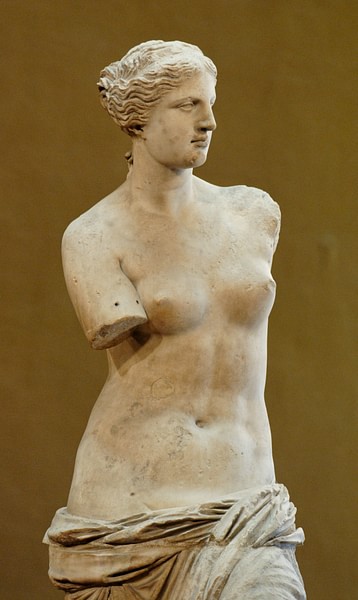 Venus of Milo Jastrow (Public Domain) ](https://www.worldhistory.org/image/111/venus-of-milo/ "Venus of Milo")According to the Homeric *Hymn to Aphrodite*, Anchises, a prince from Dardania and ally to [Troy](https://www.worldhistory.org/troy/), was seduced by Venus. She disguised herself as a Phrygian princess and seduced him; it was only nine months later that she revealed her divine identity. She presented Anchises with their son [Aeneas](https://www.worldhistory.org/Aeneas/). Venus warned Anchises never to brag about their affair lest he be struck by Jupiter. Unfortunately, Anchises did brag and was crippled by Jupiter's bolt. The Trojan Aeneas, according to [Virgil](https://www.worldhistory.org/virgil/)'s *[Aeneid](https://www.worldhistory.org/The_Aeneid/)*, was fated to found [Rome](https://www.worldhistory.org/Rome/) guided by his divine mother Venus. Aeneas' son Ascanius or Iulus, a king of Alba Longa, was credited, by Virgil, to be the ancestor of the founders of Rome: [Romulus and Remus](https://www.worldhistory.org/Romulus_and_Remus/) along with the *Gens* (family) Julia. The *Gens* Julia was the family that included [Julius Caesar](https://www.worldhistory.org/Julius_Caesar/), [Augustus](https://www.worldhistory.org/augustus/) ([Octavian](https://www.worldhistory.org/augustus/)) [Caesar](https://www.worldhistory.org/disambiguation/caesar/), and his descendants.
### Temples, Cults, & Festival in Ancient Rome
The first appearance of a [temple](https://www.worldhistory.org/temple/) to Venus was in 295 BCE. It was to *Venus Obsequens* (Obedient Venus) on the Aventine Hill by Q. Fabius Gurges. However, this temple was diffused with Greek aspects (Aphrodite's cults) and was not a new creation. In 217 BCE, the Sibylline oracle suggested that if Rome (at that time losing the [Second Punic War](https://www.worldhistory.org/Second_Punic_War/)) could persuade *Venus Erycina* (Venus of Eryx) to change her allegiance from the Carthaginian Silician allies to the Romans, the [war](https://www.worldhistory.org/disambiguation/War/) would be won. Rome laid siege to Eryx, offered the goddess a magnificent temple, and took her image back to Rome. It was this foreign image that eventually became Rome's *Venus Genetrix* (Venus the Mother). The cult forming around *Venus Genetrix* on the Capitoline Hill was reserved for the higher classes, but in 181 BCE and 114 BCE, the temples and cult of *Venus Erycina* and *Venus Verticordia* (Venus the changer of hearts) were established for the [plebeians](https://www.worldhistory.org/Plebeians/).
Venus' month was April (the beginning of spring and fertility) when most of her festivals were held. On 1 April a festival was held in honor of *Venus Verticordia* called *Veneralia*. On the 23rd, *Vinalia Urbana* was held which was a wine festival belonging to both Venus (goddess of profane wine) and Jupiter. *Vinalia Rusticia* was held on 10 August. It was Venus' oldest festival and associated with her form as *Venus Obsequens*. 26 September was the date for the festival of *Venus Genetrix*, the mother and protector of Rome.
[  Crouching Venus Carole Raddato (CC BY-SA) ](https://www.worldhistory.org/image/2971/crouching-venus/ "Crouching Venus")### Venus & Politics
At the close of the [Roman Republic](https://www.worldhistory.org/Roman_Republic/), some Romans laid claim to Venus' favor and competed for it, such as [Sulla](https://www.worldhistory.org/sulla/) (adopting the name Felix, Latin for lucky, and accrediting *Venus Felix* to his divine favor), [Pompey](https://www.worldhistory.org/pompey/) (who dedicated, in 55 BCE, a temple to *Venus Victrix* - Venus of Victory), [Julius](https://www.worldhistory.org/disambiguation/Julius/) Caesar (who claimed favor with *Venus Victrix* and *Venus Genetrix*), and [Hadrian](https://www.worldhistory.org/hadrian/) (who, in 139 CE, dedicated a temple to Venus and *[Roma](https://www.worldhistory.org/disambiguation/Roma/) Aeterna* - Eternal Rome - making Venus the protective mother of the Roman state).
### Venus & The Evening Star
In Virgil's *Aeneid*, the Trojan hero Aeneas is led to Latium by his mother in her celestial form: the evening star. It is this same star which Virgil accounts lifts Julius Caesar's soul to the heavens. This is also the secondary name for the planet Venus because it so bright and discernible in the night's sky.
### Art & Appearance
Images of Venus have been found in countless forms from sculptures to mosaics to shrines and even domestic murals and [fresco](https://www.worldhistory.org/disambiguation/Fresco/). Venus, due to her natural beauty and sexual nature, was often depicted nude. Most sculptures of Venus resembled a close similarity to the Aphrodite of Cnidus and the Venus de Milo. However, there are many fine [wall](https://www.worldhistory.org/wall/) paintings from [Pompeii](https://www.worldhistory.org/pompeii/) that depict Venus in different forms. Venus continued to be a popular subject matter for artists through antiquity and the Renaissance even into the 20th century.
#### Editorial Review
This human-authored definition has been reviewed by our editorial team before publication to ensure accuracy, reliability and adherence to academic standards in accordance with our [editorial policy](https://www.worldhistory.org/static/editorial-policy/).
## Bibliography
- [Hesiod. Theogany](http://www.sacred-texts.com/cla/hesiod/theogony.htm "Hesiod. Theogany"), accessed 1 Dec 2016.
- [Homer. Hymn to Aphrodite](http://www.uh.edu/~cldue/texts/aphrodite.html "Homer. Hymn to Aphrodite"), accessed 1 Dec 2016.
- [Homer. Iliad](http://www.sacred-texts.com/cla/homer/ili/index.htm "Homer. Iliad"), accessed 1 Dec 2016.
- [Pausanias. Description of Greece](http://classics.mit.edu/Browse/browse-Pausanias.html "Pausanias. Description of Greece"), accessed 1 Dec 2016.
- [Pindar. Full Work of Odes](http://classics.mit.edu/Browse/browse-Pindar.html "Pindar. Full Work of Odes"), accessed 1 Dec 2016.
## About the Author
Brittany is a freelance writer and Classical Latin and Ancient Greek tutor. She maintains a personal blog and Facebook page about on news of the Ancient World. She is a volunteer Latin translator for the Iris Project with NASA's "Making Mars Speak Latin."
## Timeline
- **c. 700 BCE**: [Greek](https://www.worldhistory.org/disambiguation/greek/) poet [Hesiod](https://www.worldhistory.org/hesiod/) writes his *[Theogony](https://www.worldhistory.org/Theogony/)* and *[Works and Days](https://www.worldhistory.org/Works_and_Days/)*.
- **295 BCE**: The first [temple](https://www.worldhistory.org/temple/) to [Venus](https://www.worldhistory.org/venus/) is dedicated on [Rome](https://www.worldhistory.org/Rome/)'s Aventine Hill.
- **140 BCE**: [Venus](https://www.worldhistory.org/venus/) of Milo is completed.
## Cite This Work
### APA
Garcia, B. (2013, August 27). Venus. *World History Encyclopedia*.
### Chicago
Garcia, Brittany. "Venus." *World History Encyclopedia*, August 27, 2013. .
### MLA
Garcia, Brittany. "Venus." *World History Encyclopedia*, 27 Aug 2013, .
## License & Copyright
Submitted by [Brittany Garcia](https://www.worldhistory.org/user/ucr_penguin/ "User Page: Brittany Garcia"), published on 27 August 2013. The copyright holder has published this content under the following license: [Creative Commons Attribution-NonCommercial-ShareAlike](https://creativecommons.org/licenses/by-nc-sa/4.0/deed.en). This license lets others remix, tweak, and build upon this content non-commercially, as long as they credit the author and license their new creations under the identical terms. When republishing on the web a hyperlink back to the original content source URL must be included. Please note that content linked from this page may have different licensing terms.