---
title: Uruk: The First Great City
author: Joshua J. Mark
source: https://www.worldhistory.org/uruk/
format: machine-readable-alternate
license: Creative Commons Attribution-NonCommercial-ShareAlike (https://creativecommons.org/licenses/by-nc-sa/4.0/)
updated: 2026-01-19
---
# Uruk: The First Great City
_Authored by [Joshua J. Mark](https://www.worldhistory.org/user/JPryst/)_
Uruk was one of the most important [cities](https://www.worldhistory.org/city/) (at one time, the most important) in ancient [Mesopotamia](https://www.worldhistory.org/Mesopotamia/). According to the [Sumerian King List](https://www.worldhistory.org/Sumerian_King_List/), it was founded by King Enmerkar circa 5000/4500 BCE. Uruk is best known as the birthplace of [writing](https://www.worldhistory.org/writing/) circa 3200 BCE, as well as for its [architecture](https://www.worldhistory.org/disambiguation/architecture/), the famous exploits of its king [Gilgamesh](https://www.worldhistory.org/gilgamesh/), the invention of the [cylinder seal](https://www.worldhistory.org/Cylinder_Seal/), and other cultural innovations.
Located in the southern region of [Sumer](https://www.worldhistory.org/sumer/) (modern-day Warka, Iraq), Uruk was known in the Aramaic language as *Erech,* which, it is believed, gave rise to the modern name for the country of Iraq, though another likely derivation is *Al-Iraq*, the Arabic name for the region of [Babylonia](https://www.worldhistory.org/babylon/). The [city](https://www.worldhistory.org/city/) of Uruk is most famous for its great king Gilgamesh and the epic tale of his quest for immortality (now regarded as the oldest work of [literature](https://www.worldhistory.org/literature/) in the world), but also for a number of firsts in the development of [civilization](https://www.worldhistory.org/civilization/), which occurred there.
It is considered the first true city in the world, the origin of writing, the first example of architectural work in stone, the building of great stone structures, the origin of the [ziggurat](https://www.worldhistory.org/ziggurat/), and the first city to develop the cylinder seal, which the ancient Mesopotamians used to designate personal property or as a signature on documents. Considering the importance the cylinder seal had for the people of the time, and that it stood for one's personal identity and reputation, Uruk could also be credited as the city that first recognized the importance of the individual in the collective community.
The city was continuously inhabited from its founding until circa 300 CE, when, owing to both natural and human influences, people began to desert the area; it was largely abandoned (though not entirely) by circa 700 CE. By this time, it had depleted natural resources in the surrounding area and was no longer a major political or commercial power. The once-great city finally lay abandoned and buried until it was excavated in 1853 by William Loftus for the British Museum.
### The Uruk Period
The Ubaid period (circa 6500-4000 BCE), when the so-called Ubaid people first inhabited the region of Sumer, is followed by the Uruk Period (4000-3100 BCE), during which time cities began to develop across Mesopotamia and Uruk became the most influential. The Uruk period is divided into 8 phases from the oldest through its prominence and into its decline, based upon the levels of the ruins excavated and the history that the artifacts found there reveal. The city was most influential between 4100 and circa 3000 BCE when Uruk was the largest urban center and the hub of trade and administration.
In precisely what manner Uruk ruled the region, why and how it became known as the first city in the world, and in what manner it exercised its authority are not fully known. Scholar Gwendolyn Leick writes:
> The Uruk phenomenon is still much debated, as to what extent Uruk exercised political control over the large area covered by the Uruk artifacts, whether this relied on the use of force, and which institutions were in charge. Too little of the site has been excavated to provide any firm answers to these questions. However, it is clear that, at this time, the [urbanization](https://www.worldhistory.org/urbanization/) process was set in motion, concentrated at Uruk itself.
> (183-184)
Since the city of [Ur](https://www.worldhistory.org/ur/) had a more advantageous placement for trade, further south toward the Persian Gulf, it would seem to make sense that city, rather than Uruk, would have wielded more influence, but this is not the case.
[  Map of the Sumerian Civilization Simeon Netchev (CC BY-NC-ND) ](https://www.worldhistory.org/image/15299/map-of-the-sumerian-civilization/ "Map of the Sumerian Civilization")Artifacts from Uruk appear at virtually every excavated site throughout Mesopotamia and even in [Egypt](https://www.worldhistory.org/egypt/). The historian Julian Reade notes:
> Perhaps the most striking example of the wide spread of some features of the Uruk [culture](https://www.worldhistory.org/disambiguation/culture/) consists in the distribution of what must be one of the crudest forms ever made, the so-called beveled-rim bowl. This kind of bowl, mould-made and mass-produced, is found in large numbers throughout Mesopotamia and beyond. (30)
This bowl was the means by which workers seem to have been paid: by a certain amount of grain ladled into a standard-sized bowl. The remains of these bowls, throughout all of Mesopotamia, suggest that they "were frequently discarded immediately after use, like the aluminum foil containing a modern take-away meal" (Reade, 30). So popular was the beveled-rim bowl that manufacturing centres sprang up throughout Mesopotamia, extending as far away from Uruk as the city of [Mari](https://www.worldhistory.org/mari/) in the far north. Because of this, it is unclear if the bowl originated at Uruk or elsewhere (though Uruk is generally held as the bowl's origin). If at Uruk, then the beveled-rim bowl must be counted among the many of the city's accomplishments, as it is the first known example of a mass-produced product.
[  Uruk-Period Beveled Rim Bowl Metropolitan Museum of Art (Public Domain) ](https://www.worldhistory.org/image/21538/uruk-period-beveled-rim-bowl/ "Uruk-Period Beveled Rim Bowl")### The City Districts & Gods
The city was divided into two sections, the Eanna District and the older [Anu](https://www.worldhistory.org/Anu/) District, named for and dedicated to the goddess [Inanna](https://www.worldhistory.org/Inanna/) and her grandfather [god](https://www.worldhistory.org/God/) Anu, respectively. The famous Mask of Warka (also known as 'The Lady of Uruk'), a sculpted marble female face found at Uruk, is considered a likeness of Inanna and was most likely part of a larger work from one of the temples in her district.
The Eanna District was walled off from the rest of the city, but it is unclear if this was for ceremonial purposes or if, in building the newer Eanna District, the builders required a [wall](https://www.worldhistory.org/wall/) for some reason. Scholar [Samuel](https://www.worldhistory.org/samuel/) [Noah](https://www.worldhistory.org/Noah/) Kramer suggests that Anu, the male god, presided over the early city until the rise in popularity of his daughter Inanna, and, at this time, she was given a private dwelling, complete with a wall, in the Eanna District.
[ 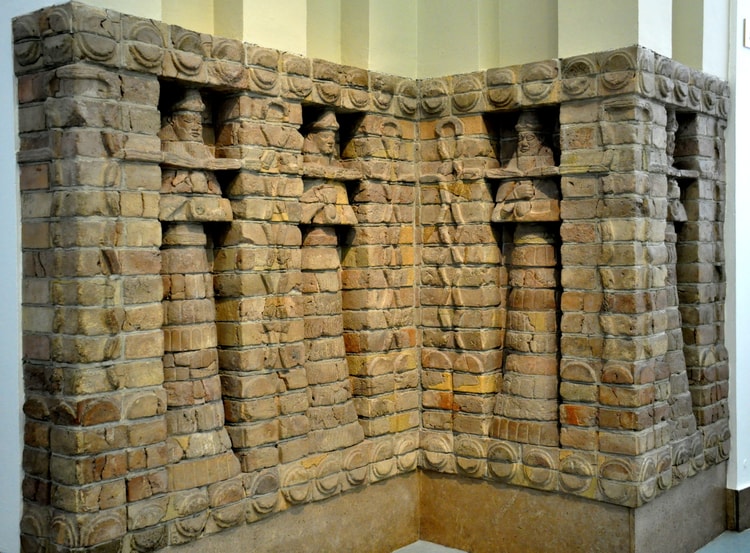 Facade of Inanna's Temple at Uruk Osama Shukir Muhammed Amin (Copyright) ](https://www.worldhistory.org/image/2958/facade-of-inannas-temple-at-uruk/ "Facade of Inanna's Temple at Uruk")Since temples were considered the literal dwelling place of deities on earth, and since Inanna is regularly depicted as a goddess who very much preferred things her own way, perhaps the walled district was simply to provide her with some privacy. Kramer also notes that, even though Inanna continued to be a popular deity throughout Mesopotamia (eventually merging into [Ishtar](https://www.worldhistory.org/ishtar/)), goddesses declined in power and prestige at the same time (during the reign of [Hammurabi](https://www.worldhistory.org/hammurabi/) of [Babylon](https://www.worldhistory.org/babylon/)), and at the same rate, as [women](https://www.worldhistory.org/disambiguation/women/)'s rights deteriorated. This being the case, perhaps the Eanna district was walled off to restrict access to a male priestly class. As with much concerning Uruk's history, however, this theory remains largely speculation.
Inanna played a pivotal role in the mythological history of Uruk, as it was she who stole the sacred *meh* from her father god [Enki](https://www.worldhistory.org/Enki/) at the sacred city of [Eridu](https://www.worldhistory.org/eridu/) and brought them to Uruk, as depicted in the tale of *Inanna and The God of Wisdom*. The *meh* were, in the words of Kramer (who first translated the [cuneiform](https://www.worldhistory.org/cuneiform/)), "the rules and regulations devised by the gods to make the cosmos run smoothly and effectively" (125). As Eridu was considered, by the [Sumerians](https://www.worldhistory.org/Sumerians/), the first city created by the gods and a place holy to them, the removal of the *meh* to Uruk signified a transference of power and prestige from one city to the other.
[  The Mask of Warka Osama Shukir Muhammed Amin (Copyright) ](https://www.worldhistory.org/image/10265/the-mask-of-warka/ "The Mask of Warka")In *Inanna and The God of Wisdom*, Enki goes to great lengths, once he finds the *meh* are stolen, to have them brought back to Eridu – but in vain. Inanna has tricked her father, and now Uruk, not Eridu, would be the seat of power. Eridu was associated with rural life and the primordial sea from which life sprang; Uruk was the embodiment of the new way of life – the city. The story would have provided an ancient Mesopotamian with the reason why Eridu declined in importance and Uruk rose to the heights it did: it was the work of the gods.
### Uruk's Importance & Long Decline
During the [Early Dynastic](https://www.worldhistory.org/disambiguation/Early_Dynastic/) Period (2900 to 2350/2334 BCE), which followed the Uruk Period, Uruk was still the seat of power in the region, though in a much diminished state, and the major dynasties of the time ruled from the city. The great wall of Uruk, which was said to have been built by King Gilgamesh himself, still rose around the city when King Eannutum forged his First Dynasty of Lagash circa 2500 BCE and established his control of the region.
The later king of that [empire](https://www.worldhistory.org/empire/), Lugal-Zage (also known as Lugalzagesi), so admired the city that he chose Uruk as his capital and seat of power. When Sumer was brought under the rule of the [Akkadian Empire](https://www.worldhistory.org/akkad/) in 2334 BCE, [Sargon of Akkad](https://www.worldhistory.org/Sargon_of_Akkad/) (ruled 2334-2279 BCE) continued to pay special reverence to Uruk, and the sacred districts of Inanna and Anu continued in use and, in fact, were renovated and improved upon.
[  Map of the Akkadian Empire at Its Height Simeon Netchev (CC BY-NC-ND) ](https://www.worldhistory.org/image/15457/map-of-the-akkadian-empire-at-its-height/ "Map of the Akkadian Empire at Its Height")Even though the city lost the position of preeminence it had enjoyed during the Uruk Period, it continued to play an important position down through the Ur III Period (circa 2112 to circa 2004 BCE). The Third Dynasty of Ur, founded by [Ur-Nammu](https://www.worldhistory.org/Ur-Nammu/) (reigned circa 2112 to circa 2094 BCE), governed in such a way as to give birth to a [Sumerian](https://www.worldhistory.org/Sumerians/) Renaissance, and Uruk benefited from this as much as the rest of the region. With the fall of the city of Ur in 1750 BCE and the invasion of Sumer by Elamites, along with the incursions of the Amorites, Uruk went into decline, along with the rest of Sumer.
The city continued to play a significant role, however, throughout the [Seleucid](https://www.worldhistory.org/Seleucid_Empire/) and Parthian periods of Sumer's late history. This is a substantial point to note in that many other Sumerian cities fared far worse at this same time. The sacred districts continued to be maintained, though to a lesser degree, into the 7th century CE, long past the time when many other Mesopotamian cities had been abandoned. Scholar Stephen Bertman writes:
> Uruk had a life-span of 5,000 years. Its oldest layers lie virtually unexplored, submerged deep in the mud of the alluvial plain from which its life once sprouted.
> (37)
Perhaps buried in the ancient ruins is the answer to why the first city in the world rose as it did, where it did, and remained so important to the people of Mesopotamia for so long. Unlike other cities throughout the region, it was not abandoned until the Muslim [Conquest](https://www.worldhistory.org/warfare/) of Mesopotamia in 630 CE.
The answer to the mystery of Uruk's prominence, however, may be simpler than it appears. The historian [Paul](https://www.worldhistory.org/disambiguation/Paul/) Kriwaczek has noted that any important change in a society springs from "the everlasting conflict between progressives and conservatives, between the forward and backward looking, between those who propose 'let's do something new' and those who think 'the old ways are best'. No great shift in culture ever took place without such a contest" (21).
Perhaps the story of Inanna and Enki and the shift of power from Eridu to Uruk told of this very contest and showed how the old ways of rural life, exemplified in the ancient site of Eridu, gave way to the rise of the city and a new kind of community. It had to happen somewhere first, once the process of urbanization began, and the place where it happened was Uruk.
#### Editorial Review
This human-authored definition has been reviewed by our editorial team before publication to ensure accuracy, reliability and adherence to academic standards in accordance with our [editorial policy](https://www.worldhistory.org/static/editorial-policy/).
## Bibliography
- [Bertman, S. *Handbook to Life in Ancient Mesopotamia.* Oxford University Press, USA, 2005.](https://www.worldhistory.org/books/0195183649/)
- [Black, J. , et. al. . *The Literature of Ancient Sumer.* Oxford University Press, 2006.](https://www.worldhistory.org/books/0199296332/)
- [Höflmayer, F. *The Late Third Millennium in the Ancient Near East.* Oriental Institute of the University of Chicago, 2017.](https://www.worldhistory.org/books/1614910367/)
- [Kramer, S. N. *The Sumerians: Their History, Culture, and Character.* University of Chicago Press, 1971.](https://www.worldhistory.org/books/0226452387/)
- [Kriwaczek, P. *Babylon: Mesopotamia and the Birth of Civilization.* Thomas Dunne Books, 2014.](https://www.worldhistory.org/books/B00DIKTPXC/)
- [Leick, G. *The A to Z of Mesopotamia.* Scarecrow Press, 2010.](https://www.worldhistory.org/books/0810875772/)
- [Podany, A.H. *The Ancient Near East.* Oxford University Press, USA, 2013.](https://www.worldhistory.org/books/0195377990/)
- [Reade, J. *Mesopotamia.* British Museum Press, 2000.](https://www.worldhistory.org/books/067456958X/)
- [Van De Mieroop, M. *The Ancient Mesopotamian City.* Oxford University Press, USA, 1999.](https://www.worldhistory.org/books/0198152868/)
- [Wise Bauer, S. *The History of the Ancient World.* W. W. Norton & Company, 2007.](https://www.worldhistory.org/books/039305974X/)
## About the Author
Joshua J. Mark is World History Encyclopedia's co-founder and Content Director. He was previously a professor at Marist College (NY) where he taught history, philosophy, literature, and writing. He has traveled extensively and lived in Greece and Germany.
- [Linkedin Profile](https://www.linkedin.com/pub/joshua-j-mark/38/614/339)
## Timeline
- **c. 6500 BCE - 4000 BCE**: The Ubaid period in [Sumer](https://www.worldhistory.org/sumer/).
- **c. 5400 BCE**: The [city](https://www.worldhistory.org/city/) of [Eridu](https://www.worldhistory.org/eridu/) is founded.
- **c. 5000 BCE - c. 4500 BCE**: The [city](https://www.worldhistory.org/city/) of [Uruk](https://www.worldhistory.org/uruk/) founded.
- **c. 4000 BCE**: Creation at [Uruk](https://www.worldhistory.org/uruk/) of first mass-produced bowls.
- **4000 BCE - 3100 BCE**: [Uruk](https://www.worldhistory.org/uruk/) period in [Mesopotamia](https://www.worldhistory.org/Mesopotamia/). First [cities](https://www.worldhistory.org/city/).
- **c. 3600 BCE**: Invention of [writing](https://www.worldhistory.org/writing/) in [Sumer](https://www.worldhistory.org/sumer/) at [Uruk](https://www.worldhistory.org/uruk/).
- **c. 3600 BCE - 3500 BCE**: First instance of written language in [Sumerian](https://www.worldhistory.org/Sumerians/).
- **c. 2900 BCE - c. 2334 BCE**: The [Early Dynastic](https://www.worldhistory.org/disambiguation/Early_Dynastic/) period in [Sumer](https://www.worldhistory.org/sumer/).
- **c. 2600 BCE**: [Uruk](https://www.worldhistory.org/uruk/) ruled by [Gilgamesh](https://www.worldhistory.org/gilgamesh/) for 126 years according to the [Sumerian King List](https://www.worldhistory.org/Sumerian_King_List/).
- **c. 2119 BCE - c. 2112 BCE**: Reign of Utu-Hegal at [Uruk](https://www.worldhistory.org/uruk/) in [Sumer](https://www.worldhistory.org/sumer/).
- **2100 BCE**: Ziggurats in use in [Sumerian](https://www.worldhistory.org/Sumerians/) [cities](https://www.worldhistory.org/city/) of [Eridu](https://www.worldhistory.org/eridu/), [Uruk](https://www.worldhistory.org/uruk/), [Ur](https://www.worldhistory.org/ur/), [Nippur](https://www.worldhistory.org/disambiguation/nippur/) and elsewhere.
- **1787 BCE**: [Hammurabi](https://www.worldhistory.org/hammurabi/) of [Babylon](https://www.worldhistory.org/babylon/) conquers [Uruk](https://www.worldhistory.org/uruk/) and Isin.
## Questions & Answers
### When was Uruk founded?
Uruk was founded c. 5000/4500 BCE.
### What is Uruk most famous for?
Uruk is most famous as the city of the king Gilgamesh, but also for a number of cultural developments, including the refining of cuneiform script c. 3200 BCE, which is considered the birth of writing.
### Does Uruk still exist today?
In the modern era, the ruins of Uruk are in Warka, Iraq. Uruk is thought to have given rise to the modern name of Iraq.
### When and why was Uruk abandoned?
Uruk was abandoned between c. 300 and 700 CE, owing to depletion of resources and its loss of status as a political and commercial power. Some people still lived there, however, as there is evidence of religious rituals still performed after 700 CE.
## External Links
- [The Epic of Gilgamish Index](http://sacred-texts.com/ane/eog/)
- [The Oriental Institute of the University of Chicago](http://oi.uchicago.edu/gallery/asp_meso_uruk/)
- [Ruins of the White Temple and Ziggurat](http://www.learner.org/courses/globalart/work/185/index.html)
- [Bevel-rimmed Bowls](http://chnm.gmu.edu/worldhistorysources/d/250/whm.html)
- [Art of the First Cities in the Third Millennium B.C. | Essay | The Metropolitan Museum of Art | Heilbrunn Timeline of Art History](https://www.metmuseum.org/toah/hd/trdm/hd_trdm.htm)
- [Uruk: The First City | Essay | The Metropolitan Museum of Art | Heilbrunn Timeline of Art History](https://www.metmuseum.org/toah/hd/uruk/hd_uruk.htm)
## Cite This Work
### APA
Mark, J. J. (2026, January 19). Uruk: The First Great City. *World History Encyclopedia*.
### Chicago
Mark, Joshua J.. "Uruk: The First Great City." *World History Encyclopedia*, January 19, 2026. .
### MLA
Mark, Joshua J.. "Uruk: The First Great City." *World History Encyclopedia*, 19 Jan 2026, .
## License & Copyright
Submitted by [Joshua J. Mark](https://www.worldhistory.org/user/JPryst/ "User Page: Joshua J. Mark"), published on 19 January 2026. The copyright holder has published this content under the following license: [Creative Commons Attribution-NonCommercial-ShareAlike](https://creativecommons.org/licenses/by-nc-sa/4.0/deed.en). This license lets others remix, tweak, and build upon this content non-commercially, as long as they credit the author and license their new creations under the identical terms. When republishing on the web a hyperlink back to the original content source URL must be included. Please note that content linked from this page may have different licensing terms.