---
title: Ur: The Great Biblical City Abandoned by the Gods
author: Joshua J. Mark
source: https://www.worldhistory.org/ur/
format: machine-readable-alternate
license: Creative Commons Attribution-NonCommercial-ShareAlike (https://creativecommons.org/licenses/by-nc-sa/4.0/)
updated: 2026-02-12
---
# Ur: The Great Biblical City Abandoned by the Gods
_Authored by [Joshua J. Mark](https://www.worldhistory.org/user/JPryst/)_
Ur was a [city](https://www.worldhistory.org/city/) in the region of [Sumer](https://www.worldhistory.org/sumer/), in southern [Mesopotamia](https://www.worldhistory.org/Mesopotamia/), and its ruins lie in what is modern-day Tell el-Muqayyar, Iraq. According to biblical tradition, the city is named after the man who founded the first settlement there, Ur, though this has been challenged. The city is famous for its biblical associations and as an ancient [trade](https://www.worldhistory.org/disambiguation/trade/) center.
The city's other biblical link is to the patriarch [Abraham](https://www.worldhistory.org/Abraham,_the_Patriarch/), who left Ur to settle in the land of [Canaan](https://www.worldhistory.org/canaan/). This claim has also been contested by scholars who believe that Abraham's home was further north in Mesopotamia in a place called Ura, near the city of Harran, and that the writers of the biblical narrative in the [Book of Genesis](https://www.worldhistory.org/Book_of_Genesis/) confused the two.
Whatever its biblical connections may have been, Ur was a significant port city on the Persian Gulf, which began, most likely, as a small village in the Ubaid period of Mesopotamian history (6500-4000 BCE) and was an established city by 3800 BCE, continually inhabited until 450 BCE. Ur's biblical associations have made it famous in the modern day, but it was a significant urban center long before those narratives were written, and it was highly respected in its time.
### The Early Period & Excavation
The site became famous in the modern era in 1922 when Sir Leonard Wooley excavated the ruins and discovered what he called The Great [Death](https://www.worldhistory.org/disambiguation/Death/) Pit (an elaborate [grave](https://www.worldhistory.org/burial/) complex), the Royal Tombs, and, more significantly to him, claimed to have found evidence of the Great Flood described in the book of Genesis. This claim was later discredited but continues to find supporters.
In its time, Ur was a city of enormous size, scope, and opulence, which drew its vast wealth from its position on the Persian Gulf and the trade this allowed with regions as far away as the [Indus Valley Civilization](https://www.worldhistory.org/Indus_Valley_Civilization/). The present site of the ruins of Ur is much further inland than it was at the time when the city flourished, owing to silting of the Tigris and Euphrates rivers.
From the beginning, Ur was an important trade center, owing to its location at a pivotal point where the Tigris and Euphrates Rivers run into the Persian Gulf. Archaeological excavations have substantiated that, early on, Ur possessed great wealth and the citizens enjoyed a level of comfort unknown in other Mesopotamian [cities](https://www.worldhistory.org/city/).
As with other great urban complexes in the region, the city began as a small village, which was most likely led by a priest or priest-king. The king of the First Dynasty, Mesannepadda, is only known through the [Sumerian King List](https://www.worldhistory.org/Sumerian_King_List/) and from inscriptions on artifacts found in the graves of Ur.
The Second Dynasty is known to have had four kings, but about them, their accomplishments, or the history during this time, nothing is known. The early Mesopotamian writers did not consider it worthwhile to record the deeds of mortals and preferred to link human achievements to the work and will of the gods. Ancient hero-kings, such as [Gilgamesh](https://www.worldhistory.org/gilgamesh/) of [Uruk](https://www.worldhistory.org/uruk/), or those who performed amazing feats, such as Etana or those recorded in the *[Myth of Adapa](https://www.worldhistory.org/article/216/the-myth-of-adapa/),* were worthy of record, but mortal kings were not afforded that same level of concern regarding the details of their reigns.
### The Hero-Kings of [Akkad](https://www.worldhistory.org/akkad/)
This changed with the rise of [Sargon of Akkad](https://www.worldhistory.org/Sargon_of_Akkad/) (reign 2334-2279 BCE) and his [Akkadian Empire](https://www.worldhistory.org/akkad/) (2334-2154 BCE), which ruled over the diverse regions of Mesopotamia. [Sargon the Great](https://www.worldhistory.org/Sargon_of_Akkad/) claimed to have been born of a priestess and a [god](https://www.worldhistory.org/God/), floated down the river in a basket of bulrushes to be found by the servant of the king of the city of Lagash, and rose from obscurity – through the will of the goddess [Inanna](https://www.worldhistory.org/Inanna/) – to rule all of Mesopotamia.
The inscriptions he left dare those who follow him to do the deeds he did if they hope to call themselves a king, and his life was worthy of the efforts of the scribes of the region for centuries after his death. Among his many accomplishments was elevating his daughter, [Enheduanna](https://www.worldhistory.org/Enheduanna/) (circa 2300 BCE), to the position of High Priestess of the [temple](https://www.worldhistory.org/temple/) at Ur, allowing her to compose her hymns which would later lead to her recognition as the first author in the world known by name.
[ 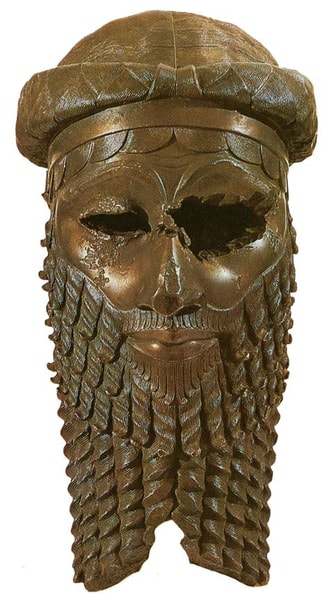 Akkadian Ruler Sumerophile (Public Domain) ](https://www.worldhistory.org/image/161/akkadian-ruler/ "Akkadian Ruler")His grandson, [Naram-Sin](https://www.worldhistory.org/Naram-Sin/) (reign 2254-2218 BCE), learning well the lessons of the importance of personal propaganda, claimed he had gone further than his grandfather and had himself deified during his reign. In doing so, he provided a model for those kings who would follow him. [Sargon](https://www.worldhistory.org/disambiguation/sargon/) the Great and Naram-Sin were the most powerful rulers of the [Akkadian](https://www.worldhistory.org/disambiguation/akkadian/) [Empire](https://www.worldhistory.org/empire/), and once it fell, their names became legend and their deeds worth emulating.
The heroes of Akkad were most closely emulated by the rulers of the Third Dynasty of Ur. This period in the history of Sumer is known as the Ur III period (circa 2112 to circa 2004 BCE) and was the age in which the city of Ur reached its height. The great [ziggurat](https://www.worldhistory.org/ziggurat/) of Ur, which can still be visited in modern times, dates from this period, as do most of the ruins of the city and the [cuneiform](https://www.worldhistory.org/cuneiform/) tablets discovered there.
Two of the greatest kings of the Third Dynasty were [Ur-Nammu](https://www.worldhistory.org/Ur-Nammu/) (reign circa 2112 to circa 2094 BCE) and his son [Shulgi of Ur](https://www.worldhistory.org/Shulgi_of_Ur/) (reign circa 2094 to circa 2046 BCE), who created an urban community devoted to cultural progress and excellence and, in doing so, gave birth to what is known as the [Sumerian](https://www.worldhistory.org/Sumerians/) Renaissance.
[  Ziggurat of Ur (Artist's Impression) Mohawk Games (Copyright) ](https://www.worldhistory.org/image/12890/ziggurat-of-ur-artists-impression/ "Ziggurat of Ur (Artist's Impression)")### Ur-Nammu & Shulgi: The Sumerian Renaissance
Ur-Nammu wrote down the first codified [law](https://www.worldhistory.org/disambiguation/law/) system of the land, the [Code of Ur-Nammu](https://www.worldhistory.org/Code_of_Ur-Nammu/), some 300 years before [Hammurabi](https://www.worldhistory.org/hammurabi/) of [Babylon](https://www.worldhistory.org/babylon/) would write his, and governed his realm in accordance with a patriarchal hierarchy in which he was the father guiding his children to prosperity and continued health. Under Ur-Nammu, the great ziggurat was built, and trade flourished. The arts and technology for which the [Sumerians](https://www.worldhistory.org/Sumerians/) are most famous were all encouraged in Ur during this time.
The scholar [Paul](https://www.worldhistory.org/disambiguation/Paul/) Kriwaczek observes that, in order for such a patriarchal system of government to succeed, the people must believe that their ruler is greater and more powerful than they are in the same way that children regard their father. To this end, it seems, Ur-Nammu presented himself to his subjects in line with the hero-kings Sargon and Naram-Sin in order to encourage the populace to follow him in the pursuit of excellence. He was killed in [battle](https://www.worldhistory.org/disambiguation/battle/) with the [Gutians](https://www.worldhistory.org/Gutians/) and immortalized in the poem *The [Death of Ur-Nammu](https://www.worldhistory.org/article/2111/the-death-of-ur-nammu/),* which imagines him in the underworld realm of [Ereshkigal](https://www.worldhistory.org/Ereshkigal/), Queen of the Dead.
His son Shulgi, in an effort to surpass the achievements of his father, went even further. One example of this is his famous run when, to impress his people and distinguish himself from his father, Shulgi ran 200 miles (321.8 km) between the religious centre of [Nippur](https://www.worldhistory.org/disambiguation/nippur/) and the capital city of Ur and back again – in one day – in order to officiate at the festivals in both cities. His feat was celebrated in *[A Praise Poem of Shulgi](https://www.worldhistory.org/article/2110/a-praise-poem-of-shulgi/),* which was read throughout his realm. Shulgi continued his father's policies, bettering them when he saw fit, and is considered the greatest king of the Third Dynasty of Ur for the heights [civilization](https://www.worldhistory.org/civilization/) reached under his reign, including making literacy a priority.
[ 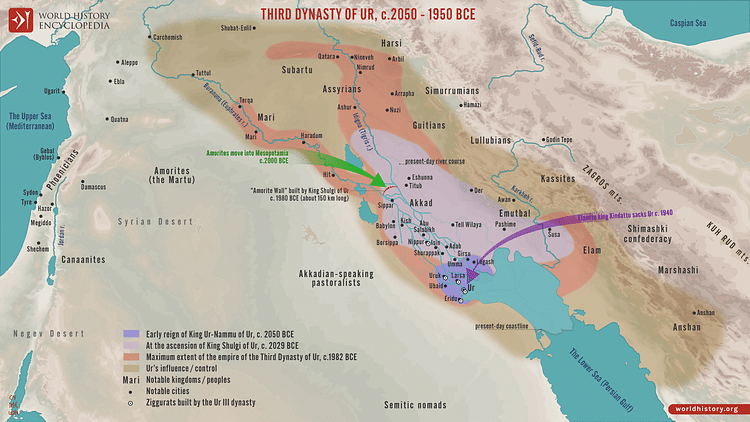 Map of the Third Dynasty of Ur Simeon Netchev (CC BY-NC-ND) ](https://www.worldhistory.org/image/15308/map-of-the-third-dynasty-of-ur/ "Map of the Third Dynasty of Ur")Shulgi improved the roads, created roadside inns with gardens and running water, and commissioned the renovation and rebuilding of many structures throughout his territories. Among his many building projects was a [wall](https://www.worldhistory.org/wall/) that ran 155 miles (250 km) along the border of the region of Sumer to keep out the barbarian tribes known as the Martu (also given as the Tidnum), who are most recognizable to modern readers from their biblical designation as Amorites. Shulgi's wall was maintained by his son, grandson, and great-grandson, but could not hold back the tribes on the borders.
The wall was too long to be properly manned, and since it was not anchored at either end, invaders could bypass the obstacle simply by marching around it. In 1750 BCE, the neighboring kingdom of [Elam](https://www.worldhistory.org/elam/) breached the wall, sacked Ur, and carried away the last king as a prisoner. The Amorites, who had already found their way around the wall, merged with the Sumerian populace and, in this way, Sumerian [culture](https://www.worldhistory.org/disambiguation/culture/) came to an end with the fall of Ur. This decline and fall was immortalized in one of the best-known poems of the genre of [Mesopotamian City Laments](https://www.worldhistory.org/article/2884/mesopotamian-city-laments/) - the *Lament for Sumer and Ur* (circa 2000 BCE) - which attributes the city's fall to the will of the gods.
### The Decline of Ur & Excavation
In the Old Babylonian Period (circa 1894-1595 BCE), Ur remained a city of importance and was considered a centre of learning and culture. According to scholar Gwendolyn Leick, "The 'heirs' of Ur, the kings of Isin and Larsa, were keen to show their respect to the gods of Ur by repairing the devastated temples" (180). The [Kassite](https://www.worldhistory.org/kassite/) kings, who later conquered the region, did the same as would the Assyrian rulers who followed them.
The city continued to be inhabited through the early part of the [Achaemenid](https://www.worldhistory.org/disambiguation/Achaemenid/) Period (circa 550-330 BCE), but, due to climate change and overuse of the land, more and more people migrated to the northern regions of Mesopotamia or south toward the land of Canaan (the patriarch Abraham, some claim, among them, as previously noted). Ur slowly dwindled in importance as the Persian Gulf receded further and further south from the city and eventually fell into ruin around 450 BCE.
The area was buried under the sands until it was visited by Pietro della Valle in 1625, who noted strange inscriptions on bricks (later identified as cuneiform [script](https://www.worldhistory.org/script/)) and images on artifacts, which were later recognized as cylinder seals used to identify property or sign letters. In 1853-1854, the first excavation of the site was made by John George Taylor in the interests of the British Museum, who noted multiple grave complexes and concluded the site may have been a Babylonian necropolis.
The definitive excavation of the ruins of Ur was conducted between 1922 and 1934 by Sir Leonard Wooley, working on behalf of the British Museum and the University of Pennsylvania. The famous [Tomb](https://www.worldhistory.org/tomb/) of [Tutankhamun](https://www.worldhistory.org/Tutankhamun/) had been discovered by Howard Carter in November 1922, and Wooley was hoping for an equally impressive find. At Ur, he uncovered the graves of sixteen kings and queens, including that of Queen Puabi (also known as Shub-ad) and her treasures. The Great Death Pit, as Wooley named it, was the largest of those uncovered.
> Wooley found six armed guards and 68 serving [women](https://www.worldhistory.org/disambiguation/women/). They wore ribbons of [gold](https://www.worldhistory.org/gold/) and [silver](https://www.worldhistory.org/Silver/) in their hair, except one woman who still held in her hand the coiled-up silver ribbon she was unable to fasten before the sleeping potion took hold that painlessly carried her away to the afterworld with her master. (Bertman, 36)
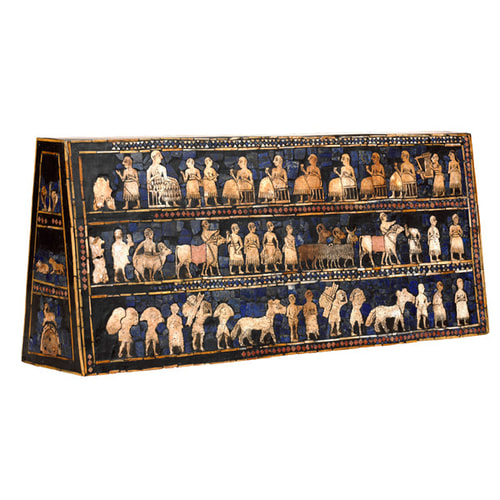
Wooley also uncovered the Royal Standard of Ur, which celebrated the city's [triumph](https://www.worldhistory.org/Roman_Triumph/) over its enemies in [war](https://www.worldhistory.org/disambiguation/War/) and the festivities the people enjoyed in peace. In an effort to outdo Carter's triumph in the [discovery of Tutankhamun's tomb](https://www.worldhistory.org/article/2063/the-discovery-of-tutankhamuns-tomb/), Wooley claimed that he had found evidence at Ur of the biblical Great Flood, but the notes taken by his assistant, Max Mallowan, later showed that the flood record at the site in no way supported a worldwide deluge and was more in keeping with the regular flooding caused by the Tigris and Euphrates rivers.
[  The Standard of Ur Trustees of the British Museum (Copyright) ](https://www.worldhistory.org/image/501/the-standard-of-ur/ "The Standard of Ur")### Conclusion
Further excavations at Ur since Wooley's time have corroborated Mallowan's notes, and, in spite of persistent beliefs to the contrary, no evidence supporting the Great Flood story from the [Bible](https://www.worldhistory.org/bible/) has been found at Ur, nor anywhere else in Mesopotamia. Still, as scholar Stephen Bertman notes:
> Even if stripped of its biblical claims to fame, Wooley's Ur is still a glittering example of [Sumeria](https://www.worldhistory.org/Sumerians/)'s golden age. Though its original lyres no longer sound, with our inner ear we can still hear their melodies.
> (36)
The ruins of Ur today are a significant archaeological site, which continues to yield important artifacts when the troubles of the region allow. The great ziggurat of Ur rises from the plains above the mud-brick ruins of the once-great city, and, as Bertman suggests, in walking among them, one relives the past when Ur was a center of commerce and trade, protected by the gods, and flourishing amidst fertile fields.
#### Editorial Review
This human-authored definition has been reviewed by our editorial team before publication to ensure accuracy, reliability and adherence to academic standards in accordance with our [editorial policy](https://www.worldhistory.org/static/editorial-policy/).
## Bibliography
- [Bertman, S. *Handbook to Life in Ancient Mesopotamia.* Oxford University Press, USA, 2005.](https://www.worldhistory.org/books/0195183649/)
- [Kramer, S. N. *The Sumerians.* University of Chicago Press, 1971.](https://www.worldhistory.org/books/0226452387/)
- [Kriwaczek, P. *Babylon.* Thomas Dunne Books, 2014.](https://www.worldhistory.org/books/B00DIKTPXC/)
- [Leick, G. *The A to Z of Mesopotamia.* Scarecrow Press, 2010.](https://www.worldhistory.org/books/0810875772/)
- [Podany, A. H. *The Ancient Near East.* Oxford University Press, USA, 2013.](https://www.worldhistory.org/books/0195377990/)
- [Reade, J. *Mesopotamia.* British Museum Press, 2000.](https://www.worldhistory.org/books/067456958X/)
- [Van De Mieroop, M. *The Ancient Mesopotamian City.* Oxford University Press, USA, 1999.](https://www.worldhistory.org/books/0198152868/)
- [Wise Bauer, S. *The History of the Ancient World.* W. W. Norton & Company, 2007.](https://www.worldhistory.org/books/039305974X/)
## About the Author
Joshua J. Mark is World History Encyclopedia's co-founder and Content Director. He was previously a professor at Marist College (NY) where he taught history, philosophy, literature, and writing. He has traveled extensively and lived in Greece and Germany.
- [Linkedin Profile](https://www.linkedin.com/pub/joshua-j-mark/38/614/339)
## Timeline
- **c. 6500 BCE - 4000 BCE**: The Ubaid period in [Sumer](https://www.worldhistory.org/sumer/).
- **c. 4000 BCE**: First settlement of [Ur](https://www.worldhistory.org/ur/).
- **c. 2600 BCE - c. 2000 BCE**: The Royal Graves of [Ur](https://www.worldhistory.org/ur/) used in [Sumer](https://www.worldhistory.org/sumer/).
- **c. 2330 BCE**: [Sargon of Akkad](https://www.worldhistory.org/Sargon_of_Akkad/) sacks [Ur](https://www.worldhistory.org/ur/).
- **c. 2112 BCE - 2094 BCE**: [Ur-Nammu](https://www.worldhistory.org/Ur-Nammu/)'s reign over [Sumer](https://www.worldhistory.org/sumer/).
- **c. 2112 BCE - c. 2004 BCE**: The [Ur](https://www.worldhistory.org/ur/) III period in [Sumer](https://www.worldhistory.org/sumer/), known as the [Sumerian](https://www.worldhistory.org/Sumerians/) Renaissance.
- **2100 BCE**: Ziggurats in use in [Sumerian](https://www.worldhistory.org/Sumerians/) [cities](https://www.worldhistory.org/city/) of [Eridu](https://www.worldhistory.org/eridu/), [Uruk](https://www.worldhistory.org/uruk/), [Ur](https://www.worldhistory.org/ur/), [Nippur](https://www.worldhistory.org/disambiguation/nippur/) and elsewhere.
- **c. 2100 BCE - c. 2050 BCE**: The [Code of Ur-Nammu](https://www.worldhistory.org/Code_of_Ur-Nammu/) (the oldest extant code of laws) is written.
- **2047 BCE - 1750 BCE**: Third Dynasty of [Ur](https://www.worldhistory.org/ur/).
- **c. 2038 BCE**: King [Shulgi of Ur](https://www.worldhistory.org/Shulgi_of_Ur/) builds his great [wall](https://www.worldhistory.org/wall/) in [Sumer](https://www.worldhistory.org/sumer/).
- **2030 BCE - 1980 BCE**: [Ur](https://www.worldhistory.org/ur/) is reputed to be the largest [city](https://www.worldhistory.org/city/) in the world.
- **c. 1750 BCE**: [Elam](https://www.worldhistory.org/elam/) conquers [Ur](https://www.worldhistory.org/ur/).
- **1000 BCE**: Chaldeans occupy [Ur](https://www.worldhistory.org/ur/).
- **450 BCE**: [Ur](https://www.worldhistory.org/ur/) is no longer inhabited, possibly due to drought or changing river patterns.
## Questions & Answers
### When was Ur founded?
Ur was founded by 3800 BCE.
### Why is Ur famous?
Ur is famous, from its mention in the Bible, as the home of the patriarch Abraham before he migrated to Canaan. It was famous prior to the biblical narratives as a great trade and cultural center. It is also famous in the modern era for the 1922 discovery of the Great Death Pit and the artifacts the graves contained.
### Where is Ur today?
The ruins of Ur, including its famous Great Ziggurat, are located in Tell el-Muqayyar, Iraq.
### When and why was Ur abandoned?
Ur was abandoned in 450 BCE due to climate change, the silting of the Tigris and Euphrates rivers, and the overuse of natural resources.
## External Links
- [Ur](https://www.penn.museum/sites/iraq/?page_id=24)
- [Site Unavailable](http://history-world.org/ur.htm)
- [Ancient Mesopotamia for Kids](https://mesopotamia.mrdonn.org/ur.html)
- [Room 56: Mesopotamia 6000-1500 BC](http://www.britishmuseum.org/explore/galleries/middle_east/room_56_mesopotamia.aspx)
- [Ancient Mesopotamian Gods and Goddesses](http://oracc.museum.upenn.edu/amgg/listofdeities/nannasuen/)
- [Who was the world's first author? - Soraya Field Fiorio](https://ed.ted.com/lessons/who-was-the-world-s-first-author-soraya-field-fiorio)
- [Art of the First Cities in the Third Millennium B.C. | Essay | The Metropolitan Museum of Art | Heilbrunn Timeline of Art History](https://www.metmuseum.org/toah/hd/trdm/hd_trdm.htm)
- [Ur: The Royal Graves | Essay | The Metropolitan Museum of Art | Heilbrunn Timeline of Art History](https://www.metmuseum.org/toah/hd/urrg/hd_urrg.htm)
- [Ur: The Ziggurat | Essay | The Metropolitan Museum of Art | Heilbrunn Timeline of Art History](https://www.metmuseum.org/toah/hd/zigg/hd_zigg.htm)
## Cite This Work
### APA
Mark, J. J. (2026, January 20). Ur: The Great Biblical City Abandoned by the Gods. *World History Encyclopedia*.
### Chicago
Mark, Joshua J.. "Ur: The Great Biblical City Abandoned by the Gods." *World History Encyclopedia*, January 20, 2026. .
### MLA
Mark, Joshua J.. "Ur: The Great Biblical City Abandoned by the Gods." *World History Encyclopedia*, 20 Jan 2026, .
## License & Copyright
Submitted by [Joshua J. Mark](https://www.worldhistory.org/user/JPryst/ "User Page: Joshua J. Mark"), published on 20 January 2026. The copyright holder has published this content under the following license: [Creative Commons Attribution-NonCommercial-ShareAlike](https://creativecommons.org/licenses/by-nc-sa/4.0/deed.en). This license lets others remix, tweak, and build upon this content non-commercially, as long as they credit the author and license their new creations under the identical terms. When republishing on the web a hyperlink back to the original content source URL must be included. Please note that content linked from this page may have different licensing terms.