---
title: Trireme
author: Mark Cartwright
source: https://www.worldhistory.org/trireme/
format: machine-readable-alternate
license: Creative Commons Attribution-NonCommercial-ShareAlike (https://creativecommons.org/licenses/by-nc-sa/4.0/)
updated: 2022-07-31
---
# Trireme
_Authored by [Mark Cartwright](https://www.worldhistory.org/user/markzcartwright/)_
The trireme ([Greek](https://www.worldhistory.org/disambiguation/greek/): *triērēs*) was the devastating warship of the ancient [Mediterranean](https://www.worldhistory.org/disambiguation/mediterranean/) with three banks of oars. Fast, manoeuvrable, and with a [bronze](https://www.worldhistory.org/disambiguation/bronze/)-sheathed ram on the prow to sink an enemy ship, the trireme permitted [Athens](https://www.worldhistory.org/Athens/) to build its maritime [empire](https://www.worldhistory.org/empire/) and dominate the [Aegean](https://www.worldhistory.org/aegean/) in the 5th century BCE.
Most scholars credit the [Phoenicians](https://www.worldhistory.org/phoenicia/) with first inventing the trireme which was itself an adaptation of the earlier bireme. According to [Thucydides](https://www.worldhistory.org/Thucydides/), it was the Corinthians who first adopted triremes on the Greek mainland c. 700 BCE. However, it was the Athenians, with their newly found wealth from local [silver](https://www.worldhistory.org/Silver/) mines, who constructed a fleet of triremes large enough to hold sway over the Aegean.
### Rowing Arrangement
The trireme was so-called because of the arrangement of rowers in three lines down the length of each side of the ship. Concrete archaeological evidence is lacking and scholars debate the exact arrangement; however, from depictions on ancient carvings and [pottery](https://www.worldhistory.org/pottery/) and references from classical authors such as [Homer](https://www.worldhistory.org/homer/), Thucydides, and Apollonius of [Rhodes](https://www.worldhistory.org/Rhodes/), a wide consensus has been reached. As many as 30 oars, each with a single oarsman, ran the length of the ship in three tiers. Consequently, the total number of rowers could have been between 170 and 180, allowing a speed of as high as nine or ten knots in short bursts. Each oarsman had a fixed seat (and leather or wool cushion) and the rowers were arranged with 31 on the top row (*thranoi*), 27 in the middle (*zygoi*), and 27 on the lowest level (*thalamoi*). Their 4 m long oars were attached to a tholepin (fixed vertical peg) with a leather oar-loop.
Archaeological remains of boathouses, most notably at [Piraeus](https://www.worldhistory.org/Piraeus/), indicate that the maximum length of the ship would have been around 37 m with a beam of 6 m. They measured about 4 m from deck to keel and may have weighed as much as 50 tons. However, this was light enough so that crews could carry the vessel if necessary and easily beach it overnight.
### Materials
The Greek ships were built using softwoods such as pine, fir, and cypress for interiors, and oak only for the outer hulls. Oars were made from a single young fir tree and measured some 4.5 metres in length. As a consequence of using lighter woods, the ship was highly manoeuvrable. The full-size reconstruction *[Olympias](https://www.worldhistory.org/Olympias/)* built in the 1980s CE has demonstrated that a trireme could turn 360 degrees in less than two ship's lengths and turn 90 degrees in a matter of seconds in only a ship's length. The vessel also displayed impressive acceleration and deceleration rates.
[  Lenormant Relief wikipedia user: Marsyas (CC BY-SA) ](https://www.worldhistory.org/image/2424/lenormant-relief/ "Lenormant Relief")The disadvantage of softwoods is their high absorption of water, and therefore the ships were usually pulled out of the water at night using slipways and then housed in protective huts. The technique used in construction was to lay down longitudinal beams joined by dowel pin-joints along an oak keel. These were then covered with the outer hull, a sheath of closely fitting (but not overlapping) planks sealed with pitch and resin. The hull was made smoother by adding wax to the pitch which added to the speed potential of the vessel. Ribs (*zyga*) and arrangements of tightened ropes (*hypozomata*) were then fixed inside to add strength to the overall structure. Finally, a simple flat deck (without rails) was added with a central space running down the length of the ship, giving access to the interior.
In addition to trireme rowers, the ship was equipped with a square sail of papyrus or flax (or sometimes two), used when cruising and taken down and stored on land when in [battle](https://www.worldhistory.org/disambiguation/battle/) conditions. Steering was achieved through two steering oars at each side of the stern and controlled by a single helmsman (*kybernetes*). Next to the helmsman stood the ship's commander (*trierarchos*), and both were protected by the upward curving structure at the stern known as the *aphlaston*. Other crew members were the rowing master (*keleustes*) who shouted instructions, the 'bow officer' (*prorates*) who relayed those instructions further down the ship, a piper (*auletes*) who kept time for the rowers playing an [aulos](https://www.worldhistory.org/Aulos/), a carpenter (*naupegos*), and deck crews to man the sails.
[ 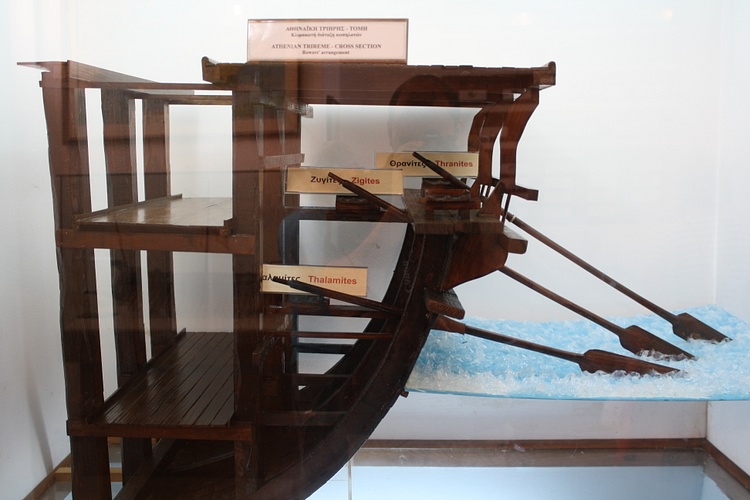 Trireme Cross Section Mark Cartwright (CC BY-NC-SA) ](https://www.worldhistory.org/image/13834/trireme-cross-section/ "Trireme Cross Section")Prows were often decorated to resemble animal heads, and a common feature was the attachment of large, painted marble eyes. The hull itself was painted with waterproofing pitch, giving the distinctive black appearance so often referred to by Homer. Ships were regarded as females and also given names, for example, [Artemis](https://www.worldhistory.org/artemis/), Equality, Sea Horse, and Good Repute.
### Military Use
The principal weapon of the trireme was the bronze-sheathed battering ram affixed to the prow which was used to sink enemy ships. These often took the form of animals, for example, the head of a goat. However, ramming would have rarely sunk an enemy vessel and an important secondary strategy was boarding the enemy ship. For this reason, the typical Athenian crew included a complement of ten hoplites and four archers.
[ ![Greek Trireme [Artist's Impression]](https://www.worldhistory.org/img/r/p/750x750/4650.jpg?v=1775715329) Greek Trireme \[Artist's Impression\] The Creative Assembly (Copyright) ](https://www.worldhistory.org/image/4650/greek-trireme-artists-impression/ "Greek Trireme [Artist's Impression]")In terms of operation, the lack of storage space onboard these ancient ships - for water and food - and the need for relatively calm seas meant that battles were most often fought close to land. In addition, shipwrecked crews could then be more easily rescued.
The most celebrated use of triremes in naval [warfare](https://www.worldhistory.org/warfare/), and perhaps the greatest naval battle in ancient history, was fought in 480 BCE at the [Battle of Salamis](https://www.worldhistory.org/Battle_of_Salamis/) between the Greek navy of the [Hellenic](https://www.worldhistory.org/greece/) League (principally represented by Athens and [Corinth](https://www.worldhistory.org/corinth/)) and the invading armada of the Persian king [Xerxes I](https://www.worldhistory.org/Xerxes_I/). The victory of Greek navy not only ensured [Greece](https://www.worldhistory.org/greece/)'s autonomy but allowed Athens to then take centre stage and make the Athenian trireme an everpresent sight in the Aegean.
#### Editorial Review
This human-authored definition has been reviewed by our editorial team before publication to ensure accuracy, reliability and adherence to academic standards in accordance with our [editorial policy](https://www.worldhistory.org/static/editorial-policy/).
## Bibliography
- [Fields, N. *Ancient Greek Warship.* Osprey Publishing, 2007.](https://www.worldhistory.org/books/1846030749/)
- [Hornblower, S. *The Oxford Classical Dictionary.* Oxford University Press, USA, 2012.](https://www.worldhistory.org/books/0199545561/)
- Lane Fox R. *The Classical World.* Penguin, London, 2006
- [Shepherd, W. *Salamis 480 BC.* Osprey Publishing, 2010.](https://www.worldhistory.org/books/1846036844/)
## About the Author
Mark is WHE’s Publishing Director and has an MA in Political Philosophy (University of York). He is a full-time researcher, writer, historian and editor. Special interests include art, architecture and discovering the ideas that all civilizations share.
## Timeline
- **c. 700 BCE**: Corinthians adopt the [trireme](https://www.worldhistory.org/trireme/) from the [Phoenicians](https://www.worldhistory.org/phoenicia/).
- **c. 483 BCE**: [Themistocles](https://www.worldhistory.org/Themistocles/) persuades the Athenians to significantly expand their fleet, which saves them at [Salamis](https://www.worldhistory.org/disambiguation/Salamis/) and becomes their source of power.
- **Aug 480 BCE**: The indecisive [battle](https://www.worldhistory.org/disambiguation/battle/) of Artemision between the [Greek](https://www.worldhistory.org/disambiguation/greek/) and Persian fleets of [Xerxes I](https://www.worldhistory.org/Xerxes_I/). The Greeks withdraw to [Salamis](https://www.worldhistory.org/disambiguation/Salamis/).
- **Sep 480 BCE**: [Battle of Salamis](https://www.worldhistory.org/Battle_of_Salamis/) where the [Greek](https://www.worldhistory.org/disambiguation/greek/) naval fleet led by [Themistocles](https://www.worldhistory.org/Themistocles/) defeats the invading armada of [Xerxes I](https://www.worldhistory.org/Xerxes_I/) of [Persia](https://www.worldhistory.org/Persia/).
- **433 BCE**: A naval [battle](https://www.worldhistory.org/disambiguation/battle/) between the victorious combined forces of [Corcyra](https://www.worldhistory.org/corcyra/) and [Athens](https://www.worldhistory.org/Athens/) against [Corinth](https://www.worldhistory.org/corinth/).
- **410 BCE**: [Alcibiades](https://www.worldhistory.org/Alcibiades/) leads the Athenian fleet to victory over [Sparta](https://www.worldhistory.org/sparta/) at Cyzicus.
- **344 BCE**: [Corcyra](https://www.worldhistory.org/corcyra/) contributes two ships to [Timoleon](https://www.worldhistory.org/Timoleon/)'s fleet which attacked [Syracuse](https://www.worldhistory.org/syracuse/).
## Cite This Work
### APA
Cartwright, M. (2012, May 31). Trireme. *World History Encyclopedia*.
### Chicago
Cartwright, Mark. "Trireme." *World History Encyclopedia*, May 31, 2012. .
### MLA
Cartwright, Mark. "Trireme." *World History Encyclopedia*, 31 May 2012, .
## License & Copyright
Submitted by [Mark Cartwright](https://www.worldhistory.org/user/markzcartwright/ "User Page: Mark Cartwright"), published on 31 May 2012. The copyright holder has published this content under the following license: [Creative Commons Attribution-NonCommercial-ShareAlike](https://creativecommons.org/licenses/by-nc-sa/4.0/deed.en). This license lets others remix, tweak, and build upon this content non-commercially, as long as they credit the author and license their new creations under the identical terms. When republishing on the web a hyperlink back to the original content source URL must be included. Please note that content linked from this page may have different licensing terms.