---
title: 拜占庭帝国
author: Mark Cartwright
translator: Jinfeng Zhang
source: https://www.worldhistory.org/trans/zh/1-953/
format: machine-readable-alternate
license: Creative Commons Attribution-NonCommercial-ShareAlike (https://creativecommons.org/licenses/by-nc-sa/4.0/)
updated: 2024-06-13
---
# 拜占庭帝国
_作者: [Mark Cartwright](https://www.worldhistory.org/user/markzcartwright/)_
_译者: [Jinfeng Zhang](https://www.worldhistory.org/user/jinfengzhang)_
[](https://www.worldhistory.org/trans/zh/1-22386/)[](https://www.worldhistory.org/trans/zh/2-2409/)拜占庭帝国存在于 330 年至 1453 年。它通常被称为东罗马帝国或简称拜占庭。君士坦丁一世(306-337 年)在君士坦丁堡建立了拜占庭首都。几个世纪以来,拜占庭帝国的版图大小不一,曾一度在意大利、希腊、巴尔干半岛、黎凡特、小亚细亚和北非拥有领土。
拜占庭是一个基督教国家,官方语言为希腊语。拜占庭发展了自己的政治制度、宗教习俗、艺术和建筑。这些都深受希腊罗马文化传统的影响,但又独树一帜,而不仅仅是古罗马的延续。拜占庭帝国是持续时间最长的中世纪强国,其影响延续至今,特别是许多西方国家、东欧、中欧和俄罗斯的宗教、艺术、建筑和法律。
### “拜占庭”的名称和时间跨度
“拜占庭”这个名字是由 16 世纪的历史学家创造的,在东罗马帝国首都改为君士坦丁堡(今伊斯坦布尔)之前的名字是拜占庭。它过去是,现在仍然是一个不太完美但却方便的用来区分东罗马帝国和西罗马帝国的名称, 5 世纪西罗马帝国灭亡后尤为重要。事实上,正因如此,历史学家们对于 “拜占庭帝国 ”一词究竟指的是哪一时期并没有达成一致意见。一些学者选择 330 年君士坦丁堡建立,另一些学者选择 476 年西罗马帝国灭亡,还有一些学者选择查士丁尼一世(527-565 年在位)未能在 565 年统一两个帝国,还有一些学者甚至选择约 650 年阿拉伯人征服拜占庭东部省份。大多数历史学家都认为拜占庭帝国于 1453 年 5 月 29 日(星期二)灭亡,奥斯曼帝国苏丹穆罕默德二世(Mehmed II,1444-6 年和 1451-81 年在位)征服了君士坦丁堡。
对时间跨度的讨论还突出了东罗马帝国和西罗马帝国之间种族和文化组合的差异,以及中世纪国家与其早期罗马传统的区别。拜占庭人自称 “罗马人” ,他们的皇帝是 basileon ton Rhomaion 或 “罗马皇帝” ,他们的首都是 “新罗马”。然而,最通用的语言是希腊语,可以说,在其历史的绝大部分时间里,拜占庭帝国在文化上更偏向希腊而非罗马。
### 君士坦丁堡
330 年 5 月 11 日,罗马帝国皇帝君士坦丁一世决定将罗马帝国的首都从罗马迁往拜占庭,拜占庭帝国由此开始。君士坦丁堡或 “君士坦丁城” 这一俗称很快取代了皇帝自己正式选择的 “新罗马” 。新首都在金角湾入海口拥有一个天然良港,横跨欧亚边界,可以控制从爱琴海到黑海的船只通过博斯普鲁斯海峡,将利润丰厚的东西方贸易连接起来。金角湾入口处横亘着一条巨大的锁链,410 年至 413 年间修建的巨大的狄奥多西城墙意味着这座城市能够抵御一次又一次来自海上和陆地的联合攻击。几个世纪以来,随着更多壮观建筑的出现,这座国际大都市成为任何时代最精美的城市之一,当然也是世界上最富有、最奢华和最重要的基督教城市之一。
[  拜占庭君士坦丁堡地图 Cplakidas (CC BY-SA) ](https://www.worldhistory.org/image/564/map-of-byzantine-constantinople/ "Map of Byzantine Constantinople")### 拜占庭皇帝
拜占庭皇帝或巴西琉斯(basileus,或更罕见的basilissa)居住在君士坦丁堡宏伟的大皇宫中,以绝对君主的身份统治着一个庞大的帝国。因此,皇帝需要专家政府和广泛而高效的官僚机构的协助。虽然皇帝是绝对统治者,但他的政府、人民和教会都期望他进行明智而公正的统治。更重要的是,皇帝必须在军事上取得成功,因为军队仍然是拜占庭最强大的机构。君士坦丁堡和各省的将军们可以罢免未能保卫帝国边境或带来经济灾难的皇帝。尽管如此,在正常情况下,皇帝仍是军队的统帅、教会和政府的首脑,他控制着国家财政,根据意愿任命或罢免贵族。在此之前或之后,很少有统治者拥有这样的权力。
皇帝的形象出现在拜占庭钱币上,这些钱币也用来显示选定的继承人,通常是长子,但也不总是这样,因为没有固定的继承规则。人们认为皇帝是上帝选中的统治者,华丽的皇冠和泰尔紫色长袍有助于进一步加强统治权。另一种策略是模仿杰出前任的年号,君士坦丁就是最受欢迎的。即使是篡位者,通常也是有权势、有成就的军事家,他们往往会通过与前任家族成员联姻来使自己的地位合法化。因此,通过精心策划的朝代、仪式、服饰和名称的延续,拜占庭皇帝的统治得以持续 12 个世纪。
### 拜占庭政治制度
拜占庭政治制度沿袭了罗马帝国的模式。皇帝无所不能,但仍需征求元老院等重要机构的意见。君士坦丁堡的元老院与罗马不同,是由在军队中晋升的人员组成的,因此没有元老院这样的阶层。由于没有选举,拜占庭的元老、大臣和地方议员大多通过帝国的福荫或大地主的身份获得职位。
[  查士丁尼一世 Sponsored by a Greek banker, Julius Argentarius (CC BY-NC-SA) ](https://www.worldhistory.org/image/3341/justinian-i/ "Justinian I")精英元老们组成了一个小型的御前会议(Sacrum consistorium),从理论上讲,皇帝应该就国家大事咨询他们的意见。此外,皇帝还可以咨询宫廷中的侍从。宫廷中还有宦官内侍(cubicularii),他们为皇帝提供各种个人服务,也可以控制谁可以接近皇帝。宦官本身也身居要职,其中最主要的是皇帝的财政管理者—司库(sakellarios),从 7 世纪开始,他的权力显著增加。其他重要的政府官员包括财务官(quaestor)或首席法务官;控制国家铸币厂的圣库随从官(comes sacrarum largitionum );负责管理宫殿、军队及其补给以及外交事务的行政长官(magister officiorum );以及一支帝国巡视员队伍,他们密切关注着帝国各地的地方事务。
拜占庭的最高官员是东方禁卫军长官(Praetorian Prefect),帝国的所有地区长官都对他负责。地区总督负责监督各个城市的市议会。地方议员负责其所在城市及其周边地区的所有公共服务和税收。这些议会按地域划分为 100 个左右的省,这些省又被划分为 12 个教区,帝国的四个省各辖三个教区。从 7 世纪起,教区的地区长官或改组后的军区( themes )长官实际上成为直接向皇帝本人负责的省级军事指挥官(strategoi),禁卫军长官被废除。8 世纪后,由于邻国的军事威胁和国内内战的加剧,帝国的行政管理比以前简化了许多。
### 《查士丁尼法典》
查士丁尼一世制定的《查士丁尼法典》或《民法大全》(Corpus Juris Civilis)为拜占庭政府提供了极大的帮助。该法典由一个法律专家小组起草,收集、编辑并修订了数百年来积累的大量罗马法律–大量的帝国法令、法律意见以及犯罪和惩罚清单。这部法典由 100 多万字组成,延续了 900 年,使所有人都能更清楚地了解法律,减少了不必要地提交法院的案件数量,加快了司法程序,并影响了此后西方民主国家的大多数法律制度。
### 拜占庭社会
拜占庭人非常重视家族的名声、继承的财富和体面的出身。社会上层人士普遍拥有这三样东西。财富来自土地所有权或个人对土地的管理权。然而,拜占庭社会并不存在血统贵族,资助和教育都是攀登社会阶梯的手段。此外,皇帝赐予的恩惠、土地和头衔,以及不加区别的降职和外国入侵与战争的危险,都意味着贵族的各个组成部分并不是一成不变的,贵族家族在几个世纪中不断兴衰更替。所有社会成员都可以通过头衔、印章、徽章、特殊服装和个人珠宝来彰显自己的等级。
[  拜占庭象牙双联画板 Osama Shukir Muhammed Amin (Copyright) ](https://www.worldhistory.org/image/5727/byzantine-ivory-diptych-panel/ "Byzantine Ivory Diptych Panel")下层阶级中的大多数人都会继承父母的职业,但遗产继承,财富积累,不正式禁止一个阶级向另一个阶级流动,至少为一个人提高自己的社会地位提供了一点可能性。有些人从事较好的工作,如法律事务、行政管理和商业(在拜占庭人看来,这并不是一种很受尊重的谋生方式)。较低级的工作包括工匠,然后是拥有自己小块土地的农民,然后是最大的群体–耕种他人土地的人,最后是奴隶,他们通常是战俘,但数量远不及自由劳动者。
拜占庭妇女的角色与男子一样,取决于她们的社会等级。贵族妇女负责管理家庭和照顾孩子。虽然她们可以拥有财产,但不能担任公职,空闲时间则用来织布、购物、去教堂或读书(尽管她们没有接受过正规教育)。遗孀成为子女的监护人,可以与兄弟平分遗产。许多妇女与男子一样从事农业、各种制造业和食品服务业。妇女可以拥有自己的土地和企业,有些妇女会通过婚姻提高自己的社会地位。与其他地方一样,最不受尊重的职业是妓女和女戏子。
### 拜占庭帝国的领土
几个世纪以来,拜占庭帝国的地理范围随着各个皇帝在军事上的成败而变化。帝国历史早期的领土包括埃及、叙利亚、约旦、黎巴嫩和巴勒斯坦。希腊在实际意义上并不那么重要,重要的是它象征着拜占庭人认为自己是希腊罗马文化的真正继承者。意大利和西西里必须抵御教皇和诺曼人的野心,但最终没有成功。巴尔干半岛直到多瑙河都很重要,小亚细亚直到北部的黑海沿岸,以及东部的亚美尼亚都是主要的财富来源,但这两个地区都需要长期有力的防御,以抵御各种宿敌。
政治版图随着相邻帝国的兴衰而不断重绘,著名的事件包括阿纳斯塔修斯一世(Anastasios I,491-518 年)成功抵御了波斯人和保加利亚人。查士丁尼一世在他的天才将领贝利萨留(Belisarius,约 500-565 年)的帮助下,夺回了被西罗马皇帝丢失的北非、西班牙和意大利的领土。6 世纪下半叶,意大利的伦巴第人和巴尔干半岛的斯拉夫人入侵了帝国,希拉克略(Heraclius,610-641 年在位)最终扭转了这一局面,627 年,他在尼尼微战役取得胜利,有效地终结了波斯萨珊帝国。
[  拜占庭帝国,约公元520年-1204年 Simeon Netchev (CC BY-NC-ND) ](https://www.worldhistory.org/image/15330/map-of-the-byzantine-empire-c520---1204/ "Map of the Byzantine Empire, c.520 - 1204")7 世纪和 8 世纪伊斯兰教的征服夺走了拜占庭帝国在黎凡特(包括 637 年的耶路撒冷)、北非和小亚细亚东部的领土。但至少拜占庭帝国作为抵御阿拉伯人向欧洲扩张的堡垒屹立不倒,君士坦丁堡两次抵挡住了阿拉伯人的强力围攻(674-8 年和 717-18 年)。不过,拜占庭帝国的根基还是受到了动摇。9 世纪,保加利亚人大举入侵帝国北部地区。马其顿王朝(867-1057 年)的建立使拜占庭的命运重新崛起。王朝的建立者巴西尔一世(Basil I,867-886 年在位)重新征服了意大利南部,解决了棘手的克里特海盗,并在塞浦路斯、希腊本土和达尔马提亚(Dalmatia)取得了对阿拉伯人的胜利。下一任皇帝利奥六世(Leo VI,886-912 年在位)失去了大部分战果,但 10 世纪中期在穆斯林控制的美索不达米亚取得了胜利。
巴西尔二世(976-1025 年)因在巴尔干半岛的胜利而被称为 "保加利亚屠夫",他使拜占庭的命运又一次出现了惊人的转机。巴西尔二世在一支来自基辅的维京后裔组成的,骁勇善战的军队的帮助下,在希腊、亚美尼亚、格鲁吉亚和叙利亚取得了胜利,使帝国的版图扩大了一倍。但这只是最后的辉煌,拜占庭帝国逐渐走向衰落。1071 年,在亚美尼亚的曼齐刻尔特战役(Battle of Manzikert)中,拜占庭令人意外地败给了塞尔柱人(Seljuks),此后,在亚历克西奥斯一世-科姆涅诺斯(Alexios I Komnenos,1081-1118 年执政)的领导下,拜占庭出现了短暂的复兴,先后战胜了达尔马提亚的诺曼人、色雷斯的佩切尼格人以及巴勒斯坦和叙利亚的塞尔柱人(在第一次十字军东征的帮助下)。但拜占庭帝国似乎在太多地区拥有太多敌人,无法持续繁荣下去。
12 和 13 世纪,罗姆苏丹国(Sultanate of Rum)占领了半个小亚细亚。1204 年,第四次十字军东征的军队洗劫了君士坦丁堡。拜占庭帝国被威尼斯及其盟国瓜分,在 1261 年复辟之前,帝国一直处于名存实亡的状态。到 14 世纪,只剩下希腊南部的一小块地区和首都周围的一大块领土。如前所述,奥斯曼帝国于 1453 年攻陷君士坦丁堡,给帝国带来了最后的打击。
### 拜占庭教会
拜占庭建国后的几个世纪里,异教仍在继续,但基督教成为拜占庭文化的显著特征,对其政治、对外关系、艺术和建筑产生了深远的影响。教会以君士坦丁堡的牧首(Patriarch)或主教为首,由皇帝任免。地方主教主持较大的城镇及其周边地区的事务,他们同时代表教会和皇帝,在当地社区拥有可观的财富和权力。因此,基督教成为了一个重要的共同点,有助于将不同的文化融合到一个统一的帝国中,其中包括信奉基督教的希腊人、亚美尼亚人、斯拉夫人、格鲁吉亚人和许多其他少数民族,以及那些被允许自由信奉其宗教的其他信仰者,如犹太人和穆斯林。
[  巴西尔圣像 Unknown Artist (Public Domain) ](https://www.worldhistory.org/image/8571/icon-of-saint-basil/ "Icon of Saint Basil")东西方教会的差异是拜占庭帝国在西方中世纪历史中形象不佳的原因之一。拜占庭人经常被描绘成颓废而多变的人,他们的文化停滞不前,他们的宗教是危险的异端。东西方教会在教皇和君士坦丁堡牧首谁应享有优先权的问题上存在分歧。教义问题也存在争议,比如耶稣基督是人性和神性合一还是只有神性。教士独身主义(Clerical celibacy)、发酵面包和无酵面包的使用、礼拜语言和意象的使用都是分歧的焦点,加上政治和领土野心的驱使,再加上各种情绪的激化,导致了 1054 年的教会分裂。
拜占庭教会也有自己的内部纷争,其中最著名的是 726-787 年和 814-843 年的圣像亵渎或 "毁像 "事件。教皇和许多拜占庭人都支持使用圣像–神圣人物的代表,尤其是耶稣基督。反对圣像的人认为圣像已成为偶像,认为用艺术来表现上帝是对上帝的亵渎。这个问题也再次引发了关于基督是否有两个本性或一个本性,以及圣像是否因此只代表人的争论。圣像的捍卫者说,圣像只是艺术家的印象,帮助文盲更好地理解神性。在圣像崇拜浪潮中,许多珍贵的艺术品被毁坏,尤其是在利奥三世(717-741 年)及其继任者君士坦丁五世(741-775 年)统治时期,连崇拜圣像的人(圣像崇拜者)也受到迫害。该问题于 843 年得到解决,最终得以保留圣像,这一事件被称为 “东正教的胜利” 。
修道院是拜占庭宗教生活的一大特色。男女隐居在修道院中,将自己的一生奉献给基督,帮助穷人和病人。在那里,他们按照巴西流(Basil the Great,约 330 - 约 379 年)等重要教会人物制定的规则过着简单的生活。许多修道士也是学者,其中最著名的是圣西里尔(Saint Cyril,卒于 867 年),他发明了格拉哥利特字母。安娜·科穆宁娜(Anna Komnene,1083-1153 年)是一位善于利用闭关时间的著名女性,她撰写了关于其父阿莱克修斯一世 (Alexios I Komnenos,1081-1118 年在位)生平和统治的 《阿莱克修斯传》(Alexiad)。修道院因此成为宝贵的典籍和知识宝库,其葡萄酒生产和圣像作坊也深受人们的喜爱。塞萨洛尼卡(Thessalonica)附近的阿索斯山(Mount Athos)是最著名的修道院遗址之一,从 9 世纪起,僧侣们就在那里建立了自己的修道院,最终在那里建造了 46 座修道院,其中许多至今仍保存完好。
[  带有圣像的拜占庭书籍封面 The Metropolitan Museum of Art (Copyright) ](https://www.worldhistory.org/image/8960/byzantine-book-cover-with-icon/ "Byzantine Book Cover with Icon")### 拜占庭艺术
拜占庭艺术家从古典传统的自然主义转向更加抽象和普遍的艺术,表现出对二维表现的明显偏好。13 世纪之前的艺术作品上很少有签名,这表明艺术家的社会地位并不高。宣扬宗教信息的艺术作品大量涌现,主要是救赎和加强信仰的需要,其中最主要的是镶嵌画(马赛克)、壁画和圣像。尽管圣像几乎可以采用任何形式的材料,但最受欢迎的还是小型彩绘木板。这些木板是为了携带或悬挂在墙上而设计的,在制作过程中使用了涂蜡技术,将彩色颜料与蜡混合,然后作为镶嵌物熔融入木板中。为了促进观看者与神灵之间的交流,单人雕像通常都是正面,周围有光环或光晕,以强调其神圣性。
拜占庭马赛克如今最常见于伊斯坦布尔的圣索菲亚大教堂或拉文纳的圣维塔(San Vitale)教堂,表现的是圣人、皇帝和皇后、教会官员以及日常生活场景,尤其是农业场景。大型雕塑似乎不如古代早期那么流行,却大量制造了大理石雕刻的石棺(sarcophagi)。最后,金属制品,尤其是珐琅工艺和圆凸面型半宝石是拜占庭人的专长,工匠们制作了许多设计精巧的高品质盘子、杯子、各种首饰、书皮(尤其是《圣经》)和圣物盒(存放圣物的盒子)。
### 拜占庭建筑
拜占庭建筑师在他们的建筑中继续采用古典式样,并从近东等地汲取灵感。与古代相比,拜占庭建筑的设计更加兼收并蓄,尤其是在新建筑中普遍采用旧建筑的材料。同时,功能也明显重于形式,人们更加关注建筑物的内部而非外部。拜占庭人继续建造拱形渡槽、圆形剧场、赛马场(hippodromes)、浴场和宫殿等典型的罗马建筑,并在此基础上建造了圆顶教堂、有围墙的修道院和更复杂的防御墙。
[ 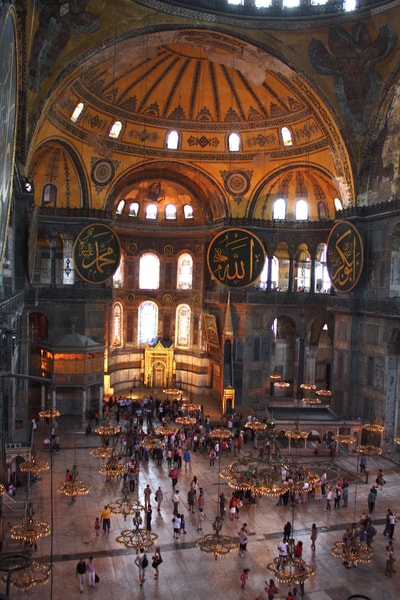 圣索菲亚大教堂内景 Mark Cartwright (CC BY-NC-SA) ](https://www.worldhistory.org/image/8973/hagia-sophia-interior/ "Hagia Sophia Interior")常用的建筑材料是大型砖块,墙体的隐蔽核心部分使用灰泥和混凝土,更负盛名的公共建筑则使用方石块(Ashlar)。大理石比早期罗马时代使用得更少,一般用于柱子、门窗框和其他装饰构件。屋顶使用木材,内墙则经常使用石膏、灰泥(stucco)、薄大理石牌匾、绘画和马赛克。
君士坦丁堡的圣索菲亚大教堂(Hagia Sophia)是最大、最重要也是最著名的拜占庭建筑,供奉上帝的神圣智慧。圣索菲亚大教堂建于 532-537 年,基本呈长方形,大小为 74.6 x 69.7 米(245 x 229 英尺),巨大的圆顶高出地面 55 米,直径达 31.8 米。穹顶由四个巨大的拱门和四个垂柱支撑,在当时是一项蔚为壮观的建筑成就。直到 16 世纪,圣索菲亚大教堂一直是世界上最大的教堂,也是装饰最华丽的教堂之一,教堂内的马赛克和壁画熠熠生辉。
总的来说,基督教教堂是拜占庭人对建筑的最大贡献之一,尤其是穹顶的使用。十字方形平面成为最常见的设计,穹顶建在四个支撑拱上。建筑的方形基座随后分支成若干个托架,托架本身可能有一个半圆顶或全圆顶的天花板。另一个常见的特点是教堂东端有一个中央天顶和两个侧天顶。随着时间的推移,中央穹顶在多边形鼓室上不断升高,有些教堂的穹顶非常高,看起来就像一座塔。许多教堂,尤其是大教堂,旁边都有一个洗礼堂(通常是八角形的),有时还会为教堂的创建者及其后人修建陵墓。这些拜占庭式的设计特点影响了东正教的建筑风格,如今在世界各地的教堂中仍能见到。
#### Editorial Review
This human-authored definition has been reviewed by our editorial team before publication to ensure accuracy, reliability and adherence to academic standards in accordance with our [editorial policy](https://www.worldhistory.org/static/editorial-policy/).
## 参考文献
- [Bagnall, R. *The Encyclopedia of Ancient History.* Wiley-Blackwell, 2012.](https://www.worldhistory.org/books/0307407969/)
- [Brownworth, L. *Lost to the West.* Broadway Books, 2010.](https://www.worldhistory.org/books/0307407969/)
- [Gregory, T.E. *A History of Byzantium.* Wiley-Blackwell, 2010.](https://www.worldhistory.org/books/140518471X/)
- [Herrin, J. *Byzantium.* Princeton University Press, 2009.](https://www.worldhistory.org/books/0691143692/)
- [Mango, C. *The Oxford History of Byzantium.* Oxford University Press, 2002.](https://www.worldhistory.org/books/0198140983/)
- [Norwich, J.J. *A Short History of Byzantium by John Julius Norwich.* Knopf, 2018.](https://www.worldhistory.org/books/B01K2R3B6U/)
- [Shepherd, J. *The Cambridge History of the Byzantine Empire c.500-1492.* Cambridge University Press, 2009.](https://www.worldhistory.org/books/0521832314/)
## 关于作者
马克是一位全职作家、研究人员、历史学家与编辑,他对艺术、建筑,以及研究所有文明共有的思想尤为感兴趣。马克拥有政治哲学硕士学位,目前担任WHE出版总监一职。
## 时间轴
- **285 CE**: The [Roman empire](https://www.worldhistory.org/Roman_Empire/) is split into the Western and Eastern [Roman](https://www.worldhistory.org/disambiguation/Roman/) empires.
- **312 CE**: [Constantine I](https://www.worldhistory.org/Constantine_I/) introduces the [gold](https://www.worldhistory.org/gold/) nomisma (solidus) [coin](https://www.worldhistory.org/coinage/).
- **312 CE**: [Roman emperor](https://www.worldhistory.org/Roman_Emperor/) [Constantine I](https://www.worldhistory.org/Constantine_I/) tolerates [Christianity](https://www.worldhistory.org/christianity/).
- **c. 330 CE - c. 379 CE**: Life of Basil Great, one of the founding fathers of the Eastern Christian Church and [Byzantine](https://www.worldhistory.org/disambiguation/Byzantine/) Monasteries.
- **11 May 330 CE**: [Constantinople](https://www.worldhistory.org/Constantinople/) is founded on the site of old [Byzantium](https://www.worldhistory.org/Byzantium/) as "the new [Rome](https://www.worldhistory.org/Rome/)."
- **c. 331 CE**: The [Great Palace of Constantinople](https://www.worldhistory.org/article/1211/the-great-palace-of-constantinople/) is first built by [Constantine I](https://www.worldhistory.org/Constantine_I/).
- **360 CE**: First [Hagia Sophia](https://www.worldhistory.org/Hagia_Sophia/) built in [Constantinople](https://www.worldhistory.org/Constantinople/).
- **361 CE**: [Roman emperor](https://www.worldhistory.org/Roman_Emperor/) Julian attempts to revive Paganism.
- **c. 370 CE**: [Basil the Great](https://www.worldhistory.org/Basil_the_Great/) is made the bishop of [Caesarea](https://www.worldhistory.org/disambiguation/Caesarea/) in Cappadocia.
- **376 CE**: The [Visigoths](https://www.worldhistory.org/visigoth/) are fleeing the [Huns](https://www.worldhistory.org/Huns/), entering the [Eastern Roman Empire](https://www.worldhistory.org/Byzantine_Empire/).
- **391 CE**: Emperor Theodosius I closes pagan temples.
- **395 CE**: The [statue of Zeus at Olympia](https://www.worldhistory.org/Statue_of_Zeus_at_Olympia/) is removed to [Constantinople](https://www.worldhistory.org/Constantinople/).
- **395 CE - 408 CE**: Reign of [Byzantine emperor](https://www.worldhistory.org/Byzantine_Emperor/) Arkadios.
- **395 CE - 637 CE**: [Byblos](https://www.worldhistory.org/Byblos/) is a colony of the [Byzantine Empire](https://www.worldhistory.org/Byzantine_Empire/) (formerly known as the [Eastern Roman Empire](https://www.worldhistory.org/Byzantine_Empire/)).
- **408 CE - 450 CE**: Reign of [Byzantine Emperor](https://www.worldhistory.org/Byzantine_Emperor/) Thedosius II.
- **410 CE - 413 CE**: The [Theodosian Walls](https://www.worldhistory.org/Theodosian_Walls/) are built to better protect [Constantinople](https://www.worldhistory.org/Constantinople/).
- **450 CE - 457 CE**: Reign of [Byzantine emperor](https://www.worldhistory.org/Byzantine_Emperor/) Marcian.
- **8 Oct 451 CE - 1 Nov 451 CE**: Fourth Ecumenical Council takes place in Chalcedon, determining that [Jesus Christ](https://www.worldhistory.org/Jesus_Christ/) had two distinct natures and wills, perfectly united.
- **457 CE**: [Leo I](https://www.worldhistory.org/Leo_I/) is crowned by the Patriarch of [Constantinople](https://www.worldhistory.org/Constantinople/), the first [Byzantine emperor](https://www.worldhistory.org/Byzantine_Emperor/) to be crowned by a bishop.
- **457 CE - 474 CE**: Reign of [Byzantine emperor](https://www.worldhistory.org/Byzantine_Emperor/) [Leo I](https://www.worldhistory.org/Leo_I/).
- **466 CE**: [Byzantine emperor](https://www.worldhistory.org/Byzantine_Emperor/) [Leo I](https://www.worldhistory.org/Leo_I/) gives his daughter [Ariadne](https://www.worldhistory.org/Ariadne/) as a wife to the Isaurian chief Tarasicodissa (Zeno).
- **468 CE**: A [Byzantine](https://www.worldhistory.org/disambiguation/Byzantine/) army led by Basiliscus is defeated by the [Vandals](https://www.worldhistory.org/Vandals/) in North [Africa](https://www.worldhistory.org/disambiguation/africa/).
- **469 CE**: The [Byzantine Empire](https://www.worldhistory.org/Byzantine_Empire/) builds the Anastasian [Wall](https://www.worldhistory.org/wall/).
- **471 CE**: [Byzantine emperor](https://www.worldhistory.org/Byzantine_Emperor/) [Leo I](https://www.worldhistory.org/Leo_I/) conspires to murder his rival the general Aspar.
- **474 CE**: Reign of [Byzantine emperor](https://www.worldhistory.org/Byzantine_Emperor/) Leo II.
- **474 CE - 491 CE**: Reign of [Byzantine emperor](https://www.worldhistory.org/Byzantine_Emperor/) Zeno.
- **475 CE - 476 CE**: Revolt of Basiliscus against Zeno in the [Byzantine Empire](https://www.worldhistory.org/Byzantine_Empire/).
- **479 CE**: Revolt by Marcian against Zeno in the [Byzantine Empire](https://www.worldhistory.org/Byzantine_Empire/).
- **481 CE**: Theodoric Strabo marches on [Constantinople](https://www.worldhistory.org/Constantinople/).
- **482 CE**: Patriarch Acacius and Zeno release the Henotikon, an attempted religious compromise, which creates the Acacian Schism with [Rome](https://www.worldhistory.org/Rome/).
- **484 CE - 519 CE**: Acacian Schism between the [Byzantine Empire](https://www.worldhistory.org/Byzantine_Empire/) and the Pope in [Rome](https://www.worldhistory.org/Rome/).
- **491 CE - 518 CE**: [Byzantine emperor](https://www.worldhistory.org/Byzantine_Emperor/) [Anastasios I](https://www.worldhistory.org/Anastasios_I/) introduces the [copper](https://www.worldhistory.org/copper/) follis [coin](https://www.worldhistory.org/coinage/) (288 are worth one [gold](https://www.worldhistory.org/gold/) nomisma).
- **491 CE - 518 CE**: Reign of [Byzantine emperor](https://www.worldhistory.org/Byzantine_Emperor/) [Anastasios I](https://www.worldhistory.org/Anastasios_I/).
- **c. 493 CE**: [Byzantine emperor](https://www.worldhistory.org/Byzantine_Emperor/) [Anastasios I](https://www.worldhistory.org/Anastasios_I/) builds the Long [Wall](https://www.worldhistory.org/wall/) in Thrace to protect [Constantinople](https://www.worldhistory.org/Constantinople/).
- **497 CE**: [Byzantine emperor](https://www.worldhistory.org/Byzantine_Emperor/) [Anastasios I](https://www.worldhistory.org/Anastasios_I/) recognises Theodoric as the King of [Italy](https://www.worldhistory.org/italy/).
- **498 CE**: [Byzantine emperor](https://www.worldhistory.org/Byzantine_Emperor/) [Anastasios I](https://www.worldhistory.org/Anastasios_I/) abolishes the chrysargyron, an unpopular tax on business transactions.
- **c. 504 CE**: [Byzantine emperor](https://www.worldhistory.org/Byzantine_Emperor/) [Anastasios I](https://www.worldhistory.org/Anastasios_I/) retakes the fortress of Amida on the Persian frontier.
- **505 CE - 507 CE**: [Byzantine emperor](https://www.worldhistory.org/Byzantine_Emperor/) [Anastasios I](https://www.worldhistory.org/Anastasios_I/) builds a new fortress at Anastasiopolis (Dara) on the frontier with [Persia](https://www.worldhistory.org/Persia/).
- **506 CE**: A peace treaty is signed between the [Byzantine Empire](https://www.worldhistory.org/Byzantine_Empire/) and the Persians.
- **507 CE**: [Byzantine emperor](https://www.worldhistory.org/Byzantine_Emperor/) [Anastasios I](https://www.worldhistory.org/Anastasios_I/) sends [Clovis I](https://www.worldhistory.org/Clovis_I/), the king of the [Franks](https://www.worldhistory.org/Franks/) in [Gaul](https://www.worldhistory.org/gaul/), a fleet to aid his [war](https://www.worldhistory.org/disambiguation/War/) with the [Ostrogoths](https://www.worldhistory.org/ostrogoth/).
- **513 CE - 515 CE**: Vitalian leads a revolt in [Byzantine](https://www.worldhistory.org/disambiguation/Byzantine/) nThrace.
- **518 CE - 527 CE**: Reign of [Byzantine emperor](https://www.worldhistory.org/Byzantine_Emperor/) Justin I.
- **525 CE**: [Justinian I](https://www.worldhistory.org/Justinian_I/) marries Theodora, a woman from a poor background and possibly a courtesan.
- **527 CE - 548 CE**: Reign of [Empress Theodora](https://www.worldhistory.org/Empress_Theodora/) of the [Byzantine Empire](https://www.worldhistory.org/Byzantine_Empire/).
- **527 CE - 565 CE**: Reign of [Byzantine Emperor](https://www.worldhistory.org/Byzantine_Emperor/) [Justinian I](https://www.worldhistory.org/Justinian_I/).
- **c. 527 CE - 646 CE**: The [Byzantine Empire](https://www.worldhistory.org/Byzantine_Empire/) controls [Egypt](https://www.worldhistory.org/egypt/).
- **1 Apr 527 CE**: Coronation of [Justinian I](https://www.worldhistory.org/Justinian_I/) and Theodora in the [Hagia Sophia](https://www.worldhistory.org/Hagia_Sophia/) Church in [Constantinople](https://www.worldhistory.org/Constantinople/).
- **529 CE**: The first part of Justinian's Code, the Codex Justinianus, is released and immediately adopted across the [Byzantine Empire](https://www.worldhistory.org/Byzantine_Empire/).
- **531 CE - 534 CE**: [Byzantine](https://www.worldhistory.org/disambiguation/Byzantine/) forces engaged in a series of military campaigns against the [Slavs](https://www.worldhistory.org/Slavs/) and other groups.
- **532 CE - 537 CE**: [Hagia Sophia](https://www.worldhistory.org/Hagia_Sophia/) is built anew in [Constantinople](https://www.worldhistory.org/Constantinople/).
- **533 CE**: [Belisarius](https://www.worldhistory.org/Belisarius/) defeats the Persians to the east of the [Byzantine Empire](https://www.worldhistory.org/Byzantine_Empire/) and the [Vandals](https://www.worldhistory.org/Vandals/) of [Africa](https://www.worldhistory.org/disambiguation/africa/).
- **533 CE - 534 CE**: The [Vandal](https://www.worldhistory.org/Vandals/) [War](https://www.worldhistory.org/disambiguation/War/) launched by Emperor [Justinian I](https://www.worldhistory.org/Justinian_I/), aimed a reconquering [Africa](https://www.worldhistory.org/disambiguation/africa/) from the [Vandals](https://www.worldhistory.org/Vandals/).
- **Dec 533 CE**: The Digestum and Institutiones parts of Justinian's Code are released which supersedes all previous laws across the [Byzantine Empire](https://www.worldhistory.org/Byzantine_Empire/).
- **534 CE**: Justinian of the [Byzantine Empire](https://www.worldhistory.org/Byzantine_Empire/) conquers the [Vandal](https://www.worldhistory.org/Vandals/) kingdom in [Africa](https://www.worldhistory.org/disambiguation/africa/).
- **535 CE**: [Belisarius](https://www.worldhistory.org/Belisarius/)' first campaign against the [Ostrogoths](https://www.worldhistory.org/ostrogoth/) in [Italy](https://www.worldhistory.org/italy/).
- **536 CE**: [Rome](https://www.worldhistory.org/Rome/) falls to [Belisarius](https://www.worldhistory.org/Belisarius/).
- **536 CE - 562 CE**: The [Byzantine Empire](https://www.worldhistory.org/Byzantine_Empire/) conquers [Italy](https://www.worldhistory.org/italy/).
- **c. 540 CE**: The [Byzantine](https://www.worldhistory.org/disambiguation/Byzantine/) mosaics of the church of San Vitale in Ravenna, [Italy](https://www.worldhistory.org/italy/) are created.
- **545 CE - 550 CE**: [Belisarius](https://www.worldhistory.org/Belisarius/)' second campaign against in [Italy](https://www.worldhistory.org/italy/) against the [Ostrogoths](https://www.worldhistory.org/ostrogoth/) under [Totila](https://www.worldhistory.org/Totila/).
- **c. 550 CE**: The [Slavs](https://www.worldhistory.org/Slavs/) advance towards [Thessalonica](https://www.worldhistory.org/Thessalonica/), entering the region of the Hebrus River and the Thracian coast. Thessalonica is saved by the [Roman army](https://www.worldhistory.org/Roman_Army/).
- **554 CE**: [Byzantine Empire](https://www.worldhistory.org/Byzantine_Empire/) conquers southern [Iberia](https://www.worldhistory.org/disambiguation/iberia/).
- **Jul 556 CE - c. Jul 572 CE**: Samaritan revolt beginning in [Caesarea Maritima](https://www.worldhistory.org/Caesarea_Maritima/), perhaps with Jewish support. A number of churches are destroyed and there is a significant loss of life.
- **565 CE - 578 CE**: Reign of [Byzantine emperor](https://www.worldhistory.org/Byzantine_Emperor/) Justin II.
- **578 CE - 582 CE**: Reign of [Byzantine emperor](https://www.worldhistory.org/Byzantine_Emperor/) [Tiberius](https://www.worldhistory.org/Tiberius/) II.
- **c. 580 CE**: The [Slavs](https://www.worldhistory.org/Slavs/) and the [Avars](https://www.worldhistory.org/Avars/) overwhelm [Greece](https://www.worldhistory.org/greece/), Thrace and [Thessaly](https://www.worldhistory.org/disambiguation/Thessaly/).
- **582 CE - 602 CE**: Reign of [Byzantine emperor](https://www.worldhistory.org/Byzantine_Emperor/) Maurice.
- **585 CE**: The [Slavs](https://www.worldhistory.org/Slavs/) march on to [Constantinople](https://www.worldhistory.org/Constantinople/), they are driven off by the [Roman](https://www.worldhistory.org/disambiguation/Roman/) defence.
- **602 CE - 610 CE**: Reign of [Byzantine emperor](https://www.worldhistory.org/Byzantine_Emperor/) Phocas.
- **607 CE - 627 CE**: East [Rome](https://www.worldhistory.org/Rome/) defeats [Sasanian](https://www.worldhistory.org/Sasanian_Empire/) [Persia](https://www.worldhistory.org/Persia/).
- **610 CE - 641 CE**: Reign of [Byzantine emperor](https://www.worldhistory.org/Byzantine_Emperor/) [Heraclius](https://www.worldhistory.org/Heraclius/).
- **626 CE**: A coalition of Persians, [Slavs](https://www.worldhistory.org/Slavs/), [Avars](https://www.worldhistory.org/Avars/) and Bulgars unsuccessfully lays siege to [Constantinople](https://www.worldhistory.org/Constantinople/).
- **627 CE**: [Byzantine emperor](https://www.worldhistory.org/Byzantine_Emperor/) [Heraclius](https://www.worldhistory.org/Heraclius/) wins a crushing victory over the Persian army at [Nineveh](https://www.worldhistory.org/nineveh/).
- **628 CE**: [Byzantine Empire](https://www.worldhistory.org/Byzantine_Empire/) re-takes [Alexandria](https://www.worldhistory.org/alexandria/), [Egypt](https://www.worldhistory.org/egypt/), from the Persians.
- **636 CE**: A [Byzantine](https://www.worldhistory.org/disambiguation/Byzantine/) army is crushed by an Arab force at the [battle](https://www.worldhistory.org/disambiguation/battle/) of Yarmuk.
- **637 CE**: Muslim invasion of the [Levant](https://www.worldhistory.org/levant/). The Byzantines are driven out.
- **641 CE**: Reign of [Byzantine emperor](https://www.worldhistory.org/Byzantine_Emperor/) [Constantine](https://www.worldhistory.org/disambiguation/Constantine/) III.
- **641 CE**: Reign of [Byzantine emperor](https://www.worldhistory.org/Byzantine_Emperor/) Heraklonas.
- **641 CE - 668 CE**: Reign of [Byzantine emperor](https://www.worldhistory.org/Byzantine_Emperor/) [Constans II](https://www.worldhistory.org/Constans_II/).
- **642 CE**: [Byzantine](https://www.worldhistory.org/disambiguation/Byzantine/) [Alexandria](https://www.worldhistory.org/alexandria/) falls to the [Rashidun Caliphate](https://www.worldhistory.org/Rashidun_Caliphate/).
- **649 CE**: The [Rashidun Caliphate](https://www.worldhistory.org/Rashidun_Caliphate/) attacks [Byzantine](https://www.worldhistory.org/disambiguation/Byzantine/) [Cyprus](https://www.worldhistory.org/cyprus/).
- **654 CE**: [Byzantine](https://www.worldhistory.org/disambiguation/Byzantine/) [Crete](https://www.worldhistory.org/crete/), [Kos](https://www.worldhistory.org/Kos/) and [Rhodes](https://www.worldhistory.org/Rhodes/) fall to the [Rashidun Caliphate](https://www.worldhistory.org/Rashidun_Caliphate/).
- **655 CE**: A [Byzantine](https://www.worldhistory.org/disambiguation/Byzantine/) fleet is destroyed by the [Rashidun Caliphate](https://www.worldhistory.org/Rashidun_Caliphate/) off the coast of [Lycia](https://www.worldhistory.org/lycia/).
- **659 CE**: A peace treaty is signed between the [Byzantine Empire](https://www.worldhistory.org/Byzantine_Empire/) and the [Rashidun Caliphate](https://www.worldhistory.org/Rashidun_Caliphate/).
- **668 CE - 685 CE**: Reign of [Byzantine emperor](https://www.worldhistory.org/Byzantine_Emperor/) [Constantine IV](https://www.worldhistory.org/Constantine_IV/).
- **674 CE - 678 CE**: The Arab [Umayyad Caliphate](https://www.worldhistory.org/Umayyad_Dynasty/) unsuccessfully besieges [Constantinople](https://www.worldhistory.org/Constantinople/).
- **678 CE**: First recorded use of [Greek Fire](https://www.worldhistory.org/Greek_Fire/) in [Byzantine](https://www.worldhistory.org/disambiguation/Byzantine/) [warfare](https://www.worldhistory.org/warfare/) during the Arab siege of [Constantinople](https://www.worldhistory.org/Constantinople/).
- **679 CE**: The [Umayyad Caliphate](https://www.worldhistory.org/Umayyad_Dynasty/) is obliged by treaty to give up former [Byzantine](https://www.worldhistory.org/disambiguation/Byzantine/) territories in the [Aegean](https://www.worldhistory.org/aegean/).
- **680 CE**: A [Byzantine](https://www.worldhistory.org/disambiguation/Byzantine/) naval fleet is defeated by the Bulgars.
- **680 CE - 681 CE**: The Sixth Ecumenical Council in [Constantinople](https://www.worldhistory.org/Constantinople/) declares the end of Monotheletism and Monoenergism.
- **681 CE**: [Byzantine emperor](https://www.worldhistory.org/Byzantine_Emperor/) [Constantine IV](https://www.worldhistory.org/Constantine_IV/) signs a peace treaty with the Bulgars.
- **685 CE - 695 CE**: First reign of [Byzantine emperor](https://www.worldhistory.org/Byzantine_Emperor/) [Justinian II](https://www.worldhistory.org/Justinian_II/).
- **c. 691 CE**: [Byzantine emperor](https://www.worldhistory.org/Byzantine_Emperor/) [Justinian II](https://www.worldhistory.org/Justinian_II/) mints the first coins to depict [Jesus Christ](https://www.worldhistory.org/Jesus_Christ/).
- **695 CE**: The usurper Leontios exiles [Byzantine emperor](https://www.worldhistory.org/Byzantine_Emperor/) [Justinian II](https://www.worldhistory.org/Justinian_II/).
- **695 CE - 698 CE**: Reign of [Byzantine emperor](https://www.worldhistory.org/Byzantine_Emperor/) Leontios.
- **698 CE**: The [Byzantine](https://www.worldhistory.org/disambiguation/Byzantine/) ruler Leontios is exiled by the usurper Apsimar (aka Tiberios III).
- **698 CE - 705 CE**: Reign of [Byzantine emperor](https://www.worldhistory.org/Byzantine_Emperor/) Tiberios II.
- **705 CE**: [Justinian II](https://www.worldhistory.org/Justinian_II/) besieges [Constantinople](https://www.worldhistory.org/Constantinople/) and reinstates himself as [Byzantine emperor](https://www.worldhistory.org/Byzantine_Emperor/), removing the usurper Tiberios III.
- **705 CE - 711 CE**: Second reign of [Byzantine emperor](https://www.worldhistory.org/Byzantine_Emperor/) [Justinian II](https://www.worldhistory.org/Justinian_II/).
- **709 CE**: [Byzantine](https://www.worldhistory.org/disambiguation/Byzantine/) Tyana in Cappadocia is lost to the Arabs.
- **711 CE**: Pope [Constantine](https://www.worldhistory.org/disambiguation/Constantine/) visits [Constantinople](https://www.worldhistory.org/Constantinople/) at the invitation of [Byzantine emperor](https://www.worldhistory.org/Byzantine_Emperor/) [Justinian II](https://www.worldhistory.org/Justinian_II/).
- **711 CE - 713 CE**: Reign of [Byzantine emperor](https://www.worldhistory.org/Byzantine_Emperor/) Philippikos.
- **4 Nov 711 CE**: The general and usurper Philippikos murders [Byzantine emperor](https://www.worldhistory.org/Byzantine_Emperor/) [Justinian II](https://www.worldhistory.org/Justinian_II/).
- **713 CE - 716 CE**: Reign of [Byzantine emperor](https://www.worldhistory.org/Byzantine_Emperor/) Anastasius II
- **716 CE - 717 CE**: Reign of [Byzantine emperor](https://www.worldhistory.org/Byzantine_Emperor/) Theodosius III.
- **717 CE - 718 CE**: [Greek Fire](https://www.worldhistory.org/Greek_Fire/) is used by [Byzantine](https://www.worldhistory.org/disambiguation/Byzantine/) ships to attack an Arab fleet besieging [Constantinople](https://www.worldhistory.org/Constantinople/).
- **717 CE - 741 CE**: Reign of [Byzantine emperor](https://www.worldhistory.org/Byzantine_Emperor/) [Leo III](https://www.worldhistory.org/Leo_III/).
- **717 CE - 802 CE**: The Isaurian dynasty, founded by [Leo III](https://www.worldhistory.org/Leo_III/), rules the [Byzantine Empire](https://www.worldhistory.org/Byzantine_Empire/).
- **720 CE - 721 CE**: The [silver](https://www.worldhistory.org/Silver/) miliaresion [coin](https://www.worldhistory.org/coinage/) is introduced in the [Byzantine Empire](https://www.worldhistory.org/Byzantine_Empire/) by [Leo III](https://www.worldhistory.org/Leo_III/).
- **726 CE**: [Byzantine emperor](https://www.worldhistory.org/Byzantine_Emperor/) [Leo III](https://www.worldhistory.org/Leo_III/) makes legal reforms, publishing his Ecloga.
- **730 CE**: [Byzantine emperor](https://www.worldhistory.org/Byzantine_Emperor/) [Leo III](https://www.worldhistory.org/Leo_III/) decrees that all religious icons be destroyed.
- **740 CE**: [Byzantine emperor](https://www.worldhistory.org/Byzantine_Emperor/) [Leo III](https://www.worldhistory.org/Leo_III/) wins a decisive victory over the Arabs at the [battle](https://www.worldhistory.org/disambiguation/battle/) of Akroinon.
- **741 CE - 775 CE**: Reign of [Byzantine emperor](https://www.worldhistory.org/Byzantine_Emperor/) [Constantine V](https://www.worldhistory.org/Constantine_V/)
- **744 CE**: Emperor [Constantine V](https://www.worldhistory.org/Constantine_V/) regains the [Byzantine](https://www.worldhistory.org/disambiguation/Byzantine/) throne from the usurper Artabasdos.
- **746 CE - 752 CE**: [Byzantine emperor](https://www.worldhistory.org/Byzantine_Emperor/) [Constantine V](https://www.worldhistory.org/Constantine_V/) conducts successful campaigns in northern [Syria](https://www.worldhistory.org/syria/) and [Armenia](https://www.worldhistory.org/armenia/).
- **754 CE**: The Council of Hieria declares the worship of icons by Christians as heresy.
- **755 CE**: [Byzantine emperor](https://www.worldhistory.org/Byzantine_Emperor/) [Constantine V](https://www.worldhistory.org/Constantine_V/) instigates a persecution of Christians who worship icons.
- **756 CE - 775 CE**: [Byzantine emperor](https://www.worldhistory.org/Byzantine_Emperor/) [Constantine V](https://www.worldhistory.org/Constantine_V/) wins a string of military victories against the Bulgars.
- **775 CE - 780 CE**: Reign of [Byzantine emperor](https://www.worldhistory.org/Byzantine_Emperor/) Leo IV.
- **780 CE - 790 CE**: [Empress Irene](https://www.worldhistory.org/Empress_Irene/) rules as regent for [Byzantine emperor](https://www.worldhistory.org/Byzantine_Emperor/) [Constantine VI](https://www.worldhistory.org/Constantine_VI/).
- **780 CE - 797 CE**: Reign of [Byzantine emperor](https://www.worldhistory.org/Byzantine_Emperor/) [Constantine VI](https://www.worldhistory.org/Constantine_VI/) (with [Empress Irene](https://www.worldhistory.org/Empress_Irene/) as regent 780-790 CE).
- **Sep 787 CE**: The Ecumenical Council of Nicaea rules an end to iconoclasm in the [Byzantine](https://www.worldhistory.org/disambiguation/Byzantine/) Christian Church.
- **790 CE**: [Byzantine emperor](https://www.worldhistory.org/Byzantine_Emperor/) [Constantine VI](https://www.worldhistory.org/Constantine_VI/) exiles his mother and regent [Empress Irene](https://www.worldhistory.org/Empress_Irene/).
- **795 CE**: [Constantine VI](https://www.worldhistory.org/Constantine_VI/) divorces Mary of Amnia and then marries his mistress Theodote, causing the so-called Moechian Controversy, which divides the [Byzantine](https://www.worldhistory.org/disambiguation/Byzantine/) Church.
- **797 CE**: [Byzantine](https://www.worldhistory.org/disambiguation/Byzantine/) [empress Irene](https://www.worldhistory.org/Empress_Irene/) blinds and kills her son [Constantine VI](https://www.worldhistory.org/Constantine_VI/).
- **797 CE - 802 CE**: [Empress Irene](https://www.worldhistory.org/Empress_Irene/) rules the [Byzantine empire](https://www.worldhistory.org/Byzantine_Empire/).
- **797 CE - 802 CE**: [Empress Irene](https://www.worldhistory.org/Empress_Irene/) is the first [Byzantine](https://www.worldhistory.org/disambiguation/Byzantine/) ruler to put an image of herself on both sides of her [coinage](https://www.worldhistory.org/coinage/).
- **802 CE - 811 CE**: Reign of [Byzantine emperor](https://www.worldhistory.org/Byzantine_Emperor/) [Nikephoros I](https://www.worldhistory.org/Nikephoros_I/).
- **807 CE**: A peace treaty is signed between king of the [Franks](https://www.worldhistory.org/Franks/) [Charlemagne](https://www.worldhistory.org/Charlemagne/) and [Byzantine emperor](https://www.worldhistory.org/Byzantine_Emperor/) [Nikephoros I](https://www.worldhistory.org/Nikephoros_I/).
- **811 CE**: Reign of [Byzantine emperor](https://www.worldhistory.org/Byzantine_Emperor/) Stavrakios.
- **811 CE - 813 CE**: Reign of [Byzantine emperor](https://www.worldhistory.org/Byzantine_Emperor/) Michael I.
- **813 CE - 820 CE**: Reign of [Byzantine emperor](https://www.worldhistory.org/Byzantine_Emperor/) [Leo V the Armenian](https://www.worldhistory.org/Leo_V_the_Armenian/).
- **814 CE**: [Byzantine emperor](https://www.worldhistory.org/Byzantine_Emperor/) [Leo V the Armenian](https://www.worldhistory.org/Leo_V_the_Armenian/) defeats a Bulgar army near Mesembria.
- **815 CE**: [Byzantine emperor](https://www.worldhistory.org/Byzantine_Emperor/) [Leo V the Armenian](https://www.worldhistory.org/Leo_V_the_Armenian/) proclaims the veneration of icons as heresy.
- **820 CE - 823 CE**: [Byzantine emperor](https://www.worldhistory.org/Byzantine_Emperor/) [Michael II](https://www.worldhistory.org/Michael_II/) puts down a revolt led by Thomas the Slav.
- **820 CE - 829 CE**: Reign of [Byzantine emperor](https://www.worldhistory.org/Byzantine_Emperor/) [Michael II](https://www.worldhistory.org/Michael_II/).
- **821 CE - 822 CE**: [Greek Fire](https://www.worldhistory.org/Greek_Fire/) is used by [Byzantine](https://www.worldhistory.org/disambiguation/Byzantine/) ships to attack a Slav fleet besieging [Constantinople](https://www.worldhistory.org/Constantinople/).
- **Dec 821 CE - Dec 823 CE**: Thomas the Slav unsuccessfully besieges [Constantinople](https://www.worldhistory.org/Constantinople/).
- **829 CE - 842 CE**: Reign of [Byzantine emperor](https://www.worldhistory.org/Byzantine_Emperor/) [Theophilos](https://www.worldhistory.org/Theophilos/).
- **830 CE - 831 CE**: [Byzantine emperor](https://www.worldhistory.org/Byzantine_Emperor/) [Theophilos](https://www.worldhistory.org/Theophilos/) wins victories in Cilica and awards himself a [triumph](https://www.worldhistory.org/Roman_Triumph/).
- **838 CE**: The Arab [Caliphate](https://www.worldhistory.org/Islamic_Caliphates/) defeats a [Byzantine](https://www.worldhistory.org/disambiguation/Byzantine/) army and captures the [cities](https://www.worldhistory.org/city/) of Ankara and Amorion.
- **839 CE**: The [Byzantine empire](https://www.worldhistory.org/Byzantine_Empire/) loses Taranto in southern [Italy](https://www.worldhistory.org/italy/) to the western Arabs.
- **842 CE - 855 CE**: Theodora rules as regent for her son [Michael III](https://www.worldhistory.org/Michael_III/), emperor of the [Byzantine empire](https://www.worldhistory.org/Byzantine_Empire/).
- **842 CE - 867 CE**: Reign of [Byzantine emperor](https://www.worldhistory.org/Byzantine_Emperor/) [Michael III](https://www.worldhistory.org/Michael_III/).
- **855 CE - 856 CE**: [Michael III](https://www.worldhistory.org/Michael_III/) removes his mother Theodora, the regent, and rules alone as emperor of the [Byzantine empire](https://www.worldhistory.org/Byzantine_Empire/).
- **856 CE**: The armies of [Byzantine emperor](https://www.worldhistory.org/Byzantine_Emperor/) [Michael III](https://www.worldhistory.org/Michael_III/) win great victories in Cappadocia and [Mesopotamia](https://www.worldhistory.org/Mesopotamia/).
- **862 CE**: Council of Sirakawan between the Armenian and [Byzantine](https://www.worldhistory.org/disambiguation/Byzantine/) Orthodox Churches discuss Christological issues in an effort to reunify, although ultimately unsuccessful.
- **863 CE**: [Byzantine emperor](https://www.worldhistory.org/Byzantine_Emperor/) [Michael III](https://www.worldhistory.org/Michael_III/) sends [Saint Cyril](https://www.worldhistory.org/Saint_Cyril/) and Methodius on a mission to Moravia.
- **864 CE**: [Byzantine emperor](https://www.worldhistory.org/Byzantine_Emperor/) [Michael III](https://www.worldhistory.org/Michael_III/) presides over the baptism of Boris I, khan of the Bulgars.
- **866 CE**: [Byzantine emperor](https://www.worldhistory.org/Byzantine_Emperor/) [Michael III](https://www.worldhistory.org/Michael_III/) makes Basil the Macedonian co-emperor.
- **867 CE**: Basil the Macedonian murders [Byzantine emperor](https://www.worldhistory.org/Byzantine_Emperor/) [Michael III](https://www.worldhistory.org/Michael_III/) and declares himself Emperor [Basil I](https://www.worldhistory.org/Basil_I/).
- **867 CE - 886 CE**: Reign of [Byzantine emperor](https://www.worldhistory.org/Byzantine_Emperor/) [Basil I](https://www.worldhistory.org/Basil_I/).
- **883 CE**: A decree by [Byzantine emperor](https://www.worldhistory.org/Byzantine_Emperor/) [Basil I](https://www.worldhistory.org/Basil_I/) is the first recorded evidence of a monastery on [Mount Athos](https://www.worldhistory.org/Mount_Athos/).
- **886 CE**: [Byzantine emperor](https://www.worldhistory.org/Byzantine_Emperor/) [Basil I](https://www.worldhistory.org/Basil_I/) is (probably) murdered by his son and successor [Leo VI](https://www.worldhistory.org/Leo_VI/).
- **886 CE - 912 CE**: Reign of [Byzantine emperor](https://www.worldhistory.org/Byzantine_Emperor/) [Leo VI](https://www.worldhistory.org/Leo_VI/).
- **894 CE**: Symeon, [Tsar](https://www.worldhistory.org/Tsar/) of the Bulgars, invades Thrace, then [Byzantine](https://www.worldhistory.org/disambiguation/Byzantine/) territory.
- **1 Aug 902 CE**: [Byzantine](https://www.worldhistory.org/disambiguation/Byzantine/) Taormina on [Sicily](https://www.worldhistory.org/sicily/) falls to Arab attacks.
- **904 CE**: Leo of Tripoli leads an Arab force which sacks [Byzantine](https://www.worldhistory.org/disambiguation/Byzantine/) [Thessaloniki](https://www.worldhistory.org/Thessalonica/) and Abydos.
- **912 CE**: [Byzantine emperor](https://www.worldhistory.org/Byzantine_Emperor/) [Constantine VII](https://www.worldhistory.org/Constantine_VII/) inherits the throne but is served by four consecutive regents.
- **912 CE - 913 CE**: Reign of [Byzantine emperor](https://www.worldhistory.org/Byzantine_Emperor/) [Alexander](https://www.worldhistory.org/disambiguation/Alexander/).
- **920 CE**: [Romanos I](https://www.worldhistory.org/Romanos_I/)'s Tome of Union reconciles the rift in the [Byzantine](https://www.worldhistory.org/disambiguation/Byzantine/) Church caused by [Leo VI](https://www.worldhistory.org/Leo_VI/)'s third and fourth marriages.
- **920 CE - 944 CE**: Reign of [Byzantine emperor](https://www.worldhistory.org/Byzantine_Emperor/) [Romanos I](https://www.worldhistory.org/Romanos_I/) Lekapenos.
- **922 CE**: [Byzantine emperor](https://www.worldhistory.org/Byzantine_Emperor/) [Romanos I](https://www.worldhistory.org/Romanos_I/) passes a [law](https://www.worldhistory.org/disambiguation/law/) to protect the land of the peasantry.
- **934 CE**: A [Byzantine](https://www.worldhistory.org/disambiguation/Byzantine/) army captures Melitene in Cappadocia.
- **941 CE**: [Greek Fire](https://www.worldhistory.org/Greek_Fire/) is used by [Romanos I](https://www.worldhistory.org/Romanos_I/)'s fleet against a Russian fleet attacking [Constantinople](https://www.worldhistory.org/Constantinople/).
- **943 CE**: A [Byzantine](https://www.worldhistory.org/disambiguation/Byzantine/) army led by John Kourkouas captures the border Mesopotamians fortresses of Nisibis, Dara, Amida, and Martyropolis.
- **944 CE**: A [Byzantine](https://www.worldhistory.org/disambiguation/Byzantine/) army led by John Kourkouas besieges [Edessa](https://www.worldhistory.org/edessa/). The Mandylion icon is taken to [Constantinople](https://www.worldhistory.org/Constantinople/)
- **945 CE - 959 CE**: Reign of [Byzantine emperor](https://www.worldhistory.org/Byzantine_Emperor/) [Constantine VII](https://www.worldhistory.org/Constantine_VII/) (ruled with a regent from 912 CE).
- **959 CE - 963 CE**: Reign of [Byzantine emperor](https://www.worldhistory.org/Byzantine_Emperor/) Romanos II.
- **962 CE**: [Byzantine](https://www.worldhistory.org/disambiguation/Byzantine/) forces under Nikephoros Phokas sack Anazarbos and Hierapolis in [Syria](https://www.worldhistory.org/syria/).
- **963 CE**: The Great Lavra monastery on [Mount Athos](https://www.worldhistory.org/Mount_Athos/) is founded by Saint Athanasios.
- **963 CE - 969 CE**: Reign of [Byzantine emperor](https://www.worldhistory.org/Byzantine_Emperor/) [Nikephoros II Phokas](https://www.worldhistory.org/Nikephoros_II_Phokas/).
- **963 CE - 969 CE**: [Byzantine emperor](https://www.worldhistory.org/Byzantine_Emperor/) [Nikephoros II Phokas](https://www.worldhistory.org/Nikephoros_II_Phokas/) introduces the [gold](https://www.worldhistory.org/gold/) tetarteron [coin](https://www.worldhistory.org/coinage/) (one-twelfth of a gold nomisma in value).
- **965 CE**: [Byzantine](https://www.worldhistory.org/disambiguation/Byzantine/) forces are defeated and forced out of [Sicily](https://www.worldhistory.org/sicily/) by Muslim troops.
- **968 CE**: [Nikephoros II Phokas](https://www.worldhistory.org/Nikephoros_II_Phokas/) marches [Byzantine](https://www.worldhistory.org/disambiguation/Byzantine/) forces as far south as Lebanon.
- **969 CE**: [Byzantine](https://www.worldhistory.org/disambiguation/Byzantine/) forces recapture the [city](https://www.worldhistory.org/city/) of [Antioch](https://www.worldhistory.org/Antiochia/) from the Arabs.
- **969 CE**: John Tzimiskes murders [Nikephoros II Phokas](https://www.worldhistory.org/Nikephoros_II_Phokas/) in the imperial [Byzantine](https://www.worldhistory.org/disambiguation/Byzantine/) [palace](https://www.worldhistory.org/disambiguation/palace/) in [Constantinople](https://www.worldhistory.org/Constantinople/).
- **969 CE - 976 CE**: Reign of [Byzantine Emperor](https://www.worldhistory.org/Byzantine_Emperor/) [John I Tzimiskes](https://www.worldhistory.org/John_I_Tzimiskes/).
- **970 CE**: The Treaty of Safar makes Aleppo a client state of the [Byzantine Empire](https://www.worldhistory.org/Byzantine_Empire/).
- **971 CE**: [John I Tzimiskes](https://www.worldhistory.org/John_I_Tzimiskes/) and the [Byzantine](https://www.worldhistory.org/disambiguation/Byzantine/) army defeat the Rus at Dorystolon, forcing Sviatoslav and the Rus army to retreat from Bulgaria.
- **972 CE**: [John I Tzimiskes](https://www.worldhistory.org/John_I_Tzimiskes/) captures Nisibis and forces the Emir of Mosul to pay tribute to the [Byzantine Empire](https://www.worldhistory.org/Byzantine_Empire/).
- **972 CE**: [Byzantine emperor](https://www.worldhistory.org/Byzantine_Emperor/) John I Tzimisces uses [Greek Fire](https://www.worldhistory.org/Greek_Fire/) to take the Bulgar capital of Preslav, then in Russian hands.
- **975 CE**: [John I Tzimiskes](https://www.worldhistory.org/John_I_Tzimiskes/) invades [Syria](https://www.worldhistory.org/syria/), conquering several [cities](https://www.worldhistory.org/city/) and forcing neighboring Muslim states such as Damascus to pay tribute to the Byzantines.
- **976 CE - 1025 CE**: Reign of [Byzantine emperor](https://www.worldhistory.org/Byzantine_Emperor/) [Basil II](https://www.worldhistory.org/Basil_II/).
- **986 CE**: [Byzantine emperor](https://www.worldhistory.org/Byzantine_Emperor/) [Basil II](https://www.worldhistory.org/Basil_II/) suffers a terrible defeat to [Samuel](https://www.worldhistory.org/samuel/) the Bulgar at [Trajan](https://www.worldhistory.org/trajan/)'s Gate.
- **987 CE - 989 CE**: [Byzantine emperor](https://www.worldhistory.org/Byzantine_Emperor/) [Basil II](https://www.worldhistory.org/Basil_II/) defeats the usurpers Bardas Skleros and Bardas Phokas.
- **c. 988 CE**: [Byzantine emperor](https://www.worldhistory.org/Byzantine_Emperor/) [Basil II](https://www.worldhistory.org/Basil_II/) uses a force of Varangians for the first time.
- **988 CE - 989 CE**: [Byzantine emperor](https://www.worldhistory.org/Byzantine_Emperor/) [Basil II](https://www.worldhistory.org/Basil_II/) uses [Greek Fire](https://www.worldhistory.org/Greek_Fire/) to attack a rebel force led by the usurper Bardas Phokas.
- **994 CE**: [Trdat the Architect](https://www.worldhistory.org/Trdat_the_Architect/) completes his reconstruction of the dome of [Hagia Sophia](https://www.worldhistory.org/Hagia_Sophia/), [Constantinople](https://www.worldhistory.org/Constantinople/).
- **995 CE**: [Byzantine emperor](https://www.worldhistory.org/Byzantine_Emperor/) [Basil II](https://www.worldhistory.org/Basil_II/) wins victories in [Syria](https://www.worldhistory.org/syria/) against the Fatimids.
- **997 CE**: [Byzantine emperor](https://www.worldhistory.org/Byzantine_Emperor/) [Basil II](https://www.worldhistory.org/Basil_II/) reconquers [Greece](https://www.worldhistory.org/greece/) from [Samuel](https://www.worldhistory.org/samuel/) the Bulgar.
- **1014 CE**: [Byzantine emperor](https://www.worldhistory.org/Byzantine_Emperor/) [Basil II](https://www.worldhistory.org/Basil_II/) wins final victory against [Samuel](https://www.worldhistory.org/samuel/) the Bulgar at Kleidion.
- **1018 CE - c. 1082 CE**: Life of [Byzantine](https://www.worldhistory.org/disambiguation/Byzantine/) minister, scholar, and historian [Michael Psellos](https://www.worldhistory.org/Michael_Psellos/).
- **1021 CE - 1022 CE**: [Byzantine emperor](https://www.worldhistory.org/Byzantine_Emperor/) [Basil II](https://www.worldhistory.org/Basil_II/) wins victories in [Armenia](https://www.worldhistory.org/armenia/) and Georgia.
- **1025 CE**: [Byzantine emperor](https://www.worldhistory.org/Byzantine_Emperor/) [Basil II](https://www.worldhistory.org/Basil_II/) dies and his plans to invade [Sicily](https://www.worldhistory.org/sicily/) are abandoned.
- **1025 CE - 1028 CE**: Reign of [Byzantine emperor](https://www.worldhistory.org/Byzantine_Emperor/) [Constantine](https://www.worldhistory.org/disambiguation/Constantine/) VIII.
- **1025 CE - 1028 CE**: Reign of [Byzantine emperor](https://www.worldhistory.org/Byzantine_Emperor/) [Constantine](https://www.worldhistory.org/disambiguation/Constantine/) VIII.
- **1028 CE - 1034 CE**: Reign of [Byzantine emperor](https://www.worldhistory.org/Byzantine_Emperor/) Romanos III Argyros.
- **1028 CE - 1050 CE**: Reign of [Byzantine](https://www.worldhistory.org/disambiguation/Byzantine/) [Empress Zoe](https://www.worldhistory.org/Empress_Zoe/) (including spells alongside three husbands, a nephew and sister).
- **1034 CE - 1041 CE**: Reign of [Byzantine emperor](https://www.worldhistory.org/Byzantine_Emperor/) Michael IV the Paphalgonian.
- **1040 CE**: The Bulgarian leader Deljan starts a major Bulgarian uprising against the [Byzantine Empire](https://www.worldhistory.org/Byzantine_Empire/).
- **1041 CE - 1042 CE**: Reign of [Byzantine emperor](https://www.worldhistory.org/Byzantine_Emperor/) Michael V.
- **1042 CE - 1055 CE**: Reign of [Byzantine emperor](https://www.worldhistory.org/Byzantine_Emperor/) [Constantine](https://www.worldhistory.org/disambiguation/Constantine/) IX.
- **Apr 1042 CE - Jun 1042 CE**: Reign of [Byzantine](https://www.worldhistory.org/disambiguation/Byzantine/) empresses Zoe and Theodora.
- **1055 CE - 1056 CE**: Reign of [Byzantine](https://www.worldhistory.org/disambiguation/Byzantine/) [Empress Theodora](https://www.worldhistory.org/Empress_Theodora/) (alone).
- **1056 CE - 1057 CE**: Reign of [Byzantine emperor](https://www.worldhistory.org/Byzantine_Emperor/) Michael VI.
- **1057 CE**: Isaac Komnenos and other leading military men in the [Byzantine Empire](https://www.worldhistory.org/Byzantine_Empire/) rebel against Emperor Michael VI.
- **1057 CE - 1059 CE**: Reign of [Byzantine emperor](https://www.worldhistory.org/Byzantine_Emperor/) [Isaac I Komnenos](https://www.worldhistory.org/Isaac_I_Komnenos/).
- **8 Jun 1057 CE**: Isaac Komnenos is declared [Byzantine emperor](https://www.worldhistory.org/Byzantine_Emperor/) by imperial soldiers in [Anatolia](https://www.worldhistory.org/Asia_Minor/) in rebellion against Emperor Michael VI.
- **1059 CE**: [Isaac I Komnenos](https://www.worldhistory.org/Isaac_I_Komnenos/) defeats the Pechenegs in [battle](https://www.worldhistory.org/disambiguation/battle/), but loses soldiers in a storm during his march home.
- **1059 CE - 1067 CE**: Reign of [Byzantine emperor](https://www.worldhistory.org/Byzantine_Emperor/) [Constantine](https://www.worldhistory.org/disambiguation/Constantine/) X.
- **1067 CE - 1071 CE**: Reign of [Byzantine emperor](https://www.worldhistory.org/Byzantine_Emperor/) Romanus IV Diogenes.
- **1068 CE**: The Normans under [Robert Guiscard](https://www.worldhistory.org/Robert_Guiscard/) begin the three-year siege of Bari, the [Byzantine](https://www.worldhistory.org/disambiguation/Byzantine/) provincial capital of southern [Italy](https://www.worldhistory.org/italy/).
- **1071 CE - 1078 CE**: Reign of [Byzantine emperor](https://www.worldhistory.org/Byzantine_Emperor/) Michael VII.
- **1078 CE - 1081 CE**: Reign of [Byzantine emperor](https://www.worldhistory.org/Byzantine_Emperor/) Nikephoros III.
- **1081 CE - 1082 CE**: The Normans, led by [Robert Guiscard](https://www.worldhistory.org/Robert_Guiscard/), attack [Byzantine](https://www.worldhistory.org/disambiguation/Byzantine/) [Greece](https://www.worldhistory.org/greece/).
- **Apr 1081 CE - Aug 1118 CE**: Reign of [Byzantine emperor](https://www.worldhistory.org/Byzantine_Emperor/) [Alexios I Komnenos](https://www.worldhistory.org/Alexios_I_Komnenos/).
- **1082 CE**: [Byzantine emperor](https://www.worldhistory.org/Byzantine_Emperor/) [Alexios I Komnenos](https://www.worldhistory.org/Alexios_I_Komnenos/) grants [trade](https://www.worldhistory.org/disambiguation/trade/) access and privileges to the Venetians in return for naval support.
- **1083 CE - 1153 CE**: Life of the [Byzantine](https://www.worldhistory.org/disambiguation/Byzantine/) historian [Anna Komnene](https://www.worldhistory.org/Anna_Komnene/).
- **1084 CE**: The Normans defeat a Venetian naval force, allies of the [Byzantine Empire](https://www.worldhistory.org/Byzantine_Empire/).
- **1085 CE**: [Alexios I Komnenos](https://www.worldhistory.org/Alexios_I_Komnenos/) recaptures Dyracchion from the Normans.
- **1087 CE - 1090 CE**: The Pechenegs attack [Byzantine](https://www.worldhistory.org/disambiguation/Byzantine/) Thrace.
- **29 Apr 1091 CE**: A [Byzantine](https://www.worldhistory.org/disambiguation/Byzantine/) army, with Cumans as allies, defeats the Pechenegs at the [battle](https://www.worldhistory.org/disambiguation/battle/) of Mount Lebounion.
- **1092 CE**: [Alexios I Komnenos](https://www.worldhistory.org/Alexios_I_Komnenos/) introduces the electrum hyperpyron [coin](https://www.worldhistory.org/coinage/) (worth one-third of a [gold](https://www.worldhistory.org/gold/) nomisma).
- **1095 CE**: [Byzantine emperor](https://www.worldhistory.org/Byzantine_Emperor/) [Alexios I Komnenos](https://www.worldhistory.org/Alexios_I_Komnenos/) quashes a rebellion led by Nikephoros Diogenes.
- **1097 CE**: The First Crusaders capture Nicaea.
- **3 Jun 1098 CE**: The First Crusaders capture [Antioch](https://www.worldhistory.org/Antiochia/) after an 8-month siege.
- **c. 1100 CE**: The [Jesus Christ](https://www.worldhistory.org/Jesus_Christ/) [mosaic](https://www.worldhistory.org/Mosaic/) in the dome of the church at Daphni, [Greece](https://www.worldhistory.org/greece/) is made.
- **1107 CE**: The Normans, led by Bohemund, besiege Dyracchion.
- **1108 CE**: The Treaty of Devol is signed between the [Byzantine Empire](https://www.worldhistory.org/Byzantine_Empire/) and the Normans, removing any Norman threat from the [empire](https://www.worldhistory.org/empire/)'s territory.
- **1118 CE - 1143 CE**: Reign of [Byzantine emperor](https://www.worldhistory.org/Byzantine_Emperor/) [John II Komnenos](https://www.worldhistory.org/John_II_Komnenos/).
- **1122 CE**: [Byzantine emperor](https://www.worldhistory.org/Byzantine_Emperor/) [John II Komnenos](https://www.worldhistory.org/John_II_Komnenos/) defeats the Pechenegs in the Balkans.
- **c. 1125 CE**: The Vladimir Icon of the Virgin and Child is painted in [Constantinople](https://www.worldhistory.org/Constantinople/).
- **1126 CE**: [Byzantine emperor](https://www.worldhistory.org/Byzantine_Emperor/) [John II Komnenos](https://www.worldhistory.org/John_II_Komnenos/) restores the [trade](https://www.worldhistory.org/disambiguation/trade/) privileges given to the Venetians.
- **1129 CE**: Serbia is obliged to accept [Byzantine](https://www.worldhistory.org/disambiguation/Byzantine/) sovereignty.
- **1130 CE**: [Byzantine emperor](https://www.worldhistory.org/Byzantine_Emperor/) [John II Komnenos](https://www.worldhistory.org/John_II_Komnenos/) defeats the Danishmendids in [Asia Minor](https://www.worldhistory.org/Asia_Minor/).
- **1133 CE**: [Byzantine emperor](https://www.worldhistory.org/Byzantine_Emperor/) [John II Komnenos](https://www.worldhistory.org/John_II_Komnenos/) celebrates a [triumph](https://www.worldhistory.org/Roman_Triumph/) in [Constantinople](https://www.worldhistory.org/Constantinople/) after five successful campaigns in [Asia Minor](https://www.worldhistory.org/Asia_Minor/).
- **c. 1137 CE**: [Byzantine](https://www.worldhistory.org/disambiguation/Byzantine/) historian [Anna Komnene](https://www.worldhistory.org/Anna_Komnene/) begins her Alexiad.
- **1137 CE**: [Byzantine emperor](https://www.worldhistory.org/Byzantine_Emperor/) [John II Komnenos](https://www.worldhistory.org/John_II_Komnenos/) conquers the Rubenids in [Armenia](https://www.worldhistory.org/armenia/) and occupies the capital at Anazarbos.
- **1138 CE**: [Byzantine emperor](https://www.worldhistory.org/Byzantine_Emperor/) [John II Komnenos](https://www.worldhistory.org/John_II_Komnenos/) besieges and takes the [city](https://www.worldhistory.org/city/) of Shaizar in [Syria](https://www.worldhistory.org/syria/).
- **1143 CE - 1180 CE**: Reign of [Byzantine emperor](https://www.worldhistory.org/Byzantine_Emperor/) [Manuel I Komnenos](https://www.worldhistory.org/Manuel_I_Komnenos/).
- **1144 CE - 1146 CE**: [Byzantine emperor](https://www.worldhistory.org/Byzantine_Emperor/) [Manuel I Komnenos](https://www.worldhistory.org/Manuel_I_Komnenos/) wins victories in [Cilicia](https://www.worldhistory.org/Cilicia/), [Syria](https://www.worldhistory.org/syria/) and [Asia Minor](https://www.worldhistory.org/Asia_Minor/).
- **Sep 1147 CE - Oct 1147 CE**: The armies of the [Second Crusade](https://www.worldhistory.org/Second_Crusade/) arrive in [Constantinople](https://www.worldhistory.org/Constantinople/).
- **1149 CE**: A fleet led by George of [Antioch](https://www.worldhistory.org/Antiochia/) attacks [Constantinople](https://www.worldhistory.org/Constantinople/).
- **1155 CE - 1157 CE**: The Byzantines unsuccessfully invade southern [Italy](https://www.worldhistory.org/italy/).
- **1158 CE**: [Byzantine emperor](https://www.worldhistory.org/Byzantine_Emperor/) [Manuel I Komnenos](https://www.worldhistory.org/Manuel_I_Komnenos/) signs a treaty with William I of [Sicily](https://www.worldhistory.org/sicily/).
- **1171 CE**: [Byzantine emperor](https://www.worldhistory.org/Byzantine_Emperor/) [Manuel I Komnenos](https://www.worldhistory.org/Manuel_I_Komnenos/) arrests 10,000 Venetian traders across the [empire](https://www.worldhistory.org/empire/) to limit their stranglehold on [trade](https://www.worldhistory.org/disambiguation/trade/).
- **17 Sep 1176 CE**: A [Byzantine](https://www.worldhistory.org/disambiguation/Byzantine/) army is ambushed by the Seljuks at the [battle](https://www.worldhistory.org/disambiguation/battle/) of Myriokephalon in Phyrgia.
- **1180 CE - 1183 CE**: Reign of [Byzantine emperor](https://www.worldhistory.org/Byzantine_Emperor/) Alexios II.
- **1183 CE - 1185 CE**: Reign of [Byzantine emperor](https://www.worldhistory.org/Byzantine_Emperor/) Andronikos I.
- **1185 CE - 1195 CE**: Reign of [Byzantine emperor](https://www.worldhistory.org/Byzantine_Emperor/) Isaac II.
- **1195 CE - 1203 CE**: Reign of [Byzantine emperor](https://www.worldhistory.org/Byzantine_Emperor/) Alexios III.
- **1203 CE - 1204 CE**: Joint reign of [Byzantine](https://www.worldhistory.org/disambiguation/Byzantine/) emperors Isaac II and Alexios IV.
- **1204 CE**: Reign of [Byzantine emperor](https://www.worldhistory.org/Byzantine_Emperor/) Alexios IV.
- **1204 CE**: Reign of [Byzantine](https://www.worldhistory.org/disambiguation/Byzantine/) Alexios V.
- **1204 CE - 1261 CE**: Latin emperors rule the [Byzantine Empire](https://www.worldhistory.org/Byzantine_Empire/).
- **12 Apr 1204 CE**: [Constantinople](https://www.worldhistory.org/Constantinople/) is sacked by the Fourth Crusaders.
- **1259 CE**: Michael VIII Palaiologos makes himself co-emperor in Nicaea with John IV Laskaris.
- **1259 CE - 1282 CE**: Reign of [Byzantine emperor](https://www.worldhistory.org/Byzantine_Emperor/) Michael VIII.
- **c. 1260 CE**: The [wall](https://www.worldhistory.org/wall/) paintings of the church of Sancta Sophia in [Trebizond](https://www.worldhistory.org/Trapezus/) are made.
- **1261 CE**: Michael VIII Palaiologos enters [Constantinople](https://www.worldhistory.org/Constantinople/) and re-establishes it as the [Byzantine](https://www.worldhistory.org/disambiguation/Byzantine/) capital.
- **1271 CE**: [Golden Horde](https://www.worldhistory.org/Golden_Horde/) forces under Nogai invade the [Byzantine Empire](https://www.worldhistory.org/Byzantine_Empire/).
- **1282 CE**: John II Megas Komenos of the [Empire of Trebizond](https://www.worldhistory.org/Empire_of_Trebizond/) formally renounces his claim to the [Byzantine Empire](https://www.worldhistory.org/Byzantine_Empire/).
- **1282 CE - 1328 CE**: Reign of [Byzantine emperor](https://www.worldhistory.org/Byzantine_Emperor/) Andronikos I.
- **1293 CE - 1320 CE**: Reign of [Byzantine emperor](https://www.worldhistory.org/Byzantine_Emperor/) Michael IX.
- **1304 CE - 1309 CE**: Spanish mercenaries of the Catalan Grand Company attack the monasteries on [Mount Athos](https://www.worldhistory.org/Mount_Athos/).
- **1306 CE**: The [Knights Hospitaller](https://www.worldhistory.org/Knights_Hospitaller/), looking for a new base, attack [Byzantine](https://www.worldhistory.org/disambiguation/Byzantine/) [Rhodes](https://www.worldhistory.org/Rhodes/).
- **1328 CE - 1341 CE**: Reign of [Byzantine emperor](https://www.worldhistory.org/Byzantine_Emperor/) Andronikos III.
- **1341 CE - 1354 CE**: Reign of [Byzantine emperor](https://www.worldhistory.org/Byzantine_Emperor/) John VI.
- **1341 CE - 1376 CE**: First reign of [Byzantine emperor](https://www.worldhistory.org/Byzantine_Emperor/) John V.
- **1370 CE - 1375 CE**: The [Byzantine](https://www.worldhistory.org/disambiguation/Byzantine/) manuscript the Theological Works of John VI Cantacuzenos is produced and contains many miniature paintings.
- **1376 CE - 1379 CE**: Reign of [Byzantine emperor](https://www.worldhistory.org/Byzantine_Emperor/) Andronikos IV.
- **1379 CE - 1391 CE**: Second reign of [Byzantine emperor](https://www.worldhistory.org/Byzantine_Emperor/) John V.
- **1390 CE**: Reign of [Byzantine emperor](https://www.worldhistory.org/Byzantine_Emperor/) John VII.
- **1391 CE - 1425 CE**: Reign of [Byzantine emperor](https://www.worldhistory.org/Byzantine_Emperor/) Manuel II.
- **1397 CE**: The [Knights Hospitaller](https://www.worldhistory.org/Knights_Hospitaller/) buy [Corinth](https://www.worldhistory.org/corinth/) from the [Byzantine Empire](https://www.worldhistory.org/Byzantine_Empire/).
- **1404 CE**: Last historical mention of the [Byzantine](https://www.worldhistory.org/disambiguation/Byzantine/) [Varangian Guard](https://www.worldhistory.org/Varangian_Guard/).
- **1425 CE - 1448 CE**: Reign of [Byzantine emperor](https://www.worldhistory.org/Byzantine_Emperor/) John VIII.
- **1430 CE**: The [Ottoman Empire](https://www.worldhistory.org/Ottoman_Empire/) grants [Mount Athos](https://www.worldhistory.org/Mount_Athos/) and its monasteries independence in exchange for annual tribute.
- **1449 CE - 1453 CE**: Reign of the last [Byzantine emperor](https://www.worldhistory.org/Byzantine_Emperor/) [Constantine](https://www.worldhistory.org/disambiguation/Constantine/) XI.
- **29 May 1453 CE**: Ottoman Sultan [Mehmed II](https://www.worldhistory.org/Mehmed_II/) sacks [Constantinople](https://www.worldhistory.org/Constantinople/).
## 问答
### 拜占庭帝国以什么而闻名?
拜占庭帝国以基督教国家而闻名,其官方语言为希腊语。它最初是罗马帝国的东部,但后来形成了自己的身份。该帝国一度覆盖大部分东欧地区、中东和部分北非地区。
### 谁建立了拜占庭帝国?
拜占庭帝国由罗马皇帝君士坦丁一世建立,他将罗马帝国分为西罗马帝国和东罗马帝国。
### 拜占庭是希腊还是罗马?
拜占庭帝国既是罗马又是希腊。起初它更接近罗马帝国,但几个世纪以来它逐渐偏离了西罗马帝国的传统。帝国的官方语言是希腊语。
## 外部链接
- [The History of Byzantium](https://thehistoryofbyzantium.com/)
- [Byzantium (ca. 330–1453) | Essay | The Metropolitan Museum of Art | Heilbrunn Timeline of Art History](https://www.metmuseum.org/toah/hd/byza/hd_byza.htm)
- [List of Rulers of the Roman Empire | Lists of Rulers | Heilbrunn Timeline of Art History | The Metropolitan Museum of Art](https://www.metmuseum.org/toah/hd/roru/hd_roru.htm)
## 引用本文
### APA
Cartwright, M. (2024, June 13). 拜占庭帝国. (J. Zhang, 翻译). *World History Encyclopedia*.
### Chicago
Cartwright, Mark. "拜占庭帝国." 翻译: Jinfeng Zhang. *World History Encyclopedia*, June 13, 2024. .
### MLA
Cartwright, Mark. "拜占庭帝国." 翻译: Jinfeng Zhang. *World History Encyclopedia*, 13 Jun 2024, .
## 许可与版权
提交人: [Jinfeng Zhang](https://www.worldhistory.org/user/jinfengzhang/ "User Page: Jinfeng Zhang"), 发表于 13 June 2024. 请查阅原始来源以获取版权信息。 请注意,从本页面链接的内容可能具有不同的许可条款。