---
title: 古代陶器
author: Cristian Violatti
translator: Yangwei Li
source: https://www.worldhistory.org/trans/zh/1-23/
format: machine-readable-alternate
license: Creative Commons Attribution-NonCommercial-ShareAlike (https://creativecommons.org/licenses/by-nc-sa/4.0/)
updated: 2025-05-14
---
# 古代陶器
_作者: [Cristian Violatti](https://www.worldhistory.org/user/violatti/)_
_译者: [Yangwei Li](https://www.worldhistory.org/user/yangweili)_
[](https://www.worldhistory.org/trans/zh/1-22386/)[](https://www.worldhistory.org/trans/zh/2-2409/)陶器是人类最早合成的材料。这个词指的是用黏土制成的物件,经过塑形、晾干,然后经过烧制或烘烤来固定形状。由于其数量丰富且经久耐用,陶器成为考古学家在挖掘过程中发现的最常见的物品之一,它有可能提供有关人类过往的重要信息。
### 早期陶器的发展
黏土储量丰富、价格低廉且易于加工,十分有利于人类对其进行开发利用。由于可用黏土分布广泛,陶器在世界各地的不同时期被分别发明出来。有记载的最早使用黏土的证据可追溯至中欧和西欧的旧石器时代晚期,当时人们制作了烧制和未烧制的黏土人像作为艺术表达形式。早在 3 万年前,我们也能看到一些对黏土进行实验的证据:在捷克共和国的一个名为多尔尼维斯托尼采(Dolni Vestonice)的遗址中,发现了用黏土和碎猛犸象骨混合制成的人像。
在日本的一个名为“奥代·山本”(Odai Yamamoto)的考古遗址中,发现了迄今为止最古老的陶器制造证据。在那里,某件特定陶器的碎片被测定年代为约 16500 至 14920 年前。绳纹(Jomon)时代日本的非农业人群早在约 13000 年前就开始制作用于食物准备的陶器,并且这些陶器还经过了精心装饰。
虽然久坐的生活方式与制陶之间不一定存在因果关系,但陶器的出现通常与农业生活方式的采用相吻合,因为那时就需要耐用且坚固的容器了。起初,陶器是在露天火堆中制作的。然而,在新石器时代早期(约公元前 8000 年),在近东地区开始建造专门用于烘烤谷物和烘焙面包的特殊烤炉,这使得人们能够控制火势并在封闭的设施中产生高温。使用烤炉为陶器的发展增添了新的可能性。大约在同一时期,南美洲的一些地区也开始发展陶器技术。
### 陶器制作中的复杂技术
早期的陶器是通过开放式烧制技术制造出来的。通过这种方法,烧制温度可以在约 600 摄氏度到约 800 至 900 摄氏度之间变化,这些温度相对较低。日本绳纹陶器(可追溯到 13000 年前)和中尼罗河畔埃及的器皿(约 10000 年前)就是采用这种技术制造出来的一些陶器。
[ 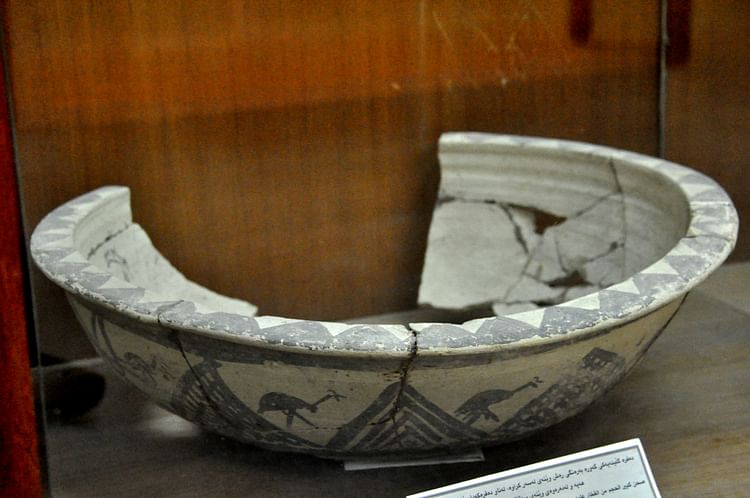 乌鲁克时期的陶制盘子 Osama Shukir Muhammed Amin (Copyright) ](https://www.worldhistory.org/image/2823/pottery-dish-from-uruk-period/ "Pottery Dish from Uruk Period")在窑中烧制陶器是另一种制作陶器的方法。将陶器置于一个密闭的容器内,会带来诸多优势:能够达到的温度更高、持续时间更长,而且热量的控制也更加高效。最简单的窑型是坑式窑,这是一种坑式火炉装置,燃料放置在底部,然后是陶器,再往上是更多的燃料。另一种窑型是上通风窑,通常是一个圆柱形结构,分为两个部分:下部是放置燃料的地方,而陶器则放在上部。这样可以使热量上升,陶器在通常为 1000 至 1200 摄氏度的温度下被烧制。
在中国古代,烧制技术使窑温能够达到约 1300 至 1400 摄氏度,甚至在某些情况下会更高。在这样的高温下,黏土中的矿物质会熔化,从而形成一种薄而透明、洁白的玻璃质陶瓷,即所谓的瓷器。并非所有类型的黏土都能承受如此高温——只有那些含杂质极少的特殊黏土才行。
在某些情况下,陶器的整体颜色可以从自然的红棕色转变为灰色,而无需使用颜料,仅仅通过在烧制过程中控制窑内的温度和空气流量就能实现。这类知识通常是漫长实验过程中的最后获取的,这表明该特定社会的陶器制作并非是全新的技艺,而且很可能已经发展了数千年之久。
[  莫切陶瓷肖像 Patrick Charpiat (CC BY) ](https://www.worldhistory.org/image/2938/moche-ceramic-portrait/ "Moche Ceramic Portrait")### 陶器与考古遗址的年代测定
根据陶器出土的环境,有几种方法可用于测定陶器的年代。陶器可以根据地层序列来测定年代:这意味着在挖掘过程中,考古学家会研究不同层次的土壤,并分析在其中发现的不同物品之间的相互关系。如果地层未受干扰,那么在下层发现的物品比上层发现的物品年代更久远。其中一些物品可以独立测定年代:放射性碳定年法可用于测定人类和动物遗骸甚至木炭的年代。例如,陶器碎片可能与一块木炭在同一层中被发现,通过测定木炭的放射性碳年代,可以推断出陶器碎片的大致年代,从而为陶器提供一个大致的年代。
如果发现的陶器碎片属于一种广为人知的陶器类型(比如中国或希腊陶器,这些陶器已被广泛研究),那么就可以依据所谓的类型学序列来确定年代。世界上大多数地区都有成熟的陶器类型学体系:器皿表面装饰风格的变化以及器皿形状的变化通常是渐进的,所以当陶器碎片能够与一种广为人知的陶器类型学相联系时,就为确定该器物的年代提供了依据。
[ 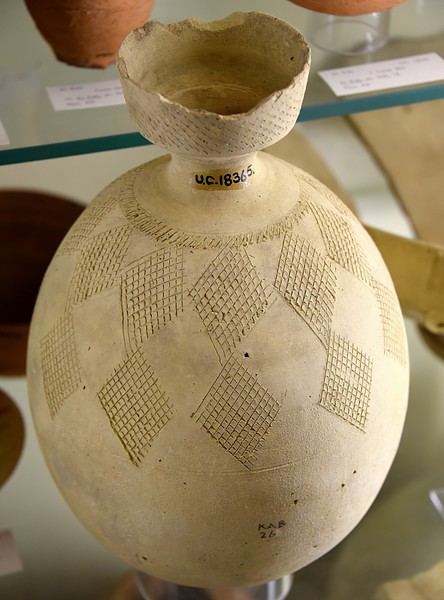 埃及巴拉陶器 Osama Shukir Muhammed Amin (Copyright) ](https://www.worldhistory.org/image/4765/egyptian-balla-pottery/ "Egyptian Balla Pottery")另一种可用于测定陶器年代的方法称为热释光法。这种测定方法适用于经过烧制并埋入地下的陶器及其他陶瓷材料。热释光法通常在没有其他方法可用时采用,主要是因为其应用存在限制,而且测定精度很少能优于样本年龄的正负10%。
陶器可用于测定考古遗址的年代。这在那些没有书面记录可提供年代参考的遗址中尤为重要,这些记录要么是因为无法找到,要么是因为它们尚未被破译。克里特岛(Crete)上的一个著名例子是,阿瑟·伊文斯(Arthur Evans )能够根据在那里发现的包括陶器在内的进口埃及文物来确定克诺索斯宫的挖掘年代,这使得研究人员能够将埃及的年代学延伸至克里特岛。这让我们想到陶器的另一个重要方面:它能提供贸易和交流网络的证据。在克里特岛的挖掘过程中,阿瑟·伊文斯还证明了克里特岛与埃及之间的贸易和文化联系,因为埃及文物在克里特岛被发现,同时克里特岛的陶器也在埃及被识别出来。
陶器可以通过以下几个特征来进行分析:形状、表面类型、颜色、图案以及装饰风格。对于每个特定的文化和时期,对这些元素进行详细研究,都有助于了解一个社会的艺术发展进程,并且还能让专家在远离其生产地的地方发现陶器碎片时,能够识别出这些碎片,从而反映出贸易活动和交流网络的情况。
#### Editorial Review
This human-authored definition has been reviewed by our editorial team before publication to ensure accuracy, reliability and adherence to academic standards in accordance with our [editorial policy](https://www.worldhistory.org/static/editorial-policy/).
## 参考文献
- [Henderson, J. *The Science and Archaeology of Materials.* Routledge, 2001.](https://www.worldhistory.org/books/0415199344/)
- [Renfrew, C. *Archaeology.* Thames & Hudson, 2012.](https://www.worldhistory.org/books/050028976X/)
- [Rice, P. *Pottery Analysis.* University Of Chicago Press, 2006.](https://www.worldhistory.org/books/0226711161/)
- [Timothy D. *Concise Oxford Dictionary of Archaeology.* Oxford University Press, 2008.](https://www.worldhistory.org/books/0199534047/)
- [Wright, R. *The Ancient Indus.* Cambridge University Press, 2009.](https://www.worldhistory.org/books/0521576520/)
## 关于作者
Cristian is a public speaker and independent author with a strong passion for the human past. Inspired by the rich lessons of history, Cristian's goal is to stimulate ideas and to spark the intellectual curiosity of his audience.
- [Facebook Profile](https://www.facebook.com/cviolatti)
- [X/Twitter Profile](https://twitter.com/@CristianViolatt)
- [Linkedin Profile](https://www.linkedin.com/in/cristian-violatti-48464458/)
## 时间轴
- **29000 BCE - 25000 BCE**: Gravettian figurines including the [Venus](https://www.worldhistory.org/venus/) of Dolní Věstonice.
- **16000 BCE**: Oldest [pottery](https://www.worldhistory.org/pottery/) vessels known found in [Japan](https://www.worldhistory.org/disambiguation/Japan/)
- **14000 BCE**: [Pottery](https://www.worldhistory.org/pottery/) production at the Amur River in modern-day Russia.
- **8000 BCE**: Ovens in use in the [Near East](https://www.worldhistory.org/Near_East/) are applied to [pottery](https://www.worldhistory.org/pottery/) production.
- **5500 BCE**: Oldest [faience](https://www.worldhistory.org/disambiguation/Faience/) workshop in [Egypt](https://www.worldhistory.org/egypt/) founded at Abydos.
- **c. 4000 BCE**: Creation at [Uruk](https://www.worldhistory.org/uruk/) of first mass-produced bowls.
- **c. 2000 BCE**: [Pottery](https://www.worldhistory.org/pottery/) wheel introduced to [Minoan civilization](https://www.worldhistory.org/Minoan_Civilization/) on [Crete](https://www.worldhistory.org/crete/).
- **c. 1000 BCE**: The first distinctive [Greek pottery](https://www.worldhistory.org/Greek_Pottery/) is produced, the Proto-geometric style.
- **c. 900 BCE**: The Geometric style of [Greek pottery](https://www.worldhistory.org/Greek_Pottery/) is first produced.
- **675 BCE - 626 BCE**: Fine [bucchero](https://www.worldhistory.org/Bucchero/) [pottery](https://www.worldhistory.org/pottery/) style in [Etruria](https://www.worldhistory.org/Etruscan_Civilization/).
- **c. 625 BCE**: [Black-figure pottery](https://www.worldhistory.org/Black_Figure_Pottery/) created in [Corinth](https://www.worldhistory.org/corinth/).
- **c. 625 BCE - 600 BCE**: The orientalizing style of [Greek pottery](https://www.worldhistory.org/Greek_Pottery/) becomes popular in [Corinth](https://www.worldhistory.org/corinth/).
- **625 BCE - 575 BCE**: Transitional [bucchero](https://www.worldhistory.org/Bucchero/) [pottery](https://www.worldhistory.org/pottery/) style in [Etruria](https://www.worldhistory.org/Etruscan_Civilization/).
- **c. 620 BCE - 600 BCE**: Proto-corinthian reaches its zenith in artistic quality producing the best [pottery](https://www.worldhistory.org/pottery/) in [Greece](https://www.worldhistory.org/greece/).
- **600 BCE - 480 BCE**: Attic [black-figure pottery](https://www.worldhistory.org/Black_Figure_Pottery/) dominates the [greek](https://www.worldhistory.org/disambiguation/greek/) ceramic market.
- **575 BCE - 480 BCE**: Heavy [bucchero](https://www.worldhistory.org/Bucchero/) [pottery](https://www.worldhistory.org/pottery/) style in [Etruria](https://www.worldhistory.org/Etruscan_Civilization/).
- **c. 570 BCE - c. 560 BCE**: The black-figure [Francois Vase](https://www.worldhistory.org/Francois_Vase/) is produced in Attica by Ergotimos (potter) and Kleitias (painter).
- **560 BCE - 520 BCE**: Chalkidian [black-figure pottery](https://www.worldhistory.org/Black_Figure_Pottery/) is produced in southern [Italy](https://www.worldhistory.org/italy/).
- **545 BCE - 530 BCE**: Exekias, perhaps the greatest [black-figure pottery](https://www.worldhistory.org/Black_Figure_Pottery/) painter is active.
- **530 BCE**: The Andokides Painter invents [red-figure pottery](https://www.worldhistory.org/Red-Figure_Pottery/).
- **c. 530 BCE**: [Red-figure pottery](https://www.worldhistory.org/Red-Figure_Pottery/) style takes precedent over black-figure.
- **320 BCE**: Last recorded examples of Attic [Red-Figure Pottery](https://www.worldhistory.org/Red-Figure_Pottery/).
- **c. 300 CE - c. 700 CE**: [Haniwa](https://www.worldhistory.org/Haniwa/) terracotta figurines are placed outside Japanese mound tombs or [kofun](https://www.worldhistory.org/Kofun/).
## 外部链接
- [The Levantine Ceramics Project](http://www.levantineceramics.org/)
- [History's most famous pot: the Meidias hydria | British Museum](https://www.britishmuseum.org/blog/historys-most-famous-pot-meidias-hydria)
## 引用本文
### APA
Violatti, C. (2025, May 14). 古代陶器. (Y. Li, 翻译). *World History Encyclopedia*.
### Chicago
Violatti, Cristian. "古代陶器." 翻译: Yangwei Li. *World History Encyclopedia*, May 14, 2025. .
### MLA
Violatti, Cristian. "古代陶器." 翻译: Yangwei Li. *World History Encyclopedia*, 14 May 2025, .
## 许可与版权
提交人: [Yangwei Li](https://www.worldhistory.org/user/yangweili/ "User Page: Yangwei Li"), 发表于 14 May 2025. 请查阅原始来源以获取版权信息。 请注意,从本页面链接的内容可能具有不同的许可条款。