---
title: 葡萄牙帝国
author: Mark Cartwright
translator: Jinfeng Zhang
source: https://www.worldhistory.org/trans/zh/1-19821/
format: machine-readable-alternate
license: Creative Commons Attribution-NonCommercial-ShareAlike (https://creativecommons.org/licenses/by-nc-sa/4.0/)
updated: 2024-04-22
---
# 葡萄牙帝国
_作者: [Mark Cartwright](https://www.worldhistory.org/user/markzcartwright/)_
_译者: [Jinfeng Zhang](https://www.worldhistory.org/user/jinfengzhang)_
[](https://www.worldhistory.org/trans/zh/1-22386/)[](https://www.worldhistory.org/trans/zh/2-2409/)葡萄牙帝国自15世纪建立,最终疆域从美洲延伸至日本。 这些殖民地往往是一连串具有防御工事的沿海贸易中心,还有巴西、安哥拉和莫桑比克等更大的殖民地。 [欧洲](https://www.worldhistory.org/trans/zh/1-35/)白人主导着贸易、政治和社会,但也存在着相当程度的种族融合。在许多地方,混血后裔在殖民地获得了财富和权力地位。
葡萄牙人建立帝国的初衷是为了寻找西非的黄金和建立东方的香料贸易。此外,葡萄牙人还希望亚洲的基督教国家能够成为盟友,支持基督教与伊斯兰哈里发国持续的斗争。建立帝国的其他动机还包括新的农业用地、殖民冒险家的财富和荣耀以及传教的使命。
卡拉克(Carrack)帆船建立了一个海上贸易通道,将里斯本与西部所有的殖民地和位于好望角以东的 葡属印度(Estado da India)连接起来。黄金、象牙、丝绸、明代瓷器和香料等商品被运往世界各地进行贸易。另一项主要贸易是奴隶贸易,这些奴隶来自西非和南部非洲,被用作北大西洋岛屿和美洲种植园的劳动力。
### 主要殖民地
葡萄牙帝国最重要的殖民地有:
- 马德拉(1420 年)
- 亚速尔群岛(1439 年)
- 佛得角(1462 年)
- 圣多美和普林西比(1486 年)
- 葡属科钦(1503 年)
- 葡属莫桑比克(1506 年)
- 葡属果阿(1510 年)
- 葡属马六甲(1511年)
- 葡属霍尔木兹(1515年)
- 葡属科伦坡(1518 年)
- 葡属巴西(1532 年)
- 葡属澳门(约 1557 年)
- 葡属长崎(约 1571 年)
- 葡属安哥拉(1571 年)
### 北大西洋群岛
葡萄牙人是无畏的航海家,他们的第一批殖民地是相对偏远的岛屿。为了寻找新的资源和土地,以解决葡萄牙小麦短缺的问题,航海家们驶向了未知的大西洋中部。葡萄牙航海家能够进行这些探险,要归功于像航海家亨利王子(又名Infante Dom Henrique,1394-1460 年)这样富有而强大的支持者。另一个不可估量的优势是创新的船舶设计和三角帆的使用。
[ 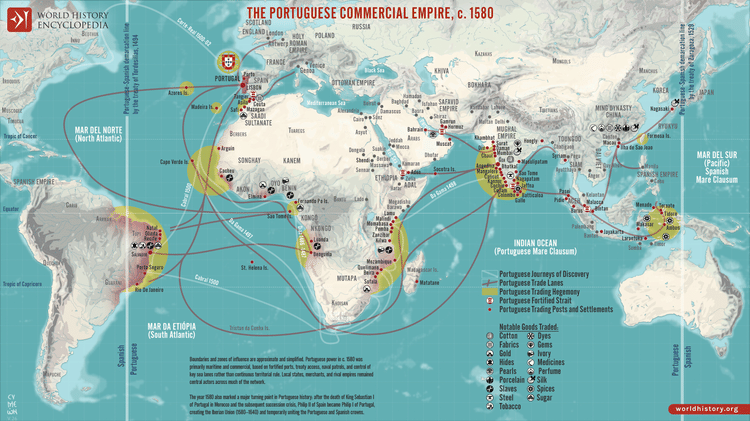 大航海時代的葡萄牙殖民帝国 Simeon Netchev (CC BY-NC-ND) ](https://www.worldhistory.org/image/14123/map-of-the-portuguese-colonial-empire/ "Map of the Portuguese Colonial Empire")第一批殖民的岛屿是火山岛和无人居住的马德拉群岛。这些岛屿拥有肥沃的火山土壤、温和的气候和充足的降雨量,可以用来种植小麦、葡萄和甘蔗。在许多方面,葡萄牙在马德拉岛的殖民为其他殖民地树立了学习的榜样。作为封建制度的一部分,葡萄牙王室将这些岛屿分割开来,并分封 "船长"(donatarias),旨在鼓励贵族资助农业和贸易发展。王室保留总体所有权,但每位船长(donatario)都享有一定的财政和司法特权,他们反过来又将自己的小块土地(semarias)分给追随者开发,追随者必须在一定年限内开垦并开始耕种。在许多情况下,这些船长职位成为世袭职位。定居者被美好生活的希望所吸引,但正如所有未来的殖民地一样,也有其他不那么受欢迎的移民。这些人是葡萄牙当局不受欢迎的人(degregados),他们被强行运往殖民地,如罪犯、乞丐、妓女、孤儿、犹太人和宗教异见者。
马德拉成为殖民模式的另一种方式是自 1455 年起建立的甘蔗种植园。这种作物的成功及其所需的大量劳动力需要从西非进口奴隶来种植甘蔗。奴隶工作的种植园系统成为新大陆经济的重要组成部分,导致了残酷的大西洋奴隶贸易。
继马德拉群岛之后,葡萄牙人又以同样的模式殖民了亚速尔群岛和佛得角群岛。这些殖民地都成为从印度和美洲驶来的船只的重要停靠港。葡萄牙人在这些殖民地上并非没有竞争对手。葡萄牙和西班牙为争夺加那利(Canary)群岛的所有权发生了争执,但 1479-80 年的《阿尔卡索瓦斯-托雷多条约》(Treaty of Alcáçovas-Toledo)和 1494 年的《托尔德西利亚斯条约》(Treaty of Tordesillas)规定了两国的势力范围,大胆地提出了涵盖全球的利益范围。虽然协议的模糊性在后来造成了一些麻烦,比如葡萄牙未来在非洲的权利,西班牙对加那利群岛以外岛屿的权利,但最终确定了两国在加勒比海甚至美洲的利益范围。
[ 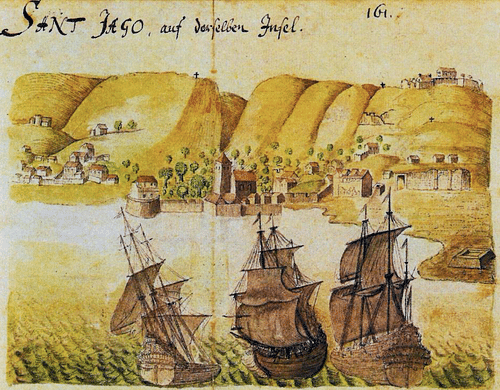 圣地亚哥大里贝拉县,佛得角 Caspar Schmalkalden (Public Domain) ](https://www.worldhistory.org/image/14108/ribeira-grande-santiago-cape-verde/ "Ribeira Grande, Santiago, Cape Verde")北大西洋群岛允许葡萄牙王室直接获取西非的黄金,避开了北非的伊斯兰国家。博哈多尔角(Cape Bojador)曾是一个重要的障碍,它似乎阻挡了帆船南下然后返回欧洲。大西洋岛屿和远离非洲海岸线的大胆航线设计提供了最佳利用风、洋流和高压区的解决方案。葡萄牙航海家现在可以放心地向南航行,最终的结果是向欧洲船队打开了亚洲。
### 西非与奴隶制
葡萄牙人热衷于西非的黄金和食盐贸易,他们沿着南部海岸(今加纳)建立了几个坚固的贸易定居点,如 1482 年的埃尔米纳(Elmina)。然而,热带疾病、人力不足以及当地统治者不愿允许出口男性奴隶意味着这里的利润是有限的。非洲酋长热衷于用火器交易,但葡萄牙人不愿意。他们在西非南海岸无人居住的圣多美和普林西比岛上实施了更为成功的战略,这两个岛屿从 1486 年开始成为殖民地,大量参与奴隶贸易。与北大西洋一样,在这里也采用了船长发展模式。
岛上的定居者获准与西非大陆进行贸易,事实证明这比几十年前的尝试更加成功。葡萄牙人在非洲大陆建立了贸易定居点,最南至罗安达(今安哥拉境内),利用组织严密的非洲贸易网络,将货物从内陆沿主要河流(如冈比亚和塞内加尔)运往海岸。这些货物包括黄金、象牙、胡椒、蜂蜡、树胶和染料。奴隶(包括男人和女人)是从刚果王国和贝宁王国购买的,这两个王国的统治者渴望得到欧洲的贸易商品,如棉布、镜子、刀具和玻璃珠。这些岛屿既是奴隶的聚集地,也是为运载货物的船只提供补给的地方。每五名奴隶中就有一人死在船上,每两名奴隶中就有一人从最初被抓到抵达最终目的地期间死亡。大西洋奴隶贸易于 19 世纪中叶结束,但即使在那之后,奴隶仍继续被贩卖至圣多美和普林西比,直到 1908 年被禁止。随后,非洲劳工取代了奴隶,他们在一定年限后必须被遣返,生活条件与之前奴隶的遭遇几乎没有区别。
[ 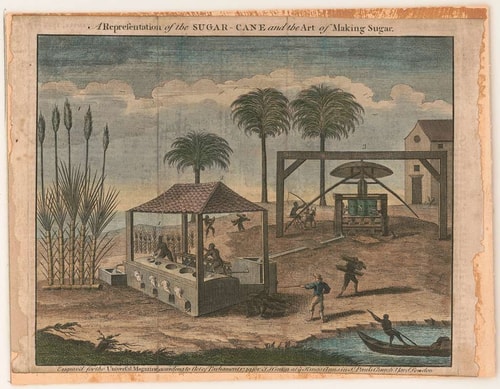 殖民地生产甘蔗 Unknown Artist (Public Domain) ](https://www.worldhistory.org/image/14118/colonial-sugar-cane-manufacturing/ "Colonial Sugar Cane Manufacturing")在西非,当时欧洲人几乎没有尝试过征服领土,因为贸易繁荣,且不具备执行这种政策的军事力量。一些定居点修建了防御工事,但这通常要征得当地非洲部落酋长的同意。欧洲人和非洲人在佛得角等岛屿上通婚,创造了一种非洲-葡萄牙文化,这种文化受到强烈的非洲宗教和艺术影响。正是这些自由的佛得角混血儿(黑白混血儿)在非洲海岸的贸易据点定居下来。
当时曾有过绕过非洲酋长直接从内陆地区掠取奴隶的举动,但这一政策恶化了与刚果的关系。随着传统文化和部落忠诚的瓦解,对基督教传教士的反抗使局势进一步恶化。欧洲人不得不沿着海岸线进一步向恩东戈(Ndongo)地区迁移,他们的到来导致该地区发生了一系列战争,很快成为葡属安哥拉。
### 东非
1498 年,探险家瓦斯科. 达. 伽马(Vasco da Gama,约 1469-1524 年)绕过好望角,驶入印度洋,葡萄牙人突然进入了一个全新的贸易网络,其中包括非洲人、印度人和阿拉伯人。这种贸易已经持续了几个世纪,但当葡萄牙人到来时,贸易变成了暴力。葡萄牙人使用先进的船只和大炮,将对手的船只轰出水面,船员被逮捕或杀害,货物被没收。事实上,大多数商人都是穆斯林,这对充满了十字军精神的欧洲人来说更是增加了用暴力赢得贸易的动力。
葡萄牙人对斯瓦希里(Swahili)海岸独立贸易城市和南部(津巴布韦/赞比亚)内陆穆塔帕(Mutapa)王国的进攻并没有带来任何实际利益,因为商人们只是向北迁移或避开这些城市。当葡萄牙人占领并加固了马林迪(Malindi)、蒙巴萨(Mombasa)、奔巴(Pemba)、索法拉(Sofala)和基尔瓦(Kilwa)等地时,他们发现自己已经失去了这些城邦的贸易伙伴。这时,波斯湾的阿曼阿拉伯人来了。阿曼人渴望保住他们的红海贸易路线,重建古老的贸易网络。他们进入斯瓦希里海岸,占领了许多城市,包括 1698 年的葡属蒙巴萨。在东非的不成功最终驱使葡萄牙人南下莫桑比克,但他们此时已经完全被世界上新发现地区的潜力所吸引: 那就是印度。
[  传统单桅帆船 Alessandro Capurso (CC BY-NC-ND) ](https://www.worldhistory.org/image/10328/traditional-dhow-sailing-vessel/ "Traditional Dhow Sailing Vessel")### 印度和香料
瓦斯科. 达. 伽马的首要目标之一是找到一条通往亚洲的海上航线,以便葡萄牙能够直接进入利润丰厚的香料贸易市场。在从英国到中国的市场上,胡椒、生姜、丁香、肉豆蔻和肉桂等香料都价格不菲。当他们到达印度马拉巴尔(Malabar)海岸时,水手们发现这里确实贸易繁荣。更多的葡萄牙探险队接踵而至,但卡利卡特城(Calicut,现称科泽科德)并不友好,它的主要竞争对手科钦(Cochin)看起来更有希望。葡萄牙人与科钦当地统治者达成了协议,于1503年建造了一座要塞,并在此安家落户,做起了大生意。不幸的是,他们遇到了一个大问题:很少有人对欧洲商品感兴趣。因此,他们采取了与在斯瓦希里海岸相同的策略。利用先进的船只和大炮,以武力占领了印度洋贸易网络,建立了香料贸易垄断地位。其他沿海城市也被占领或建立起来,1530 年果阿取代科钦成为葡属印度的首府。
葡萄牙印度总督就居住在果阿,他是权力金字塔的顶端,建立权力金字塔的主要目的是控制贸易。总督是葡属印度的文职和军事长官,只对葡萄牙国王负责。在里斯本,"超级顾问团"(Conselho ultramarino)就海外殖民地的事务向君主提供建议,而 "印度之家"(Casa da India)则是王室机构,负责监督与亚洲的所有交流和贸易。
在果阿和大多数其他殖民地,都有一个理事会( câmara),负责决定税收等地方事务。宗教事务由大主教或主教领导,所有主要的修会,尤其是耶稣会,都建立了教堂、修道院、修女院和医院。Misericórdia 兄弟会的分支机构为穷人提供基本的社会福利服务。法律事务由果阿的高等法院和各殖民地的地方法院负责。一名船长领导当地的军事力量,通常驻扎在堡垒中,一名代表负责皇家贸易,并从其他类型的贸易中收取利润丰厚的关税。这是大多数殖民地采用的殖民模式。
[  圣卡特琳娜大教堂,果阿 Ondřej Žváček (CC BY-SA) ](https://www.worldhistory.org/image/14226/cathedral-of-santa-caterina-goa/ "Cathedral of Santa Caterina, Goa")葡萄牙人在亚洲和欧洲之间以及亚洲内部都积极尝试建立香料贸易的垄断地位。海洋不再是自由的。没有许可证的商人会被逮捕或处决,他们的货物也会被没收。某些港口受到限制,船只必须携带葡萄牙签发的护照(cartaz),而且通常必须乘坐葡萄牙保护的船队(cafilas)。港口要征收关税,这些关税约占葡萄牙在东方全部收入的 60%。然而,许多商人对欧洲人避之唯恐不及,一些城市还进行了武装抵抗,而且葡萄牙帝国太大,人力不够,根本无法管理亚洲范围内的贸易,哪怕是一小部分。这些现实的考虑促使葡萄牙人在帝国发展成熟后放松了对贸易垄断的狂热。
### 远东
葡萄牙控制贸易的另一个策略是寻找珍贵香料的原产地。许多香料来自印度尼西亚的香料群岛(马鲁古群岛或摩鹿加群岛)。这些岛屿上的大部分香料被运往马来半岛西南海岸的马六甲(Malacca),马六甲控制着从印度洋通往南中国海的马六甲海峡。由阿丰索. 德. 阿尔布克尔克 (Afonso de Albuquerque,1453-1515 年)率领的葡萄牙舰队于 1511 年占领了马六甲,从 1512 年起,他们从帝汶岛的非正式定居点收购檀香。
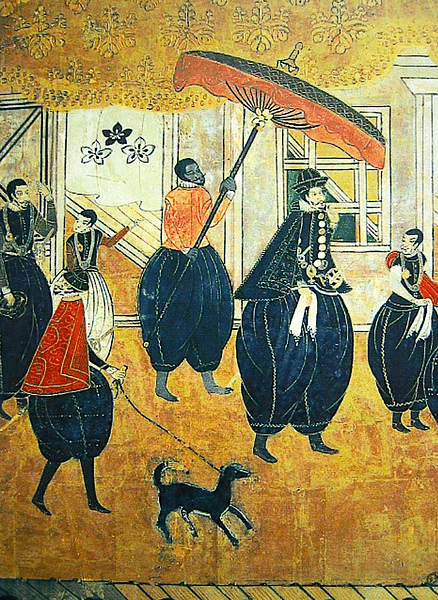
葡萄牙人渴望进入利润丰厚的中国丝绸市场,因此在中国南部珠江三角洲靠近广州的一个半岛上建立了葡属澳门。同样,约 1571 年,葡萄牙人在日本九州岛西北海岸建立了殖民地长崎,从而获得了该国的贸易货物,其中最重要的是白银。葡萄牙船只满载贸易货物,定期往返于里斯本、果阿、马六甲、澳门和其最东面的殖民地长崎之间。1639 年,日本政府实施永久孤立政策,将所有外国人驱逐出本土,并反对基督教的传播,因此葡萄牙人不得不被放弃长崎。
[  日本画家笔下的葡萄牙商人 Unknown Artist (Public Domain) ](https://www.worldhistory.org/image/14353/portuguese-traders-by-japanese-painters/ "Portuguese Traders by Japanese Painters")### 巴西
巴西于 1500 年被葡萄牙人 "发现",并成为葡萄牙人所有殖民地中最重要的一个。巴西拥有丰富的自然资源,如硬木、钻石和黄金(产自米纳斯吉拉斯地区)。1532 年,圣维森特(São Vicente)成为葡萄牙人的第一个定居点。1549 年,葡萄牙任命第一任巴西总督,巴西成为官方殖民地,首都设在巴伊亚州的萨尔瓦多(1763 年被里约热内卢取代)。
与其他任何地方相比,巴西更大规模地引入了由美洲印第安人和非洲奴隶组成的殖民地种植园模式,巴西成为世界上主要的蔗糖和烟草生产国。仅在 17 世纪第一季度,就有 15 万非洲奴隶跨越大西洋来到南美洲。1853 年,独立的巴西废除了奴隶制度,结束了跨大西洋奴隶贸易。
除奴隶外,殖民化的另一个牺牲品是图皮-瓜拉尼(Tupi-Guarani)美洲印第安人,他们的村庄和文化遭到系统性的破坏,剩下的人被迫逃到雨林深处。直到 1755 年,美洲印第安人才被承认为葡萄牙王室完全、自由的臣民。
与其他地方一样,巴西的殖民社会也是多层次的。欧洲人的地位最高,他们通常通过奢华的服饰、仆人、奴隶和武装人员的数量来显示自己的社会地位。欧洲人分为三个等级: 欧洲人、在殖民地出生的欧洲人和混血欧洲人(殖民地的欧洲女性很少)。在此基础上,又根据贵族、教士、军队和所有其他人(又分为已婚和未婚)的成员身份分为四层。此外,还有来访的欧洲人,如海上贸易商和来自更广泛地区的当地商人。此外还有当地居民,他们在任何殖民地中都占大多数,他们可能因自身的社会等级和皈依基督教等因素而被区分开来。殖民地社会的最底层是奴隶。
[  巴西女奴 Carlos Julião (Public Domain) ](https://www.worldhistory.org/image/14378/slave-women-brazil/ "Slave Women, Brazil")### 南部非洲
安哥拉地区自 1571 年起成为葡萄牙的殖民地,成为欧洲在非洲的第一个领土殖民地(而非单纯的城邦或沿海定居点)。恩东戈王国(成立于约 1500 年)在灭亡之前,曾被当作盟友来对付北方的刚果。欧洲人拥有火器的优势,葡萄牙开始了第一次领土征服。这是一个不祥的序幕,预示着未来几个世纪在非洲各地将要发生的事情。
葡萄牙定居者与安哥拉地区的当地人混血,形成了一个被称为卢索非洲人(Luso-Africans)的混血种族。这些定居者及其后裔以罗安达(Luanda)和其他几个沿海定居点为基地,努力争夺对安哥拉内陆地区的控制权,在那里,新的马坦巴(Matamba)王国正在崛起。随后一个世纪的战斗被称为 "安哥拉战争"。事实证明,安哥拉殖民地让葡萄牙感到失望。广为人知的内陆银矿被证明只是一个传说,资源有限,传播基督教的希望被证明过于高估。一些私人定居者和商人获得了利益,正是他们确保了殖民地主要贸易(奴隶贸易)的持续发展。到16世纪末,安哥拉每年贩卖近1万名奴隶,从罗安达直接运往巴西和美洲其他地方。欧洲人带来的天花和其他疾病已经让安哥拉社会元气大伤,而奴隶贸易则给安哥拉带来了毁灭性的打击。
在南部非洲的另一端,葡萄牙人建立了另一个大型殖民地: 莫桑比克(19 世纪更名为葡属东非)。第一批葡萄牙定居者于 1506 年抵达莫桑比克岛,设立了一个船长职位。莫桑比克并不像人们希望的那样盛产黄金,但有象牙和奴隶。从 1571 年起,莫桑比克成为葡属印度的 一部分(1752 年脱离),作为被称为 "carreira da India"航线的一部分,利用克拉克帆船直接与果阿进行贸易。在内陆地区,形成了一种称为普拉索(prazo)的制度,非洲酋长将土地、贸易和进贡权交给葡萄牙人和非裔葡萄牙人,这种任命当时得到葡萄牙王室的正式承认。作为回报,被任命者穆宗戈(muzungo)必须确保在其领地内执行司法,监督传统仪式,并批准其管辖范围内较小村庄的酋长。为了维护自己的地位,穆宗戈拥有一支由家臣(chicunda)组成的私人军队,人数可达数千非洲人。到 1637 年,至少有 80个普拉索,他们大多独立于首都马普托(Maputo)软弱的葡萄牙管理机构。
[ 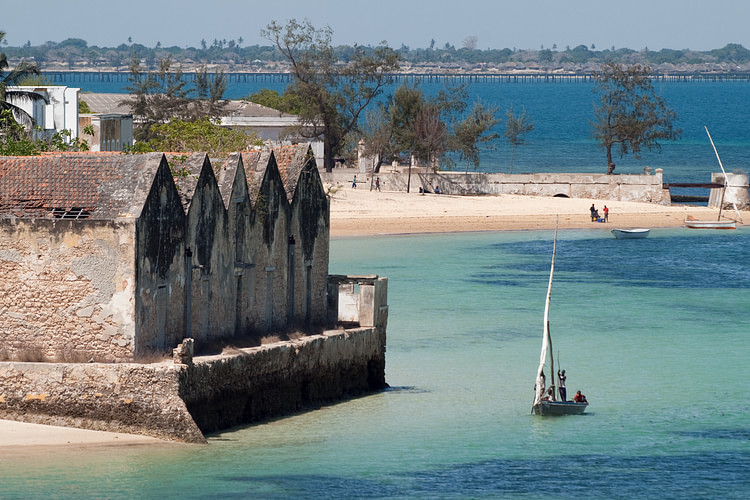 莫桑比克岛 Stig Nygaard (CC BY) ](https://www.worldhistory.org/image/8906/island-of-mozambique/ "Island of Mozambique")葡萄牙王室随后将殖民地留给莫桑比克公司和尼亚萨公司等私营公司开发。由于缺乏中央行政机构,再加上英国人在南部非洲取得的成功,将安哥拉和莫桑比克这两个非洲殖民地连接起来的梦想也破灭了。
### 衰落、去殖民化与遗产
除了来自当地统治者无时不在的威胁,葡萄牙人还面临着来自其他欧洲海洋强国的激烈竞争,这些强国很快就开始妒忌他们的帝国。尤其是葡萄牙的堡垒缺乏维护,各个沿海城市普遍与世隔绝,没有当地居民的支持和帮助。英国和法国的私掠船最喜欢在公海上袭击葡萄牙商船。具有讽刺意味的是,葡萄牙探险家费迪南德.麦哲伦(Ferdinand Magellan,约 1480-1521 年)是另一个主要威胁,他在 1519-22 年期间为西班牙服务,环绕南美洲南端航行,开辟了一条横跨太平洋并通往东亚的海上航线。探险队最终完成了环球航行,关键是获取了香料贸易。其他欧洲国家紧随麦哲伦之后,葡萄牙人突然对垄断东方贸易不再抱有任何希望。
对葡萄牙领土最成功和最广泛的威胁来自荷兰人,他们在 17 世纪头十年进攻了莫桑比克,1622 年和 1626 年进攻了澳门,1641 年进攻了安哥拉。16 世纪 20 年代和 30 年代,荷兰人进攻并占领了巴西北部的部分地区。 1641 年占领了马六甲,1656 年占领了科伦坡,1663 年占领了科钦。英国是另一个日益增长的威胁,他们在 1622 年帮助阿拉伯人夺回了霍尔木兹。
18 世纪,巴西的葡萄牙人不得不给予英国、法国和荷兰等海上强国非常有利的贸易权。英国人在 1799 至 1815 年间占领了果阿。其他威胁来自内部。巴西人民希望所有公民享有平等权利,他们于 1822 年实现了独立,宣布佩德罗一世(1822-1831 年在位)为国王,使他成为巴西的第一位皇帝。佩德罗是葡萄牙若昂六世(1816-1826 年在位)的儿子,此后两国保持着密切的关系。
[  圣弗朗西斯科教堂,旧城 Nice Marinho (CC BY-SA) ](https://www.worldhistory.org/image/14109/sao-francisco-church-cidade-velha/ "São Francisco Church, Cidade Velha")到 20 世纪,葡萄牙因竞争对手或内部战争丧失了许多殖民地。在保留下来的殖民地中,马德拉和亚速尔群岛成为葡萄牙的自治区,果阿在 1962 年成为印度的一部分。葡萄牙政府当时是安东尼奥.德奥利维拉.萨拉查(António de Oliveira Salazar ,1932-1968 年在位)领导下的军事独裁政府,他拒绝承认非洲独立运动,因此安哥拉和莫桑比克都发生了血腥战争。1975 年,佛得角群岛、圣多美和普林西比、东帝汶、安哥拉和莫桑比克都从葡萄牙获得独立,澳门于 1999 年回归中国。
葡萄牙帝国给殖民地人民带来了许多灾难:奴隶、战争、贸易中断、传统文化终结、森林砍伐和疾病等等,其他后果还包括葡萄牙语和天主教在当今世界许多地方继续盛行。葡萄牙人还对直接推动了动植物在世界各地的传播,有时会对当地生态系统造成灾难性影响,但也取得了显著的成功,如将木薯、玉米和甘蔗等移植到全新的地方,成为当地常见的作物。最后,葡萄牙人是第一个横跨几大洲建立真正意义上全球帝国的人,尽管这个帝国相当不稳固和不连贯,但他们留给后人的最大遗产或许是这样一个不幸的事实:其他欧洲列强自此意识到帝国主义的可能性,于是开始在更大程度上剥削世界各地的人民,殖民主义变得不仅仅是控制贸易,而是控制领土、资源和人口。
#### Editorial Review
This human-authored definition has been reviewed by our editorial team before publication to ensure accuracy, reliability and adherence to academic standards in accordance with our [editorial policy](https://www.worldhistory.org/static/editorial-policy/).
## 参考文献
- [Bergreen, Laurence. *Over the Edge of the World.* William Morrow Paperbacks, 2019.](https://www.worldhistory.org/books/0062890484/)
- [Cliff, Nigel. *The Last Crusade.* Harper Perennial, 2012.](https://www.worldhistory.org/books/0061735132/)
- [Dillon, Michael. *China.* I.B. Tauris, 2021.](https://www.worldhistory.org/books/0755601858/)
- [Disney, A. R. *A History of Portugal and the Portuguese Empire, Vol. 1.* Cambridge University Press, 2009.](https://www.worldhistory.org/books/0521603978/)
- [Disney, A. R. *A History of Portugal and the Portuguese Empire, Vol. 2.* Cambridge University Press, 2009.](https://www.worldhistory.org/books/0521738229/)
- [El Fasi, M. *UNESCO General History of Africa, Vol. III, Abridged Edition.* University of California Press, 1992.](https://www.worldhistory.org/books/0520066987/)
- [Henshall, Kenneth. *Historical Dictionary of Japan to 1945 .* Scarecrow Press, 2013.](https://www.worldhistory.org/books/0810878712/)
- [Huffman, James L. *Japan in World History .* Oxford University Press, 2010.](https://www.worldhistory.org/books/0195368096/)
- [Ki-Zerbo, Joseph . *UNESCO General History of Africa, Vol. IV, Abridged Edition.* University of California Press; Abridged edition (1998-05-10), 2021.](https://www.worldhistory.org/books/B017WQ7W28/)
- [Mason, R. H. P. & Caiger, J. G. *A History of Japan.* Tuttle Publishing, 1997.](https://www.worldhistory.org/books/080482097X/)
- [Newitt, Malyn. *The Portuguese in West Africa, 1415–1670.* Cambridge University Press, 2010.](https://www.worldhistory.org/books/0521768942/)
- [Ogot, B. A. *UNESCO General History of Africa, Vol. V, Abridged Edition.* University of California Press, 1999.](https://www.worldhistory.org/books/0520067002/)
- [Oliver, R. A. *Cambridge Encyclopedia of Africa .* Cambridge University Press, 1981.](https://www.worldhistory.org/books/0521230969/)
- [Oliver, Roland. *The Cambridge History of Africa, Vol. 3.* Cambridge University Press, 2001.](https://www.worldhistory.org/books/0521209811/)
- [Pearson. *New Cambridge History of India .* Cambridge UP, Paperback(2006), 2021.](https://www.worldhistory.org/books/B008CMA22E/)
- [Russell-Wood, A. J.R. *The Portuguese Empire, 1415-1808.* JHUP, 1998.](https://www.worldhistory.org/books/0801859557/)
- [Subrahmanyam, Sanjay. *The Career and Legend of Vasco da Gama.* Cambridge University Press, 1998.](https://www.worldhistory.org/books/0521646294/)
## 关于作者
马克是一位全职作家、研究人员、历史学家与编辑,他对艺术、建筑,以及研究所有文明共有的思想尤为感兴趣。马克拥有政治哲学硕士学位,目前担任WHE出版总监一职。
## 时间轴
- **1420 CE**: The Portuguese colonize the Madeira archipelago.
- **1439 CE**: The Portuguese colonize the Azores archipelago.
- **1462 CE**: The Portuguese colonize the Cape Verde archipelago.
- **1486 CE**: The Portuguese colonize the islands of São Tomé and Principe.
- **7 Jun 1494 CE**: Portugal and Spain sign the [Treaty of Tordesillas](https://www.worldhistory.org/Treaty_of_Tordesillas/) which divides the world into two spheres of influence.
- **8 Jul 1497 CE - Aug 1499 CE**: The Portuguese explorer [Vasco da Gama](https://www.worldhistory.org/Vasco_da_Gama/) sails around the Cape of Good Hope and on to [India](https://www.worldhistory.org/india/) and back.
- **24 Apr 1498 CE - 18 May 1498 CE**: [Vasco da Gama](https://www.worldhistory.org/Vasco_da_Gama/) crosses the Indian Ocean for the first time by sailing from Malindi to Calicut, [India](https://www.worldhistory.org/india/).
- **1500 CE**: The Portuguese mariner Pedro Álvares Cabral lands in Brazil.
- **1502 CE**: The Portuguese establish the first trading station (feitoria) in Brazil north of Rio de Janeiro.
- **1502 CE - 1503 CE**: [Vasco da Gama](https://www.worldhistory.org/Vasco_da_Gama/) sails a 15-ship fleet from Portugal to Calicut, [India](https://www.worldhistory.org/india/).
- **1503 CE**: The Portuguese colonize Cochin in western [India](https://www.worldhistory.org/india/).
- **1505 CE**: The Portuguese begin to attack [cities](https://www.worldhistory.org/city/) and build forts along the [Swahili Coast](https://www.worldhistory.org/Swahili_Coast/) in order to control [trade](https://www.worldhistory.org/disambiguation/trade/).
- **1505 CE - 1961 CE**: The [Estado da India](https://www.worldhistory.org/Estado_da_India/) is in existence, that part of the [Portuguese Empire](https://www.worldhistory.org/Portuguese_Empire/) from East [Africa](https://www.worldhistory.org/disambiguation/africa/) to [Japan](https://www.worldhistory.org/disambiguation/Japan/).
- **1506 CE**: The Portuguese coloinze Mozambique Island.
- **1510 CE**: Afonso de Albuquerque conquers Goa in [India](https://www.worldhistory.org/india/) for Portugal.
- **1510 CE - 1961 CE**: Goa on the west coast of [india](https://www.worldhistory.org/india/) is a Portuguese colony.
- **1511 CE**: Afonso de Albuquerque captures Malacca in Malaysia for Portugal.
- **1511 CE - 1641 CE**: Malacca in Malaysia is a Portuguese colony.
- **1515 CE**: Hormuz at the mouth of the Persian Gulf is colonized by the Portuguese.
- **1518 CE**: The Portuguese establish a fort at Colombo, Sri Lanka.
- **1519 CE**: The Portuguese establish a fort at Kollam in [India](https://www.worldhistory.org/india/).
- **1519 CE - 1522 CE**: [Ferdinand Magellan](https://www.worldhistory.org/Ferdinand_Magellan/)'s expedition circumnavigates the globe for the first time.
- **1521 CE**: The Portuguese establish a fort at Chaul in [India](https://www.worldhistory.org/india/).
- **Apr 1524 CE**: [Vasco da Gama](https://www.worldhistory.org/Vasco_da_Gama/) sails om his third voyage from Portugal to [India](https://www.worldhistory.org/india/).
- **1530 CE**: [Portuguese Goa](https://www.worldhistory.org/Portuguese_Goa/) replaces Cochin as the capital of the [Estado da India](https://www.worldhistory.org/Estado_da_India/).
- **1532 CE**: The first Portuguese settlement in Brazil is founded at São Vicente.
- **1533 CE**: A papal bull establishes the archdiocese of the [Estado da India](https://www.worldhistory.org/Estado_da_India/).
- **1533 CE - 1539 CE**: The first sugar plantations are established in [Portuguese Brazil](https://www.worldhistory.org/Portuguese_Brazil/) at Pernambuco, Sâo Vicente and Rio.
- **1543 CE**: Three Portuguese mariners accidentally land in [Japan](https://www.worldhistory.org/disambiguation/Japan/), the first Europeans to do so.
- **1546 CE**: The Portuguese establish a formidable fortress on Mozambique Island.
- **1549 CE**: Brazil is made a Crown colony of the [Portuguese empire](https://www.worldhistory.org/Portuguese_Empire/).
- **1560 CE**: [Portuguese Goa](https://www.worldhistory.org/Portuguese_Goa/) has it first archbishop appointed.
- **1567 CE**: The French colony of France Antarctique in Guanabara Bay, Brazil is taken over by the Portuguese.
- **c. 1571 CE**: The Japanese daimyo Omura Sumitada grants the Portuguese control of Nagasaki.
- **1571 CE**: Foundation of the colony of [Portuguese Angola](https://www.worldhistory.org/Portuguese_Angola/).
- **1571 CE - 1639 CE**: The Portuguese control the port of Nagasaki in [Japan](https://www.worldhistory.org/disambiguation/Japan/).
- **1572 CE**: The Portuguese Crown establishes a viceroy in [Portuguese Brazil](https://www.worldhistory.org/Portuguese_Brazil/).
- **1575 CE**: The Crown appoints a governor of [Portuguese Angola](https://www.worldhistory.org/Portuguese_Angola/).
- **1576 CE**: Luanda on the coast of [Portuguese Angola](https://www.worldhistory.org/Portuguese_Angola/) is founded. It will be the capital and a major hub of the Atlantic slave [trade](https://www.worldhistory.org/disambiguation/trade/).
- **1596 CE**: The Dutch arrive in Southeast Asia and challenge the Portuguese and their [empire](https://www.worldhistory.org/empire/).
- **1603 CE**: Dutch forces attack [Portuguese Goa](https://www.worldhistory.org/Portuguese_Goa/).
- **1604 CE**: A Council of State is established at [Portuguese Goa](https://www.worldhistory.org/Portuguese_Goa/).
- **1610 CE**: Dutch forces once again attack [Portuguese Goa](https://www.worldhistory.org/Portuguese_Goa/).
- **1616 CE**: The Dutch attack [Portuguese Malacca](https://www.worldhistory.org/Portuguese_Malacca/) for the first time.
- **1621 CE**: The Portuguese, with help from the Jaga, force the king of Ndongo to flee his kingdom in [Portuguese Angola](https://www.worldhistory.org/Portuguese_Angola/).
- **1622 CE**: The Persians, with English assistance, take control of Hormuz from the Portuguese.
- **1624 CE**: The Dutch capture Salvador in [Portuguese Brazil](https://www.worldhistory.org/Portuguese_Brazil/).
- **1629 CE**: The Dutch attack [Portuguese Malacca](https://www.worldhistory.org/Portuguese_Malacca/) for a second time.
- **1630 CE**: The Dutch capture Olinda and Recife in [Portuguese Brazil](https://www.worldhistory.org/Portuguese_Brazil/).
- **1632 CE**: The Dutch capture Pernambuco in [Portuguese Brazil](https://www.worldhistory.org/Portuguese_Brazil/).
- **c. 1633 CE**: The Portuguese [conquer](https://www.worldhistory.org/warfare/) the southern African kingdom of [Mutapa](https://www.worldhistory.org/Mutapa/).
- **Dec 1637 CE - Apr 1638 CE**: The [Shimabara Rebellion](https://www.worldhistory.org/Shimabara_Rebellion/) in [Japan](https://www.worldhistory.org/disambiguation/Japan/), which the shogunate blames on Christians, leading to an expulsion of all Europeans.
- **1638 CE - 1644 CE**: Dutch forces attempt to blockade [Portuguese Goa](https://www.worldhistory.org/Portuguese_Goa/).
- **1640 CE - 1668 CE**: Spain is at [war](https://www.worldhistory.org/disambiguation/War/) with Portugal.
- **1641 CE**: The Dutch attack and take over [Portuguese Malacca](https://www.worldhistory.org/Portuguese_Malacca/).
- **1641 CE**: A Dutch force takes over Luanda, capital of [Portuguese Angola](https://www.worldhistory.org/Portuguese_Angola/).
- **1648 CE**: A military froce from [Portuguese Brazil](https://www.worldhistory.org/Portuguese_Brazil/) recaptures Luanda, the capital of [Portuguese Angola](https://www.worldhistory.org/Portuguese_Angola/), from Dutch control.
- **1654 CE**: [Portuguese Brazil](https://www.worldhistory.org/Portuguese_Brazil/) regains control of those parts of the colony taken over by the Dutch.
- **1656 CE**: The Dutch attack and take over Portuguese Colombo.
- **1656 CE - 1663 CE**: Dutch forces attempt to blockade [Portuguese Goa](https://www.worldhistory.org/Portuguese_Goa/) for a second time. The blockade ends with a peace treaty.
- **1663 CE**: The Dutch attack and take over [Portuguese Cochin](https://www.worldhistory.org/Portuguese_Cochin/).
- **1663 CE**: A peace treaty is agreed between Portugal and the Netherlands regarding [Portuguese Brazil](https://www.worldhistory.org/Portuguese_Brazil/).
- **1665 CE**: An alliance of Angolan tribes and the Portuguese defeat the [Kingdom of Kongo](https://www.worldhistory.org/Kingdom_of_Kongo/) at the [Battle](https://www.worldhistory.org/disambiguation/battle/) of Mbwila.
- **1670 CE**: A Portuguese force is defeated by the [Kingdom of Kongo](https://www.worldhistory.org/Kingdom_of_Kongo/) at Soyo.
- **1676 CE**: The first bishop is appointed at Luanda, capital of [Portuguese Angola](https://www.worldhistory.org/Portuguese_Angola/).
- **1683 CE**: A peace treaty is agreed between the Portuguese and the Matamba kingdom in [Portuguese Angola](https://www.worldhistory.org/Portuguese_Angola/). This ends the Angolan Wars.
- **1711 CE**: French forces briefly take over Rio de Janeiro in [Portuguese Brazil](https://www.worldhistory.org/Portuguese_Brazil/).
- **1755 CE**: Amerindians in [Portuguese Brazil](https://www.worldhistory.org/Portuguese_Brazil/) are recognised as full and free subjects of the Portuguese Crown.
- **1763 CE**: Rio de Janeiro is made sole capital of [Portuguese Brazil](https://www.worldhistory.org/Portuguese_Brazil/).
- **1799 CE - 1815 CE**: [Portuguese Goa](https://www.worldhistory.org/Portuguese_Goa/) is occupied by the British during the Napoleonic Wars.
- **1808 CE**: Fearing for its safety, the Portuguese monarchy relocates to [Portuguese Brazil](https://www.worldhistory.org/Portuguese_Brazil/).
- **1822 CE**: Brazil declares independence form Portugal.
- **1853 CE**: Brazil porhibits the importation of slaves, ending the slave [trade](https://www.worldhistory.org/disambiguation/trade/) from [Portuguese Angola](https://www.worldhistory.org/Portuguese_Angola/).
- **1902 CE - 1915 CE**: A series of rebellions within [Portuguese Angola](https://www.worldhistory.org/Portuguese_Angola/) are put down.
- **1951 CE**: Angola becomes an Overseas Province of Portugal.
- **1961 CE**: [Portuguese Goa](https://www.worldhistory.org/Portuguese_Goa/) is invaded by the Indian military.
- **1975 CE**: Angola gains independence from Portugal.
- **1999 CE**: [Portuguese Macao](https://www.worldhistory.org/Portuguese_Macao/) is handed over to [China](https://www.worldhistory.org/china/).
## 问答
### 哪些国家在葡萄牙帝国的统治之下?
葡萄牙帝国控制了非洲沿岸的亚速尔群岛、马德拉群岛、佛得角以及圣多美和普林西比; 印度次大陆的科钦、果阿和科伦坡; 东亚的澳门和长崎; 非洲的莫桑比克和安哥拉; 以及巴西。
### 葡萄牙帝国和西班牙帝国有何不同?
葡萄牙帝国和西班牙帝国不同,因为西班牙征服了大片土地,而葡萄牙则更愿意控制主要贸易港口。
### 葡萄牙帝国为何衰落?
葡萄牙帝国之所以衰落,是因为要控制一个横跨全球的庞大帝国非常困难,而且其他更富裕、更强大的欧洲国家(如荷兰、英国和法国)也想建立自己的帝国,与葡萄牙展开了激烈的竞争。
## 外部链接
- [The Portuguese in Africa, 1415–1600 | Essay | The Metropolitan Museum of Art | Heilbrunn Timeline of Art History](https://www.metmuseum.org/toah/hd/agex/hd_agex.htm)
## 引用本文
### APA
Cartwright, M. (2024, April 22). 葡萄牙帝国. (J. Zhang, 翻译). *World History Encyclopedia*.
### Chicago
Cartwright, Mark. "葡萄牙帝国." 翻译: Jinfeng Zhang. *World History Encyclopedia*, April 22, 2024. .
### MLA
Cartwright, Mark. "葡萄牙帝国." 翻译: Jinfeng Zhang. *World History Encyclopedia*, 22 Apr 2024, .
## 许可与版权
提交人: [Jinfeng Zhang](https://www.worldhistory.org/user/jinfengzhang/ "User Page: Jinfeng Zhang"), 发表于 22 April 2024. 请查阅原始来源以获取版权信息。 请注意,从本页面链接的内容可能具有不同的许可条款。