---
title: 文艺复兴时期的艺术
author: Mark Cartwright
translator: Xu Hanning
source: https://www.worldhistory.org/trans/zh/1-19090/
format: machine-readable-alternate
license: Creative Commons Attribution-NonCommercial-ShareAlike (https://creativecommons.org/licenses/by-nc-sa/4.0/)
updated: 2024-11-22
---
# 文艺复兴时期的艺术
_作者: [Mark Cartwright](https://www.worldhistory.org/user/markzcartwright/)_
_译者: [Xu Hanning](https://www.worldhistory.org/user/hannahprime)_
[](https://www.worldhistory.org/trans/zh/1-22386/)[](https://www.worldhistory.org/trans/zh/2-2409/)[欧洲](https://www.worldhistory.org/trans/zh/1-35/)文艺复兴时期(公元14—16世纪)的艺术创作包含了许多辨识度和人气都很高的绘画、雕塑作品。这一时期的艺术大师通常同时精通绘画与雕刻,他们通过研习古希腊和古罗马的艺术、学习线性透视理论、掌握新式绘画技巧,创造出了真正独一无二的作品。逼真写实、细节把控、戏剧性和对深层含义的巧妙表达成为了宗教艺术与世俗艺术的共同特征。这一刻,艺术家们终于突破了作为手工艺人的传统社会地位,并因为对当时的社会文化做出的重要贡献和自身社会声望的提升而站上了新的高度。
文艺复兴时期的艺术有以下几点典型特征:
- 艺术作品中经常出现古典艺术中的重要元素,尤其是在人体的结构和比例上。
- 兴起了对当代艺术史的研究,推动了艺术史研究的持续发展。
- 将世俗与宗教肖像混合,但核心观念是以人为本。
- 作品中的情景趋向于具有纪念意义,人物姿势趋向于夸张化。
- 艺术家喜欢通过作品使观众产生情绪反应。
- 精确线性透视得到发展。
- 艺术家喜欢创作超现实的题材并对肖像、场景、风景进行细节刻画。
- 艺术家喜欢使用明艳的色彩,喜欢使用阴影,并体现光对画面的影响。
- 油画画法和精细印刷得到发展。
- 艺术家在创作时运用精巧的形状和日常物品,赋予它们深层次的含义。
- 艺术家融合了高级手工艺者的身份,将思想研究与实践技巧结合,社会地位得到了提升。
### 起源:中世纪
人们通常认为,正是文艺复兴时期的思想复苏与人才辈出催生了文艺复兴时期的艺术,然而,现代历史学家们的调查表明,自十四世纪起,许多文艺复兴艺术中的元素就开始用于艺术实践了。在那时,艺术家们希望自己的画作可以更具写实性,于是他们使用了短缩法,加强了画面的层次感。乔托·迪·邦多纳(逝世于1337年)便是这些艺术家中的一员,他对短缩法、光影、情感和场景的动态选择的运用,在位于意大利帕多瓦的斯柯洛文尼教堂的宗教壁画(约1315年)中体现的淋漓尽致。无论是他在绘画中使用的技巧还是他画作中的人物栩栩如生的特点,都深刻的影响着后世的艺术家们。因此,即使乔托生活在文艺复兴时代之前,他仍经常被称为“文艺复兴的第一位画家”。
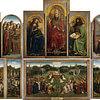
[  《犹大之吻》,乔托 Giotto (Public Domain) ](https://www.worldhistory.org/image/12690/kiss-of-judas-by-giotto/ "Kiss of Judas by Giotto")在一段时期内,绝大多数的艺术作品都是受委托创作的,因此富裕的赞助人们是文艺复兴艺术的推动力。文艺复兴之初,教堂是这一运作体系下的主要受益者。最常见的艺术装饰形式是祭坛画和壁画,主题通常为“圣会图”,即圣母玛利亚与圣子耶稣被圣徒和祝福者们环绕的场景。大型祭坛画的高度可达数米,通常模仿同时期的建筑风格进行精心装裱。最著名的祭坛画作品是扬·凡·艾克(约1390年-1441年)在1432年创作的《根特祭坛画》。因此,文艺复兴早期作品的创作题材与中世纪流行的题材非常相似。
教皇、神圣罗马帝国皇帝、国王、公爵等私家赞助人都看到了用艺术作品美化他们的城市与宫殿带来的好处,他们一方面想听到别人赞誉他们虔诚,另一方面也希望学习艺术与历史方面的知识。一旦赞助人发掘到了令他们满意的艺术家,他们通常会长期雇佣这些艺术家作为正式的宫廷艺术家,让他们承担从肖像画绘制到制服设计等一系列的工作。在创作过程中,作为资金的提供者,这些赞助人会对艺术作品的细节提出特定的要求,对艺术家造成限制。此外,尽管艺术家们可以使用自己的技艺和想象力,但他们的创作仍受到传统风格的束缚,即他们的作品中的人物必须能被辨识出来是谁。举个例子,如果一副壁画描绘的是一位圣徒的生活,但没有人能认出这是哪一位圣徒,那么这副壁画的创作便毫无意义。因此,这一时期艺术的发展相对缓慢,但随着部分艺术家的名声逐渐积累,他们开始有能力提出新的艺术思想,并使艺术变得与从前有所不同。
### 古典复兴
文艺复兴时期的一个典型特征便是重燃了研究古希腊和古罗马世界的热潮。人们从古典文学、建筑和艺术中凝练思想,加以转化,用于当时的社会,这些思想便是我们今天所说的“文艺复兴人文主义”的一部分。佛罗伦萨大家族的领导者洛伦佐·德·美第奇(1449年—1492年)是一位著名的赞助人,他收藏的古典艺术品是许多艺术家研究学习的对象。年轻的艺术家们在知名艺术大师的工作室中接受培训时也能接触到古代艺术,最差的也能接触到古代艺术的复制品。
[  《維納斯的誕生》,波提切利 Sandro Botticelli (CC BY-SA) ](https://www.worldhistory.org/image/711/the-birth-of-venus-by-botticelli/ "The Birth of Venus by Botticelli")艺术家们会直接仿制古典艺术品或在他们自己的作品中仿效它们的部分内容。比如,米开朗基罗(1475年—1564年)在1496年创作雕塑作品《沉睡的丘比特》(现遗失)时有意做旧,使它看起来像一件真正的古代艺术品。另一件再现古代场景的作品是拉斐尔(1483年-1520年)创作的壁画作品《雅典学院》,这幅壁画完工于1511年,位于梵蒂冈。不同的是,这幅画的内容全部源于作者的想象,画面中包含了古希腊和古罗马时期的所有主要思想家。文艺复兴时期的作品中,古希腊和古罗马神话中常见的场景也盛极一时。艺术家们在描绘这些场景时,也用想象力对它们进行了重构,这种做法影响深远,以至于在某些条件下,当我们想到特定的神话主题时,脑海中出现的画面不再是古希腊和古罗马时期的作品,取而代之的是文艺复兴时期的作品。其中一个典型案例是桑德罗·波提切利(1445年—1510年)创作的《维纳斯的诞生》。(该画创作于1484年,现存于意大利弗洛伦萨 乌菲齐艺术馆)最后,无论作品的主题是神话还是宗教故事,许多文艺复兴艺术家在渲染作品的背景气氛时,都尤其钟爱描绘古代建筑及废墟。
### 艺术家社会地位的提升
文艺复兴艺术的另一项全新发展是促进了艺术史的重构,并且,当时的学者们对“谁是真正伟大的艺术家?为什么?”的答案进行了记载。其中最著名的学者是乔尔乔·瓦萨里(1511年—1574年),他的著作《艺苑名人传》中编纂了这段历史。(该书发表于1550年,修订于1568年)这本书中记录了文艺复兴时期的艺术家们、他们的作品以及与他们相关的奇闻轶事,是一部具有里程碑意义的著作,因此它的作者瓦萨里也被认为是艺术史研究的先驱之一。艺术家们也能从这些专门记述他们的生活和作品的传记中获益,有些传记甚至写于艺术家仍然在世时,比如阿斯卡尼奥·康迪维(1525年—1574年)编写的《米开朗基罗传》。艺术家们也会撰写一些关于艺术技法的文章来造福他人,这方面最早的例子是洛伦佐·吉贝尔蒂(1378年—1455年)的《评论集》,约完成于1450年。《评论集》不仅是对吉贝尔蒂个人生活及作品细节的记述,也是欧洲艺术家的第一部自传。
[  《大卫》,米开朗基罗 Joe Hunt (CC BY) ](https://www.worldhistory.org/image/7451/david-by-michelangelo/ "David by Michelangelo")这种对文艺复兴艺术家、他们的私人生活以及他们的代表作的创作过程的研究兴趣,反映了艺术家们当时所享有的崇高社会地位。此前,艺术家仍被视作手工艺者,与鞋匠和木匠同列,并被迫加入行业协会,但自文艺复兴时期起,这种局面开始发生改变。艺术家与其他工匠有着明显的不同,他们可以凭借作品声名远扬,人们的追捧让他们感到荣耀。但除此之外,真正将他们的身份提升到“大师(*Artist*)”水平的是一些画家在知识理论方面做出的努力,如列昂纳多·达·芬奇(1452年—1519年)和阿尔布雷特·丢勒(1471年—1528年),在此之前,只有学习拉丁语、修辞学等传统文科的人才配享有“大师”的名号。这一时期,艺术家们热衷于研究艺术史,了解其他地区艺术界的发展进程,以自己的作品为基础撰写论文,并对线性透视理论进行了实验。这些举动都将艺术提升到了一门科学的水平。
文艺复兴艺术家的另一个典型特征是他们在不同创作媒介的使用上都有着非凡的能力,这一特征在文艺复兴盛期的艺术家身上表现尤为明显。米开朗基罗和达·芬奇就是两个典型案例,两人都既是才华出众的画家,又是雕塑家,同时又像很多其他艺术大师一样兼修建筑学。这些成功的艺术大家们经营着大型的工作室,为下一代艺术家们开辟训练场。
此外,越来越多的艺术家开始画自画像,体现出他们对自己的技艺、知识功底和对文化的贡献愈加自信。这种自信还体现在作品上越来越频繁的出现的签名上,有时候甚至是签在画作上很显眼的位置(即便是大师工作室里的助手频繁炮制的作品上也是如此)。
[](https://www.worldhistory.org/collection/120/a-gallery-of-50-renaissance-paintings/)Image Gallery#### [A Gallery of 50 Renaissance Paintings](https://www.worldhistory.org/collection/120/a-gallery-of-50-renaissance-paintings/)
In this gallery, we present 50 of the most important Renaissance paintings created by the greatest artists from Jan van Eyck (c. 1390-1441) to Tintoretto... ### 绘画与新技术
文艺复兴艺术家们多才多艺,经常大胆创新,绘画技术是他们的一大创新对象,但随着文艺复兴的发展,他们常用的绘画技术也逐渐定型,笼统来看,他们通常在墙壁上使用湿壁画技术,在画板上使用蛋彩画法和油画画法,在画布上使用油画画法。湿壁画是一种在湿石灰背景上进行绘画的方法,蛋彩画法是将颜料与蛋黄混合,再用来绘画的方法,这两种技术最初投入使用的时代远在文艺复兴时期之前。与这两种颜料不同的是,文艺复兴艺术家们在实验中使用了油画颜料,这种颜料是混合亚麻籽油或核桃油制成的,比传统颜料色彩更丰富,色调范围更广,色彩浓度更强。这些特点使油画颜料在帮助画家展现画作中的细节时更具优势,也使笔刷的笔触成为了一种视觉效果。因此,到15世纪晚期,大部分主要艺术家在画布上作画时使用的都是油画颜料,而非蛋彩画法。当然,油画颜料也有缺点,如果用它在普通墙壁上而非湿壁画中作画,它会很快变质。
当时,地域不同,绘画风格和技法也有所不同。例如,威尼斯盛行色彩技法(那里的画家们使用对比色,使构图更加明晰,以实现画面的和谐性);而佛罗伦萨的画家们则更偏爱素描技法(他们认为结构的清晰线条更为重要)。其它由文艺复兴时期的艺术家完善的技法还有:明暗对比法(光与阴影的对比使用),晕涂法(由浅色过渡到深色的画法)。
艺术家们还热衷于创新绘画题材。文艺复兴时期,在画作中描绘姿势夸张的人物形象风靡一时,米开朗基罗在罗马西斯廷教堂创作的天顶画就是一个典型案例。(该天顶画创作于1512年)为了使作品表现出一种强烈的运动感,艺术家们使用了对立式平衡的技法,即让作品中人物的上半身与下半身呈不对称姿态,达·芬奇和其他许多艺术家都使用过这一技法。另一种方法是在场景中构造图形,尤其是三角形。这种做法的目的在于加强构图的协调性,加深画面的深度,例如达·芬奇创作的《最后的晚餐》(创作于1498年,现存于意大利米兰圣玛丽亚感恩教堂),还有拉斐尔创作的《伽拉忒亚》(创作于1513年,现存于意大利罗马法尔内西纳别墅)。
[  《创造日、月、草木》,西斯廷教堂 Michelangelo (Public Domain) ](https://www.worldhistory.org/image/12753/god-creating-the-sun-moon--planets-sistine-chapel/ "God Creating the Sun, Moon & Planets, Sistine Chapel")这一时期,艺术家们努力在绘画中追求一种前所未有的真实感,为了达成这一目的,他们在画面中再现了观众在三维空间中看到的角度。安德烈亚·曼特尼亚(约1431年—1506年)像乔托一样在绘画中使用了短缩法,这点在他的画作《园中祈祷》中有所体现。(约1460年,现存于英国伦敦英国国家美术馆)曼特尼亚还热衷于绘制仰视视角下的场景,这种技巧也使他的作品画面更具视觉深度。有时,画作中的深远场景位于画面中部,人物在前景中占主导位置,从视觉效果上来讲,这种画法使人物更靠近观众。这种绘画技术由彼得罗·佩鲁吉诺(1450年—1523年)改革产生,在他曾经的学生拉斐尔的画作《圣母的婚礼》中体现的淋漓尽致。(该画约创作于1504年,现存于意大利米兰布雷拉美术馆)
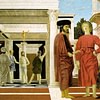
与此同时,在这一方面,皮耶罗·德拉·弗朗切斯卡(约1420年—1492年)等画家则进行了更加深入的研究,他们在创作时运用了透视法中精确的数学原理,例如皮耶罗的作品《鞭打基督》(约1455年,现存于意大利乌尔比诺马尔凯国家美术馆)。一些评论家认为,有的画家滥用了透视法,导致他们的画作失去了原有的观感,保罗·乌切洛(1397年—1475年)就深受这一论断所害。乌切洛的作品《林中狩猎》毫无疑问是一幅大胆的作品,这幅画描绘了一副大全景:一片对称的森林逐渐隐匿在越来越暗的背景里,前景中的猎人和他们的猎犬占据了主要位置,并且都在向一个遥远的中心点聚集。(该画约创作于1460年,现存于英国牛津阿什莫尔博物馆)
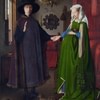
[  《圣方济各的狂喜》,乔瓦尼·贝里尼 Google Cultural Institute (Public Domain) ](https://www.worldhistory.org/image/12834/ecstasy-of-saint-francis-by-giovanni-bellini/ "Ecstasy of Saint Francis by Giovanni Bellini")有了透视以后,要想让画面看起来更加真实,还可以进行另一步:确保场景中只有一个光源,画面中所有要素的阴影都由它产生。乔凡尼·贝利尼(1430年—1516年)创作的《圣方济各的狂喜》就遵循了这一原则。(该画约创作于1480年,现存于美国纽约弗里克收藏馆)渐渐的,艺术家们甚至用技法和观众开起了玩笑,比如扬·凡·艾克的作品《阿尔诺芬尼夫妇像》中的镜子,镜中映出的人影本应站在观众身旁的位置上。(该画创作于1434年,现存于英国伦敦英国国家美术馆)这些技术还有另一个优点,那就是让从未见过这种创新画法的观众们惊叹连连。
艺术家们并没有因为掌握了精湛的技术而满足,他们不想让自己的作品留给观众的第一印象仅仅停留在视觉层面,他们还想赋予画作更深层次的内涵。更深层次的内涵。神话场景通常具有象征意义,意在从人群中筛选出受过优良教育的观众。提香(1487年—1576年)甚至将他的神话画作描述为另一种形式的诗歌,称为*Poesia*,因为他在作画时会大量的“引经据典”,他的作品《酒神巴库斯与阿里阿德涅》就是一个典型案例。(该画约创作于1523年,现存于英国伦敦英国国家美术馆)
[  《蒙娜丽莎》 Centre for Research and Restoration of the Museums of France (Public Domain) ](https://www.worldhistory.org/image/12640/mona-lisa/ "Mona Lisa")文艺复兴时期的艺术家们在肖像画领域也建树颇丰,其中最著名的一副就是达·芬奇的《蒙娜丽莎》,画作的内容是一名身份不明的女子。(该画约创作于1506年,现存于法国巴黎卢浮宫)在这幅画中,达·芬奇不仅画出了模特的样貌,还捕捉到了她的情绪。这幅画的轮廓、透视和色彩层次相互结合,赋予了画面生命。此外,画中人物随意的姿势与四分之三身的视角也暗藏变革的玄机。这幅作品对后世肖像画的创作产生了极大的影响。肖像画领域的另一项发展是在画面中利用日常物品暗示模特的性格、信仰和爱好。荷兰的画家们在创作逼真的肖像画这方面可谓出类拔萃,他们的理念在意大利广为传播,影响深远,皮耶罗·德拉·弗朗切斯卡的著名画作《费德里科·达·蒙特费尔特罗》就是一个很好的例证。(该画又称《乌尔比诺公爵》,约创作于1470年,现存于意大利佛罗伦萨乌菲齐美术馆)
### 雕塑与传统框架的打破
虽然宗教主题在文艺复兴时期的雕塑作品中仍很流行,也产出了很多优秀的作品,如表现圣母玛丽亚在耶稣的尸体前哀悼的作品《哀悼基督》,但越来越多的创新性处理很快就替代了这些传统的造像内容。例如,多纳泰罗(1386年—1466年)尝试牺牲技巧和修饰来捕捉人物的情感,这一策略在他的木制雕塑作品《抹大拉的玛丽亚》中得到了很好的体现。(该作品约创作于1446年,现存于意大利佛罗伦萨主教座堂博物馆)
[  《抹大拉的玛利亚》,多纳泰罗 Sailko (CC BY-SA) ](https://www.worldhistory.org/image/12620/mary-magdalene-by-donatello/ "Mary Magdalene by Donatello")随着古希腊、古罗马文化的复兴,雕刻家们开始用木材、石材和青铜创造他们心目中古代人物的形象。其中最著名的当属米开朗基罗的大理石雕像《大卫》,刻画了一位圣经中在年少时期因杀死巨人哥利亚而一战成名的王。(该雕像创作于1504年,现存于意大利弗洛伦萨佛罗伦萨学院美术馆)这尊雕像比真人高大很多,约5.2米高,使人想起古罗马时期的赫拉克勒斯巨像,但作品中人物饱满紧绷的肌肉线条和坚定无比的神态是文艺复兴的创新产物。
多纳泰罗也用青铜铸造了他心目中的大卫,这是另一件与古典雕塑截然不同的雕塑作品。(该雕像创作于1420年或1440年,现存于意大利佛罗伦萨巴尔杰洛博物馆)作品中人物的姿势极具美感,而这种美感在古典时期的作品中根本无从找寻。米开朗基罗和多纳泰罗的《大卫》都体现了文艺复兴时期的艺术所具有的强大功能性。《大卫》的形象出现在了佛罗伦萨的官方图章上,作为杀死哥利亚的人,他的形象能够及时提醒佛罗伦萨人,让他们想起自己的城市与对手城市米兰之间的斗争。
[  《驴子的奇迹》,多纳泰罗 Sailko (Public Domain) ](https://www.worldhistory.org/image/12619/miracle-of-the-mule-by-donatello/ "Miracle of the Mule by Donatello")另一种与雕塑相关的艺术形式是雕刻。多纳泰罗在这方面也颇有建树,他为锡耶纳大教堂等几个佛罗伦萨的教堂的洗礼堂创作了极其精美的青铜浅浮雕作品。这种雕刻深度较浅却仍能实现场景透视效果的方法在当时称为“展平浮雕”(*rilievo schiacciato*)。另一种截然不同的雕刻方式是在金属板上进行很深的雕刻,雕刻内容几乎可以从背景板上单独分离。这种雕刻方法创作的作品中最著名的是洛伦佐•吉贝尔蒂创作的“天堂之门”,是他为圣乔凡尼礼拜堂的洗礼堂雕刻的大门。(该作品完工于1452年)大门上镶嵌的镀金浮雕板块展现的是圣经里的场景,甚至有一块雕刻的是吉贝尔蒂本人的形象。
除雕塑与雕刻外,版画也是文艺复兴时期的一大艺术门类。从1420年起,木刻版画趋于流行,但直到公元15世纪70年代铜版雕刻技术有所发展,版画才真正成为了一门艺术。铜版让艺术家在雕刻的精度和细节处理上有了更大的发挥空间。曼特尼亚和丟勒是这一领域的著名专家,他们的版画作品有很高的收藏价值。最著名的版画艺术家是马尔坎托尼奥·雷梦迪(1480年-1534年),他精美的作品推动了当地与北欧的思想双向交流。
[  《圣马可的奇迹》,丁托列托 Didier Descouens (CC BY-SA) ](https://www.worldhistory.org/image/12827/miracle-of-st-mark-by-tintoretto/ "Miracle of St. Mark by Tintoretto")### 文艺复兴的遗产
收藏艺术品是富人的一大爱好,但随着经济发展,中产阶级变得愈加富有,也有了购入艺术品的能力,尽管这些艺术品的质量一般。一些艺术工作室不再进行单纯的大规模创作,而是至少依照当时的商品目录,采用一些标准化的元素进行生产,吉贝尔蒂的工作室就是如此。简而言之,艺术不再是富人的特权,而对于那些仍无力购买原作的人,他们可以购买印刷品作为替代,而印刷品也让艺术家们名满天下。同时,多亏了艺术市场的发展,艺术大师们不再受限于赞助人,能够按照自己原本的想法创作作品。
文艺复兴时期的艺术一直在持续发展。比如矫饰主义,一开始是一个含义模糊的名词,指文艺复兴盛期后出现的一些古怪而不同的艺术作品。后来,矫饰主义有了一个更加积极的含义,代指时髦、含义模糊、明暗对比明显、大量的使用各种技法和文艺复兴早期艺术家们确立的标准化规则的作品。例如丁托列托(约1518年—1594年)于1548年创作的《圣马可奇迹》。矫饰主义催生了欧洲艺术史上的另一个主要艺术风格,即装饰华丽的巴洛克风格,它将文艺复兴艺术色彩鲜艳、细节丰富、人物姿态充满活力的创作风格推向了另一个极端:重于一切的戏剧化处理与华美的装饰性。
#### Editorial Review
This human-authored definition has been reviewed by our editorial team before publication to ensure accuracy, reliability and adherence to academic standards in accordance with our [editorial policy](https://www.worldhistory.org/static/editorial-policy/).
## 参考文献
- [Campbell, Gordon. *The Oxford Illustrated History of the Renaissance.* Oxford University Press, 2019.](https://www.worldhistory.org/books/019871615X/)
- [Hale, J.R. (ed). *The Thames & Hudson Dictionary of the Italian Renaissance.* Thames & Hudson, 2020.](https://www.worldhistory.org/books/B01K0SPLDW/)
- [Nash, Susie. *Northern Renaissance Art.* Oxford University Press, 2009.](https://www.worldhistory.org/books/0192842692/)
- [Paoletti, John T. & Radke, Gary M. *Art in Renaissance Italy.* Pearson, 2011.](https://www.worldhistory.org/books/0205010474/)
- [Rundle, David. *The Hutchinson Encyclopedia of the Renaissance.* Hodder Arnold, 2000.](https://www.worldhistory.org/books/1859863329/)
- [Woods, Kim W. *Making Renaissance Art.* Yale University Press, 2007.](https://www.worldhistory.org/books/030012189X/)
- [Wyatt, Michael. *The Cambridge Companion to the Italian Renaissance.* Cambridge University Press, 2014.](https://www.worldhistory.org/books/0521699460/)
## 关于作者
马克是一位全职作家、研究人员、历史学家与编辑,他对艺术、建筑,以及研究所有文明共有的思想尤为感兴趣。马克拥有政治哲学硕士学位,目前担任WHE出版总监一职。
## 时间轴
- **1376 CE - 1455 CE**: Life of the Italian Renaissance artist [Lorenzo Ghiberti](https://www.worldhistory.org/Lorenzo_Ghiberti/).
- **1377 CE - 1446 CE**: Life of the Italian Renaissance architect and sculptor [Filippo Brunelleschi](https://www.worldhistory.org/Filippo_Brunelleschi/).
- **c. 1390 CE - 1441 CE**: The life of the Netherlandish Renaissance artist [Jan van Eyck](https://www.worldhistory.org/Jan_van_Eyck/).
- **1397 CE - 1475 CE**: Life of the Italian Renaissance artist [Paolo Uccello](https://www.worldhistory.org/Paolo_Uccello/).
- **c. 1415 CE**: The Italian Renaissance artist [Donatello](https://www.worldhistory.org/Donatello/) completes his [sculpture](https://www.worldhistory.org/disambiguation/Sculpture/) of Saint George for the Orsanmichele in Florence.
- **1420 CE - 1450 CE**: The Italian Renaissance artist [Donatello](https://www.worldhistory.org/Donatello/) sculpts his [bronze](https://www.worldhistory.org/disambiguation/bronze/) David in Florence.
- **c. 1420 CE - 1492 CE**: Life of the Italian Renaissance artist [Piero della Francesca](https://www.worldhistory.org/Piero_della_Francesca/).
- **1425 CE - 1452 CE**: The Italian Renaissance sculptor [Lorenzo Ghiberti](https://www.worldhistory.org/Lorenzo_Ghiberti/) works on his second set of doors, the 'Gates of Paradise', for the Baptistery of Florence's Cathedral.
- **c. 1430 CE - 1516 CE**: Life of the Italian Renaissance artist [Giovanni Bellini](https://www.worldhistory.org/Giovanni_Bellini/).
- **1432 CE**: The [Ghent Altarpiece](https://www.worldhistory.org/Ghent_Altarpiece/) is completed by the Netherlandish Renaissance artists [Jan van Eyck](https://www.worldhistory.org/Jan_van_Eyck/) and Hubert van Eyck.
- **1435 CE**: The Italian Renaissance architect [Leon Battista Alberti](https://www.worldhistory.org/Leon_Battista_Alberti/) writes his treatise De pictura (On Painting).
- **1436 CE**: The Italian Renaissance artist [Paolo Uccello](https://www.worldhistory.org/Paolo_Uccello/) completes his equestrian [fresco](https://www.worldhistory.org/disambiguation/Fresco/) of Sir John Hawkwood.
- **1446 CE - 1453 CE**: The Italian Renaissance artist [Donatello](https://www.worldhistory.org/Donatello/) creates his [bronze](https://www.worldhistory.org/disambiguation/bronze/) panels for the high altar of the Basilica Sant’ Antonio in Padua.
- **c. 1450 CE**: The Italian Renaissance sculptor [Lorenzo Ghiberti](https://www.worldhistory.org/Lorenzo_Ghiberti/) writes his Commentaries, a mix of art history and autobiography.
- **c. 1450 CE - 1523 CE**: Life of the Italian Renaissance artist [Pietro Perugino](https://www.worldhistory.org/Pietro_Perugino/).
- **1452 CE - 1465 CE**: The Italian Renaissance artist [Piero della Francesca](https://www.worldhistory.org/Piero_della_Francesca/) produces his cycle of frescoes on the Legend of the True Cross for the San Francesco church, Arezzo.
- **c. 1453 CE**: The Italian Renaissance artist [Donatello](https://www.worldhistory.org/Donatello/) completes his equestrian statue of Erasmo da Narni, the Gattamelata (‘honeycat’) in Padua.
- **c. 1455 CE**: The Italian Renaissance artist [Piero della Francesca](https://www.worldhistory.org/Piero_della_Francesca/) produces his painted panel the Flagellation of Christ.
- **c. 1456 CE**: The Italian Renaissance artist [Donatello](https://www.worldhistory.org/Donatello/) sculpts his wooden statue of a penitent Mary Magdalene.
- **1464 CE**: The Italian Renaissance architect [Leon Battista Alberti](https://www.worldhistory.org/Leon_Battista_Alberti/) writes his treatise on [sculpture](https://www.worldhistory.org/disambiguation/Sculpture/).
- **c. 1465 CE**: The Italian Renaissance artist [Piero della Francesca](https://www.worldhistory.org/Piero_della_Francesca/) produces his [fresco](https://www.worldhistory.org/disambiguation/Fresco/) the Resurrection of Christ.
- **1465 CE - 1474 CE**: The Italian Renaissance artist [Andrea Mantegna](https://www.worldhistory.org/Andrea_Mantegna/) works on his [fresco](https://www.worldhistory.org/disambiguation/Fresco/) cycles in the Palazzo Ducale of Mantua.
- **c. 1470 CE**: The Italian Renaissance artist [Piero della Francesca](https://www.worldhistory.org/Piero_della_Francesca/) produces his portrait of the Duke of Urbino, Federico da Montefeltro.
- **1471 CE - 1528 CE**: Life of the German Renaissance artist [Albrecht Dürer](https://www.worldhistory.org/Albrecht_Durer/).
- **c. 1474 CE**: The Italian Renaissance artist [Piero della Francesca](https://www.worldhistory.org/Piero_della_Francesca/) writes his treatise On Perspective in Painting.
- **1475 CE - 1564 CE**: Life of the Italian Renaissance artist [Michelangelo](https://www.worldhistory.org/Michelangelo/).
- **c. 1480 CE**: The Italian Renaissance artist [Giovanni Bellini](https://www.worldhistory.org/Giovanni_Bellini/) completes his Ecstasy of Saint Francis painting.
- **1480 CE - 1484 CE**: The Italian Renaissance artist [Sandro Botticelli](https://www.worldhistory.org/Sandro_Botticelli/) produces his painting the Birth of [Venus](https://www.worldhistory.org/venus/).
- **c. 1482 CE**: The Italian Renaissance artist [Sandro Botticelli](https://www.worldhistory.org/Sandro_Botticelli/) produces his Primavera painting.
- **c. 1487 CE - 1576 CE**: Life of the Italian Renaissance artist [Titian](https://www.worldhistory.org/Titian/).
- **1490 CE - 1492 CE**: The Italian Renaissance artist [Sandro Botticelli](https://www.worldhistory.org/Sandro_Botticelli/) produces his Lamentation over the Dead Christ painting.
- **c. 1492 CE**: [Leonardo da Vinci](https://www.worldhistory.org/Leonardo_da_Vinci/) completes his 'Vitruvian Man' sketch.
- **1497 CE - 1500 CE**: The Italian Renaissance artist [Michelangelo](https://www.worldhistory.org/Michelangelo/) works on his masterpiece the Pieta.
- **c. 1497 CE - 1543 CE**: Life of the German Renaissance painter [Hans Holbein the Younger](https://www.worldhistory.org/Hans_Holbein_the_Younger/).
- **c. 1498 CE**: [Leonardo da Vinci](https://www.worldhistory.org/Leonardo_da_Vinci/) completes his [wall](https://www.worldhistory.org/wall/) mural 'The Last Supper' in Milan's Sante Maria delle Grazie.
- **c. 1500 CE**: The Italian Renaissance artist [Sandro Botticelli](https://www.worldhistory.org/Sandro_Botticelli/) produces his Mystic Nativity painting.
- **c. 1500 CE**: The Italian Renaissance artist [Giovanni Bellini](https://www.worldhistory.org/Giovanni_Bellini/) completes his portrait of Doge Leonardo Loredan.
- **c. 1503 CE - c. 1506 CE**: [Leonardo da Vinci](https://www.worldhistory.org/Leonardo_da_Vinci/) completes his painting the 'Mona Lisa'.
- **1504 CE**: The German Renaissance artist [Albrecht Dürer](https://www.worldhistory.org/Albrecht_Durer/) creates his Adam and Eve print.
- **1504 CE**: The Italian Renaissance artist [Michelangelo](https://www.worldhistory.org/Michelangelo/) completes his masterpiece the statue of David.
- **c. 1504 CE**: The Italian Renaissance artist [Raphael](https://www.worldhistory.org/Raphael/) completes his The Marriage of the Virgin.
- **c. 1505 CE**: The Italian Renaissance artist [Giovanni Bellini](https://www.worldhistory.org/Giovanni_Bellini/) completes his altarpiece for the San Zaccaria church in Venice.
- **1507 CE**: The Italian Renaissance artist [Raphael](https://www.worldhistory.org/Raphael/) completes his painting The Entombment of Christ (aka The Deposition).
- **1508 CE - 1512 CE**: The Italian Renaissance artist [Michelangelo](https://www.worldhistory.org/Michelangelo/) works on his painting of the Sistine Chapel ceiling in [Rome](https://www.worldhistory.org/Rome/).
- **1511 CE**: The Italian Renaissance artist [Raphael](https://www.worldhistory.org/Raphael/) completes his frescoes in the Stanze della Segnatura of the Vatican which include The School of [Athens](https://www.worldhistory.org/Athens/).
- **c. 1518 CE - 1594 CE**: Life of the Italian Renaissance painter [Tintoretto](https://www.worldhistory.org/Tintoretto/) (Jacopo Robusti).
- **c. 1520 CE**: The Italian Renaissance artist [Michelangelo](https://www.worldhistory.org/Michelangelo/) completes his masterpiece statue of [Moses](https://www.worldhistory.org/Moses/) for the [tomb](https://www.worldhistory.org/tomb/) of Pope [Julius](https://www.worldhistory.org/disambiguation/Julius/) II.
- **c. 1525 CE**: The German Renaissance painter [Hans Holbein the Younger](https://www.worldhistory.org/Hans_Holbein_the_Younger/) creates his 41-print series the Dance of [Death](https://www.worldhistory.org/disambiguation/Death/).
- **1536 CE**: The German Renaissance painter [Hans Holbein the Younger](https://www.worldhistory.org/Hans_Holbein_the_Younger/) becomes the court painter of [Henry VIII of England](https://www.worldhistory.org/Henry_VIII_of_England/).
- **1545 CE - 1554 CE**: The Italian Renaissance artist [Benvenuto Cellini](https://www.worldhistory.org/Benvenuto_Cellini/) works on his [bronze](https://www.worldhistory.org/disambiguation/bronze/) [sculpture](https://www.worldhistory.org/disambiguation/Sculpture/) of [Perseus](https://www.worldhistory.org/Perseus/) and [Medusa](https://www.worldhistory.org/Medusa/).
- **1548 CE**: The Italian Renaissance artist [Tintoretto](https://www.worldhistory.org/Tintoretto/) produces his celebrated Miracle of Saint [Mark](https://www.worldhistory.org/disambiguation/Mark/) Rescuing a Slave painting.
- **1564 CE - 1481 CE**: The Italian Renaissance artist [Tintoretto](https://www.worldhistory.org/Tintoretto/) works on his cycle of paintings for Venice’s Scuola Grande di San Rocco.
- **c. 1570 CE**: The Italian Renaissance artist [Tintoretto](https://www.worldhistory.org/Tintoretto/) porduces his Saint George and the Dragon painting.
## 问答
### ”文艺复兴时期的艺术“的定义是什么?
文艺复兴时期的艺术可以定义为:艺术家与雕塑家展现出对古典艺术的兴趣,并使用线性透视的艺术。
文艺复兴时期的艺术是写实的、细致的、戏剧性的,并通常包含不同层次的内涵。
### 文艺复兴时期的艺术有哪些例子?
文艺复兴时期的艺术中最为著名的例子包括米开朗基罗的雕像作品《大卫》(现收藏于意大利佛罗伦萨美术学院)和位于罗马的壁画作品“西斯廷教堂天顶画”。文艺复兴时期的化作中最著名的是莱昂纳多·达·芬奇创作的《蒙娜丽莎》(现收藏于法国卢浮宫)和拉斐尔创作的《雅典学院》(现收藏于意大利梵蒂冈博物馆)。
### 如何区分文艺复兴时期的艺术与巴洛克艺术?
相比文艺复兴时期的艺术,巴洛克艺术作品的色彩更丰富,细节更细致。同时,巴洛克艺术更具戏剧性和装饰性,而文艺复兴艺术在传统上更接近古代艺术,但比古代艺术更注重透视、写实和作品的多层次内涵。
## 外部链接
- [Famous Renaissance Artists of the Italian and Northern Renaissance](https://mymodernmet.com/renaissance-artists/)
- [20 Famous Renaissance Paintings Every Art Lover Should Know](https://mymodernmet.com/famous-renaissance-paintings/)
- [Anatomy in the Renaissance | Essay | The Metropolitan Museum of Art | Heilbrunn Timeline of Art History](https://www.metmuseum.org/toah/hd/anat/hd_anat.htm)
## 引用本文
### APA
Cartwright, M. (2024, November 22). 文艺复兴时期的艺术. (X. Hanning, 翻译). *World History Encyclopedia*.
### Chicago
Cartwright, Mark. "文艺复兴时期的艺术." 翻译: Xu Hanning. *World History Encyclopedia*, November 22, 2024. .
### MLA
Cartwright, Mark. "文艺复兴时期的艺术." 翻译: Xu Hanning. *World History Encyclopedia*, 22 Nov 2024, .
## 许可与版权
提交人: [Xu Hanning](https://www.worldhistory.org/user/hannahprime/ "User Page: Xu Hanning"), 发表于 22 November 2024. 请查阅原始来源以获取版权信息。 请注意,从本页面链接的内容可能具有不同的许可条款。