---
title: 中國皇帝
author: Mark Cartwright
translator: 晚生姓高
source: https://www.worldhistory.org/trans/zh/1-16204/
format: machine-readable-alternate
license: Creative Commons Attribution-NonCommercial-ShareAlike (https://creativecommons.org/licenses/by-nc-sa/4.0/)
updated: 2023-03-17
---
# 中國皇帝
_作者: [Mark Cartwright](https://www.worldhistory.org/user/markzcartwright/)_
_译者: [晚生姓高](https://www.worldhistory.org/user/ezswvyqf)_
[](https://www.worldhistory.org/trans/zh/1-22386/)[](https://www.worldhistory.org/trans/zh/2-2409/)中國古代皇帝擁有巨大權力和責任。 稱為“天子”,被賦予統治人的神權,期望促進他們的最大利益,而不是自己的利益。 一個專制君主,雖然實際上依賴核心圈子,但皇帝的神秘感因他,對普通人的隱身性而增強,因為他經常在皇宮裡與世隔絕。 能親見皇上,哪怕是隱於屏風,坐在金龍寶座上,是至高無上的榮耀。 也許沒有其他古代統治者,像中國皇帝高高在上,受人膜拜。
### 天降大任
西周的統治者,是第一個將傳統的祖先崇拜,更進一步,並擁有“天子”稱號的人。 周文王,公元前 1050 年,聲稱,並且由於它很方便地被調出,他的所有繼任者也被賦予了眾神(上天)統治的權利。 這無異於天命,也就是不容挑戰的統治權。 實際上不是神聖的,而是代表地上的眾神統治,這個角色也肩負著,為人民的利益做出決定,的重大責任。 如果統治不好,就會遭受洪旱等可怕災難,他會失去統治權。 這也是為什麼幾個世紀以來王朝更替的一個有用解釋:因統治不善,而失去上天的庇護。 正如一個流行的諺語所說,由荀子記錄:
> 人君為舟,百姓為水。 水能載舟,水能覆舟。 (埃布雷,8 )
因此,統治者必須始終以仁政指導。 人民的父母官。 因此,以他的名義治理地方的地方官,被俗稱為“父母官”。 統治者可能公然忽視道德,但是,直到公元 19 世紀,天命思想仍然被用作皇帝統治,甚至外族征服統治的合法論據。 少有皇帝能夠,完全忽視人民的集體道德和歷史期望。
[  秦始皇 Dennis Jarvis (CC BY-SA) ](https://www.worldhistory.org/image/988/shi-huangdi/ "Shi Huangdi")因此,在古代中國,統治者被認為是皇室、貴族、國家、司法和宗教等級的首腦。 自然地,當他死後,他去了天堂並在那裡侍奉眾神。 這種崇高的依戀,確保中國的所有統治者,都受到有幸與他們有接觸的人,極大尊敬和敬畏。 即使是最高級政府官員,進入內廷,並真正會見皇帝——而且很少有人真正會見——這種體驗就像他們在地上接近神一樣。
### 秦始皇帝
第一位皇帝稱號的,是秦始皇帝(公元前 259-210 年)。 事實上,他的名字本身就是一個榮譽頭銜,意思是“始皇”。 在某種不朽的奢侈嘗試中,相當成功,下令為他建造由兵馬俑守衛的巨大墳墓,這是一支由 八千名栩栩如生,戰士軍隊,包括戰車,馬匹,動物和百姓。
此後,所有統治者都獲得皇帝的稱號和製度,歷經數次改朝換代,直到1911年建立民國才結束。 最後皇帝是清朝的愛新覺羅·溥儀,他還是個孩子在位僅三年。
### 演替
皇帝通常繼位,除非是開國的,並且武力奪權。 通常長子繼承父親,但也有皇帝認為更適合統治的,會選擇他另個孩子。 這種情況導致了手足反目成仇,,經常死亡和失踪事件。 如果一位皇帝在他繼承人成年之前去世了,那麼這位年輕的皇帝,就會得到高官的建議,尤其是主宰宮廷生活的太監中。 有時,即使是新成年的皇帝,也不得不與有權勢的官員或親戚競爭,他們更了解宮廷政治的錯綜複雜,並尋求實現自己的抱負,而不是國家的抱負。 死亡、自殺和被迫退位,中並不為人所知。 幸運的是,這是例外,並且在整個世紀中,人們對任何因出生,或環境被選為皇帝的人,都懷有強烈敬意,正如歷史學家 R. 道森 (R. Dawson) 在此解釋的那樣:
> 新君出,天子靈氣籠罩,一職神授,確定皇帝地位……天子坐龍座,神聖不凡。 眼睛,屏幕止眼直視。 (10-11)
[ 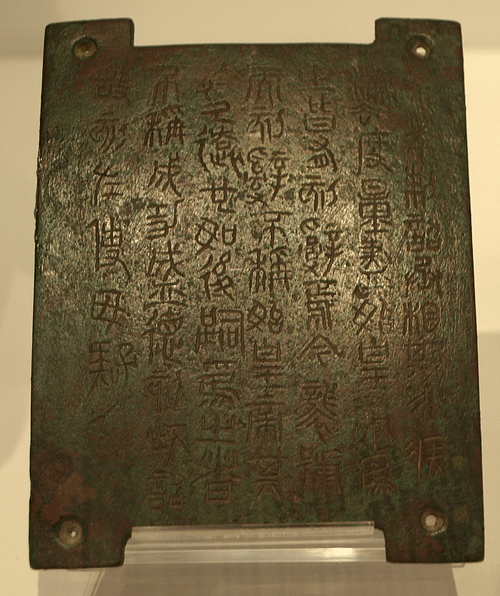 秦朝銅匾詔書 Captmondo (CC BY-SA) ](https://www.worldhistory.org/image/4527/qin-dynasty-edict-on-a-bronze-plaque/ "Qin Dynasty Edict on a Bronze Plaque")### 皇帝的權力
皇帝沒有王法規定他們的權力和政府的權力。 皇是最高行政官、最高立法權和最後的訴求,也是軍隊最高統帥。 皇帝可以指導政策,引入新法規和稅收,任命,恩惠,特權和頭銜,處罰和赦免。 即使需要考慮優先權,他也可以推翻法律。 有些皇帝比其他更多參與日常統治,但普遍將實際事務,留給為此目的,精心挑選的職業政治家。 皇帝被視為慈父和國家命運的道德領袖,漢代(公元前 206 年 - 公元 220 年)文本的摘錄說明了這一點:
> 為人君者,以無為為道,以公正為寶。 坐在無為的寶座上,乘著他的官員的完美。 腳不動,臣領前行; 他一言不發,但他的侍從們卻對他支持。 他的頭腦不關心問題,但他的大臣們採取適當的行動。 因此,沒有人看到他的行為,但他卻取得成功。 這就是君主效法天道的方式。 (在道森,7)
皇帝支持政府領域,基於的儒家原則,但他本人可以根據個人信仰,從佛教和道教等選擇。 正式地,他舉行按曆法,最重要的宗教儀式,其中包括在山河聖地獻祭。 皇帝還定期祭祀他的皇先,並負責每個農曆年的首耕儀式。 最重要的儀式一直持續到 20 世紀,是在冬至日獻上一頭無瑕疵的公牛,向天獻祭。
[  中國王朝的列表一覽 Simeon Netchev (CC BY-NC-ND) ](https://www.worldhistory.org/image/16125/imperial-dynasties-of-china-visual-timeline/ "Imperial Dynasties of China Visual Timeline")對皇帝的另個期望,是興學。 因此,許多皇帝在位期間,訪問國立書院並建立新學校。 皇帝受過儒家經典和歷史的嚴格教育,他為人民之父的角色,需要掃盲和學習。
儘管擁有絕對的權力,但皇帝仍然不能為所欲為。 國家及其官僚機構的規模如此之大,以至他依靠士大夫了解最新情況,依靠忠實的支持者在傳統政府內執行他的政策。 因此,他得軍師謀士建議和協助,他們可能擔任首相,太師,三公九卿等頭銜。 正如歷史學家 R. Dawson 在這裡總結,
> 即使是最專制的皇帝,也不可避免地受到傳統、慣例和先例的限制,受到外戚的壓力,以及對消息靈通大臣的依賴。 儘管有時皇帝行為,會突然變得嚴厲,但他們任意行事的權利構成一種威脅,很少付諸實踐。 (15)
出於這個原因,皇帝定期組織朝廷會議,討論預算、法律和軍事政策,邀請高級官員發表意見,並根據大多數人的意見作出決定。 因此,政府在很大程度上遵循協商一致的原則; 事實上,古漢語中的“治”(t'ing) 也有“聽”的意思。 隨著政府變得越來越大和越複雜,高級官員仍然由皇帝任命,但是由他的推薦候選名單。 在進入皇帝考慮之前,也經過各部門的嚴格過濾。 因此,隨著時間的推移,高級政治家為自己的利益,而影響決策權力越來越大。 此外,皇帝的政策,也受到前任政策的限制,尤其是被視為特別受上天寵愛的開國元勳。 這是成為神聖的陷阱。 如果所有的統治者都授權,那麼他們的政策就必須得到考慮和尊重。
[  唐太宗 Hardouin (Public Domain) ](https://www.worldhistory.org/image/4584/emperor-taizong/ "Emperor Taizong")### 獨特性和神秘性
皇帝的神秘感來自他的天命,而且很難一睹他的風采,只有向他的肖像鞠躬,這樣的習俗。 就連在外省,得到提拔的官員,也都感激地向著遙遠的京城宮殿方向磕頭。 為保皇上隱居,凡擅自入宮者,一律處死。
皇帝生日的慶祝與其他宗教節日不同,他的皇袍上印有龍的圖案,龍是中國神話中最負盛名。 他戴著只有他有權穿的特殊的帽子和衣服。 鮮豔的黃色和特定圖案的衣服、帷幔、器皿和家具開始與皇帝聯繫在一起。 自然地,他乘坐特別定制的馬車,掛著特殊旗幟,在專供他使用的道路上行駛。 在他去世前,道路小心翼翼地迥避。 甚至語言也表明皇帝的獨特性,因為他自己稱孤家寡人,並且禁止寫或說他的名字。 在死亡時,已故統治者的巨大陵墓寶藏,是對皇權和威望,強烈持久的紀念。
#### Editorial Review
This human-authored definition has been reviewed by our editorial team before publication to ensure accuracy, reliability and adherence to academic standards in accordance with our [editorial policy](https://www.worldhistory.org/static/editorial-policy/).
## 参考文献
- Anonymous. "The Emperor of China and His Court." *T'oung Pao*, Vol. 9, No. 5, 1991, pp. 277-282.
- [Dillon, M. *China.* Routledge, 1998.](https://www.worldhistory.org/books/0700704396/)
- [Ebrey, P.B. *East Asia.* Wadsworth Publishing, 2013.](https://www.worldhistory.org/books/1133606474/)
- [Lewis, M.E. *The Early Chinese Empires.* Belknap Press: An Imprint of Harvard University Press, 2010.](https://www.worldhistory.org/books/0674057341/)
- [Rossabi, M. *A History of China.* Wiley-Blackwell, 2013.](https://www.worldhistory.org/books/1577181131/)
## 关于作者
马克是一位全职作家、研究人员、历史学家与编辑,他对艺术、建筑,以及研究所有文明共有的思想尤为感兴趣。马克拥有政治哲学硕士学位,目前担任WHE出版总监一职。
## 时间轴
- **c. 1050 BCE**: King Wen of [Zhou](https://www.worldhistory.org/Zhou_Dynasty/) is the first Chinese ruler to claim a [Mandate of Heaven](https://www.worldhistory.org/Mandate_of_Heaven/).
- **221 BCE**: King Ying Zheng assumes the title [Shi Huangdi](https://www.worldhistory.org/Shi_Huangdi/), First Emperor of [China](https://www.worldhistory.org/china/). Founds [Qin Dynasty](https://www.worldhistory.org/Qin_Dynasty/).
- **210 BCE**: First Emperor of [China](https://www.worldhistory.org/china/) [Shi Huangdi](https://www.worldhistory.org/Shi_Huangdi/) dies, buried with army of 8,000 terracotta warriors in [palace](https://www.worldhistory.org/disambiguation/palace/) [tomb](https://www.worldhistory.org/tomb/).
- **202 BCE**: Liu Bang is proclaimed emperor of [China](https://www.worldhistory.org/china/) after defeating the rival general Xiang Yu.
- **Mar 202 BCE**: Emperor Gaozu (Liu Bang) becomes the first [Han](https://www.worldhistory.org/Han_Dynasty/) ruler.
- **141 BCE - 87 BCE**: Reign of Emperor Wu (Wu the Great), the most effective and influential of the [Han](https://www.worldhistory.org/Han_Dynasty/) monarchs.
- **9 CE**: Wang Mang takes control of the [empire](https://www.worldhistory.org/empire/) by usurping the throne and proclaiming his innovative dynasty called Xin ("new").
- **168 CE - 189 CE**: Ling is emperor in [China](https://www.worldhistory.org/china/).
- **190 CE**: Dong [Zhou](https://www.worldhistory.org/Zhou_Dynasty/) seized control of the Chinese imperial capital and placed a child, Liu Xie, as the new ruler.
- **581 CE - 601 CE**: Reign of Wen (aka Wendi), first [Sui](https://www.worldhistory.org/Sui_Dynasty/) emperor in [China](https://www.worldhistory.org/china/).
- **598 CE - 649 CE**: Life of Li-Shimin, Emperor [Taizong](https://www.worldhistory.org/disambiguation/Taizong/) of [China](https://www.worldhistory.org/china/).
- **604 CE - 618 CE**: Reign of [Yang](https://www.worldhistory.org/Yin_and_Yang/) (aka Yangdi), second and last [Sui](https://www.worldhistory.org/Sui_Dynasty/) emperor in [China](https://www.worldhistory.org/china/).
- **618 CE - 626 CE**: Reign of Gaozu, 1st Emperor of [Tang Dynasty](https://www.worldhistory.org/Tang_Dynasty/) in [China](https://www.worldhistory.org/china/).
- **626 CE - 649 CE**: Reign of Emperor [Taizong](https://www.worldhistory.org/disambiguation/Taizong/) in [China](https://www.worldhistory.org/china/).
- **649 CE - 683 CE**: Reign of Emperor Gaozong in [China](https://www.worldhistory.org/china/).
- **683 CE - 704 CE**: Reign of Empress [Wu Zetian](https://www.worldhistory.org/Wu_Zetian/), only female monarch of [China](https://www.worldhistory.org/china/).
- **712 CE - 756 CE**: Reign of [Xuanzong](https://www.worldhistory.org/disambiguation/Xuanzong/), 7th emperor of the [Tang Dynasty](https://www.worldhistory.org/Tang_Dynasty/) in [China](https://www.worldhistory.org/china/).
- **756 CE**: [Chinese emperor](https://www.worldhistory.org/Chinese_Emperor/) [Xuanzong](https://www.worldhistory.org/disambiguation/Xuanzong/) abdicates in favor of his son Suzong.
- **762 CE**: [Death](https://www.worldhistory.org/disambiguation/Death/) of [Chinese emperor](https://www.worldhistory.org/Chinese_Emperor/) [Xuanzong](https://www.worldhistory.org/disambiguation/Xuanzong/).
- **840 CE - 846 CE**: Reign of [Chinese emperor](https://www.worldhistory.org/Chinese_Emperor/) Wuzong of the [Tang dynasty](https://www.worldhistory.org/Tang_Dynasty/).
- **960 CE - 976 CE**: Reign of Emperor Taizu, founder of the [Song dynasty](https://www.worldhistory.org/Song_Dynasty/) in [China](https://www.worldhistory.org/china/).
- **976 CE - 997 CE**: Reign of Emperor [Taizong](https://www.worldhistory.org/disambiguation/Taizong/) of the [Song dynasty](https://www.worldhistory.org/Song_Dynasty/) in [China](https://www.worldhistory.org/china/).
- **997 CE - 1022 CE**: Reign of Emperor Zhenzong of the [Song dynasty](https://www.worldhistory.org/Song_Dynasty/) in [China](https://www.worldhistory.org/china/).
- **1022 CE - 1063 CE**: Reign of Emperor Renzong of the [Song dynasty](https://www.worldhistory.org/Song_Dynasty/) in [China](https://www.worldhistory.org/china/).
- **1063 CE - 1067 CE**: Reign of Emperor Yingzong of the [Song dynasty](https://www.worldhistory.org/Song_Dynasty/) in [China](https://www.worldhistory.org/china/).
- **1067 CE - 1085 CE**: Reign of Emperor Shenzong of the [Song dynasty](https://www.worldhistory.org/Song_Dynasty/) in [China](https://www.worldhistory.org/china/).
- **1085 CE - 1100 CE**: Reign of Emperor Zhizong of the [Song dynasty](https://www.worldhistory.org/Song_Dynasty/) in [China](https://www.worldhistory.org/china/).
- **1100 CE - 1126 CE**: Reign of Emperor Huizong of the [Song dynasty](https://www.worldhistory.org/Song_Dynasty/) in [China](https://www.worldhistory.org/china/).
- **1127 CE - 1162 CE**: Reign of Emperor Gaozong of the [Song dynasty](https://www.worldhistory.org/Song_Dynasty/) in [China](https://www.worldhistory.org/china/).
- **1162 CE - 1189 CE**: Reign of Emperor Xiaozong of the [Song dynasty](https://www.worldhistory.org/Song_Dynasty/) in [China](https://www.worldhistory.org/china/).
- **1189 CE - 1194 CE**: Reign of Emperor Guangzong of the [Song dynasty](https://www.worldhistory.org/Song_Dynasty/) in [China](https://www.worldhistory.org/china/).
- **1194 CE - 1224 CE**: Reign of Emperor Ningzong of the [Song dynasty](https://www.worldhistory.org/Song_Dynasty/) in [China](https://www.worldhistory.org/china/).
- **1224 CE - 1264 CE**: Reign of Emperor Lizong of the [Song dynasty](https://www.worldhistory.org/Song_Dynasty/) in [China](https://www.worldhistory.org/china/).
- **1264 CE - 1274 CE**: Reign of Emperor Duzong of the [Song dynasty](https://www.worldhistory.org/Song_Dynasty/) in [China](https://www.worldhistory.org/china/).
- **1274 CE - 1275 CE**: Reign of Emperor Gongzong of the [Song dynasty](https://www.worldhistory.org/Song_Dynasty/) in southern [China](https://www.worldhistory.org/china/).
- **1275 CE - 1277 CE**: Reign of Emperor Duanzong of the [Song dynasty](https://www.worldhistory.org/Song_Dynasty/) in southern [China](https://www.worldhistory.org/china/).
- **1278 CE - 1279 CE**: Reign of Emperor Dibing of the [Song dynasty](https://www.worldhistory.org/Song_Dynasty/) in southern [China](https://www.worldhistory.org/china/).
- **1368 CE - 1398 CE**: Reign of the [Hongwu Emperor](https://www.worldhistory.org/Hongwu_Emperor/), founder of the [Ming Dynasty](https://www.worldhistory.org/Ming_Dynasty/) in [China](https://www.worldhistory.org/china/).
- **1368 CE - 1644 CE**: Reign of the [Ming Dynasty](https://www.worldhistory.org/Ming_Dynasty/) in [China](https://www.worldhistory.org/china/).
- **1398 CE - 1402 CE**: Reign of the [Jianwen Emperor](https://www.worldhistory.org/Jianwen_Emperor/) of the Chinese [Ming Dynasty](https://www.worldhistory.org/Ming_Dynasty/).
- **1403 CE - 1424 CE**: Reign of the [Yongle Emperor](https://www.worldhistory.org/Yongle_Emperor/) (aka Chengzu) of the [Ming Dynasty](https://www.worldhistory.org/Ming_Dynasty/).
## 引用本文
### APA
Cartwright, M. (2023, March 17). 中國皇帝. (. 晚生姓高, 翻译). *World History Encyclopedia*.
### Chicago
Cartwright, Mark. "中國皇帝." 翻译: 晚生姓高. *World History Encyclopedia*, March 17, 2023. .
### MLA
Cartwright, Mark. "中國皇帝." 翻译: 晚生姓高. *World History Encyclopedia*, 17 Mar 2023, .
## 许可与版权
提交人: [晚生姓高](https://www.worldhistory.org/user/ezswvyqf/ "User Page: 晚生姓高"), 发表于 17 March 2023. 请查阅原始来源以获取版权信息。 请注意,从本页面链接的内容可能具有不同的许可条款。