---
title: 長安
author: Mark Cartwright
translator: 晚生姓高
source: https://www.worldhistory.org/trans/zh/1-16172/
format: machine-readable-alternate
license: Creative Commons Attribution-NonCommercial-ShareAlike (https://creativecommons.org/licenses/by-nc-sa/4.0/)
updated: 2023-03-02
---
# 長安
_作者: [Mark Cartwright](https://www.worldhistory.org/user/markzcartwright/)_
_译者: [晚生姓高](https://www.worldhistory.org/user/ezswvyqf)_
[](https://www.worldhistory.org/trans/zh/1-22386/)[](https://www.worldhistory.org/trans/zh/2-2409/)長安位於今陝西省西安市附近,是中國從周到唐幾個朝代的都城,最終成為世界大都市之一。 它擁有規則的綠樹成蔭的大道、高牆、遊樂園,和特區,被其他亞洲國家(尤其是日本和韓國)效仿的模式。
### 早期定居與地理
長安是新石器時代的聚居地,四面環山,是抵禦入侵軍隊的有效屏障,並且靠近黃河和渭河,是建都的理想地點。 班固在《前漢書》中描述了地理位置的優勢,
> 大量的開花植物和水果
> 它是九省中最肥沃的
> 在保護和防禦的天然屏障中
> 是天地間最堅不可摧的避難所
> (在道森,59 )
長安這個名字的意思是“永遠的平安”,雖然並不完全符合它的名字,但這座城市確實在一千多年的時間裡,仍然很重要。 長安是商代(公元前 1600-1046 年)的重要城市,但首先成為西周時期(公元前 1046-771 年)的首都。 當東周王朝(公元前 771-256 年)興起時,首都遷至長安的主要競爭對手洛陽,在中國歷史上曾數次取代長安作為首都。
### 漢都
在戰國時期(公元前 481-221 年)的動蕩之後,長安在公元前 206 年至公元 9 年的西漢時期,再次成為首都。 古代作家和一些現代歷史學家曾提出,這座城市的佈局,是為了準確反映大熊星座的角點,而建造,但懷疑論者指出,這座城市的進化發展,是反對這種可能的論據。 這座城市得到一個軍械庫、國有市場和糧倉,這些項目由高祖,首席大臣蕭何監督,後來因過度揮霍而受到指責。 下任皇帝劉恆看到了首都,反映他的統治價值,下令建造新市場、新城牆、高祖陵墓和皇家住所的冰庫。 京城甚至有自己的警隊,以京城總管織金烏為首。
漢武帝,第五位統治者,修整了兩座宮殿,又建造了三座。 他最著名的建築工程是重建上林公園。 位於城西南,年久失修,將其徹底改造成一個遊樂園,有人工水景,建章宮成為皇家住所,還有許多附屬建築。 公園裡有各種各樣的奇花異草、熱帶植物和樹木,還有幾尊雕像,包括鯨魚和銀河系的複製品。 甚至還有一個動物園,裡面有異國情調的鳥類、犀牛和大象。
在早期的長安,未央宮占主導地位,建在城市上方龍頭山梯田上。 接下來,1 世紀初的攝政王和篡位者,王莽對首都進行重大開發。 建有禮堂(辟雍)、觀察四季變化的光堂(明堂)和靈臺(靈臺),但更著名的是他的九廟,中國古代帝王都曾在這裡 受崇拜,其基礎至今仍在。 其中一座寺廟是一個,四扇門方形結構,設置在有四扇門的圓形區域內。 這座城市最終達到了大約 450 公頃(約 1110 英畝)的範圍。 此外,在渭河以北,圍繞著秦漢王陵的遺址,紛紛湧現出城鎮。 整個山谷正在成為人們的主要集中地。
### 南北朝
在洛陽成為後/東漢(公元 23-220 年)的首都之後,在中國歷史上被稱為南北朝的複雜時期,長安作為後來許多不同王朝的首都:晉( 公元 311-316 年)、趙(公元 319-329 年)、秦(公元 351-385 年)、後秦(公元 386-417 年)、西魏(公元 535-554 年)和北周(公元 557-581 年) . 這座城市是隋朝(公元 581-618 年)的首都,由文帝重新設計,隋朝再次統一中國。
### 唐都
在唐朝(公元 618-907 年)期間,長安仍然是首都,成為世上最偉大的城市之一,也是東亞最重要的城市。 在公元 8 世紀的鼎盛時期,這可能是地上人口最集中的城市:近 300 萬居民(100 萬在城內,另外 200 萬在周邊郊區)。這些人來自中國各地, 包括許多移民,被這城巨大商業所吸引,因為它位於橫貫亞洲,[絲綢之路](https://www.worldhistory.org/trans/zh/1-466/)的盡頭。從家具到香料的各種商品,都在這座城市的兩大市場交易。
[  長安城平面圖 Jason22 (CC BY-SA) ](https://www.worldhistory.org/image/6859/changan-street-plan/ "Chang'an Street Plan")這座城市現佔地約 8,600 公頃(約 21,250 英畝),並圍在 5.3 米高的城牆內,城牆由泥土製成,兩側各有城門,其中主要是南門。 由 114 個獨立圍牆組成的矩形網格佈局,寬闊的大道和街道 - 11 條從北到南,14 條從東到西 - 綠樹成蔭,兩側有溝渠排水。 也有運河,更好地促進貨物,在整個城市流動,並將其連接到北部的北京地區,以及南部長江流域和杭州地區。 該市的某些區域,專門用於特定目的,例如製造業、商業和宗教,以及公園和私人住宅區。
最高的建築物,本來是宗教建築,佛教寺廟和寶塔點綴著這座城市。 想要了解這些,今天去日本比去中國更好,奈良的 Horyuji 等寺廟保留了公元 7 世紀,典型中國寺廟的建築規劃和風格。 長安的廟宇除了定期舉行宗教活動、四顆佛牙等供奉的舍利,和供大眾欣賞的藝術品外,還提供扶貧濟困、公共浴場和醫療救病等服務。 政府和宮殿建築都有自己的圍牆院落,甚至還有供來訪,外國大使館使用的區域。 最後,在城市的東南角是一個巨大的遊園,裡面有湖、荷塘、花園和亭台樓閣。 在那裡,人們可以欣賞自然美景,在湖上划船,還可以看到皇帝為宴會,和樂隊搭建的五顏六色的帳篷,舉辦的節日表演。
這座城市從未停止擴張或發展。 公元 634 年,太宗皇帝在城北邊緣的大獵園內,建立了一座新宮殿,即大明宮。 這座已經宏偉的宮殿,在公元 662 年由高宗皇帝進一步擴建,包括廣闊的花園和水景。 翰林院由唐玄宗於公元 725 年創立,作為學者、藝術家、作家和占星家的學習場所。 與此同時,梨園成為著名的戲子、歌手和舞蹈員,培訓學校。
[ 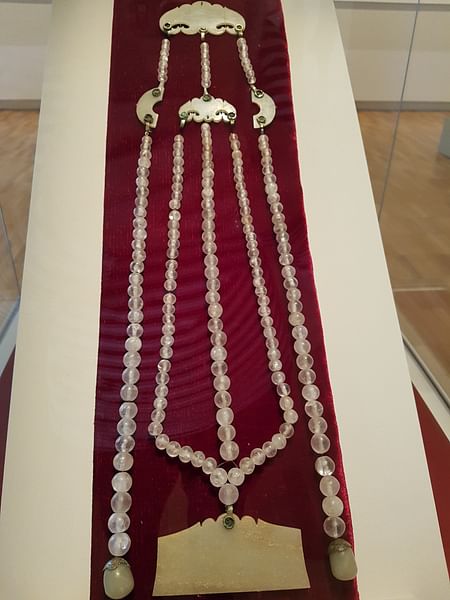 玉與水晶裝飾品 Liana Miate (CC BY-NC-SA) ](https://www.worldhistory.org/image/6057/jade--crystal-ornament/ "Jade & Crystal Ornament")### 衰落與遺產
長安的輝煌歲月在公元 880 年,被黃巢洗劫後,戛然而止,黃巢一場反政府的叛亂,而政府已經被多年的軍閥和土匪,橫掃鄉村所削弱。 公元 904-906 年,軍事將領朱全忠再次進攻,長安再被洛陽取代為首都。 由於城市的大部分建築都是木頭,因此更重要的建築被拆除並搬遷,而其他建築則被遺棄腐爛。 最終,這座曾經偉大的城市,變得雜草叢生,該地區用於農業,就像 2000 年前一樣。 唐朝詩人韋莊曾雄辯地,描述過這座城市的廢墟:
> 荒涼的長安城,你現在有什麼?
> 破敗的集市,荒涼的街道,長著嫩嫩的麥穗。
> 收集燃料,他們砍掉了杏仁公園的每一朵花;
> 為了建造路障,他們拔掉了大運河的柳樹。
> 彩繪客車,花紋車輪,早已散去;
> 富麗堂皇的朱紅色門樓,已不復存在!
> (道森,61 )
這座城市可能很快就消失了,但它確實留下了有形的遺產,因為長安極大地.影響東亞國家的首都,這些國家渴望被視為,像中國文明和先進。 日本的奈良及其繼承者平安京(京都)和韓國新羅王國的首都慶州,是模仿長安的高牆、寬闊街道的網格佈局,和隔離城區的突出例子。
#### Editorial Review
This human-authored definition has been reviewed by our editorial team before publication to ensure accuracy, reliability and adherence to academic standards in accordance with our [editorial policy](https://www.worldhistory.org/static/editorial-policy/).
## 参考文献
- [Dawson, R. *THE CHINESE EXPERIENCE.* Phoenix Press - Orion, 2017.](https://www.worldhistory.org/books/1898800499/)
- [Dillon, M. *China.* Routledge, 1998.](https://www.worldhistory.org/books/0700704396/)
- [Do Cosmo, N. *Military Culture in Imperial China.* Harvard University Press, 2011.](https://www.worldhistory.org/books/0674060725/)
- [Feng, L. *Early China.* Cambridge University Press, 2013.](https://www.worldhistory.org/books/052171981X/)
- [Lewis, M.E. *The Early Chinese Empires.* Belknap Press: An Imprint of Harvard University Press, 2010.](https://www.worldhistory.org/books/0674057341/)
- [Tregear, M. *Chinese Art.* Thames & Hudson, 1997.](https://www.worldhistory.org/books/0500202990/)
- [Watson, W. *The Arts of China to A.D. 900.* Yale University Press, 1995.](https://www.worldhistory.org/books/0300059892/)
## 关于作者
马克是一位全职作家、研究人员、历史学家与编辑,他对艺术、建筑,以及研究所有文明共有的思想尤为感兴趣。马克拥有政治哲学硕士学位,目前担任WHE出版总监一职。
## 时间轴
- **1600 BCE - 1046 BCE**: [Shang Dynasty](https://www.worldhistory.org/Shang_Dynasty/) in [China](https://www.worldhistory.org/china/).
- **1046 BCE - 771 BCE**: Western [Zhou dynasty](https://www.worldhistory.org/Zhou_Dynasty/) replaces the [Shang Dynasty](https://www.worldhistory.org/Shang_Dynasty/) in [China](https://www.worldhistory.org/china/).
- **206 BCE - 9 CE**: The Western [Han dynasty](https://www.worldhistory.org/Han_Dynasty/) rules [China](https://www.worldhistory.org/china/) from their capital in [Chang'an](https://www.worldhistory.org/Chang'an/).
- **Mar 202 BCE**: Emperor Gaozu (Liu Bang) becomes the first [Han](https://www.worldhistory.org/Han_Dynasty/) ruler.
- **141 BCE - 87 BCE**: Reign of Emperor Wu (Wu the Great), the most effective and influential of the [Han](https://www.worldhistory.org/Han_Dynasty/) monarchs.
- **140 BCE - 87 BCE**: [Han](https://www.worldhistory.org/Han_Dynasty/) emperor Wu rules and expands Han territory in [China](https://www.worldhistory.org/china/).
- **130 BCE**: The [Silk Road](https://www.worldhistory.org/Silk_Road/) is officially opened.
- **2 CE**: [Chang'an](https://www.worldhistory.org/Chang'an/), the imperial capital of [China](https://www.worldhistory.org/china/), had a population of nearly 250 thousand people.
- **23 CE**: The sack of [Chang'an](https://www.worldhistory.org/Chang'an/), imperial capital of [China](https://www.worldhistory.org/china/).
- **c. 23 CE**: After the sack of [Chang'an](https://www.worldhistory.org/Chang'an/), Liu Xiu led his loyal officials to the [city](https://www.worldhistory.org/city/) of [Luoyang](https://www.worldhistory.org/Luoyang/), where the Chinese imperial capital was relocated.
- **618 CE - 626 CE**: Reign of Gaozu, 1st Emperor of [Tang Dynasty](https://www.worldhistory.org/Tang_Dynasty/) in [China](https://www.worldhistory.org/china/).
- **618 CE - 907 CE**: The [Tang Dynasty](https://www.worldhistory.org/Tang_Dynasty/) in [China](https://www.worldhistory.org/china/).
- **626 CE - 649 CE**: Reign of Emperor [Taizong](https://www.worldhistory.org/disambiguation/Taizong/) in [China](https://www.worldhistory.org/china/).
- **649 CE - 683 CE**: Reign of Emperor Gaozong in [China](https://www.worldhistory.org/china/).
- **683 CE - 704 CE**: Reign of Empress [Wu Zetian](https://www.worldhistory.org/Wu_Zetian/), only female monarch of [China](https://www.worldhistory.org/china/).
- **712 CE - 756 CE**: Reign of [Xuanzong](https://www.worldhistory.org/disambiguation/Xuanzong/), 7th emperor of the [Tang Dynasty](https://www.worldhistory.org/Tang_Dynasty/) in [China](https://www.worldhistory.org/china/).
- **756 CE - 762 CE**: Reign of Emperor Suzong in [China](https://www.worldhistory.org/china/).
- **762 CE - 779 CE**: Reign of Emperor Daizong in [China](https://www.worldhistory.org/china/).
- **780 CE - 805 CE**: Reign of Emperor Dezong in [China](https://www.worldhistory.org/china/).
- **805 CE**: Reign of Emperor Shunzong in [China](https://www.worldhistory.org/china/).
- **821 CE - 824 CE**: Reign of Emperor Muzong in [China](https://www.worldhistory.org/china/).
- **824 CE - 826 CE**: Reign of Emperor Jingzong in [China](https://www.worldhistory.org/china/).
- **826 CE - 840 CE**: Reign of Emperor Wenzong in [China](https://www.worldhistory.org/china/).
- **840 CE - 846 CE**: Reign of Emperor Wuzong in [China](https://www.worldhistory.org/china/).
- **846 CE - 859 CE**: Reign of Emperor [Xuanzong](https://www.worldhistory.org/disambiguation/Xuanzong/) II in [China](https://www.worldhistory.org/china/).
- **859 CE - 873 CE**: Reign of Emperor Yizong in [China](https://www.worldhistory.org/china/); severe drought causes famine.
- **873 CE - 888 CE**: Reign of Emperor Xizong in [China](https://www.worldhistory.org/china/); Huang-Chao Rebellion erupts against government corruption and neglect.
- **874 CE - 884 CE**: Huang-Chao Rebellion topples weakened [Tang Dynasty](https://www.worldhistory.org/Tang_Dynasty/) in [China](https://www.worldhistory.org/china/).
- **904 CE - 907 CE**: Reign of Ai, last [Tang Dynasty](https://www.worldhistory.org/Tang_Dynasty/) Emperor of [China](https://www.worldhistory.org/china/); assassinated by Warlord Zhu Quanzong at age fifteen.
## 引用本文
### APA
Cartwright, M. (2023, March 02). 長安. (. 晚生姓高, 翻译). *World History Encyclopedia*.
### Chicago
Cartwright, Mark. "長安." 翻译: 晚生姓高. *World History Encyclopedia*, March 02, 2023. .
### MLA
Cartwright, Mark. "長安." 翻译: 晚生姓高. *World History Encyclopedia*, 02 Mar 2023, .
## 许可与版权
提交人: [晚生姓高](https://www.worldhistory.org/user/ezswvyqf/ "User Page: 晚生姓高"), 发表于 02 March 2023. 请查阅原始来源以获取版权信息。 请注意,从本页面链接的内容可能具有不同的许可条款。