---
title: 放逐制
author: Mark Cartwright
translator: Jinfeng Zhang
source: https://www.worldhistory.org/trans/zh/1-14606/
format: machine-readable-alternate
license: Creative Commons Attribution-NonCommercial-ShareAlike (https://creativecommons.org/licenses/by-nc-sa/4.0/)
updated: 2024-02-26
---
# 放逐制
_作者: [Mark Cartwright](https://www.worldhistory.org/user/markzcartwright/)_
_译者: [Jinfeng Zhang](https://www.worldhistory.org/user/jinfengzhang)_
[](https://www.worldhistory.org/trans/zh/1-22386/)[](https://www.worldhistory.org/trans/zh/2-2409/)放逐制是公元前五世纪雅典采用的一种政治程序,即通过民众投票,将那些被认为权力过大或对城邦造成危险的人流放 10 年。希腊历史上一些最伟大的人物都是这一制度的受害者,不过,由于投票往往不是针对个人,而是基于政策,因此许多人在被放逐10 年后,又重新开始从政。放逐是普通民众(demos)在雅典民主制度中打击滥用权力的最高典范。
### 程序
是否放逐某个人的决定每年做出一次。首先,就放逐问题要提交给在普尼克斯(Pnyx)山上召开的雅典公民大会(ekklesia)由6000 名男性公民在那里进行进行投票决定。如果同意,则在一年中第八个 prytany(一年分为十个prytany)的某一天在 阿哥拉(agora) 组织一次称为 “放逐投票”(ostracophoria) 的特别会议。投票由 500 人主席团(boule)和 9 名最高行政官员(archons)监督。公民在陶器(ostrakon)上写出某个人的名字进行投票。投票是匿名进行的。然后,被称为phylai的官员收集陶器,并确保没有人投两次票。
要使放逐的结果生效,至少要有 6000 张选票。然后,官员宣布哪个人获得了最多的选票,这个人就会被放逐,也就是“流放”这个词的原意。对这一决定不得上诉。被放逐的人有 10 天的时间来安排自己的事务,然后他必须离开城邦,10 年内不得返回阿提卡地区。有意思的是,该人并没有失去公民身份,也不没收其个人财产。
[  刻有伯利克里名字的陶片 Mark Cartwright (CC BY-NC-SA) ](https://www.worldhistory.org/image/4522/ostrakon-for-pericles/ "Ostrakon for Pericles")### 制度的滥用
流放并不是一种永久的耻辱,因为有些人在流放结束后确实会回来,并继续参与公共事务。这或许表明,投票反对的往往是某个人的政策,而非其个人,投票反对某个人也是对其竞争对手及其政策的支持。不过,肯定也有这样的情况,即在没有任何正式指控的情况下,公民大会被民粹主义所左右,在没有充分理由的情况下投票反对某个人。普鲁塔克(Plutarch)在他的《阿里斯提德传》中记述了一个有名的例子:一位公民大会成员打算投票反对阿里斯提德,原因仅仅是他听够了这位政治家不断被称为 "正义者"。
另一个可疑的制度滥用是,在雅典卫城附近的一口井里发现了 190 片陶器,上面都刻有忒米斯托克勒(Themistocles)的名字,但很难辨认出是出自何人之手。这些是否表明,忒米斯托克勒对手的支持者将陶片交给了腐败的公民大会成员,以操纵投票?
### 著名(或臭名昭著)的流放者
[亚里士多德](https://www.worldhistory.org/trans/zh/1-355/)称,约公元前 508 年,在克里斯提尼(Cleisthenes)统治下,为了防止个人的暴政,制定了陶片放逐法。然而,直到公元前约 487 年才实行了第一次真正意义上的流放。随后,查尔摩斯(Charmus)之子、与僭主庇西特拉图有亲戚关系的喜帕恰斯声称自己是第一个使用这种方法进行流放的人。随后两年,克拉提乌斯(Cratius)之子梅格克莱斯(Megacles)和卡利亚斯(Callias)也被流放。这些早期的流亡者很可能因支持波斯和反对日益民主的雅典政府而被判有罪。
桑西普斯(公元前 484 年被流放)和阿里斯提德(公元前 482 年)的情况值得注意,因为他们都在公元前 480 年获得赦免并获准返回雅典,以应对薛西斯发动的波斯入侵的新威胁。在接下来的几十年里,希腊历史上一些最著名的人物都成为了这一制度的牺牲品,这一点可以从古代流传下来的 12 000 个陶片中看出。公元前 471 年,著名政治家忒米斯托克勒因被指控贿赂而被流放;公元前 461 年,伟大的西蒙(Cimon)将军被怀疑与斯巴达过于友好;公元前 443 年,佩里克利斯(Pericles)利用放逐手段将对手赶出了政治舞台,修昔底德(不是古希腊历史学家修昔底德)成为了佩里克利斯的牺牲品。
[ 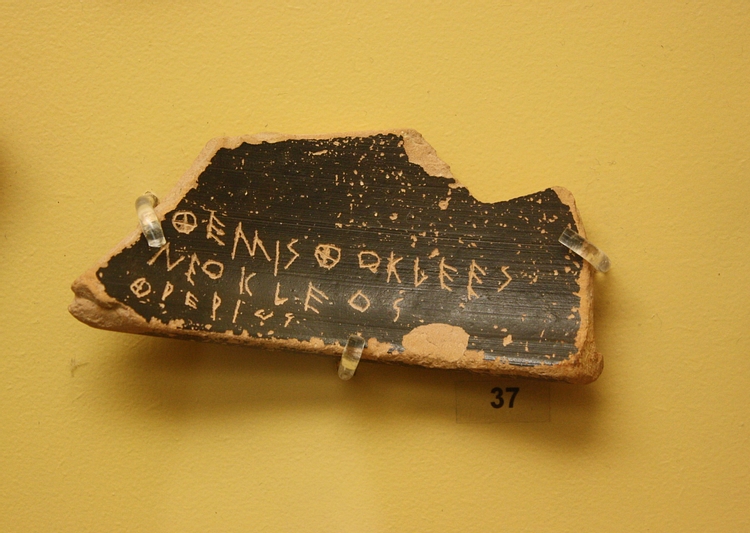 刻有特米斯托克利名字的陶片 Mark Cartwright (CC BY-NC-SA) ](https://www.worldhistory.org/image/4782/ostrakon-for-themistocles/ "Ostrakon for Themistocles")### 放逐制度的结束
最后一个被流放的人是煽动者希柏波罗(Hyperbolos,约公元前 417 年)。他本想利用这一制度流放他的两个主要对手阿尔西比亚德斯(Alcibiades)或尼西亚斯(Nicias)中的一个,但两人联合起来,成功地将希柏波罗斯赶出了城邦。此后,尽管直到公元前 4 世纪这一程序在法律上仍然可行,但再也没有出现过这种情况。政治对手们转而采用 "graphe paranomon "程序,即任何人都可以对某人提出正式指控,可以声称其提案违宪。被指控者如果被判有罪,将被处以巨额罚款,如果在三起此类案件中败诉,则不再有资格参与政治。
后来的史料显示,曾被放逐过的著名人物包括阿尔戈斯、梅加拉、米利托斯和锡拉库扎,但缺少这方面的考古证据。公元前一世纪的西西里历史学家狄奥多罗斯(Diodorus)描述了西西里岛的一种放逐行为,简单说就是在放逐制度中用橄榄叶代替陶器碎片,这被称为 "花瓣放逐"(petalismos)。
#### Editorial Review
This human-authored definition has been reviewed by our editorial team before publication to ensure accuracy, reliability and adherence to academic standards in accordance with our [editorial policy](https://www.worldhistory.org/static/editorial-policy/).
## 参考文献
- Bagnall, R. et al. *The Encyclopedia of Ancient History.* Wiley-Blackwell, 2012
- [Boyes-Stones, G. et al. *The Oxford Handbook of Hellenic Studies.* Oxford University Press, 2009.](https://www.worldhistory.org/books/0199286140/)
- [Hornblower, S. *The Oxford Classical Dictionary.* Oxford University Press, 2012.](https://www.worldhistory.org/books/0199545561/)
- [Plutarch. *By Plutarch - The Rise and Fall of Athens.* Penguin Classics, 1960.](https://www.worldhistory.org/books/B00HTKATHS/)
## 关于作者
马克是一位全职作家、研究人员、历史学家与编辑,他对艺术、建筑,以及研究所有文明共有的思想尤为感兴趣。马克拥有政治哲学硕士学位,目前担任WHE出版总监一职。
## 时间轴
- **c. 508 BCE**: According to [Aristotle](https://www.worldhistory.org/aristotle/), the institution of [ostracism](https://www.worldhistory.org/Ostracism/) is introduced in [Athens](https://www.worldhistory.org/Athens/) under [Cleisthenes](https://www.worldhistory.org/Cleisthenes/).
- **c. 487 BCE**: The first [ostracism](https://www.worldhistory.org/Ostracism/) vote takes place in [Athens](https://www.worldhistory.org/Athens/) and Hipparchus is exiled.
- **482 BCE**: [Aristides](https://www.worldhistory.org/Aristides/) is voted in an [ostracism](https://www.worldhistory.org/Ostracism/) in [Athens](https://www.worldhistory.org/Athens/) and exiled from the [city](https://www.worldhistory.org/city/).
- **c. 471 BCE**: The general and statesman [Themistocles](https://www.worldhistory.org/Themistocles/) is voted in an [ostracism](https://www.worldhistory.org/Ostracism/) and exiled from [Athens](https://www.worldhistory.org/Athens/).
- **461 BCE**: [Cimon](https://www.worldhistory.org/cimon/) is voted in an [ostracism](https://www.worldhistory.org/Ostracism/) in [Athens](https://www.worldhistory.org/Athens/) and exiled from the [city](https://www.worldhistory.org/city/).
- **c. 417 BCE**: In the last recorded [ostracism](https://www.worldhistory.org/Ostracism/) the demagogue Hyperbolos is exiled from [Athens](https://www.worldhistory.org/Athens/).
## 引用本文
### APA
Cartwright, M. (2024, February 26). 放逐制. (J. Zhang, 翻译). *World History Encyclopedia*.
### Chicago
Cartwright, Mark. "放逐制." 翻译: Jinfeng Zhang. *World History Encyclopedia*, February 26, 2024. .
### MLA
Cartwright, Mark. "放逐制." 翻译: Jinfeng Zhang. *World History Encyclopedia*, 26 Feb 2024, .
## 许可与版权
提交人: [Jinfeng Zhang](https://www.worldhistory.org/user/jinfengzhang/ "User Page: Jinfeng Zhang"), 发表于 26 February 2024. 请查阅原始来源以获取版权信息。 请注意,从本页面链接的内容可能具有不同的许可条款。