---
title: 古代絲綢
author: Mark Cartwright
translator: 晚生姓高
source: https://www.worldhistory.org/trans/zh/1-14550/
format: machine-readable-alternate
license: Creative Commons Attribution-NonCommercial-ShareAlike (https://creativecommons.org/licenses/by-nc-sa/4.0/)
updated: 2023-05-03
---
# 古代絲綢
_作者: [Mark Cartwright](https://www.worldhistory.org/user/markzcartwright/)_
_译者: [晚生姓高](https://www.worldhistory.org/user/ezswvyqf)_
[](https://www.worldhistory.org/trans/zh/1-22386/)[](https://www.worldhistory.org/trans/zh/2-2409/)絲綢是中國新石器時代,最早由蠶繭的細絲製成的織物。 成為小農的主要收入來源,隨著織造技術的改進,中國絲綢的名聲傳遍,整個古代世界的帝國。 作為中國歷史上,最重要的出口產品,這種材料以其名字,命名了偉大的貿易網絡絲綢之路,該網絡將東亞與歐洲、印度和非洲連接起來。 絲綢不僅用於製作精美的衣服,還用於製作扇子、壁掛、橫幅,並作為作家和藝術家常用的紙張替代品。
### 起源與栽培
絲綢由蠶 產生,以形成幼蟲在其中發育的繭。 單個樣本能夠生產超過 900 米(3,000 英尺)長的 0.025 毫米粗線。 然後將幾根這樣的細絲捻在一起,製成一根足夠粗的線,用於編織材料。 織物是使用織布機製造,腳踏式出現在漢代(公元前 206 年 - 公元 220 年)墓葬的壁畫中。 絲綢可以使用硃砂、紅赭石、銀粉、蛤殼粉、靛藍和其他從植物中提取的墨水等礦物和天然材料進行染色和繪畫。
養蠶——即種桑葉、養蠶、採繭和織絲——最早出現在中國古代的考古記錄中。 公元前 3600 年。 浙江省河姆渡的發掘,揭示了新石器時代的織布工具和絲網。 編織絲綢的最早已知例子,可以追溯到 公元前2700年,來自同樣位於浙江的千山陽遺址。 最近的考古證據表明,印度次大陸北部的印度河流域文明,也在使絲綢與新石器時代的中國同時代。 他們用 Antheraea 蛾生產用於編織的絲線。
然而,大規模的絲綢生產,和更複雜的織造技術,只出現在公元前 2 千年的中國商周時期。 絲綢隨後成為古代中國,最重要的製造和貿易商品之一,在埃及墓葬中發現的商代(公元前 1600 - 1046 年)絲綢證明了其在早期國際貿易中的重要價值和用途。
### 進化
到了漢代,絲綢的質量進一步提高,變得更細、更結實,並且經常繡有五彩斑斕的人物和動物圖案。 漢字也被編織到許多倖存的例子中。 一些漢代的織品,每厘米有220根經線,非常精細。 從公元 1 世紀開始,蠶本身的栽培也變得更加複雜,其技術用於通過調節環境溫度,來加速或減緩它們的生長。 使用了不同的品種,並將它們雜交以培育出,能夠生產對織工有用的不同質量線的蠶。
[ 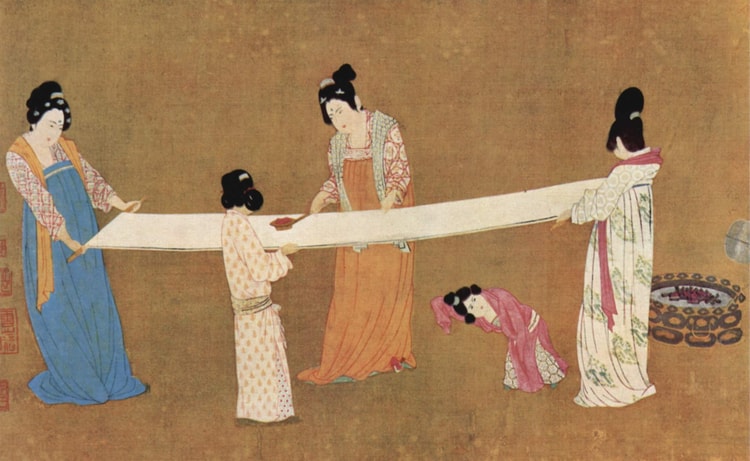 宋代檢查絲綢的婦女。 Unknown Artist (Public Domain) ](https://www.worldhistory.org/image/6920/women-checking-silk-song-china/ "Women Checking Silk, Song China.")織工通常是女性,她們也有責任確保,蠶以最喜歡的切碎桑葉為食,並確保它們足夠暖和,足以吐絲結繭。 該產業成為家庭,重要的收入來源,以至於專門用於種植桑樹的土地,免於收集,否則農地將不屬農民所有,桑地成為農民唯一可能擁有土地 的世襲所有權。 儒家孟子提倡最小的土地佔有量,總是留出一塊土地來種植桑樹。 隨著需求增長,國家和那些有足夠資金的人,建立男女工作的大型作坊。 大貴族之家有自己的私人絲綢生產團隊,數百名工人受僱生產絲綢,以滿足莊園的需要和轉售。 絲綢生產甚至成為詩詞的題材,例如戰國時期荀子〈蠶賦〉:
> 有物於此,
> 㒩㒩其狀,
> 屢化如神。
> 功被天下,
> 爲萬世文
> 禮樂以成,
> 貴賤以分。
> 養老長幼,
> 待而後存。
> (劉易斯,114-115)
最終,中國人無法再保守利潤豐厚的絲綢生產秘密,開始在韓國和日本製造絲綢,成為國家控制的行業。 其他國家,隨後在公元 300 年左右獲得了養蠶技術,例如印度,並從那里傳播到拜占庭、阿拉伯、黎凡特和意大利。
### 貿易:絲綢之路
中國製造的絲綢名聲,傳遍了著名的貿易路線——絲綢之路——這就是這種商品對中國經濟的重要。 [絲綢之路](https://www.worldhistory.org/trans/zh/1-466/),實際上是連接中國和中東,的一整套陸路駱駝商隊路線網絡,因此現在常被歷史學家稱為絲綢之路。 絲綢——以線、織布和成品的形式——因此通過中間商(沒有一個商人走過這條路)不僅出口到朝鮮王國和日本等鄰國,而且出口到偉大的 印度、波斯、埃及、希臘和羅馬帝國。 就後者而言,據說國家最終的金融崩潰部分是由於白銀不斷流向東方,在那裡購買羅馬人離不開的絲綢。 羅馬人甚至將中國的 絲稱為 Seres,以該語言中的絲綢一詞命名。
[  絲綢之路 Simeon Netchev (CC BY-NC-ND) ](https://www.worldhistory.org/image/146/map-of-the-silk-road-during-the-late-8th-century/ "Map of the Silk Road During the Late 8th Century")除了陸路和穿越內海通往日本的通道外,從公元 11 世紀開始,中國帆船還橫跨印度洋航行和貿易,絲綢因此幾個世紀以來,一直是中國的第一大出口產品; 它只能與公元 15 世紀的瓷器和茶葉相媲美。 到 20 世紀,日本將取代中國,成為世界上最大的絲綢生產國。
### 用途
在中國,後來在其他地方,絲綢用來製作服裝(特別是長袍、長袍和夾克)、手扇、家具、壁掛、屏風、名著和詩歌的裝飾場景、軍旗、喪葬旗幟、 佛教曼荼羅,以書寫為目的,代替竹紙。 色彩鮮豔、繡花精美的絲綢長袍成為身份的象徵,有助於將官員和朝臣,與穿著棉質或素色絲綢,下層階級區分開來。 在其他文化中,例如韓國,甚至有法律禁止低於一定社會地位的人,穿著絲綢。 刺繡絲綢變得如此多樣和精緻,以至於圍繞這種材料形成了一種完整的鑑賞力,類似於對中國陶藝家精美瓷器的鑑賞力。 道士是另一個以他們的絲綢長袍,而著稱的群體,通常繡有儀式場景。
作為一種有價值的商品,絲綢經常被用作一種貨幣形式,特別是在北宋(公元 960-1127 年)和南宋(公元 1127-1276 年)向遼金進貢時 皇帝分別。 絲綢也是一種受人尊敬的禮物。 贈予附屬國以表彰他們的忠誠,這是中國皇帝巨大財富和慷慨大方的令人印象深刻的象徵。 例如,僅在公元前 25 年,漢人就贈送了令人難以置信的 20,000 卷絲布。 商人用它作為一種付款,人們用它來納稅,甚至軍隊有時也用絲綢來支付。
[  來自中國的絲綢和紡織鞋 The Trustees of the British Museum (Copyright) ](https://www.worldhistory.org/image/4988/silk--textile-shoe-from-china/ "Silk & Textile Shoe from China")在藝術中,絲綢成為一種流行的書面,可以在其上繪製風景和肖像。 唐朝(公元 618-907 年)的藝術家以其在絲綢上的染色、印刷和繪畫技藝而聞名,他們的許多作品留存於日本,並被作為禮物送往日本。 絲綢書被製成,其中有名畫的副本,因此成為藝術鑑賞家的參考冊。
### 文化影響
絲綢之路沿線的絲綢和其他商品貿易,也帶來了雙向的思想和文化習俗; 語言和文字是商人、外交官、僧侶和旅行者,沿途傳播的特別重要的元素。 佛教從印度傳到中國,然後傳到韓國和日本。 [馬可波羅](https://www.worldhistory.org/trans/zh/1-17877/)等探險家,使用這條路線,西方基督教傳教士,首次進入中國也是如此。 核桃、石榴、芝麻和香菜等新食品被引入中國,並在中國種植。 長期以來,絲綢一直是中國的象徵,它打開了通向新大陸和新思想的大門,最終連接了古代世界的偉大帝國。
#### Editorial Review
This human-authored definition has been reviewed by our editorial team before publication to ensure accuracy, reliability and adherence to academic standards in accordance with our [editorial policy](https://www.worldhistory.org/static/editorial-policy/).
## 参考文献
- Bagnall, R et al. *The Encycloedia of Ancient History.* Wiley-Blackwell, 2012
- [Clunas, C. *Art in China.* Oxford University Press, 2009.](https://www.worldhistory.org/books/0199217343/)
- [Dawson, R. *The Chinese Experience.* Phoenix Press - Orion, 2017.](https://www.worldhistory.org/books/1898800499/)
- [Dillon, M. *China.* Routledge, 1998.](https://www.worldhistory.org/books/0700704396/)
- [Ebrey, P.B. *East Asia.* Wadsworth Publishing, 2013.](https://www.worldhistory.org/books/1133606474/)
- [Feng, L. *Early China.* Cambridge University Press, 2013.](https://www.worldhistory.org/books/052171981X/)
- [Henshall, K. *Historical Dictionary of Japan to 1945.* Scarecrow Press, 2013.](https://www.worldhistory.org/books/0810878712/)
- [Hornblower, S. *The Oxford Classical Dictionary.* Oxford University Press, 2012.](https://www.worldhistory.org/books/0199545561/)
- [Lewis, M.E. *The Early Chinese Empires.* Belknap Press: An Imprint of Harvard University Press, 2010.](https://www.worldhistory.org/books/0674057341/)
- [Pratt, K. *Korea.* Routledge, 1999.](https://www.worldhistory.org/books/0700704639/)
- [Tregear, M. *Chinese Art.* Thames & Hudson, 2017.](https://www.worldhistory.org/books/B01FIXNVW2/)
## 关于作者
马克是一位全职作家、研究人员、历史学家与编辑,他对艺术、建筑,以及研究所有文明共有的思想尤为感兴趣。马克拥有政治哲学硕士学位,目前担任WHE出版总监一职。
## 时间轴
- **c. 3600 BCE**: First appearance of [silk](https://www.worldhistory.org/Silk/) in [China](https://www.worldhistory.org/china/).
- **c. 2700 BCE**: The earliest known examples of woven [silk](https://www.worldhistory.org/Silk/) from Qianshanyang, [China](https://www.worldhistory.org/china/).
- **130 BCE**: The [Silk Road](https://www.worldhistory.org/Silk_Road/) is officially opened.
- **129 BCE**: Parthians [conquer](https://www.worldhistory.org/warfare/) [Mesopotamia](https://www.worldhistory.org/Mesopotamia/). The [Silk Road](https://www.worldhistory.org/Silk_Road/) to [China](https://www.worldhistory.org/china/) is now controlled by the Parthians.
- **27 BCE - 14 CE**: Reign of [Augustus](https://www.worldhistory.org/augustus/) [Caesar](https://www.worldhistory.org/disambiguation/caesar/) in [Rome](https://www.worldhistory.org/Rome/), Chinese [silk](https://www.worldhistory.org/Silk/) is very popular.
- **161 CE - 180 CE**: Reign of Emperor [Marcus Aurelius](https://www.worldhistory.org/Marcus_Aurelius/) in [Rome](https://www.worldhistory.org/Rome/), Chinese [silk](https://www.worldhistory.org/Silk/) popularity endures.
- **527 CE - 565 CE**: Reign of Emperor Julian of the Eastern [Roman](https://www.worldhistory.org/disambiguation/Roman/) ([Byzantine](https://www.worldhistory.org/disambiguation/Byzantine/)) [Empire](https://www.worldhistory.org/empire/). Beginning of Byzantine [silk](https://www.worldhistory.org/Silk/) industry.
- **542 CE**: The bubonic [plague](https://www.worldhistory.org/disambiguation/plague/), thought to have been brought through the [Silk Road](https://www.worldhistory.org/Silk_Road/), decimates [Constantinople](https://www.worldhistory.org/Constantinople/).
## 外部链接
- [Trade Routes between Europe and Asia during Antiquity | Essay | The Metropolitan Museum of Art | Heilbrunn Timeline of Art History](https://www.metmuseum.org/toah/hd/trade/hd_trade.htm)
## 引用本文
### APA
Cartwright, M. (2023, May 03). 古代絲綢. (. 晚生姓高, 翻译). *World History Encyclopedia*.
### Chicago
Cartwright, Mark. "古代絲綢." 翻译: 晚生姓高. *World History Encyclopedia*, May 03, 2023. .
### MLA
Cartwright, Mark. "古代絲綢." 翻译: 晚生姓高. *World History Encyclopedia*, 03 May 2023, .
## 许可与版权
提交人: [晚生姓高](https://www.worldhistory.org/user/ezswvyqf/ "User Page: 晚生姓高"), 发表于 03 May 2023. 请查阅原始来源以获取版权信息。 请注意,从本页面链接的内容可能具有不同的许可条款。