---
title: 汉朝
author: Joshua J. Mark
translator: Jinfeng Zhang
source: https://www.worldhistory.org/trans/zh/1-11960/
format: machine-readable-alternate
license: Creative Commons Attribution-NonCommercial-ShareAlike (https://creativecommons.org/licenses/by-nc-sa/4.0/)
updated: 2024-03-18
---
# 汉朝
_作者: [Joshua J. Mark](https://www.worldhistory.org/user/JPryst/)_
_译者: [Jinfeng Zhang](https://www.worldhistory.org/user/jinfengzhang)_
[](https://www.worldhistory.org/trans/zh/1-22386/)[](https://www.worldhistory.org/trans/zh/2-2409/)汉朝(前 202 年- 220 年)是帝制中国的第二个王朝(中央集权的王朝时代,前 221 年-1912 年),它为直到公元 1912 年的所有后继王朝建立了一种范式。它继承了秦朝(前 221-前206 年),之后是三国时期(220-280 年)。
汉朝由平民刘邦(汉高祖,前 256-前195 年)建立,刘邦致力于通过更加仁慈的法律和对人民的关怀来弥补秦朝高压统治所造成的损害。王朝分为两个时期:
- 西汉(亦称前汉): 前 202 年 - 9 年
- 东汉(亦称后汉): 25-220 年
王莽(前 45 年- 23 年)宣布汉朝灭亡,建立了新朝(9 年-23 年)。王莽的理想主义政体失败了,在短暂的动乱之后,汉朝又恢复了。
汉高祖最初保留了秦朝的法家思想,但没有那么严厉。汉武帝(又称汉武大帝,前 141-前87 年)是汉朝最有名的君主,有许多令人印象深刻的成就,他开辟了丝绸之路,建立了与西方的贸易。汉朝还与北边的匈奴和鲜卑游牧民族以及西边的西戎进行了和谈,和谈或多或少得到了遵守,稳定了边境,促进了和平以及艺术和科学文化的发展。今天许多习以为常的物品都是汉代发明的,如独轮车、指南针、活动扳手、地震仪和纸张等等。
汉朝还恢复了被秦朝抛弃的周朝文化价值观,鼓励文学和研究历史。史学家司马迁(公元前 145/35-前86 年)生活在这一时期,他的《史记》为直到 20 世纪的中国历史著作确立了标准和范式。中国的神话和宗教也在这一时期得到了发展,其中包括以西王母为中心的民间救世主。
但到了约 130 年,宫廷腐败,宦官的实际权力超过了汉朝皇帝。到了汉灵帝(168-189 年)时期,汉朝皇室的实际权力小于宫廷宦官和驻守边疆的将领(他们或多或少是自治的军阀)。184 年,因苛捐杂税和饥荒爆发了黄巾起义,朝廷将领平定了这场叛乱。
在平定叛乱的将领中包括曹操(155-220 年),后来为争夺国家控制权而与群雄发动战争。他在208 年的赤壁之战中战败,之后三国鼎立,汉朝灭亡。汉朝的影响深远,一直延续至今,大多数中国人都自豪地称自己为 "汉人",认为自己是这个伟大古代王朝的后裔。
### 秦朝的兴衰
周朝(前 1046-前256 年)建立了自己的分封制,由忠于国王的诸侯统治不同的邦国。起初,这种政府治理形式运行良好,但随着时间的推移,各诸侯国的势力逐渐超过了中央政府,并试图向周朝索要天命。
“天命”这一概念最初产生于商朝(前 1600 年-前 1046 年),后经周朝发展,认为君主的统治由神权赋予合法性,神权与君主达成协议:只要君主关心臣民的福祉,就会得到神权的庇佑。当君主和王朝家族似乎更关心自己而不是人民时(社会和经济动荡就是证明),人们就会认为他们已经失去了天命,应该被取代。
[ 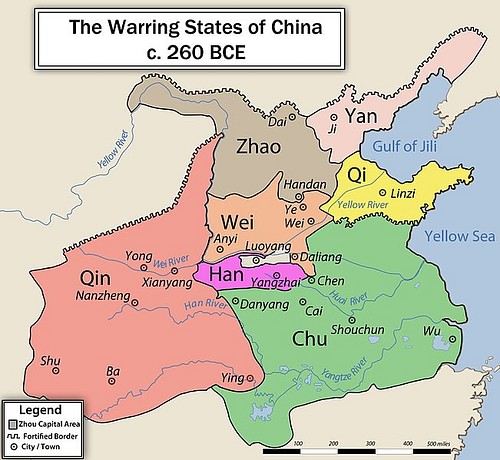 战国时期,公元前 3 世纪 Philg88 (CC BY-SA) ](https://www.worldhistory.org/image/6864/chinese-warring-states-3rd-century-bce/ "Chinese Warring States, 3rd century BCE")在整个战国时代(前 481 年至前 221 年),七个独立的国家为争夺霸权(这将使它们获得天命)而相互征战,但都未能取得优势,直到秦国在国王嬴政的领导下采取全面战争政策,击败了其他国家。嬴政自称始皇帝,于公元前 221 年建立了秦朝。起初,始皇帝似乎遵守天命,爱护百姓,但后来变得越来越专制和暴虐。到公元前 213 年,人们被征召为他修建工程,实质上充当奴隶劳工。同时禁止言论自由,焚烧除秦史、法家或实用书籍以外的任何书籍。
公元前 210 年,始皇帝驾崩,他软弱的儿子秦二世(前 210-前207 年)继位,但他无法抵御叛乱,无法维持帝国。起义军由楚国贵族项羽(前 232-前202 年)领导,项羽封平民刘邦为汉王。刘邦接受了秦朝末代皇帝子婴(卒于前 206 年)的投降,并对他及其家人礼遇有加,但项羽却下令将他们全部处死。
这绝非两人的第一次意见分歧(此时他们已经争斗了一年多),他们都想成为中国唯一统治者的野心引发了被称为楚汉争霸(公元前 206-202 年)的冲突,公元前 202 年的垓下之战对刘邦获胜,项羽兵败,自杀身亡。刘邦(后称高祖)成为中国的最高统治者,建立了汉朝。
### 西汉
刘邦起初奖赏韩信、彭越和其他帮助他打败项羽的将领,给他们大笔的财产和分封诸侯国,但后来对他们产生了怀疑,可能是在他野心勃勃的妻子吕雉皇后(公元前 241-180 年)的怂恿下,把他们全部处死了。他最初在洛阳建都,后来出于防御目的迁都长安。由于没有治国经验,高祖不得不借鉴以前的模式,因此采用了周朝的分封制和秦朝的法家思想(尽管实施更为仁慈)。分权的国家被划分为 13 个行政区域,称为郡,并将 10个诸侯国授予他的家族成员,希望他们能够秉公行事。
[  汉高祖刘邦 Miuki (CC BY-SA) ](https://www.worldhistory.org/image/994/liu-bang-emperor-gaozu/ "Liu Bang (Emperor Gaozu)")秦朝曾滥用天命镇压人民,为的是皇帝得到更大荣耀,而高祖则采取措施确保自己不会重蹈覆辙。作为曾经的平民,他了解农民的生活,并采取了一些措施,如降低税收和向所有阶层开放官职,为人们提供向上流动的机会。
高祖于公元前 195 年去世,吕后控制的三个傀儡诸侯王继位:孝惠皇帝刘盈(前 195-前188 年)、前少帝刘恭(前 188-前184 年)和后少帝刘弘(前 184-前180 年)。在这一时期,吕雉皇后是王位背后的掌权者,她令人生畏,没有人质疑她的政策。她死后,贵族们诛杀了她的全家,并选择了自己人汉文帝刘恒(前 180-前157 年),刘恒被认为是汉代最有作为的君主之一。
此时的汉朝仍然沿袭周朝的分封制。在汉文帝的儿子汉景帝(前 157-前141 年)的统治下,随着诸侯国势力的增长,他们对皇位的威胁也被认识到。景帝明白,诸侯国迟早会反叛,他指责诸侯国的统治者和郡县官员犯有各种罪行,并减少了他们的领土。
景帝的治理行动导致了公元前 154 年的七国之乱。景帝的军队击败了叛军,恢复了秩序,但很明显,分封制对汉朝来说不会比对周朝更好。景帝实行中央集权,并制定了其他措施来维持各诸侯国的秩序。文景之治因其稳定和文化进步而常被称为汉朝历史上的 "黄金时代",如果他们是较弱的君主,汉朝可能会随着七国之乱而灭亡。
景帝由他的儿子武帝继承,由于他的扩张主义政策和改革,人们通常称他为汉武大帝。他的早期改革为下层民众提供了前所未有的担任政府职务的机会,抑制了贵族的贪婪,并扩大了法典的范围,法律面前人人平等。这些改革遭到了贵族们的反对,尤其是武帝的祖母皇太后,她在宫廷中拥有强大的影响力。武帝绕过他们的反对,建立了由平民组成的 "内朝",并将他们提升到重要的政府职位,以便在未经官方批准的情况下执行他的改革建议。皇太后去世后,他得以公开实施改革,并将儒家思想作为国家哲学。
他还实行了全方位的扩张政策,在北方打败了匈奴,征服了今朝鲜和越南地区。公元前 130 年,他开辟了丝绸之路,建立了与西方的贸易往来,开启了跨文化传播的先河,并鼓励西王母崇拜,激发了关于不朽和生命意义的宗教、哲学和文学作品。
[ 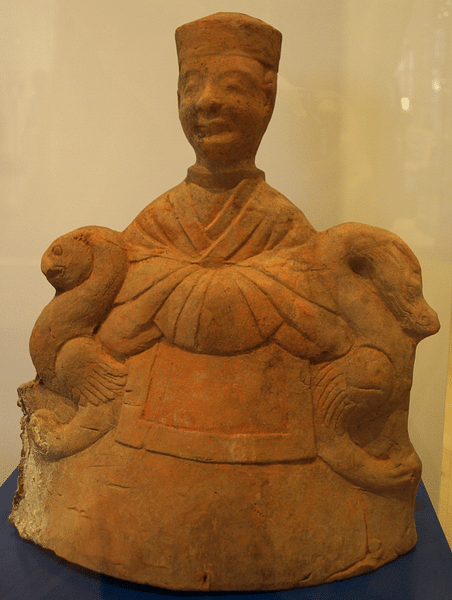 西王母 Captmondo (CC BY-SA) ](https://www.worldhistory.org/image/12426/queen-mother-of-the-west/ "Queen Mother of the West")武帝时期,西王母崇拜盛行,中国各地的西王母神庙成倍增加。西王母最早出现在商代甲骨文中,在周秦时期一直被奉为神灵。她也被称为王母娘娘,是繁荣和永生的女神。
民间流传着这样的故事:西王母在七月七日的圣夜秘密会见了汉武帝,与他分享了自己的秘密,这也是汉武帝统治时期智慧的来源。学者 Patricia Buckley Ebrey 指出,"这场运动是中国历史上第一次有记载的救世主千禧年运动"(73),无论正在经历怎样的考验,它鼓励人们进一步发展死后生命、永恒和终极意义的概念。对西王母的崇拜往往表现为激情的爆发和预言性的幻象,其中一个幻象据说预言了汉朝即将灭亡。
### 新朝和东汉
汉武帝之后的八位君主中,最后一位是皇太后王政君的侄子王莽(前 71 年- 13 年),王莽被任命为皇位继承人的摄政王,并承诺在继承人成年后交出王权,但后来却篡权建立了新朝("新 "王朝)。王莽是一位儒家学者,也是一位理想主义者,他认为一个有明确愿景、可以随心所欲的独裁强势统治者,要比一个在执行政策之前还要听取他人意见、与他人讨论政策的统治者更有效力。因此,他基本上是事必躬亲的独裁统治者。
由于他不信任他人,他拒绝将责任下放,因此本应进行改革的政府薪资制度被忽视,官员们无偿工作。这助长了腐败,因为为了购买生活必需品,这些官员开始向公民收取本应免费的服务费用,并收受贿赂。王莽试图在政府政策中全面贯彻儒家理念,本意是好的,但他既没有经验,也没有有效治理国家的能力。
他建立了国家森林所有权制度,让所有人都能利用森林,建造了用于祭祀的公共场所和用于分配食物的公共粮仓,并削减了宫廷预算,为公共项目提供更多资金。然而,他不善于授权,对自己和自己所能取得的成就抱有不切实际的幻想,最终导致了他的垮台。人民对他的无能日益不满,一群暴民攻占了皇宫,将他砍成碎片,把他的头颅当球踢。
王莽死后,太子刘玄即位(即所谓的 "更始帝",23-25 年),但他软弱无能,在 "赤眉之乱 "中被废黜(所谓赤眉之乱是因为叛军在眉毛上画了一条红色的条纹)。王莽的统治通常被学者们视为篡位,东汉时期从汉光武帝(公元 25-57 年)开始。光武帝迁都洛阳,并进行了一系列改革,以防止新朝的混乱局面再次发生。
光武帝的改革使汉朝得以延续,但汉朝的统治集团很快就蜕变为一系列只顾享乐而不顾治国的君主。汉安帝(106-125 年)将自己的责任交给宫中的宦官,自己却整日饮酒作乐。他的继任者汉顺帝(125-144 年在位)同样无能,而且非常腐败,他的统治引发了公元 142 年的五斗米之乱。桓帝(146-168 年在位)是顺帝的继任者,他懒惰无能,当一群学生要求他罢免和惩治贪官污吏时,他抓捕学生而让官员留任。
[  中国仆人雕像 Guillaume Jacquet (CC BY-SA) ](https://www.worldhistory.org/image/1242/a-chinese-servant-statue/ "A Chinese Servant Statue")东汉继续走下坡路,由宦官和腐败官员做出政治决策,并任命无能的亲戚担任重要官职。与此同时,东汉实施他们在越南和朝鲜的扩张政策,同时还要抵御鲜卑人对边境的袭击。这些战役不仅耗资巨大,需要更高的税收来支付,而且还需要在边境地区驻扎强大的军队。这增强了驻扎在那里的将领的权力,皇帝却越来越孤立无援。
在桓帝的继任者灵帝时期,洪水、饥荒和苛捐杂税导致了公元 184 年的黄巾之乱,这些将领表面上以桓帝的名义但实际上是为了自身利益而平定了这场叛乱,进一步削弱了皇权。这些将领中包括权臣曹操,他随后与其他群雄开战,试图在他的统治下统一中国,但他在公元 208 年的赤壁之战中战败,中国分裂为三国:曹魏、东吴和蜀汉,各领天命,标志着汉朝的灭亡。
### 结论
汉朝始于一种政府治理创新,高祖和他的谋臣们试图在周朝的过度信任政策和秦朝的偏执镇压之间找到一种平衡,但却无从下手。汉朝继承了秦朝以过度蛮力维持的广袤疆土,而周朝则以过少的武力失去了这些疆土。为了达到完美的平衡,汉朝鼓励人民创新。
约公元前 180 年,汉朝人就发明了乐理;公元前 132 年,汉朝人发明了地震仪;约公元前 105 年,汉朝人发明了造纸术;公元前 40 年,汉朝人发明了用于发电的水车。还有历法、数学和医学典籍、制图学、冶金学、建筑学、天文学以及其他许多学科和概念,这些常用与不常用的物品都是汉代发明或发展起来的。丝绸之路建立了与西方的直接联系,使这些发明以及宗教、哲学和其他文化价值得以在不同文明之间传播。
但汉朝的灭亡是不可避免的,因为帝国已经发展得过于庞大,中央政府已无法有效治理。雪上加霜的是,后来的汉朝皇帝品行不端,忘记了自己对人民的责任,只把人民视为奢侈生活的手段,而不是承担照顾和保护人民的责任。
汉朝灭亡后的三国时期是一个充满暴力和不确定性的时期,其苦难程度不亚于战国时期。多年后,隋朝(589 年- 618 年)才恢复了汉朝的稳定和统一,隋朝实施了改革,以防止导致汉朝灭亡的弱点,同时保留了使汉朝成为中国历史上最伟大王朝行列的诸多方面。
#### Editorial Review
This human-authored definition has been reviewed by our editorial team before publication to ensure accuracy, reliability and adherence to academic standards in accordance with our [editorial policy](https://www.worldhistory.org/static/editorial-policy/).
## 参考文献
- [Durant, W. *Our Oriental Heritage.* Simon and Schuster, 2014.](https://www.worldhistory.org/books/B001EBTCZS/)
- [Ebrey, P. B. *The Cambridge Illustrated History of China.* Cambridge University Press, 2010.](https://www.worldhistory.org/books/0521124336/)
- [Feng, Li. *Early China: A Social and Cultural History.* Cambridge University Press, 2013.](https://www.worldhistory.org/books/052171981X/)
- [Scarre, C. & Fagan, B. M. *Ancient Civilizations.* Routledge, 2011.](https://www.worldhistory.org/books/B014S2N7EQ/)
- [Sima Qian. *The First Emperor.* Oxford University Press, USA, 2008.](https://www.worldhistory.org/books/B008UBOWR8/)
- [Sima, Qian & Watson, B. *Records of the Grand Historian.* Columbia University Press, 1995.](https://www.worldhistory.org/books/0231081693/)
- [Tanner, H. M. *China: A History From Neolithic Cultures through Great Qing Empire.* Hackett Publishing Company, Inc., 2010.](https://www.worldhistory.org/books/B008AUBD8K/)
- [Wintle, J. *The Timeline of History: China.* Barnes & Noble Books, 2010.](https://www.worldhistory.org/books/0760779724/)
## 关于作者
约书亚·J·马克(Joshua J. Mark)是世界历史百科全书的联合创始人兼内容总监。他曾在纽约马里斯特学院(Marist College)担任教授,教授历史、哲学、文学和写作课程。他游历广泛,曾在希腊和德国生活。
- [Linkedin Profile](https://www.linkedin.com/pub/joshua-j-mark/38/614/339)
## 时间轴
- **206 BCE - 9 CE**: The Western [Han dynasty](https://www.worldhistory.org/Han_Dynasty/) rules [China](https://www.worldhistory.org/china/) from their capital in [Chang'an](https://www.worldhistory.org/Chang'an/).
- **202 BCE**: Liu-Bang of [Han](https://www.worldhistory.org/Han_Dynasty/) establishes the [Han Dynasty](https://www.worldhistory.org/Han_Dynasty/) in [China](https://www.worldhistory.org/china/).
- **202 BCE**: Liu Bang is proclaimed emperor of [China](https://www.worldhistory.org/china/) after defeating the rival general Xiang Yu.
- **202 BCE - 220 CE**: [Han Dynasty](https://www.worldhistory.org/Han_Dynasty/) reigns in [China](https://www.worldhistory.org/china/).
- **Mar 202 BCE**: Emperor Gaozu (Liu Bang) becomes the first [Han](https://www.worldhistory.org/Han_Dynasty/) ruler.
- **195 BCE**: Liu Bang dies. His empress Lü Zhi (also known as Lü Hou) rules through puppet kings for her own benefit for the next fifteen years.
- **141 BCE - 87 BCE**: [Han](https://www.worldhistory.org/Han_Dynasty/) Emperor Wu abandons [Legalism](https://www.worldhistory.org/Legalism/) in favor of [Confucianism](https://www.worldhistory.org/Confucianism/).
- **141 BCE - 87 BCE**: Reign of Emperor Wu (Wu the Great), the most effective and influential of the [Han](https://www.worldhistory.org/Han_Dynasty/) monarchs.
- **140 BCE - 87 BCE**: [Han](https://www.worldhistory.org/Han_Dynasty/) emperor Wu rules and expands Han territory in [China](https://www.worldhistory.org/china/).
- **138 BCE - 126 BCE**: Zhang Qian, as envoy of Emperor Wu, opens up the '[Silk Road](https://www.worldhistory.org/Silk_Road/)' trading route between [China](https://www.worldhistory.org/china/) and central Asia.
- **117 BCE - 100 BCE**: [Han](https://www.worldhistory.org/Han_Dynasty/) emperors extend the western part of the [Great Wall of China](https://www.worldhistory.org/Great_Wall_of_China/).
- **109 BCE**: Chinese [Han](https://www.worldhistory.org/Han_Dynasty/) [Empire](https://www.worldhistory.org/empire/) conquers the kingdom of Tien.
- **108 BCE**: Wiman Joseon is conquered by the [Han dynasty](https://www.worldhistory.org/Han_Dynasty/).
- **104 BCE - 101 BCE**: The [War](https://www.worldhistory.org/disambiguation/War/) of the Heavenly Horses, general Li Guangli forces the [city](https://www.worldhistory.org/city/) of Da Yuan ([Alexandria](https://www.worldhistory.org/alexandria/) Eschate) into tributary status.
- **2 CE**: [Chang'an](https://www.worldhistory.org/Chang'an/), the imperial capital of [China](https://www.worldhistory.org/china/), had a population of nearly 250 thousand people.
- **9 CE**: Wang Mang takes control of the [empire](https://www.worldhistory.org/empire/) by usurping the throne and proclaiming his innovative dynasty called Xin ("new").
- **23 CE**: The sack of [Chang'an](https://www.worldhistory.org/Chang'an/), imperial capital of [China](https://www.worldhistory.org/china/).
- **c. 23 CE**: After the sack of [Chang'an](https://www.worldhistory.org/Chang'an/), Liu Xiu led his loyal officials to the [city](https://www.worldhistory.org/city/) of [Luoyang](https://www.worldhistory.org/Luoyang/), where the Chinese imperial capital was relocated.
- **25 CE - 220 CE**: The Eastern [Han dynasty](https://www.worldhistory.org/Han_Dynasty/) rules [China](https://www.worldhistory.org/china/).
- **91 CE**: The [Han dynasty](https://www.worldhistory.org/Han_Dynasty/) of [China](https://www.worldhistory.org/china/) invades Mongolia.
- **105 CE**: Invention of fine paper-making process by Cai Lun.
- **148 CE**: An Shigao is the first [Buddhist](https://www.worldhistory.org/buddhism/) translator mentioned in Chinese sources who established a translation centre in the Chinese imperial capital, [Luoyang](https://www.worldhistory.org/Luoyang/).
- **c. 155 CE - 220 CE**: Life of [Cao Cao](https://www.worldhistory.org/Cao_Cao/), Chinese military dictator and founder of the Wei state.
- **160 CE**: Chinese [Han](https://www.worldhistory.org/Han_Dynasty/) [empire](https://www.worldhistory.org/empire/) in decline.
- **184 CE**: The Yellow Turban rebellion breaks out when local government offices are attacked across [China](https://www.worldhistory.org/china/).
- **184 CE**: A large peasant uprising known as the Yellow Turban Rebellion (sometimes referred to as the Yellow Scarves Rebellion) threatened the [city](https://www.worldhistory.org/city/) of [Luoyang](https://www.worldhistory.org/Luoyang/).
- **184 CE - 192 CE**: The 'Yellow Turban' rebellion is quashed by the [Han](https://www.worldhistory.org/Han_Dynasty/) in [China](https://www.worldhistory.org/china/).
- **189 CE**: [Luoyang](https://www.worldhistory.org/Luoyang/), the [Han](https://www.worldhistory.org/Han_Dynasty/) capital, is sacked by the Chinese warlord Dong Zhuo.
- **190 CE**: [Luoyang](https://www.worldhistory.org/Luoyang/), the [Han](https://www.worldhistory.org/Han_Dynasty/) capital in [China](https://www.worldhistory.org/china/), is burned.
- **190 CE**: Dong [Zhou](https://www.worldhistory.org/Zhou_Dynasty/) seized control of the Chinese imperial capital and placed a child, Liu Xie, as the new ruler.
- **205 CE**: [Cao Cao](https://www.worldhistory.org/Cao_Cao/) takes over the former [Han](https://www.worldhistory.org/Han_Dynasty/) government and appoints himself chancellor, in effect, a military dictator.
- **215 CE**: [Cao Cao](https://www.worldhistory.org/Cao_Cao/) represses for good the Yellow Turban rebellion in [China](https://www.worldhistory.org/china/).
- **220 CE**: Liu Xie abdicated the throne. Wars between warlords and states continued and [China](https://www.worldhistory.org/china/) would have to wait about 350 years to be unified again.
## 外部链接
- [Han Dynasty — Golden Era of Legendary Civilians](https://www.chinafetching.com/han-dynasty)
- [Han Dynasty (206 B.C.–220 A.D.) | Essay | The Metropolitan Museum of Art | Heilbrunn Timeline of Art History](https://www.metmuseum.org/toah/hd/hand/hd_hand.htm)
## 引用本文
### APA
Mark, J. J. (2024, March 18). 汉朝. (J. Zhang, 翻译). *World History Encyclopedia*.
### Chicago
Mark, Joshua J.. "汉朝." 翻译: Jinfeng Zhang. *World History Encyclopedia*, March 18, 2024. .
### MLA
Mark, Joshua J.. "汉朝." 翻译: Jinfeng Zhang. *World History Encyclopedia*, 18 Mar 2024, .
## 许可与版权
提交人: [Jinfeng Zhang](https://www.worldhistory.org/user/jinfengzhang/ "User Page: Jinfeng Zhang"), 发表于 18 March 2024. 请查阅原始来源以获取版权信息。 请注意,从本页面链接的内容可能具有不同的许可条款。