---
title: 基克拉迪群岛
author: Mark Cartwright
translator: Claude He
source: https://www.worldhistory.org/trans/zh/1-11293/
format: machine-readable-alternate
license: Creative Commons Attribution-NonCommercial-ShareAlike (https://creativecommons.org/licenses/by-nc-sa/4.0/)
updated: 2025-11-02
---
# 基克拉迪群岛
_作者: [Mark Cartwright](https://www.worldhistory.org/user/markzcartwright/)_
_译者: [Claude He](https://www.worldhistory.org/user/claudehe)_
[](https://www.worldhistory.org/trans/zh/1-22386/)[](https://www.worldhistory.org/trans/zh/2-2409/)基克拉迪群岛(Cyclades)是位于爱琴海南部、希腊本土与土耳其之间的一系列岛屿。该名称源自古风时期(Archaic period),因其岛屿大致呈环状(希腊语“kyklos”,意为“圆圈”)环绕着当时最中心、也是最神圣的岛屿——提洛岛(Delos)而得名。在青铜时代早期与中期,这些岛屿曾发展出独具特色的文化;到了古风时期与古典时期(Archaic and Classical periods),它们重又成为地区中具有重要影响力的区域。
### 青铜时代早期的基克拉迪群岛
基克拉迪群岛由200多座小岛组成,其中最重要的岛屿包括纳克索斯(Naxos)、米洛斯(Melos)、帕罗斯(Paros)、锡拉(Thera)、锡夫诺斯(Siphnos)、伊奥斯(Ios)、凯阿(Kea)、安德罗斯(Andros)、忒诺斯(Tenos)和米科诺斯(Mykonos)。早在公元前5000年,这些岛屿就显示出人类居住的迹象,定居者很可能是来自小亚细亚的航海者。其中,黑曜石(obsidian,一种火山玻璃)是该地区最具价值的自然资源之一,被广泛用于制作切割工具,并出口至整个爱琴海地区。其中,米洛斯岛尤其盛产这种珍贵的矿产。在青铜时代早期,岛上还出口铅、铜和大理石。这些自然资源为群岛带来了长期繁荣,并且贯穿了整个青铜时代,大致可划分为三个主要阶段:早期基克拉迪(Early Cycladic)、中期基克拉迪(Middle Cycladic)和晚期基克拉迪(Late Cycladic)。不过,关于这些阶段的确切年代划分,学界仍有很大争议。为了将这些岛屿置于更广阔的爱琴海地理与文化背景中,本文将采用更广义的爱琴海地区早期、中期与晚期青铜时代的分期方式。
在早期青铜时代(约公元前3000–前2200年),基克拉迪群岛上出现了不少小型渔村和农村聚落,人们的房舍一般以石基为基础,上面是未烧制的黏土墙或夯土结构。当时最常见的粮食作物是大麦和小麦,同时也有一些证据表明,人们种植了橄榄和葡萄藤。家畜包括绵羊、山羊、牛、猪,甚至还有鹿。鱼类也是重要的食物来源,尤其是金枪鱼和鲈鱼。考古发现了纺锤锭盘,表明当时已有纺织工艺,而出土的陶器数量众多,器皿通常是深色,其装饰手法包括刻画纹饰或用白色颜料绘制图案。大理石也被用于制作各类器皿,其器型包括碗、高脚杯、罐子、船形容器和煎锅。这些器物的造型与当时大陆地区以及安纳托利亚的陶器相似,表明两地之间存在文化联系。事实上,这一时期的“带把杯”很可能源自安纳托利亚。当时的工具由骨头、石头、贝壳和黑曜石制成,其中还包括用金刚砂(emery)磨制的斧头。在锡罗斯岛(Syros)和安德罗斯岛(Andros),人们使用大理石板建造了多墓室石墓,并修建了防御工事;这两类建筑均是爱琴海地区同类结构的最早实例。考古发现的陶制封印表明,当时已存在某种形式的行政管理体系;而在小型工艺品方面,最为突出的代表是银质与铜质的珠宝首饰,以及小型大理石人像雕塑的制作。这些高度风格化的人形雕塑,是整个爱琴海青铜时代所生产的最具特色的艺术品之一。早期作品外形类似小提琴,但实际上它们刻画的是蹲坐女性形象;后期作品则为站立人像,双臂交叉,面部表情极简,通常只有鼻子这一特征被表现出来。在一些保存下来的雕像上,还留有颜料的痕迹,说明它们原本被涂上了鲜艳的颜色。
[  基克拉迪群岛的竖琴演奏者雕像 Mary Harrsch (Photographed at the Getty Villa, Malibu) (CC BY-NC-SA) ](https://www.worldhistory.org/image/915/cycladic-harp-player-figurine/ "Cycladic Harp Player Figurine")### 中青铜时代与晚青铜时代的基克拉迪群岛
在中期青铜时代(约公元前2200–前1700年),聚落的规模与复杂程度都有所提升,城镇规划也变得更加规整有序。人口似乎也逐渐向较大的城市区域集中。建筑物的规模更大、构造更复杂,防御工事也成为城镇中较为常见的设施。在陶器风格方面,除了延续此前的深色磨光陶,还出现了具有地方特色的基克拉迪白陶(Cycladic White Pottery),这是一种表面施以哑光釉、并装饰有抽象纹样、几何图案、花卉纹以及螺旋纹的器皿。常见器型包括鸟嘴形壶和浅盘。与此同时,来自米诺斯克里特(Minoan Crete)与希腊本土的陶器进口显著增加,反映出区域间贸易联系的加强。此外,大理石人像的生产也在持续进行,部分雕像的尺寸已与真人相当。
在晚期青铜时代(约公元前1700–前1000年),基克拉迪群岛的文化特征逐渐减弱,受到米诺斯克里特(Minoan Crete)文化的影响愈加显著;而大约从公元前1400年起,又进一步受到来自希腊本土迈锡尼(Mycenaean)文明的强烈影响。例如,虽然陶器仍为本地生产,但其风格却越来越多地融入了米诺斯设计元素:海洋生物、动物与植物等,都被流畅而生动的画笔描绘得栩栩如生。同时,米诺斯陶器的进口量也显著增加。尤其是在锡拉岛(Thera),现存的壁画与建筑结构(如浴池和柱厅)与同时期克里特岛上的建筑极为相似。岛上还发现了米诺斯重量单位以及线形文字A的实物例证。然而,这种艺术风格上的相近,是否意味着米诺斯人对基克拉迪群岛实施了某种政治或军事上的控制,目前仍无法确定。
大约在公元前1650年至公元前1550年之间,锡拉岛(Thera)的火山口发生了一场灾难性的剧烈喷发,这次爆发将岛上重要城镇阿克罗蒂里(Akrotiri)完全掩埋在厚厚的火山灰之下,并引发了一道高达九米的毁灭性海啸,对整个爱琴海地区的多处遗址都造成了严重影响。这次爆发是有历史记录以来规模最大的一次火山灾难,并且在喷发之前,该地区还曾发生过震级至少达到7级的强烈地震。如此巨大的破坏力,必定对爱琴海地区的青铜时代文明造成了严重影响,但具体影响程度如何,学界仍存在很大争议。甚至连这场灾难的大致发生时间,目前也尚未达成一致意见。21世纪初进行的冰芯分析与碳十四测年结果显示,这次火山爆发的时间比先前认为的还要更早,这对目前已有的区域历史年代框架提出了严峻挑战。但可以确定的是,这次喷发将阿克罗蒂里(Akrotiri)这座城镇近乎完美地保存了下来,为我们提供了一个极其珍贵的机会,得以一窥当时青铜时代的生活面貌。
[ 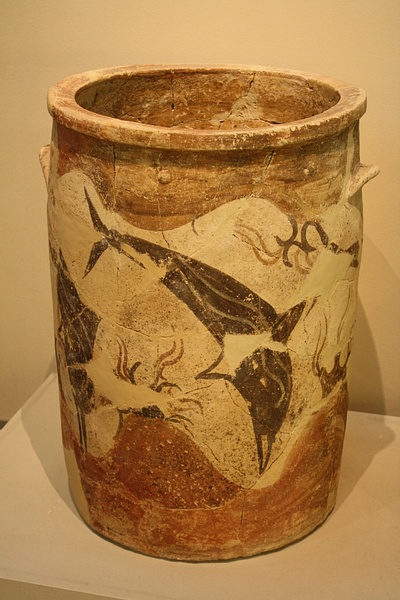 饰有海豚图案的大储罐 ,来自阿克罗蒂里(Akrotiri) Mark Cartwright (CC BY-NC-SA) ](https://www.worldhistory.org/image/1369/dolphin-decorated-pithoi-akrotiri/ "Dolphin Decorated Pithoi, Akrotiri")大约从公元前1400年起,迈锡尼文明崛起,成为爱琴海地区的主导文化,这在基克拉迪群岛也有反应,不仅迈锡尼陶器进口的数量显著增加,宫殿建筑的特征也出现了相应变化,尤其是在米洛斯岛上的菲拉科皮(Phylakopi)遗址中最为明显。此外,在米科诺斯岛(Mykonos)、忒诺斯岛(Tenos)和纳克索斯岛(Naxos)等地,也发现了具有迈锡尼文明特色的大型圆顶墓。然而,从公元前1250年开始,与爱琴海其他地区一样,迈锡尼文明的影响力逐渐减弱,这一时期聚落的防御工事明显增多;而到了大约公元前1100年,有证据显示,很多聚落遭到了破坏,并被废弃。
### 古风时期与古典时期的基克拉迪群岛
在古风时期与古典时期,基克拉迪群岛在一定程度上重新恢复了曾经拥有的地区重要性,尤其是提洛岛(Delos)和纳克索斯岛(Naxos)这两座岛屿上的城邦。提洛岛自公元前700年起便成为了供奉阿波罗(Apollo)的重要圣所;事实上,根据希腊神话,阿波罗与其姐姐阿尔忒弥斯(Artemis)正是在这座岛上诞生的。而纳克索斯岛则拥有供奉阿波罗、德墨忒尔(Demeter,农业女神)和狄俄尼索斯(Dionysos,酒神)的重要神庙,其中根据神话传说,狄俄尼索斯也是出生在该岛。此外,神话中还描述了狄俄尼索斯曾在提洛岛上与阿里阿德涅(Ariadne)成婚,为纪念这一事件,在古风时期每年都会在岛上举行相应的纪念庆典。在公元前8世纪,希腊人在纳克索斯岛建立了西西里地区的第一个殖民地;到了公元前6世纪,在盟友雅典僭主庇西特拉图(Peisistratus)的支持下,僭主吕格达米斯(Lygdamis)统治下的纳克索斯迎来了一段繁荣时期。正是在这一时期,岛上建造了阿波罗神庙,并且首次创办了著名的狄俄尼索斯节(Dionysia festival),这一节庆后来在整个希腊世界广为人知,用以纪念酒神狄俄尼索斯。从公元前6世纪起,帕罗斯岛(Paros)开始出口质地细腻的帕罗斯(Parian)白大理石,这种石材备受希腊雕塑家与建筑师的珍视。
在公元前5世纪这个动荡不安的时期,当波斯帝国试图征服希腊之时,基克拉迪群岛中的多个岛屿崭露头角,充当了重要角色。纳克索斯岛(Naxos)在公元前499年和公元前490年两次遭到波斯国王大流士(Darius)军队的进攻。然而,该岛后来成为希腊联军中一支重要的力量,参与了公元前480年的萨拉米斯海战(Battle of Salamis)和公元前479年的普拉提亚战役(Battle of Plataea),并在这些著名的战役中与盟友一起击败了波斯人。从公元前478年起,许多基克拉迪岛屿加入了由雅典领导、以抗击波斯侵略为目的而组建的提洛同盟(Delian League)。该同盟的金库最初设在提洛岛上(直到公元前454年被迁至雅典)。然而,这个同盟内部并非始终和谐。例如,纳克索斯岛在公元前469/468年以及北部的萨索斯岛(Thasos)在公元前465年先后爆发了反抗雅典统治的叛乱,这些事件显示出同盟成员对雅典日益独断专行的作风感到不满。但作为当时强大的海上强权,雅典迅速镇压了这些起义。
[  纳克索斯岛的阿波罗神庙 Mark Cartwright (CC BY-NC-SA) ](https://www.worldhistory.org/image/1383/temple-of-apollo-naxos/ "Temple of Apollo, Naxos")在分别由雅典与斯巴达所领导的同盟之间爆发的伯罗奔尼撒战争(公元前431–前404年)期间,基克拉迪群岛总体上站在雅典一方,但也出现了一些叛离的例子,其中最著名的或许是米洛斯岛(Melos)。该岛积极支持斯巴达,因此在公元前417年至公元前415年之间遭到了雅典军队的进攻与征服。在这次冲突中,岛上所有成年男性都被杀害,而妇女与儿童则被卖为奴隶。后来,在公元前377年至前355年之间成立的第二次雅典同盟(Second Athenian League)期间,这些岛屿再次与雅典站在一起,共同抵御斯巴达的威胁。但即便在此时,仍然发生了叛乱事件,其中比较突出的有基奥斯岛(Keos,即凯阿岛)在公元前363年爆发的叛乱。
### 希腊化时期的基克拉迪群岛
在希腊化时期(始于公元前2世纪),基克拉迪群岛处于埃及托勒密王朝(Ptolemies of Egypt)的统治之下;到了罗马时期,这些岛屿一度在公元前166年重新归于雅典,并凭借其在爱琴海地区的重要贸易位置,再次迎来了一段繁荣期。然而,这一繁荣阶段却以戏剧性的方式宣告结束:公元前88年,本都王国(Pontus)的米特里达梯六世(Mithridates)袭击了提洛岛(Delos);随后在公元前69年,雅典诺多罗斯(Athenodoros)在该群岛建立了一个海盗基地。事实上,这些岛屿作为海盗避风港的恶名一直持续到中世纪乃至更晚时期。最终,随着公元5世纪至6世纪期间,许多希腊神庙被改建为基督教巴西利卡教堂(Basilica),岛上希腊文明的最后痕迹也逐渐消失。不过,从20世纪中叶起,随着一系列重要考古遗址的发掘,世人再次认识到基克拉迪群岛对西欧文明发展所作出的贡献。这些遗址包括:阿克罗蒂里(Akrotiri,位于锡拉岛,今圣托里尼)、阿依亚伊里尼(Ayia Irini)、菲拉科皮(Phylakopi,位于米洛斯岛)、卡斯特里(Kastri,位于锡罗斯岛)、卡沃斯(Kavos,位于凯罗斯岛)、斯卡尔克斯(Skarkos,位于伊奥斯岛)、帕罗伊基亚(Paroikia,位于帕罗斯岛),斯特罗菲拉斯(Strophilas,位于安德罗斯岛)。这些遗址至今仍在发掘中,不断为我们提供关于古代爱琴海生活的宝贵见解。
#### Editorial Review
This human-authored definition has been reviewed by our editorial team before publication to ensure accuracy, reliability and adherence to academic standards in accordance with our [editorial policy](https://www.worldhistory.org/static/editorial-policy/).
## 参考文献
- Anonymous. *Ancient Greece Temples And Sanctuaries.* Toubis, Athens, 2010
- [Cline, E.H. *The Oxford Handbook of the Bronze Age Aegean.* Oxford University Press, USA, 2012.](https://www.worldhistory.org/books/0199873607/)
- [Doumas, C.G. *Santorini the Prehistoric City of Akroteri.* Athens Editions Hannibal, 2014.](https://www.worldhistory.org/books/B0016OWXJA/)
## 关于作者
马克是一位全职作家、研究人员、历史学家与编辑,他对艺术、建筑,以及研究所有文明共有的思想尤为感兴趣。马克拥有政治哲学硕士学位,目前担任WHE出版总监一职。
## 时间轴
- **c. 5000 BCE**: The [Cyclades](https://www.worldhistory.org/Cyclades/) are first inhabited by settlers from Asia Mnior.
- **c. 3200 BCE - 1100 BCE**: The Cycladic [Civilization](https://www.worldhistory.org/civilization/) in [Greece](https://www.worldhistory.org/greece/).
- **3000 BCE - 2200 BCE**: The first archaeological evidence of organised communities in the [Cyclades](https://www.worldhistory.org/Cyclades/).
- **3000 BCE - 2000 BCE**: Distinctive minimalistic standing marble figurines are produced in the [Cyclades](https://www.worldhistory.org/Cyclades/).
- **3000 BCE - 2000 BCE**: First rock-cut [burial](https://www.worldhistory.org/burial/) chambers at [Akrotiri](https://www.worldhistory.org/thera/).
- **2700 BCE - 2300 BCE**: The first depiction in art of the [aulos](https://www.worldhistory.org/Aulos/) musical instrument appears in [Cycladic sculpture](https://www.worldhistory.org/article/457/cycladic-sculpture/).
- **2200 BCE - 1700 BCE**: Evidence of town planning and more sophisticated [architecture](https://www.worldhistory.org/disambiguation/architecture/) in the Cylades.
- **2000 BCE - 1650 BCE**: [Akrotiri](https://www.worldhistory.org/thera/) on [Thera](https://www.worldhistory.org/thera/) reaches its peak of prosperity and becomes a flourishing [Mediterranean](https://www.worldhistory.org/disambiguation/mediterranean/) trading centre.
- **1700 BCE - 1400 BCE**: The [culture](https://www.worldhistory.org/disambiguation/culture/) in the [Cyclades](https://www.worldhistory.org/Cyclades/) is increasingly influenced by [Minoan](https://www.worldhistory.org/disambiguation/Minoan/) [Crete](https://www.worldhistory.org/crete/).
- **1650 BCE - 1550 BCE**: Eruption of [Thera](https://www.worldhistory.org/thera/) and consequent tidal waves, destruction of [Akrotiri](https://www.worldhistory.org/thera/) and other [Aegean](https://www.worldhistory.org/aegean/) centres.
- **1400 BCE - 1100 BCE**: [Culture](https://www.worldhistory.org/disambiguation/culture/) in the [Cyclades](https://www.worldhistory.org/Cyclades/) is increasingly influenced by the [Mycenaean civilization](https://www.worldhistory.org/Mycenaean_Civilization/) of mainland [Greece](https://www.worldhistory.org/greece/).
- **c. 1100 BCE**: Evidence of settlement destruction and abandonment across the [Cyclades](https://www.worldhistory.org/Cyclades/).
- **c. 700 BCE**: The [temple](https://www.worldhistory.org/temple/) of [Apollo](https://www.worldhistory.org/apollo/) is built on the island of [Delos](https://www.worldhistory.org/delos/).
- **c. 700 BCE**: [Paros](https://www.worldhistory.org/Paros/) begins to export its Parian marble across the [Greek](https://www.worldhistory.org/disambiguation/greek/) world and it is widely used in temples and [sculpture](https://www.worldhistory.org/disambiguation/Sculpture/).
- **700 BCE - 600 BCE**: Temples are built in honour of [Apollo](https://www.worldhistory.org/apollo/), [Demeter](https://www.worldhistory.org/demeter/) and [Dionysos](https://www.worldhistory.org/Dionysos/) on the island of [Naxos](https://www.worldhistory.org/Naxos/).
- **631 BCE**: [Greek](https://www.worldhistory.org/disambiguation/greek/) colonists from the island of [Thera](https://www.worldhistory.org/thera/) found the [city](https://www.worldhistory.org/city/) of [Cyrene](https://www.worldhistory.org/cyrene/) in North [Africa](https://www.worldhistory.org/disambiguation/africa/).
- **c. 550 BCE**: The [silver](https://www.worldhistory.org/Silver/) drachma of [Delos](https://www.worldhistory.org/delos/) depicts a [lyre](https://www.worldhistory.org/Lyre/) - symbolic of [Apollo](https://www.worldhistory.org/apollo/) - on its reverse side.
- **c. 550 BCE**: Oldest surviving [sculpture](https://www.worldhistory.org/disambiguation/Sculpture/) of a winged [Nike](https://www.worldhistory.org/nike/) found on [Delos](https://www.worldhistory.org/delos/).
- **c. 540 BCE**: [Athens](https://www.worldhistory.org/Athens/) removes and prohibits further burials on [Delos](https://www.worldhistory.org/delos/) to purify the sacred island.
- **c. 499 BCE**: [Naxos](https://www.worldhistory.org/Naxos/) is attacked by [Darius](https://www.worldhistory.org/disambiguation/darius/)' Persian forces.
- **490 BCE**: [Naxos](https://www.worldhistory.org/Naxos/) is attacked for a second time by Persian forces.
- **480 BCE**: Cycladic states contribute to the victorious [Greek](https://www.worldhistory.org/disambiguation/greek/) forces against the Persians at the [Battle of Salamis](https://www.worldhistory.org/Battle_of_Salamis/).
- **479 BCE**: Cycladic [city](https://www.worldhistory.org/city/) states contribute to the victorious [Greek](https://www.worldhistory.org/disambiguation/greek/) forces against the Persians at the [battle](https://www.worldhistory.org/disambiguation/battle/) of [Plataea](https://www.worldhistory.org/Plataea/).
- **478 BCE**: Many Cycladic states join the Athenian led [Delian League](https://www.worldhistory.org/Delian_League/) as a defence against Persian agression.
- **478 BCE - 454 BCE**: The treasury of the [Delian League](https://www.worldhistory.org/Delian_League/) is kept on [Delos](https://www.worldhistory.org/delos/) until its removal to [Athens](https://www.worldhistory.org/Athens/).
- **c. 467 BCE**: The island of [Naxos](https://www.worldhistory.org/Naxos/) rebels against Athenian dominance of the [Delian League](https://www.worldhistory.org/Delian_League/).
- **431 BCE - 404 BCE**: The Cycladic [city](https://www.worldhistory.org/city/) states side with [Athens](https://www.worldhistory.org/Athens/) in the [Peloponnesian war](https://www.worldhistory.org/Peloponnesian_War/) against [Sparta](https://www.worldhistory.org/sparta/) and her allies.
- **417 BCE - 415 BCE**: Melos, after supporting [Sparta](https://www.worldhistory.org/sparta/) in the [Peloponnesian War](https://www.worldhistory.org/Peloponnesian_War/), is attacked by [Athens](https://www.worldhistory.org/Athens/).
- **377 BCE - 355 BCE**: The Cycladic [city](https://www.worldhistory.org/city/) states join [Athens](https://www.worldhistory.org/Athens/) in the Second Athenian League against [Sparta](https://www.worldhistory.org/sparta/) .
- **363 BCE**: A rebellion against Athenian dominance of the Second Athenian League on Keos is quashed by [Athens](https://www.worldhistory.org/Athens/).
- **166 BCE**: [Rome](https://www.worldhistory.org/Rome/) puts [Delos](https://www.worldhistory.org/delos/) under the jurisdiction of [Athens](https://www.worldhistory.org/Athens/) and makes the island a free port.
- **166 BCE**: [Rome](https://www.worldhistory.org/Rome/) gives dominion over the [Cyclades](https://www.worldhistory.org/Cyclades/) to [Athens](https://www.worldhistory.org/Athens/).
- **88 BCE**: Mithridates attacks and detroys the island of [Delos](https://www.worldhistory.org/delos/).
- **69 BCE**: [Delos](https://www.worldhistory.org/delos/) is sacked by pirates.
- **41 BCE**: [Rome](https://www.worldhistory.org/Rome/) takes control over [Naxos](https://www.worldhistory.org/Naxos/) in the [Cyclades](https://www.worldhistory.org/Cyclades/).
## 外部链接
- [the sacred island](https://www.visit-ancient-greece.com/delos.html)
## 引用本文
### APA
Cartwright, M. (2025, November 02). 基克拉迪群岛. (C. He, 翻译). *World History Encyclopedia*.
### Chicago
Cartwright, Mark. "基克拉迪群岛." 翻译: Claude He. *World History Encyclopedia*, November 02, 2025. .
### MLA
Cartwright, Mark. "基克拉迪群岛." 翻译: Claude He. *World History Encyclopedia*, 02 Nov 2025, .
## 许可与版权
提交人: [Claude He](https://www.worldhistory.org/user/claudehe/ "User Page: Claude He"), 发表于 02 November 2025. 请查阅原始来源以获取版权信息。 请注意,从本页面链接的内容可能具有不同的许可条款。