---
title: Bizans İmparatorluğu
author: Mark Cartwright
translator: Batuhan Aksu
source: https://www.worldhistory.org/trans/tr/1-953/bizans-imparatorlugu/
format: machine-readable-alternate
license: Creative Commons Attribution-NonCommercial-ShareAlike (https://creativecommons.org/licenses/by-nc-sa/4.0/)
updated: 2023-05-04
---
# Bizans İmparatorluğu
_Yazan: [Mark Cartwright](https://www.worldhistory.org/user/markzcartwright/)_
_Çeviren [Batuhan Aksu](https://www.worldhistory.org/user/batuhanaksu)_
Sıklıkla Doğu [Roma İmparatorluğu](https://www.worldhistory.org/trans/tr/1-100/roma-imparatorlugu/) veya sadece Bizans olarak isimlendirilen Bizans İmparatorluğu, 330'dan 1453'e kadar varlığını sürdürdü. Başkenti [Konstantinopolis](https://www.worldhistory.org/trans/tr/1-700/konstantinopolis/)'te I. Konstantin (306-337) tarafından kurulan imparatorluğun büyüklüğü asırlar boyunca, bir defasında veya diğerinde, İtalya, Yunanistan, Balkanlar, [Levant](https://www.worldhistory.org/trans/tr/1-178/levant/), Küçük Asya ve Kuzey Afrika'da bulunan bölgelere sahipti.
Bizans, resmi dili Yunanca olan bir Hıristiyan devletiydi, Bizanslılar kendi siyasi sistemlerini, dini pratiklerini, sanatını ve mimarisini geliştirdiler; bu, Greko-Romen kültürel ananesinin mühim derecede tesiri altında kalmasına rağmen, sadece [antik Roma](https://www.worldhistory.org/trans/tr/1-68/antik-roma/)'nın bir devamı değildi, ondan farklıydı. Bizans İmparatorluğu, Orta Çağ'ın en uzun ömürlü gücüydü ve tesiri günümüzde, bilhassa da birçok Batılı devletin, Doğu ve Orta [Avrupa](https://www.worldhistory.org/trans/tr/1-35/avrupa/)'nın ve Rusya'nın dininde, sanatında, mimarisinde ve hukukunda devam ediyor.
### Bizans Adı ve Tarihleri
'Bizans' ismi, 16. asır tarihçileri tarafından, başkentin Konstantinopolis'e (modern İstanbul) dönüşmeden önce ilk isminin Byzantium olduğu hakikatine dayanılarak türetilmiştir. Bizans, Doğu Roma İmparatorluğu'nu [Batı Roma İmparatorluğu](https://www.worldhistory.org/trans/tr/1-696/bati-roma-imparatorlugu/)'ndan ayıran, bilhassa 5. yüzyılda Batı Roma İmparatorluğu'nun çöküşünden sonra mühim ama mükemmel olmayan kullanışlı bir etiketti ve olmaya devam ediyor. Nitekim bu sebeple, tarihçiler arasında "Bizans İmparatorluğu" mefhumunun hakikaten hangi devre işaret ettiği hususunda evrensel bir fikir birliği yoktur. Birtakım bilginler 330'u ve Konstantinopolis'in kuruluşunu, diğerleri Batı Roma İmparatorluğu'nun 476'daki çöküşünü, bazıları ise I. Justinianus'un (527-565) iki imparatorluğu 565'te birleştirmedeki başarısızlığını ve hatta bazıları Bizans'ın doğu vilayetlerinin Araplar tarafından fethedildiği 650'leri dikkate alır. Çoğu tarihçi, Bizans İmparatorluğu'nun 29 Mayıs 1453 Salı günü Osmanlı Padişahı [Fatih Sultan Mehmed](https://www.worldhistory.org/trans/tr/1-18932/fatih-sultan-mehmed/) tarafından İstanbul'un Fethi ile nihayete erdiğini kabul eder.
Tarihlerin münakaşa edilmesi, Roma dünyasının iki yarısı arasındaki etnik ve kültürel karışımdaki farklılıkları ve Ortaçağ devletinin daha evvelki Roma mirasından farklılığını da vurgular. Bizanslılar kendilerine 'Romalılar' diyorlardı, imparatorları basileon ton Rhomaion veya 'Romalıların İmparatoru' idi ve başkentleri 'Yeni Roma' idi. Bununla beraber, en yaygın lisan Yunancaydı ve tarihinin kahir ekseriyeti için Bizans İmparatorluğu'nun kültürel açıdan Roma'dan daha ziyade Yunan olduğunu söylemek doğru olabilir.
### Konstantinopolis
Bizans İmparatorluğu'nun başlangıcı, Roma imparatoru I. Konstantin'in 11 Mayıs 330'da Roma İmparatorluğu'nun başkentini Roma'dan Bizantium'a taşıma kararına dayanır. Popüler olan ad Konstantinopolis veya 'Konstantin Şehri' kısa müddet sonra imparatorun kendi resmi seçimi "Yeni Roma"nın yerini aldı. Yeni başkentin Haliç girişinde mükemmel bir tabii limanı vardı ve [Avrupa](https://www.worldhistory.org/trans/tr/1-15614/avrupa/) ile Asya arasındaki sınırda yer alan gemilerin Ege'den Karadeniz'e geçişini kontrol ederek garp ve şark arasındaki kazançlı ticareti birbirine bağlayabiliyordu. Haliç'in girişi boyunca uzanan büyük bir zincir ve 410-413 seneleri arasında devasa Theodosian Surları'nın inşası, şehrin hem deryadan hem de karadan düzenlenen mütekerrir taarruzlara karşı koyabileceği manasına geliyordu. Asırlar boyunca, daha muhteşem binalar ilave edildikçe, kozmopolit şehir, herhangi bir çağın en iyilerinden biri ve kesinlikle cihanın en zengin, en şatafatlı ve en mühim Hıristiyan şehri haline geldi.
[  Bizans İstanbul'unun Haritası Cplakidas (CC BY-SA) ](https://www.worldhistory.org/image/564/map-of-byzantine-constantinople/ "Map of Byzantine Constantinople")### Bizans İmparatorları
Bizans imparatoru veya *basileus* (veya daha nadiren imparatoriçe için *basilissa*) muhteşem Konstantinopolis Sarayı'nda ikamet eder ve geniş bir [imparatorluk](https://www.worldhistory.org/trans/tr/1-99/imparatorluk/) üzerinde mutlak bir hükümdar olarak hükmederdi. Bu sebeple, *basileus*, uzman bir hükümet ile yaygın ve verimli bir bürokrasinin yardımına ihtiyaç duyuyordu. Mutlak bir hükümdar olmasına rağmen, bir imparatorun - hükümeti, halkı ve kilisesi tarafından - imparatorluğu makul ve adil bir şekilde idaresi bekleniyordu. Daha da mühimi, ordu hakiki manada Bizans'taki en kuvvetli müessese olarak kaldığı için bir imparator askeri zafere sahip olmalıydı. Konstantinopolis'teki ve eyaletlerdeki generaller, imparatorluğun sınırlarını müdafaa etmeyen yahut iktisadi felaket getiren bir imparatoru vazifeden azledebilirdi - ve yaptı da. Yine de, hadiselerin normal akışında, imparator ordunun başkumandanı, kilise ve hükümetin başıydı, devlet maliyesini kontrol ediyordu ve istediği zaman asilleri tayin eder veya vazifeden alırdı; önce veya sonra çok az hükümdar böyle bir kuvvete sahip olmuştur.
İmparatorun imajı, seçilen halefi, umumiyetle en büyük evladı göstermek için kullanılan Bizans sikkelerinde göründü, lakin bu veraset için belirlenmiş usüller olmadığı için her zaman vaki değildi. İmparatorların idare etmek için [Tanrı](https://www.worldhistory.org/trans/tr/1-10299/tanri/) tarafından seçildiğine inanılıyordu ama muhteşem bir taç ve [Tyrian moru](https://www.worldhistory.org/trans/tr/1-14999/tyrian-moru/) kaftanları hükmetme hakkını daha da kuvvetlendirmeye yardımcı oldu. Diğer bir pazarlama stratejisi, Konstantin'in hususi favorisi olan şanlı seleflerinin saltanat adlarını kopyalamaktı. Tipik olarak kuvvet ve muvaffakiyetin askeri adamları olan gaspçılar bile, umumen önceki ailelerinin bir mensubuyla evlenerek mevkilerini meşrulaştırmaya çalıştılar. Böylece, hanedanların, ritüellerin, kostümlerin ve isimlerin itinayla düzenlenmiş sürekliliği sayesinde, imparatorun müessesesi 12 yüzyıl boyunca ayakta kalabildi.
### [Bizans Hükümeti](https://www.worldhistory.org/trans/tr/1-16943/bizans-hukumeti/)
Bizans hükümeti, imparatorluk Roma'sında kurulan kalıpları takip etti. İmparator çok kuvvetliydi lakin yine de Senato gibi mühim organlara danışması beklenirdi. Konstantinopolis'teki Senato, Roma'nın aksine, askerlik hizmetinin saflarında yükselmiş adamlardan oluşuyordu ve bu sebeple böyle bir senatör sınıfı yoktu. Seçimler olmadan, Bizans senatörleri, bakanları ve yerel meclis üyeleri, mevkilerini büyük ölçüde imparatorluk himayesi yoluyla veya büyük toprak sahibi statüleri sebebiyle elde etti.
[  I. Justinianus Sponsored by a Greek banker, Julius Argentarius (CC BY-NC-SA) ](https://www.worldhistory.org/image/3341/justinian-i/ "Justinian I")Mümtaz senatörler, imparatorun teoride devlet açısından mühim mevzularda danışması gereken küçük *sakrum konsorsiyumunu* oluşturuyordu. Ayrıca, imparator saraydaki şahsi maiyeti üyelerine danışabilirdi. Dahası sarayda, imparatora çeşitli şahsi vazifelerde hizmet eden lakin aynı zamanda ona erişmeyi kontrol edebilen hadım mabeyinciler (*cubicularii*) de vardı. Hadımlar mesuliyet pozisyonlarını kendileri üstlendiler, bunların başında imparatorun cüzdanının sahibi olan ve kuvvetleri 7. yüzyıldan itibaren önemli ölçüde artacak olan *sakellarios* vardı. Diğer mühim hükümet memurları arasında quaestor veya baş hukuk görevlisi; devlet darphanesini kontrol eden *comes sacrarum largitionum*; sarayın umumi idaresine, orduya ve erzakına ve dış işlerine bakan *magister officiorum*; ve imparatorluğun dört bir yanındaki mahalli konseylerdeki hadiseleri izleyen bir imparatorluk müfettişi ekibi vardı.
Ancak Bizans'taki en üst seviyedeki memur, imparatorluğun bütün bölge valilerinin mesul olduğu Doğu'nun Praetorian Prefect'iydi. Bölge valileri, münferit şehir konseylerini veya *küraları* (curae) kontrol etti. Mahalli meclis mensupları, bütün kamu hizmetlerinden ve kasabalarındaki ve muhitindeki topraklardaki vergilerin toplanmasından mesuldu. Bu konseyler coğrafi olarak, imparatorluğun dört vilayetinin her birinde üçer tane olmak üzere, kendileri 12 piskoposluk halinde düzenlenmiş 100 kadar yerde teşkilatlandı. 7. asırdan itibaren, piskoposlukların bölge valileri veya bir yeniden yapılanmadan sonra bilindikleri şekliyle *themalar*, aslında doğrudan imparatora karşı mesul olan il askeri kumandanları (*strategoi*) haline geldi ve Praetorian Prefect kaldırıldı. 8. asırdan sonra, komşulardan gelen artan askeri tehditler ve iç harpler nedeniyle imparatorluğun idaresi eskisinden çok daha basit hale geldi.
### Corpus Juris Civilis
Bizans hükümetine I. Justinianus tarafından öncülük edilen Justinian Kanunları veya *Corpus Juris Civilis*'in (Medeni Hukuk Derlenmesi) oluşturulması büyük ölçüde yardımcı oldu. Bir grup hukuk uzmanı bunun için asırlar boyunca birikmiş olan Roma kanunlarını - çok sayıda imparatorluk fermanı, yasal görüş ve suç ve ceza listeleri - derledi, topladı ve düzenledi, Bir milyonun üzerinde kelimeden oluşan kanunlar, 900 sene sürecek, yasaları herkes için daha net hale getirecek, mahkemelere lüzumsuz yere getirilen davaların sayısını azaltacak, yargı sürecini hızlandıracak ve bundan sonra batı demokrasilerindeki çoğu hukuk sistemine tesir edecektir.
### Bizans Toplumu
Bizanslılar aile ismine, miras kalan zenginliğe ve bir ferdin saygın doğumuna büyük ehemmiyet atfetti. Cemiyetin üst kademelerindeki fertler bu üç şeye sahipti. Zenginlik, arazi mülkiyetinden veya müstakil bir idarecinin yargı salahiyeti altındaki arazi idaresinden gelirdi. Mamafih Bizans cemiyetinde böyle bir kan aristokrasisi yoktu ve hem himaye hem de tahsil sosyal merdiveni tırmanmanın bir yoluydu. Buna ilaveten, imparatorlar tarafından lütufların, toprakların ve unvanların dağıtılmasının yanı sıra fark gözetmeyen rütbeler ve yabancı istila ve savaşların tehlikeleri, asaletin ferdi kısımlarının sabit olmadığı ve ailelerin yüzyıllar boyunca yükselip düştüğü manasına geliyordu. Rütbe, unvanlar, mühürler, nişanlar, belirli giysiler ve şahsi mücevherlerin kullanılması yoluyla toplumun bütün mensupları tarafından görülebilirdi.
[  Bizans'tan İki Parçalı Fildişi Panel Osama Shukir Muhammed Amin (Copyright) ](https://www.worldhistory.org/image/5727/byzantine-ivory-diptych-panel/ "Byzantine Ivory Diptych Panel")Alt sınıfların çoğu, ebeveynlerinin mesleğini takip ederdi, lakin miras, servet biriktirme ve bir sınıfın diğerine taşınması için herhangi bir resmi yasağın olmaması, bir kişinin sosyal vaziyetini ve mevkiini iyileştirmesi için en azından küçük bir ihtimal sunuyordu. Hukuk işleri, idare ve ticarette (Bizanslılar için geçimini sağlamak için pek saygın bir yol değildi) gibi daha iyi işlere sahip işçiler vardı. Bir sonraki basamakta zanaatkarlar, sonra kendi küçük toprak parsellerine sahip olan çiftçiler, müteakiben en büyük grup - başkalarının toprağında çalışanlar ve nihayet, tipik olarak harp esiri olan ancak hiçbir yerde hür işçiler kadar sayılamayacak köleler vardı.
Erkeklerde olduğu gibi Bizans kadınlarının rolü de sosyal mevkilerine bağlıydı. Aristokrat kadınların evi idare etmesi ve çocuklara bakmaları bekleniyordu. Mülk sahibi olmalarına rağmen, kadınlar kamu görevlerinde bulunamıyor ve boş zamanlarını dokuma, alışveriş, kiliseye gitme veya okuma (resmi eğitimleri olmamasına rağmen) yaparak geçiriyordu. Dullar, çocuklarının koruyucusu oldular ve kardeşleriyle eşit olarak miras alabilirdi. Birçok kadın, erkek kılığına girerek tarımda ve çeşitli imalat sanayilerinde ve gıda hizmetlerinde çalıştı. Kadınlar kendi topraklarına ve işlerine malik olabilir ve bazıları evlilik yoluyla sosyal mevkilerini iyileştirebilirdi. En az saygı duyulan meslekler, başka yerlerde olduğu gibi, fahişeler ve aktrislerdi.
### Bizans İmpratorluğu'nun Yüzölçümleri
Bizans İmparatorluğu'nun coğrafi hudutları yüzyıllar boyunca imparatorların askeri galibiyet ve mağlubiyetleri dalgalandıkça değişti. İmparatorluğun tarihinin ilk kısmında tutulan topraklar Mısır, Suriye, Ürdün, Lübnan ve [Filistin](https://www.worldhistory.org/trans/tr/1-192/filistin/)'i içeriyordu. Yunanistan, pratik açıdan Bizans'ın kendilerini Greko-Romen kültürünün gerçek mirasçıları olarak görmelerinin bir sembolü olduğundan daha az mühimdi. İtalya ve Sicilya, Papaların ve Normanların hırslarına karşı nihayetinde başarısız bir şekilde savunulmalıydı. Tuna Nehri'ne kadar Balkanlar baştan sona önemliydi ve kuzeyde Karadeniz kıyılarına kadar Küçük Asya ve doğuda Ermenistan mühim bir zenginlik kaynağıydı lakin bu bölgelerin her ikisi de çeşitli daimi düşmanlara karşı düzenli ve kuvvetli müdafaa gerektirecekti.
Siyasi harita komşu imparatorlukların yükselişi ve düşüşü ile sürekli olarak yeniden çizildiğinden, dikkate değer hadiseler arasında I. Anastasios (491-518)'un imparatorluğu hem Perslere hem de Bulgarlara karşı başarıyla müdafaa etmesi yer aldı. Kabiliyetli generali [Belisarius](https://www.worldhistory.org/trans/tr/1-10466/belisarius/)'un (yaklaşık 500-565) yardımıyla I. Justinianus, Kuzey Afrika, İspanya ve İtalya'da batı imparatorları tarafından kaybedilen toprakları geri kazandı. İtalya'daki Lombardlar ve Balkanlar'daki [Slavlar](https://www.worldhistory.org/trans/tr/1-13215/slavlar/), 6. asrın ikinci yarısında İmparatorluğa akın ettiler, bu vaziyet nihayet Herakleios (610-641) tarafından 627'de [Ninova](https://www.worldhistory.org/trans/tr/1-294/ninova/)'da aksine çevrildi ve zaferiyle Pers [Sasani İmparatorluğu](https://www.worldhistory.org/trans/tr/1-690/sasani-imparatorlugu/)'nu fiilen sona erdirdi.
[  Bizans İmparatorluğu Haritası, c.520 - 1204 Simeon Netchev (CC BY-NC-ND) ](https://www.worldhistory.org/image/15330/map-of-the-byzantine-empire-c520---1204/ "Map of the Byzantine Empire, c.520 - 1204")7\. ve 8. yüzyılın İslami fetihleri, imparatorluğun Levant'taki (637'de [Kudüs](https://www.worldhistory.org/trans/tr/1-194/kudus/) dahil), Kuzey Afrika ve Doğu Küçük Asya'daki topraklarını kaybetmesine yol açtı. En azından, Konstantinopolis, kararlı Arap muhasaralarına (674-8 ve 717-18) iki defa direnerek Arapların Avrupa'ya yayılmasına karşı sağlam bir siper olarak durdu. Lakin Bizans İmparatorluğu temellerinden sarsıldı. Daha sonra 9. yüzyılda Bulgarlar İmparatorluğun kuzey bölgelerine kayda değer akınlar yaptılar. (Uygunsuz bir isimlendirmeyle böyle anılan) Makedon hanedanı (867-1057) ile Bizans servetinde bir canlanma geldi. Hanedanlığın kurucusu I. Basileios (taht. 867-886) güney İtalya'yı yeniden fethetti, belalı Giritli korsanlarla uğraştı ve Araplara karşı Kıbrıs'ta, anakara Yunanistan'da ve Dalmaçya'da zaferler kazandı. Hemen sonraki imparator VI. Leo (hükümdarlık 886-912) kazançların ekserisini kaybetti, lakin 10. yüzyılın ortalarında Müslümanların kontrolündeki [Mezopotamya](https://www.worldhistory.org/trans/tr/1-34/mezopotamya/)'da zaferler görüldü.
Balkanlar'daki zaferleriyle 'Bulgar Katili' olarak bilinen II. Basileios (h. 976-1025), Bizans'ın kaderinde bir başka şaşırtıcı yükselişe nezaret etti. Kiev'den gelen Viking kökenli şiddetli muhariplerden oluşan bir ordunun yardım ettiği Basil, Yunanistan, Ermenistan, Gürcistan ve Suriye'de de zaferler kazanarak İmparatorluğun büyüklüğünü ikiye katladı. Yine de, kademeli bir düşüş olarak son büyük darbe gelecekti. 1071'de Armeniakon Theması'nda Malazgirt Savaşı'nda Selçukluların şok edici galibiyetinden sonra, I. Aleksios Komnenos'un (taht. 1081-1118) karşısında zaferlerle kısa bir canlanma yaşandı. Dalmaçya'daki Normanlar, Trakya'daki Peçenekler ve Filistin ve Suriye'deki Selçuklular (Birinci Haçlıların yardımıyla)la birlikte Bizanslıların ebediyen zenginleşmesi için çok fazla bölgede çok fazla düşman varmış gibi görünüyordu.
12\. ve 13. yüzyılda Rum Sultanlığı ([Anadolu](https://www.worldhistory.org/trans/tr/1-228/anadolu/) Selçuklu Devleti) Küçük Asya'nın yarısını aldı ve sonra [Dördüncü Haçlı Seferi](https://www.worldhistory.org/trans/tr/1-16760/dorduncu-hacli-seferi/) orduları 1204'te Konstantinopolis'i yağmaladığında felaket yaşandı. Venedik ve müttefikleri arasında parçalanmış olan İmparatorluk, 1261'deki restorasyondan önce yalnızca sürgünde vardı. 14. yüzyılda İmparatorluk, güney Yunanistan'ın ucundaki küçük bir sahadan ve başkentin etrafındaki bir yığın topraktan ibaretti. Son darbe, daha önce de belirtildiği gibi, 1453'te Osmanlıların Konstantinopolis'i zaptıyla geldi.
### Bizans Kilisesi
Paganizm, Bizans'ın kuruluşundan sonra asırlarca tatbik edilmeye devam etti ama Bizans kültürünün belirleyici hususiyeti haline gelen, siyasetini, harici münasebetlerini, sanatını ve mimarisini derinden etkileyen Hıristiyanlıktı. Kilise, imparator tarafından tayin edilen veya vazifeden azledilen Konstantinopolis Patriği veya piskoposu tarafından idare edilirdi. Daha büyük kasabalara ve çevredeki bölgelere reislik eden ve hem kiliseyi hem de imparatoru temsil eden mahalli piskoposlar, mahalli topluluklarında hatırı sayılır bir zenginlik ve salahiyete sahipti. O zaman [Hristiyanlık](https://www.worldhistory.org/trans/tr/1-665/hristiyanlik/), farklı kültürleri Hristiyan Rumları, Ermenileri, Slavları, Gürcüleri ve diğer birçok azınlığı Yahudiler ve Müslümanlar gibi hür yaşamalarına izin verilen diğer inançları içerisine alan tek bir imparatorlukta bir araya getirmeye yardımcı olan önemli bir ortak payda haline geldi.
[  Aziz Basil İkonu Unknown Artist (Public Domain) ](https://www.worldhistory.org/image/8571/icon-of-saint-basil/ "Icon of Saint Basil")Doğu ve Batı kiliselerindeki farklılıklar, Bizans İmparatorluğu'nun Batı Ortaçağ tarihinde bu kadar zayıf bir şekilde temsil edilmesinin sebeplerinden biriydi. Bu eserlerde Bizanslılar sıklıkla yozlaşmış ve değişken, kültürleri durağan ve dinleri tehlikeli bir sapkınlık olarak tasvir edildi. Doğu ve Batı kiliseleri, kimin önceliğe sahip olması gerektiği, Papa'nın mı yoksa Konstantinopolis Patriğinin mi olması gerektiği konusunda anlaşamadılar. [İsa Mesih](https://www.worldhistory.org/trans/tr/1-12343/isa-mesih/)'in tek bir beşeri ve bir ilahi tabiata sahip olması veya sadece ilahi bir tabiata sahip olması gibi doktrin meseleleri de münakaşalıydı. Kilise bekarlığı, mayalı yahut mayasız ekmek kullanımı, hizmet dili ve imajların kullanılması, siyasi ve bölgesel hırsların yakıtıyla, havai duyguların karışımına eklenen, 1054'teki Kilise Ayrılığına yol açan farklılık noktalarıydı.
Bizans kilisesinin de kendi iç anlaşmazlıkları vardı, en meşhuru 726-787 ve 814-843'teki ikonoklazm yahut 'ikonların yok edilmesi' idi. Papalar ve birçok Bizanslı, mukaddes figürlerin, özellikle de İsa Mesih'in temsili olan ikonların kullanılmasını destekledi. İkonlara karşı olanlar kendilerinin put haline geldiklerine inanıyorlardı ve Tanrı'nın sanatta temsil edilebileceğini düşünmek küfürdü. Bu husus aynı zamanda Hazreti İsa'nın iki mi yoksa bir mi olduğu ve bu sebeple bir ikonun sadece insanı temsil edip etmediği mevzusundaki münakaşayı yeniden alevlendirdi. İkonların müdafileri, bunların yalnızca bir sanatçının intibası olduğunu ve okuma yazma bilmeyenlerin ilahi olanı daha iyi anlamalarına yardımcı olduğunu söyledi. İkonoklazm dalgası sırasında, bilhassa III. Leo (h. 717-741) ve halefi V. Konstantin (h. 741-775) devrinde, ikonalara inanan (ikonophil) insanlara bile zulmedildiğinde birçok değerli sanat eseri yok edildi. Mesele, "Ortodoksluğun Zaferi" olarak bilinen bir hadiseyle 843'te ikon ve semboller lehine çözüldü.
Manastırcılık, Bizans dini yaşamının spesifik bir hususiyetiydi. Erkekler ve kadınlar, hayatlarını Mesih'e adadıkları, fakir ve hastalara yardım ettikleri manastırlara çekildiler. Orada, Büyük Basil (c. 330 - c. 379) gibi önemli kilise figürlerinin koyduğu kaidelere göre basit bir hayat yaşadılar. Pek çok keşiş aynı zamanda bilgindi, en şöhretlisi de Glagolitik alfabeyi icat eden [Aziz Kiril](https://www.worldhistory.org/trans/tr/1-16547/aziz-kiril/) (ö. 867) idi. Geri çekilme zamanını iyi kullanan kayda değer bir kadın, babası I. Aleksios Komnenos'un (1081-1118) hayatı ve saltanatı üzerine Aleksiad'ını yazan Anna Komnene'dir (1083-1153). Manastırlar böylece paha biçilmez metin ve malumat depoları haline gelirken, şarap üretimi ve ikona atölyeleri de büyük beğeni topladı. En meşhur manastır alanlarından biri, 9. yüzyılda keşişlerin kendilerini kurduğu ve sonunda çoğu bugün hayatta kalan 46 manastır inşa ettiği [Selanik](https://www.worldhistory.org/trans/tr/1-14719/selanik/) yakınlarındaki Athos Dağı'dır.
[  Bizans'tan İkonlu Kitap Kapağı The Metropolitan Museum of Art (Copyright) ](https://www.worldhistory.org/image/8960/byzantine-book-cover-with-icon/ "Byzantine Book Cover with Icon")### [Bizans Sanatı](https://www.worldhistory.org/trans/tr/1-12725/bizans-sanati/)
Bizanslı sanatkarlar, klasik ananenin natüralizminden daha müşahhas ve üniversal olana doğru hareket ederek, iki boyutlu temsiller için kesin bir tercih sergiledi. 13. asırdan önce üretilen sanat eserlerinde imzaların azlığı, sanatçıların yüksek bir sosyal statüye sahip olmadıklarını göstermektedir. Başta kurtuluş ihtiyacı ve imanın pekiştirilmesi olmak üzere dini bir mesajı destekleyen sanat eserleri çok sayıda üretildi ve bunların başlıcaları duvar mozaikleri, duvar resimleri ve ikonlardı. Semboller hemen hemen her çeşit malzemeyi alabilse de, en popüler olanı küçük boyalı ahşap panellerdi. Duvarlara asılmak veya taşınmak için dizayn edilip, renkli pigmentlerin mumla karıştırıldığı ve kakma olarak ahşaba yakıldığı enkaustik teknik kullanılarak yapılmıştı. Seyirci ve ilahi arasındaki iletişimi kolaylaştırmak maksadıyla, tek figürler tipik olarak, mukaddesliklerini vurgulamak için etraflarında bir nimbus veya hale ile tam öndendir.
Bugün en iyi İstanbul'daki [Ayasofya](https://www.worldhistory.org/trans/tr/1-14168/ayasofya/)'da veya Ravenna'daki San Vitale Kilisesi'nde görülen Bizans mozaikleri, mukaddes şahsiyetleri, imparatorları ve imparatoriçeleri, kilise vazifelilerini ve bilhassa tarımda günlük hayatın sahnelerini temsil ediyordu. Büyük ölçekli heykeltıraşlık, daha evvelki antik çağda olduğundan daha az popüler olmuş gibi görünüyordu lakin yontulmuş mermer lahitler çok sayıda üretildi. Nihayetinde, özellikle emaye işi ve kabaşon yarı değerli taşları içeren metal işleri Bizans'a hastı ve zanaatkarlar birçok yüksek kaliteli ve karmaşık dizaynlı tabaklar, kupalar, her çeşitten mücevher, kitap kapakları (hususen İnciller için) ve relikler (mukaddes kalıntıları saklamak için kutular) üretti.
### [Bizans Mimarisi](https://www.worldhistory.org/trans/tr/1-16596/bizans-mimarisi/)
Bizans mimarları binalarında Klasik düzenleri kullanmaya devam etti ve diğer yerlerin yanı sıra [Yakın Doğu](https://www.worldhistory.org/trans/tr/1-16/yakin-dogu/)'dan düşünceler aldı. Dizaynlar, bilhassa eski binalardaki malzemeleri yeni yapılar için yeniden kullanma itiyatı göz önüne alındığında, antik çağdan daha eklektik hale geldi. Ayrıca, form yerine fonksiyon üzerinde kati bir vurgu vardı ve binaların dış cephelerinden ziyade iç kısımlarına daha fazla alaka mevcuttu. Kemerli su kemerleri, amfi tiyatrolar, hipodromlar, hamamlar ve villalar gibi özünde Roma yapıları inşa etmeye devam eden Bizanslılar, kubbeli kiliseleri, duvarlı manastırları ve daha sofistike [sur](https://www.worldhistory.org/trans/tr/1-83/sur/) duvarlarıyla Roma repertuarına katkıda bulunacaklardı.
[ 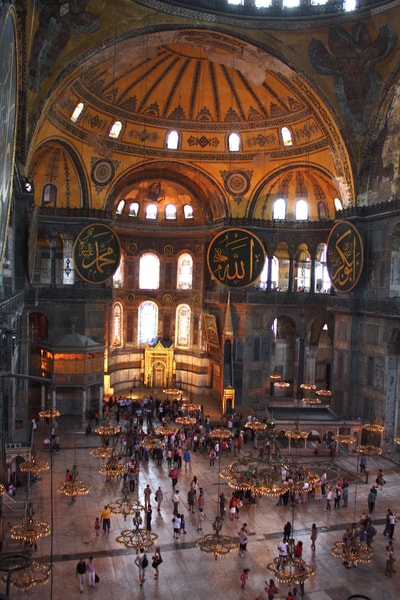 Ayasofya'nın İçi Mark Cartwright (CC BY-NC-SA) ](https://www.worldhistory.org/image/8973/hagia-sophia-interior/ "Hagia Sophia Interior")Tercih edilen yapı malzemeleri, duvarların gizli çekirdeği için harçlı ve betonlu büyük tuğlalardı. Daha prestijli kamu binalarında kesme kesme taş bloklar kullanılırken, daha evvelki Roma devirlerine göre daha az kullanılan mermer umumen sütunlar, kapı ve pencere çerçeveleri ve diğer dekoratif öğeler için ayrılmıştır. Çatılar ahşap iken, iç duvarlar sıklıkla sıva, ince mermer levhalar, tablolar ve mozaiklerle kaplanmıştır.
En büyük, en mühim ve hala en meşhur Bizans yapısı, Tanrı'nın mukaddes bilgeliğine (*hagia sophia*) adanmış Konstantinopolis'in Ayasofya'sıdır. 532-537'de yeniden inşa edilen temel dikdörtgen şekli 74,6 x 69,7 metre (245 x 229 ft) ölçülerinde olup devasa kubbeli tavanı yerden 55 metre yükseklikte ve 31,8 metre çapındadır. Dört destekleyici pandantifli dört masif kemer üzerine oturan kubbe, dönem için muhteşem bir mimari başarıydı. Ayasofya, 16. asra kadar dünyanın en büyük kilisesi olarak kaldı ve muhteşem ışıltılı mozaikler ve duvar resimleriyle en çok süslenen kiliselerden biriydi.
Umumiyetle Hıristiyan kiliseleri, Bizans'ın mimariye, bilhassa kubbenin kullanımına en büyük katkılarından biriydi. Kare-içi plan, dört destekleyici kemer üzerine inşa edilen kubbe ile bunlar arasında en yaygını oldu. Binanın kare kaidesi daha sonra yarım veya tam kubbe tavana sahip olabilen bölmelere ayrıldı. Bir diğer müşterek hususiyet, kilisenin doğu ucunda iki yan apsisli merkezi bir apsistir. Zamanla, merkezi kubbe, bazı kiliselerde kule görünümüne sahip olacak kadar yüksek olan çokgen bir tambur üzerinde daha da yükseltildi. Birçok kilise, bilhassa bazilikalar, yanlarında bir vaftiz odası (genellikle sekizgen) ve bazen kilisenin kurucusu ve onların soyundan gelenler için bir türbeye sahipti. Bu nevi Bizans dizayn hususiyetleri Ortodoks Hıristiyan mimarisine tesir etmeye devam edecek ve bugün dünya çapındaki kiliselerde bu tesir hala görülmektedir.
#### Editorial Review
This human-authored definition has been reviewed by our editorial team before publication to ensure accuracy, reliability and adherence to academic standards in accordance with our [editorial policy](https://www.worldhistory.org/static/editorial-policy/).
## Bibliografya
- [Bagnall, R. *The Encyclopedia of Ancient History.* Wiley-Blackwell, 2012.](https://www.worldhistory.org/books/0307407969/)
- [Brownworth, L. *Lost to the West.* Broadway Books, 2010.](https://www.worldhistory.org/books/0307407969/)
- [Gregory, T.E. *A History of Byzantium.* Wiley-Blackwell, 2010.](https://www.worldhistory.org/books/140518471X/)
- [Herrin, J. *Byzantium.* Princeton University Press, 2009.](https://www.worldhistory.org/books/0691143692/)
- [Mango, C. *The Oxford History of Byzantium.* Oxford University Press, 2002.](https://www.worldhistory.org/books/0198140983/)
- [Norwich, J.J. *A Short History of Byzantium by John Julius Norwich.* Knopf, 2018.](https://www.worldhistory.org/books/B01K2R3B6U/)
- [Shepherd, J. *The Cambridge History of the Byzantine Empire c.500-1492.* Cambridge University Press, 2009.](https://www.worldhistory.org/books/0521832314/)
## Yazar Hakkında
Mark, WHE'nin Yayın Direktörü olup Siyaset Felsefesi alanında yüksek lisans derecesine sahiptir (York Üniversitesi). Tam zamanlı bir araştırmacı, yazar, tarihçi ve editördür. Özel ilgi alanları arasında sanat, mimari ve tüm medeniyetlerin paylaştığı fikirleri keşfetmek yer almaktadır.
## Zaman çizelgesi
- **285 CE**: The [Roman empire](https://www.worldhistory.org/Roman_Empire/) is split into the Western and Eastern [Roman](https://www.worldhistory.org/disambiguation/Roman/) empires.
- **312 CE**: [Constantine I](https://www.worldhistory.org/Constantine_I/) introduces the [gold](https://www.worldhistory.org/gold/) nomisma (solidus) [coin](https://www.worldhistory.org/coinage/).
- **312 CE**: [Roman emperor](https://www.worldhistory.org/Roman_Emperor/) [Constantine I](https://www.worldhistory.org/Constantine_I/) tolerates [Christianity](https://www.worldhistory.org/christianity/).
- **c. 330 CE - c. 379 CE**: Life of Basil Great, one of the founding fathers of the Eastern Christian Church and [Byzantine](https://www.worldhistory.org/disambiguation/Byzantine/) Monasteries.
- **11 May 330 CE**: [Constantinople](https://www.worldhistory.org/Constantinople/) is founded on the site of old [Byzantium](https://www.worldhistory.org/Byzantium/) as "the new [Rome](https://www.worldhistory.org/Rome/)."
- **c. 331 CE**: The [Great Palace of Constantinople](https://www.worldhistory.org/article/1211/the-great-palace-of-constantinople/) is first built by [Constantine I](https://www.worldhistory.org/Constantine_I/).
- **360 CE**: First [Hagia Sophia](https://www.worldhistory.org/Hagia_Sophia/) built in [Constantinople](https://www.worldhistory.org/Constantinople/).
- **361 CE**: [Roman emperor](https://www.worldhistory.org/Roman_Emperor/) Julian attempts to revive Paganism.
- **c. 370 CE**: [Basil the Great](https://www.worldhistory.org/Basil_the_Great/) is made the bishop of [Caesarea](https://www.worldhistory.org/disambiguation/Caesarea/) in Cappadocia.
- **376 CE**: The [Visigoths](https://www.worldhistory.org/visigoth/) are fleeing the [Huns](https://www.worldhistory.org/Huns/), entering the [Eastern Roman Empire](https://www.worldhistory.org/Byzantine_Empire/).
- **391 CE**: Emperor Theodosius I closes pagan temples.
- **395 CE**: The [statue of Zeus at Olympia](https://www.worldhistory.org/Statue_of_Zeus_at_Olympia/) is removed to [Constantinople](https://www.worldhistory.org/Constantinople/).
- **395 CE - 408 CE**: Reign of [Byzantine emperor](https://www.worldhistory.org/Byzantine_Emperor/) Arkadios.
- **395 CE - 637 CE**: [Byblos](https://www.worldhistory.org/Byblos/) is a colony of the [Byzantine Empire](https://www.worldhistory.org/Byzantine_Empire/) (formerly known as the [Eastern Roman Empire](https://www.worldhistory.org/Byzantine_Empire/)).
- **408 CE - 450 CE**: Reign of [Byzantine Emperor](https://www.worldhistory.org/Byzantine_Emperor/) Thedosius II.
- **410 CE - 413 CE**: The [Theodosian Walls](https://www.worldhistory.org/Theodosian_Walls/) are built to better protect [Constantinople](https://www.worldhistory.org/Constantinople/).
- **450 CE - 457 CE**: Reign of [Byzantine emperor](https://www.worldhistory.org/Byzantine_Emperor/) Marcian.
- **8 Oct 451 CE - 1 Nov 451 CE**: Fourth Ecumenical Council takes place in Chalcedon, determining that [Jesus Christ](https://www.worldhistory.org/Jesus_Christ/) had two distinct natures and wills, perfectly united.
- **457 CE**: [Leo I](https://www.worldhistory.org/Leo_I/) is crowned by the Patriarch of [Constantinople](https://www.worldhistory.org/Constantinople/), the first [Byzantine emperor](https://www.worldhistory.org/Byzantine_Emperor/) to be crowned by a bishop.
- **457 CE - 474 CE**: Reign of [Byzantine emperor](https://www.worldhistory.org/Byzantine_Emperor/) [Leo I](https://www.worldhistory.org/Leo_I/).
- **466 CE**: [Byzantine emperor](https://www.worldhistory.org/Byzantine_Emperor/) [Leo I](https://www.worldhistory.org/Leo_I/) gives his daughter [Ariadne](https://www.worldhistory.org/Ariadne/) as a wife to the Isaurian chief Tarasicodissa (Zeno).
- **468 CE**: A [Byzantine](https://www.worldhistory.org/disambiguation/Byzantine/) army led by Basiliscus is defeated by the [Vandals](https://www.worldhistory.org/Vandals/) in North [Africa](https://www.worldhistory.org/disambiguation/africa/).
- **469 CE**: The [Byzantine Empire](https://www.worldhistory.org/Byzantine_Empire/) builds the Anastasian [Wall](https://www.worldhistory.org/wall/).
- **471 CE**: [Byzantine emperor](https://www.worldhistory.org/Byzantine_Emperor/) [Leo I](https://www.worldhistory.org/Leo_I/) conspires to murder his rival the general Aspar.
- **474 CE**: Reign of [Byzantine emperor](https://www.worldhistory.org/Byzantine_Emperor/) Leo II.
- **474 CE - 491 CE**: Reign of [Byzantine emperor](https://www.worldhistory.org/Byzantine_Emperor/) Zeno.
- **475 CE - 476 CE**: Revolt of Basiliscus against Zeno in the [Byzantine Empire](https://www.worldhistory.org/Byzantine_Empire/).
- **479 CE**: Revolt by Marcian against Zeno in the [Byzantine Empire](https://www.worldhistory.org/Byzantine_Empire/).
- **481 CE**: Theodoric Strabo marches on [Constantinople](https://www.worldhistory.org/Constantinople/).
- **482 CE**: Patriarch Acacius and Zeno release the Henotikon, an attempted religious compromise, which creates the Acacian Schism with [Rome](https://www.worldhistory.org/Rome/).
- **484 CE - 519 CE**: Acacian Schism between the [Byzantine Empire](https://www.worldhistory.org/Byzantine_Empire/) and the Pope in [Rome](https://www.worldhistory.org/Rome/).
- **491 CE - 518 CE**: [Byzantine emperor](https://www.worldhistory.org/Byzantine_Emperor/) [Anastasios I](https://www.worldhistory.org/Anastasios_I/) introduces the [copper](https://www.worldhistory.org/copper/) follis [coin](https://www.worldhistory.org/coinage/) (288 are worth one [gold](https://www.worldhistory.org/gold/) nomisma).
- **491 CE - 518 CE**: Reign of [Byzantine emperor](https://www.worldhistory.org/Byzantine_Emperor/) [Anastasios I](https://www.worldhistory.org/Anastasios_I/).
- **c. 493 CE**: [Byzantine emperor](https://www.worldhistory.org/Byzantine_Emperor/) [Anastasios I](https://www.worldhistory.org/Anastasios_I/) builds the Long [Wall](https://www.worldhistory.org/wall/) in Thrace to protect [Constantinople](https://www.worldhistory.org/Constantinople/).
- **497 CE**: [Byzantine emperor](https://www.worldhistory.org/Byzantine_Emperor/) [Anastasios I](https://www.worldhistory.org/Anastasios_I/) recognises Theodoric as the King of [Italy](https://www.worldhistory.org/italy/).
- **498 CE**: [Byzantine emperor](https://www.worldhistory.org/Byzantine_Emperor/) [Anastasios I](https://www.worldhistory.org/Anastasios_I/) abolishes the chrysargyron, an unpopular tax on business transactions.
- **c. 504 CE**: [Byzantine emperor](https://www.worldhistory.org/Byzantine_Emperor/) [Anastasios I](https://www.worldhistory.org/Anastasios_I/) retakes the fortress of Amida on the Persian frontier.
- **505 CE - 507 CE**: [Byzantine emperor](https://www.worldhistory.org/Byzantine_Emperor/) [Anastasios I](https://www.worldhistory.org/Anastasios_I/) builds a new fortress at Anastasiopolis (Dara) on the frontier with [Persia](https://www.worldhistory.org/Persia/).
- **506 CE**: A peace treaty is signed between the [Byzantine Empire](https://www.worldhistory.org/Byzantine_Empire/) and the Persians.
- **507 CE**: [Byzantine emperor](https://www.worldhistory.org/Byzantine_Emperor/) [Anastasios I](https://www.worldhistory.org/Anastasios_I/) sends [Clovis I](https://www.worldhistory.org/Clovis_I/), the king of the [Franks](https://www.worldhistory.org/Franks/) in [Gaul](https://www.worldhistory.org/gaul/), a fleet to aid his [war](https://www.worldhistory.org/disambiguation/War/) with the [Ostrogoths](https://www.worldhistory.org/ostrogoth/).
- **513 CE - 515 CE**: Vitalian leads a revolt in [Byzantine](https://www.worldhistory.org/disambiguation/Byzantine/) nThrace.
- **518 CE - 527 CE**: Reign of [Byzantine emperor](https://www.worldhistory.org/Byzantine_Emperor/) Justin I.
- **525 CE**: [Justinian I](https://www.worldhistory.org/Justinian_I/) marries Theodora, a woman from a poor background and possibly a courtesan.
- **527 CE - 548 CE**: Reign of [Empress Theodora](https://www.worldhistory.org/Empress_Theodora/) of the [Byzantine Empire](https://www.worldhistory.org/Byzantine_Empire/).
- **527 CE - 565 CE**: Reign of [Byzantine Emperor](https://www.worldhistory.org/Byzantine_Emperor/) [Justinian I](https://www.worldhistory.org/Justinian_I/).
- **c. 527 CE - 646 CE**: The [Byzantine Empire](https://www.worldhistory.org/Byzantine_Empire/) controls [Egypt](https://www.worldhistory.org/egypt/).
- **1 Apr 527 CE**: Coronation of [Justinian I](https://www.worldhistory.org/Justinian_I/) and Theodora in the [Hagia Sophia](https://www.worldhistory.org/Hagia_Sophia/) Church in [Constantinople](https://www.worldhistory.org/Constantinople/).
- **529 CE**: The first part of Justinian's Code, the Codex Justinianus, is released and immediately adopted across the [Byzantine Empire](https://www.worldhistory.org/Byzantine_Empire/).
- **531 CE - 534 CE**: [Byzantine](https://www.worldhistory.org/disambiguation/Byzantine/) forces engaged in a series of military campaigns against the [Slavs](https://www.worldhistory.org/Slavs/) and other groups.
- **532 CE - 537 CE**: [Hagia Sophia](https://www.worldhistory.org/Hagia_Sophia/) is built anew in [Constantinople](https://www.worldhistory.org/Constantinople/).
- **533 CE**: [Belisarius](https://www.worldhistory.org/Belisarius/) defeats the Persians to the east of the [Byzantine Empire](https://www.worldhistory.org/Byzantine_Empire/) and the [Vandals](https://www.worldhistory.org/Vandals/) of [Africa](https://www.worldhistory.org/disambiguation/africa/).
- **533 CE - 534 CE**: The [Vandal](https://www.worldhistory.org/Vandals/) [War](https://www.worldhistory.org/disambiguation/War/) launched by Emperor [Justinian I](https://www.worldhistory.org/Justinian_I/), aimed a reconquering [Africa](https://www.worldhistory.org/disambiguation/africa/) from the [Vandals](https://www.worldhistory.org/Vandals/).
- **Dec 533 CE**: The Digestum and Institutiones parts of Justinian's Code are released which supersedes all previous laws across the [Byzantine Empire](https://www.worldhistory.org/Byzantine_Empire/).
- **534 CE**: Justinian of the [Byzantine Empire](https://www.worldhistory.org/Byzantine_Empire/) conquers the [Vandal](https://www.worldhistory.org/Vandals/) kingdom in [Africa](https://www.worldhistory.org/disambiguation/africa/).
- **535 CE**: [Belisarius](https://www.worldhistory.org/Belisarius/)' first campaign against the [Ostrogoths](https://www.worldhistory.org/ostrogoth/) in [Italy](https://www.worldhistory.org/italy/).
- **536 CE**: [Rome](https://www.worldhistory.org/Rome/) falls to [Belisarius](https://www.worldhistory.org/Belisarius/).
- **536 CE - 562 CE**: The [Byzantine Empire](https://www.worldhistory.org/Byzantine_Empire/) conquers [Italy](https://www.worldhistory.org/italy/).
- **c. 540 CE**: The [Byzantine](https://www.worldhistory.org/disambiguation/Byzantine/) mosaics of the church of San Vitale in Ravenna, [Italy](https://www.worldhistory.org/italy/) are created.
- **545 CE - 550 CE**: [Belisarius](https://www.worldhistory.org/Belisarius/)' second campaign against in [Italy](https://www.worldhistory.org/italy/) against the [Ostrogoths](https://www.worldhistory.org/ostrogoth/) under [Totila](https://www.worldhistory.org/Totila/).
- **c. 550 CE**: The [Slavs](https://www.worldhistory.org/Slavs/) advance towards [Thessalonica](https://www.worldhistory.org/Thessalonica/), entering the region of the Hebrus River and the Thracian coast. Thessalonica is saved by the [Roman army](https://www.worldhistory.org/Roman_Army/).
- **554 CE**: [Byzantine Empire](https://www.worldhistory.org/Byzantine_Empire/) conquers southern [Iberia](https://www.worldhistory.org/disambiguation/iberia/).
- **Jul 556 CE - c. Jul 572 CE**: Samaritan revolt beginning in [Caesarea Maritima](https://www.worldhistory.org/Caesarea_Maritima/), perhaps with Jewish support. A number of churches are destroyed and there is a significant loss of life.
- **565 CE - 578 CE**: Reign of [Byzantine emperor](https://www.worldhistory.org/Byzantine_Emperor/) Justin II.
- **578 CE - 582 CE**: Reign of [Byzantine emperor](https://www.worldhistory.org/Byzantine_Emperor/) [Tiberius](https://www.worldhistory.org/Tiberius/) II.
- **c. 580 CE**: The [Slavs](https://www.worldhistory.org/Slavs/) and the [Avars](https://www.worldhistory.org/Avars/) overwhelm [Greece](https://www.worldhistory.org/greece/), Thrace and [Thessaly](https://www.worldhistory.org/disambiguation/Thessaly/).
- **582 CE - 602 CE**: Reign of [Byzantine emperor](https://www.worldhistory.org/Byzantine_Emperor/) Maurice.
- **585 CE**: The [Slavs](https://www.worldhistory.org/Slavs/) march on to [Constantinople](https://www.worldhistory.org/Constantinople/), they are driven off by the [Roman](https://www.worldhistory.org/disambiguation/Roman/) defence.
- **602 CE - 610 CE**: Reign of [Byzantine emperor](https://www.worldhistory.org/Byzantine_Emperor/) Phocas.
- **607 CE - 627 CE**: East [Rome](https://www.worldhistory.org/Rome/) defeats [Sasanian](https://www.worldhistory.org/Sasanian_Empire/) [Persia](https://www.worldhistory.org/Persia/).
- **610 CE - 641 CE**: Reign of [Byzantine emperor](https://www.worldhistory.org/Byzantine_Emperor/) [Heraclius](https://www.worldhistory.org/Heraclius/).
- **626 CE**: A coalition of Persians, [Slavs](https://www.worldhistory.org/Slavs/), [Avars](https://www.worldhistory.org/Avars/) and Bulgars unsuccessfully lays siege to [Constantinople](https://www.worldhistory.org/Constantinople/).
- **627 CE**: [Byzantine emperor](https://www.worldhistory.org/Byzantine_Emperor/) [Heraclius](https://www.worldhistory.org/Heraclius/) wins a crushing victory over the Persian army at [Nineveh](https://www.worldhistory.org/nineveh/).
- **628 CE**: [Byzantine Empire](https://www.worldhistory.org/Byzantine_Empire/) re-takes [Alexandria](https://www.worldhistory.org/alexandria/), [Egypt](https://www.worldhistory.org/egypt/), from the Persians.
- **636 CE**: A [Byzantine](https://www.worldhistory.org/disambiguation/Byzantine/) army is crushed by an Arab force at the [battle](https://www.worldhistory.org/disambiguation/battle/) of Yarmuk.
- **637 CE**: Muslim invasion of the [Levant](https://www.worldhistory.org/levant/). The Byzantines are driven out.
- **641 CE**: Reign of [Byzantine emperor](https://www.worldhistory.org/Byzantine_Emperor/) [Constantine](https://www.worldhistory.org/disambiguation/Constantine/) III.
- **641 CE**: Reign of [Byzantine emperor](https://www.worldhistory.org/Byzantine_Emperor/) Heraklonas.
- **641 CE - 668 CE**: Reign of [Byzantine emperor](https://www.worldhistory.org/Byzantine_Emperor/) [Constans II](https://www.worldhistory.org/Constans_II/).
- **642 CE**: [Byzantine](https://www.worldhistory.org/disambiguation/Byzantine/) [Alexandria](https://www.worldhistory.org/alexandria/) falls to the [Rashidun Caliphate](https://www.worldhistory.org/Rashidun_Caliphate/).
- **649 CE**: The [Rashidun Caliphate](https://www.worldhistory.org/Rashidun_Caliphate/) attacks [Byzantine](https://www.worldhistory.org/disambiguation/Byzantine/) [Cyprus](https://www.worldhistory.org/cyprus/).
- **654 CE**: [Byzantine](https://www.worldhistory.org/disambiguation/Byzantine/) [Crete](https://www.worldhistory.org/crete/), [Kos](https://www.worldhistory.org/Kos/) and [Rhodes](https://www.worldhistory.org/Rhodes/) fall to the [Rashidun Caliphate](https://www.worldhistory.org/Rashidun_Caliphate/).
- **655 CE**: A [Byzantine](https://www.worldhistory.org/disambiguation/Byzantine/) fleet is destroyed by the [Rashidun Caliphate](https://www.worldhistory.org/Rashidun_Caliphate/) off the coast of [Lycia](https://www.worldhistory.org/lycia/).
- **659 CE**: A peace treaty is signed between the [Byzantine Empire](https://www.worldhistory.org/Byzantine_Empire/) and the [Rashidun Caliphate](https://www.worldhistory.org/Rashidun_Caliphate/).
- **668 CE - 685 CE**: Reign of [Byzantine emperor](https://www.worldhistory.org/Byzantine_Emperor/) [Constantine IV](https://www.worldhistory.org/Constantine_IV/).
- **674 CE - 678 CE**: The Arab [Umayyad Caliphate](https://www.worldhistory.org/Umayyad_Dynasty/) unsuccessfully besieges [Constantinople](https://www.worldhistory.org/Constantinople/).
- **678 CE**: First recorded use of [Greek Fire](https://www.worldhistory.org/Greek_Fire/) in [Byzantine](https://www.worldhistory.org/disambiguation/Byzantine/) [warfare](https://www.worldhistory.org/warfare/) during the Arab siege of [Constantinople](https://www.worldhistory.org/Constantinople/).
- **679 CE**: The [Umayyad Caliphate](https://www.worldhistory.org/Umayyad_Dynasty/) is obliged by treaty to give up former [Byzantine](https://www.worldhistory.org/disambiguation/Byzantine/) territories in the [Aegean](https://www.worldhistory.org/aegean/).
- **680 CE**: A [Byzantine](https://www.worldhistory.org/disambiguation/Byzantine/) naval fleet is defeated by the Bulgars.
- **680 CE - 681 CE**: The Sixth Ecumenical Council in [Constantinople](https://www.worldhistory.org/Constantinople/) declares the end of Monotheletism and Monoenergism.
- **681 CE**: [Byzantine emperor](https://www.worldhistory.org/Byzantine_Emperor/) [Constantine IV](https://www.worldhistory.org/Constantine_IV/) signs a peace treaty with the Bulgars.
- **685 CE - 695 CE**: First reign of [Byzantine emperor](https://www.worldhistory.org/Byzantine_Emperor/) [Justinian II](https://www.worldhistory.org/Justinian_II/).
- **c. 691 CE**: [Byzantine emperor](https://www.worldhistory.org/Byzantine_Emperor/) [Justinian II](https://www.worldhistory.org/Justinian_II/) mints the first coins to depict [Jesus Christ](https://www.worldhistory.org/Jesus_Christ/).
- **695 CE**: The usurper Leontios exiles [Byzantine emperor](https://www.worldhistory.org/Byzantine_Emperor/) [Justinian II](https://www.worldhistory.org/Justinian_II/).
- **695 CE - 698 CE**: Reign of [Byzantine emperor](https://www.worldhistory.org/Byzantine_Emperor/) Leontios.
- **698 CE**: The [Byzantine](https://www.worldhistory.org/disambiguation/Byzantine/) ruler Leontios is exiled by the usurper Apsimar (aka Tiberios III).
- **698 CE - 705 CE**: Reign of [Byzantine emperor](https://www.worldhistory.org/Byzantine_Emperor/) Tiberios II.
- **705 CE**: [Justinian II](https://www.worldhistory.org/Justinian_II/) besieges [Constantinople](https://www.worldhistory.org/Constantinople/) and reinstates himself as [Byzantine emperor](https://www.worldhistory.org/Byzantine_Emperor/), removing the usurper Tiberios III.
- **705 CE - 711 CE**: Second reign of [Byzantine emperor](https://www.worldhistory.org/Byzantine_Emperor/) [Justinian II](https://www.worldhistory.org/Justinian_II/).
- **709 CE**: [Byzantine](https://www.worldhistory.org/disambiguation/Byzantine/) Tyana in Cappadocia is lost to the Arabs.
- **711 CE**: Pope [Constantine](https://www.worldhistory.org/disambiguation/Constantine/) visits [Constantinople](https://www.worldhistory.org/Constantinople/) at the invitation of [Byzantine emperor](https://www.worldhistory.org/Byzantine_Emperor/) [Justinian II](https://www.worldhistory.org/Justinian_II/).
- **711 CE - 713 CE**: Reign of [Byzantine emperor](https://www.worldhistory.org/Byzantine_Emperor/) Philippikos.
- **4 Nov 711 CE**: The general and usurper Philippikos murders [Byzantine emperor](https://www.worldhistory.org/Byzantine_Emperor/) [Justinian II](https://www.worldhistory.org/Justinian_II/).
- **713 CE - 716 CE**: Reign of [Byzantine emperor](https://www.worldhistory.org/Byzantine_Emperor/) Anastasius II
- **716 CE - 717 CE**: Reign of [Byzantine emperor](https://www.worldhistory.org/Byzantine_Emperor/) Theodosius III.
- **717 CE - 718 CE**: [Greek Fire](https://www.worldhistory.org/Greek_Fire/) is used by [Byzantine](https://www.worldhistory.org/disambiguation/Byzantine/) ships to attack an Arab fleet besieging [Constantinople](https://www.worldhistory.org/Constantinople/).
- **717 CE - 741 CE**: Reign of [Byzantine emperor](https://www.worldhistory.org/Byzantine_Emperor/) [Leo III](https://www.worldhistory.org/Leo_III/).
- **717 CE - 802 CE**: The Isaurian dynasty, founded by [Leo III](https://www.worldhistory.org/Leo_III/), rules the [Byzantine Empire](https://www.worldhistory.org/Byzantine_Empire/).
- **720 CE - 721 CE**: The [silver](https://www.worldhistory.org/Silver/) miliaresion [coin](https://www.worldhistory.org/coinage/) is introduced in the [Byzantine Empire](https://www.worldhistory.org/Byzantine_Empire/) by [Leo III](https://www.worldhistory.org/Leo_III/).
- **726 CE**: [Byzantine emperor](https://www.worldhistory.org/Byzantine_Emperor/) [Leo III](https://www.worldhistory.org/Leo_III/) makes legal reforms, publishing his Ecloga.
- **730 CE**: [Byzantine emperor](https://www.worldhistory.org/Byzantine_Emperor/) [Leo III](https://www.worldhistory.org/Leo_III/) decrees that all religious icons be destroyed.
- **740 CE**: [Byzantine emperor](https://www.worldhistory.org/Byzantine_Emperor/) [Leo III](https://www.worldhistory.org/Leo_III/) wins a decisive victory over the Arabs at the [battle](https://www.worldhistory.org/disambiguation/battle/) of Akroinon.
- **741 CE - 775 CE**: Reign of [Byzantine emperor](https://www.worldhistory.org/Byzantine_Emperor/) [Constantine V](https://www.worldhistory.org/Constantine_V/)
- **744 CE**: Emperor [Constantine V](https://www.worldhistory.org/Constantine_V/) regains the [Byzantine](https://www.worldhistory.org/disambiguation/Byzantine/) throne from the usurper Artabasdos.
- **746 CE - 752 CE**: [Byzantine emperor](https://www.worldhistory.org/Byzantine_Emperor/) [Constantine V](https://www.worldhistory.org/Constantine_V/) conducts successful campaigns in northern [Syria](https://www.worldhistory.org/syria/) and [Armenia](https://www.worldhistory.org/armenia/).
- **754 CE**: The Council of Hieria declares the worship of icons by Christians as heresy.
- **755 CE**: [Byzantine emperor](https://www.worldhistory.org/Byzantine_Emperor/) [Constantine V](https://www.worldhistory.org/Constantine_V/) instigates a persecution of Christians who worship icons.
- **756 CE - 775 CE**: [Byzantine emperor](https://www.worldhistory.org/Byzantine_Emperor/) [Constantine V](https://www.worldhistory.org/Constantine_V/) wins a string of military victories against the Bulgars.
- **775 CE - 780 CE**: Reign of [Byzantine emperor](https://www.worldhistory.org/Byzantine_Emperor/) Leo IV.
- **780 CE - 790 CE**: [Empress Irene](https://www.worldhistory.org/Empress_Irene/) rules as regent for [Byzantine emperor](https://www.worldhistory.org/Byzantine_Emperor/) [Constantine VI](https://www.worldhistory.org/Constantine_VI/).
- **780 CE - 797 CE**: Reign of [Byzantine emperor](https://www.worldhistory.org/Byzantine_Emperor/) [Constantine VI](https://www.worldhistory.org/Constantine_VI/) (with [Empress Irene](https://www.worldhistory.org/Empress_Irene/) as regent 780-790 CE).
- **Sep 787 CE**: The Ecumenical Council of Nicaea rules an end to iconoclasm in the [Byzantine](https://www.worldhistory.org/disambiguation/Byzantine/) Christian Church.
- **790 CE**: [Byzantine emperor](https://www.worldhistory.org/Byzantine_Emperor/) [Constantine VI](https://www.worldhistory.org/Constantine_VI/) exiles his mother and regent [Empress Irene](https://www.worldhistory.org/Empress_Irene/).
- **795 CE**: [Constantine VI](https://www.worldhistory.org/Constantine_VI/) divorces Mary of Amnia and then marries his mistress Theodote, causing the so-called Moechian Controversy, which divides the [Byzantine](https://www.worldhistory.org/disambiguation/Byzantine/) Church.
- **797 CE**: [Byzantine](https://www.worldhistory.org/disambiguation/Byzantine/) [empress Irene](https://www.worldhistory.org/Empress_Irene/) blinds and kills her son [Constantine VI](https://www.worldhistory.org/Constantine_VI/).
- **797 CE - 802 CE**: [Empress Irene](https://www.worldhistory.org/Empress_Irene/) rules the [Byzantine empire](https://www.worldhistory.org/Byzantine_Empire/).
- **797 CE - 802 CE**: [Empress Irene](https://www.worldhistory.org/Empress_Irene/) is the first [Byzantine](https://www.worldhistory.org/disambiguation/Byzantine/) ruler to put an image of herself on both sides of her [coinage](https://www.worldhistory.org/coinage/).
- **802 CE - 811 CE**: Reign of [Byzantine emperor](https://www.worldhistory.org/Byzantine_Emperor/) [Nikephoros I](https://www.worldhistory.org/Nikephoros_I/).
- **807 CE**: A peace treaty is signed between king of the [Franks](https://www.worldhistory.org/Franks/) [Charlemagne](https://www.worldhistory.org/Charlemagne/) and [Byzantine emperor](https://www.worldhistory.org/Byzantine_Emperor/) [Nikephoros I](https://www.worldhistory.org/Nikephoros_I/).
- **811 CE**: Reign of [Byzantine emperor](https://www.worldhistory.org/Byzantine_Emperor/) Stavrakios.
- **811 CE - 813 CE**: Reign of [Byzantine emperor](https://www.worldhistory.org/Byzantine_Emperor/) Michael I.
- **813 CE - 820 CE**: Reign of [Byzantine emperor](https://www.worldhistory.org/Byzantine_Emperor/) [Leo V the Armenian](https://www.worldhistory.org/Leo_V_the_Armenian/).
- **814 CE**: [Byzantine emperor](https://www.worldhistory.org/Byzantine_Emperor/) [Leo V the Armenian](https://www.worldhistory.org/Leo_V_the_Armenian/) defeats a Bulgar army near Mesembria.
- **815 CE**: [Byzantine emperor](https://www.worldhistory.org/Byzantine_Emperor/) [Leo V the Armenian](https://www.worldhistory.org/Leo_V_the_Armenian/) proclaims the veneration of icons as heresy.
- **820 CE - 823 CE**: [Byzantine emperor](https://www.worldhistory.org/Byzantine_Emperor/) [Michael II](https://www.worldhistory.org/Michael_II/) puts down a revolt led by Thomas the Slav.
- **820 CE - 829 CE**: Reign of [Byzantine emperor](https://www.worldhistory.org/Byzantine_Emperor/) [Michael II](https://www.worldhistory.org/Michael_II/).
- **821 CE - 822 CE**: [Greek Fire](https://www.worldhistory.org/Greek_Fire/) is used by [Byzantine](https://www.worldhistory.org/disambiguation/Byzantine/) ships to attack a Slav fleet besieging [Constantinople](https://www.worldhistory.org/Constantinople/).
- **Dec 821 CE - Dec 823 CE**: Thomas the Slav unsuccessfully besieges [Constantinople](https://www.worldhistory.org/Constantinople/).
- **829 CE - 842 CE**: Reign of [Byzantine emperor](https://www.worldhistory.org/Byzantine_Emperor/) [Theophilos](https://www.worldhistory.org/Theophilos/).
- **830 CE - 831 CE**: [Byzantine emperor](https://www.worldhistory.org/Byzantine_Emperor/) [Theophilos](https://www.worldhistory.org/Theophilos/) wins victories in Cilica and awards himself a [triumph](https://www.worldhistory.org/Roman_Triumph/).
- **838 CE**: The Arab [Caliphate](https://www.worldhistory.org/Islamic_Caliphates/) defeats a [Byzantine](https://www.worldhistory.org/disambiguation/Byzantine/) army and captures the [cities](https://www.worldhistory.org/city/) of Ankara and Amorion.
- **839 CE**: The [Byzantine empire](https://www.worldhistory.org/Byzantine_Empire/) loses Taranto in southern [Italy](https://www.worldhistory.org/italy/) to the western Arabs.
- **842 CE - 855 CE**: Theodora rules as regent for her son [Michael III](https://www.worldhistory.org/Michael_III/), emperor of the [Byzantine empire](https://www.worldhistory.org/Byzantine_Empire/).
- **842 CE - 867 CE**: Reign of [Byzantine emperor](https://www.worldhistory.org/Byzantine_Emperor/) [Michael III](https://www.worldhistory.org/Michael_III/).
- **855 CE - 856 CE**: [Michael III](https://www.worldhistory.org/Michael_III/) removes his mother Theodora, the regent, and rules alone as emperor of the [Byzantine empire](https://www.worldhistory.org/Byzantine_Empire/).
- **856 CE**: The armies of [Byzantine emperor](https://www.worldhistory.org/Byzantine_Emperor/) [Michael III](https://www.worldhistory.org/Michael_III/) win great victories in Cappadocia and [Mesopotamia](https://www.worldhistory.org/Mesopotamia/).
- **862 CE**: Council of Sirakawan between the Armenian and [Byzantine](https://www.worldhistory.org/disambiguation/Byzantine/) Orthodox Churches discuss Christological issues in an effort to reunify, although ultimately unsuccessful.
- **863 CE**: [Byzantine emperor](https://www.worldhistory.org/Byzantine_Emperor/) [Michael III](https://www.worldhistory.org/Michael_III/) sends [Saint Cyril](https://www.worldhistory.org/Saint_Cyril/) and Methodius on a mission to Moravia.
- **864 CE**: [Byzantine emperor](https://www.worldhistory.org/Byzantine_Emperor/) [Michael III](https://www.worldhistory.org/Michael_III/) presides over the baptism of Boris I, khan of the Bulgars.
- **866 CE**: [Byzantine emperor](https://www.worldhistory.org/Byzantine_Emperor/) [Michael III](https://www.worldhistory.org/Michael_III/) makes Basil the Macedonian co-emperor.
- **867 CE**: Basil the Macedonian murders [Byzantine emperor](https://www.worldhistory.org/Byzantine_Emperor/) [Michael III](https://www.worldhistory.org/Michael_III/) and declares himself Emperor [Basil I](https://www.worldhistory.org/Basil_I/).
- **867 CE - 886 CE**: Reign of [Byzantine emperor](https://www.worldhistory.org/Byzantine_Emperor/) [Basil I](https://www.worldhistory.org/Basil_I/).
- **883 CE**: A decree by [Byzantine emperor](https://www.worldhistory.org/Byzantine_Emperor/) [Basil I](https://www.worldhistory.org/Basil_I/) is the first recorded evidence of a monastery on [Mount Athos](https://www.worldhistory.org/Mount_Athos/).
- **886 CE**: [Byzantine emperor](https://www.worldhistory.org/Byzantine_Emperor/) [Basil I](https://www.worldhistory.org/Basil_I/) is (probably) murdered by his son and successor [Leo VI](https://www.worldhistory.org/Leo_VI/).
- **886 CE - 912 CE**: Reign of [Byzantine emperor](https://www.worldhistory.org/Byzantine_Emperor/) [Leo VI](https://www.worldhistory.org/Leo_VI/).
- **894 CE**: Symeon, [Tsar](https://www.worldhistory.org/Tsar/) of the Bulgars, invades Thrace, then [Byzantine](https://www.worldhistory.org/disambiguation/Byzantine/) territory.
- **1 Aug 902 CE**: [Byzantine](https://www.worldhistory.org/disambiguation/Byzantine/) Taormina on [Sicily](https://www.worldhistory.org/sicily/) falls to Arab attacks.
- **904 CE**: Leo of Tripoli leads an Arab force which sacks [Byzantine](https://www.worldhistory.org/disambiguation/Byzantine/) [Thessaloniki](https://www.worldhistory.org/Thessalonica/) and Abydos.
- **912 CE**: [Byzantine emperor](https://www.worldhistory.org/Byzantine_Emperor/) [Constantine VII](https://www.worldhistory.org/Constantine_VII/) inherits the throne but is served by four consecutive regents.
- **912 CE - 913 CE**: Reign of [Byzantine emperor](https://www.worldhistory.org/Byzantine_Emperor/) [Alexander](https://www.worldhistory.org/disambiguation/Alexander/).
- **920 CE**: [Romanos I](https://www.worldhistory.org/Romanos_I/)'s Tome of Union reconciles the rift in the [Byzantine](https://www.worldhistory.org/disambiguation/Byzantine/) Church caused by [Leo VI](https://www.worldhistory.org/Leo_VI/)'s third and fourth marriages.
- **920 CE - 944 CE**: Reign of [Byzantine emperor](https://www.worldhistory.org/Byzantine_Emperor/) [Romanos I](https://www.worldhistory.org/Romanos_I/) Lekapenos.
- **922 CE**: [Byzantine emperor](https://www.worldhistory.org/Byzantine_Emperor/) [Romanos I](https://www.worldhistory.org/Romanos_I/) passes a [law](https://www.worldhistory.org/disambiguation/law/) to protect the land of the peasantry.
- **934 CE**: A [Byzantine](https://www.worldhistory.org/disambiguation/Byzantine/) army captures Melitene in Cappadocia.
- **941 CE**: [Greek Fire](https://www.worldhistory.org/Greek_Fire/) is used by [Romanos I](https://www.worldhistory.org/Romanos_I/)'s fleet against a Russian fleet attacking [Constantinople](https://www.worldhistory.org/Constantinople/).
- **943 CE**: A [Byzantine](https://www.worldhistory.org/disambiguation/Byzantine/) army led by John Kourkouas captures the border Mesopotamians fortresses of Nisibis, Dara, Amida, and Martyropolis.
- **944 CE**: A [Byzantine](https://www.worldhistory.org/disambiguation/Byzantine/) army led by John Kourkouas besieges [Edessa](https://www.worldhistory.org/edessa/). The Mandylion icon is taken to [Constantinople](https://www.worldhistory.org/Constantinople/)
- **945 CE - 959 CE**: Reign of [Byzantine emperor](https://www.worldhistory.org/Byzantine_Emperor/) [Constantine VII](https://www.worldhistory.org/Constantine_VII/) (ruled with a regent from 912 CE).
- **959 CE - 963 CE**: Reign of [Byzantine emperor](https://www.worldhistory.org/Byzantine_Emperor/) Romanos II.
- **962 CE**: [Byzantine](https://www.worldhistory.org/disambiguation/Byzantine/) forces under Nikephoros Phokas sack Anazarbos and Hierapolis in [Syria](https://www.worldhistory.org/syria/).
- **963 CE**: The Great Lavra monastery on [Mount Athos](https://www.worldhistory.org/Mount_Athos/) is founded by Saint Athanasios.
- **963 CE - 969 CE**: Reign of [Byzantine emperor](https://www.worldhistory.org/Byzantine_Emperor/) [Nikephoros II Phokas](https://www.worldhistory.org/Nikephoros_II_Phokas/).
- **963 CE - 969 CE**: [Byzantine emperor](https://www.worldhistory.org/Byzantine_Emperor/) [Nikephoros II Phokas](https://www.worldhistory.org/Nikephoros_II_Phokas/) introduces the [gold](https://www.worldhistory.org/gold/) tetarteron [coin](https://www.worldhistory.org/coinage/) (one-twelfth of a gold nomisma in value).
- **965 CE**: [Byzantine](https://www.worldhistory.org/disambiguation/Byzantine/) forces are defeated and forced out of [Sicily](https://www.worldhistory.org/sicily/) by Muslim troops.
- **968 CE**: [Nikephoros II Phokas](https://www.worldhistory.org/Nikephoros_II_Phokas/) marches [Byzantine](https://www.worldhistory.org/disambiguation/Byzantine/) forces as far south as Lebanon.
- **969 CE**: [Byzantine](https://www.worldhistory.org/disambiguation/Byzantine/) forces recapture the [city](https://www.worldhistory.org/city/) of [Antioch](https://www.worldhistory.org/Antiochia/) from the Arabs.
- **969 CE**: John Tzimiskes murders [Nikephoros II Phokas](https://www.worldhistory.org/Nikephoros_II_Phokas/) in the imperial [Byzantine](https://www.worldhistory.org/disambiguation/Byzantine/) [palace](https://www.worldhistory.org/disambiguation/palace/) in [Constantinople](https://www.worldhistory.org/Constantinople/).
- **969 CE - 976 CE**: Reign of [Byzantine Emperor](https://www.worldhistory.org/Byzantine_Emperor/) [John I Tzimiskes](https://www.worldhistory.org/John_I_Tzimiskes/).
- **970 CE**: The Treaty of Safar makes Aleppo a client state of the [Byzantine Empire](https://www.worldhistory.org/Byzantine_Empire/).
- **971 CE**: [John I Tzimiskes](https://www.worldhistory.org/John_I_Tzimiskes/) and the [Byzantine](https://www.worldhistory.org/disambiguation/Byzantine/) army defeat the Rus at Dorystolon, forcing Sviatoslav and the Rus army to retreat from Bulgaria.
- **972 CE**: [John I Tzimiskes](https://www.worldhistory.org/John_I_Tzimiskes/) captures Nisibis and forces the Emir of Mosul to pay tribute to the [Byzantine Empire](https://www.worldhistory.org/Byzantine_Empire/).
- **972 CE**: [Byzantine emperor](https://www.worldhistory.org/Byzantine_Emperor/) John I Tzimisces uses [Greek Fire](https://www.worldhistory.org/Greek_Fire/) to take the Bulgar capital of Preslav, then in Russian hands.
- **975 CE**: [John I Tzimiskes](https://www.worldhistory.org/John_I_Tzimiskes/) invades [Syria](https://www.worldhistory.org/syria/), conquering several [cities](https://www.worldhistory.org/city/) and forcing neighboring Muslim states such as Damascus to pay tribute to the Byzantines.
- **976 CE - 1025 CE**: Reign of [Byzantine emperor](https://www.worldhistory.org/Byzantine_Emperor/) [Basil II](https://www.worldhistory.org/Basil_II/).
- **986 CE**: [Byzantine emperor](https://www.worldhistory.org/Byzantine_Emperor/) [Basil II](https://www.worldhistory.org/Basil_II/) suffers a terrible defeat to [Samuel](https://www.worldhistory.org/samuel/) the Bulgar at [Trajan](https://www.worldhistory.org/trajan/)'s Gate.
- **987 CE - 989 CE**: [Byzantine emperor](https://www.worldhistory.org/Byzantine_Emperor/) [Basil II](https://www.worldhistory.org/Basil_II/) defeats the usurpers Bardas Skleros and Bardas Phokas.
- **c. 988 CE**: [Byzantine emperor](https://www.worldhistory.org/Byzantine_Emperor/) [Basil II](https://www.worldhistory.org/Basil_II/) uses a force of Varangians for the first time.
- **988 CE - 989 CE**: [Byzantine emperor](https://www.worldhistory.org/Byzantine_Emperor/) [Basil II](https://www.worldhistory.org/Basil_II/) uses [Greek Fire](https://www.worldhistory.org/Greek_Fire/) to attack a rebel force led by the usurper Bardas Phokas.
- **994 CE**: [Trdat the Architect](https://www.worldhistory.org/Trdat_the_Architect/) completes his reconstruction of the dome of [Hagia Sophia](https://www.worldhistory.org/Hagia_Sophia/), [Constantinople](https://www.worldhistory.org/Constantinople/).
- **995 CE**: [Byzantine emperor](https://www.worldhistory.org/Byzantine_Emperor/) [Basil II](https://www.worldhistory.org/Basil_II/) wins victories in [Syria](https://www.worldhistory.org/syria/) against the Fatimids.
- **997 CE**: [Byzantine emperor](https://www.worldhistory.org/Byzantine_Emperor/) [Basil II](https://www.worldhistory.org/Basil_II/) reconquers [Greece](https://www.worldhistory.org/greece/) from [Samuel](https://www.worldhistory.org/samuel/) the Bulgar.
- **1014 CE**: [Byzantine emperor](https://www.worldhistory.org/Byzantine_Emperor/) [Basil II](https://www.worldhistory.org/Basil_II/) wins final victory against [Samuel](https://www.worldhistory.org/samuel/) the Bulgar at Kleidion.
- **1018 CE - c. 1082 CE**: Life of [Byzantine](https://www.worldhistory.org/disambiguation/Byzantine/) minister, scholar, and historian [Michael Psellos](https://www.worldhistory.org/Michael_Psellos/).
- **1021 CE - 1022 CE**: [Byzantine emperor](https://www.worldhistory.org/Byzantine_Emperor/) [Basil II](https://www.worldhistory.org/Basil_II/) wins victories in [Armenia](https://www.worldhistory.org/armenia/) and Georgia.
- **1025 CE**: [Byzantine emperor](https://www.worldhistory.org/Byzantine_Emperor/) [Basil II](https://www.worldhistory.org/Basil_II/) dies and his plans to invade [Sicily](https://www.worldhistory.org/sicily/) are abandoned.
- **1025 CE - 1028 CE**: Reign of [Byzantine emperor](https://www.worldhistory.org/Byzantine_Emperor/) [Constantine](https://www.worldhistory.org/disambiguation/Constantine/) VIII.
- **1025 CE - 1028 CE**: Reign of [Byzantine emperor](https://www.worldhistory.org/Byzantine_Emperor/) [Constantine](https://www.worldhistory.org/disambiguation/Constantine/) VIII.
- **1028 CE - 1034 CE**: Reign of [Byzantine emperor](https://www.worldhistory.org/Byzantine_Emperor/) Romanos III Argyros.
- **1028 CE - 1050 CE**: Reign of [Byzantine](https://www.worldhistory.org/disambiguation/Byzantine/) [Empress Zoe](https://www.worldhistory.org/Empress_Zoe/) (including spells alongside three husbands, a nephew and sister).
- **1034 CE - 1041 CE**: Reign of [Byzantine emperor](https://www.worldhistory.org/Byzantine_Emperor/) Michael IV the Paphalgonian.
- **1040 CE**: The Bulgarian leader Deljan starts a major Bulgarian uprising against the [Byzantine Empire](https://www.worldhistory.org/Byzantine_Empire/).
- **1041 CE - 1042 CE**: Reign of [Byzantine emperor](https://www.worldhistory.org/Byzantine_Emperor/) Michael V.
- **1042 CE - 1055 CE**: Reign of [Byzantine emperor](https://www.worldhistory.org/Byzantine_Emperor/) [Constantine](https://www.worldhistory.org/disambiguation/Constantine/) IX.
- **Apr 1042 CE - Jun 1042 CE**: Reign of [Byzantine](https://www.worldhistory.org/disambiguation/Byzantine/) empresses Zoe and Theodora.
- **1055 CE - 1056 CE**: Reign of [Byzantine](https://www.worldhistory.org/disambiguation/Byzantine/) [Empress Theodora](https://www.worldhistory.org/Empress_Theodora/) (alone).
- **1056 CE - 1057 CE**: Reign of [Byzantine emperor](https://www.worldhistory.org/Byzantine_Emperor/) Michael VI.
- **1057 CE**: Isaac Komnenos and other leading military men in the [Byzantine Empire](https://www.worldhistory.org/Byzantine_Empire/) rebel against Emperor Michael VI.
- **1057 CE - 1059 CE**: Reign of [Byzantine emperor](https://www.worldhistory.org/Byzantine_Emperor/) [Isaac I Komnenos](https://www.worldhistory.org/Isaac_I_Komnenos/).
- **8 Jun 1057 CE**: Isaac Komnenos is declared [Byzantine emperor](https://www.worldhistory.org/Byzantine_Emperor/) by imperial soldiers in [Anatolia](https://www.worldhistory.org/Asia_Minor/) in rebellion against Emperor Michael VI.
- **1059 CE**: [Isaac I Komnenos](https://www.worldhistory.org/Isaac_I_Komnenos/) defeats the Pechenegs in [battle](https://www.worldhistory.org/disambiguation/battle/), but loses soldiers in a storm during his march home.
- **1059 CE - 1067 CE**: Reign of [Byzantine emperor](https://www.worldhistory.org/Byzantine_Emperor/) [Constantine](https://www.worldhistory.org/disambiguation/Constantine/) X.
- **1067 CE - 1071 CE**: Reign of [Byzantine emperor](https://www.worldhistory.org/Byzantine_Emperor/) Romanus IV Diogenes.
- **1068 CE**: The Normans under [Robert Guiscard](https://www.worldhistory.org/Robert_Guiscard/) begin the three-year siege of Bari, the [Byzantine](https://www.worldhistory.org/disambiguation/Byzantine/) provincial capital of southern [Italy](https://www.worldhistory.org/italy/).
- **1071 CE - 1078 CE**: Reign of [Byzantine emperor](https://www.worldhistory.org/Byzantine_Emperor/) Michael VII.
- **1078 CE - 1081 CE**: Reign of [Byzantine emperor](https://www.worldhistory.org/Byzantine_Emperor/) Nikephoros III.
- **1081 CE - 1082 CE**: The Normans, led by [Robert Guiscard](https://www.worldhistory.org/Robert_Guiscard/), attack [Byzantine](https://www.worldhistory.org/disambiguation/Byzantine/) [Greece](https://www.worldhistory.org/greece/).
- **Apr 1081 CE - Aug 1118 CE**: Reign of [Byzantine emperor](https://www.worldhistory.org/Byzantine_Emperor/) [Alexios I Komnenos](https://www.worldhistory.org/Alexios_I_Komnenos/).
- **1082 CE**: [Byzantine emperor](https://www.worldhistory.org/Byzantine_Emperor/) [Alexios I Komnenos](https://www.worldhistory.org/Alexios_I_Komnenos/) grants [trade](https://www.worldhistory.org/disambiguation/trade/) access and privileges to the Venetians in return for naval support.
- **1083 CE - 1153 CE**: Life of the [Byzantine](https://www.worldhistory.org/disambiguation/Byzantine/) historian [Anna Komnene](https://www.worldhistory.org/Anna_Komnene/).
- **1084 CE**: The Normans defeat a Venetian naval force, allies of the [Byzantine Empire](https://www.worldhistory.org/Byzantine_Empire/).
- **1085 CE**: [Alexios I Komnenos](https://www.worldhistory.org/Alexios_I_Komnenos/) recaptures Dyracchion from the Normans.
- **1087 CE - 1090 CE**: The Pechenegs attack [Byzantine](https://www.worldhistory.org/disambiguation/Byzantine/) Thrace.
- **29 Apr 1091 CE**: A [Byzantine](https://www.worldhistory.org/disambiguation/Byzantine/) army, with Cumans as allies, defeats the Pechenegs at the [battle](https://www.worldhistory.org/disambiguation/battle/) of Mount Lebounion.
- **1092 CE**: [Alexios I Komnenos](https://www.worldhistory.org/Alexios_I_Komnenos/) introduces the electrum hyperpyron [coin](https://www.worldhistory.org/coinage/) (worth one-third of a [gold](https://www.worldhistory.org/gold/) nomisma).
- **1095 CE**: [Byzantine emperor](https://www.worldhistory.org/Byzantine_Emperor/) [Alexios I Komnenos](https://www.worldhistory.org/Alexios_I_Komnenos/) quashes a rebellion led by Nikephoros Diogenes.
- **1097 CE**: The First Crusaders capture Nicaea.
- **3 Jun 1098 CE**: The First Crusaders capture [Antioch](https://www.worldhistory.org/Antiochia/) after an 8-month siege.
- **c. 1100 CE**: The [Jesus Christ](https://www.worldhistory.org/Jesus_Christ/) [mosaic](https://www.worldhistory.org/Mosaic/) in the dome of the church at Daphni, [Greece](https://www.worldhistory.org/greece/) is made.
- **1107 CE**: The Normans, led by Bohemund, besiege Dyracchion.
- **1108 CE**: The Treaty of Devol is signed between the [Byzantine Empire](https://www.worldhistory.org/Byzantine_Empire/) and the Normans, removing any Norman threat from the [empire](https://www.worldhistory.org/empire/)'s territory.
- **1118 CE - 1143 CE**: Reign of [Byzantine emperor](https://www.worldhistory.org/Byzantine_Emperor/) [John II Komnenos](https://www.worldhistory.org/John_II_Komnenos/).
- **1122 CE**: [Byzantine emperor](https://www.worldhistory.org/Byzantine_Emperor/) [John II Komnenos](https://www.worldhistory.org/John_II_Komnenos/) defeats the Pechenegs in the Balkans.
- **c. 1125 CE**: The Vladimir Icon of the Virgin and Child is painted in [Constantinople](https://www.worldhistory.org/Constantinople/).
- **1126 CE**: [Byzantine emperor](https://www.worldhistory.org/Byzantine_Emperor/) [John II Komnenos](https://www.worldhistory.org/John_II_Komnenos/) restores the [trade](https://www.worldhistory.org/disambiguation/trade/) privileges given to the Venetians.
- **1129 CE**: Serbia is obliged to accept [Byzantine](https://www.worldhistory.org/disambiguation/Byzantine/) sovereignty.
- **1130 CE**: [Byzantine emperor](https://www.worldhistory.org/Byzantine_Emperor/) [John II Komnenos](https://www.worldhistory.org/John_II_Komnenos/) defeats the Danishmendids in [Asia Minor](https://www.worldhistory.org/Asia_Minor/).
- **1133 CE**: [Byzantine emperor](https://www.worldhistory.org/Byzantine_Emperor/) [John II Komnenos](https://www.worldhistory.org/John_II_Komnenos/) celebrates a [triumph](https://www.worldhistory.org/Roman_Triumph/) in [Constantinople](https://www.worldhistory.org/Constantinople/) after five successful campaigns in [Asia Minor](https://www.worldhistory.org/Asia_Minor/).
- **c. 1137 CE**: [Byzantine](https://www.worldhistory.org/disambiguation/Byzantine/) historian [Anna Komnene](https://www.worldhistory.org/Anna_Komnene/) begins her Alexiad.
- **1137 CE**: [Byzantine emperor](https://www.worldhistory.org/Byzantine_Emperor/) [John II Komnenos](https://www.worldhistory.org/John_II_Komnenos/) conquers the Rubenids in [Armenia](https://www.worldhistory.org/armenia/) and occupies the capital at Anazarbos.
- **1138 CE**: [Byzantine emperor](https://www.worldhistory.org/Byzantine_Emperor/) [John II Komnenos](https://www.worldhistory.org/John_II_Komnenos/) besieges and takes the [city](https://www.worldhistory.org/city/) of Shaizar in [Syria](https://www.worldhistory.org/syria/).
- **1143 CE - 1180 CE**: Reign of [Byzantine emperor](https://www.worldhistory.org/Byzantine_Emperor/) [Manuel I Komnenos](https://www.worldhistory.org/Manuel_I_Komnenos/).
- **1144 CE - 1146 CE**: [Byzantine emperor](https://www.worldhistory.org/Byzantine_Emperor/) [Manuel I Komnenos](https://www.worldhistory.org/Manuel_I_Komnenos/) wins victories in [Cilicia](https://www.worldhistory.org/Cilicia/), [Syria](https://www.worldhistory.org/syria/) and [Asia Minor](https://www.worldhistory.org/Asia_Minor/).
- **Sep 1147 CE - Oct 1147 CE**: The armies of the [Second Crusade](https://www.worldhistory.org/Second_Crusade/) arrive in [Constantinople](https://www.worldhistory.org/Constantinople/).
- **1149 CE**: A fleet led by George of [Antioch](https://www.worldhistory.org/Antiochia/) attacks [Constantinople](https://www.worldhistory.org/Constantinople/).
- **1155 CE - 1157 CE**: The Byzantines unsuccessfully invade southern [Italy](https://www.worldhistory.org/italy/).
- **1158 CE**: [Byzantine emperor](https://www.worldhistory.org/Byzantine_Emperor/) [Manuel I Komnenos](https://www.worldhistory.org/Manuel_I_Komnenos/) signs a treaty with William I of [Sicily](https://www.worldhistory.org/sicily/).
- **1171 CE**: [Byzantine emperor](https://www.worldhistory.org/Byzantine_Emperor/) [Manuel I Komnenos](https://www.worldhistory.org/Manuel_I_Komnenos/) arrests 10,000 Venetian traders across the [empire](https://www.worldhistory.org/empire/) to limit their stranglehold on [trade](https://www.worldhistory.org/disambiguation/trade/).
- **17 Sep 1176 CE**: A [Byzantine](https://www.worldhistory.org/disambiguation/Byzantine/) army is ambushed by the Seljuks at the [battle](https://www.worldhistory.org/disambiguation/battle/) of Myriokephalon in Phyrgia.
- **1180 CE - 1183 CE**: Reign of [Byzantine emperor](https://www.worldhistory.org/Byzantine_Emperor/) Alexios II.
- **1183 CE - 1185 CE**: Reign of [Byzantine emperor](https://www.worldhistory.org/Byzantine_Emperor/) Andronikos I.
- **1185 CE - 1195 CE**: Reign of [Byzantine emperor](https://www.worldhistory.org/Byzantine_Emperor/) Isaac II.
- **1195 CE - 1203 CE**: Reign of [Byzantine emperor](https://www.worldhistory.org/Byzantine_Emperor/) Alexios III.
- **1203 CE - 1204 CE**: Joint reign of [Byzantine](https://www.worldhistory.org/disambiguation/Byzantine/) emperors Isaac II and Alexios IV.
- **1204 CE**: Reign of [Byzantine emperor](https://www.worldhistory.org/Byzantine_Emperor/) Alexios IV.
- **1204 CE**: Reign of [Byzantine](https://www.worldhistory.org/disambiguation/Byzantine/) Alexios V.
- **1204 CE - 1261 CE**: Latin emperors rule the [Byzantine Empire](https://www.worldhistory.org/Byzantine_Empire/).
- **12 Apr 1204 CE**: [Constantinople](https://www.worldhistory.org/Constantinople/) is sacked by the Fourth Crusaders.
- **1259 CE**: Michael VIII Palaiologos makes himself co-emperor in Nicaea with John IV Laskaris.
- **1259 CE - 1282 CE**: Reign of [Byzantine emperor](https://www.worldhistory.org/Byzantine_Emperor/) Michael VIII.
- **c. 1260 CE**: The [wall](https://www.worldhistory.org/wall/) paintings of the church of Sancta Sophia in [Trebizond](https://www.worldhistory.org/Trapezus/) are made.
- **1261 CE**: Michael VIII Palaiologos enters [Constantinople](https://www.worldhistory.org/Constantinople/) and re-establishes it as the [Byzantine](https://www.worldhistory.org/disambiguation/Byzantine/) capital.
- **1271 CE**: [Golden Horde](https://www.worldhistory.org/Golden_Horde/) forces under Nogai invade the [Byzantine Empire](https://www.worldhistory.org/Byzantine_Empire/).
- **1282 CE**: John II Megas Komenos of the [Empire of Trebizond](https://www.worldhistory.org/Empire_of_Trebizond/) formally renounces his claim to the [Byzantine Empire](https://www.worldhistory.org/Byzantine_Empire/).
- **1282 CE - 1328 CE**: Reign of [Byzantine emperor](https://www.worldhistory.org/Byzantine_Emperor/) Andronikos I.
- **1293 CE - 1320 CE**: Reign of [Byzantine emperor](https://www.worldhistory.org/Byzantine_Emperor/) Michael IX.
- **1304 CE - 1309 CE**: Spanish mercenaries of the Catalan Grand Company attack the monasteries on [Mount Athos](https://www.worldhistory.org/Mount_Athos/).
- **1306 CE**: The [Knights Hospitaller](https://www.worldhistory.org/Knights_Hospitaller/), looking for a new base, attack [Byzantine](https://www.worldhistory.org/disambiguation/Byzantine/) [Rhodes](https://www.worldhistory.org/Rhodes/).
- **1328 CE - 1341 CE**: Reign of [Byzantine emperor](https://www.worldhistory.org/Byzantine_Emperor/) Andronikos III.
- **1341 CE - 1354 CE**: Reign of [Byzantine emperor](https://www.worldhistory.org/Byzantine_Emperor/) John VI.
- **1341 CE - 1376 CE**: First reign of [Byzantine emperor](https://www.worldhistory.org/Byzantine_Emperor/) John V.
- **1370 CE - 1375 CE**: The [Byzantine](https://www.worldhistory.org/disambiguation/Byzantine/) manuscript the Theological Works of John VI Cantacuzenos is produced and contains many miniature paintings.
- **1376 CE - 1379 CE**: Reign of [Byzantine emperor](https://www.worldhistory.org/Byzantine_Emperor/) Andronikos IV.
- **1379 CE - 1391 CE**: Second reign of [Byzantine emperor](https://www.worldhistory.org/Byzantine_Emperor/) John V.
- **1390 CE**: Reign of [Byzantine emperor](https://www.worldhistory.org/Byzantine_Emperor/) John VII.
- **1391 CE - 1425 CE**: Reign of [Byzantine emperor](https://www.worldhistory.org/Byzantine_Emperor/) Manuel II.
- **1397 CE**: The [Knights Hospitaller](https://www.worldhistory.org/Knights_Hospitaller/) buy [Corinth](https://www.worldhistory.org/corinth/) from the [Byzantine Empire](https://www.worldhistory.org/Byzantine_Empire/).
- **1404 CE**: Last historical mention of the [Byzantine](https://www.worldhistory.org/disambiguation/Byzantine/) [Varangian Guard](https://www.worldhistory.org/Varangian_Guard/).
- **1425 CE - 1448 CE**: Reign of [Byzantine emperor](https://www.worldhistory.org/Byzantine_Emperor/) John VIII.
- **1430 CE**: The [Ottoman Empire](https://www.worldhistory.org/Ottoman_Empire/) grants [Mount Athos](https://www.worldhistory.org/Mount_Athos/) and its monasteries independence in exchange for annual tribute.
- **1449 CE - 1453 CE**: Reign of the last [Byzantine emperor](https://www.worldhistory.org/Byzantine_Emperor/) [Constantine](https://www.worldhistory.org/disambiguation/Constantine/) XI.
- **29 May 1453 CE**: Ottoman Sultan [Mehmed II](https://www.worldhistory.org/Mehmed_II/) sacks [Constantinople](https://www.worldhistory.org/Constantinople/).
## Sorular & Cevaplar
### Bizans İmparatorluğu neyiyle biliniyordu?
Bizans İmparatorluğu, resmi dili Yunanca olan bir Hıristiyan devleti olarak biliniyordu. Roma İmparatorluğu'nun doğu kısmı olarak zuhur etti lakin sonra kendi kimliğini aldı. İmparatorluk bir zamanlar Doğu Avrupa, Orta Doğu ve Kuzey Afrika'nın bazı kısımlarını ihtiva ediyordu.
### Bizans İmparatorluğu'nu kim kurdu?
Bizans İmparatorluğu, Roma İmparatorluğu'nu batı ve doğu kısımlarına ayıran Roma imparatoru I. Konstantin tarafından kuruldu.
### Bizans Yunanlı mıydı, Romalı mı?
Bizans İmparatorluğu hem Romalı hem de Yunanlıydı. Daha çok Romalı olarak başladı, lakin yüzyıllar boyunca Batı Roma İmparatorluğu'nun ananelerinden daha d uzaklaştı. İmparatorluğun resmi dili Yunanca idi.
## Dış Bağlantılar
- [The History of Byzantium](https://thehistoryofbyzantium.com/)
- [Byzantium (ca. 330–1453) | Essay | The Metropolitan Museum of Art | Heilbrunn Timeline of Art History](https://www.metmuseum.org/toah/hd/byza/hd_byza.htm)
- [List of Rulers of the Roman Empire | Lists of Rulers | Heilbrunn Timeline of Art History | The Metropolitan Museum of Art](https://www.metmuseum.org/toah/hd/roru/hd_roru.htm)
## Bu Çalışmayı Alıntıla
### APA
Cartwright, M. (2023, May 04). Bizans İmparatorluğu. (B. Aksu, Çevirmen). *World History Encyclopedia*.
### Chicago
Cartwright, Mark. "Bizans İmparatorluğu." tarafından çevrildi Batuhan Aksu. *World History Encyclopedia*, May 04, 2023. .
### MLA
Cartwright, Mark. "Bizans İmparatorluğu." tarafından çevrildi Batuhan Aksu. *World History Encyclopedia*, 04 May 2023, .
## Lisans & Telif Hakkı
Gönderen [Batuhan Aksu](https://www.worldhistory.org/user/batuhanaksu/ "User Page: Batuhan Aksu"), tarihinde yayınlandı 04 May 2023. Telif hakkı bilgileri için lütfen orijinal kaynakları kontrol edin. Lütfen bu sayfadan gidebileceğiniz içeriklerin daha farklı lisans koşullarına sahip olabileceğini unutmayın.