---
title: Roma Savaşları
author: Mark Cartwright
translator: Batuhan Aksu
source: https://www.worldhistory.org/trans/tr/1-11866/roma-savaslari/
format: machine-readable-alternate
license: Creative Commons Attribution-NonCommercial-ShareAlike (https://creativecommons.org/licenses/by-nc-sa/4.0/)
updated: 2026-02-14
---
# Roma Savaşları
_Yazan: [Mark Cartwright](https://www.worldhistory.org/user/markzcartwright/)_
_Çeviren [Batuhan Aksu](https://www.worldhistory.org/user/batuhanaksu)_
Roma savaşları, yüzyıllar boyunca ve birçok bölgede dikkat çekici derecede muvaffak olmuştur. Bunun birkaç mühim sebebi vardı. İtalya, kolayca taarruza uğramayan bir yarımadaydı, başvurulabilecek çok sayıda savaşçı vardı, disiplinli ve yenilikçi bir ordu, merkezi bir kumanda ve tedarik hattı, usta mühendisler ve müttefikler ağı vasıtasıyla müessir diplomasi.
Ayrıca, Roma'nın müttefikleri yalnız ilave asker temin ve teçhizi ile ödemeyle kalmadı, aynı zamanda tahıl ve gemi gibi hayati malzemeler de sağladı. Buna ilaveten, Romalılar fethedilen halklara karşı kapsayıcı bir yaklaşımla Roma kuvvetinin ve lojistik üslerinin güçlenmesine ve genişlemesine imkan sağladılar. Bütün bunların üstüne, Roma neredeyse devamlı bir savaş veya savaşa hazırlık halindeydi ve kültürel üstünlüğüne olan inancını müdafaanın ve başkalarına zorlamanın kesinlikle elzem olduğuna inanıyordu.
### Savaşa Hazır
Roma kültüründe askeri değerler son derece önemsenirdi ve savaş, idari sınıf için bir prestij kaynağıydı; kariyer ilerlemesi başarılı askeri teşebbüslerden gelirdi. Filhakika, Roma kültüründeki çatışma, Roma'nın kökenlerine ve Romulus ile Remus arasındaki efsanevi savaşa kadar uzanır. Bu savaş arzusu, Polybius'un "tükenmez kaynak ve insan gücü" olarak belirttiği şeyle birleştiğinde, Roma'nın Akdeniz ve ötesindeki halklar için korkunç ve müşkül bir düşman haline gelmesi anlamına geliyordu. Bununla beraber, Romalıların kendilerinden daha güçlü rakiplerle karşılaştığı zamanlar da oldu - mesela [Kartaca](https://www.worldhistory.org/trans/tr/1-205/kartaca/), Partlar ve Cermen kabilelerine karşı - veya Romalıların kendi aralarında savaştığı zamanlar da oldu; örneğin Julius Caesar ile Pompey veya [Vitellius](https://www.worldhistory.org/trans/tr/1-10435/vitellius/) ile Otho arasındaki iç savaşlar gibi, ve o zaman antik savaşın katliamı daha da büyük boyutlara ulaştı.
Cumhuriyet devrinde savaş ilanı teoride halkın elindeydi ama pratikte silahlanma kararı Senato tarafından veriliyordu. [Augustus](https://www.worldhistory.org/trans/tr/1-412/augustus/)'tan itibaren karar tamamen imparatora ait oldu. Askeri harekât kararı alındıktan sonra, hayırlı alametler bulmak için kurban sunma ve kehanet gibi muayyen ritüellerin yerine getirilmesi gerekiyordu; ayrıca her büyük tanrının mabedinde dualar ve adaklar sunulan *supplicatio* ayini de bu ritüellerden biriydi.
### [Roma Ordusu](https://www.worldhistory.org/trans/tr/1-11830/roma-ordusu/)'nun Yapısı ve Kumandası
Roma ordusu gittiği her yerde iz bıraktı; yollar, depolar ve üsler kurdu. 16 ila 60 yaş arası erkeklerden oluşan ordu, fethedilen toprakların Romalılaştırılmasının bir kanalı ve Roma'ya geri dönen yabancı kültürel tesirlerin başlıca taşıyıcılarından biriydi.
İki konsülden biri veya her ikisi de harp sahasında muharebeye liderlik ederdi, ancak kumanda, aksi takdirde ferdi lejyonlara kumanda eden bir praetor veya pro-magistrate'in elinde de olabilirdi. Her iki konsül de mevcutsa, kumanda her gün münavebeli olarak yapılırdı. İmparatorluk çağında imparatorun kendisi orduya liderlik edebilirdi. Tribünler ve Legatlar da bir lejyon veya alt birliklere kumanda edebilirdi ve 200 kişiden oluşan her maniple, bir prior ve posterior centurion (önceki daha kıdemliydi) tarafından kumanda edilirdi; bu da lejyon başına yaklaşık 60 centurion anlamına geliyordu.
[ 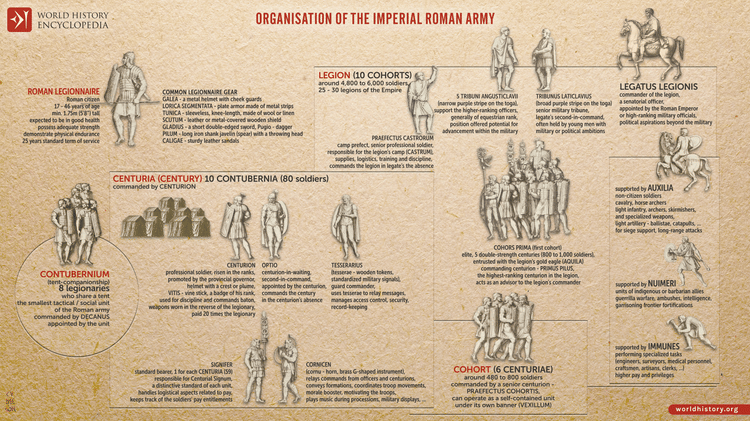 Roma İmparatorluk Ordusunun Organizasyonu Simeon Netchev (CC BY-NC-ND) ](https://www.worldhistory.org/image/17572/organization-of-the-imperial-roman-army/ "Organization of the Imperial Roman Army")Erken Cumhuriyet devrinde birlik dizilimi Yunan falanksının örneğini takip ediyordu, ancak MÖ 3. yüzyıldan MÖ 1. yüzyıla kadar piyade mevzilendirme taktikleri değişti. Roma ordusunun en büyük birimi, 30 tümen veya manipleye bölünmüş 4200 kişilik lejyondu ve her biri artık üç hat halinde (*hastati*, *principes* ve *triarii* - yani kıdemli askerler) satranç tahtası (*quincunx*) şeklinde düzenlenmişti. Genellikle Roma'nın müttefiklerinden gelen 800 ila 1200 hafif zırhlı asker (*velites*) lejyonun önünde yer alırken, 300 süvari de destek için mevzilendirilmişti. Bu iki grup, ağır piyade lejyonları için koruyucu bir kalkan vazifesi görüyordu ve düşman lejyonlarla doğrudan karşılaştığında düşmanı kanatlardan taciz ediyordu. MÖ 1. yüzyılda her ikisi de ordudan kayboldu, ancak süvariler İmparatorluk devrinde geri döndü. Romalıların sahip olmadığı maharetlere sahip usta paralı asker birlikleri de kullanılabilirdi; örneğin Giritli okçular ve Rodoslu sapan kullananlar.
Manipleler hareketliydi, yakın formasyonlarında disiplinliydiler ve düşmanla olan çatışmalarını değiştirerek harbe yeni birliklerin girmesine imkan tanıyabiliyorlardı. Manevra kabiliyeti, daha hafif silahların benimsenmesiyle de destekleniyordu: kısa kılıç veya *gladius Hispaniensis*, ananevi ağır mızrak yerine pilum cirit ve ortadan saplı, içbükey kalkan veya scutum. Ayrıca, arazinin birlik hareketlerini kolaylaştırmada veya mani olmada mühim bir faktör olabileceği de anlaşıldı. Birlikler ayrıca bu silahları iyi kullanmak ve karmaşık harp manevraları gerçekleştirmek üzere talim ediliyorlardı, ancak talimin süresi ve yoğunluğu büyük ölçüde ferdi kumandanlara bağlıydı.
MÖ 100'den (hatta belki daha da öncesinden) itibaren maniple sistemi terk edildi ve bunun yerine lejyon, 400-500 kişiden oluşan 10 kohorta bölündü; bu da Roma'nın temel taktik birimi olarak kaldı. Bu devirde lejyonlar kalıcı adlar ve kimlikler edindi ve devletçe teçhiz edildi. MÖ 167'de 8 lejyon varken, MÖ 50'ye gelindiğinde bu sayı yaklaşık 15 lejyona yükselmişti. Augustus, MÖ 31 civarında ilk kez merkezi kumanda ve lojistik yapısına sahip kalıcı ve tamamen profesyonel bir ordu kurarak 300.000 kişilik kalıcı bir kuvvet tesis etti ve bu da daha sonraki yüzyıllarda [imparatorluk](https://www.worldhistory.org/trans/tr/1-99/imparatorluk/) çapında 25-30 lejyonun bulunduğu devasa orduların yolunu açtı. MS 6'da imparator ayrıca, vergilerle finanse edilen ve emeklilik hakları sistemine izin veren, bilhassa ordu için bir hazine (*aerarium militare*) kurdu. Augustus'un bir diğer politikası da, kumanda pozisyonlarını İmparatorluk kliğiyle sınırlandırarak sadakati temin etmekti.
### Birlikleri Motive Etmek
Bütün askerler imparatora bağlılık andı (*sacramentum*) içerlerdi. Bu, sadakati teminde önemli bir faktördü, ancak aynı zamanda Roma silahlı kuvvetlerinin erken Cumhuriyet devrinden beri meşhur olduğu ve savaş sahasındaki birçok zaferin doğrudan mesulü olan disiplini (*disciplina militaris*) de teşvik ediyordu. Disiplin, mükafat ve ceza sistemiyle daha da teminat altına alınıyordu. Askerler, cesaret ve inisiyatif gösterdikleri için nişan, para, ganimet ve terfi alabiliyorlardı. Mamafih, mükafat eksikliği ve izinsiz aşırı uzun hizmet, bazen isyana dönüşen şikayetlere sebep olabiliyordu. Ceza birçok biçimde tatbik edilebiliyor ve isyankar muhalefet sebebiyle olduğu kadar savaşta cesaret eksikliği yüzünden de uygulanabiliyordu. Filhakika, onda bir nispetinde öldürme cezası sıklıkla korkaklık için, mesela düşmüş bir kumandanın cesedini terk etmek için ayrılmıştı. Bu, kura çekilmesi ve her onuncu adamın diğer dokuzunca sopayla öldürülmesi manasına geliyordu. Diğer cezalar arasında ganimet, maaş veya rütbe kaybı, kırbaçlanma, gurursuz terhis, köle olarak satılma ve hatta idam yer alıyordu. Temel prensip, bağlılık andını bozan kişinin bütün haklarını kaybetmesiydi.
[  Centurion Luc Viatour / www.Lucnix.be (CC BY-NC-SA) ](https://www.worldhistory.org/image/2736/centurion/ "Centurion")### Stratejiler
Julius Caesar'ın *[Galya](https://www.worldhistory.org/trans/tr/1-354/galya/) Savaşı Üzerine Yorumları*, büyük kumandanın lojistiğe, kararlılığa ve özgüven görünüşüne verdiği ehemmiyeti ve bunların birliklerin moraline müspet tesirini anlatır. Ayrıca yenilikçiliğin, yurtseverliğin, disiplinin ve şansın önemini de kaydeder. Buna ilaveten, bir kumandan, esirlerden, muhaliflerden ve firarilerden düşman hakkında askeri istihbarat toplayarak savaştan önce başarı şansını büyük ölçüde artırabilirdi. Kumandanlar (Sezar'ın kendisinin yaptığı gibi) subaylarıyla birlikte bir c*onsilium* veya savaş konseyi düzenleyerek taarruz stratejilerini sunabilir ve münakaşa edebilir, ayrıca tecrübeli savaşçıların tecrübelerinden yararlanabilirlerdi. Roma'nın yüzyıllarca süren askeri üstünlüğünü sağlayacak olan bütün bu faktörlerin birleşmesiydi. Yol boyunca mühim mağlubiyetler de oldu, ancak kumandanların askeri kifayetsizliklerinden dolayı sıklıkla cezadan kurtulduklarını ve mağlubiyetin mesuliyetinin genelde askerlere yüklendiğini müşahede etmek ilginçtir.
Roma kumandanları umumiyetle agresif ve direkt bir taarruzu tercih ederdi (ancak *exploratores* birliklerinden oluşan bir öncü birlik tarafından uygun bir keşif yapılması şartıyla), aynı zamanda mahalli halkı bastırmak için terör ve intikam taktikleri de kullanılırdı; bu strateji, düşmandan rehineler ve sulh vaatleri kabul etme anlamına gelen *clementia* ile harmanlanmıştı. MÖ 1. yüzyıldan itibaren harp sahası tahkimatları, siperler ve muhasaraların kullanılması arttı. MS 3. yüzyıldan itibaren imparatorluğun hudutlarının müdafaası öncelik haline geldi ve şehirlerin tahkim edilmesine ve 500 ila 1000 kişilik daha küçük birliklerin (*vexillationes*) daha hareketli bir şekilde mevzilendirilmesine yol açtı. Bu büyük ölçüde düşman kuvvetlerinin güçlü Romalılara karşı doğrudan hücumlarının çekinmesinden ve bu yüzden gerilla taktiklerini tercih etmesinden kaynaklanıyordu. Julius Caesar da muhasaraların büyük bir müdafiiydi ve muhasaralar bazı avantajlar sunuyordu. Zıt kuvvet tek bir darbeyle ciddi şekilde zayıflatılabilir, mahalli halk uygun şekilde terörize edilerek Roma'yı yeni efendileri olarak kabul ettirilebilir ve muzaffer olunursa hazır bir kale ele geçirilebilir.
[  Roma Balistası Rekonstrüksiyonu Oren Rozen (GNU FDL) ](https://www.worldhistory.org/image/2284/roman-ballista-reconstruction/ "Roman Ballista Reconstruction")### Kuşatmalar
Tipik bir kuşatmada, hücuma uğrayacak yerleşim mahallini kuşatmak ve kimsenin kaçmasına mani olmak için önden kuvvetler gönderilirdi. Ana kuvvet, şehirden füze menzili dışında ve tercihen yüksek bir yerde, yerleşim mahallinin içini müşahede etmek ve su temini gibi önemli hedefleri belirlemek için iyi bir görüş noktası sağlayan tahkim edilmiş bir kamp kurardı. Taarruz başladığında, müdafiilerin duvarları, ağaçlar, toprak ve kayalar kullanılarak duvarlara karşı bir rampa inşa edilerek aşılabilirdi. Bu yapılırken, saldırganlar geçici siperler ve burulma mancınıkları, cıvata atıcıları, taş atıcıları ve okçulardan oluşan bataryaların destek ateşiyle korunurdu. Müdafiiler, taarruz altındaki duvar bölümünün yüksekliğini artırmaya ve hatta kuleler ilavesine çalışabilirlerdi. Saldırganlar ayrıca ağır koçbaşlarıyla (bir çerçeveye asılı) duvarlara hücum edebilir ve kuşatma kuleleri de kullanabilirlerdi. Müdafiiler, saldırganların üzerine yanan yağ, yanan tahta parçaları ve taşlar gibi ellerine geçen her şeyi attılar; ayrıca tünel kazarak kuşatma rampalarını ve kulelerini zayıflatmaya çalışabilirlerdi; saldırganlar da müdafaa duvarlarını zayıflatmak için aynı tekniği kullanabilirlerdi. Umumiyetle, fethedildikten sonra, uzun zamanlı mukavemenetin boşuna olduğunun bir örneği gösterilmek zorunda olduğu için yalnızca kadınlar ve çocuklar hayatta kalmayı umabilirdi.
### Lojistikler
İmparatorluk ordusu yürüyüş halindeyken her şeyden önce iyi düzenlenmişti. Lejyonerlerin yanı sıra, birlik süvari, okçu, yardımcı birlikler, topçu, koçbaşları, sancaktarlar, borazan çalanlar, hizmetkarlar, yük katırları, demirciler, mühendisler, haritacılar ve yol yapımcılarından oluşabiliyordu. Ordu hedefine ulaştığında, müstahkem bir kamp kurardı ve Romalıların lojistik becerileri, bilhassa yiyecek açısından, mahalli bölgeden müstakil olarak tedarik edilebilmelerini temin ederdi. Malzemeler kampa ulaştığında, direkler üzerine inşa edilmiş ve iyi havalandırılmış, bozulabilir malları daha iyi koruyan hususi olarak inşa edilmiş depolarda (*horrea*) saklanırdı. Yiyecek depoları, bir numaralı düşmanları olan kara sıçana karşı, aynı nedenle gemilerde de kullanılan kediler kullanılarak korunuyordu.
İmparatorluk devrinin hususi bir yeniliği, çoğu askeri birliğe bağlı doktorların (*medici*) ve sağlık asistanlarının (*capsarii*) getirilmesiydi. Müstahkem kampların içinde ordu hastaneleri (*valetudinarium*) bile vardı.
[  Deniz Çıkarması The Creative Assembly (Copyright) ](https://www.worldhistory.org/image/1341/naval-landing/ "Naval Landing")### Deniz Savaşları
Roma denizcilik taktikleri, Yunanlıların kullandığı usullerden pek farklı değildi. Gemiler, asker taşımak için kürekçiler ve yelkenlerle hareket ettiriliyor, deniz savaşlarında ise gemilerin pruvasına sabitlenmiş bronz kaplı koçbaşları kullanılarak düşman gemilerine karşı birer koçbaşı vazifesi görüyordu. Roma, erken Cumhuriyet devrinden itibaren deniz vasıtaları kullanmıştı, ancak MÖ 260 yılında Kartaca'dan gelen tehdide mukabil olarak 100 beş kürekli ve 20 üç kürekli gemiden oluşan ilk mühim donanmasını kurdu. Beş kürekli gemilere, düşman gemilerini tutmak ve zaptetmek için kullanılan, *corvus* (karga) olarak bilinen bir köprü takılmıştı. Romalılar, kaybettikleri gemileri ve askerleri daha hızlı bir şekilde yerine koyabildikleri için Kartaca filosunu sonunda mağlup ettiler. Roma, MÖ 67'de Pompey'in Pamfilya ve [Kilikya](https://www.worldhistory.org/trans/tr/1-10741/kilikya/)'ya saldırmasıyla (Plutarkhos'un korsanlığın bastırılmasıyla özdeşleştirdiği bir sefer) ve MÖ 36'da [Marcus Agrippa](https://www.worldhistory.org/trans/tr/1-14477/marcus-agrippa/)'nın Sicilya'ya ve Sextus Pompeius Magnus'un filosuna saldırmak için yaklaşık 400 gemi toplamasıyla bir kez daha filo topladı. Agrippa'nın gemilerinden bazılarında, bir vinçle düşman gemisini çekmek ve ele geçirmek için kullanılan, mancınıkla fırlatılan yeni bir kanca vardı.
MÖ 31'de, Octavian ve Mark Antony ile Kleopatra'nın filoları arasında Aktium yakınlarında büyük bir deniz savaşı yaşandı. Zaferin ardından, yeni imparator Augustus, 4. yüzyıla kadar faaliyet gösteren iki filo kurdu: Ravenna'da mevzilenmiş *Classis Ravennatium* ve Misenum'da mevzilenmiş *Classis Misenatium*. Ayrıca [İskenderiye](https://www.worldhistory.org/trans/tr/1-245/iskenderiye/), [Antakya](https://www.worldhistory.org/trans/tr/1-11771/antakya/), [Rodos](https://www.worldhistory.org/trans/tr/1-534/rodos/), Sicilya, Libya ve Britanya'da mevzilenmiş filoların yanı sıra Ren Nehri'nde ve Tuna Nehri'nde faaliyet gösteren iki filo daha vardı. Bu filolar, Roma'nın imparatorluk çapındaki askeri ihtiyaçlara hızla cevap vermesini ve ordunun muhtelif seferlerinde ihtiyaç duyduğu malzemeleri tedarik etmesini sağladı.
Filolar, imparatorca tayin edilen bir vali (*praefectus*) tarafından kumanda ediliyordu. Geminin kaptanı, centurion rütbesine veya *trierarchus* unvanına sahipti. Filolar, Campania'daki Portus Julius gibi suni limanlar ve tünellerle birbirine bağlanan lagünleri içeren müstahkem limanlarda mevzilenmişti. Roma askeri gemilerinin mürettebatı, gerektiğinde hafif silahlı kara birlikleri olarak hareket etmeleri beklendiği için, gerçekte denizcilerden çok askerlerden oluşuyordu. Sıklıkla mahalli olarak ve fakir sınıflardan seçiliyorlardı, ancak savaş esirleri ve köleler de mürettebata dahil edilebiliyordu.
[  Roma Zafer Alayı The Creative Assembly (Copyright) ](https://www.worldhistory.org/image/1214/roman-victory-procession/ "Roman Victory Procession")### Galibin Ganimetleri
Savaşta kazanılan zafer, yeni topraklar kazandırdı, servet ve kaynaklar elde etti, düşmanları barış istemeye ikna etti ve Roma'nın sınırlarını müdafaa edeceğine, doyumsuz bir genişleme arzusuna sahip olduğuna dair net bir mesaj verdi; ayrıca Romalıların savaş sahasında ne kadar müthiş bir savaş makinesi sunabileceğine dair su götürmez deliller sağladı.
Cumhuriyet çağında düşman silahları yakılabilir ve bilhassa [Mars](https://www.worldhistory.org/trans/tr/1-10341/mars/), [Minerva](https://www.worldhistory.org/trans/tr/1-12417/minerva/) ve Vulcan'a adaklar sunulabilirdi. Zafer kazanan kumandanlar, yüzyıllarca 300'den fazla kişinin katıldığı görklü bir zafer alayıyla Roma'ya kahramanlar olarak döndüler. Zafer alayı önce Senato tarafından teyit edilip finanse edilirdi. Kumandan, esirler, altın ve sanat eserleri gibi hazineler ve hatta zafer kazanılan bölgeden egzotik hayvanlar da içeren görklü bir alayla şehre bir savaş arabasıyla girerdi. Mor cübbeler (*toga picta* ve *tunica palmata*) ve defne yaprağından bir taç giyer, fildişi bir asa ve defne dalı tutar ve arkasında duran bir köle, başının üzerinde altın bir taç tutarak, gurur ve kibirin tehlikelerini hatırlatmak için "Arkaya bak" (*Respice*) diye fısıldardı. Augustus devrinden itibaren sadece imparatorlar zafer alayı tertipleyebiliyordu, ama her halükarda bu pratik çok daha az sıklıkta görülmeye başlandı.
Zafer kazanan kumadanlar ayrıca harp ganimetlerini Roma'yı güzelleştirmek için de kullandılar; mesela Pompey'in tiyatrosu, Augustus'un forumu ve Vespasian'ın Kolezyumu. Zaferin diğer mimari kutlamaları arasında dikilitaşlar ve sütunlar yer alıyordu, ancak belki de Roma askeri kibrinin en çarpıcı abidesi, en büyük ve en süslü olanı Roma'daki I. Konstantin'in zafer takıydı.
### Sonuç
Roma'nın silahlı kuvvetleri devletin en büyük tek gider kalemiydi, lakin ele geçirilen topraklar, kaynaklar, zenginlik ve köleler ile daha sonraki sınır müdafaası lüzumu, savaşın Roma için kaçınılmaz bir meşguliyet olması manasına geliyordu. Savaşta büyük muvaffakiyetler elde edilebiliyordu, lakin kabiliyetli rakipler Roma'nın kazanma stratejilerini kendi avantajlarına kullanmaya başladıkça, mağlubiyetler de Roma'yı temellerinden sarsabiliyordu. Dahası, Roma'nın askeri gücü giderek daha fazla bilindikçe, Roma ordusunun hasımla doğrudan çatışmaya girmesi giderek zorlaşacaktı. Mamafih, yüzyıllar boyunca ve üç kıtada Romalılar, kabiliyetli kumandanlarca tam olarak kullanıldığında, iyi eğitilmiş, iyi disiplinli bir ordunun büyük mükafatlar getirebileceğini göstermişlerdi ve savaşın Roma'nın harp sahasına getirdiği ölçü ve profesyonelliğe geri dönmesi ancak düşüşünden bin yıl sonra gerçekleşecekti.
#### Editorial Review
This human-authored definition has been reviewed by our editorial team before publication to ensure accuracy, reliability and adherence to academic standards in accordance with our [editorial policy](https://www.worldhistory.org/static/editorial-policy/).
## Bibliografya
- [Barchiesi, A. *The Oxford Handbook of Roman Studies.* Oxford University Press, USA, 2010.](https://www.worldhistory.org/books/0199211523/)
- [Caesar. *The Conquest of Gaul.* Penguin Classics, 1983.](https://www.worldhistory.org/books/0140444335/)
- [Campbell, B. (ed). *The Oxford Handbook of Warfare in the Classical World.* Oxford University Press, USA, 2013.](https://www.worldhistory.org/books/0195304659/)
- [Hornblower, S. *The Oxford Classical Dictionary.* Oxford University Press, USA, 2012.](https://www.worldhistory.org/books/0199545561/)
- [Oleson, J.P. *The Oxford Handbook of Engineering and Technology in the Classical World.* Oxford University Press, USA, 2009.](https://www.worldhistory.org/books/0199734852/)
- [Potter, D.S. (ed). *A Companion to the Roman Empire.* Wiley-Blackwell, 2010.](https://www.worldhistory.org/books/1405199180/)
## Yazar Hakkında
Mark, WHE'nin Yayın Direktörü olup Siyaset Felsefesi alanında yüksek lisans derecesine sahiptir (York Üniversitesi). Tam zamanlı bir araştırmacı, yazar, tarihçi ve editördür. Özel ilgi alanları arasında sanat, mimari ve tüm medeniyetlerin paylaştığı fikirleri keşfetmek yer almaktadır.
## Zaman çizelgesi
- **750 BCE - 510 BCE**: The semi-legendary celeres or trossuli - a 300-man cavalry corps which the first kings of [Rome](https://www.worldhistory.org/Rome/) incorporated into the legion - is formed, later their number is increased to 600.
- **578 BCE - 535 BCE**: Servius Tullius, the king of [Rome](https://www.worldhistory.org/Rome/), increases the number of the cavalry corps (equites) to 1,800.
- **c. 508 BCE**: [Lars Porsenna](https://www.worldhistory.org/Lars_Porsenna/), [Etruscan](https://www.worldhistory.org/Etruscan_Civilization/) king of [Chiusi](https://www.worldhistory.org/Chiusi/), lays siege to [Rome](https://www.worldhistory.org/Rome/).
- **498 BCE - 493 BCE**: [Rome](https://www.worldhistory.org/Rome/) defeats the Latins.
- **437 BCE - 435 BCE**: [Rome](https://www.worldhistory.org/Rome/) defeats [Etruscan](https://www.worldhistory.org/Etruscan_Civilization/) [Veii](https://www.worldhistory.org/Veii/) in the Veientine [War](https://www.worldhistory.org/disambiguation/War/); the Etruscan king Lars Tolumnius is killed.
- **c. 400 BCE**: The [Roman cavalry](https://www.worldhistory.org/Roman_Cavalry/) is expanded to include riders who can pay for their own horse.
- **396 BCE**: [Rome](https://www.worldhistory.org/Rome/) sacks the [Etruscan](https://www.worldhistory.org/Etruscan_Civilization/) town of [Veii](https://www.worldhistory.org/Veii/) after a ten-year siege.
- **396 BCE**: [Roman](https://www.worldhistory.org/disambiguation/Roman/) expansion begins with the capture of [Veii](https://www.worldhistory.org/Veii/) from the [Etruscans](https://www.worldhistory.org/Etruscan_Civilization/).
- **390 BCE**: Gauls sack [Rome](https://www.worldhistory.org/Rome/).
- **c. 390 BCE**: "Gallic Catastrophe:" [Brennus](https://www.worldhistory.org/brennus/) of the Senones defeats the Romans at Allia, and subsequently sacks [Rome](https://www.worldhistory.org/Rome/).
- **356 BCE**: 307 [Roman](https://www.worldhistory.org/disambiguation/Roman/) prisoners are sacrificed in the forum of the [Etruscan](https://www.worldhistory.org/Etruscan_Civilization/) [city](https://www.worldhistory.org/city/) of [Tarquinia](https://www.worldhistory.org/Tarquinia/).
- **343 BCE - 341 BCE**: First Samnite [War](https://www.worldhistory.org/disambiguation/War/) ([Rome](https://www.worldhistory.org/Rome/) vs. Samnites).
- **326 BCE - 304 BCE**: Second Samnite [War](https://www.worldhistory.org/disambiguation/War/).
- **298 BCE - 290 BCE**: Third Samnite [War](https://www.worldhistory.org/disambiguation/War/). Victory for [Rome](https://www.worldhistory.org/Rome/), peace with the [Etruscans](https://www.worldhistory.org/Etruscan_Civilization/).
- **298 BCE - 290 BCE**: Third Samnite [War](https://www.worldhistory.org/disambiguation/War/) between [Rome](https://www.worldhistory.org/Rome/) and the Samnite people.
- **297 BCE**: [Celts](https://www.worldhistory.org/celt/) and Samnites join forces and defeat the Romans at Camertium.
- **c. 295 BCE**: In a [battle](https://www.worldhistory.org/disambiguation/battle/) lasting all day, Romans narrowly defeat a force of [Celts](https://www.worldhistory.org/celt/) and Samnites at Sentinum.
- **295 BCE**: [Roman](https://www.worldhistory.org/disambiguation/Roman/) victory over Samnites, Gauls and Umbrians at Sentinum.
- **294 BCE**: A [Roman army](https://www.worldhistory.org/Roman_Army/) led by L. Postimius Megellus defeats an army from [Etruscan](https://www.worldhistory.org/Etruscan_Civilization/) [Volsinii](https://www.worldhistory.org/volsinii/).
- **285 BCE - 282 BCE**: [Rome](https://www.worldhistory.org/Rome/) defeats the [Celts](https://www.worldhistory.org/celt/) in [Italy](https://www.worldhistory.org/italy/). Rome's dominance in central Italy is secured.
- **284 BCE**: Gauls of the Insubres and Boii tribes defeat the Romans at [Arretium](https://www.worldhistory.org/arretium/).
- **283 BCE**: [Rome](https://www.worldhistory.org/Rome/) decisively defeats the Senones at Picenum.
- **280 BCE**: The Romans [conquer](https://www.worldhistory.org/warfare/) the [Etruscan](https://www.worldhistory.org/Etruscan_Civilization/) [cities](https://www.worldhistory.org/city/) of [Tarquinia](https://www.worldhistory.org/Tarquinia/), [Volsinii](https://www.worldhistory.org/volsinii/) and [Vulci](https://www.worldhistory.org/Vulci/).
- **280 BCE - 275 BCE**: King [Pyrrhus](https://www.worldhistory.org/pyrrhus/) of Epirus wages the Pyrrhic [War](https://www.worldhistory.org/disambiguation/War/) against the Romans in [Italy](https://www.worldhistory.org/italy/), defence of [Tarentum](https://www.worldhistory.org/tarentum/) being the pretext.
- **280 BCE - 272 BCE**: [Roman](https://www.worldhistory.org/disambiguation/Roman/) [war](https://www.worldhistory.org/disambiguation/War/) against [Tarentum](https://www.worldhistory.org/tarentum/). [Rome](https://www.worldhistory.org/Rome/) conquers Tarentum. Rome's dominance in lower [Italy](https://www.worldhistory.org/italy/) is secured.
- **Jul 280 BCE**: [Pyrrhus](https://www.worldhistory.org/pyrrhus/) defeats the Romans at the [Battle](https://www.worldhistory.org/disambiguation/battle/) of Heraclea.
- **279 BCE**: [Pyrrhus](https://www.worldhistory.org/pyrrhus/) defeats the Romans at the [Battle](https://www.worldhistory.org/disambiguation/battle/) of Asculum.
- **275 BCE**: The Romans defeat [Pyrrhus](https://www.worldhistory.org/pyrrhus/) of Epirus at the [Battle](https://www.worldhistory.org/disambiguation/battle/) of Maleventum.
- **273 BCE**: [Rome](https://www.worldhistory.org/Rome/) conquers the [Etruscan](https://www.worldhistory.org/Etruscan_Civilization/) town of [Cerveteri](https://www.worldhistory.org/Cerveteri/).
- **264 BCE**: The Mamertines at Messana on [Sicily](https://www.worldhistory.org/sicily/) call for Carthaginian and then [Roman](https://www.worldhistory.org/disambiguation/Roman/) help in defence against [Syracuse](https://www.worldhistory.org/syracuse/), sparking the [First Punic War](https://www.worldhistory.org/First_Punic_War/).
- **264 BCE - 241 BCE**: [First Punic War](https://www.worldhistory.org/First_Punic_War/). [Carthage](https://www.worldhistory.org/carthage/) cedes [Sicily](https://www.worldhistory.org/sicily/) to [Rome](https://www.worldhistory.org/Rome/).
- **262 BCE**: [Rome](https://www.worldhistory.org/Rome/) besieges and sacks [Agrigento](https://www.worldhistory.org/agrigento/) on [Sicily](https://www.worldhistory.org/sicily/) in one of the first actions of the [First Punic War](https://www.worldhistory.org/First_Punic_War/).
- **260 BCE**: First [Roman](https://www.worldhistory.org/disambiguation/Roman/) naval victory against [Carthage](https://www.worldhistory.org/carthage/) off Mylae in the [First Punic War](https://www.worldhistory.org/First_Punic_War/).
- **260 BCE**: [Rome](https://www.worldhistory.org/Rome/) builds a fleet of 120 ships in just 60 days to fight the [First Punic War](https://www.worldhistory.org/First_Punic_War/).
- **258 BCE**: [Rome](https://www.worldhistory.org/Rome/) wins a naval [battle](https://www.worldhistory.org/disambiguation/battle/) against [Carthage](https://www.worldhistory.org/carthage/) at Sulcis during the [First Punic War](https://www.worldhistory.org/First_Punic_War/).
- **256 BCE**: [Roman](https://www.worldhistory.org/disambiguation/Roman/) naval victory against [Carthage](https://www.worldhistory.org/carthage/) off Ecnomus during the [First Punic War](https://www.worldhistory.org/First_Punic_War/).
- **256 BCE**: [Rome](https://www.worldhistory.org/Rome/) lands an army of four legions on African soil at Clupea during the [First Punic War](https://www.worldhistory.org/First_Punic_War/).
- **256 BCE**: [Rome](https://www.worldhistory.org/Rome/) wins a land [battle](https://www.worldhistory.org/disambiguation/battle/) south of Tunis during the [First Punic War](https://www.worldhistory.org/First_Punic_War/).
- **255 BCE**: A Carthaginain army led by the mercenary Spartan commander Xanthippus defeats two [Roman](https://www.worldhistory.org/disambiguation/Roman/) legions near Tunis during the [First Punic War](https://www.worldhistory.org/First_Punic_War/).
- **255 BCE - 253 BCE**: [Roman](https://www.worldhistory.org/disambiguation/Roman/) fleets are wrecked by storms off Pachynus and Palinurus during the [First Punic War](https://www.worldhistory.org/First_Punic_War/).
- **c. 250 BCE - c. 200 CE**: Originally a Celtiberian weapon, the [Gladius Hispaniensis](https://www.worldhistory.org/Gladius_Hispaniensis/) was commonly used by [Roman](https://www.worldhistory.org/disambiguation/Roman/) soldiers for more than four centuries.
- **Jun 250 BCE**: A [Carthaginian army](https://www.worldhistory.org/Carthaginian_Army/) led by Hasdrubal is defeated by [Roman](https://www.worldhistory.org/disambiguation/Roman/) [consul](https://www.worldhistory.org/Consul/) Metellus near Palermo in the [First Punic War](https://www.worldhistory.org/First_Punic_War/).
- **249 BCE**: [Carthage](https://www.worldhistory.org/carthage/) defeats [Rome](https://www.worldhistory.org/Rome/) in a naval [battle](https://www.worldhistory.org/disambiguation/battle/) at Drepanum during the [First Punic War](https://www.worldhistory.org/First_Punic_War/).
- **241 BCE**: [Roman](https://www.worldhistory.org/disambiguation/Roman/) naval victory off the Aegates Islands leads to victory over [Carthage](https://www.worldhistory.org/carthage/), ending the [First Punic War](https://www.worldhistory.org/First_Punic_War/).
- **229 BCE - 228 BCE**: [Rome](https://www.worldhistory.org/Rome/) fights Illyrian pirates. Queen Teuta pays tribute to Rome.
- **223 BCE**: Romans successfully campaign against [Celtic](https://www.worldhistory.org/celt/) tribes of Cisalpine [Gaul](https://www.worldhistory.org/gaul/).
- **222 BCE**: [Rome](https://www.worldhistory.org/Rome/) conquers Cisalpine [Gaul](https://www.worldhistory.org/gaul/) (modern-day Provence, France).
- **219 BCE**: [Hannibal](https://www.worldhistory.org/hannibal/) crosses the Ebro river in Spain and sacks the [city](https://www.worldhistory.org/city/) of [Saguntum](https://www.worldhistory.org/Saguntum/), [Rome](https://www.worldhistory.org/Rome/)'s ally, sparking off the [Second Punic War](https://www.worldhistory.org/Second_Punic_War/).
- **218 BCE - 201 BCE**: [Second Punic War](https://www.worldhistory.org/Second_Punic_War/).
- **Mar 218 BCE**: [Rome](https://www.worldhistory.org/Rome/) declares [war](https://www.worldhistory.org/disambiguation/War/) on [Carthage](https://www.worldhistory.org/carthage/) after [Hannibal](https://www.worldhistory.org/hannibal/) sacks [Saguntum](https://www.worldhistory.org/Saguntum/) in Spain. The [Second Punic War](https://www.worldhistory.org/Second_Punic_War/) begins.
- **Apr 218 BCE - May 218 BCE**: [Hannibal](https://www.worldhistory.org/hannibal/) leaves Spain to cross the Pyrenees and Alps into [Italy](https://www.worldhistory.org/italy/).
- **Nov 218 BCE**: [Hannibal](https://www.worldhistory.org/hannibal/) wins the [battle](https://www.worldhistory.org/disambiguation/battle/) of Ticinus.
- **Dec 218 BCE**: [Hannibal](https://www.worldhistory.org/hannibal/) wins the [battle](https://www.worldhistory.org/disambiguation/battle/) of Trebia.
- **Jun 217 BCE**: [Hannibal](https://www.worldhistory.org/hannibal/) wins the [battle](https://www.worldhistory.org/disambiguation/battle/) of Lake Trasimene.
- **Aug 216 BCE**: [Hannibal](https://www.worldhistory.org/hannibal/) wins the [battle of Cannae](https://www.worldhistory.org/Battle_of_Cannae/), the worst defeat in [Roman](https://www.worldhistory.org/disambiguation/Roman/) history.
- **215 BCE**: A [Carthaginian army](https://www.worldhistory.org/Carthaginian_Army/) led by Hasdrubal is defeated at the [battle](https://www.worldhistory.org/disambiguation/battle/) of Ibera in Spain.
- **214 BCE - 205 BCE**: First Macedonian [War](https://www.worldhistory.org/disambiguation/War/): [Rome](https://www.worldhistory.org/Rome/) defeats Philip V of [Macedon](https://www.worldhistory.org/macedon/).
- **212 BCE**: A [Carthaginian army](https://www.worldhistory.org/Carthaginian_Army/) is defeated in [Sicily](https://www.worldhistory.org/sicily/) by a [Roman army](https://www.worldhistory.org/Roman_Army/) led by Marcellus. [Syracuse](https://www.worldhistory.org/syracuse/) falls to [Rome](https://www.worldhistory.org/Rome/) who now control the island.
- **211 BCE**: A [Carthaginian army](https://www.worldhistory.org/Carthaginian_Army/) defeats two [Roman](https://www.worldhistory.org/disambiguation/Roman/) consuls and their armies in the Tader valley, Spain.
- **210 BCE - 207 BCE**: [Scipio Africanus](https://www.worldhistory.org/disambiguation/Scipio_Africanus/) conquers Spain for [Rome](https://www.worldhistory.org/Rome/).
- **209 BCE**: [Scipio Africanus](https://www.worldhistory.org/disambiguation/Scipio_Africanus/) captures the Carthaginian base and treasury [Carthago Nova](https://www.worldhistory.org/Carthago_Nova/) in southern Spain.
- **208 BCE**: [Scipio Africanus](https://www.worldhistory.org/disambiguation/Scipio_Africanus/) defeats a [Carthaginian army](https://www.worldhistory.org/Carthaginian_Army/) led by Hasdrubal at Baecula in Spain.
- **207 BCE**: [Hannibal](https://www.worldhistory.org/hannibal/), harassed by [Roman](https://www.worldhistory.org/disambiguation/Roman/) forces, is reduced to controlling only Bruttium in southern [Italy](https://www.worldhistory.org/italy/).
- **c. 22 Jun 207 BCE**: [Rome](https://www.worldhistory.org/Rome/) defeats a [Carthaginian army](https://www.worldhistory.org/Carthaginian_Army/) at the [battle](https://www.worldhistory.org/disambiguation/battle/) of Metaurus.
- **206 BCE**: [Scipio Africanus](https://www.worldhistory.org/disambiguation/Scipio_Africanus/) wins the [battle](https://www.worldhistory.org/disambiguation/battle/) of Ilipa in Spain.
- **204 BCE**: [Scipio Africanus](https://www.worldhistory.org/disambiguation/Scipio_Africanus/) sails to North [Africa](https://www.worldhistory.org/disambiguation/africa/) in the [Second Punic War](https://www.worldhistory.org/Second_Punic_War/).
- **204 BCE - 203 BCE**: [Scipio Africanus](https://www.worldhistory.org/disambiguation/Scipio_Africanus/) wins two battles and besieges [Utica](https://www.worldhistory.org/Utica/) in North [Africa](https://www.worldhistory.org/disambiguation/africa/).
- **203 BCE**: Carthaginian commander Mago is unable to join forces with [Hannibal](https://www.worldhistory.org/hannibal/) and his army is defeated in Cisalpine [Gaul](https://www.worldhistory.org/gaul/).
- **203 BCE**: [Scipio Africanus](https://www.worldhistory.org/disambiguation/Scipio_Africanus/) defeats a [Carthaginian army](https://www.worldhistory.org/Carthaginian_Army/) led by Hasdrubal in North [Africa](https://www.worldhistory.org/disambiguation/africa/).
- **203 BCE**: [Hannibal](https://www.worldhistory.org/hannibal/) is recalled from [Italy](https://www.worldhistory.org/italy/) to defend [Carthage](https://www.worldhistory.org/carthage/) against [Scipio Africanus](https://www.worldhistory.org/disambiguation/Scipio_Africanus/).
- **19 Oct 202 BCE**: [Battle](https://www.worldhistory.org/disambiguation/battle/) of Zama: [Scipio Africanus](https://www.worldhistory.org/disambiguation/Scipio_Africanus/) defeats [Hannibal](https://www.worldhistory.org/hannibal/), ending the [Second Punic War](https://www.worldhistory.org/Second_Punic_War/).
- **200 BCE - 196 BCE**: Second Macedonian [War](https://www.worldhistory.org/disambiguation/War/): [Roman](https://www.worldhistory.org/disambiguation/Roman/) victory.
- **197 BCE**: Romans are victorious over Philip V of [Macedon](https://www.worldhistory.org/macedon/) at Cynoscephalae.
- **194 BCE**: Romans defeat Antiochus III at [Battle](https://www.worldhistory.org/disambiguation/battle/) of Magnesia.
- **193 BCE**: The Boii are defeated by the Romans, suffering, according to [Livy](https://www.worldhistory.org/livy/), 14,000 dead.
- **190 BCE**: [Battle](https://www.worldhistory.org/disambiguation/battle/) of Magnesia ad Sipylum, disastrous defeat for [Antiochos](https://www.worldhistory.org/disambiguation/antiochos/) III against Romans.
- **172 BCE - 168 BCE**: Third Macedonian [War](https://www.worldhistory.org/disambiguation/War/): [Perseus](https://www.worldhistory.org/Perseus/) of [Macedon](https://www.worldhistory.org/macedon/) challenges [Rome](https://www.worldhistory.org/Rome/) and is defeated.
- **Jun 168 BCE**: Romans defeat [Perseus](https://www.worldhistory.org/Perseus/) of [Macedon](https://www.worldhistory.org/macedon/) at Pydna.
- **150 BCE**: The Lusitani are betrayed and slaughtered by the Romans.
- **149 BCE**: [Rome](https://www.worldhistory.org/Rome/) sends an army of 80,000 infantry and 4,000 cavalry to attack [Carthage](https://www.worldhistory.org/carthage/).
- **149 BCE - 146 BCE**: [Third Punic War](https://www.worldhistory.org/Third_Punic_War/).
- **148 BCE**: The [Roman](https://www.worldhistory.org/disambiguation/Roman/) siege of [Carthage](https://www.worldhistory.org/carthage/), in its second year, remains unsuccessful.
- **147 BCE**: [Viriathus](https://www.worldhistory.org/Viriathus/) leads the Lusitani in victory against the Romans.
- **146 BCE**: [Viriathus](https://www.worldhistory.org/Viriathus/) leads the Lusitani to a second victory against a [Roman army](https://www.worldhistory.org/Roman_Army/), capturing Segobriga in Spain.
- **146 BCE**: [Scipio Africanus](https://www.worldhistory.org/disambiguation/Scipio_Africanus/) the Younger sacks [Carthage](https://www.worldhistory.org/carthage/) and enslaves its population.
- **133 BCE**: [Rome](https://www.worldhistory.org/Rome/) captures Numantia. End of Iberian resistance.
- **113 BCE**: Romans defeated at Noreia by the [Cimbri](https://www.worldhistory.org/Cimbri/).
- **107 BCE - 100 BCE**: [Gaius Marius](https://www.worldhistory.org/Gaius_Marius/) reforms the [Roman army](https://www.worldhistory.org/Roman_Army/).
- **c. 100 BCE**: [Roman cavalry](https://www.worldhistory.org/Roman_Cavalry/) riders are by now classified as auxilia and organised in wings or alae.
- **88 BCE - 63 BCE**: Mithridates of Pontus fights three wars to free [Greece](https://www.worldhistory.org/greece/) from [Rome](https://www.worldhistory.org/Rome/).
- **86 BCE**: The [Roman](https://www.worldhistory.org/disambiguation/Roman/) general [Sulla](https://www.worldhistory.org/sulla/) sacks [Athens](https://www.worldhistory.org/Athens/) and the port of [Piraeus](https://www.worldhistory.org/Piraeus/).
- **82 BCE - 80 BCE**: [Volterra](https://www.worldhistory.org/Volterra/) is besieged and sacked by [Roman](https://www.worldhistory.org/disambiguation/Roman/) general [Sulla](https://www.worldhistory.org/sulla/).
- **69 BCE**: Licinius Lucullus leads a [Roman army](https://www.worldhistory.org/Roman_Army/) which defeats Armenian king [Tigranes II](https://www.worldhistory.org/Tigranes_the_Great/) and his capital [Tigranocerta](https://www.worldhistory.org/Tigranocerta/) is captured. [Artashat](https://www.worldhistory.org/Artashat/) becomes the capital again.
- **67 BCE**: [Pompey](https://www.worldhistory.org/pompey/) assembles a naval fleet and attacks Pamphylia and [Cilicia](https://www.worldhistory.org/Cilicia/), principally to repress [piracy](https://www.worldhistory.org/Piracy/).
- **66 BCE**: [Pompey the Great](https://www.worldhistory.org/pompey/) attacks the Armenian kingdom of [Tigranes II](https://www.worldhistory.org/Tigranes_the_Great/) and makes it a [Roman](https://www.worldhistory.org/disambiguation/Roman/) protectorate.
- **63 BCE**: The [Roman](https://www.worldhistory.org/disambiguation/Roman/) general [Pompey](https://www.worldhistory.org/pompey/) defeats the [Seleucid](https://www.worldhistory.org/Seleucid_Empire/) Antiochus XIII and incorporates [Syria](https://www.worldhistory.org/syria/) as a province of the [Roman empire](https://www.worldhistory.org/Roman_Empire/).
- **58 BCE**: [Caesar](https://www.worldhistory.org/disambiguation/caesar/) attacks the Helvetii while on migration and defeats them.
- **58 BCE - 51 BCE**: [Julius Caesar](https://www.worldhistory.org/Julius_Caesar/)'s [conquest](https://www.worldhistory.org/warfare/) of [Gaul](https://www.worldhistory.org/gaul/).
- **57 BCE**: A [Roman army](https://www.worldhistory.org/Roman_Army/) under [Caesar](https://www.worldhistory.org/disambiguation/caesar/) narrowly defeats an army of Nervii, Atrebates, and Viromandui.
- **56 BCE**: The navies of [Rome](https://www.worldhistory.org/Rome/) and the Veneti Gauls clash resulting in a [Roman](https://www.worldhistory.org/disambiguation/Roman/) victory. This is the first recorded naval [battle](https://www.worldhistory.org/disambiguation/battle/) in the Atlantic Ocean.
- **55 BCE - 54 BCE**: [Julius Caesar](https://www.worldhistory.org/Julius_Caesar/)'s expeditions in [Britain](https://www.worldhistory.org/disambiguation/Britain/).
- **53 BCE**: [Roman](https://www.worldhistory.org/disambiguation/Roman/) general [Marcus Licinius Crassus](https://www.worldhistory.org/Marcus_Licinius_Crassus/) compels [Armenia](https://www.worldhistory.org/armenia/) to provide troops for his campaigns against [Parthia](https://www.worldhistory.org/disambiguation/Parthia/).
- **53 BCE**: [Battle](https://www.worldhistory.org/disambiguation/battle/) of Carrhae. [Crassus](https://www.worldhistory.org/Marcus_Licinius_Crassus/) is captured and executed by the Parthians.
- **52 BCE**: [Julius Caesar](https://www.worldhistory.org/Julius_Caesar/) is defeated at Gergovia by [Vercingetorix](https://www.worldhistory.org/vercingetorix/).
- **52 BCE**: After becoming trapped and besieged at Alesia, [Vercingetorix](https://www.worldhistory.org/vercingetorix/) surrenders to [Caesar](https://www.worldhistory.org/disambiguation/caesar/).
- **49 BCE**: [Julius Caesar](https://www.worldhistory.org/Julius_Caesar/) besieges [Massilia](https://www.worldhistory.org/massilia/).
- **38 BCE**: [Octavian](https://www.worldhistory.org/augustus/) amasses a naval fleet to defeat Sextus [Pompey](https://www.worldhistory.org/pompey/).
- **36 BCE**: [Agrippa](https://www.worldhistory.org/Marcus_Agrippa/) defeats the naval fleet of Sextus [Pompey](https://www.worldhistory.org/pompey/) in the [battle](https://www.worldhistory.org/disambiguation/battle/) of Naulochos.
- **2 Sep 31 BCE**: The [Battle of Actium](https://www.worldhistory.org/Battle_of_Actium/). [Octavian](https://www.worldhistory.org/augustus/) defeats [Mark Antony](https://www.worldhistory.org/Mark_Antony/) and [Cleopatra VII](https://www.worldhistory.org/Cleopatra_VII/).
- **27 BCE - 19 BCE**: Cantabrian Wars: [Roman](https://www.worldhistory.org/disambiguation/Roman/) [conquest](https://www.worldhistory.org/warfare/) of the Iberian Penninsula.
- **6 CE**: [Augustus](https://www.worldhistory.org/augustus/) creates the aerarium militare, a treasury drawn from taxes in order to fund a professional [Roman army](https://www.worldhistory.org/Roman_Army/).
- **9 CE**: The Rhine River is established as the boundary between the Latin and German speaking worlds, following the defeat of the [Roman army](https://www.worldhistory.org/Roman_Army/), under the command of Varus, at the [Battle](https://www.worldhistory.org/disambiguation/battle/) of the Teutoburg Forest.
- **15 CE**: [Germanicus](https://www.worldhistory.org/Germanicus/) leads 12,000 men across the Rhine to attack the Chatti.
- **43 CE**: [Claudius](https://www.worldhistory.org/claudius/) commences the [Roman](https://www.worldhistory.org/disambiguation/Roman/) [conquest](https://www.worldhistory.org/warfare/) of [Britain](https://www.worldhistory.org/disambiguation/Britain/).
- **43 CE**: Maiden Castle, a [Celtic](https://www.worldhistory.org/celt/) hilltop fort in southern [Britain](https://www.worldhistory.org/disambiguation/Britain/), is captured by [Roman](https://www.worldhistory.org/disambiguation/Roman/) legions.
- **54 CE - 60 CE**: [Roman](https://www.worldhistory.org/disambiguation/Roman/) general Corbulo successfully campaigns in [Armenia](https://www.worldhistory.org/armenia/).
- **58 CE - 63 CE**: [Roman](https://www.worldhistory.org/disambiguation/Roman/)-Parthian [War](https://www.worldhistory.org/disambiguation/War/).
- **60 CE - 61 CE**: [Boudicca](https://www.worldhistory.org/Boudicca/)'s Revolt in [Britain](https://www.worldhistory.org/disambiguation/Britain/).
- **70 CE**: The [city](https://www.worldhistory.org/city/) of [Jerusalem](https://www.worldhistory.org/jerusalem/) is besieged and captured by [Rome](https://www.worldhistory.org/Rome/); the Second [Temple](https://www.worldhistory.org/temple/) destroyed.
- **75 CE - 77 CE**: Romans defeat the last of the Northern tribes; [Roman](https://www.worldhistory.org/disambiguation/Roman/) [conquest](https://www.worldhistory.org/warfare/) of [Britain](https://www.worldhistory.org/disambiguation/Britain/) complete.
- **101 CE - 106 CE**: [Trajan](https://www.worldhistory.org/trajan/) conquers [Dacia](https://www.worldhistory.org/dacia/).
- **114 CE**: [Roman emperor](https://www.worldhistory.org/Roman_Emperor/) [Trajan](https://www.worldhistory.org/trajan/) annexes [Armenia](https://www.worldhistory.org/armenia/) and declares [war](https://www.worldhistory.org/disambiguation/War/) on [Parthia](https://www.worldhistory.org/disambiguation/Parthia/).
- **167 CE - 180 CE**: Marcomannic Wars.
- **192 CE**: Emperor [Commodus](https://www.worldhistory.org/commodus/) is murdered, civil [war](https://www.worldhistory.org/disambiguation/War/) ensues (until 197 CE).
- **195 CE**: First Parthian [war](https://www.worldhistory.org/disambiguation/War/).
- **232 CE**: Emperor [Maximinus Thrax](https://www.worldhistory.org/Maximinus_Thrax/) commands a legion in [Egypt](https://www.worldhistory.org/egypt/).
- **293 CE**: Emperor Carausius assassinated by Allectus.
- **312 CE**: [Constantine](https://www.worldhistory.org/disambiguation/Constantine/) defeats Maxentius at Milvian Bridge.
- **Sep 324 CE**: [Constantine I](https://www.worldhistory.org/Constantine_I/) defeats Licinius at Chrysopolis.
- **367 CE**: [Picts](https://www.worldhistory.org/picts/), Scots, [Saxons](https://www.worldhistory.org/Saxons/), and [Franks](https://www.worldhistory.org/Franks/) attack the [Roman Empire](https://www.worldhistory.org/Roman_Empire/).
- **402 CE**: [Alaric](https://www.worldhistory.org/Alaric/) invades [Italy](https://www.worldhistory.org/italy/).
- **410 CE**: The Romans withdraw from [Britain](https://www.worldhistory.org/disambiguation/Britain/).
- **24 Aug 410 CE**: [Alaric](https://www.worldhistory.org/Alaric/) sacks [Rome](https://www.worldhistory.org/Rome/).
- **455 CE**: [Vandals](https://www.worldhistory.org/Vandals/) sack [Rome](https://www.worldhistory.org/Rome/).
- **488 CE - 493 CE**: [Theodoric the Great](https://www.worldhistory.org/Theodoric_the_Great/) of the [Ostrogoths](https://www.worldhistory.org/ostrogoth/) conquers [Italy](https://www.worldhistory.org/italy/).
- **536 CE - 562 CE**: The [Byzantine Empire](https://www.worldhistory.org/Byzantine_Empire/) conquers [Italy](https://www.worldhistory.org/italy/).
- **607 CE - 627 CE**: East [Rome](https://www.worldhistory.org/Rome/) defeats [Sasanian](https://www.worldhistory.org/Sasanian_Empire/) [Persia](https://www.worldhistory.org/Persia/).
## Sorular & Cevaplar
### Romalılar hangi taktikleri kullandılar?
Roma ordusu savaşta birçok farklı taktik kullandı. Roma piyadeleri, satranç tahtası gibi bloklar halinde maniple veya kohortlar halinde mevzilendirildi. Roma manipleleri, sıklıkla kendilerini kalkanlarıyla koruyarak, savaş alanında hareket edebilen ve düşman ateşine direnebilen bir "kaplumbağa" oluşturarak önden ve yandan agresif bir şekilde saldırırlardı. Romalılar ayrıca düşmanlarına üstünlük sağlamak için askeri istihbarat, hile ve muhasara savaşını da kullandılar.
### Romalılar kimlerle savaştı?
Romalılar imparatorluklarını genişletirken birçok farklı kültürle savaştı. Diğer İtalyan kabileleriyle, Batı Avrupa'daki Galyalılarla, Kuzey Afrika'daki Kartacalılarla ve Britanya'daki Kelt Britanyalılarla savaştılar ve onları mağlup ettiler. Romalılar ayrıca Kuzey Avrupa'daki Cermen kabileleriyle ve Orta Doğu'daki Partlarla da savaştılar, ancak daha az muvaffakiyetle.
### Roma ordusu neden bu kadar tesirliydi?
Roma ordusu, iyi talimli, iyi silahlanmış ve disiplinli profesyonel birliklerden oluştuğu için tesirliydi. Romalı kumandanlar harp sahasında çok çeşitli taktikler kullandı, askeri istihbarattan faydalandı ve düşmanlarının savaş usullerinin daha başarılı unsurlarını benimsedi. Roma savaşları ayrıca mükemmel lojistik sayesinde de başarılıydı.
### Romalılar hiç savaş kaybetti mi?
Romalılar birçok muvaffkiyet elde ettiler, ancak bazen de kaybettiler. Bilhassa Germen kabilelerine ve Partlara karşı önemli kayıplar verdiler. Her iki vaziyette de Romalılar düşmanlarını ve mahalli şartların zorluklarını hafife aldılar.
## Dış Bağlantılar
- [A day in the life of a Roman soldier - Robert Garland](https://ed.ted.com/lessons/a-day-in-the-life-of-a-roman-soldier-robert-garland)
- [Decimation: The Brutal Military Punishment Of Ancient Rome](https://allthatsinteresting.com/decimation-punishment)
## Bu Çalışmayı Alıntıla
### APA
Cartwright, M. (2026, February 14). Roma Savaşları. (B. Aksu, Çevirmen). *World History Encyclopedia*.
### Chicago
Cartwright, Mark. "Roma Savaşları." tarafından çevrildi Batuhan Aksu. *World History Encyclopedia*, February 14, 2026. .
### MLA
Cartwright, Mark. "Roma Savaşları." tarafından çevrildi Batuhan Aksu. *World History Encyclopedia*, 14 Feb 2026, .
## Lisans & Telif Hakkı
Gönderen [Batuhan Aksu](https://www.worldhistory.org/user/batuhanaksu/ "User Page: Batuhan Aksu"), tarihinde yayınlandı 14 February 2026. Telif hakkı bilgileri için lütfen orijinal kaynakları kontrol edin. Lütfen bu sayfadan gidebileceğiniz içeriklerin daha farklı lisans koşullarına sahip olabileceğini unutmayın.