---
title: Византийская империя
author: Mark Cartwright
translator: Alena Belova
source: https://www.worldhistory.org/trans/ru/1-953/
format: machine-readable-alternate
license: Creative Commons Attribution-NonCommercial-ShareAlike (https://creativecommons.org/licenses/by-nc-sa/4.0/)
updated: 2026-10-27
---
# Византийская империя
_Автор: [Mark Cartwright](https://www.worldhistory.org/user/markzcartwright/)_
_Перевод: [Alena Belova](https://www.worldhistory.org/user/alena)_
Византийская империя существовала с 330 по 1453 год. Её часто называют Восточной Римской империей или просто Византией. Столицу империи, Константинополь, основал Константин I (пр. 306–337). Границы Византии за века не раз менялись: в разное время ей принадлежали земли в Италии, Греции, на Балканах, в [Левант](https://www.worldhistory.org/trans/ru/1-178/)е, Малой Азии и Северной Африке.
Византия была христианским государством с греческим языком в качестве официального. Византийцы выработали собственное политическое устройство, религиозную практику, искусство и архитектуру. Всё это многое взяло от греко-римской традиции, но было самобытным, а не просто продолжением Древнего Рима. Византийская империя — самая долговечная держава Средневековья, и её влияние ощущается до сих пор, особенно в религии, искусстве, архитектуре и праве многих западных государств, Восточной и Центральной Европы и России.
### Название «Византия» и даты
Название «Византийская империя» придумали историки XVI века: до того как столицу переименовали в Константинополь (нынешний Стамбул), город назывался Византием. Такой ярлык не идеален, но удобен — он отличает Восточную Римскую империю от Западной, что было особенно важно после падения последней в V веке. Как раз поэтому историки до сих пор не сходятся в том, с какого времени, собственно, говорить о Византийской империи. Одни ведут отсчёт от 330 года и основания Константинополя, другие — от падения Западной Римской империи в 476 году, третьи — от 565 года, когда Юстиниану I (пр. 527–565) так и не удалось вновь объединить две империи, а некоторые даже от 650-х годов, когда арабы завоевали восточные провинции Византии. Зато с концом империи согласны почти все: она пала во вторник, 29 мая 1453 года, когда Константинополь взял османский султан Мехмед II (пр. 1444–1446 и 1451–1481).
Спор о датах заодно показывает, насколько по-разному были устроены этнически и культурно две половины римского мира и насколько средневековое государство отличалось от своего римского наследия. Византийцы называли себя «ромеями», то есть римлянами, их император носил титул *Василевс ромеев*, а столица звалась «Новым Римом». Однако, говорили в империи чаще всего по-гречески, и можно с уверенностью сказать, что почти всю свою историю, культура Византии была куда больше греческой, чем римской.
### Константинополь
Начало Византийской империи положило решение римского императора Константина I перенести столицу из Рима в Византий 11 мая 330 года. Народное название — Константинополь, «город Константина», — вскоре вытеснило официальное, выбранное самим императором: «Новый Рим». У новой столицы была отличная естественная гавань в бухте Золотой Рог, а стояла она на границе Европы и Азии. Это позволяло контролировать проход судов через Босфор из Эгейского моря в Чёрное — путь выгодной торговли между Западом и Востоком. Вход в Золотой Рог перегораживала огромная цепь, а после того как в 410–413 годах возвели мощные Феодосиевы стены, город раз за разом выдерживал согласованные атаки и с моря, и с суши. С веками в нём появлялись всё новые великолепные постройки, и этот космополитичный город стал одним из прекраснейших во все времена и, безусловно, самым богатым, самым роскошным и самым важным христианским городом в мире.
[  Карта византийского Константинополя Cplakidas (CC BY-SA) ](https://www.worldhistory.org/image/564/map-of-byzantine-constantinople/ "Map of Byzantine Constantinople")### Византийские императоры
Византийский император, или *василевс* (реже, если правила императрица — *василисса*), жил в великолепном Большом дворце Константинополя и правил огромной империей как абсолютный монарх. Поэтому ему требовались умелое правительство и разветвлённый, хорошо отлаженный бюрократический аппарат. При всём своём единовластии, император, как ожидали от него правительство, народ и Церковь, должен был править мудро и справедливо. А главное — ему нужны были военные победы, ведь на деле, самой могущественной силой в Византии оставалась армия. Полководцы в столице и провинциях могли сместить императора, который не сумел защитить границы или довёл страну до экономической катастрофы. И не раз это делали. Но в обычное время император был верховным главнокомандующим, главой Церкви и правительства, распоряжался государственной казной и по своей воле назначал и смещал вельмож. Мало кто из правителей до и после обладал такой властью.
Изображение императора чеканили на византийских монетах. С их помощью показывали и избранного наследника — часто старшего сына, но не всегда, поскольку твёрдых правил престолонаследия не было. Считалось, что императоров избирает для правления сам Бог, но великолепная корона и одеяния из тирского пурпура тоже немало укрепляли право на власть. Ещё одним приёмом, своего рода маркетинговым ходом, было брать тронные имена прославленных предшественников — особенно любили имя Константин. Даже узурпаторы, как правило, влиятельные и удачливые военные, очень часто старались узаконить своё положение браком с кем-нибудь из семьи предшественника. Так, благодаря тщательно выстроенной преемственности династий, обрядов, облачений и имён, власть императора продержалась двенадцать веков.
### Византийское правительство
Византийское правительство следовало образцам, сложившимся в императорском Риме. Император был всесилен, но от него всё же ждали, что он будет советоваться с такими важными органами, как сенат. В отличие от римского, константинопольский сенат состоял из людей, выдвинувшихся на военной службе, так что сенаторского сословия как такового не было. Выборов не существовало, и византийские сенаторы, министры и члены местных советов получали свои должности в основном по милости императора или как крупные землевладельцы.
[  Юстиниан I Sponsored by a Greek banker, Julius Argentarius (CC BY-NC-SA) ](https://www.worldhistory.org/image/3341/justinian-i/ "Justinian I")Самые знатные сенаторы входили в небольшую *священную консисторию*, с которой император, по крайней мере в теории, должен был советоваться по важным государственным делам. Кроме того, он мог прислушиваться к людям из своего ближнего окружения при дворе. Там же служили евнухи-постельничие (*кубикуларии*): они исполняли при императоре самые разные личные обязанности, но могли и решать, кого к нему допускать. Евнухи и сами занимали ответственные посты, и главным из них был хранитель императорской казны — *сакелларий*, чья власть с VII века заметно выросла. Среди других важных чиновников были квестор, главный законовед; *комит священных щедрот*, ведавший государственным монетным двором; *магистр оффиций*, отвечавший за общее управление дворцом, армию и её снабжение, а также за внешние сношения; и команда императорских ревизоров, которые присматривали за делами местных советов по всей империи.
Но самым высоким чиновником Византии был префект претория Востока: перед ним отчитывались все наместники областей. Наместники, в свою очередь, надзирали за городскими советами, или *куриями*. Члены местных советов отвечали за все общественные службы и сбор налогов в своём городе и его округе. Советы объединялись по территориальному принципу примерно в сто провинций, а те — в двенадцать диоцезов, по три в каждой из четырёх префектур империи. С VII века наместники диоцезов — или *фем*, как их стали называть после реформы, — по сути превратились в военачальников провинций (*стратигов*), подчинённых непосредственно императору, а должность префекта претория упразднили. После VIII века из-за растущей военной угрозы со стороны соседей и внутренних гражданских войн управление империей стало гораздо проще, чем прежде.
### Свод гражданского права
Управлять государством Византии помогал Кодекс Юстиниана, или *Corpus Juris Civilis* (Свод гражданского права), созданный при Юстиниане I. Комиссия знатоков права собрала, отредактировала и пересмотрела огромный массив римских законов, накопленных за века: бесчисленные императорские указы, мнения правоведов, перечни преступлений и наказаний. Кодекс, в котором больше миллиона слов, действовал девятьсот лет. Он сделал законы понятнее для всех, сократил число дел, без нужды доходивших до суда, ускорил судопроизводство и повлиял затем на большинство правовых систем западных демократий.
### Византийское общество
Византийцы придавали большое значение родовому имени, унаследованному богатству и достойному происхождению. Всё это было у людей из высших слоёв общества. Богатство давало владение землёй или управление землями, вверенными тому или иному чиновнику. Однако родовой аристократии как таковой в Византии не было, и подняться по социальной лестнице помогали покровительство и образование. К тому же, императоры не только раздавали милости, земли и титулы, но и без разбору лишали чинов, а иноземные нашествия и войны вносили свою долю случайности. Так что состав знати не оставался неизменным: семьи за века возвышались и приходили в упадок. Положение человека было видно всем по титулам, печатям, знакам отличия, особой одежде и украшениям.
[  Створка византийского диптиха из слоновой кости Osama Shukir Muhammed Amin (Copyright) ](https://www.worldhistory.org/image/5727/byzantine-ivory-diptych-panel/ "Byzantine Ivory Diptych Panel")Большинство людей из низших слоёв, скорее всего, занимались тем же, чем их родители. Но наследство, накопление богатства и отсутствие формального запрета переходить из одного сословия в другое всё же давали небольшой шанс улучшить своё положение. Были и те, у кого работа была получше — в правовых делах, управлении и торговле (последнюю византийцы, впрочем, не слишком уважали). Ступенью ниже были ремесленники, затем крестьяне со своими небольшими наделами, затем самая многочисленная группа — те, кто обрабатывал чужую землю, и, наконец, рабы. Рабами обычно становились военнопленные, но их было куда меньше, чем свободных работников.
Роль византийских женщин, как и мужчин, зависела от их положения в обществе. От знатных женщин ожидали, что они будут вести хозяйство и заботиться о детях. Владеть имуществом они могли, но занимать государственные должности — нет, а свободное время проводили за ткачеством, покупками, в церкви или за чтением (хотя формального образования не получали). Вдовы становились опекунами своих детей и могли наследовать наравне с братьями. Многие женщины, как и мужчины, работали в сельском хозяйстве, разных ремёслах и в торговле едой. Женщины могли владеть собственной землёй и делом, а некоторые поднимались по социальной лестнице благодаря браку. Наименее уважаемыми занятиями, как и везде, считались ремёсла проституток и актрис.
### Территории Византийской империи
Границы Византийской империи менялись век от века вместе с военными успехами и неудачами отдельных императоров. В ранний период, империи принадлежали Египет, Сирия, Иордания, Ливан и [Палестина](https://www.worldhistory.org/trans/ru/1-192/). Греция имела значение для Византии не столько практически, сколько символически: она подтверждала представление византийцев о себе как об истинных наследниках греко-римской культуры. Италию и Сицилию приходилось защищать — в итоге безуспешно — от притязаний пап и норманнов. Балканы до Дуная оставались важны на протяжении всей истории империи, а Малая Азия — до черноморского побережья на севере и Армении на востоке — была главным источником богатства. Но обе эти области приходилось постоянно и упорно оборонять от многочисленных извечных врагов.
Политическая карта постоянно перекраивалась по мере того, как соседние империи возвышались и падали. Среди заметных событий — успешная оборона империи Анастасием I (491–518) и от персов, и от болгар. Юстиниан I с помощью своего талантливого полководца Велизария (ок. 500–565) вернул земли в Северной Африке, Испании и Италии, утраченные западными императорами. Во второй половине VI века лангобарды в Италии и славяне на Балканах потеснили империю, но в итоге положение исправил Ираклий (пр. 610–641), который своей победой при Ниневии в 627 году фактически положил конец персидской державе Сасанидов.
[  Карта Византийской империи, ок. 520–1204 Simeon Netchev (CC BY-NC-ND) ](https://www.worldhistory.org/image/15330/map-of-the-byzantine-empire-c520---1204/ "Map of the Byzantine Empire, c.520 - 1204")Исламские завоевания VII–VIII веков отняли у империи её земли в Леванте (в том числе Иерусалим в 637 году), Северной Африке и на востоке Малой Азии. Но империя хотя бы выстояла как оплот против арабской экспансии в Европу: Константинополь дважды выдержал упорные арабские осады (674–678 и 717–718), но всё же Византию потрясло до основания. Затем, в IX веке, болгары вторглись в северные области империи. Новый подъём начался при Македонской династии (867–1057), название которой не вполне точно. Её основатель Василий I (пр. 867–886) отвоевал Южную Италию, расправился с докучливыми критскими пиратами и одержал победы над арабами на Кипре, в материковой Греции и Далмации. Уже следующий император, Лев VI (пр. 886–912), утратил большую часть завоёванного, но в середине X века последовали победы в Месопотамии, находившейся под властью мусульман.
Василий II (пр. 976–1025), прозванный Болгаробойцей за победы на Балканах, привёл империю к новому поразительному взлёту. С помощью войска свирепых воинов варяжского происхождения из Киева Василий одержал победы также в Греции, Армении, Грузии и Сирии, вдвое увеличив территорию империи. Но это был последний большой триумф, и дальше начался постепенный упадок. После сокрушительного поражения от сельджуков при Манцикерте в Армении в 1071 году, ненадолго наступило оживление при Алексее I Комнине (пр. 1081–1118), разбившем норманнов в Далмации, печенегов во Фракии, а сельджуков — в Палестине и Сирии (с помощью участников Первого крестового похода). Но врагов в слишком многих краях было слишком много, чтобы Византия могла процветать бесконечно.
#### Book Promotion
[  ](https://amzn.to/4isZ4B5 "The Forsaken 14th Century")### The Forsaken 14th Century
by World History Encyclopedia WHE's first book takes a truly global outlook and introduces readers to the different cultures that survived, thrived, and fell amid adversity in the 14th century. Filled with in-depth text written by WHE authors, many exclusive maps, and plenty of illustrations, The Forsaken 14th Century takes you on a global journey from the nomads of the Mongol Empire to the Black Death in Europe, the booming trade on the Swahili Coast to the Aztecs and the Māori settlements in New Zealand. [Learn More](https://amzn.to/4isZ4B5)
.sponsor.book img.key_art {
box-shadow: none !important;
}
.button_container {
margin-top: 1em;
}
.sponsor.book h3 {
text-transform: none;
margin-top: 0px;
margin-bottom: 15px;
font-family: "Libre Baskerville", "Palatino Linotype", "Book Antiqua", Palatino, serif;
}
.sponsor_message {
margin-left: 190px;
font-family: Karla, Arial, Helvetica, sans-serif;
line-height: 140%;
min-height: 200px;
}
.sponsor.book {
padding: 20px;
margin: 25px 0px;
background-color: #f3f3f3;
}
.sponsor.book .key_art {
margin-top: 0px;
margin-bottom: 10px;
float: left;
}
.sponsor h4 {
font-weight: bold;
text-transform: uppercase;
color: #000;
margin-bottom: 10px;
margin-top: 0px;
font-family: Karla,Arial,Helvetica,sans-serif;
font-size: 13px;
padding: 0;
}
.sponsor_book_author {
color: #999;
margin: -10px 0px 20px;
}
@media (max-width: 1199px) {
.sponsor.book .key_art {
float: none;
width: 100%;
}
.sponsor.book .sponsor_message {
margin-left: 0px;
}
.sponsor.book h3 {
margin-top: 20px;
margin-bottom: 10px;
}
}
@media (max-width: 767px) {
}
В XII–XIII веках Румский султанат захватил половину Малой Азии, а затем случилась катастрофа: в 1204 году войска Четвёртого крестового похода разграбили Константинополь. Земли империи поделили Венеция и её союзники, и до восстановления в 1261 году империя существовала лишь в изгнании. К XIV веку от неё остались небольшая область на юге Греции и клочок земли вокруг столицы. Последний удар, как уже говорилось, нанесли османы, взявшие Константинополь в 1453 году.
### Византийская церковь
Язычество продолжало жить ещё много веков после основания Византии, но определяющей чертой византийской культуры стало христианство — оно глубоко повлияло на политику, внешние связи, искусство и архитектуру. Во главе Церкви стоял патриарх, или епископ Константинопольский, которого назначал и смещал император. Местные епископы, управлявшие крупными городами и их округой и представлявшие и Церковь, и императора, обладали в своих общинах немалым богатством и властью. Так христианство стало важным общим знаменателем, который помогал удерживать в одной империи самые разные культуры: христиан-греков, армян, славян, грузин и многие другие меньшинства, а также иноверцев, например, иудеев и мусульман, которым позволяли свободно исповедовать свою веру.
[  Икона святого Василия Unknown Artist (Public Domain) ](https://www.worldhistory.org/image/8571/icon-of-saint-basil/ "Icon of Saint Basil")Различия между Восточной и Западной церковью — одна из причин, по которым в средневековых западных хрониках Византию изображали так нелестно. Византийцев часто представляли изнеженными и коварными, их культуру застывшей, а их веру — опасной ересью. Восточная и западная церкви спорили о том, кому принадлежит первенство — папе или константинопольскому патриарху. Оспаривались и вопросы вероучения, например, соединены ли во Христе две природы, человеческая и божественная, или у Него лишь одна, божественная природа. Безбрачие духовенства, квасный или пресный хлеб для причастия, язык богослужения и отношение к изображениям — всё это тоже было предметом разногласий. А когда в эту взрывоопасную смесь подлили масла политические и территориальные амбиции, дело дошло до церковного раскола 1054 года.
Были у византийской церкви и свои внутренние споры, самый печально известный из которых — иконоборчество, то есть «уничтожение образов», в 726–787 и 814–843 годах. Папы и многие византийцы поддерживали почитание икон — изображений святых и прежде всего Иисуса Христа. Противники икон считали, что те превратились в идолов и что думать, будто Бога можно изобразить, — кощунство. Спор заново разжёг и вопрос о том, одна у Христа природа или две, а значит, не изображает ли икона только человеческую природу. Защитники икон отвечали, что икона — лишь образ, созданный художником, и что она помогает неграмотным лучше постичь божественное. Во время волны иконоборчества погибло множество драгоценных произведений искусства, особенно при Льве III (пр. 717–741) и его преемнике Константине V (пр. 741–775), когда преследовали даже тех, кто почитал иконы (иконопочитателей). Спор решился в пользу икон в 843 году — это событие известно как Торжество православия.
Особой чертой религиозной жизни Византии было монашество. Мужчины и женщины уходили в монастыри и посвящали жизнь Христу и помощи бедным и больным. Там они жили просто, по уставам, составленным видными церковными деятелями, как, например, Василий Великий (ок. 330 — ок. 379). Многие монахи были и учёными, самый знаменитый из них — святой Кирилл (ум. 867), создатель глаголицы. Среди женщин, проведших время в уединении, выделяется Анна Комнина (1083–1153): она написала *Алексиаду* о жизни и правлении своего отца Алексея I Комнина (пр. 1081–1118). Так монастыри стали бесценными хранилищами текстов и знаний, а их вино и иконописные мастерские тоже высоко ценились. Одно из самых знаменитых монашеских мест — гора Афон близ Салоник: монахи селились там с IX века и со временем построили 46 монастырей, многие из которых сохранились до наших дней.
[  Византийский оклад книги с иконой The Metropolitan Museum of Art (Copyright) ](https://www.worldhistory.org/image/8960/byzantine-book-cover-with-icon/ "Byzantine Book Cover with Icon")### Византийское искусство
Византийские художники отошли от натурализма классической традиции к более отвлечённому и обобщённому и явно предпочитали плоское изображение объёмному. Подписи на произведениях, созданных до XIII века, редки — по-видимому, художники не занимали высокого положения в обществе. Произведения с религиозным посланием — прежде всего о необходимости спасения и укреплении веры — создавались в огромном количестве, и главными среди них были настенные мозаики, росписи и иконы. Иконы делали почти из любых материалов, но чаще всего это были небольшие расписные деревянные доски. Их носили с собой или вешали на стену, а писали в технике энкаустики: цветные пигменты смешивали с воском и вжигали в дерево. Иконы должны были помогать общению молящегося с божественным, поэтому одиночные фигуры обычно изображали строго анфас, с нимбом вокруг головы, подчёркивающим святость.
Византийские мозаики, которые лучше всего сегодня видно в соборе Святой Софии в Стамбуле и в церкви Сан-Витале в Равенне, изображали святых, императоров и императриц, церковных иерархов и сцены повседневной жизни, особенно сельской. Крупная скульптура, похоже, была менее популярна, чем в древности, зато резные мраморные саркофаги делали в большом количестве. Наконец, византийской специальностью была работа по металлу, особенно с эмалью и кабошонами из полудрагоценных камней: мастера создавали множество искусно украшенных блюд, чаш, всевозможных украшений, окладов для книг (особенно для Библий) и реликвариев — ковчегов для хранения святых мощей.
### Византийская архитектура
Византийские зодчие продолжали использовать классические ордера и заимствовали идеи, среди прочего, с Ближнего Востока. Постройки стали эклектичнее, чем в древности, не в последнюю очередь потому, что для новых зданий часто брали материалы из старых. Кроме того, функция явно ставилась выше формы, а интерьерам уделяли больше внимания, чем фасадам. Византийцы продолжали возводить такие типично римские сооружения, как арочные акведуки, амфитеатры, ипподромы, бани и виллы, и добавили к ним купольные храмы, монастыри за крепостными стенами и более совершенные укрепления.
[ 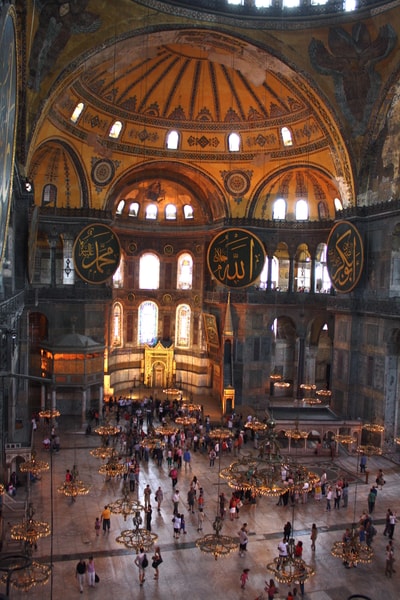 Интерьер собора Святой Софии Mark Cartwright (CC BY-NC-SA) ](https://www.worldhistory.org/image/8973/hagia-sophia-interior/ "Hagia Sophia Interior")Любимыми строительными материалами были крупный кирпич на растворе и бетон для скрытого ядра стен. Тёсаный камень шёл на более престижные общественные здания, а мрамор, который использовали экономнее, чем в римские времена, обычно оставляли для колонн, дверных и оконных обрамлений и другого декора. Кровли делали деревянными, а внутренние стены часто покрывали штукатуркой, лепниной, тонкими мраморными плитами, росписями и мозаиками.
Самое большое, самое важное и до сих пор самое знаменитое здание Византии — собор Святой Софии в Константинополе, посвящённый Премудрости Божией (*Айя София*). Его заново выстроили в 532–537 годах. Основной прямоугольник здания — 74,6 на 69,7 метра, а огромный купол диаметром 31,8 метра поднимается на 55 метров над полом. Купол опирается на четыре мощные арки с четырьмя парусами; для своего времени это было выдающееся достижение строительной мысли. Святая София оставалась крупнейшим храмом мира до XVI века и одним из самых богато украшенных великолепными сверкающими мозаиками и росписями.
Христианские храмы вообще стали одним из главных вкладов Византии в архитектуру, особенно благодаря куполу. Самым распространённым стал крестово-купольный план с куполом на четырёх опорных арках. Квадратное основание здания разветвлялось на отсеки, которые и сами могли быть перекрыты полукуполом или полным куполом. Ещё одна частая черта — центральная апсида с двумя боковыми в восточной части храма. Со временем, центральный купол поднимали всё выше на многогранном барабане, и в некоторых храмах он так высок, что похож на башню. Рядом со многими храмами, особенно базиликами, стоял баптистерий (обычно восьмигранный), а иногда и мавзолей основателя храма и его потомков. Эти черты византийского зодчества повлияли на православную архитектуру, и сегодня их можно увидеть в храмах по всему миру.
#### Editorial Review
This human-authored definition has been reviewed by our editorial team before publication to ensure accuracy, reliability and adherence to academic standards in accordance with our [editorial policy](https://www.worldhistory.org/static/editorial-policy/).
## Список используемой литературы
- [Bagnall, R. *The Encyclopedia of Ancient History.* Wiley-Blackwell, 2012.](https://www.worldhistory.org/books/0307407969/)
- [Brownworth, L. *Lost to the West.* Broadway Books, 2010.](https://www.worldhistory.org/books/0307407969/)
- [Gregory, T.E. *A History of Byzantium.* Wiley-Blackwell, 2010.](https://www.worldhistory.org/books/140518471X/)
- [Herrin, J. *Byzantium.* Princeton University Press, 2009.](https://www.worldhistory.org/books/0691143692/)
- [Mango, C. *The Oxford History of Byzantium.* Oxford University Press, 2002.](https://www.worldhistory.org/books/0198140983/)
- [Norwich, J.J. *A Short History of Byzantium by John Julius Norwich.* Knopf, 2018.](https://www.worldhistory.org/books/B01K2R3B6U/)
- [Shepherd, J. *The Cambridge History of the Byzantine Empire c.500-1492.* Cambridge University Press, 2009.](https://www.worldhistory.org/books/0521832314/)
## автор
Марк - писатель, исследователь, историк и редактор. Его интересы включают в себя искусство, архитектуру и открытие идей, которые разделяют все цивилизации. Он получил степень магистра в области политической философии (University of York) и является директором издательства WHE.
## Хронология
- **285 CE**: The [Roman empire](https://www.worldhistory.org/Roman_Empire/) is split into the Western and Eastern [Roman](https://www.worldhistory.org/disambiguation/Roman/) empires.
- **312 CE**: [Roman emperor](https://www.worldhistory.org/Roman_Emperor/) [Constantine I](https://www.worldhistory.org/Constantine_I/) tolerates [Christianity](https://www.worldhistory.org/christianity/).
- **312 CE**: [Constantine I](https://www.worldhistory.org/Constantine_I/) introduces the [gold](https://www.worldhistory.org/gold/) nomisma (solidus) [coin](https://www.worldhistory.org/coinage/).
- **c. 330 CE - c. 379 CE**: Life of Basil Great, one of the founding fathers of the Eastern Christian Church and [Byzantine](https://www.worldhistory.org/disambiguation/Byzantine/) Monasteries.
- **11 May 330 CE**: [Constantinople](https://www.worldhistory.org/Constantinople/) is founded on the site of old [Byzantium](https://www.worldhistory.org/Byzantium/) as "the new [Rome](https://www.worldhistory.org/Rome/)."
- **c. 331 CE**: The [Great Palace of Constantinople](https://www.worldhistory.org/article/1211/the-great-palace-of-constantinople/) is first built by [Constantine I](https://www.worldhistory.org/Constantine_I/).
- **360 CE**: First [Hagia Sophia](https://www.worldhistory.org/Hagia_Sophia/) built in [Constantinople](https://www.worldhistory.org/Constantinople/).
- **361 CE**: [Roman emperor](https://www.worldhistory.org/Roman_Emperor/) Julian attempts to revive Paganism.
- **c. 370 CE**: [Basil the Great](https://www.worldhistory.org/Basil_the_Great/) is made the bishop of [Caesarea](https://www.worldhistory.org/disambiguation/Caesarea/) in Cappadocia.
- **376 CE**: The [Visigoths](https://www.worldhistory.org/visigoth/) are fleeing the [Huns](https://www.worldhistory.org/Huns/), entering the [Eastern Roman Empire](https://www.worldhistory.org/Byzantine_Empire/).
- **391 CE**: Emperor Theodosius I closes pagan temples.
- **395 CE**: The [statue of Zeus at Olympia](https://www.worldhistory.org/Statue_of_Zeus_at_Olympia/) is removed to [Constantinople](https://www.worldhistory.org/Constantinople/).
- **395 CE - 408 CE**: Reign of [Byzantine emperor](https://www.worldhistory.org/Byzantine_Emperor/) Arkadios.
- **395 CE - 637 CE**: [Byblos](https://www.worldhistory.org/Byblos/) is a colony of the [Byzantine Empire](https://www.worldhistory.org/Byzantine_Empire/) (formerly known as the [Eastern Roman Empire](https://www.worldhistory.org/Byzantine_Empire/)).
- **408 CE - 450 CE**: Reign of [Byzantine Emperor](https://www.worldhistory.org/Byzantine_Emperor/) Thedosius II.
- **410 CE - 413 CE**: The [Theodosian Walls](https://www.worldhistory.org/Theodosian_Walls/) are built to better protect [Constantinople](https://www.worldhistory.org/Constantinople/).
- **450 CE - 457 CE**: Reign of [Byzantine emperor](https://www.worldhistory.org/Byzantine_Emperor/) Marcian.
- **8 Oct 451 CE - 1 Nov 451 CE**: Fourth Ecumenical Council takes place in Chalcedon, determining that [Jesus Christ](https://www.worldhistory.org/Jesus_Christ/) had two distinct natures and wills, perfectly united.
- **457 CE**: [Leo I](https://www.worldhistory.org/Leo_I/) is crowned by the Patriarch of [Constantinople](https://www.worldhistory.org/Constantinople/), the first [Byzantine emperor](https://www.worldhistory.org/Byzantine_Emperor/) to be crowned by a bishop.
- **457 CE - 474 CE**: Reign of [Byzantine emperor](https://www.worldhistory.org/Byzantine_Emperor/) [Leo I](https://www.worldhistory.org/Leo_I/).
- **466 CE**: [Byzantine emperor](https://www.worldhistory.org/Byzantine_Emperor/) [Leo I](https://www.worldhistory.org/Leo_I/) gives his daughter [Ariadne](https://www.worldhistory.org/Ariadne/) as a wife to the Isaurian chief Tarasicodissa (Zeno).
- **468 CE**: A [Byzantine](https://www.worldhistory.org/disambiguation/Byzantine/) army led by Basiliscus is defeated by the [Vandals](https://www.worldhistory.org/Vandals/) in North [Africa](https://www.worldhistory.org/disambiguation/africa/).
- **469 CE**: The [Byzantine Empire](https://www.worldhistory.org/Byzantine_Empire/) builds the Anastasian [Wall](https://www.worldhistory.org/wall/).
- **471 CE**: [Byzantine emperor](https://www.worldhistory.org/Byzantine_Emperor/) [Leo I](https://www.worldhistory.org/Leo_I/) conspires to murder his rival the general Aspar.
- **474 CE**: Reign of [Byzantine emperor](https://www.worldhistory.org/Byzantine_Emperor/) Leo II.
- **474 CE - 491 CE**: Reign of [Byzantine emperor](https://www.worldhistory.org/Byzantine_Emperor/) Zeno.
- **475 CE - 476 CE**: Revolt of Basiliscus against Zeno in the [Byzantine Empire](https://www.worldhistory.org/Byzantine_Empire/).
- **479 CE**: Revolt by Marcian against Zeno in the [Byzantine Empire](https://www.worldhistory.org/Byzantine_Empire/).
- **481 CE**: Theodoric [Strabo](https://www.worldhistory.org/Strabo_of_Amasia/) marches on [Constantinople](https://www.worldhistory.org/Constantinople/).
- **482 CE**: Patriarch Acacius and Zeno release the Henotikon, an attempted religious compromise, which creates the Acacian Schism with [Rome](https://www.worldhistory.org/Rome/).
- **484 CE - 519 CE**: Acacian Schism between the [Byzantine Empire](https://www.worldhistory.org/Byzantine_Empire/) and the Pope in [Rome](https://www.worldhistory.org/Rome/).
- **491 CE - 518 CE**: [Byzantine emperor](https://www.worldhistory.org/Byzantine_Emperor/) [Anastasios I](https://www.worldhistory.org/Anastasios_I/) introduces the [copper](https://www.worldhistory.org/copper/) follis [coin](https://www.worldhistory.org/coinage/) (288 are worth one [gold](https://www.worldhistory.org/gold/) nomisma).
- **491 CE - 518 CE**: Reign of [Byzantine emperor](https://www.worldhistory.org/Byzantine_Emperor/) [Anastasios I](https://www.worldhistory.org/Anastasios_I/).
- **c. 493 CE**: [Byzantine emperor](https://www.worldhistory.org/Byzantine_Emperor/) [Anastasios I](https://www.worldhistory.org/Anastasios_I/) builds the Long [Wall](https://www.worldhistory.org/wall/) in Thrace to protect [Constantinople](https://www.worldhistory.org/Constantinople/).
- **497 CE**: [Byzantine emperor](https://www.worldhistory.org/Byzantine_Emperor/) [Anastasios I](https://www.worldhistory.org/Anastasios_I/) recognises Theodoric as the King of [Italy](https://www.worldhistory.org/italy/).
- **498 CE**: [Byzantine emperor](https://www.worldhistory.org/Byzantine_Emperor/) [Anastasios I](https://www.worldhistory.org/Anastasios_I/) abolishes the chrysargyron, an unpopular tax on business transactions.
- **c. 504 CE**: [Byzantine emperor](https://www.worldhistory.org/Byzantine_Emperor/) [Anastasios I](https://www.worldhistory.org/Anastasios_I/) retakes the fortress of Amida on the Persian frontier.
- **505 CE - 507 CE**: [Byzantine emperor](https://www.worldhistory.org/Byzantine_Emperor/) [Anastasios I](https://www.worldhistory.org/Anastasios_I/) builds a new fortress at Anastasiopolis (Dara) on the frontier with [Persia](https://www.worldhistory.org/Persia/).
- **506 CE**: A peace treaty is signed between the [Byzantine Empire](https://www.worldhistory.org/Byzantine_Empire/) and the Persians.
- **507 CE**: [Byzantine emperor](https://www.worldhistory.org/Byzantine_Emperor/) [Anastasios I](https://www.worldhistory.org/Anastasios_I/) sends [Clovis I](https://www.worldhistory.org/Clovis_I/), the king of the [Franks](https://www.worldhistory.org/Franks/) in [Gaul](https://www.worldhistory.org/gaul/), a fleet to aid his [war](https://www.worldhistory.org/disambiguation/War/) with the [Ostrogoths](https://www.worldhistory.org/ostrogoth/).
- **513 CE - 515 CE**: Vitalian leads a revolt in [Byzantine](https://www.worldhistory.org/disambiguation/Byzantine/) nThrace.
- **518 CE - 527 CE**: Reign of [Byzantine emperor](https://www.worldhistory.org/Byzantine_Emperor/) Justin I.
- **525 CE**: [Justinian I](https://www.worldhistory.org/Justinian_I/) marries Theodora, a woman from a poor background and possibly a courtesan.
- **527 CE - 548 CE**: Reign of [Empress Theodora](https://www.worldhistory.org/Empress_Theodora/) of the [Byzantine Empire](https://www.worldhistory.org/Byzantine_Empire/).
- **527 CE - 565 CE**: Reign of [Byzantine Emperor](https://www.worldhistory.org/Byzantine_Emperor/) [Justinian I](https://www.worldhistory.org/Justinian_I/).
- **c. 527 CE - 646 CE**: The [Byzantine Empire](https://www.worldhistory.org/Byzantine_Empire/) controls [Egypt](https://www.worldhistory.org/egypt/).
- **1 Apr 527 CE**: Coronation of [Justinian I](https://www.worldhistory.org/Justinian_I/) and Theodora in the [Hagia Sophia](https://www.worldhistory.org/Hagia_Sophia/) Church in [Constantinople](https://www.worldhistory.org/Constantinople/).
- **529 CE**: The first part of Justinian's Code, the Codex Justinianus, is released and immediately adopted across the [Byzantine Empire](https://www.worldhistory.org/Byzantine_Empire/).
- **7 Apr 529 CE**: The Justinian Code is issued by [Byzantine Emperor](https://www.worldhistory.org/Byzantine_Emperor/) [Justinian I](https://www.worldhistory.org/Justinian_I/) at [Constantinople](https://www.worldhistory.org/Constantinople/), streamlining and reorganizing [Roman law](https://www.worldhistory.org/Roman_Law/), and serving as a model for later European legal systems.
- **531 CE - 534 CE**: [Byzantine](https://www.worldhistory.org/disambiguation/Byzantine/) forces engaged in a series of military campaigns against the [Slavs](https://www.worldhistory.org/Slavs/) and other groups.
- **532 CE - 537 CE**: [Hagia Sophia](https://www.worldhistory.org/Hagia_Sophia/) is built anew in [Constantinople](https://www.worldhistory.org/Constantinople/).
- **10 Jan 532 CE**: The Nika Riots are triggered in [Constantinople](https://www.worldhistory.org/Constantinople/) when two members of the [chariot](https://www.worldhistory.org/chariot/) teams of the Blues and Greens, sentenced to [death](https://www.worldhistory.org/disambiguation/Death/), are denied clemency by Emperor [Justinian I](https://www.worldhistory.org/Justinian_I/). The riots broke out on 13 January and lasted a week with an estimated death toll of around 30,000.
- **18 Jan 532 CE**: The Nika Riots in [Constantinople](https://www.worldhistory.org/Constantinople/) are suppressed when generals [Belisarius](https://www.worldhistory.org/Belisarius/) and Mundus trap the protestors inside the Hippodrome and massacre them, resulting in the deaths of at least 30,000 people before order is restored on 20 January.
- **533 CE**: [Belisarius](https://www.worldhistory.org/Belisarius/) defeats the Persians to the east of the [Byzantine Empire](https://www.worldhistory.org/Byzantine_Empire/) and the [Vandals](https://www.worldhistory.org/Vandals/) of [Africa](https://www.worldhistory.org/disambiguation/africa/).
- **533 CE - 534 CE**: The [Vandal](https://www.worldhistory.org/Vandals/) [War](https://www.worldhistory.org/disambiguation/War/) launched by Emperor [Justinian I](https://www.worldhistory.org/Justinian_I/), aimed a reconquering [Africa](https://www.worldhistory.org/disambiguation/africa/) from the [Vandals](https://www.worldhistory.org/Vandals/).
- **Dec 533 CE**: The Digestum and Institutiones parts of Justinian's Code are released which supersedes all previous laws across the [Byzantine Empire](https://www.worldhistory.org/Byzantine_Empire/).
- **534 CE**: Justinian of the [Byzantine Empire](https://www.worldhistory.org/Byzantine_Empire/) conquers the [Vandal](https://www.worldhistory.org/Vandals/) kingdom in [Africa](https://www.worldhistory.org/disambiguation/africa/).
- **535 CE**: [Belisarius](https://www.worldhistory.org/Belisarius/)' first campaign against the [Ostrogoths](https://www.worldhistory.org/ostrogoth/) in [Italy](https://www.worldhistory.org/italy/).
- **536 CE**: [Rome](https://www.worldhistory.org/Rome/) falls to [Belisarius](https://www.worldhistory.org/Belisarius/).
- **536 CE - 562 CE**: The [Byzantine Empire](https://www.worldhistory.org/Byzantine_Empire/) conquers [Italy](https://www.worldhistory.org/italy/).
- **2 Mar 537 CE**: The First Siege of [Rome](https://www.worldhistory.org/Rome/) begins as the forces of the [Ostrogoths](https://www.worldhistory.org/ostrogoth/) under their king Vitiges surround the [city](https://www.worldhistory.org/city/) which is defended by the [Byzantine](https://www.worldhistory.org/disambiguation/Byzantine/) forces under General [Belisarius](https://www.worldhistory.org/Belisarius/), one of the most famous events from the Gothic [War](https://www.worldhistory.org/disambiguation/War/) of 535-554. After one year and nine days, the Ostrogoths lifted the siege and retreated, leaving Rome intact and Belisarius victorious.
- **12 Mar 538 CE**: The siege of [Rome](https://www.worldhistory.org/Rome/) during the Gothic [War](https://www.worldhistory.org/disambiguation/War/) ends when Ostrogothic King Vitiges orders his camps burned and retreats after failed attempts to take the [city](https://www.worldhistory.org/city/) lasting one year and nine days.
- **c. 540 CE**: The [Byzantine](https://www.worldhistory.org/disambiguation/Byzantine/) mosaics of the church of San Vitale in Ravenna, [Italy](https://www.worldhistory.org/italy/) are created.
- **545 CE - 550 CE**: [Belisarius](https://www.worldhistory.org/Belisarius/)' second campaign against in [Italy](https://www.worldhistory.org/italy/) against the [Ostrogoths](https://www.worldhistory.org/ostrogoth/) under [Totila](https://www.worldhistory.org/Totila/).
- **c. 550 CE**: The [Slavs](https://www.worldhistory.org/Slavs/) advance towards [Thessalonica](https://www.worldhistory.org/Thessalonica/), entering the region of the Hebrus River and the Thracian coast. Thessalonica is saved by the [Roman army](https://www.worldhistory.org/Roman_Army/).
- **554 CE**: [Byzantine Empire](https://www.worldhistory.org/Byzantine_Empire/) conquers southern [Iberia](https://www.worldhistory.org/disambiguation/iberia/).
- **Jul 556 CE - c. Jul 572 CE**: Samaritan revolt beginning in [Caesarea Maritima](https://www.worldhistory.org/Caesarea_Maritima/), perhaps with Jewish support. A number of churches are destroyed and there is a significant loss of life.
- **565 CE - 578 CE**: Reign of [Byzantine emperor](https://www.worldhistory.org/Byzantine_Emperor/) Justin II.
- **578 CE - 582 CE**: Reign of [Byzantine emperor](https://www.worldhistory.org/Byzantine_Emperor/) [Tiberius](https://www.worldhistory.org/Tiberius/) II.
- **c. 580 CE**: The [Slavs](https://www.worldhistory.org/Slavs/) and the [Avars](https://www.worldhistory.org/Avars/) overwhelm [Greece](https://www.worldhistory.org/greece/), Thrace and [Thessaly](https://www.worldhistory.org/disambiguation/Thessaly/).
- **582 CE - 602 CE**: Reign of [Byzantine emperor](https://www.worldhistory.org/Byzantine_Emperor/) Maurice.
- **585 CE**: The [Slavs](https://www.worldhistory.org/Slavs/) march on to [Constantinople](https://www.worldhistory.org/Constantinople/), they are driven off by the [Roman](https://www.worldhistory.org/disambiguation/Roman/) defence.
- **602 CE - 610 CE**: Reign of [Byzantine emperor](https://www.worldhistory.org/Byzantine_Emperor/) Phocas.
- **27 Nov 602 CE**: Deposed [Byzantine Emperor](https://www.worldhistory.org/Byzantine_Emperor/) Maurice is assassinated by order of the rebel officer Phocas at the Harbor of Eutropius in [Asia Minor](https://www.worldhistory.org/Asia_Minor/). Phocas forced Maurice to watch the execution of five of his sons before having him beheaded. The coup provided the Persian [Sassanian Empire](https://www.worldhistory.org/Sasanian_Empire/) with the opportunity to renew hostilities, leading to a ruinous 26-year [war](https://www.worldhistory.org/disambiguation/War/) for both sides.
- **607 CE - 627 CE**: East [Rome](https://www.worldhistory.org/Rome/) defeats [Sasanian](https://www.worldhistory.org/Sasanian_Empire/) [Persia](https://www.worldhistory.org/Persia/).
- **610 CE - 641 CE**: Reign of [Byzantine emperor](https://www.worldhistory.org/Byzantine_Emperor/) [Heraclius](https://www.worldhistory.org/Heraclius/).
- **626 CE**: A coalition of Persians, [Slavs](https://www.worldhistory.org/Slavs/), [Avars](https://www.worldhistory.org/Avars/) and Bulgars unsuccessfully lays siege to [Constantinople](https://www.worldhistory.org/Constantinople/).
- **627 CE**: [Byzantine emperor](https://www.worldhistory.org/Byzantine_Emperor/) [Heraclius](https://www.worldhistory.org/Heraclius/) wins a crushing victory over the Persian army at [Nineveh](https://www.worldhistory.org/nineveh/).
- **628 CE**: [Byzantine Empire](https://www.worldhistory.org/Byzantine_Empire/) re-takes [Alexandria](https://www.worldhistory.org/alexandria/), [Egypt](https://www.worldhistory.org/egypt/), from the Persians.
- **636 CE**: A [Byzantine](https://www.worldhistory.org/disambiguation/Byzantine/) army is crushed by an Arab force at the [battle](https://www.worldhistory.org/disambiguation/battle/) of Yarmuk.
- **637 CE**: Muslim invasion of the [Levant](https://www.worldhistory.org/levant/). The Byzantines are driven out.
- **6 Jul 640 CE**: The [Battle](https://www.worldhistory.org/disambiguation/battle/) Heliopolis is fought in the region of modern-day Cairo, [Egypt](https://www.worldhistory.org/egypt/) between the [Rashidun Caliphate](https://www.worldhistory.org/Rashidun_Caliphate/) and the [Byzantine Empire](https://www.worldhistory.org/Byzantine_Empire/) for control of Egypt, ending in a Rashidun victory and opening up Egypt for [conquest](https://www.worldhistory.org/warfare/) by the Muslim Arabs.
- **641 CE**: Reign of [Byzantine emperor](https://www.worldhistory.org/Byzantine_Emperor/) [Constantine](https://www.worldhistory.org/disambiguation/Constantine/) III.
- **641 CE**: Reign of [Byzantine emperor](https://www.worldhistory.org/Byzantine_Emperor/) Heraklonas.
- **641 CE - 668 CE**: Reign of [Byzantine emperor](https://www.worldhistory.org/Byzantine_Emperor/) [Constans II](https://www.worldhistory.org/Constans_II/).
- **642 CE**: [Byzantine](https://www.worldhistory.org/disambiguation/Byzantine/) [Alexandria](https://www.worldhistory.org/alexandria/) falls to the [Rashidun Caliphate](https://www.worldhistory.org/Rashidun_Caliphate/).
- **649 CE**: The [Rashidun Caliphate](https://www.worldhistory.org/Rashidun_Caliphate/) attacks [Byzantine](https://www.worldhistory.org/disambiguation/Byzantine/) [Cyprus](https://www.worldhistory.org/cyprus/).
- **654 CE**: [Byzantine](https://www.worldhistory.org/disambiguation/Byzantine/) [Crete](https://www.worldhistory.org/crete/), [Kos](https://www.worldhistory.org/Kos/) and [Rhodes](https://www.worldhistory.org/Rhodes/) fall to the [Rashidun Caliphate](https://www.worldhistory.org/Rashidun_Caliphate/).
- **655 CE**: A [Byzantine](https://www.worldhistory.org/disambiguation/Byzantine/) fleet is destroyed by the [Rashidun Caliphate](https://www.worldhistory.org/Rashidun_Caliphate/) off the coast of [Lycia](https://www.worldhistory.org/lycia/).
- **659 CE**: A peace treaty is signed between the [Byzantine Empire](https://www.worldhistory.org/Byzantine_Empire/) and the [Rashidun Caliphate](https://www.worldhistory.org/Rashidun_Caliphate/).
- **668 CE - 685 CE**: Reign of [Byzantine emperor](https://www.worldhistory.org/Byzantine_Emperor/) [Constantine IV](https://www.worldhistory.org/Constantine_IV/).
- **674 CE - 678 CE**: The Arab [Umayyad Caliphate](https://www.worldhistory.org/Umayyad_Dynasty/) unsuccessfully besieges [Constantinople](https://www.worldhistory.org/Constantinople/).
- **678 CE**: First recorded use of [Greek Fire](https://www.worldhistory.org/Greek_Fire/) in [Byzantine](https://www.worldhistory.org/disambiguation/Byzantine/) [warfare](https://www.worldhistory.org/warfare/) during the Arab siege of [Constantinople](https://www.worldhistory.org/Constantinople/).
- **679 CE**: The [Umayyad Caliphate](https://www.worldhistory.org/Umayyad_Dynasty/) is obliged by treaty to give up former [Byzantine](https://www.worldhistory.org/disambiguation/Byzantine/) territories in the [Aegean](https://www.worldhistory.org/aegean/).
- **680 CE**: A [Byzantine](https://www.worldhistory.org/disambiguation/Byzantine/) naval fleet is defeated by the Bulgars.
- **680 CE - 681 CE**: The Sixth Ecumenical Council in [Constantinople](https://www.worldhistory.org/Constantinople/) declares the end of Monotheletism and Monoenergism.
- **681 CE**: [Byzantine emperor](https://www.worldhistory.org/Byzantine_Emperor/) [Constantine IV](https://www.worldhistory.org/Constantine_IV/) signs a peace treaty with the Bulgars.
- **685 CE - 695 CE**: First reign of [Byzantine emperor](https://www.worldhistory.org/Byzantine_Emperor/) [Justinian II](https://www.worldhistory.org/Justinian_II/).
- **c. 691 CE**: [Byzantine emperor](https://www.worldhistory.org/Byzantine_Emperor/) [Justinian II](https://www.worldhistory.org/Justinian_II/) mints the first coins to depict [Jesus Christ](https://www.worldhistory.org/Jesus_Christ/).
- **695 CE**: The usurper Leontios exiles [Byzantine emperor](https://www.worldhistory.org/Byzantine_Emperor/) [Justinian II](https://www.worldhistory.org/Justinian_II/).
- **695 CE - 698 CE**: Reign of [Byzantine emperor](https://www.worldhistory.org/Byzantine_Emperor/) Leontios.
- **698 CE**: The [Byzantine](https://www.worldhistory.org/disambiguation/Byzantine/) ruler Leontios is exiled by the usurper Apsimar (aka Tiberios III).
- **698 CE - 705 CE**: Reign of [Byzantine emperor](https://www.worldhistory.org/Byzantine_Emperor/) Tiberios II.
- **705 CE**: [Justinian II](https://www.worldhistory.org/Justinian_II/) besieges [Constantinople](https://www.worldhistory.org/Constantinople/) and reinstates himself as [Byzantine emperor](https://www.worldhistory.org/Byzantine_Emperor/), removing the usurper Tiberios III.
- **705 CE - 711 CE**: Second reign of [Byzantine emperor](https://www.worldhistory.org/Byzantine_Emperor/) [Justinian II](https://www.worldhistory.org/Justinian_II/).
- **709 CE**: [Byzantine](https://www.worldhistory.org/disambiguation/Byzantine/) Tyana in Cappadocia is lost to the Arabs.
- **711 CE**: Pope [Constantine](https://www.worldhistory.org/disambiguation/Constantine/) visits [Constantinople](https://www.worldhistory.org/Constantinople/) at the invitation of [Byzantine emperor](https://www.worldhistory.org/Byzantine_Emperor/) [Justinian II](https://www.worldhistory.org/Justinian_II/).
- **711 CE - 713 CE**: Reign of [Byzantine emperor](https://www.worldhistory.org/Byzantine_Emperor/) Philippikos.
- **4 Nov 711 CE**: The general and usurper Philippikos murders [Byzantine emperor](https://www.worldhistory.org/Byzantine_Emperor/) [Justinian II](https://www.worldhistory.org/Justinian_II/).
- **713 CE - 716 CE**: Reign of [Byzantine emperor](https://www.worldhistory.org/Byzantine_Emperor/) Anastasius II
- **716 CE - 717 CE**: Reign of [Byzantine emperor](https://www.worldhistory.org/Byzantine_Emperor/) Theodosius III.
- **717 CE - 718 CE**: [Greek Fire](https://www.worldhistory.org/Greek_Fire/) is used by [Byzantine](https://www.worldhistory.org/disambiguation/Byzantine/) ships to attack an Arab fleet besieging [Constantinople](https://www.worldhistory.org/Constantinople/).
- **717 CE - 741 CE**: Reign of [Byzantine emperor](https://www.worldhistory.org/Byzantine_Emperor/) [Leo III](https://www.worldhistory.org/Leo_III/).
- **717 CE - 802 CE**: The Isaurian dynasty, founded by [Leo III](https://www.worldhistory.org/Leo_III/), rules the [Byzantine Empire](https://www.worldhistory.org/Byzantine_Empire/).
- **720 CE - 721 CE**: The [silver](https://www.worldhistory.org/Silver/) miliaresion [coin](https://www.worldhistory.org/coinage/) is introduced in the [Byzantine Empire](https://www.worldhistory.org/Byzantine_Empire/) by [Leo III](https://www.worldhistory.org/Leo_III/).
- **726 CE**: [Byzantine emperor](https://www.worldhistory.org/Byzantine_Emperor/) [Leo III](https://www.worldhistory.org/Leo_III/) makes legal reforms, publishing his Ecloga.
- **730 CE**: [Byzantine emperor](https://www.worldhistory.org/Byzantine_Emperor/) [Leo III](https://www.worldhistory.org/Leo_III/) decrees that all religious icons be destroyed.
- **740 CE**: [Byzantine emperor](https://www.worldhistory.org/Byzantine_Emperor/) [Leo III](https://www.worldhistory.org/Leo_III/) wins a decisive victory over the Arabs at the [battle](https://www.worldhistory.org/disambiguation/battle/) of Akroinon.
- **741 CE - 775 CE**: Reign of [Byzantine emperor](https://www.worldhistory.org/Byzantine_Emperor/) [Constantine V](https://www.worldhistory.org/Constantine_V/)
- **744 CE**: Emperor [Constantine V](https://www.worldhistory.org/Constantine_V/) regains the [Byzantine](https://www.worldhistory.org/disambiguation/Byzantine/) throne from the usurper Artabasdos.
- **746 CE - 752 CE**: [Byzantine emperor](https://www.worldhistory.org/Byzantine_Emperor/) [Constantine V](https://www.worldhistory.org/Constantine_V/) conducts successful campaigns in northern [Syria](https://www.worldhistory.org/syria/) and [Armenia](https://www.worldhistory.org/armenia/).
- **754 CE**: The Council of Hieria declares the worship of icons by Christians as heresy.
- **755 CE**: [Byzantine emperor](https://www.worldhistory.org/Byzantine_Emperor/) [Constantine V](https://www.worldhistory.org/Constantine_V/) instigates a persecution of Christians who worship icons.
- **756 CE - 775 CE**: [Byzantine emperor](https://www.worldhistory.org/Byzantine_Emperor/) [Constantine V](https://www.worldhistory.org/Constantine_V/) wins a string of military victories against the Bulgars.
- **775 CE - 780 CE**: Reign of [Byzantine emperor](https://www.worldhistory.org/Byzantine_Emperor/) Leo IV.
- **780 CE - 790 CE**: [Empress Irene](https://www.worldhistory.org/Empress_Irene/) rules as regent for [Byzantine emperor](https://www.worldhistory.org/Byzantine_Emperor/) [Constantine VI](https://www.worldhistory.org/Constantine_VI/).
- **780 CE - 797 CE**: Reign of [Byzantine emperor](https://www.worldhistory.org/Byzantine_Emperor/) [Constantine VI](https://www.worldhistory.org/Constantine_VI/) (with [Empress Irene](https://www.worldhistory.org/Empress_Irene/) as regent 780-790 CE).
- **Sep 787 CE**: The Ecumenical Council of Nicaea rules an end to iconoclasm in the [Byzantine](https://www.worldhistory.org/disambiguation/Byzantine/) Christian Church.
- **790 CE**: [Byzantine emperor](https://www.worldhistory.org/Byzantine_Emperor/) [Constantine VI](https://www.worldhistory.org/Constantine_VI/) exiles his mother and regent [Empress Irene](https://www.worldhistory.org/Empress_Irene/).
- **795 CE**: [Constantine VI](https://www.worldhistory.org/Constantine_VI/) divorces Mary of Amnia and then marries his mistress Theodote, causing the so-called Moechian Controversy, which divides the [Byzantine](https://www.worldhistory.org/disambiguation/Byzantine/) Church.
- **797 CE**: [Byzantine](https://www.worldhistory.org/disambiguation/Byzantine/) [empress Irene](https://www.worldhistory.org/Empress_Irene/) blinds and kills her son [Constantine VI](https://www.worldhistory.org/Constantine_VI/).
- **797 CE - 802 CE**: [Empress Irene](https://www.worldhistory.org/Empress_Irene/) rules the [Byzantine empire](https://www.worldhistory.org/Byzantine_Empire/).
- **797 CE - 802 CE**: [Empress Irene](https://www.worldhistory.org/Empress_Irene/) is the first [Byzantine](https://www.worldhistory.org/disambiguation/Byzantine/) ruler to put an image of herself on both sides of her [coinage](https://www.worldhistory.org/coinage/).
- **802 CE - 811 CE**: Reign of [Byzantine emperor](https://www.worldhistory.org/Byzantine_Emperor/) [Nikephoros I](https://www.worldhistory.org/Nikephoros_I/).
- **807 CE**: A peace treaty is signed between king of the [Franks](https://www.worldhistory.org/Franks/) [Charlemagne](https://www.worldhistory.org/Charlemagne/) and [Byzantine emperor](https://www.worldhistory.org/Byzantine_Emperor/) [Nikephoros I](https://www.worldhistory.org/Nikephoros_I/).
- **811 CE**: Reign of [Byzantine emperor](https://www.worldhistory.org/Byzantine_Emperor/) Stavrakios.
- **811 CE - 813 CE**: Reign of [Byzantine emperor](https://www.worldhistory.org/Byzantine_Emperor/) Michael I.
- **813 CE - 820 CE**: Reign of [Byzantine emperor](https://www.worldhistory.org/Byzantine_Emperor/) [Leo V the Armenian](https://www.worldhistory.org/Leo_V_the_Armenian/).
- **814 CE**: [Byzantine emperor](https://www.worldhistory.org/Byzantine_Emperor/) [Leo V the Armenian](https://www.worldhistory.org/Leo_V_the_Armenian/) defeats a Bulgar army near Mesembria.
- **815 CE**: [Byzantine emperor](https://www.worldhistory.org/Byzantine_Emperor/) [Leo V the Armenian](https://www.worldhistory.org/Leo_V_the_Armenian/) proclaims the veneration of icons as heresy.
- **820 CE - 823 CE**: [Byzantine emperor](https://www.worldhistory.org/Byzantine_Emperor/) [Michael II](https://www.worldhistory.org/Michael_II/) puts down a revolt led by Thomas the Slav.
- **820 CE - 829 CE**: Reign of [Byzantine emperor](https://www.worldhistory.org/Byzantine_Emperor/) [Michael II](https://www.worldhistory.org/Michael_II/).
- **821 CE - 822 CE**: [Greek Fire](https://www.worldhistory.org/Greek_Fire/) is used by [Byzantine](https://www.worldhistory.org/disambiguation/Byzantine/) ships to attack a Slav fleet besieging [Constantinople](https://www.worldhistory.org/Constantinople/).
- **Dec 821 CE - Dec 823 CE**: Thomas the Slav unsuccessfully besieges [Constantinople](https://www.worldhistory.org/Constantinople/).
- **829 CE - 842 CE**: Reign of [Byzantine emperor](https://www.worldhistory.org/Byzantine_Emperor/) [Theophilos](https://www.worldhistory.org/Theophilos/).
- **830 CE - 831 CE**: [Byzantine emperor](https://www.worldhistory.org/Byzantine_Emperor/) [Theophilos](https://www.worldhistory.org/Theophilos/) wins victories in Cilica and awards himself a [triumph](https://www.worldhistory.org/Roman_Triumph/).
- **838 CE**: The Arab [Caliphate](https://www.worldhistory.org/Islamic_Caliphates/) defeats a [Byzantine](https://www.worldhistory.org/disambiguation/Byzantine/) army and captures the [cities](https://www.worldhistory.org/city/) of Ankara and Amorion.
- **839 CE**: The [Byzantine empire](https://www.worldhistory.org/Byzantine_Empire/) loses Taranto in southern [Italy](https://www.worldhistory.org/italy/) to the western Arabs.
- **842 CE - 855 CE**: Theodora rules as regent for her son [Michael III](https://www.worldhistory.org/Michael_III/), emperor of the [Byzantine empire](https://www.worldhistory.org/Byzantine_Empire/).
- **842 CE - 867 CE**: Reign of [Byzantine emperor](https://www.worldhistory.org/Byzantine_Emperor/) [Michael III](https://www.worldhistory.org/Michael_III/).
- **11 Mar 843 CE**: The event known as "The [Triumph](https://www.worldhistory.org/Roman_Triumph/) of Orthodoxy" takes place at the [Hagia Sophia](https://www.worldhistory.org/Hagia_Sophia/) Cathedral in [Constantinople](https://www.worldhistory.org/Constantinople/) as [Empress Theodora](https://www.worldhistory.org/Empress_Theodora/), acting as regent for her son, [Michael III](https://www.worldhistory.org/Michael_III/), leads a procession to restore the icons that were removed, ending the iconoclastic controversy.
- **6 Mar 845 CE**: The 42 Martyrs of Amorium are executed at Samarra (in present-day Iraq) on the banks of the Euphrates River. The 42 [Byzantine](https://www.worldhistory.org/disambiguation/Byzantine/) sailors were captured in 838 and held prisoner, refusing to convert to [Islam](https://www.worldhistory.org/islam/), until the [Abbasid Caliphate](https://www.worldhistory.org/Abbasid_Dynasty/) ran out of patience and ordered them killed.
- **855 CE - 856 CE**: [Michael III](https://www.worldhistory.org/Michael_III/) removes his mother Theodora, the regent, and rules alone as emperor of the [Byzantine empire](https://www.worldhistory.org/Byzantine_Empire/).
- **856 CE**: The armies of [Byzantine emperor](https://www.worldhistory.org/Byzantine_Emperor/) [Michael III](https://www.worldhistory.org/Michael_III/) win great victories in Cappadocia and [Mesopotamia](https://www.worldhistory.org/Mesopotamia/).
- **862 CE**: Council of Sirakawan between the Armenian and [Byzantine](https://www.worldhistory.org/disambiguation/Byzantine/) Orthodox Churches discuss Christological issues in an effort to reunify, although ultimately unsuccessful.
- **863 CE**: [Byzantine emperor](https://www.worldhistory.org/Byzantine_Emperor/) [Michael III](https://www.worldhistory.org/Michael_III/) sends [Saint Cyril](https://www.worldhistory.org/Saint_Cyril/) and Methodius on a mission to Moravia.
- **864 CE**: [Byzantine emperor](https://www.worldhistory.org/Byzantine_Emperor/) [Michael III](https://www.worldhistory.org/Michael_III/) presides over the baptism of Boris I, khan of the Bulgars.
- **866 CE**: [Byzantine emperor](https://www.worldhistory.org/Byzantine_Emperor/) [Michael III](https://www.worldhistory.org/Michael_III/) makes Basil the Macedonian co-emperor.
- **867 CE**: Basil the Macedonian murders [Byzantine emperor](https://www.worldhistory.org/Byzantine_Emperor/) [Michael III](https://www.worldhistory.org/Michael_III/) and declares himself Emperor [Basil I](https://www.worldhistory.org/Basil_I/).
- **867 CE - 886 CE**: Reign of [Byzantine emperor](https://www.worldhistory.org/Byzantine_Emperor/) [Basil I](https://www.worldhistory.org/Basil_I/).
- **883 CE**: A decree by [Byzantine emperor](https://www.worldhistory.org/Byzantine_Emperor/) [Basil I](https://www.worldhistory.org/Basil_I/) is the first recorded evidence of a monastery on [Mount Athos](https://www.worldhistory.org/Mount_Athos/).
- **886 CE**: [Byzantine emperor](https://www.worldhistory.org/Byzantine_Emperor/) [Basil I](https://www.worldhistory.org/Basil_I/) is (probably) murdered by his son and successor [Leo VI](https://www.worldhistory.org/Leo_VI/).
- **886 CE - 912 CE**: Reign of [Byzantine emperor](https://www.worldhistory.org/Byzantine_Emperor/) [Leo VI](https://www.worldhistory.org/Leo_VI/).
- **894 CE**: Symeon, [Tsar](https://www.worldhistory.org/Tsar/) of the Bulgars, invades Thrace, then [Byzantine](https://www.worldhistory.org/disambiguation/Byzantine/) territory.
- **1 Aug 902 CE**: [Byzantine](https://www.worldhistory.org/disambiguation/Byzantine/) Taormina on [Sicily](https://www.worldhistory.org/sicily/) falls to Arab attacks.
- **904 CE**: Leo of Tripoli leads an Arab force which sacks [Byzantine](https://www.worldhistory.org/disambiguation/Byzantine/) [Thessaloniki](https://www.worldhistory.org/Thessalonica/) and Abydos.
- **912 CE**: [Byzantine emperor](https://www.worldhistory.org/Byzantine_Emperor/) [Constantine VII](https://www.worldhistory.org/Constantine_VII/) inherits the throne but is served by four consecutive regents.
- **912 CE - 913 CE**: Reign of [Byzantine emperor](https://www.worldhistory.org/Byzantine_Emperor/) [Alexander](https://www.worldhistory.org/disambiguation/Alexander/).
- **920 CE**: [Romanos I](https://www.worldhistory.org/Romanos_I/)'s Tome of Union reconciles the rift in the [Byzantine](https://www.worldhistory.org/disambiguation/Byzantine/) Church caused by [Leo VI](https://www.worldhistory.org/Leo_VI/)'s third and fourth marriages.
- **920 CE - 944 CE**: Reign of [Byzantine emperor](https://www.worldhistory.org/Byzantine_Emperor/) [Romanos I](https://www.worldhistory.org/Romanos_I/) Lekapenos.
- **922 CE**: [Byzantine emperor](https://www.worldhistory.org/Byzantine_Emperor/) [Romanos I](https://www.worldhistory.org/Romanos_I/) passes a [law](https://www.worldhistory.org/disambiguation/law/) to protect the land of the peasantry.
- **934 CE**: A [Byzantine](https://www.worldhistory.org/disambiguation/Byzantine/) army captures Melitene in Cappadocia.
- **941 CE**: [Greek Fire](https://www.worldhistory.org/Greek_Fire/) is used by [Romanos I](https://www.worldhistory.org/Romanos_I/)'s fleet against a Russian fleet attacking [Constantinople](https://www.worldhistory.org/Constantinople/).
- **943 CE**: A [Byzantine](https://www.worldhistory.org/disambiguation/Byzantine/) army led by John Kourkouas captures the border Mesopotamians fortresses of Nisibis, Dara, Amida, and Martyropolis.
- **944 CE**: A [Byzantine](https://www.worldhistory.org/disambiguation/Byzantine/) army led by John Kourkouas besieges [Edessa](https://www.worldhistory.org/edessa/). The Mandylion icon is taken to [Constantinople](https://www.worldhistory.org/Constantinople/)
- **945 CE - 959 CE**: Reign of [Byzantine emperor](https://www.worldhistory.org/Byzantine_Emperor/) [Constantine VII](https://www.worldhistory.org/Constantine_VII/) (ruled with a regent from 912 CE).
- **959 CE - 963 CE**: Reign of [Byzantine emperor](https://www.worldhistory.org/Byzantine_Emperor/) Romanos II.
- **962 CE**: [Byzantine](https://www.worldhistory.org/disambiguation/Byzantine/) forces under Nikephoros Phokas sack Anazarbos and Hierapolis in [Syria](https://www.worldhistory.org/syria/).
- **963 CE**: The Great Lavra monastery on [Mount Athos](https://www.worldhistory.org/Mount_Athos/) is founded by Saint Athanasios.
- **963 CE - 969 CE**: [Byzantine emperor](https://www.worldhistory.org/Byzantine_Emperor/) [Nikephoros II Phokas](https://www.worldhistory.org/Nikephoros_II_Phokas/) introduces the [gold](https://www.worldhistory.org/gold/) tetarteron [coin](https://www.worldhistory.org/coinage/) (one-twelfth of a gold nomisma in value).
- **963 CE - 969 CE**: Reign of [Byzantine emperor](https://www.worldhistory.org/Byzantine_Emperor/) [Nikephoros II Phokas](https://www.worldhistory.org/Nikephoros_II_Phokas/).
- **965 CE**: [Byzantine](https://www.worldhistory.org/disambiguation/Byzantine/) forces are defeated and forced out of [Sicily](https://www.worldhistory.org/sicily/) by Muslim troops.
- **968 CE**: [Nikephoros II Phokas](https://www.worldhistory.org/Nikephoros_II_Phokas/) marches [Byzantine](https://www.worldhistory.org/disambiguation/Byzantine/) forces as far south as Lebanon.
- **969 CE**: [Byzantine](https://www.worldhistory.org/disambiguation/Byzantine/) forces recapture the [city](https://www.worldhistory.org/city/) of [Antioch](https://www.worldhistory.org/Antiochia/) from the Arabs.
- **969 CE**: John Tzimiskes murders [Nikephoros II Phokas](https://www.worldhistory.org/Nikephoros_II_Phokas/) in the imperial [Byzantine](https://www.worldhistory.org/disambiguation/Byzantine/) [palace](https://www.worldhistory.org/disambiguation/palace/) in [Constantinople](https://www.worldhistory.org/Constantinople/).
- **969 CE - 976 CE**: Reign of [Byzantine Emperor](https://www.worldhistory.org/Byzantine_Emperor/) [John I Tzimiskes](https://www.worldhistory.org/John_I_Tzimiskes/).
- **970 CE**: The Treaty of Safar makes Aleppo a client state of the [Byzantine Empire](https://www.worldhistory.org/Byzantine_Empire/).
- **971 CE**: [John I Tzimiskes](https://www.worldhistory.org/John_I_Tzimiskes/) and the [Byzantine](https://www.worldhistory.org/disambiguation/Byzantine/) army defeat the Rus at Dorystolon, forcing Sviatoslav and the Rus army to retreat from Bulgaria.
- **972 CE**: [Byzantine emperor](https://www.worldhistory.org/Byzantine_Emperor/) John I Tzimisces uses [Greek Fire](https://www.worldhistory.org/Greek_Fire/) to take the Bulgar capital of Preslav, then in Russian hands.
- **972 CE**: [John I Tzimiskes](https://www.worldhistory.org/John_I_Tzimiskes/) captures Nisibis and forces the Emir of Mosul to pay tribute to the [Byzantine Empire](https://www.worldhistory.org/Byzantine_Empire/).
- **975 CE**: [John I Tzimiskes](https://www.worldhistory.org/John_I_Tzimiskes/) invades [Syria](https://www.worldhistory.org/syria/), conquering several [cities](https://www.worldhistory.org/city/) and forcing neighboring Muslim states such as Damascus to pay tribute to the Byzantines.
- **976 CE - 1025 CE**: Reign of [Byzantine emperor](https://www.worldhistory.org/Byzantine_Emperor/) [Basil II](https://www.worldhistory.org/Basil_II/).
- **986 CE**: [Byzantine emperor](https://www.worldhistory.org/Byzantine_Emperor/) [Basil II](https://www.worldhistory.org/Basil_II/) suffers a terrible defeat to [Samuel](https://www.worldhistory.org/samuel/) the Bulgar at [Trajan](https://www.worldhistory.org/trajan/)'s Gate.
- **987 CE - 989 CE**: [Byzantine emperor](https://www.worldhistory.org/Byzantine_Emperor/) [Basil II](https://www.worldhistory.org/Basil_II/) defeats the usurpers Bardas Skleros and Bardas Phokas.
- **c. 988 CE**: [Byzantine emperor](https://www.worldhistory.org/Byzantine_Emperor/) [Basil II](https://www.worldhistory.org/Basil_II/) uses a force of Varangians for the first time.
- **988 CE - 989 CE**: [Byzantine emperor](https://www.worldhistory.org/Byzantine_Emperor/) [Basil II](https://www.worldhistory.org/Basil_II/) uses [Greek Fire](https://www.worldhistory.org/Greek_Fire/) to attack a rebel force led by the usurper Bardas Phokas.
- **994 CE**: [Trdat the Architect](https://www.worldhistory.org/Trdat_the_Architect/) completes his reconstruction of the dome of [Hagia Sophia](https://www.worldhistory.org/Hagia_Sophia/), [Constantinople](https://www.worldhistory.org/Constantinople/).
- **995 CE**: [Byzantine emperor](https://www.worldhistory.org/Byzantine_Emperor/) [Basil II](https://www.worldhistory.org/Basil_II/) wins victories in [Syria](https://www.worldhistory.org/syria/) against the Fatimids.
- **997 CE**: [Byzantine emperor](https://www.worldhistory.org/Byzantine_Emperor/) [Basil II](https://www.worldhistory.org/Basil_II/) reconquers [Greece](https://www.worldhistory.org/greece/) from [Samuel](https://www.worldhistory.org/samuel/) the Bulgar.
- **1014 CE**: [Byzantine emperor](https://www.worldhistory.org/Byzantine_Emperor/) [Basil II](https://www.worldhistory.org/Basil_II/) wins final victory against [Samuel](https://www.worldhistory.org/samuel/) the Bulgar at Kleidion.
- **1018 CE - c. 1082 CE**: Life of [Byzantine](https://www.worldhistory.org/disambiguation/Byzantine/) minister, scholar, and historian [Michael Psellos](https://www.worldhistory.org/Michael_Psellos/).
- **1021 CE - 1022 CE**: [Byzantine emperor](https://www.worldhistory.org/Byzantine_Emperor/) [Basil II](https://www.worldhistory.org/Basil_II/) wins victories in [Armenia](https://www.worldhistory.org/armenia/) and Georgia.
- **1025 CE**: [Byzantine emperor](https://www.worldhistory.org/Byzantine_Emperor/) [Basil II](https://www.worldhistory.org/Basil_II/) dies and his plans to invade [Sicily](https://www.worldhistory.org/sicily/) are abandoned.
- **1025 CE - 1028 CE**: Reign of [Byzantine emperor](https://www.worldhistory.org/Byzantine_Emperor/) [Constantine](https://www.worldhistory.org/disambiguation/Constantine/) VIII.
- **1028 CE - 1034 CE**: Reign of [Byzantine emperor](https://www.worldhistory.org/Byzantine_Emperor/) Romanos III Argyros.
- **1028 CE - 1050 CE**: Reign of [Byzantine](https://www.worldhistory.org/disambiguation/Byzantine/) [Empress Zoe](https://www.worldhistory.org/Empress_Zoe/) (including spells alongside three husbands, a nephew and sister).
- **1034 CE - 1041 CE**: Reign of [Byzantine emperor](https://www.worldhistory.org/Byzantine_Emperor/) Michael IV the Paphalgonian.
- **1040 CE**: The Bulgarian leader Deljan starts a major Bulgarian uprising against the [Byzantine Empire](https://www.worldhistory.org/Byzantine_Empire/).
- **1041 CE - 1042 CE**: Reign of [Byzantine emperor](https://www.worldhistory.org/Byzantine_Emperor/) Michael V.
- **1042 CE - 1055 CE**: Reign of [Byzantine emperor](https://www.worldhistory.org/Byzantine_Emperor/) [Constantine](https://www.worldhistory.org/disambiguation/Constantine/) IX.
- **Apr 1042 CE - Jun 1042 CE**: Reign of [Byzantine](https://www.worldhistory.org/disambiguation/Byzantine/) empresses Zoe and Theodora.
- **1055 CE - 1056 CE**: Reign of [Byzantine](https://www.worldhistory.org/disambiguation/Byzantine/) [Empress Theodora](https://www.worldhistory.org/Empress_Theodora/) (alone).
- **1056 CE - 1057 CE**: Reign of [Byzantine emperor](https://www.worldhistory.org/Byzantine_Emperor/) Michael VI.
- **1057 CE**: Isaac Komnenos and other leading military men in the [Byzantine Empire](https://www.worldhistory.org/Byzantine_Empire/) rebel against Emperor Michael VI.
- **1057 CE - 1059 CE**: Reign of [Byzantine emperor](https://www.worldhistory.org/Byzantine_Emperor/) [Isaac I Komnenos](https://www.worldhistory.org/Isaac_I_Komnenos/).
- **8 Jun 1057 CE**: Isaac Komnenos is declared [Byzantine emperor](https://www.worldhistory.org/Byzantine_Emperor/) by imperial soldiers in [Anatolia](https://www.worldhistory.org/Asia_Minor/) in rebellion against Emperor Michael VI.
- **1059 CE**: [Isaac I Komnenos](https://www.worldhistory.org/Isaac_I_Komnenos/) defeats the Pechenegs in [battle](https://www.worldhistory.org/disambiguation/battle/), but loses soldiers in a storm during his march home.
- **1059 CE - 1067 CE**: Reign of [Byzantine emperor](https://www.worldhistory.org/Byzantine_Emperor/) [Constantine](https://www.worldhistory.org/disambiguation/Constantine/) X.
- **1067 CE - 1071 CE**: Reign of [Byzantine emperor](https://www.worldhistory.org/Byzantine_Emperor/) Romanus IV Diogenes.
- **1068 CE**: The Normans under [Robert Guiscard](https://www.worldhistory.org/Robert_Guiscard/) begin the three-year siege of Bari, the [Byzantine](https://www.worldhistory.org/disambiguation/Byzantine/) provincial capital of southern [Italy](https://www.worldhistory.org/italy/).
- **1071 CE - 1078 CE**: Reign of [Byzantine emperor](https://www.worldhistory.org/Byzantine_Emperor/) Michael VII.
- **1078 CE - 1081 CE**: Reign of [Byzantine emperor](https://www.worldhistory.org/Byzantine_Emperor/) Nikephoros III.
- **1081 CE - 1082 CE**: The Normans, led by [Robert Guiscard](https://www.worldhistory.org/Robert_Guiscard/), attack [Byzantine](https://www.worldhistory.org/disambiguation/Byzantine/) [Greece](https://www.worldhistory.org/greece/).
- **Apr 1081 CE - Aug 1118 CE**: Reign of [Byzantine emperor](https://www.worldhistory.org/Byzantine_Emperor/) [Alexios I Komnenos](https://www.worldhistory.org/Alexios_I_Komnenos/).
- **1082 CE**: [Byzantine emperor](https://www.worldhistory.org/Byzantine_Emperor/) [Alexios I Komnenos](https://www.worldhistory.org/Alexios_I_Komnenos/) grants [trade](https://www.worldhistory.org/disambiguation/trade/) access and privileges to the Venetians in return for naval support.
- **1083 CE - 1153 CE**: Life of the [Byzantine](https://www.worldhistory.org/disambiguation/Byzantine/) historian [Anna Komnene](https://www.worldhistory.org/Anna_Komnene/).
- **1084 CE**: The Normans defeat a Venetian naval force, allies of the [Byzantine Empire](https://www.worldhistory.org/Byzantine_Empire/).
- **1085 CE**: [Alexios I Komnenos](https://www.worldhistory.org/Alexios_I_Komnenos/) recaptures Dyracchion from the Normans.
- **1087 CE - 1090 CE**: The Pechenegs attack [Byzantine](https://www.worldhistory.org/disambiguation/Byzantine/) Thrace.
- **29 Apr 1091 CE**: A [Byzantine](https://www.worldhistory.org/disambiguation/Byzantine/) army, with Cumans as allies, defeats the Pechenegs at the [battle](https://www.worldhistory.org/disambiguation/battle/) of Mount Lebounion.
- **1092 CE**: [Alexios I Komnenos](https://www.worldhistory.org/Alexios_I_Komnenos/) introduces the electrum hyperpyron [coin](https://www.worldhistory.org/coinage/) (worth one-third of a [gold](https://www.worldhistory.org/gold/) nomisma).
- **1095 CE**: [Byzantine emperor](https://www.worldhistory.org/Byzantine_Emperor/) [Alexios I Komnenos](https://www.worldhistory.org/Alexios_I_Komnenos/) quashes a rebellion led by Nikephoros Diogenes.
- **1097 CE**: The First Crusaders capture Nicaea.
- **3 Jun 1098 CE**: The First Crusaders capture [Antioch](https://www.worldhistory.org/Antiochia/) after an 8-month siege.
- **c. 1100 CE**: The [Jesus Christ](https://www.worldhistory.org/Jesus_Christ/) [mosaic](https://www.worldhistory.org/Mosaic/) in the dome of the church at Daphni, [Greece](https://www.worldhistory.org/greece/) is made.
- **1107 CE**: The Normans, led by Bohemund, besiege Dyracchion.
- **1108 CE**: The Treaty of Devol is signed between the [Byzantine Empire](https://www.worldhistory.org/Byzantine_Empire/) and the Normans, removing any Norman threat from the [empire](https://www.worldhistory.org/empire/)'s territory.
- **1118 CE - 1143 CE**: Reign of [Byzantine emperor](https://www.worldhistory.org/Byzantine_Emperor/) [John II Komnenos](https://www.worldhistory.org/John_II_Komnenos/).
- **1122 CE**: [Byzantine emperor](https://www.worldhistory.org/Byzantine_Emperor/) [John II Komnenos](https://www.worldhistory.org/John_II_Komnenos/) defeats the Pechenegs in the Balkans.
- **c. 1125 CE**: The Vladimir Icon of the Virgin and Child is painted in [Constantinople](https://www.worldhistory.org/Constantinople/).
- **1126 CE**: [Byzantine emperor](https://www.worldhistory.org/Byzantine_Emperor/) [John II Komnenos](https://www.worldhistory.org/John_II_Komnenos/) restores the [trade](https://www.worldhistory.org/disambiguation/trade/) privileges given to the Venetians.
- **1129 CE**: Serbia is obliged to accept [Byzantine](https://www.worldhistory.org/disambiguation/Byzantine/) sovereignty.
- **1130 CE**: [Byzantine emperor](https://www.worldhistory.org/Byzantine_Emperor/) [John II Komnenos](https://www.worldhistory.org/John_II_Komnenos/) defeats the Danishmendids in [Asia Minor](https://www.worldhistory.org/Asia_Minor/).
- **1133 CE**: [Byzantine emperor](https://www.worldhistory.org/Byzantine_Emperor/) [John II Komnenos](https://www.worldhistory.org/John_II_Komnenos/) celebrates a [triumph](https://www.worldhistory.org/Roman_Triumph/) in [Constantinople](https://www.worldhistory.org/Constantinople/) after five successful campaigns in [Asia Minor](https://www.worldhistory.org/Asia_Minor/).
- **1137 CE**: [Byzantine emperor](https://www.worldhistory.org/Byzantine_Emperor/) [John II Komnenos](https://www.worldhistory.org/John_II_Komnenos/) conquers the Rubenids in [Armenia](https://www.worldhistory.org/armenia/) and occupies the capital at Anazarbos.
- **c. 1137 CE**: [Byzantine](https://www.worldhistory.org/disambiguation/Byzantine/) historian [Anna Komnene](https://www.worldhistory.org/Anna_Komnene/) begins her Alexiad.
- **1138 CE**: [Byzantine emperor](https://www.worldhistory.org/Byzantine_Emperor/) [John II Komnenos](https://www.worldhistory.org/John_II_Komnenos/) besieges and takes the [city](https://www.worldhistory.org/city/) of Shaizar in [Syria](https://www.worldhistory.org/syria/).
- **1143 CE - 1180 CE**: Reign of [Byzantine emperor](https://www.worldhistory.org/Byzantine_Emperor/) [Manuel I Komnenos](https://www.worldhistory.org/Manuel_I_Komnenos/).
- **1144 CE - 1146 CE**: [Byzantine emperor](https://www.worldhistory.org/Byzantine_Emperor/) [Manuel I Komnenos](https://www.worldhistory.org/Manuel_I_Komnenos/) wins victories in [Cilicia](https://www.worldhistory.org/Cilicia/), [Syria](https://www.worldhistory.org/syria/) and [Asia Minor](https://www.worldhistory.org/Asia_Minor/).
- **Sep 1147 CE - Oct 1147 CE**: The armies of the [Second Crusade](https://www.worldhistory.org/Second_Crusade/) arrive in [Constantinople](https://www.worldhistory.org/Constantinople/).
- **1149 CE**: A fleet led by George of [Antioch](https://www.worldhistory.org/Antiochia/) attacks [Constantinople](https://www.worldhistory.org/Constantinople/).
- **1155 CE - 1157 CE**: The Byzantines unsuccessfully invade southern [Italy](https://www.worldhistory.org/italy/).
- **1158 CE**: [Byzantine emperor](https://www.worldhistory.org/Byzantine_Emperor/) [Manuel I Komnenos](https://www.worldhistory.org/Manuel_I_Komnenos/) signs a treaty with William I of [Sicily](https://www.worldhistory.org/sicily/).
- **1171 CE**: [Byzantine emperor](https://www.worldhistory.org/Byzantine_Emperor/) [Manuel I Komnenos](https://www.worldhistory.org/Manuel_I_Komnenos/) arrests 10,000 Venetian traders across the [empire](https://www.worldhistory.org/empire/) to limit their stranglehold on [trade](https://www.worldhistory.org/disambiguation/trade/).
- **17 Sep 1176 CE**: A [Byzantine](https://www.worldhistory.org/disambiguation/Byzantine/) army is ambushed by the Seljuks at the [battle](https://www.worldhistory.org/disambiguation/battle/) of Myriokephalon in Phyrgia.
- **1180 CE - 1183 CE**: Reign of [Byzantine emperor](https://www.worldhistory.org/Byzantine_Emperor/) Alexios II.
- **1183 CE - 1185 CE**: Reign of [Byzantine emperor](https://www.worldhistory.org/Byzantine_Emperor/) Andronikos I.
- **1185 CE - 1195 CE**: Reign of [Byzantine emperor](https://www.worldhistory.org/Byzantine_Emperor/) Isaac II.
- **26 Oct 1185 CE**: The Uprising of Asen and Peter begins on the Balkan Peninsula when Bulgarians and Vlachs revolt against a tax increase imposed by [Byzantine Emperor](https://www.worldhistory.org/Byzantine_Emperor/) Isaac II Angelus to help pay for the wedding of his daughter, resulting in a victory for the rebels, the loss of the region to the [Byzantine Empire](https://www.worldhistory.org/Byzantine_Empire/), and the creation of the Second Bulgarian [Empire](https://www.worldhistory.org/empire/).
- **1195 CE - 1203 CE**: Reign of [Byzantine emperor](https://www.worldhistory.org/Byzantine_Emperor/) Alexios III.
- **1203 CE - 1204 CE**: Joint reign of [Byzantine](https://www.worldhistory.org/disambiguation/Byzantine/) emperors Isaac II and Alexios IV.
- **1204 CE**: Reign of [Byzantine emperor](https://www.worldhistory.org/Byzantine_Emperor/) Alexios IV.
- **1204 CE**: Reign of [Byzantine](https://www.worldhistory.org/disambiguation/Byzantine/) Alexios V.
- **1204 CE - 1261 CE**: Latin emperors rule the [Byzantine Empire](https://www.worldhistory.org/Byzantine_Empire/).
- **12 Apr 1204 CE**: [Constantinople](https://www.worldhistory.org/Constantinople/) is sacked by the Fourth Crusaders.
- **1259 CE**: Michael VIII Palaiologos makes himself co-emperor in Nicaea with John IV Laskaris.
- **1259 CE - 1282 CE**: Reign of [Byzantine emperor](https://www.worldhistory.org/Byzantine_Emperor/) Michael VIII.
- **c. 1260 CE**: The [wall](https://www.worldhistory.org/wall/) paintings of the church of Sancta Sophia in [Trebizond](https://www.worldhistory.org/Trapezus/) are made.
- **1261 CE**: Michael VIII Palaiologos enters [Constantinople](https://www.worldhistory.org/Constantinople/) and re-establishes it as the [Byzantine](https://www.worldhistory.org/disambiguation/Byzantine/) capital.
- **1271 CE**: [Golden Horde](https://www.worldhistory.org/Golden_Horde/) forces under Nogai invade the [Byzantine Empire](https://www.worldhistory.org/Byzantine_Empire/).
- **1282 CE**: John II Megas Komenos of the [Empire of Trebizond](https://www.worldhistory.org/Empire_of_Trebizond/) formally renounces his claim to the [Byzantine Empire](https://www.worldhistory.org/Byzantine_Empire/).
- **1282 CE - 1328 CE**: Reign of [Byzantine emperor](https://www.worldhistory.org/Byzantine_Emperor/) Andronikos I.
- **1293 CE - 1320 CE**: Reign of [Byzantine emperor](https://www.worldhistory.org/Byzantine_Emperor/) Michael IX.
- **1304 CE - 1309 CE**: Spanish mercenaries of the Catalan Grand Company attack the monasteries on [Mount Athos](https://www.worldhistory.org/Mount_Athos/).
- **1306 CE**: The [Knights Hospitaller](https://www.worldhistory.org/Knights_Hospitaller/), looking for a new base, attack [Byzantine](https://www.worldhistory.org/disambiguation/Byzantine/) [Rhodes](https://www.worldhistory.org/Rhodes/).
- **1328 CE - 1341 CE**: Reign of [Byzantine emperor](https://www.worldhistory.org/Byzantine_Emperor/) Andronikos III.
- **1341 CE - 1354 CE**: Reign of [Byzantine emperor](https://www.worldhistory.org/Byzantine_Emperor/) John VI.
- **1341 CE - 1376 CE**: First reign of [Byzantine emperor](https://www.worldhistory.org/Byzantine_Emperor/) John V.
- **1370 CE - 1375 CE**: The [Byzantine](https://www.worldhistory.org/disambiguation/Byzantine/) manuscript the Theological Works of John VI Cantacuzenos is produced and contains many miniature paintings.
- **1376 CE - 1379 CE**: Reign of [Byzantine emperor](https://www.worldhistory.org/Byzantine_Emperor/) Andronikos IV.
- **1379 CE - 1391 CE**: Second reign of [Byzantine emperor](https://www.worldhistory.org/Byzantine_Emperor/) John V.
- **1390 CE**: Reign of [Byzantine emperor](https://www.worldhistory.org/Byzantine_Emperor/) John VII.
- **1391 CE - 1425 CE**: Reign of [Byzantine emperor](https://www.worldhistory.org/Byzantine_Emperor/) Manuel II.
- **1397 CE**: The [Knights Hospitaller](https://www.worldhistory.org/Knights_Hospitaller/) buy [Corinth](https://www.worldhistory.org/corinth/) from the [Byzantine Empire](https://www.worldhistory.org/Byzantine_Empire/).
- **1404 CE**: Last historical mention of the [Byzantine](https://www.worldhistory.org/disambiguation/Byzantine/) [Varangian Guard](https://www.worldhistory.org/Varangian_Guard/).
- **1425 CE - 1448 CE**: Reign of [Byzantine emperor](https://www.worldhistory.org/Byzantine_Emperor/) John VIII.
- **1430 CE**: The [Ottoman Empire](https://www.worldhistory.org/Ottoman_Empire/) grants [Mount Athos](https://www.worldhistory.org/Mount_Athos/) and its monasteries independence in exchange for annual tribute.
- **1449 CE - 1453 CE**: Reign of the last [Byzantine emperor](https://www.worldhistory.org/Byzantine_Emperor/) [Constantine](https://www.worldhistory.org/disambiguation/Constantine/) XI.
- **29 May 1453 CE**: Ottoman Sultan [Mehmed II](https://www.worldhistory.org/Mehmed_II/) sacks [Constantinople](https://www.worldhistory.org/Constantinople/).
## Вопросы и ответы
### Чем была известна Византийская империя?
Византийская империя была христианским государством с официальным греческим языком. Она возникла как восточная часть Римской империи, но со временем обрела собственное лицо. Когда-то империя занимала значительную часть Восточной Европы, Ближнего Востока и часть Северной Африки.
### Кто основал Византийскую империю?
Византийскую империю основал римский император Константин I, разделивший Римскую империю на Западную и Восточную части.
### Византия была греческой или римской?
Византийская империя была и римской, и греческой. Поначалу в ней было больше римского, но с веками она всё дальше отходила от традиций Западной Римской империи. Официальным языком империи был греческий.
## Внешние ссылки
- [The History of Byzantium](https://thehistoryofbyzantium.com/)
- [Byzantium (ca. 330–1453) | Essay | The Metropolitan Museum of Art | Heilbrunn Timeline of Art History](https://www.metmuseum.org/toah/hd/byza/hd_byza.htm)
- [List of Rulers of the Roman Empire | Lists of Rulers | Heilbrunn Timeline of Art History | The Metropolitan Museum of Art](https://www.metmuseum.org/toah/hd/roru/hd_roru.htm)
## Цитировать эту работу
### APA
Cartwright, M. (2026, October 27). Византийская империя. (A. Belova, Переводчик). *World History Encyclopedia*.
### Chicago
Cartwright, Mark. "Византийская империя." Перевод Alena Belova. *World History Encyclopedia*, October 27, 2026. .
### MLA
Cartwright, Mark. "Византийская империя." Перевод Alena Belova. *World History Encyclopedia*, 27 Oct 2026, .
## Лицензия и авторские права
Отправлено [Alena Belova](https://www.worldhistory.org/user/alena/ "User Page: Alena Belova"), Опубликован в 27 October 2026. Информацию об авторских правах просьба уточнять в исходных источниках. Обратите внимание, что контент, на который ведут ссылки с этой страницы, может иметь другие условия лицензирования.