---
title: Império Bizantino
author: Mark Cartwright
translator: Gilda Macedo
source: https://www.worldhistory.org/trans/pt/1-953/imperio-bizantino/
format: machine-readable-alternate
license: Creative Commons Attribution-NonCommercial-ShareAlike (https://creativecommons.org/licenses/by-nc-sa/4.0/)
updated: 2023-04-03
---
# Império Bizantino
_Escrito por [Mark Cartwright](https://www.worldhistory.org/user/markzcartwright/)_
_Traduzido por [Gilda Macedo](https://www.worldhistory.org/user/gilda)_
O [Império](https://www.worldhistory.org/trans/pt/1-99/imperio/) Bizantino, frequentemente chamado [Império Romano](https://www.worldhistory.org/trans/pt/1-100/imperio-romano/) Oriental ou simplesmente Império Bizantino, existiu de 330 a 1453. Com a sua capital fundada em [Constantinopla](https://www.worldhistory.org/trans/pt/1-700/constantinopla/) por [Constantino I](https://www.worldhistory.org/trans/pt/1-699/constantino-i/) (r. 306-337 d. C.), o Império variou em tamanho ao longo dos séculos, num ou noutro tempo, possuindo territórios localizados em [Itália](https://www.worldhistory.org/trans/pt/1-207/italia/), Grécia, Balcãs, [Levante](https://www.worldhistory.org/trans/pt/1-178/levante/), [Ásia Menor](https://www.worldhistory.org/trans/pt/1-228/asia-menor/), e Norte de África.
[Bizâncio](https://www.worldhistory.org/trans/pt/1-11367/bizancio/) era um Estado Cristão com o Grego como língua oficial, os Bizantinos desenvolveram os seus próprios sistemas políticos, práticas religiosas, arte e arquitectura, que, embora significativamente influenciados pela tradição cultural Greco-Romana, eram distintos e não apenas uma continuação da [Roma antiga](https://www.worldhistory.org/trans/pt/1-68/roma-antiga/). O Império Bizantino foi a potência medieval mais duradoura, e a sua influência continua até hoje, especialmente na religião, arte, arquitectura e direito de muitos estados ocidentais, [Europa](https://www.worldhistory.org/trans/pt/1-35/europa/) Central e Oriental, e Rússia.
### O nome 'Bizantino' e datas
O nome 'Bizantino' foi cunhado por historiadores do século XVI com base no facto de o primeiro nome da capital ter sido Bizâncio antes de ter mudado para Constantinopla (Istambul moderna). Foi e continua a ser um rótulo menos perfeito, mas conveniente que diferencia o Império Romano Oriental do [Império Romano Ocidental](https://www.worldhistory.org/trans/pt/1-696/imperio-romano-ocidental/), especialmente importante após a queda deste último no século V. De facto, por esta razão, não há acordo universal entre os historiadores quanto ao período de tempo a que o termo "Império Bizantino" realmente se refere. Alguns estudiosos selecionam 330 como a fundação de Constantinopla, outros a queda do Império Romano Ocidental em 476 d. C., outros ainda preferem o fracasso de [Justiniano I](https://www.worldhistory.org/trans/pt/1-726/justiniano-i/) (r. 527-565) para unificar os dois impérios em 565, e alguns até assentar para c. 650 e a conquista Árabe das províncias orientais de Bizâncio. A maioria dos historiadores concorda que o Império Bizantino terminou na terça-feira 29 de Maio de 1453, quando o Sultão Otomano Mehmed II (r.1444-6 e 1451-81) conquistou Constantinopla.
A discussão das datas também destaca as diferenças na mistura étnica e cultural entre as duas metades do mundo romano e a distinção do estado medieval da sua herança romana anterior. Os bizantinos chamavam-se "Romanos", o seu imperador era *basileon ton Rhomaion* ou "Imperador dos Romanos" e a sua capital era "Nova Roma". No entanto, a língua mais comum era o Grego, e é justo dizer que para a grande maioria da sua história, o Império Bizantino era muito mais Grego do que Romano em termos culturais.
### Constantinopla
O início do Império Bizantino reside na decisão do [imperador Romano](https://www.worldhistory.org/trans/pt/1-1032/imperador-romano/) Constantino I de transferir a capital do Império Romano de Roma para Bizâncio a 11 de Maio de 330 d. C. O nome popular Constantinopla ou "Cidade de Constantino" logo substituiu a escolha oficial do próprio imperador de "Nova Roma". A nova capital possuía um excelente porto natural na enseada do Corno de Ouro e, encravada na fronteira entre a [Europa](https://www.worldhistory.org/trans/pt/1-15614/europa/) e a Ásia, podia controlar a passagem de navios através do Bósforo desde o Egeu até ao Mar Negro, ligando o comércio lucrativo entre o Ocidente e o Oriente. Uma grande cadeia estendida através da entrada do Corno de Ouro, e a construção das enormes Muralhas Teodósias entre 410 e 413 significou que a cidade foi capaz de resistir repetidamente a ataques concertados tanto de mar como de terra. Ao longo dos séculos, à medida que se foram acrescentando edifícios mais espetaculares, a cidade cosmopolita tornou-se uma das melhores de qualquer época e certamente a mais rica, mais pródiga e mais importante cidade Cristã do mundo.
[  Mapa de Constantinopla Cplakidas (CC BY-SA) ](https://www.worldhistory.org/image/564/map-of-byzantine-constantinople/ "Map of Byzantine Constantinople")### Imperadores Bizantinos
O imperador Bizantino ou *basileu* (ou mais raramente *basilissa* para imperatriz) residia no magnífico Grande Palácio de Constantinopla e governava como monarca absoluto sobre um vasto império. Como tal, o *basileu* necessitava da assistência de um governo perito e de uma burocracia generalizada e eficiente. Embora fosse um governante absoluto, esperava-se que um imperador - pelo seu governo, pelo seu povo e pela Igreja - governasse com sabedoria e justiça. Ainda mais importante, um imperador tinha de ter sucesso militar, pois o exército continuava a ser a instituição mais poderosa de Bizâncio em termos reais. Os generais em Constantinopla e nas províncias podiam - e conseguiram - remover um imperador que não conseguiu defender as fronteiras do império ou que trouxe uma catástrofe económica. Ainda assim, na sequência normal dos acontecimentos, o imperador era comandante-chefe do exército, chefe da Igreja e do governo, controlava as finanças do Estado e nomeou ou demitiu nobres à vontade; poucos governantes antes ou desde então exerceram tal poder.
A imagem do imperador apareceu nas moedas bizantinas, que também foram utilizadas para mostrar um sucessor escolhido, muitas vezes o filho mais velho, mas nem sempre porque não existiam regras estabelecidas para a sucessão. Pensava-se que os imperadores tinham sido escolhidos por [Deus](https://www.worldhistory.org/trans/pt/1-10299/deus/) para governar, mas uma magnífica coroa e vestes de púrpura tíria ajudaram a reforçar ainda mais o direito de governar. Outra estratégia de marketing era copiar os nomes de reinados de ilustres antecessores, sendo Constantino um favorito particular. Mesmo os usurpadores, tipicamente militares de poder e sucesso, procuraram muitas vezes legitimar a sua posição casando com um membro da família dos seus antecessores. Assim, através de uma continuidade cuidadosamente orquestrada de dinastias, rituais, trajes e nomes, a instituição do imperador foi capaz de durar 12 séculos.
### [Governo Bizantino](https://www.worldhistory.org/trans/pt/1-16943/governo-bizantino/)
O governo Bizantino seguiu os padrões estabelecidos na Roma imperial. O imperador era todo-poderoso, mas ainda se esperava que consultasse órgãos tão importantes como o Senado. O Senado em Constantinopla, ao contrário de Roma, era composto por homens que tinham subido nas fileiras do serviço militar, pelo que não havia nenhuma classe senatorial como tal. Sem eleições, os senadores, ministros e conselheiros locais bizantinos adquiriram em grande parte a sua posição através do patrocínio imperial ou devido ao seu estatuto de grandes proprietários de terras.
[  Justiniano I Sponsored by a Greek banker, Julius Argentarius (CC BY-NC-SA) ](https://www.worldhistory.org/image/3341/justinian-i/ "Justinian I")Os senadores de elite constituíam o pequeno *sacrum* *consistorium* que o imperador deveria, em teoria, consultar sobre assuntos de importância estatal. Além disso, o imperador podia consultar os membros da sua comitiva pessoal na corte. Também na corte estavam os camareiros eunucos (*cubicularii*) que serviam o imperador em vários deveres pessoais, mas que também podiam controlar o acesso a ele. Os eunucos ocupavam eles próprios cargos de responsabilidade, sendo o principal deles o detentor da bolsa do imperador, os *sakellarios*, cujos poderes aumentariam significativamente a partir do século VII. Outros oficiais importantes do governo incluíam o [questor](https://www.worldhistory.org/trans/pt/1-11784/questor/) ou chefe legal; o *comes sacrarum largitionum* que controlava a casa da moeda do estado; o *magister officiorum* que cuidava da administração geral do palácio, do exército e dos seus abastecimentos, bem como dos negócios estrangeiros; e uma equipa de inspetores imperiais que se mantinham atentos aos assuntos nos conselhos locais de todo o império.
O principal funcionário em Bizâncio, porém, era o Prefeito Pretoriano do Oriente, perante o qual todos os governadores regionais do império eram responsáveis. Os governadores regionais supervisionavam os conselhos municipais individuais ou *curae*. Os conselheiros locais eram responsáveis por todos os serviços públicos e pela cobrança de impostos na sua cidade e terras circundantes. Estes conselhos estavam organizados geograficamente em cerca de 100 províncias que estavam organizadas em 12 dioceses, três em cada uma das quatro prefeituras do império. A partir do século VII, os governadores regionais das dioceses, ou *temas* como ficaram conhecidos após uma reestruturação, tornaram-se, com efeito, comandantes militares provinciais (*strategoi*) que eram directamente responsáveis perante o próprio imperador, e o Prefeito Pretoriano foi abolido. Após o século VIII, a administração do império, devido ao aumento da ameaça militar dos vizinhos e das guerras civis internas, tornou-se muito mais simplificada do que anteriormente.
. ### Corpus Juris Civilis
O governo bizantino foi muito ajudado pela criação do Código Justiniano ou *Corpus Juris Civilis* (Corpus of Civil Law) por Justinian I. O corpus, elaborado por um painel de juristas, recolheu, editou e reviu o enorme corpo de leis romanas que tinha sido acumulado ao longo dos séculos - um enorme número de decretos imperiais, pareceres jurídicos e listas de crimes e punições. O código, composto por mais de um milhão de palavras, duraria 900 anos, tornaria as leis mais claras para todos, reduziria o número de casos desnecessariamente levados aos tribunais, aceleraria o processo judicial e influenciaria posteriormente a maioria dos sistemas jurídicos nas democracias ocidentais.
### Sociedade Bizantina
Os Bizantinos deram grande importância ao nome de família, à riqueza herdada, e ao nascimento respeitável de um indivíduo. Os indivíduos nos níveis mais elevados da sociedade possuíam estas três coisas. A riqueza provinha da propriedade da terra ou da administração de terras sob a jurisdição de um administrador individual. Contudo, não havia aristocracia de sangue enquanto tal na sociedade bizantina, e tanto o patrocínio como a educação eram um meio de subir a escada social. Além disso, a concessão de favores, terras e títulos pelos imperadores, bem como as despromoções indiscriminadas e os perigos de invasões e guerras estrangeiras, tudo isto significava que os componentes individuais da nobreza não eram estáticos e as famílias ergueram-se e caíram ao longo dos séculos. A classificação era visível para todos os membros da sociedade através do uso de títulos, selos, insígnias, vestuário particular, e jóias pessoais.
[  Painel Bizantino de Dípticos de Marfim Osama Shukir Muhammed Amin (Copyright) ](https://www.worldhistory.org/image/5727/byzantine-ivory-diptych-panel/ "Byzantine Ivory Diptych Panel")A maioria nas classes mais baixas teria seguido a profissão dos seus pais, mas a herança, a acumulação de riqueza, e a falta de qualquer proibição formal de uma classe se mudar para outra oferecia pelo menos uma pequena possibilidade para uma pessoa melhorar a sua posição social. Havia trabalhadores com melhores empregos, como os que trabalhavam em assuntos jurídicos, administração e comércio (uma forma não muito estimada de ganhar a vida para os Bizantinos). No degrau seguinte havia artesãos, depois agricultores que possuíam as suas próprias pequenas parcelas de terra, depois o maior grupo - aqueles que trabalhavam a terra de outros, e finalmente, escravos que eram tipicamente prisioneiros de guerra mas que não eram tão numerosos como os trabalhadores livres.
O papel das mulheres Bizantinas, tal como o dos homens, dependia da sua posição social. Esperava-se das mulheres aristocráticas que gerissem o lar e cuidassem das crianças. Embora capazes de possuir propriedade, não podiam ocupar cargos públicos e passar o seu tempo livre a tecer, fazer compras, ir à igreja ou ler (embora não tivessem educação formal). As viúvas tornaram-se as guardiãs dos seus filhos e podiam herdar igualmente com os seus irmãos. Muitas mulheres trabalharam, como homens, na agricultura e em várias indústrias transformadoras e serviços alimentares. As mulheres podiam possuir as suas próprias terras e empresas, e algumas teriam melhorado a sua posição social através do casamento. As profissões menos respeitadas eram, como noutros lugares, as prostitutas e atrizes.
### Territórios do Império Bizantino
A extensão geográfica do Império Bizantino mudou ao longo dos séculos à medida que os sucessos e fracassos militares de imperadores individuais flutuavam. Os territórios que se realizaram na primeira parte da história do império incluíram o Egipto, Síria, Jordânia, Líbano e [Palestina](https://www.worldhistory.org/trans/pt/1-192/palestina/). A Grécia era menos importante em termos práticos do que era como símbolo da visão dos Bizantinos de si próprios como verdadeiros herdeiros da cultura Greco-Romana. A Itália e a Sicília tiveram de ser defendidas, em última análise sem sucesso, contra as ambições dos Papas e dos Normandos. Os Balcãs até ao rio Danúbio foram importantes em todo o lado, e a Ásia Menor até à costa do Mar Negro, no Norte, e a Arménia, no leste, foi uma importante fonte de riqueza, mas ambas estas regiões exigiriam uma defesa regular e vigorosa contra vários inimigos perenes.
Como o mapa político foi constantemente redesenhado com a ascensão e queda dos impérios vizinhos, acontecimentos notáveis incluíram Anastasios I (491-518) defendendo com sucesso o império tanto contra os Persas como contra os Búlgaros. Justiniano I, auxiliado pelo seu talentoso general Belisário (c. 500-565), reconquistou territórios no Norte de África, Espanha e Itália que tinham sido perdidos pelos imperadores ocidentais. Os lombardos em Itália e os eslavos nos Balcãs fizeram incursões no Império durante a segunda metade do século VI, situação que acabou por ser invertida por Heraclius (r. 610-641), pondo efetivamente fim ao Império Sasaniano Persa com a sua vitória em [Nínive](https://www.worldhistory.org/trans/pt/1-294/ninive/) em 627.
[  Império Bizantino c. 626 d. C. Justinian43 (CC BY-SA) ](https://www.worldhistory.org/image/7696/byzantine-empire-c-626-ce/ "Byzantine Empire c. 626 CE")As conquistas islâmicas dos séculos VII e VIII assaltaram o Império dos seus territórios no Levante (incluindo [Jerusalém](https://www.worldhistory.org/trans/pt/1-194/jerusalem/) em 637), Norte de África e Ásia Oriental Menor. Pelo menos, porém, o Império manteve-se firme como um baluarte contra a expansão árabe para a Europa, com Constantinopla a resistir duas vezes a determinados cercos Árabes (674-8 e 717-18). O Império Bizantino foi, no entanto, abalado até aos seus fundamentos. Depois, no século IX, os Búlgaros fizeram incursões significativas nas zonas setentrionais do Império. Um ressurgimento nas fortunas Bizantinas veio com a (inadequadamente nomeada) dinastia Macedónia (867-1057). O fundador da dinastia, Basílio I (r. 867-886), reconquistou o sul da Itália, lidou com os problemáticos piratas Cretenses, e obteve vitórias contra os Árabes em Chipre, na Grécia continental e na Dalmácia. O próprio imperador seguinte, Leão VI (r. 886-912) perdeu a maior parte dos ganhos, mas em meados do século X, obteve vitórias na [Mesopotâmia](https://www.worldhistory.org/trans/pt/1-34/mesopotamia/), controlada pelos Muçulmanos.
Basílio II (r. 976-1025), conhecido como o "Assassino de Búlgaros" pelas suas vitórias nos Balcãs, supervisionou uma outra surpreendente retoma nas fortunas Bizantinas. Basílio, ajudado por um exército de ferozes guerreiros de ascendência viking de Kiev, também ganhou vitórias na Grécia, Arménia, Geórgia e Síria, duplicando o tamanho do Império. Foi, no entanto, o último grande hurra como um declínio gradual. Após a chocante derrota para os Seljuks na Batalha de Manzikert na Arménia em 1071, ocorreu um breve ressurgimento sob Alexios I Komnenos (r. 1081-1118) com vitórias contra os normandos na Dalmácia, os Pechenegs na Trácia, e os Seljuks na Palestina e na Síria (com a ajuda dos Primeiros Cruzados), mas parecia haver demasiados inimigos em demasiadas regiões para que os bizantinos prosperassem indefinidamente.
Nos séculos XII e XIII, o Sultanato de Rum levou metade da Ásia Menor, e depois o desastre ocorreu quando os exércitos da [Quarta Cruzada](https://www.worldhistory.org/trans/pt/1-16760/quarta-cruzada/) saquearam Constantinopla em 1204. Escavado entre Veneza e os seus aliados, o Império só existia no exílio antes de uma restauração em 1261. No século XIV, o Império consistia numa pequena área na ponta do sul da Grécia e num pedaço de território em redor da capital. O golpe final veio, como já mencionado, com o saco Otomano de Constantinopla, em 1453.
### A Igreja Bizantina
O paganismo continuou a ser praticado durante séculos após a fundação da Bizâncio, mas foi o [Cristianismo](https://www.worldhistory.org/trans/pt/1-665/cristianismo/) que se tornou a característica determinante da cultura Bizantina, afectando profundamente a sua política, relações externas, e arte e arquitectura. A Igreja era presidida pelo Patriarca ou bispo de Constantinopla, que foi nomeado ou destituído pelo imperador. Os bispos locais, que presidiam a cidades maiores e aos seus territórios circundantes e que representavam tanto a igreja como o imperador, possuíam uma riqueza e poderes consideráveis nas suas comunidades locais. O Cristianismo, então, tornou-se um importante denominador comum que ajudou a unir diversas culturas num único império que incluía Gregos Cristãos, Arménios, Eslavos, Georgianos, e muitas outras minorias, e os de outras religiões, tais como Judeus e Muçulmanos, a quem era permitido praticar livremente a sua religião.
[  Ícone de São Basílio Unknown Artist (Public Domain) ](https://www.worldhistory.org/image/8571/icon-of-saint-basil/ "Icon of Saint Basil")As diferenças na igreja oriental e ocidental foi uma das razões pelas quais o Império Bizantino recebeu uma tão fraca representação nas histórias medievais ocidentais. Frequentemente os Bizantinos eram retratados como decadentes e mutáveis, a sua cultura estagnada, e a sua religião uma heresia perigosa. As igrejas do Oriente e do Ocidente discordaram sobre quem deveria ter prioridade, o Papa ou o Patriarca de Constantinopla. Questões de doutrina também foram contestadas, tais como se Jesus Cristo tinha uma natureza humana e uma natureza divina combinadas ou apenas uma natureza divina. O celibato clerical, o uso de pão fermentado ou ázimo, a linguagem do serviço, e o uso de imagens foram pontos de diferenças, que, com o combustível das ambições políticas e territoriais acrescentadas à mistura volátil de emoções, levaram ao Cisma da Igreja de 1054.
A Igreja Bizantina também teve as suas próprias disputas internas, muito infamemente o iconoclasmo ou "destruição de imagens" de 726-787 e 814-843. Os Papas e muitos Bizantinos apoiaram a utilização de ícones - representações de figuras sagradas, mas especialmente Jesus Cristo. Os que se opunham aos ícones acreditavam ter-se tornado ídolos e era uma blasfémia pensar que Deus podia ser representado na arte. A questão também reacendeu o debate sobre se Cristo tinha duas naturezas ou uma e se um ícone, portanto, apenas representava o humano. Os defensores dos ícones disseram que eram apenas uma impressão de artista e ajudaram os analfabetos a compreender melhor o divino. Durante a onda do iconoclasmo, muitas obras de arte preciosas foram destruídas, especialmente durante os reinados de Leão III (r. 717-741) e do seu sucessor Constantino V (r. 741-775), quando até pessoas que veneravam ícones (iconófilos) eram perseguidas. A questão foi resolvida a favor dos ícones em 843, um evento conhecido como o "Triunfo da Ortodoxia".
O monaquismo foi uma característica particular da vida religiosa Bizantina. Homens e mulheres retiravam-se para mosteiros onde dedicavam as suas vidas a Cristo e ajudavam os pobres e doentes. Ali viviam uma vida simples de acordo com regras estabelecidas por figuras eclesiásticas tão importantes como Basílio, o Grande (c. 330 - c. 379). Muitos monges eram também estudiosos, o mais famoso Santo Cirilo (d. 867) que inventou o [alfabeto](https://www.worldhistory.org/trans/pt/1-73/alfabeto/) glagolítico. Uma mulher notável que usou bem o seu tempo de retiro foi Anna Komnene (1083-1153), que escreveu o seu Alexiad sobre a vida e reinado do seu pai Alexios I Komnenos (r. 1081-1118). Os mosteiros tornaram-se assim repositórios inestimáveis de textos e conhecimentos, enquanto as suas oficinas de produção de vinhos e de ícones também foram muito apreciadas. Um dos locais monásticos mais célebres é o Monte Athos, perto de Salónica, onde monges se estabeleceram a partir do século IX, acabando por construir ali 46 mosteiros, muitos dos quais sobrevivem hoje em dia.
[  Capa de Livro Bizantino com Ícone The Metropolitan Museum of Art (Copyright) ](https://www.worldhistory.org/image/8960/byzantine-book-cover-with-icon/ "Byzantine Book Cover with Icon")### [Arte Bizantina](https://www.worldhistory.org/trans/pt/1-12725/arte-bizantina/)
Os artistas Bizantinos afastaram-se do naturalismo da tradição Clássica em direção ao mais abstrato e universal, demonstrando uma preferência definitiva pelas representações bidimensionais. A raridade de assinaturas em obras de arte produzidas antes do século XIII sugere que os artistas não gozavam de um elevado estatuto social. Obras de arte que promoviam uma mensagem religiosa - principalmente a necessidade de salvação e um reforço da fé - foram produzidas em grande número e, entre elas, principalmente mosaicos de parede, pinturas murais e ícones. Embora os ícones pudessem ter quase qualquer forma de material, os mais populares eram pequenos painéis de madeira pintados. Concebidos para serem transportados ou pendurados nas paredes, foram feitos usando a técnica encáustica onde pigmentos coloridos eram misturados com cera e queimados na madeira como uma incrustação. Com o objetivo de facilitar a comunicação entre o observador e o divino, as figuras únicas são tipicamente de frente cheia com uma auréola ou auréola à sua volta para realçar a sua santidade.
Mosaicos Bizantinos, melhor vistos hoje em dia na Hagia Sophia em Istambul ou na igreja de San Vitale em Ravenna, representavam figuras sagradas, imperadores e imperadores, oficiais da igreja, e cenas da vida quotidiana, especialmente na agricultura. A escultura em grande escala parece ter sido menos popular do que na antiguidade anterior, mas os sarcófagos de mármore esculpidos eram produzidos em grande número. Finalmente, o trabalho em metal, especialmente incorporando trabalho de esmalte e pedras semipreciosas em cabochon, era uma especialidade bizantina, e os artesãos produziam muitos pratos, copos, joias de todos os tipos, capas de livros (especialmente para Bíblias), e relicários (caixas para guardar relíquias sagradas) de alta qualidade e de design intrincado.
### Arquitectura Bizantina
Os arquitectos Bizantinos continuaram a empregar as ordens clássicas nos seus edifícios e levaram ideias do Próximo Oriente, entre outros locais. Os projetos tornaram-se mais ecléticos do que na antiguidade, especialmente dado o hábito comum de reutilizar os materiais dos edifícios mais antigos para novas estruturas. Havia também uma ênfase definida na função sobre a forma e uma maior preocupação com os interiores e não com os exteriores dos edifícios. Continuando a construir estruturas tão quintessencialmente romanas como aquedutos arqueados, anfiteatros, hipódromos, banhos e vilas, os bizantinos acrescentariam ao repertório com as suas igrejas abobadadas, mosteiros murados, e muros de fortificação mais sofisticados.
[ 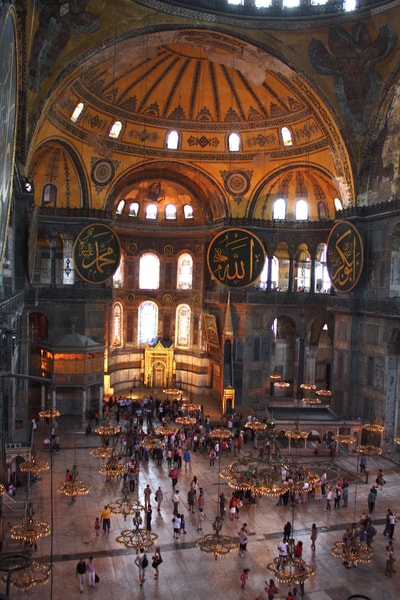 Interior de Hagia Sophia Mark Cartwright (CC BY-NC-SA) ](https://www.worldhistory.org/image/8973/hagia-sophia-interior/ "Hagia Sophia Interior")Os materiais de construção preferidos eram tijolos grandes com argamassa e betão para o núcleo oculto das paredes. Os blocos de pedra Ashlar eram utilizados em edifícios públicos de maior prestígio, enquanto o mármore, utilizado com mais moderação do que nos tempos romanos anteriores, era geralmente reservado para [colunas](https://www.worldhistory.org/trans/pt/1-10260/colunas/), caixilhos de portas e janelas, e outros elementos decorativos. Os telhados eram de madeira enquanto as paredes interiores eram frequentemente cobertas de gesso, estuque, placas finas de mármore, pinturas e mosaicos.
O maior, mais importante e ainda mais famoso edifício bizantino é a Hagia Sophia de Constantinopla, dedicada à santa sabedoria (Hagia Sophia) de Deus. Construída de novo em 532-537, a sua forma básica retangular mede 74,6 x 69,7 metros (245 x 229 pés) e o seu enorme teto abobadado é 55 metros acima do chão, com 31,8 metros de diâmetro. Descansando sobre quatro arcos maciços com quatro pingentes de suporte, a cúpula foi um feito arquitetônico espetacular para o período. A Hagia Sophia permaneceu a maior igreja do mundo até ao século XVI e foi uma das mais decoradas com soberbos mosaicos e pinturas murais cintilantes.
As igrejas cristãs, em geral, foram uma das maiores contribuições dos bizantinos para a arquitetura, especialmente a utilização da cúpula. O plano transversal em quadrados tornou-se o mais comum com a cúpula construída sobre quatro arcos de suporte. A base quadrada do edifício ramificou-se então em baías que poderiam ter, elas próprias, um teto de meia cúpula ou uma cúpula completa. Outra característica comum é uma abside central com duas abóbadas laterais no extremo oriental da igreja. Com o tempo, a cúpula central foi levantada cada vez mais alto sobre um tambor poligonal, que em algumas igrejas é tão alto que tem a aparência de uma torre. Muitas igrejas, especialmente basílicas, tinham ao seu lado um baptistério (geralmente octogonal), e por vezes um mausoléu para o fundador da igreja e os seus descendentes. Tais características de design bizantino continuariam a influenciar a arquitetura Cristã ortodoxa e assim são ainda hoje vistas nas igrejas de todo o mundo.
*Este artigo é baseado numa versão antiga da definição. Se desejar traduzir a nova versão, não hesite em contactar-nos.*
#### Editorial Review
This human-authored definition has been reviewed by our editorial team before publication to ensure accuracy, reliability and adherence to academic standards in accordance with our [editorial policy](https://www.worldhistory.org/static/editorial-policy/).
## Bibliografia
- [Bagnall, R. *The Encyclopedia of Ancient History.* Wiley-Blackwell, 2012.](https://www.worldhistory.org/books/0307407969/)
- [Brownworth, L. *Lost to the West.* Broadway Books, 2010.](https://www.worldhistory.org/books/0307407969/)
- [Gregory, T.E. *A History of Byzantium.* Wiley-Blackwell, 2010.](https://www.worldhistory.org/books/140518471X/)
- [Herrin, J. *Byzantium.* Princeton University Press, 2009.](https://www.worldhistory.org/books/0691143692/)
- [Mango, C. *The Oxford History of Byzantium.* Oxford University Press, 2002.](https://www.worldhistory.org/books/0198140983/)
- [Norwich, J.J. *A Short History of Byzantium by John Julius Norwich.* Knopf, 2018.](https://www.worldhistory.org/books/B01K2R3B6U/)
- [Shepherd, J. *The Cambridge History of the Byzantine Empire c.500-1492.* Cambridge University Press, 2009.](https://www.worldhistory.org/books/0521832314/)
## Sobre o Autor
Mark é Diretor Editorial da WHE, mestre em Filosofia Política pela Universidade de York. Investigador em tempo integral, é também escritor, historiador e editor. Os seus interesses particulares incluem arte, arquitetura e a descoberta das ideias partilhadas por todas as civilizações.
## Histórico
- **285 CE**: The [Roman empire](https://www.worldhistory.org/Roman_Empire/) is split into the Western and Eastern [Roman](https://www.worldhistory.org/disambiguation/Roman/) empires.
- **312 CE**: [Constantine I](https://www.worldhistory.org/Constantine_I/) introduces the [gold](https://www.worldhistory.org/gold/) nomisma (solidus) [coin](https://www.worldhistory.org/coinage/).
- **312 CE**: [Roman emperor](https://www.worldhistory.org/Roman_Emperor/) [Constantine I](https://www.worldhistory.org/Constantine_I/) tolerates [Christianity](https://www.worldhistory.org/christianity/).
- **c. 330 CE - c. 379 CE**: Life of Basil Great, one of the founding fathers of the Eastern Christian Church and [Byzantine](https://www.worldhistory.org/disambiguation/Byzantine/) Monasteries.
- **11 May 330 CE**: [Constantinople](https://www.worldhistory.org/Constantinople/) is founded on the site of old [Byzantium](https://www.worldhistory.org/Byzantium/) as "the new [Rome](https://www.worldhistory.org/Rome/)."
- **c. 331 CE**: The [Great Palace of Constantinople](https://www.worldhistory.org/article/1211/the-great-palace-of-constantinople/) is first built by [Constantine I](https://www.worldhistory.org/Constantine_I/).
- **360 CE**: First [Hagia Sophia](https://www.worldhistory.org/Hagia_Sophia/) built in [Constantinople](https://www.worldhistory.org/Constantinople/).
- **361 CE**: [Roman emperor](https://www.worldhistory.org/Roman_Emperor/) Julian attempts to revive Paganism.
- **c. 370 CE**: [Basil the Great](https://www.worldhistory.org/Basil_the_Great/) is made the bishop of [Caesarea](https://www.worldhistory.org/disambiguation/Caesarea/) in Cappadocia.
- **376 CE**: The [Visigoths](https://www.worldhistory.org/visigoth/) are fleeing the [Huns](https://www.worldhistory.org/Huns/), entering the [Eastern Roman Empire](https://www.worldhistory.org/Byzantine_Empire/).
- **391 CE**: Emperor Theodosius I closes pagan temples.
- **395 CE**: The [statue of Zeus at Olympia](https://www.worldhistory.org/Statue_of_Zeus_at_Olympia/) is removed to [Constantinople](https://www.worldhistory.org/Constantinople/).
- **395 CE - 408 CE**: Reign of [Byzantine emperor](https://www.worldhistory.org/Byzantine_Emperor/) Arkadios.
- **395 CE - 637 CE**: [Byblos](https://www.worldhistory.org/Byblos/) is a colony of the [Byzantine Empire](https://www.worldhistory.org/Byzantine_Empire/) (formerly known as the [Eastern Roman Empire](https://www.worldhistory.org/Byzantine_Empire/)).
- **408 CE - 450 CE**: Reign of [Byzantine Emperor](https://www.worldhistory.org/Byzantine_Emperor/) Thedosius II.
- **410 CE - 413 CE**: The [Theodosian Walls](https://www.worldhistory.org/Theodosian_Walls/) are built to better protect [Constantinople](https://www.worldhistory.org/Constantinople/).
- **450 CE - 457 CE**: Reign of [Byzantine emperor](https://www.worldhistory.org/Byzantine_Emperor/) Marcian.
- **8 Oct 451 CE - 1 Nov 451 CE**: Fourth Ecumenical Council takes place in Chalcedon, determining that [Jesus Christ](https://www.worldhistory.org/Jesus_Christ/) had two distinct natures and wills, perfectly united.
- **457 CE**: [Leo I](https://www.worldhistory.org/Leo_I/) is crowned by the Patriarch of [Constantinople](https://www.worldhistory.org/Constantinople/), the first [Byzantine emperor](https://www.worldhistory.org/Byzantine_Emperor/) to be crowned by a bishop.
- **457 CE - 474 CE**: Reign of [Byzantine emperor](https://www.worldhistory.org/Byzantine_Emperor/) [Leo I](https://www.worldhistory.org/Leo_I/).
- **466 CE**: [Byzantine emperor](https://www.worldhistory.org/Byzantine_Emperor/) [Leo I](https://www.worldhistory.org/Leo_I/) gives his daughter [Ariadne](https://www.worldhistory.org/Ariadne/) as a wife to the Isaurian chief Tarasicodissa (Zeno).
- **468 CE**: A [Byzantine](https://www.worldhistory.org/disambiguation/Byzantine/) army led by Basiliscus is defeated by the [Vandals](https://www.worldhistory.org/Vandals/) in North [Africa](https://www.worldhistory.org/disambiguation/africa/).
- **469 CE**: The [Byzantine Empire](https://www.worldhistory.org/Byzantine_Empire/) builds the Anastasian [Wall](https://www.worldhistory.org/wall/).
- **471 CE**: [Byzantine emperor](https://www.worldhistory.org/Byzantine_Emperor/) [Leo I](https://www.worldhistory.org/Leo_I/) conspires to murder his rival the general Aspar.
- **474 CE**: Reign of [Byzantine emperor](https://www.worldhistory.org/Byzantine_Emperor/) Leo II.
- **474 CE - 491 CE**: Reign of [Byzantine emperor](https://www.worldhistory.org/Byzantine_Emperor/) Zeno.
- **475 CE - 476 CE**: Revolt of Basiliscus against Zeno in the [Byzantine Empire](https://www.worldhistory.org/Byzantine_Empire/).
- **479 CE**: Revolt by Marcian against Zeno in the [Byzantine Empire](https://www.worldhistory.org/Byzantine_Empire/).
- **481 CE**: Theodoric Strabo marches on [Constantinople](https://www.worldhistory.org/Constantinople/).
- **482 CE**: Patriarch Acacius and Zeno release the Henotikon, an attempted religious compromise, which creates the Acacian Schism with [Rome](https://www.worldhistory.org/Rome/).
- **484 CE - 519 CE**: Acacian Schism between the [Byzantine Empire](https://www.worldhistory.org/Byzantine_Empire/) and the Pope in [Rome](https://www.worldhistory.org/Rome/).
- **491 CE - 518 CE**: [Byzantine emperor](https://www.worldhistory.org/Byzantine_Emperor/) [Anastasios I](https://www.worldhistory.org/Anastasios_I/) introduces the [copper](https://www.worldhistory.org/copper/) follis [coin](https://www.worldhistory.org/coinage/) (288 are worth one [gold](https://www.worldhistory.org/gold/) nomisma).
- **491 CE - 518 CE**: Reign of [Byzantine emperor](https://www.worldhistory.org/Byzantine_Emperor/) [Anastasios I](https://www.worldhistory.org/Anastasios_I/).
- **c. 493 CE**: [Byzantine emperor](https://www.worldhistory.org/Byzantine_Emperor/) [Anastasios I](https://www.worldhistory.org/Anastasios_I/) builds the Long [Wall](https://www.worldhistory.org/wall/) in Thrace to protect [Constantinople](https://www.worldhistory.org/Constantinople/).
- **497 CE**: [Byzantine emperor](https://www.worldhistory.org/Byzantine_Emperor/) [Anastasios I](https://www.worldhistory.org/Anastasios_I/) recognises Theodoric as the King of [Italy](https://www.worldhistory.org/italy/).
- **498 CE**: [Byzantine emperor](https://www.worldhistory.org/Byzantine_Emperor/) [Anastasios I](https://www.worldhistory.org/Anastasios_I/) abolishes the chrysargyron, an unpopular tax on business transactions.
- **c. 504 CE**: [Byzantine emperor](https://www.worldhistory.org/Byzantine_Emperor/) [Anastasios I](https://www.worldhistory.org/Anastasios_I/) retakes the fortress of Amida on the Persian frontier.
- **505 CE - 507 CE**: [Byzantine emperor](https://www.worldhistory.org/Byzantine_Emperor/) [Anastasios I](https://www.worldhistory.org/Anastasios_I/) builds a new fortress at Anastasiopolis (Dara) on the frontier with [Persia](https://www.worldhistory.org/Persia/).
- **506 CE**: A peace treaty is signed between the [Byzantine Empire](https://www.worldhistory.org/Byzantine_Empire/) and the Persians.
- **507 CE**: [Byzantine emperor](https://www.worldhistory.org/Byzantine_Emperor/) [Anastasios I](https://www.worldhistory.org/Anastasios_I/) sends [Clovis I](https://www.worldhistory.org/Clovis_I/), the king of the [Franks](https://www.worldhistory.org/Franks/) in [Gaul](https://www.worldhistory.org/gaul/), a fleet to aid his [war](https://www.worldhistory.org/disambiguation/War/) with the [Ostrogoths](https://www.worldhistory.org/ostrogoth/).
- **513 CE - 515 CE**: Vitalian leads a revolt in [Byzantine](https://www.worldhistory.org/disambiguation/Byzantine/) nThrace.
- **518 CE - 527 CE**: Reign of [Byzantine emperor](https://www.worldhistory.org/Byzantine_Emperor/) Justin I.
- **525 CE**: [Justinian I](https://www.worldhistory.org/Justinian_I/) marries Theodora, a woman from a poor background and possibly a courtesan.
- **527 CE - 548 CE**: Reign of [Empress Theodora](https://www.worldhistory.org/Empress_Theodora/) of the [Byzantine Empire](https://www.worldhistory.org/Byzantine_Empire/).
- **527 CE - 565 CE**: Reign of [Byzantine Emperor](https://www.worldhistory.org/Byzantine_Emperor/) [Justinian I](https://www.worldhistory.org/Justinian_I/).
- **c. 527 CE - 646 CE**: The [Byzantine Empire](https://www.worldhistory.org/Byzantine_Empire/) controls [Egypt](https://www.worldhistory.org/egypt/).
- **1 Apr 527 CE**: Coronation of [Justinian I](https://www.worldhistory.org/Justinian_I/) and Theodora in the [Hagia Sophia](https://www.worldhistory.org/Hagia_Sophia/) Church in [Constantinople](https://www.worldhistory.org/Constantinople/).
- **529 CE**: The first part of Justinian's Code, the Codex Justinianus, is released and immediately adopted across the [Byzantine Empire](https://www.worldhistory.org/Byzantine_Empire/).
- **531 CE - 534 CE**: [Byzantine](https://www.worldhistory.org/disambiguation/Byzantine/) forces engaged in a series of military campaigns against the [Slavs](https://www.worldhistory.org/Slavs/) and other groups.
- **532 CE - 537 CE**: [Hagia Sophia](https://www.worldhistory.org/Hagia_Sophia/) is built anew in [Constantinople](https://www.worldhistory.org/Constantinople/).
- **533 CE**: [Belisarius](https://www.worldhistory.org/Belisarius/) defeats the Persians to the east of the [Byzantine Empire](https://www.worldhistory.org/Byzantine_Empire/) and the [Vandals](https://www.worldhistory.org/Vandals/) of [Africa](https://www.worldhistory.org/disambiguation/africa/).
- **533 CE - 534 CE**: The [Vandal](https://www.worldhistory.org/Vandals/) [War](https://www.worldhistory.org/disambiguation/War/) launched by Emperor [Justinian I](https://www.worldhistory.org/Justinian_I/), aimed a reconquering [Africa](https://www.worldhistory.org/disambiguation/africa/) from the [Vandals](https://www.worldhistory.org/Vandals/).
- **Dec 533 CE**: The Digestum and Institutiones parts of Justinian's Code are released which supersedes all previous laws across the [Byzantine Empire](https://www.worldhistory.org/Byzantine_Empire/).
- **534 CE**: Justinian of the [Byzantine Empire](https://www.worldhistory.org/Byzantine_Empire/) conquers the [Vandal](https://www.worldhistory.org/Vandals/) kingdom in [Africa](https://www.worldhistory.org/disambiguation/africa/).
- **535 CE**: [Belisarius](https://www.worldhistory.org/Belisarius/)' first campaign against the [Ostrogoths](https://www.worldhistory.org/ostrogoth/) in [Italy](https://www.worldhistory.org/italy/).
- **536 CE**: [Rome](https://www.worldhistory.org/Rome/) falls to [Belisarius](https://www.worldhistory.org/Belisarius/).
- **536 CE - 562 CE**: The [Byzantine Empire](https://www.worldhistory.org/Byzantine_Empire/) conquers [Italy](https://www.worldhistory.org/italy/).
- **c. 540 CE**: The [Byzantine](https://www.worldhistory.org/disambiguation/Byzantine/) mosaics of the church of San Vitale in Ravenna, [Italy](https://www.worldhistory.org/italy/) are created.
- **545 CE - 550 CE**: [Belisarius](https://www.worldhistory.org/Belisarius/)' second campaign against in [Italy](https://www.worldhistory.org/italy/) against the [Ostrogoths](https://www.worldhistory.org/ostrogoth/) under [Totila](https://www.worldhistory.org/Totila/).
- **c. 550 CE**: The [Slavs](https://www.worldhistory.org/Slavs/) advance towards [Thessalonica](https://www.worldhistory.org/Thessalonica/), entering the region of the Hebrus River and the Thracian coast. Thessalonica is saved by the [Roman army](https://www.worldhistory.org/Roman_Army/).
- **554 CE**: [Byzantine Empire](https://www.worldhistory.org/Byzantine_Empire/) conquers southern [Iberia](https://www.worldhistory.org/disambiguation/iberia/).
- **Jul 556 CE - c. Jul 572 CE**: Samaritan revolt beginning in [Caesarea Maritima](https://www.worldhistory.org/Caesarea_Maritima/), perhaps with Jewish support. A number of churches are destroyed and there is a significant loss of life.
- **565 CE - 578 CE**: Reign of [Byzantine emperor](https://www.worldhistory.org/Byzantine_Emperor/) Justin II.
- **578 CE - 582 CE**: Reign of [Byzantine emperor](https://www.worldhistory.org/Byzantine_Emperor/) [Tiberius](https://www.worldhistory.org/Tiberius/) II.
- **c. 580 CE**: The [Slavs](https://www.worldhistory.org/Slavs/) and the [Avars](https://www.worldhistory.org/Avars/) overwhelm [Greece](https://www.worldhistory.org/greece/), Thrace and [Thessaly](https://www.worldhistory.org/disambiguation/Thessaly/).
- **582 CE - 602 CE**: Reign of [Byzantine emperor](https://www.worldhistory.org/Byzantine_Emperor/) Maurice.
- **585 CE**: The [Slavs](https://www.worldhistory.org/Slavs/) march on to [Constantinople](https://www.worldhistory.org/Constantinople/), they are driven off by the [Roman](https://www.worldhistory.org/disambiguation/Roman/) defence.
- **602 CE - 610 CE**: Reign of [Byzantine emperor](https://www.worldhistory.org/Byzantine_Emperor/) Phocas.
- **607 CE - 627 CE**: East [Rome](https://www.worldhistory.org/Rome/) defeats [Sasanian](https://www.worldhistory.org/Sasanian_Empire/) [Persia](https://www.worldhistory.org/Persia/).
- **610 CE - 641 CE**: Reign of [Byzantine emperor](https://www.worldhistory.org/Byzantine_Emperor/) [Heraclius](https://www.worldhistory.org/Heraclius/).
- **626 CE**: A coalition of Persians, [Slavs](https://www.worldhistory.org/Slavs/), [Avars](https://www.worldhistory.org/Avars/) and Bulgars unsuccessfully lays siege to [Constantinople](https://www.worldhistory.org/Constantinople/).
- **627 CE**: [Byzantine emperor](https://www.worldhistory.org/Byzantine_Emperor/) [Heraclius](https://www.worldhistory.org/Heraclius/) wins a crushing victory over the Persian army at [Nineveh](https://www.worldhistory.org/nineveh/).
- **628 CE**: [Byzantine Empire](https://www.worldhistory.org/Byzantine_Empire/) re-takes [Alexandria](https://www.worldhistory.org/alexandria/), [Egypt](https://www.worldhistory.org/egypt/), from the Persians.
- **636 CE**: A [Byzantine](https://www.worldhistory.org/disambiguation/Byzantine/) army is crushed by an Arab force at the [battle](https://www.worldhistory.org/disambiguation/battle/) of Yarmuk.
- **637 CE**: Muslim invasion of the [Levant](https://www.worldhistory.org/levant/). The Byzantines are driven out.
- **641 CE**: Reign of [Byzantine emperor](https://www.worldhistory.org/Byzantine_Emperor/) [Constantine](https://www.worldhistory.org/disambiguation/Constantine/) III.
- **641 CE**: Reign of [Byzantine emperor](https://www.worldhistory.org/Byzantine_Emperor/) Heraklonas.
- **641 CE - 668 CE**: Reign of [Byzantine emperor](https://www.worldhistory.org/Byzantine_Emperor/) [Constans II](https://www.worldhistory.org/Constans_II/).
- **642 CE**: [Byzantine](https://www.worldhistory.org/disambiguation/Byzantine/) [Alexandria](https://www.worldhistory.org/alexandria/) falls to the [Rashidun Caliphate](https://www.worldhistory.org/Rashidun_Caliphate/).
- **649 CE**: The [Rashidun Caliphate](https://www.worldhistory.org/Rashidun_Caliphate/) attacks [Byzantine](https://www.worldhistory.org/disambiguation/Byzantine/) [Cyprus](https://www.worldhistory.org/cyprus/).
- **654 CE**: [Byzantine](https://www.worldhistory.org/disambiguation/Byzantine/) [Crete](https://www.worldhistory.org/crete/), [Kos](https://www.worldhistory.org/Kos/) and [Rhodes](https://www.worldhistory.org/Rhodes/) fall to the [Rashidun Caliphate](https://www.worldhistory.org/Rashidun_Caliphate/).
- **655 CE**: A [Byzantine](https://www.worldhistory.org/disambiguation/Byzantine/) fleet is destroyed by the [Rashidun Caliphate](https://www.worldhistory.org/Rashidun_Caliphate/) off the coast of [Lycia](https://www.worldhistory.org/lycia/).
- **659 CE**: A peace treaty is signed between the [Byzantine Empire](https://www.worldhistory.org/Byzantine_Empire/) and the [Rashidun Caliphate](https://www.worldhistory.org/Rashidun_Caliphate/).
- **668 CE - 685 CE**: Reign of [Byzantine emperor](https://www.worldhistory.org/Byzantine_Emperor/) [Constantine IV](https://www.worldhistory.org/Constantine_IV/).
- **674 CE - 678 CE**: The Arab [Umayyad Caliphate](https://www.worldhistory.org/Umayyad_Dynasty/) unsuccessfully besieges [Constantinople](https://www.worldhistory.org/Constantinople/).
- **678 CE**: First recorded use of [Greek Fire](https://www.worldhistory.org/Greek_Fire/) in [Byzantine](https://www.worldhistory.org/disambiguation/Byzantine/) [warfare](https://www.worldhistory.org/warfare/) during the Arab siege of [Constantinople](https://www.worldhistory.org/Constantinople/).
- **679 CE**: The [Umayyad Caliphate](https://www.worldhistory.org/Umayyad_Dynasty/) is obliged by treaty to give up former [Byzantine](https://www.worldhistory.org/disambiguation/Byzantine/) territories in the [Aegean](https://www.worldhistory.org/aegean/).
- **680 CE**: A [Byzantine](https://www.worldhistory.org/disambiguation/Byzantine/) naval fleet is defeated by the Bulgars.
- **680 CE - 681 CE**: The Sixth Ecumenical Council in [Constantinople](https://www.worldhistory.org/Constantinople/) declares the end of Monotheletism and Monoenergism.
- **681 CE**: [Byzantine emperor](https://www.worldhistory.org/Byzantine_Emperor/) [Constantine IV](https://www.worldhistory.org/Constantine_IV/) signs a peace treaty with the Bulgars.
- **685 CE - 695 CE**: First reign of [Byzantine emperor](https://www.worldhistory.org/Byzantine_Emperor/) [Justinian II](https://www.worldhistory.org/Justinian_II/).
- **c. 691 CE**: [Byzantine emperor](https://www.worldhistory.org/Byzantine_Emperor/) [Justinian II](https://www.worldhistory.org/Justinian_II/) mints the first coins to depict [Jesus Christ](https://www.worldhistory.org/Jesus_Christ/).
- **695 CE**: The usurper Leontios exiles [Byzantine emperor](https://www.worldhistory.org/Byzantine_Emperor/) [Justinian II](https://www.worldhistory.org/Justinian_II/).
- **695 CE - 698 CE**: Reign of [Byzantine emperor](https://www.worldhistory.org/Byzantine_Emperor/) Leontios.
- **698 CE**: The [Byzantine](https://www.worldhistory.org/disambiguation/Byzantine/) ruler Leontios is exiled by the usurper Apsimar (aka Tiberios III).
- **698 CE - 705 CE**: Reign of [Byzantine emperor](https://www.worldhistory.org/Byzantine_Emperor/) Tiberios II.
- **705 CE**: [Justinian II](https://www.worldhistory.org/Justinian_II/) besieges [Constantinople](https://www.worldhistory.org/Constantinople/) and reinstates himself as [Byzantine emperor](https://www.worldhistory.org/Byzantine_Emperor/), removing the usurper Tiberios III.
- **705 CE - 711 CE**: Second reign of [Byzantine emperor](https://www.worldhistory.org/Byzantine_Emperor/) [Justinian II](https://www.worldhistory.org/Justinian_II/).
- **709 CE**: [Byzantine](https://www.worldhistory.org/disambiguation/Byzantine/) Tyana in Cappadocia is lost to the Arabs.
- **711 CE**: Pope [Constantine](https://www.worldhistory.org/disambiguation/Constantine/) visits [Constantinople](https://www.worldhistory.org/Constantinople/) at the invitation of [Byzantine emperor](https://www.worldhistory.org/Byzantine_Emperor/) [Justinian II](https://www.worldhistory.org/Justinian_II/).
- **711 CE - 713 CE**: Reign of [Byzantine emperor](https://www.worldhistory.org/Byzantine_Emperor/) Philippikos.
- **4 Nov 711 CE**: The general and usurper Philippikos murders [Byzantine emperor](https://www.worldhistory.org/Byzantine_Emperor/) [Justinian II](https://www.worldhistory.org/Justinian_II/).
- **713 CE - 716 CE**: Reign of [Byzantine emperor](https://www.worldhistory.org/Byzantine_Emperor/) Anastasius II
- **716 CE - 717 CE**: Reign of [Byzantine emperor](https://www.worldhistory.org/Byzantine_Emperor/) Theodosius III.
- **717 CE - 718 CE**: [Greek Fire](https://www.worldhistory.org/Greek_Fire/) is used by [Byzantine](https://www.worldhistory.org/disambiguation/Byzantine/) ships to attack an Arab fleet besieging [Constantinople](https://www.worldhistory.org/Constantinople/).
- **717 CE - 741 CE**: Reign of [Byzantine emperor](https://www.worldhistory.org/Byzantine_Emperor/) [Leo III](https://www.worldhistory.org/Leo_III/).
- **717 CE - 802 CE**: The Isaurian dynasty, founded by [Leo III](https://www.worldhistory.org/Leo_III/), rules the [Byzantine Empire](https://www.worldhistory.org/Byzantine_Empire/).
- **720 CE - 721 CE**: The [silver](https://www.worldhistory.org/Silver/) miliaresion [coin](https://www.worldhistory.org/coinage/) is introduced in the [Byzantine Empire](https://www.worldhistory.org/Byzantine_Empire/) by [Leo III](https://www.worldhistory.org/Leo_III/).
- **726 CE**: [Byzantine emperor](https://www.worldhistory.org/Byzantine_Emperor/) [Leo III](https://www.worldhistory.org/Leo_III/) makes legal reforms, publishing his Ecloga.
- **730 CE**: [Byzantine emperor](https://www.worldhistory.org/Byzantine_Emperor/) [Leo III](https://www.worldhistory.org/Leo_III/) decrees that all religious icons be destroyed.
- **740 CE**: [Byzantine emperor](https://www.worldhistory.org/Byzantine_Emperor/) [Leo III](https://www.worldhistory.org/Leo_III/) wins a decisive victory over the Arabs at the [battle](https://www.worldhistory.org/disambiguation/battle/) of Akroinon.
- **741 CE - 775 CE**: Reign of [Byzantine emperor](https://www.worldhistory.org/Byzantine_Emperor/) [Constantine V](https://www.worldhistory.org/Constantine_V/)
- **744 CE**: Emperor [Constantine V](https://www.worldhistory.org/Constantine_V/) regains the [Byzantine](https://www.worldhistory.org/disambiguation/Byzantine/) throne from the usurper Artabasdos.
- **746 CE - 752 CE**: [Byzantine emperor](https://www.worldhistory.org/Byzantine_Emperor/) [Constantine V](https://www.worldhistory.org/Constantine_V/) conducts successful campaigns in northern [Syria](https://www.worldhistory.org/syria/) and [Armenia](https://www.worldhistory.org/armenia/).
- **754 CE**: The Council of Hieria declares the worship of icons by Christians as heresy.
- **755 CE**: [Byzantine emperor](https://www.worldhistory.org/Byzantine_Emperor/) [Constantine V](https://www.worldhistory.org/Constantine_V/) instigates a persecution of Christians who worship icons.
- **756 CE - 775 CE**: [Byzantine emperor](https://www.worldhistory.org/Byzantine_Emperor/) [Constantine V](https://www.worldhistory.org/Constantine_V/) wins a string of military victories against the Bulgars.
- **775 CE - 780 CE**: Reign of [Byzantine emperor](https://www.worldhistory.org/Byzantine_Emperor/) Leo IV.
- **780 CE - 790 CE**: [Empress Irene](https://www.worldhistory.org/Empress_Irene/) rules as regent for [Byzantine emperor](https://www.worldhistory.org/Byzantine_Emperor/) [Constantine VI](https://www.worldhistory.org/Constantine_VI/).
- **780 CE - 797 CE**: Reign of [Byzantine emperor](https://www.worldhistory.org/Byzantine_Emperor/) [Constantine VI](https://www.worldhistory.org/Constantine_VI/) (with [Empress Irene](https://www.worldhistory.org/Empress_Irene/) as regent 780-790 CE).
- **Sep 787 CE**: The Ecumenical Council of Nicaea rules an end to iconoclasm in the [Byzantine](https://www.worldhistory.org/disambiguation/Byzantine/) Christian Church.
- **790 CE**: [Byzantine emperor](https://www.worldhistory.org/Byzantine_Emperor/) [Constantine VI](https://www.worldhistory.org/Constantine_VI/) exiles his mother and regent [Empress Irene](https://www.worldhistory.org/Empress_Irene/).
- **795 CE**: [Constantine VI](https://www.worldhistory.org/Constantine_VI/) divorces Mary of Amnia and then marries his mistress Theodote, causing the so-called Moechian Controversy, which divides the [Byzantine](https://www.worldhistory.org/disambiguation/Byzantine/) Church.
- **797 CE**: [Byzantine](https://www.worldhistory.org/disambiguation/Byzantine/) [empress Irene](https://www.worldhistory.org/Empress_Irene/) blinds and kills her son [Constantine VI](https://www.worldhistory.org/Constantine_VI/).
- **797 CE - 802 CE**: [Empress Irene](https://www.worldhistory.org/Empress_Irene/) rules the [Byzantine empire](https://www.worldhistory.org/Byzantine_Empire/).
- **797 CE - 802 CE**: [Empress Irene](https://www.worldhistory.org/Empress_Irene/) is the first [Byzantine](https://www.worldhistory.org/disambiguation/Byzantine/) ruler to put an image of herself on both sides of her [coinage](https://www.worldhistory.org/coinage/).
- **802 CE - 811 CE**: Reign of [Byzantine emperor](https://www.worldhistory.org/Byzantine_Emperor/) [Nikephoros I](https://www.worldhistory.org/Nikephoros_I/).
- **807 CE**: A peace treaty is signed between king of the [Franks](https://www.worldhistory.org/Franks/) [Charlemagne](https://www.worldhistory.org/Charlemagne/) and [Byzantine emperor](https://www.worldhistory.org/Byzantine_Emperor/) [Nikephoros I](https://www.worldhistory.org/Nikephoros_I/).
- **811 CE**: Reign of [Byzantine emperor](https://www.worldhistory.org/Byzantine_Emperor/) Stavrakios.
- **811 CE - 813 CE**: Reign of [Byzantine emperor](https://www.worldhistory.org/Byzantine_Emperor/) Michael I.
- **813 CE - 820 CE**: Reign of [Byzantine emperor](https://www.worldhistory.org/Byzantine_Emperor/) [Leo V the Armenian](https://www.worldhistory.org/Leo_V_the_Armenian/).
- **814 CE**: [Byzantine emperor](https://www.worldhistory.org/Byzantine_Emperor/) [Leo V the Armenian](https://www.worldhistory.org/Leo_V_the_Armenian/) defeats a Bulgar army near Mesembria.
- **815 CE**: [Byzantine emperor](https://www.worldhistory.org/Byzantine_Emperor/) [Leo V the Armenian](https://www.worldhistory.org/Leo_V_the_Armenian/) proclaims the veneration of icons as heresy.
- **820 CE - 823 CE**: [Byzantine emperor](https://www.worldhistory.org/Byzantine_Emperor/) [Michael II](https://www.worldhistory.org/Michael_II/) puts down a revolt led by Thomas the Slav.
- **820 CE - 829 CE**: Reign of [Byzantine emperor](https://www.worldhistory.org/Byzantine_Emperor/) [Michael II](https://www.worldhistory.org/Michael_II/).
- **821 CE - 822 CE**: [Greek Fire](https://www.worldhistory.org/Greek_Fire/) is used by [Byzantine](https://www.worldhistory.org/disambiguation/Byzantine/) ships to attack a Slav fleet besieging [Constantinople](https://www.worldhistory.org/Constantinople/).
- **Dec 821 CE - Dec 823 CE**: Thomas the Slav unsuccessfully besieges [Constantinople](https://www.worldhistory.org/Constantinople/).
- **829 CE - 842 CE**: Reign of [Byzantine emperor](https://www.worldhistory.org/Byzantine_Emperor/) [Theophilos](https://www.worldhistory.org/Theophilos/).
- **830 CE - 831 CE**: [Byzantine emperor](https://www.worldhistory.org/Byzantine_Emperor/) [Theophilos](https://www.worldhistory.org/Theophilos/) wins victories in Cilica and awards himself a [triumph](https://www.worldhistory.org/Roman_Triumph/).
- **838 CE**: The Arab [Caliphate](https://www.worldhistory.org/Islamic_Caliphates/) defeats a [Byzantine](https://www.worldhistory.org/disambiguation/Byzantine/) army and captures the [cities](https://www.worldhistory.org/city/) of Ankara and Amorion.
- **839 CE**: The [Byzantine empire](https://www.worldhistory.org/Byzantine_Empire/) loses Taranto in southern [Italy](https://www.worldhistory.org/italy/) to the western Arabs.
- **842 CE - 855 CE**: Theodora rules as regent for her son [Michael III](https://www.worldhistory.org/Michael_III/), emperor of the [Byzantine empire](https://www.worldhistory.org/Byzantine_Empire/).
- **842 CE - 867 CE**: Reign of [Byzantine emperor](https://www.worldhistory.org/Byzantine_Emperor/) [Michael III](https://www.worldhistory.org/Michael_III/).
- **855 CE - 856 CE**: [Michael III](https://www.worldhistory.org/Michael_III/) removes his mother Theodora, the regent, and rules alone as emperor of the [Byzantine empire](https://www.worldhistory.org/Byzantine_Empire/).
- **856 CE**: The armies of [Byzantine emperor](https://www.worldhistory.org/Byzantine_Emperor/) [Michael III](https://www.worldhistory.org/Michael_III/) win great victories in Cappadocia and [Mesopotamia](https://www.worldhistory.org/Mesopotamia/).
- **862 CE**: Council of Sirakawan between the Armenian and [Byzantine](https://www.worldhistory.org/disambiguation/Byzantine/) Orthodox Churches discuss Christological issues in an effort to reunify, although ultimately unsuccessful.
- **863 CE**: [Byzantine emperor](https://www.worldhistory.org/Byzantine_Emperor/) [Michael III](https://www.worldhistory.org/Michael_III/) sends [Saint Cyril](https://www.worldhistory.org/Saint_Cyril/) and Methodius on a mission to Moravia.
- **864 CE**: [Byzantine emperor](https://www.worldhistory.org/Byzantine_Emperor/) [Michael III](https://www.worldhistory.org/Michael_III/) presides over the baptism of Boris I, khan of the Bulgars.
- **866 CE**: [Byzantine emperor](https://www.worldhistory.org/Byzantine_Emperor/) [Michael III](https://www.worldhistory.org/Michael_III/) makes Basil the Macedonian co-emperor.
- **867 CE**: Basil the Macedonian murders [Byzantine emperor](https://www.worldhistory.org/Byzantine_Emperor/) [Michael III](https://www.worldhistory.org/Michael_III/) and declares himself Emperor [Basil I](https://www.worldhistory.org/Basil_I/).
- **867 CE - 886 CE**: Reign of [Byzantine emperor](https://www.worldhistory.org/Byzantine_Emperor/) [Basil I](https://www.worldhistory.org/Basil_I/).
- **883 CE**: A decree by [Byzantine emperor](https://www.worldhistory.org/Byzantine_Emperor/) [Basil I](https://www.worldhistory.org/Basil_I/) is the first recorded evidence of a monastery on [Mount Athos](https://www.worldhistory.org/Mount_Athos/).
- **886 CE**: [Byzantine emperor](https://www.worldhistory.org/Byzantine_Emperor/) [Basil I](https://www.worldhistory.org/Basil_I/) is (probably) murdered by his son and successor [Leo VI](https://www.worldhistory.org/Leo_VI/).
- **886 CE - 912 CE**: Reign of [Byzantine emperor](https://www.worldhistory.org/Byzantine_Emperor/) [Leo VI](https://www.worldhistory.org/Leo_VI/).
- **894 CE**: Symeon, [Tsar](https://www.worldhistory.org/Tsar/) of the Bulgars, invades Thrace, then [Byzantine](https://www.worldhistory.org/disambiguation/Byzantine/) territory.
- **1 Aug 902 CE**: [Byzantine](https://www.worldhistory.org/disambiguation/Byzantine/) Taormina on [Sicily](https://www.worldhistory.org/sicily/) falls to Arab attacks.
- **904 CE**: Leo of Tripoli leads an Arab force which sacks [Byzantine](https://www.worldhistory.org/disambiguation/Byzantine/) [Thessaloniki](https://www.worldhistory.org/Thessalonica/) and Abydos.
- **912 CE**: [Byzantine emperor](https://www.worldhistory.org/Byzantine_Emperor/) [Constantine VII](https://www.worldhistory.org/Constantine_VII/) inherits the throne but is served by four consecutive regents.
- **912 CE - 913 CE**: Reign of [Byzantine emperor](https://www.worldhistory.org/Byzantine_Emperor/) [Alexander](https://www.worldhistory.org/disambiguation/Alexander/).
- **920 CE**: [Romanos I](https://www.worldhistory.org/Romanos_I/)'s Tome of Union reconciles the rift in the [Byzantine](https://www.worldhistory.org/disambiguation/Byzantine/) Church caused by [Leo VI](https://www.worldhistory.org/Leo_VI/)'s third and fourth marriages.
- **920 CE - 944 CE**: Reign of [Byzantine emperor](https://www.worldhistory.org/Byzantine_Emperor/) [Romanos I](https://www.worldhistory.org/Romanos_I/) Lekapenos.
- **922 CE**: [Byzantine emperor](https://www.worldhistory.org/Byzantine_Emperor/) [Romanos I](https://www.worldhistory.org/Romanos_I/) passes a [law](https://www.worldhistory.org/disambiguation/law/) to protect the land of the peasantry.
- **934 CE**: A [Byzantine](https://www.worldhistory.org/disambiguation/Byzantine/) army captures Melitene in Cappadocia.
- **941 CE**: [Greek Fire](https://www.worldhistory.org/Greek_Fire/) is used by [Romanos I](https://www.worldhistory.org/Romanos_I/)'s fleet against a Russian fleet attacking [Constantinople](https://www.worldhistory.org/Constantinople/).
- **943 CE**: A [Byzantine](https://www.worldhistory.org/disambiguation/Byzantine/) army led by John Kourkouas captures the border Mesopotamians fortresses of Nisibis, Dara, Amida, and Martyropolis.
- **944 CE**: A [Byzantine](https://www.worldhistory.org/disambiguation/Byzantine/) army led by John Kourkouas besieges [Edessa](https://www.worldhistory.org/edessa/). The Mandylion icon is taken to [Constantinople](https://www.worldhistory.org/Constantinople/)
- **945 CE - 959 CE**: Reign of [Byzantine emperor](https://www.worldhistory.org/Byzantine_Emperor/) [Constantine VII](https://www.worldhistory.org/Constantine_VII/) (ruled with a regent from 912 CE).
- **959 CE - 963 CE**: Reign of [Byzantine emperor](https://www.worldhistory.org/Byzantine_Emperor/) Romanos II.
- **962 CE**: [Byzantine](https://www.worldhistory.org/disambiguation/Byzantine/) forces under Nikephoros Phokas sack Anazarbos and Hierapolis in [Syria](https://www.worldhistory.org/syria/).
- **963 CE**: The Great Lavra monastery on [Mount Athos](https://www.worldhistory.org/Mount_Athos/) is founded by Saint Athanasios.
- **963 CE - 969 CE**: Reign of [Byzantine emperor](https://www.worldhistory.org/Byzantine_Emperor/) [Nikephoros II Phokas](https://www.worldhistory.org/Nikephoros_II_Phokas/).
- **963 CE - 969 CE**: [Byzantine emperor](https://www.worldhistory.org/Byzantine_Emperor/) [Nikephoros II Phokas](https://www.worldhistory.org/Nikephoros_II_Phokas/) introduces the [gold](https://www.worldhistory.org/gold/) tetarteron [coin](https://www.worldhistory.org/coinage/) (one-twelfth of a gold nomisma in value).
- **965 CE**: [Byzantine](https://www.worldhistory.org/disambiguation/Byzantine/) forces are defeated and forced out of [Sicily](https://www.worldhistory.org/sicily/) by Muslim troops.
- **968 CE**: [Nikephoros II Phokas](https://www.worldhistory.org/Nikephoros_II_Phokas/) marches [Byzantine](https://www.worldhistory.org/disambiguation/Byzantine/) forces as far south as Lebanon.
- **969 CE**: [Byzantine](https://www.worldhistory.org/disambiguation/Byzantine/) forces recapture the [city](https://www.worldhistory.org/city/) of [Antioch](https://www.worldhistory.org/Antiochia/) from the Arabs.
- **969 CE**: John Tzimiskes murders [Nikephoros II Phokas](https://www.worldhistory.org/Nikephoros_II_Phokas/) in the imperial [Byzantine](https://www.worldhistory.org/disambiguation/Byzantine/) [palace](https://www.worldhistory.org/disambiguation/palace/) in [Constantinople](https://www.worldhistory.org/Constantinople/).
- **969 CE - 976 CE**: Reign of [Byzantine Emperor](https://www.worldhistory.org/Byzantine_Emperor/) [John I Tzimiskes](https://www.worldhistory.org/John_I_Tzimiskes/).
- **970 CE**: The Treaty of Safar makes Aleppo a client state of the [Byzantine Empire](https://www.worldhistory.org/Byzantine_Empire/).
- **971 CE**: [John I Tzimiskes](https://www.worldhistory.org/John_I_Tzimiskes/) and the [Byzantine](https://www.worldhistory.org/disambiguation/Byzantine/) army defeat the Rus at Dorystolon, forcing Sviatoslav and the Rus army to retreat from Bulgaria.
- **972 CE**: [John I Tzimiskes](https://www.worldhistory.org/John_I_Tzimiskes/) captures Nisibis and forces the Emir of Mosul to pay tribute to the [Byzantine Empire](https://www.worldhistory.org/Byzantine_Empire/).
- **972 CE**: [Byzantine emperor](https://www.worldhistory.org/Byzantine_Emperor/) John I Tzimisces uses [Greek Fire](https://www.worldhistory.org/Greek_Fire/) to take the Bulgar capital of Preslav, then in Russian hands.
- **975 CE**: [John I Tzimiskes](https://www.worldhistory.org/John_I_Tzimiskes/) invades [Syria](https://www.worldhistory.org/syria/), conquering several [cities](https://www.worldhistory.org/city/) and forcing neighboring Muslim states such as Damascus to pay tribute to the Byzantines.
- **976 CE - 1025 CE**: Reign of [Byzantine emperor](https://www.worldhistory.org/Byzantine_Emperor/) [Basil II](https://www.worldhistory.org/Basil_II/).
- **986 CE**: [Byzantine emperor](https://www.worldhistory.org/Byzantine_Emperor/) [Basil II](https://www.worldhistory.org/Basil_II/) suffers a terrible defeat to [Samuel](https://www.worldhistory.org/samuel/) the Bulgar at [Trajan](https://www.worldhistory.org/trajan/)'s Gate.
- **987 CE - 989 CE**: [Byzantine emperor](https://www.worldhistory.org/Byzantine_Emperor/) [Basil II](https://www.worldhistory.org/Basil_II/) defeats the usurpers Bardas Skleros and Bardas Phokas.
- **c. 988 CE**: [Byzantine emperor](https://www.worldhistory.org/Byzantine_Emperor/) [Basil II](https://www.worldhistory.org/Basil_II/) uses a force of Varangians for the first time.
- **988 CE - 989 CE**: [Byzantine emperor](https://www.worldhistory.org/Byzantine_Emperor/) [Basil II](https://www.worldhistory.org/Basil_II/) uses [Greek Fire](https://www.worldhistory.org/Greek_Fire/) to attack a rebel force led by the usurper Bardas Phokas.
- **994 CE**: [Trdat the Architect](https://www.worldhistory.org/Trdat_the_Architect/) completes his reconstruction of the dome of [Hagia Sophia](https://www.worldhistory.org/Hagia_Sophia/), [Constantinople](https://www.worldhistory.org/Constantinople/).
- **995 CE**: [Byzantine emperor](https://www.worldhistory.org/Byzantine_Emperor/) [Basil II](https://www.worldhistory.org/Basil_II/) wins victories in [Syria](https://www.worldhistory.org/syria/) against the Fatimids.
- **997 CE**: [Byzantine emperor](https://www.worldhistory.org/Byzantine_Emperor/) [Basil II](https://www.worldhistory.org/Basil_II/) reconquers [Greece](https://www.worldhistory.org/greece/) from [Samuel](https://www.worldhistory.org/samuel/) the Bulgar.
- **1014 CE**: [Byzantine emperor](https://www.worldhistory.org/Byzantine_Emperor/) [Basil II](https://www.worldhistory.org/Basil_II/) wins final victory against [Samuel](https://www.worldhistory.org/samuel/) the Bulgar at Kleidion.
- **1018 CE - c. 1082 CE**: Life of [Byzantine](https://www.worldhistory.org/disambiguation/Byzantine/) minister, scholar, and historian [Michael Psellos](https://www.worldhistory.org/Michael_Psellos/).
- **1021 CE - 1022 CE**: [Byzantine emperor](https://www.worldhistory.org/Byzantine_Emperor/) [Basil II](https://www.worldhistory.org/Basil_II/) wins victories in [Armenia](https://www.worldhistory.org/armenia/) and Georgia.
- **1025 CE**: [Byzantine emperor](https://www.worldhistory.org/Byzantine_Emperor/) [Basil II](https://www.worldhistory.org/Basil_II/) dies and his plans to invade [Sicily](https://www.worldhistory.org/sicily/) are abandoned.
- **1025 CE - 1028 CE**: Reign of [Byzantine emperor](https://www.worldhistory.org/Byzantine_Emperor/) [Constantine](https://www.worldhistory.org/disambiguation/Constantine/) VIII.
- **1025 CE - 1028 CE**: Reign of [Byzantine emperor](https://www.worldhistory.org/Byzantine_Emperor/) [Constantine](https://www.worldhistory.org/disambiguation/Constantine/) VIII.
- **1028 CE - 1034 CE**: Reign of [Byzantine emperor](https://www.worldhistory.org/Byzantine_Emperor/) Romanos III Argyros.
- **1028 CE - 1050 CE**: Reign of [Byzantine](https://www.worldhistory.org/disambiguation/Byzantine/) [Empress Zoe](https://www.worldhistory.org/Empress_Zoe/) (including spells alongside three husbands, a nephew and sister).
- **1034 CE - 1041 CE**: Reign of [Byzantine emperor](https://www.worldhistory.org/Byzantine_Emperor/) Michael IV the Paphalgonian.
- **1040 CE**: The Bulgarian leader Deljan starts a major Bulgarian uprising against the [Byzantine Empire](https://www.worldhistory.org/Byzantine_Empire/).
- **1041 CE - 1042 CE**: Reign of [Byzantine emperor](https://www.worldhistory.org/Byzantine_Emperor/) Michael V.
- **1042 CE - 1055 CE**: Reign of [Byzantine emperor](https://www.worldhistory.org/Byzantine_Emperor/) [Constantine](https://www.worldhistory.org/disambiguation/Constantine/) IX.
- **Apr 1042 CE - Jun 1042 CE**: Reign of [Byzantine](https://www.worldhistory.org/disambiguation/Byzantine/) empresses Zoe and Theodora.
- **1055 CE - 1056 CE**: Reign of [Byzantine](https://www.worldhistory.org/disambiguation/Byzantine/) [Empress Theodora](https://www.worldhistory.org/Empress_Theodora/) (alone).
- **1056 CE - 1057 CE**: Reign of [Byzantine emperor](https://www.worldhistory.org/Byzantine_Emperor/) Michael VI.
- **1057 CE**: Isaac Komnenos and other leading military men in the [Byzantine Empire](https://www.worldhistory.org/Byzantine_Empire/) rebel against Emperor Michael VI.
- **1057 CE - 1059 CE**: Reign of [Byzantine emperor](https://www.worldhistory.org/Byzantine_Emperor/) [Isaac I Komnenos](https://www.worldhistory.org/Isaac_I_Komnenos/).
- **8 Jun 1057 CE**: Isaac Komnenos is declared [Byzantine emperor](https://www.worldhistory.org/Byzantine_Emperor/) by imperial soldiers in [Anatolia](https://www.worldhistory.org/Asia_Minor/) in rebellion against Emperor Michael VI.
- **1059 CE**: [Isaac I Komnenos](https://www.worldhistory.org/Isaac_I_Komnenos/) defeats the Pechenegs in [battle](https://www.worldhistory.org/disambiguation/battle/), but loses soldiers in a storm during his march home.
- **1059 CE - 1067 CE**: Reign of [Byzantine emperor](https://www.worldhistory.org/Byzantine_Emperor/) [Constantine](https://www.worldhistory.org/disambiguation/Constantine/) X.
- **1067 CE - 1071 CE**: Reign of [Byzantine emperor](https://www.worldhistory.org/Byzantine_Emperor/) Romanus IV Diogenes.
- **1068 CE**: The Normans under [Robert Guiscard](https://www.worldhistory.org/Robert_Guiscard/) begin the three-year siege of Bari, the [Byzantine](https://www.worldhistory.org/disambiguation/Byzantine/) provincial capital of southern [Italy](https://www.worldhistory.org/italy/).
- **1071 CE - 1078 CE**: Reign of [Byzantine emperor](https://www.worldhistory.org/Byzantine_Emperor/) Michael VII.
- **1078 CE - 1081 CE**: Reign of [Byzantine emperor](https://www.worldhistory.org/Byzantine_Emperor/) Nikephoros III.
- **1081 CE - 1082 CE**: The Normans, led by [Robert Guiscard](https://www.worldhistory.org/Robert_Guiscard/), attack [Byzantine](https://www.worldhistory.org/disambiguation/Byzantine/) [Greece](https://www.worldhistory.org/greece/).
- **Apr 1081 CE - Aug 1118 CE**: Reign of [Byzantine emperor](https://www.worldhistory.org/Byzantine_Emperor/) [Alexios I Komnenos](https://www.worldhistory.org/Alexios_I_Komnenos/).
- **1082 CE**: [Byzantine emperor](https://www.worldhistory.org/Byzantine_Emperor/) [Alexios I Komnenos](https://www.worldhistory.org/Alexios_I_Komnenos/) grants [trade](https://www.worldhistory.org/disambiguation/trade/) access and privileges to the Venetians in return for naval support.
- **1083 CE - 1153 CE**: Life of the [Byzantine](https://www.worldhistory.org/disambiguation/Byzantine/) historian [Anna Komnene](https://www.worldhistory.org/Anna_Komnene/).
- **1084 CE**: The Normans defeat a Venetian naval force, allies of the [Byzantine Empire](https://www.worldhistory.org/Byzantine_Empire/).
- **1085 CE**: [Alexios I Komnenos](https://www.worldhistory.org/Alexios_I_Komnenos/) recaptures Dyracchion from the Normans.
- **1087 CE - 1090 CE**: The Pechenegs attack [Byzantine](https://www.worldhistory.org/disambiguation/Byzantine/) Thrace.
- **29 Apr 1091 CE**: A [Byzantine](https://www.worldhistory.org/disambiguation/Byzantine/) army, with Cumans as allies, defeats the Pechenegs at the [battle](https://www.worldhistory.org/disambiguation/battle/) of Mount Lebounion.
- **1092 CE**: [Alexios I Komnenos](https://www.worldhistory.org/Alexios_I_Komnenos/) introduces the electrum hyperpyron [coin](https://www.worldhistory.org/coinage/) (worth one-third of a [gold](https://www.worldhistory.org/gold/) nomisma).
- **1095 CE**: [Byzantine emperor](https://www.worldhistory.org/Byzantine_Emperor/) [Alexios I Komnenos](https://www.worldhistory.org/Alexios_I_Komnenos/) quashes a rebellion led by Nikephoros Diogenes.
- **1097 CE**: The First Crusaders capture Nicaea.
- **3 Jun 1098 CE**: The First Crusaders capture [Antioch](https://www.worldhistory.org/Antiochia/) after an 8-month siege.
- **c. 1100 CE**: The [Jesus Christ](https://www.worldhistory.org/Jesus_Christ/) [mosaic](https://www.worldhistory.org/Mosaic/) in the dome of the church at Daphni, [Greece](https://www.worldhistory.org/greece/) is made.
- **1107 CE**: The Normans, led by Bohemund, besiege Dyracchion.
- **1108 CE**: The Treaty of Devol is signed between the [Byzantine Empire](https://www.worldhistory.org/Byzantine_Empire/) and the Normans, removing any Norman threat from the [empire](https://www.worldhistory.org/empire/)'s territory.
- **1118 CE - 1143 CE**: Reign of [Byzantine emperor](https://www.worldhistory.org/Byzantine_Emperor/) [John II Komnenos](https://www.worldhistory.org/John_II_Komnenos/).
- **1122 CE**: [Byzantine emperor](https://www.worldhistory.org/Byzantine_Emperor/) [John II Komnenos](https://www.worldhistory.org/John_II_Komnenos/) defeats the Pechenegs in the Balkans.
- **c. 1125 CE**: The Vladimir Icon of the Virgin and Child is painted in [Constantinople](https://www.worldhistory.org/Constantinople/).
- **1126 CE**: [Byzantine emperor](https://www.worldhistory.org/Byzantine_Emperor/) [John II Komnenos](https://www.worldhistory.org/John_II_Komnenos/) restores the [trade](https://www.worldhistory.org/disambiguation/trade/) privileges given to the Venetians.
- **1129 CE**: Serbia is obliged to accept [Byzantine](https://www.worldhistory.org/disambiguation/Byzantine/) sovereignty.
- **1130 CE**: [Byzantine emperor](https://www.worldhistory.org/Byzantine_Emperor/) [John II Komnenos](https://www.worldhistory.org/John_II_Komnenos/) defeats the Danishmendids in [Asia Minor](https://www.worldhistory.org/Asia_Minor/).
- **1133 CE**: [Byzantine emperor](https://www.worldhistory.org/Byzantine_Emperor/) [John II Komnenos](https://www.worldhistory.org/John_II_Komnenos/) celebrates a [triumph](https://www.worldhistory.org/Roman_Triumph/) in [Constantinople](https://www.worldhistory.org/Constantinople/) after five successful campaigns in [Asia Minor](https://www.worldhistory.org/Asia_Minor/).
- **c. 1137 CE**: [Byzantine](https://www.worldhistory.org/disambiguation/Byzantine/) historian [Anna Komnene](https://www.worldhistory.org/Anna_Komnene/) begins her Alexiad.
- **1137 CE**: [Byzantine emperor](https://www.worldhistory.org/Byzantine_Emperor/) [John II Komnenos](https://www.worldhistory.org/John_II_Komnenos/) conquers the Rubenids in [Armenia](https://www.worldhistory.org/armenia/) and occupies the capital at Anazarbos.
- **1138 CE**: [Byzantine emperor](https://www.worldhistory.org/Byzantine_Emperor/) [John II Komnenos](https://www.worldhistory.org/John_II_Komnenos/) besieges and takes the [city](https://www.worldhistory.org/city/) of Shaizar in [Syria](https://www.worldhistory.org/syria/).
- **1143 CE - 1180 CE**: Reign of [Byzantine emperor](https://www.worldhistory.org/Byzantine_Emperor/) [Manuel I Komnenos](https://www.worldhistory.org/Manuel_I_Komnenos/).
- **1144 CE - 1146 CE**: [Byzantine emperor](https://www.worldhistory.org/Byzantine_Emperor/) [Manuel I Komnenos](https://www.worldhistory.org/Manuel_I_Komnenos/) wins victories in [Cilicia](https://www.worldhistory.org/Cilicia/), [Syria](https://www.worldhistory.org/syria/) and [Asia Minor](https://www.worldhistory.org/Asia_Minor/).
- **Sep 1147 CE - Oct 1147 CE**: The armies of the [Second Crusade](https://www.worldhistory.org/Second_Crusade/) arrive in [Constantinople](https://www.worldhistory.org/Constantinople/).
- **1149 CE**: A fleet led by George of [Antioch](https://www.worldhistory.org/Antiochia/) attacks [Constantinople](https://www.worldhistory.org/Constantinople/).
- **1155 CE - 1157 CE**: The Byzantines unsuccessfully invade southern [Italy](https://www.worldhistory.org/italy/).
- **1158 CE**: [Byzantine emperor](https://www.worldhistory.org/Byzantine_Emperor/) [Manuel I Komnenos](https://www.worldhistory.org/Manuel_I_Komnenos/) signs a treaty with William I of [Sicily](https://www.worldhistory.org/sicily/).
- **1171 CE**: [Byzantine emperor](https://www.worldhistory.org/Byzantine_Emperor/) [Manuel I Komnenos](https://www.worldhistory.org/Manuel_I_Komnenos/) arrests 10,000 Venetian traders across the [empire](https://www.worldhistory.org/empire/) to limit their stranglehold on [trade](https://www.worldhistory.org/disambiguation/trade/).
- **17 Sep 1176 CE**: A [Byzantine](https://www.worldhistory.org/disambiguation/Byzantine/) army is ambushed by the Seljuks at the [battle](https://www.worldhistory.org/disambiguation/battle/) of Myriokephalon in Phyrgia.
- **1180 CE - 1183 CE**: Reign of [Byzantine emperor](https://www.worldhistory.org/Byzantine_Emperor/) Alexios II.
- **1183 CE - 1185 CE**: Reign of [Byzantine emperor](https://www.worldhistory.org/Byzantine_Emperor/) Andronikos I.
- **1185 CE - 1195 CE**: Reign of [Byzantine emperor](https://www.worldhistory.org/Byzantine_Emperor/) Isaac II.
- **1195 CE - 1203 CE**: Reign of [Byzantine emperor](https://www.worldhistory.org/Byzantine_Emperor/) Alexios III.
- **1203 CE - 1204 CE**: Joint reign of [Byzantine](https://www.worldhistory.org/disambiguation/Byzantine/) emperors Isaac II and Alexios IV.
- **1204 CE**: Reign of [Byzantine emperor](https://www.worldhistory.org/Byzantine_Emperor/) Alexios IV.
- **1204 CE**: Reign of [Byzantine](https://www.worldhistory.org/disambiguation/Byzantine/) Alexios V.
- **1204 CE - 1261 CE**: Latin emperors rule the [Byzantine Empire](https://www.worldhistory.org/Byzantine_Empire/).
- **12 Apr 1204 CE**: [Constantinople](https://www.worldhistory.org/Constantinople/) is sacked by the Fourth Crusaders.
- **1259 CE**: Michael VIII Palaiologos makes himself co-emperor in Nicaea with John IV Laskaris.
- **1259 CE - 1282 CE**: Reign of [Byzantine emperor](https://www.worldhistory.org/Byzantine_Emperor/) Michael VIII.
- **c. 1260 CE**: The [wall](https://www.worldhistory.org/wall/) paintings of the church of Sancta Sophia in [Trebizond](https://www.worldhistory.org/Trapezus/) are made.
- **1261 CE**: Michael VIII Palaiologos enters [Constantinople](https://www.worldhistory.org/Constantinople/) and re-establishes it as the [Byzantine](https://www.worldhistory.org/disambiguation/Byzantine/) capital.
- **1271 CE**: [Golden Horde](https://www.worldhistory.org/Golden_Horde/) forces under Nogai invade the [Byzantine Empire](https://www.worldhistory.org/Byzantine_Empire/).
- **1282 CE**: John II Megas Komenos of the [Empire of Trebizond](https://www.worldhistory.org/Empire_of_Trebizond/) formally renounces his claim to the [Byzantine Empire](https://www.worldhistory.org/Byzantine_Empire/).
- **1282 CE - 1328 CE**: Reign of [Byzantine emperor](https://www.worldhistory.org/Byzantine_Emperor/) Andronikos I.
- **1293 CE - 1320 CE**: Reign of [Byzantine emperor](https://www.worldhistory.org/Byzantine_Emperor/) Michael IX.
- **1304 CE - 1309 CE**: Spanish mercenaries of the Catalan Grand Company attack the monasteries on [Mount Athos](https://www.worldhistory.org/Mount_Athos/).
- **1306 CE**: The [Knights Hospitaller](https://www.worldhistory.org/Knights_Hospitaller/), looking for a new base, attack [Byzantine](https://www.worldhistory.org/disambiguation/Byzantine/) [Rhodes](https://www.worldhistory.org/Rhodes/).
- **1328 CE - 1341 CE**: Reign of [Byzantine emperor](https://www.worldhistory.org/Byzantine_Emperor/) Andronikos III.
- **1341 CE - 1354 CE**: Reign of [Byzantine emperor](https://www.worldhistory.org/Byzantine_Emperor/) John VI.
- **1341 CE - 1376 CE**: First reign of [Byzantine emperor](https://www.worldhistory.org/Byzantine_Emperor/) John V.
- **1370 CE - 1375 CE**: The [Byzantine](https://www.worldhistory.org/disambiguation/Byzantine/) manuscript the Theological Works of John VI Cantacuzenos is produced and contains many miniature paintings.
- **1376 CE - 1379 CE**: Reign of [Byzantine emperor](https://www.worldhistory.org/Byzantine_Emperor/) Andronikos IV.
- **1379 CE - 1391 CE**: Second reign of [Byzantine emperor](https://www.worldhistory.org/Byzantine_Emperor/) John V.
- **1390 CE**: Reign of [Byzantine emperor](https://www.worldhistory.org/Byzantine_Emperor/) John VII.
- **1391 CE - 1425 CE**: Reign of [Byzantine emperor](https://www.worldhistory.org/Byzantine_Emperor/) Manuel II.
- **1397 CE**: The [Knights Hospitaller](https://www.worldhistory.org/Knights_Hospitaller/) buy [Corinth](https://www.worldhistory.org/corinth/) from the [Byzantine Empire](https://www.worldhistory.org/Byzantine_Empire/).
- **1404 CE**: Last historical mention of the [Byzantine](https://www.worldhistory.org/disambiguation/Byzantine/) [Varangian Guard](https://www.worldhistory.org/Varangian_Guard/).
- **1425 CE - 1448 CE**: Reign of [Byzantine emperor](https://www.worldhistory.org/Byzantine_Emperor/) John VIII.
- **1430 CE**: The [Ottoman Empire](https://www.worldhistory.org/Ottoman_Empire/) grants [Mount Athos](https://www.worldhistory.org/Mount_Athos/) and its monasteries independence in exchange for annual tribute.
- **1449 CE - 1453 CE**: Reign of the last [Byzantine emperor](https://www.worldhistory.org/Byzantine_Emperor/) [Constantine](https://www.worldhistory.org/disambiguation/Constantine/) XI.
- **29 May 1453 CE**: Ottoman Sultan [Mehmed II](https://www.worldhistory.org/Mehmed_II/) sacks [Constantinople](https://www.worldhistory.org/Constantinople/).
## Perguntas & Respostas
### Por que era conhecido o Império Bizantino?
O Império Bizantino era conhecido por ser um estado cristão com o grego como sua língua oficial. Começou como a parte oriental do Império Romano, mas depois assumiu uma identidade própria. Em tempos, o império cobriu grande parte da Europa Oriental, o Médio Oriente, e partes do Norte de África.
### Quem fundou o Império Bizantino?
O Império Bizantino foi fundado pelo imperador romano Constantino I que separou o Império Romano em partes ocidentais e orientais.
### Era grego bizantino ou romano?
O Império Bizantino era simultaneamente romano e grego. Começou mais romano, mas ao longo dos séculos afastou-se ainda mais das tradições do Império Romano Ocidental. A língua oficial do império era o grego.
## Links Externos
- [The History of Byzantium](https://thehistoryofbyzantium.com/)
- [Byzantium (ca. 330–1453) | Essay | The Metropolitan Museum of Art | Heilbrunn Timeline of Art History](https://www.metmuseum.org/toah/hd/byza/hd_byza.htm)
- [List of Rulers of the Roman Empire | Lists of Rulers | Heilbrunn Timeline of Art History | The Metropolitan Museum of Art](https://www.metmuseum.org/toah/hd/roru/hd_roru.htm)
## Cite Este Artigo
### APA
Cartwright, M. (2022, January 06). Império Bizantino. (G. Macedo, Tradutor). *World History Encyclopedia*.
### Chicago
Cartwright, Mark. "Império Bizantino." Traduzido por Gilda Macedo. *World History Encyclopedia*, January 06, 2022. .
### MLA
Cartwright, Mark. "Império Bizantino." Traduzido por Gilda Macedo. *World History Encyclopedia*, 06 Jan 2022, .
## Licença & Direitos de Autor
Enviado por [Gilda Macedo](https://www.worldhistory.org/user/gilda/ "User Page: Gilda Macedo"), publicado em 06 January 2022. Consulte a(s) fonte(s) original(ais) para informações sobre direitos de autor. Note que os conteúdos com ligação a partir desta página podem ter termos de licenciamento diferentes.