---
title: Período Helenístico
author: Antoine Simonin
translator: Filipa Oliveira
source: https://www.worldhistory.org/trans/pt/1-829/periodo-helenistico/
format: machine-readable-alternate
license: Creative Commons Attribution-NonCommercial-ShareAlike (https://creativecommons.org/licenses/by-nc-sa/4.0/)
updated: 2026-05-16
---
# Período Helenístico
_Escrito por [Antoine Simonin](https://www.worldhistory.org/user/Deathfinger/)_
_Traduzido por [Filipa Oliveira](https://www.worldhistory.org/user/filipaoliveira)_
O Período Helenístico faz parte do Período Antigo no espaço europeu e do Próximo Oriente. A designação deste período justifica-se pela extensão da cultura helénica na maior parte destas regiões, devido à presença política grega, especialmente na Ásia após as conquistas de Alexandre, mas também a uma nova onda de colonização grega. Consequentemente, aceita-se geralmente que o Período Helenístico tenha início em 323 a.C., com a morte de Alexandre, e termine em 31 a.C., com a conquista do último reino helenístico por Roma, o reino lagídico do Egito. No que diz respeito à parte asiática, poderíamos prolongá-lo até 10 a.C., quando o último reino indo-grego foi conquistado pelos indo-sacas.
Politicamente, o Período Helenístico caracteriza-se por uma divisão e uma fragmentação do antigo [império](https://www.worldhistory.org/trans/pt/1-99/imperio/) de Alexandre, com guerras intermináveis entre os Diádocos e os seus sucessores. Assim, os reinos helenísticos enfraqueceram-se e, gradualmente, criaram espaço para reinos concorrentes, como o Ponto ou a Bactria. Ao mesmo tempo, o poder romano estava em expansão exponencial, aniquilando outras presenças políticas na [Itália](https://www.worldhistory.org/trans/pt/1-207/italia/) e, posteriormente, o domínio cartaginês do Mediterrâneo nas três [Guerras Púnicas](https://www.worldhistory.org/trans/pt/1-736/guerras-punicas/). No final do Período Helenístico, o jovem [Império Romano](https://www.worldhistory.org/trans/pt/1-100/imperio-romano/) tinha quase atingido a sua máxima expansão, desde a Lusitânia (atual Portugal) até à Síria e desde o sul da Grã-Bretanha até ao Egito.
Outras evoluções políticas gerais também podem ser observadas: os celtas foram abalados mais uma vez por uma grande onda de migração (da qual surgiram, entre outros, os famosos gálatas na Anatólia). A pressão crescente dos vizinhos dos celtas, porém, especialmente das tribos germânicas e dos romanos, reduziu drasticamente o seu domínio no final do período. Nas intermináveis estepes do norte da Ásia, as pressões nómadas continuaram de forma semelhante à anterior, com os sármatas a pressionarem os [citas](https://www.worldhistory.org/trans/pt/1-645/citas/) e os yuezhei a pressionarem os sakas, que intensificaram assim os seus ataques contra os reinos da [Báctria](https://www.worldhistory.org/trans/pt/1-291/bactria/) e, posteriormente, indo-gregos.
Em geral, alguns aspetos caracterizaram este período em oposição ao anterior: o modelo da cidade-estado que dominava anteriormente foi substituído por diferentes tipos de reinos, com um poder mais centralizado. Além disso, foi a própria ideia básica de administração que mudou: já não se tratava de gerir os assuntos cívicos em nome da comunidade, mas por delegação em nome de uma autoridade pessoal. Ao mesmo tempo, os mercenários passaram a ser utilizados com maior frequência nos exércitos helenísticos, a fim de fazer face à evolução militar e técnica que aumentou consideravelmente o custo de equipar um exército cívico. O melhor exemplo é a fama e o uso dos gálatas pelos reinos helenísticos.
[ 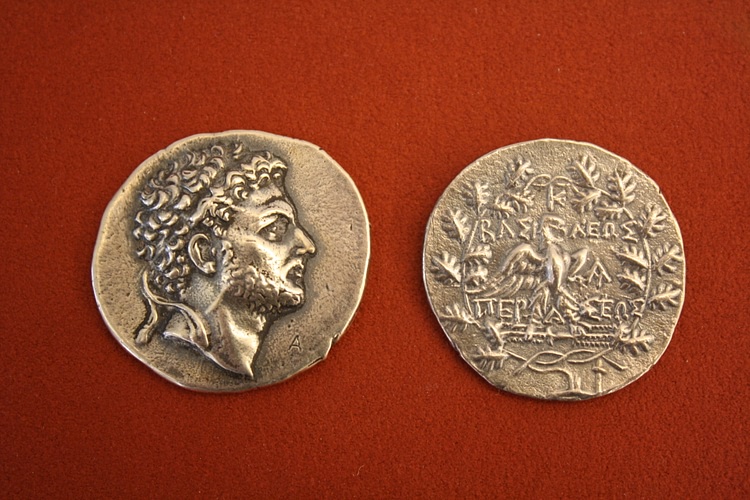 Perseu, Tetradracma de Prata Macedónio Mark Cartwright (CC BY-NC-SA) ](https://www.worldhistory.org/image/844/perseus-macedonian-silver-tetradrachm/ "Perseus, Macedonian Silver Tetradrachm")Culturalmente, este período não é uma era intermediária entre as prósperas épocas Clássica e Imperial, como foi descrito no passado. [Aristóteles](https://www.worldhistory.org/trans/pt/1-355/aristoteles/), o pai das ciências modernas, Menandro, o grande autor de comédias, Epicuro, o moralista, Eratóstenes, mas também [Euclides](https://www.worldhistory.org/trans/pt/1-14091/euclides/), Arquimedes e Políbio viveram e trabalharam durante o Período Helenístico. Este período revelou progressos na arquitetura, um grande euergetismo (doações altruístas à comunidade), uma multiplicação de dias festivos e celebrações (evidenciada pelo grande número de teatros construídos), o desenvolvimento da arte e a criação de bibliotecas, sendo a mais famosa a de Alexandria.
#### Editorial Review
This human-authored definition has been reviewed by our editorial team before publication to ensure accuracy, reliability and adherence to academic standards in accordance with our [editorial policy](https://www.worldhistory.org/static/editorial-policy/).
## Sobre o Autor
Apaixonado pela Ásia Central Antiga. Mantém o sítio Web 'From Bactria to Taxila'. Colabora no projeto 'Europa Barbarorum'.
- [Linkedin Profile](https://www.linkedin.com/in/antoine-simonin/52/685/a9a/e)
## Histórico
- **c. 402 BCE - 318 BCE**: Life of Athenian statesman and general [Phocion](https://www.worldhistory.org/Phocion/).
- **330 BCE - 64 BCE**: [Hellenistic Period](https://www.worldhistory.org/Hellenistic_Period/) in [Byblos](https://www.worldhistory.org/Byblos/).
- **c. 325 BCE - c. 320 BCE**: [Greek](https://www.worldhistory.org/disambiguation/greek/) rule in [Gandhara](https://www.worldhistory.org/Gandhara_Civilization/), ending some time after the [death of Alexander the Great](https://www.worldhistory.org/article/2366/death-of-alexander-the-great/).
- **323 BCE**: [Death of Alexander the Great](https://www.worldhistory.org/article/2366/death-of-alexander-the-great/), beginning of The [Hellenistic Period](https://www.worldhistory.org/Hellenistic_Period/) / The [Hellenistic World](https://www.worldhistory.org/Hellenistic_Period/).
- **322 BCE - 320 BCE**: First Successor [War](https://www.worldhistory.org/disambiguation/War/) between [Alexander](https://www.worldhistory.org/disambiguation/Alexander/)'s successors.
- **319 BCE - 315 BCE**: Second Successor [War](https://www.worldhistory.org/disambiguation/War/) between [Alexander](https://www.worldhistory.org/disambiguation/Alexander/)'s successors.
- **314 BCE - 311 BCE**: Third Successor [War](https://www.worldhistory.org/disambiguation/War/) between [Alexander](https://www.worldhistory.org/disambiguation/Alexander/)'s successors.
- **312 BCE**: [Seleucos](https://www.worldhistory.org/disambiguation/Seleucos/) conquers [Babylon](https://www.worldhistory.org/babylon/) and founds the [Seleucid](https://www.worldhistory.org/Seleucid_Empire/) dynasty.
- **c. 312 BCE - 63 BCE**: Duration of the [Seleucid Empire](https://www.worldhistory.org/Seleucid_Empire/).
- **310 BCE**: Assassination of [Roxanne](https://www.worldhistory.org/Roxanne/) and [Alexander](https://www.worldhistory.org/disambiguation/Alexander/) IV, wife and son of [Alexander the Great](https://www.worldhistory.org/Alexander_the_Great/).
- **309 BCE - 308 BCE**: [Agathocles of Syracuse](https://www.worldhistory.org/Agathocles_of_Syracuse/) successfuly campaigns in North [Africa](https://www.worldhistory.org/disambiguation/africa/) defeating Carthaginian armies and taking [Utica](https://www.worldhistory.org/Utica/) and Hippacra.
- **308 BCE - 301 BCE**: Fourth Successor [War](https://www.worldhistory.org/disambiguation/War/) between [Alexander](https://www.worldhistory.org/disambiguation/Alexander/)'s successors.
- **306 BCE**: [Demetrius I of Macedon](https://www.worldhistory.org/Demetrius_I_of_Macedon/) defeats [Ptolemy](https://www.worldhistory.org/disambiguation/Ptolemy/)'s fleet at [Salamis](https://www.worldhistory.org/disambiguation/Salamis/), off the coast of [Cyprus](https://www.worldhistory.org/cyprus/).
- **306 BCE**: [Epicurus](https://www.worldhistory.org/Epicurus/) buys a garden in [Athens](https://www.worldhistory.org/Athens/) in which he begins to teach Epicureanism.
- **c. 301 BCE - c. 320 BCE**: Doric [temple](https://www.worldhistory.org/temple/) to [Athena](https://www.worldhistory.org/athena/) and fortifications of [Lysimachus](https://www.worldhistory.org/Lysimachus/) built at [Troy](https://www.worldhistory.org/troy/).
- **301 BCE**: The [Battle](https://www.worldhistory.org/disambiguation/battle/) of Ipsus in central [Phrygia](https://www.worldhistory.org/phrygia/) where [Lysimachus](https://www.worldhistory.org/Lysimachus/) and [Seleucos I](https://www.worldhistory.org/Seleucos_I/) defeat [Antigonus I](https://www.worldhistory.org/Antigonus_I/) and [Demetrius I of Macedon](https://www.worldhistory.org/Demetrius_I_of_Macedon/).
- **295 BCE**: Demetrius I campaigns in central [Greece](https://www.worldhistory.org/greece/), removes the tyrant Lachares from [Athens](https://www.worldhistory.org/Athens/) and defeats [Sparta](https://www.worldhistory.org/sparta/).
- **294 BCE - c. 288 BCE**: Demetrius I rules as king of [Macedon](https://www.worldhistory.org/macedon/).
- **287 BCE - 212 BCE**: Life of [Archimedes](https://www.worldhistory.org/Archimedes/), physician, mathematician and engineer.
- **285 BCE - 282 BCE**: [Rome](https://www.worldhistory.org/Rome/) defeats the [Celts](https://www.worldhistory.org/celt/) in [Italy](https://www.worldhistory.org/italy/). Rome's dominance in central Italy is secured.
- **c. 280 BCE**: Founding of the [Achaean League](https://www.worldhistory.org/Achaean_League/) in the [Peloponnese](https://www.worldhistory.org/Peloponnese/) of [Greece](https://www.worldhistory.org/greece/).
- **280 BCE - 275 BCE**: King [Pyrrhus](https://www.worldhistory.org/pyrrhus/) of Epirus wages the Pyrrhic [War](https://www.worldhistory.org/disambiguation/War/) against the Romans in [Italy](https://www.worldhistory.org/italy/), defence of [Tarentum](https://www.worldhistory.org/tarentum/) being the pretext.
- **279 BCE**: [Celts](https://www.worldhistory.org/celt/) invade Thrace and [Anatolia](https://www.worldhistory.org/Asia_Minor/).
- **272 BCE**: [Death](https://www.worldhistory.org/disambiguation/Death/) of [Pyrrhus](https://www.worldhistory.org/pyrrhus/) of Epirus in a street [battle](https://www.worldhistory.org/disambiguation/battle/) in [Argos](https://www.worldhistory.org/argos/).
- **c. 270 BCE**: [Aristarchus of Samos](https://www.worldhistory.org/Aristarchus_of_Samos/) proposes a heliocentric world view.
- **263 BCE - 241 BCE**: Reign of Eumenes I at [Pergamon](https://www.worldhistory.org/pergamon/).
- **262 BCE**: Eumenes rebels and wins against the [Seleucid](https://www.worldhistory.org/Seleucid_Empire/) Antiochus I. Beginning of the [Pergamon](https://www.worldhistory.org/pergamon/) [Empire](https://www.worldhistory.org/empire/).
- **250 BCE**: Former [satrap](https://www.worldhistory.org/Persian_Governor/) [Diodotos](https://www.worldhistory.org/disambiguation/diodotos/) rebels against [Seleucid](https://www.worldhistory.org/Seleucid_Empire/) king [Antiochos](https://www.worldhistory.org/disambiguation/antiochos/) I, creating the [Greco-Bactrian kingdom](https://www.worldhistory.org/Greco-Bactria/).
- **241 BCE - 197 BCE**: Reign of Attalus I at [Pergamon](https://www.worldhistory.org/pergamon/).
- **222 BCE**: The [Achaean League](https://www.worldhistory.org/Achaean_League/) and [Antigonos](https://www.worldhistory.org/disambiguation/Antigonos/) III of [Macedon](https://www.worldhistory.org/macedon/) defeat [Sparta](https://www.worldhistory.org/sparta/) at Sellasia.
- **c. 190 BCE**: First appearance of multiple [Euthydemid](https://www.worldhistory.org/euthydemid/) kings at the same time. Beginning of the [Indo-Greek](https://www.worldhistory.org/Indo-Greek/) kingdoms.
- **c. 188 BCE**: The treaty of Apamea Kibotos. Peace and alliance is established between the [Seleucid Empire](https://www.worldhistory.org/Seleucid_Empire/) and [Rome](https://www.worldhistory.org/Rome/) joined by its allies, such as [Pergamon](https://www.worldhistory.org/pergamon/) and [Rhodes](https://www.worldhistory.org/Rhodes/). The Seleucids have to evacuate all the land and the [cities](https://www.worldhistory.org/city/) from [Asia Minor](https://www.worldhistory.org/Asia_Minor/) and to pay a huge [war](https://www.worldhistory.org/disambiguation/War/) indemnity.
- **172 BCE - 168 BCE**: Third Macedonian [War](https://www.worldhistory.org/disambiguation/War/): [Perseus](https://www.worldhistory.org/Perseus/) of [Macedon](https://www.worldhistory.org/macedon/) challenges [Rome](https://www.worldhistory.org/Rome/) and is defeated.
- **147 BCE - 139 BCE**: The Lusitanian commander Viriatus bleeds [Roman](https://www.worldhistory.org/disambiguation/Roman/) armies.
- **146 BCE**: [Rome](https://www.worldhistory.org/Rome/) sacks [Corinth](https://www.worldhistory.org/corinth/) and dissolves the [Achaean league](https://www.worldhistory.org/Achaean_League/). [Greece](https://www.worldhistory.org/greece/) is ruled by Rome.
- **146 BCE**: End of the [Third Punic War](https://www.worldhistory.org/Third_Punic_War/). [Carthage](https://www.worldhistory.org/carthage/) is destroyed and its lands become the [Roman](https://www.worldhistory.org/disambiguation/Roman/) province [Africa](https://www.worldhistory.org/disambiguation/africa/).
- **133 BCE**: Attalus III, the last king of [Pergamon](https://www.worldhistory.org/pergamon/), bequeathes the whole of Pergamon to [Rome](https://www.worldhistory.org/Rome/).
- **129 BCE**: Parthians [conquer](https://www.worldhistory.org/warfare/) [Mesopotamia](https://www.worldhistory.org/Mesopotamia/). The [Silk Road](https://www.worldhistory.org/Silk_Road/) to [China](https://www.worldhistory.org/china/) is now controlled by the Parthians.
- **89 BCE - 63 BCE**: Mithridatic Wars between [Mithridates VI](https://www.worldhistory.org/Mithridates_VI/) and [Roman Republic](https://www.worldhistory.org/Roman_Republic/) .
- **83 BCE**: [Tigranes II](https://www.worldhistory.org/Tigranes_the_Great/) invades and destroys the [Seleucid Empire](https://www.worldhistory.org/Seleucid_Empire/).
- **58 BCE - 51 BCE**: [Julius Caesar](https://www.worldhistory.org/Julius_Caesar/)'s [conquest](https://www.worldhistory.org/warfare/) of [Gaul](https://www.worldhistory.org/gaul/).
- **37 BCE**: [Herod the Great](https://www.worldhistory.org/Herod_the_Great/) is installed as King of [Judaea](https://www.worldhistory.org/disambiguation/judaea/). Rebuilding of the [Temple](https://www.worldhistory.org/temple/) of [Jerusalem](https://www.worldhistory.org/jerusalem/).
- **c. 30 BCE - c. 19 BCE**: [Roman](https://www.worldhistory.org/disambiguation/Roman/) poet [Virgil](https://www.worldhistory.org/virgil/) writes his [Aeneid](https://www.worldhistory.org/The_Aeneid/).
## Links Externos
- [What is Hellenistic Sculpture? Exploring the History of Hellenistic Art](https://mymodernmet.com/what-is-hellenistic-sculpture-history/)
- [Hellenistic Rulers](http://allthingsclassics.weebly.com/hellenistic-rulers.html)
- [Hellenistic Jewelry | Essay | The Metropolitan Museum of Art | Heilbrunn Timeline of Art History](https://www.metmuseum.org/toah/hd/hjew/hd_hjew.htm)
- [Intellectual Pursuits of the Hellenistic Age | Essay | The Metropolitan Museum of Art | Heilbrunn Timeline of Art History](https://www.metmuseum.org/toah/hd/ipha/hd_ipha.htm)
- [List of Rulers of the Ancient Greek World | Lists of Rulers | Heilbrunn Timeline of Art History | The Metropolitan Museum of Art](https://www.metmuseum.org/toah/hd/gkru/hd_gkru.htm)
## Cite Este Artigo
### APA
Simonin, A. (2026, May 16). Período Helenístico. (F. Oliveira, Tradutor). *World History Encyclopedia*.
### Chicago
Simonin, Antoine. "Período Helenístico." Traduzido por Filipa Oliveira. *World History Encyclopedia*, May 16, 2026. .
### MLA
Simonin, Antoine. "Período Helenístico." Traduzido por Filipa Oliveira. *World History Encyclopedia*, 16 May 2026, .
## Licença & Direitos de Autor
Enviado por [Filipa Oliveira](https://www.worldhistory.org/user/filipaoliveira/ "User Page: Filipa Oliveira"), publicado em 16 May 2026. Consulte a(s) fonte(s) original(ais) para informações sobre direitos de autor. Note que os conteúdos com ligação a partir desta página podem ter termos de licenciamento diferentes.