---
title: Het Byzantijnse Rijk
author: Mark Cartwright
translator: Theo Poot
source: https://www.worldhistory.org/trans/nl/1-953/het-byzantijnse-rijk/
format: machine-readable-alternate
license: Creative Commons Attribution-NonCommercial-ShareAlike (https://creativecommons.org/licenses/by-nc-sa/4.0/)
updated: 2026-03-12
---
# Het Byzantijnse Rijk
_Geschreven door [Mark Cartwright](https://www.worldhistory.org/user/markzcartwright/)_
_Vertaald door [Theo Poot](https://www.worldhistory.org/user/theopoot)_
Het Byzantijnse Rijk bestond van 330 tot 1453. Het wordt vaak het Oost-Romeinse Rijk of gewoon Byzantium genoemd. De Byzantijnse hoofdstad werd gesticht in Constantinopel door Constantijn I (regeerde van 306 tot 337). De omvang van het Byzantijnse Rijk varieerde door de eeuwen heen en op verschillende momenten bezat het gebieden in Italië, Griekenland, de Balkan, de Levant, Klein-Azië en Noord-Afrika.
Byzantium was een christelijke staat met Grieks als officiële taal. De Byzantijnen ontwikkelden hun eigen politieke systemen, religieuze praktijken, kunst en architectuur. Deze werden alle sterk beïnvloed door de Grieks-Romeinse culturele traditie, maar waren ook onderscheidend en niet louter een voortzetting van [het oude Rome](https://www.worldhistory.org/trans/nl/1-68/het-oude-rome/). Het Byzantijnse Rijk was de langst bestaande middeleeuwse grootmacht en de invloed ervan is nog steeds voelbaar, vooral in religie, kunst, architectuur en wetgeving van veel westerse staten, Oost- en Midden-[Europa](https://www.worldhistory.org/trans/nl/1-35/europa/) en Rusland.
### Naamgeving en chronologie
De naam 'Byzantijns' werd bedacht door 16e-eeuwse historici op basis van het feit dat de hoofdstad eerst Byzantium heette, voordat deze werd omgedoopt tot Constantinopel (het huidige Istanbul). Het was en is nog steeds een onvolmaakte maar werkbare benaming om het Oost-Romeinse Rijk te onderscheiden van het West-Romeinse Rijk, wat vooral belangrijk was na de val van dat laatste in de 5e eeuw. Om dezelfde reden bestaat er onder historici geen algemene overeenstemming over de periode waarnaar de term 'Byzantijnse Rijk' eigenlijk verwijst. Sommige wetenschappers kiezen voor 330 en de stichting van Constantinopel, anderen voor de val van het West-Romeinse Rijk in 476, weer anderen geven de voorkeur aan het falen van Justinianus I (r. 527-565) om de twee rijken in 565 te verenigen, en sommigen kiezen zelfs voor ca. 650 en de Arabische verovering van de oostelijke provincies van Byzantium. De meeste historici zijn het erover eens dat het Byzantijnse Rijk op dinsdag 29 mei 1453 ten einde kwam, toen de Ottomaanse sultan Mehmed II (r. 1444-6 & 1451-81) Constantinopel veroverde.
Het debat over de chronologie onderstreept ook de verschillen tussen de twee helften van de Romeinse wereld, qua etnische en culturele mix, en het onderscheid tussen de middeleeuwse staat en zijn vroegere Romeinse erfgoed. De Byzantijnen noemden zichzelf 'Romeinen', hun keizer was *basileon ton Rhomaion* ofwel 'keizer van de Romeinen' en hun hoofdstad was 'Nieuw Rome'. De meest gangbare taal was echter het Grieks, en men kan op goede gronden stellen dat het Byzantijnse Rijk gedurende het grootste deel van zijn geschiedenis in cultureel opzicht veel meer Grieks dan Romeins was.
### Constantinopel
Het begin van het Byzantijnse Rijk ligt in het besluit van de Romeinse keizer Constantijn I om op 11 mei 330 de hoofdstad van [het Romeinse Rijk](https://www.worldhistory.org/trans/nl/1-100/het-romeinse-rijk/) te verplaatsen van Rome naar Byzantium. De populaire naam Constantinopel of 'Stad van Constantijn' verving al snel de officiële keuze van de keizer, 'Nieuw Rome'. De nieuwe hoofdstad bezat een uitstekende natuurlijke haven aan de inham van de Gouden Hoorn en lag op de grens tussen Europa en Azië, waardoor het de doorvaart van schepen door de Bosporus van de Egeïsche Zee naar de Zwarte Zee kon beheersen en zo de lucratieve handel tussen west en oost verbinden. Een grote ketting overspande de ingang van de Gouden Hoorn en dankzij de bouw van de massieve Theodosiaanse muren tussen 410 en 413 kon de stad keer op keer gecoördineerde aanvallen vanaf zee en land weerstaan. In de loop der eeuwen, toen er steeds meer spectaculaire bouwwerken bij kwamen, groeide de kosmopolitische stad uit tot een van de mooiste van alle tijden en zeker tot de rijkste, meest weelderige en belangrijkste christelijke stad ter wereld.
[  Kaart van Byzantijns Constantinopel Cplakidas (CC BY-SA) ](https://www.worldhistory.org/image/564/map-of-byzantine-constantinople/ "Map of Byzantine Constantinople")### Byzantijnse keizers
De Byzantijnse keizer of *basileus* (of, in zeldzamere gevallen, *basilissa* voor keizerin) woonde in het prachtige Grote Paleis van Constantinopel en regeerde als absoluut vorst over een uitgestrekt rijk. Als zodanig had de *basileus* de hulp nodig van een deskundige regering en een wijdvertakte en efficiënte bureaucratie. Hoewel hij absoluut vorst was, werd van een keizer verwacht – door regering, volk en kerk – dat hij wijs en rechtvaardig regeerde. Nog belangrijker was dat een keizer militaire successen moest boeken, aangezien het leger in feite de machtigste instelling in Byzantium bleef. De generaals in Constantinopel en de provincies konden een keizer die er niet in slaagde de grenzen van het rijk te verdedigen of een economische catastrofe veroorzaakte, afzetten - en dat deden ze ook. Toch was de keizer in normale omstandigheden de opperbevelhebber van het leger, het hoofd van de kerk en de regering, had hij de controle over de staatsfinanciën en benoemde of ontsloeg hij edelen naar eigen goeddunken; weinig heersers voor of na hem hebben ooit zo'n macht uitgeoefend.
Het beeld van de keizer verscheen op Byzantijnse munten, die ook werden gebruikt om een gekozen opvolger te tonen: vaak de oudste zoon, maar niet altijd, aangezien er geen vaste regels voor opvolging waren. Keizers werden geacht door God te zijn uitverkoren om te regeren, maar een prachtige kroon en gewaden van Tyrisch purper hielpen het recht om te regeren verder bekrachtigen. Een andere marketingstrategie was het kopiëren van regeringsnamen van illustere voorgangers, waarbij Constantijn een bijzondere favoriet was. Zelfs usurpatoren, doorgaans machtige en succesvolle militairen, probeerden vaak hun positie te legitimeren door te trouwen met een lid van de familie van hun voorgangers. Door een zorgvuldig georkestreerde continuïteit van dynastieën, rituelen, kleding en namen kon het keizerlijke instituut aldus twaalf eeuwen standhouden.
### Byzantijns bestuur
De Byzantijnse regering volgde de patronen die in het keizerlijke Rome waren vastgesteld. De keizer was almachtig, maar er werd toch van hem verwacht dat hij belangrijke instanties als de senaat raadpleegde. De senaat in Constantinopel bestond, in tegenstelling tot die in Rome, uit mannen die carrière hadden gemaakt in het leger, en er was dus geen senatoriale klasse als zodanig. Zonder verkiezingen verwierven Byzantijnse senatoren, ministers en lokale raadsleden hun positie grotendeels door keizerlijke bescherming of vanwege hun status als grote landeigenaar.
[  Justinianus I Sponsored by a Greek banker, Julius Argentarius (CC BY-NC-SA) ](https://www.worldhistory.org/image/3341/justinian-i/ "Justinian I")De elite van senatoren vormde het kleine *sacrum consistorium*, dat de keizer in theorie moest raadplegen over zaken van staatsbelang. Daarnaast kon de keizer ook leden van zijn persoonlijke gevolg aan het hof raadplegen. Aan het hof waren ook de kamerheren (*cubicularii*) aanwezig, die de keizer in verschillende persoonlijke taken dienden, maar ook de toegang tot hem konden controleren. Eunuchen bekleedden zelf verantwoordelijke posities, met als belangrijkste de beheerder van de keizerlijke schatkist, de *sakellarios,* wiens macht vanaf de 7e eeuw aanzienlijk zou toenemen. Andere belangrijke regeringsfunctionarissen waren de *[quaestor](https://www.worldhistory.org/trans/nl/1-11784/quaestor/)* of hoofdjurist, de *comes sacrarum largitionum* die de staatsmunt controleerde, de *magister officiorum* die zorgde voor het algemene bestuur van het paleis, het leger en de bevoorrading daarvan, evenals buitenlandse zaken, en een team van keizerlijke inspecteurs die toezicht hielden op de zaken in de lokale raden in het hele rijk.
De hoogste ambtenaar in Byzantium was echter de praetoriaanse prefect van het Oosten, aan wie alle regionale gouverneurs van het rijk verantwoording verschuldigd waren. De regionale gouverneurs hielden toezicht op de afzonderlijke gemeenteraden of *curae*. Lokale raadsleden waren verantwoordelijk voor alle openbare diensten en de inning van belastingen in hun stad en de omliggende gebieden. Deze raden waren geografisch georganiseerd in ongeveer 100 provincies, die op hun beurt waren ingedeeld in 12 diocesen, drie in elk van de vier prefecturen van het rijk. Vanaf de 7e eeuw werden de regionale gouverneurs van de diocesen, of *themes* zoals ze na een herstructurering werden genoemd, in feite provinciale militaire commandanten (*strategoi*) die rechtstreeks verantwoording verschuldigd waren aan de keizer zelf, en werd de praetoriaanse prefect afgeschaft. Na de 8e eeuw werd het bestuur van het rijk, als gevolg van de toegenomen militaire dreiging van buurlanden en interne burgeroorlogen, veel eenvoudiger dan voorheen.
### Corpus Juris Civilis
De Byzantijnse regering ontving krachtige ondersteuning dankzij de totstandkoming van de Codex Justinianus of *Corpus Juris Civilis (*Verzameling van Burgerlijk Recht) door Justinianus I. Het corpus, opgesteld door een panel van juridische experts, omvatte het veelomvattende geheel van bewerkte en herziene Romeinse wetten die in de loop der eeuwen waren verzameld - een enorm aantal keizerlijke edicten, juridische adviezen en lijsten van misdrijven en straffen. De codex, die uit meer dan een miljoen woorden bestond, zou 900 jaar standhouden, de wetten voor iedereen verduidelijken, het aantal onnodig voor de rechter gebrachte zaken verminderen, het gerechtelijk proces versnellen en daarna de meeste rechtssystemen in westerse democratieën beïnvloeden.
### Byzantijnse samenleving
De Byzantijnen hechtten veel belang aan de familienaam, geërfde rijkdom en respectabele afkomst van een individu. De individuen in de hogere lagen van de samenleving bezaten deze drie dingen. Rijkdom kwam voort uit grondbezit, ofwel uit beheer van grond onder de jurisdictie van een individuele beheerder. Er was echter geen sprake van een erfelijke aristocratie in de Byzantijnse samenleving, en zowel patronage als onderwijs waren middelen om de sociale ladder te beklimmen. Het toekennen van gunsten, landerijen en titels door keizers, evenals willekeurige degradaties en de gevaren van buitenlandse invasies en oorlogen, hadden bovendien tot gevolg dat lidmaatschap van de adel niet statisch was en dat families door de eeuwen heen opkwamen en ten onder gingen. Iemands rang was voor alle leden van de samenleving zichtbaar door het gebruik van titels, zegels, insignes, bijzondere kleding en persoonlijke sieraden.
[  Byzantijnse ivoren diptiek op paneel Osama Shukir Muhammed Amin (Copyright) ](https://www.worldhistory.org/image/5727/byzantine-ivory-diptych-panel/ "Byzantine Ivory Diptych Panel")De meeste mensen in de lagere klassen volgden op in het beroep van hun ouders, maar erfenissen, accumulatie van rijkdom en het ontbreken van een formeel verbod op klassemobiliteit boden op zijn minst een kleine mogelijkheid voor een persoon om diens sociale positie te verbeteren. Er waren arbeiders met betere banen, zoals degenen die werkzaam waren in juridische zaken, administratie en handel (voor Byzantijnen geen hoog gewaardeerde manier om in het levensonderhoud te voorzien). Op de volgende, lagere trede stonden ambachtslieden, vervolgens boeren die hun eigen kleine stukjes land bezaten, daarna de grootste groep: degenen die het land van anderen bewerkten, en ten slotte slaafgemaakten, doorgaans krijgsgevangenen, een groep die echter lang niet zo talrijk was als die van vrije arbeiders.
De rol van Byzantijnse vrouwen hing, net als die van mannen, af van hun sociale rang. Van aristocratische vrouwen werd verwacht dat ze het huishouden bestuurden en voor de kinderen zorgden. Hoewel ze eigendom konden bezitten, konden ze geen openbaar ambt bekleden en brachten ze hun vrije tijd door met weven, winkelen, naar de kerk gaan of lezen (hoewel ze geen formele opleiding hadden genoten). Weduwen werden voogd van hun kinderen en konden evenveel erven als hun broers. Veel vrouwen werkten, net als mannen, in de landbouw, in verschillende productie-industrieën en in de horeca. Vrouwen konden hun eigen land en bedrijven bezitten, en sommigen konden hun sociale positie verbeteren door te trouwen. De minst gerespecteerde beroepen waren, net als elders, die van prostituees en actrices.
### Gebieden van het Byzantijnse Rijk
De geografische omvang van het Byzantijnse Rijk veranderde in de loop der eeuwen met het verloop van de militaire successen en mislukkingen van individuele keizers. Gebieden die in bezit waren tijdens de vroege geschiedenis van het rijk, omvatten Egypte, Syrië, Jordanië, Libanon en [Palestina](https://www.worldhistory.org/trans/nl/1-192/palestina/). Griekenland was in praktisch opzicht minder belangrijk dan als symbool van het Byzantijnse zelfbeeld: dat van de ware erfgenaam van de Grieks-Romeinse cultuur. Italië en Sicilië werden, zij het uiteindelijk zonder succes, verdedigd tegen de ambities van pausen en de Noormannen. De Balkan tot aan de Donau was altijd belangrijk, en Klein-Azië tot aan de kust van de Zwarte Zee in het noorden en Armenië in het oosten vormden een voorname bron van rijkdom, maar beide regio's moesten geregeld en krachtig worden verdedigd tegen diverse eeuwige vijanden.
Terwijl de politieke kaart voortdurend werd hertekend met de opkomst en ondergang van naburige rijken, vonden er opmerkelijke gebeurtenissen plaats, zoals de succesvolle verdediging van het rijk door Anastasios I (491-518) tegen zowel de Perzen als de Bulgaren. Justinianus I, bijgestaan door zijn begaafde generaal Belisarius (ca. 500-565), heroverde gebieden in Noord-Afrika, Spanje en Italië die door de westerse keizers waren verloren. De Longobarden in Italië en de Slaven op de Balkan drongen in de tweede helft van de 6e eeuw het rijk binnen, een situatie die uiteindelijk werd gekeerd door Heraclius (r. 610-641), die met zijn overwinning bij Nineveh in 627 effectief een einde maakte aan het Perzische Sassanidische Rijk.
[  Kaart van het Byzantijnse Rijk, ca. 520-1204 Simeon Netchev (CC BY-NC-ND) ](https://www.worldhistory.org/image/15330/map-of-the-byzantine-empire-c520---1204/ "Map of the Byzantine Empire, c.520 - 1204")De islamitische veroveringen van de 7e en 8e eeuw beroofden het rijk van zijn gebieden in de Levant (waaronder Jeruzalem in 637), Noord-Afrika en Oost-Klein-Azië. Het rijk bleef echter standvastig als bolwerk tegen de Arabische expansie in Europa, waarbij Constantinopel tweemaal standhield tegen vastberaden Arabische belegeringen (674-8 en 717-18). Het Byzantijnse Rijk werd hierdoor echter tot op zijn grondvesten geschokt. In de 9e eeuw deden de Bulgaren vervolgens aanzienlijke invallen in de noordelijke gebieden van het Rijk. Een heropleving van het Byzantijnse fortuin kwam met de (onjuist zo genoemde) Macedonische dynastie (867-1057). De stichter van deze dynastie, Basilius I (r. 867-886), heroverde Zuid-Italië, rekende af met de lastige Kretenzische piraten en behaalde overwinningen op de Arabieren op Cyprus, het Griekse vasteland en in Dalmatië. De volgende keizer, Leo VI (r. 886-912), verloor het grootste deel van de veroveringen weer, maar halverwege de 10e eeuw werden overwinningen behaald in het door moslims beheerste [Mesopotamië](https://www.worldhistory.org/trans/nl/1-34/mesopotamie/).
Basilius II (976-1025), bekend als de 'Bulgarenmoordenaar' vanwege zijn overwinningen in de Balkan, zorgde voor een nieuwe opmerkelijke opleving van het Byzantijnse rijk. Geholpen door een leger van woeste krijgers van Viking-afkomst uit Kiev, behaalde hij ook overwinningen in Griekenland, Armenië, Georgië en Syrië, waardoor het rijk in omvang verdubbelde. Het was echter de laatste grote triomf, want daarna begon een geleidelijke neergang. Na de schokkende nederlaag tegen de Seltsjoeken in de Slag bij Manzikert in Armenië in 1071 vond er een korte opleving plaats onder Alexios I Komnenos (regeerde van 1081 tot 1118) met overwinningen op de Noormannen in Dalmatië, de Pechenegs in Thracië en de Seltsjoeken in Palestina en Syrië (met de hulp van de eerste kruisvaarders), maar er leken te veel vijanden in te veel regio's te zijn om de bloei van Byzantium blijvend te kunnen verzekeren.
#### Book Promotion
[  ](https://amzn.to/4isZ4B5 "The Forsaken 14th Century")### The Forsaken 14th Century
by World History Encyclopedia WHE's first book takes a truly global outlook and introduces readers to the different cultures that survived, thrived, and fell amid adversity in the 14th century. Filled with in-depth text written by WHE authors, many exclusive maps, and plenty of illustrations, The Forsaken 14th Century takes you on a global journey from the nomads of the Mongol Empire to the Black Death in Europe, the booming trade on the Swahili Coast to the Aztecs and the Māori settlements in New Zealand. [Learn More](https://amzn.to/4isZ4B5)
.sponsor.book img.key_art {
box-shadow: none !important;
}
.button_container {
margin-top: 1em;
}
.sponsor.book h3 {
text-transform: none;
margin-top: 0px;
margin-bottom: 15px;
font-family: "Libre Baskerville", "Palatino Linotype", "Book Antiqua", Palatino, serif;
}
.sponsor_message {
margin-left: 190px;
font-family: Karla, Arial, Helvetica, sans-serif;
line-height: 140%;
min-height: 200px;
}
.sponsor.book {
padding: 20px;
margin: 25px 0px;
background-color: #f3f3f3;
}
.sponsor.book .key_art {
margin-top: 0px;
margin-bottom: 10px;
float: left;
}
.sponsor h4 {
font-weight: bold;
text-transform: uppercase;
color: #000;
margin-bottom: 10px;
margin-top: 0px;
font-family: Karla,Arial,Helvetica,sans-serif;
font-size: 13px;
padding: 0;
}
.sponsor_book_author {
color: #999;
margin: -10px 0px 20px;
}
@media (max-width: 1199px) {
.sponsor.book .key_art {
float: none;
width: 100%;
}
.sponsor.book .sponsor_message {
margin-left: 0px;
}
.sponsor.book h3 {
margin-top: 20px;
margin-bottom: 10px;
}
}
@media (max-width: 767px) {
}
In de 12e en 13e eeuw veroverde het Sultanaat van Rum de helft van Klein-Azië en daarna sloeg het noodlot toe, toen de legers van de Vierde Kruistocht in 1204 Constantinopel plunderden. Het rijk werd verdeeld tussen Venetië en zijn bondgenoten en bestond alleen nog in ballingschap tot het in 1261 werd hersteld. In de 14e eeuw bestond het rijk uit een klein gebied in het zuidelijkste puntje van Griekenland en een stuk grondgebied rond de hoofdstad. De genadeslag kwam, zoals reeds vermeld, met de Ottomaanse plundering van Constantinopel in 1453.
### De Byzantijnse Kerk
Nog eeuwenlang na de stichting van Byzantium bleven de Romeinse, 'heidense' godsdienstige praktijken bestaan, maar het was het christendom dat het bepalende kenmerk van de Byzantijnse cultuur werd en dat een diepgaande invloed had op de politiek, de buitenlandse betrekkingen, de kunst en de architectuur. De kerk stond onder leiding van de patriarch of bisschop van Constantinopel, die door de keizer werd benoemd of ontslagen. Lokale bisschoppen, die de leiding hadden over grotere steden en de omliggende gebieden en die zowel de kerk als de keizer vertegenwoordigden, beschikten over aanzienlijke rijkdom en macht in hun lokale gemeenschappen. Het christendom werd zo een belangrijke gemeenschappelijke noemer die hielp om diverse culturen samen te brengen in één rijk, dat bestond uit christelijke Grieken, Armeniërs, Slaven, Georgiërs en vele andere minderheden, en mensen met andere geloofsovertuigingen, zoals joden en moslims, die hun religie vrij mochten belijden.
[  Ikoon van de H. Basilius Unknown Artist (Public Domain) ](https://www.worldhistory.org/image/8571/icon-of-saint-basil/ "Icon of Saint Basil")De verschillen tussen de oosterse en westerse kerk vormden een reden waarom het Byzantijnse Rijk er zo slecht van afkwam in de middeleeuwse westerse geschiedschrijving. Byzantijnen werden vaak afgeschilderd als decadent en onbetrouwbaar, hun cultuur als stagnerend en hun godsdienst als een gevaarlijke ketterij. De kerken van het oosten en het westen waren het oneens over wie voorrang moest krijgen, de paus of de patriarch van Constantinopel. Ook over leerstellige kwesties bestond onenigheid, zoals over de vraag of Jezus Christus zowel een menselijke als een goddelijke natuur had of alleen een goddelijke. Het celibaat van geestelijken, het gebruik van gezuurd of ongezuurd brood, de taal van de eredienst en het gebruik van beelden waren allemaal punten van verschil, die, aangewakkerd door politieke en territoriale ambities in een explosieve mix van emoties, leidden tot het Schisma van 1054.
De Byzantijnse kerk had ook haar eigen interne geschillen; het meest beruchte was het conflict over het iconoclasme ofwel de 'vernietiging van beelden', van 726-787 en van 814-843. De pausen en veel Byzantijnen waren voorstander van het gebruik van iconen - afbeeldingen van heilige personages, maar vooral van Jezus Christus. Tegenstanders van dit gebruik van iconen waren van mening dat ze tot afgoden waren verworden en dat het godslasterlijk was om te denken dat God in de kunst kon worden afgebeeld. De kwestie wakkerde ook het debat aan over de vraag of Christus twee naturen had of één, en of een icoon daarom alleen het menselijke aspect vertegenwoordigde. Verdedigers van iconen zeiden dat het niet meer dan artistieke impressies waren, die ongeletterden hielpen om het goddelijke beter te begrijpen. Tijdens de golf van iconoclasme werden veel kostbare kunstwerken vernietigd, vooral tijdens de regeringen van Leo III (r. 717-741) en zijn opvolger Constantijn V (r. 741-775), toen zelfs mensen die iconen vereerden (iconodulen) werden vervolgd. De kwestie werd in 843 in het voordeel van de iconen opgelost, een gebeurtenis die bekend staat als de "Triomf van de Orthodoxie".
Het kloosterleven was een bijzonder kenmerk van het Byzantijnse religieuze leven. Mannen en vrouwen trokken zich terug in kloosters waar ze hun leven wijdden aan Christus en het helpen van armen en zieken. Daar leefden ze een eenvoudig leven volgens regels die waren opgesteld door belangrijke kerkelijke figuren zoals Basilius de Grote (ca. 330 - ca. 379). Veel monniken waren ook geleerden, met als bekendste voorbeeld Sint Cyrillus (overleden in 867), die het Glagolitische alfabet uitvond. Een opmerkelijke vrouw die haar tijd in het klooster goed besteedde, was Anna Komnene (1083-1153), die haar *Alexiade* schreef over het leven en de regering van haar vader Alexios I Komnenos (regeerde van 1081 tot 1118). Kloosters werden zo onschatbare opslagplaatsen van teksten en kennis, terwijl hun wijnproductie en iconenateliers ook zeer gewaardeerd werden. Een van de meest beroemde kloosterlocaties is de berg Athos bij Thessaloniki, waar monniken zich vanaf de 9e eeuw vestigden en uiteindelijk 46 kloosters bouwden, waarvan er vele nog steeds bestaan.
[  Byzantijnse boekband met ikoon The Metropolitan Museum of Art (Copyright) ](https://www.worldhistory.org/image/8960/byzantine-book-cover-with-icon/ "Byzantine Book Cover with Icon")### Byzantijnse kunst
Byzantijnse kunstenaars stapten af van het naturalisme van de klassieke traditie en gingen meer abstract en universeel werken, waarbij ze een duidelijke voorkeur toonden voor tweedimensionale voorstellingen. Het feit dat er zo weinig signaturen te vinden zijn op kunstwerken van vóór de 13e eeuw, suggereert dat kunstenaars geen hoge sociale status genoten. Kunstwerken die een religieuze boodschap uitdroegen – voornamelijk de noodzaak van verlossing en een versterking van het geloof – werden in grote aantallen geproduceerd, met als belangrijkste voorbeelden muurmozaïeken, muurschilderingen en iconen. Hoewel iconen in vrijwel elke vorm konden worden gemaakt, waren kleine beschilderde houten panelen het populairst. Ze waren ontworpen om te worden meegenomen of aan de muur te worden gehangen en werden gemaakt met behulp van de encaustische techniek, waarbij gekleurde pigmenten werden gemengd met was en als inlegwerk in het hout werden gebrand. Om de communicatie tussen de toeschouwer en het goddelijke te vergemakkelijken, worden de afbeeldingen meestal frontaal weergegeven met een nimbus of aureool om hun heiligheid te benadrukken.
Byzantijnse mozaïeken, die tegenwoordig het best te zien zijn in de Hagia Sophia in Istanbul of de kerk van San Vitale in Ravenna, stelden heilige figuren, keizers en keizerinnen, kerkelijke functionarissen en scènes uit het dagelijks leven voor, met name uit de landbouw. Grootschalige beeldhouwkunst lijkt minder populair te zijn geweest dan in de vroegere Oudheid, maar er werden wel grote aantallen gebeeldhouwde marmeren sarcofagen geproduceerd. Ten slotte was metaalbewerking, vooral met emaille en cabochon geslepen halfedelstenen, een Byzantijnse specialiteit, en ambachtslieden produceerden veel hoogwaardige en ingewikkeld ontworpen borden, bekers, allerlei soorten sieraden, boekomslagen (vooral voor bijbels) en reliekschrijnen (kistjes voor het bewaren van heilige relikwieën).
### Byzantijnse architectuur
Byzantijnse architecten bleven de klassieke ordes in hun gebouwen toepassen en haalden onder andere ideeën uit het Nabije Oosten. Ontwerpen werden eclectischer dan in de oudheid, vooral met de gangbare gewoonte om materialen van oudere gebouwen te hergebruiken voor nieuwe constructies. Er was ook een duidelijke nadruk op functie boven vorm en er was meer aandacht voor het interieur dan voor het exterieur van gebouwen. De Byzantijnen bleven typisch Romeinse constructies bouwen, zoals gewelfde aquaducten, amfitheaters, hippodromen, baden en villa's, maar voegden daar ook koepelkerken, ommuurde kloosters en meer geavanceerde vestingmuren aan toe.
[ 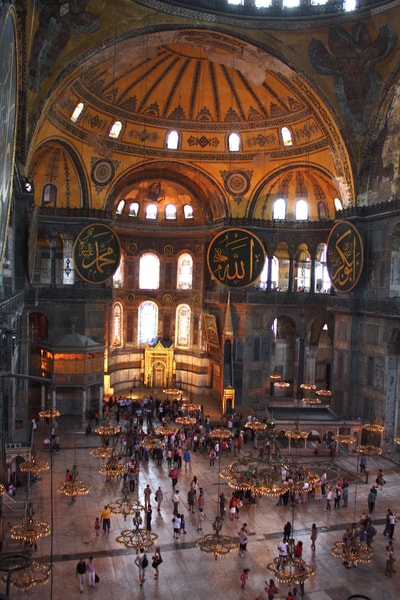 Hafia Sophia, interieur Mark Cartwright (CC BY-NC-SA) ](https://www.worldhistory.org/image/8973/hagia-sophia-interior/ "Hagia Sophia Interior")Favoriete bouwmaterialen waren grote bakstenen, met mortel en beton voor de verborgen kernen van muren. In prestigieuze openbare gebouwen werden natuurstenen blokken gebruikt, terwijl marmer, dat spaarzamer werd gebruikt dan in vroegere Romeinse tijden, over het algemeen werd gereserveerd voor zuilen, deur- en raamkozijnen en andere decoratieve elementen. Daken waren van hout, terwijl binnenmuren vaak werden bedekt met pleisterwerk, stucwerk, dunne marmeren plaquettes, schilderingen en mozaïeken.
Het grootste, belangrijkste en nog steeds beroemdste Byzantijnse gebouw is de Hagia Sophia in Constantinopel, gewijd aan de heilige wijsheid (*hagia sophia*) van God. Het werd opnieuw gebouwd in 532-537 en heeft een rechthoekige vorm van 74,6 x 69,7 meter. Het enorme koepelvormige plafond bevindt zich 55 meter boven de vloer en heeft een diameter van 31,8 meter. De koepel rust op vier massieve bogen met vier ondersteunende pendentieven en was voor die tijd een spectaculaire architectonische prestatie. De Hagia Sophia bleef tot de 16e eeuw de grootste kerk ter wereld en was een van de meest versierde kerken met prachtige glinsterende mozaïeken en muurschilderingen.
Christelijke kerkbouw vormde in het algemeen een van de grootste bijdragen van de Byzantijnen aan de architectuur, met name het gebruik van de koepel. Het kruisvormige grondplan werd het meest gangbaar, met de koepel gebouwd boven vier ondersteunende bogen. De vierkante basis van het gebouw vertakte zich vervolgens in traveeën die zelf een half of volledig koepelplafond konden hebben. Een ander veelvoorkomend kenmerk is een centrale apsis met twee zijapsissen aan de oostkant van de kerk. In de loop van de tijd werd de centrale koepel steeds hoger op een veelhoekige trommel gebouwd, die in sommige kerken zo hoog is dat hij eruitziet als een toren. Veel kerken, vooral basilieken, kregen naast zich een doopkapel (meestal achthoekig) en soms een mausoleum voor de stichter van de kerk en zijn nakomelingen. Dergelijke Byzantijnse ontwerpkenmerken zouden de orthodox-christelijke architectuur blijven beïnvloeden en zijn dus nog steeds te zien in kerken over de hele wereld.
#### Editorial Review
This human-authored definition has been reviewed by our editorial team before publication to ensure accuracy, reliability and adherence to academic standards in accordance with our [editorial policy](https://www.worldhistory.org/static/editorial-policy/).
## Bibliografie
- [Bagnall, R. *The Encyclopedia of Ancient History.* Wiley-Blackwell, 2012.](https://www.worldhistory.org/books/0307407969/)
- [Brownworth, L. *Lost to the West.* Broadway Books, 2010.](https://www.worldhistory.org/books/0307407969/)
- [Gregory, T.E. *A History of Byzantium.* Wiley-Blackwell, 2010.](https://www.worldhistory.org/books/140518471X/)
- [Herrin, J. *Byzantium.* Princeton University Press, 2009.](https://www.worldhistory.org/books/0691143692/)
- [Mango, C. *The Oxford History of Byzantium.* Oxford University Press, 2002.](https://www.worldhistory.org/books/0198140983/)
- [Norwich, J.J. *A Short History of Byzantium by John Julius Norwich.* Knopf, 2018.](https://www.worldhistory.org/books/B01K2R3B6U/)
- [Shepherd, J. *The Cambridge History of the Byzantine Empire c.500-1492.* Cambridge University Press, 2009.](https://www.worldhistory.org/books/0521832314/)
## Over de auteur
Mark is een fulltime schrijver, onderzoeker, historicus en redacteur. Speciale interesse gaat uit naar kunst, architectuur en het ontdekken van ideeën die alle beschavingen gemeen hebben. Hij heeft een MA in politieke filosofie en is een WHE Publishing Director.
## Tijdlijn
- **285 CE**: The [Roman empire](https://www.worldhistory.org/Roman_Empire/) is split into the Western and Eastern [Roman](https://www.worldhistory.org/disambiguation/Roman/) empires.
- **312 CE**: [Constantine I](https://www.worldhistory.org/Constantine_I/) introduces the [gold](https://www.worldhistory.org/gold/) nomisma (solidus) [coin](https://www.worldhistory.org/coinage/).
- **312 CE**: [Roman emperor](https://www.worldhistory.org/Roman_Emperor/) [Constantine I](https://www.worldhistory.org/Constantine_I/) tolerates [Christianity](https://www.worldhistory.org/christianity/).
- **c. 330 CE - c. 379 CE**: Life of Basil Great, one of the founding fathers of the Eastern Christian Church and [Byzantine](https://www.worldhistory.org/disambiguation/Byzantine/) Monasteries.
- **11 May 330 CE**: [Constantinople](https://www.worldhistory.org/Constantinople/) is founded on the site of old [Byzantium](https://www.worldhistory.org/Byzantium/) as "the new [Rome](https://www.worldhistory.org/Rome/)."
- **c. 331 CE**: The [Great Palace of Constantinople](https://www.worldhistory.org/article/1211/the-great-palace-of-constantinople/) is first built by [Constantine I](https://www.worldhistory.org/Constantine_I/).
- **360 CE**: First [Hagia Sophia](https://www.worldhistory.org/Hagia_Sophia/) built in [Constantinople](https://www.worldhistory.org/Constantinople/).
- **361 CE**: [Roman emperor](https://www.worldhistory.org/Roman_Emperor/) Julian attempts to revive Paganism.
- **c. 370 CE**: [Basil the Great](https://www.worldhistory.org/Basil_the_Great/) is made the bishop of [Caesarea](https://www.worldhistory.org/disambiguation/Caesarea/) in Cappadocia.
- **376 CE**: The [Visigoths](https://www.worldhistory.org/visigoth/) are fleeing the [Huns](https://www.worldhistory.org/Huns/), entering the [Eastern Roman Empire](https://www.worldhistory.org/Byzantine_Empire/).
- **391 CE**: Emperor Theodosius I closes pagan temples.
- **395 CE**: The [statue of Zeus at Olympia](https://www.worldhistory.org/Statue_of_Zeus_at_Olympia/) is removed to [Constantinople](https://www.worldhistory.org/Constantinople/).
- **395 CE - 408 CE**: Reign of [Byzantine emperor](https://www.worldhistory.org/Byzantine_Emperor/) Arkadios.
- **395 CE - 637 CE**: [Byblos](https://www.worldhistory.org/Byblos/) is a colony of the [Byzantine Empire](https://www.worldhistory.org/Byzantine_Empire/) (formerly known as the [Eastern Roman Empire](https://www.worldhistory.org/Byzantine_Empire/)).
- **408 CE - 450 CE**: Reign of [Byzantine Emperor](https://www.worldhistory.org/Byzantine_Emperor/) Thedosius II.
- **410 CE - 413 CE**: The [Theodosian Walls](https://www.worldhistory.org/Theodosian_Walls/) are built to better protect [Constantinople](https://www.worldhistory.org/Constantinople/).
- **450 CE - 457 CE**: Reign of [Byzantine emperor](https://www.worldhistory.org/Byzantine_Emperor/) Marcian.
- **8 Oct 451 CE - 1 Nov 451 CE**: Fourth Ecumenical Council takes place in Chalcedon, determining that [Jesus Christ](https://www.worldhistory.org/Jesus_Christ/) had two distinct natures and wills, perfectly united.
- **457 CE**: [Leo I](https://www.worldhistory.org/Leo_I/) is crowned by the Patriarch of [Constantinople](https://www.worldhistory.org/Constantinople/), the first [Byzantine emperor](https://www.worldhistory.org/Byzantine_Emperor/) to be crowned by a bishop.
- **457 CE - 474 CE**: Reign of [Byzantine emperor](https://www.worldhistory.org/Byzantine_Emperor/) [Leo I](https://www.worldhistory.org/Leo_I/).
- **466 CE**: [Byzantine emperor](https://www.worldhistory.org/Byzantine_Emperor/) [Leo I](https://www.worldhistory.org/Leo_I/) gives his daughter [Ariadne](https://www.worldhistory.org/Ariadne/) as a wife to the Isaurian chief Tarasicodissa (Zeno).
- **468 CE**: A [Byzantine](https://www.worldhistory.org/disambiguation/Byzantine/) army led by Basiliscus is defeated by the [Vandals](https://www.worldhistory.org/Vandals/) in North [Africa](https://www.worldhistory.org/disambiguation/africa/).
- **469 CE**: The [Byzantine Empire](https://www.worldhistory.org/Byzantine_Empire/) builds the Anastasian [Wall](https://www.worldhistory.org/wall/).
- **471 CE**: [Byzantine emperor](https://www.worldhistory.org/Byzantine_Emperor/) [Leo I](https://www.worldhistory.org/Leo_I/) conspires to murder his rival the general Aspar.
- **474 CE**: Reign of [Byzantine emperor](https://www.worldhistory.org/Byzantine_Emperor/) Leo II.
- **474 CE - 491 CE**: Reign of [Byzantine emperor](https://www.worldhistory.org/Byzantine_Emperor/) Zeno.
- **475 CE - 476 CE**: Revolt of Basiliscus against Zeno in the [Byzantine Empire](https://www.worldhistory.org/Byzantine_Empire/).
- **479 CE**: Revolt by Marcian against Zeno in the [Byzantine Empire](https://www.worldhistory.org/Byzantine_Empire/).
- **481 CE**: Theodoric Strabo marches on [Constantinople](https://www.worldhistory.org/Constantinople/).
- **482 CE**: Patriarch Acacius and Zeno release the Henotikon, an attempted religious compromise, which creates the Acacian Schism with [Rome](https://www.worldhistory.org/Rome/).
- **484 CE - 519 CE**: Acacian Schism between the [Byzantine Empire](https://www.worldhistory.org/Byzantine_Empire/) and the Pope in [Rome](https://www.worldhistory.org/Rome/).
- **491 CE - 518 CE**: [Byzantine emperor](https://www.worldhistory.org/Byzantine_Emperor/) [Anastasios I](https://www.worldhistory.org/Anastasios_I/) introduces the [copper](https://www.worldhistory.org/copper/) follis [coin](https://www.worldhistory.org/coinage/) (288 are worth one [gold](https://www.worldhistory.org/gold/) nomisma).
- **491 CE - 518 CE**: Reign of [Byzantine emperor](https://www.worldhistory.org/Byzantine_Emperor/) [Anastasios I](https://www.worldhistory.org/Anastasios_I/).
- **c. 493 CE**: [Byzantine emperor](https://www.worldhistory.org/Byzantine_Emperor/) [Anastasios I](https://www.worldhistory.org/Anastasios_I/) builds the Long [Wall](https://www.worldhistory.org/wall/) in Thrace to protect [Constantinople](https://www.worldhistory.org/Constantinople/).
- **497 CE**: [Byzantine emperor](https://www.worldhistory.org/Byzantine_Emperor/) [Anastasios I](https://www.worldhistory.org/Anastasios_I/) recognises Theodoric as the King of [Italy](https://www.worldhistory.org/italy/).
- **498 CE**: [Byzantine emperor](https://www.worldhistory.org/Byzantine_Emperor/) [Anastasios I](https://www.worldhistory.org/Anastasios_I/) abolishes the chrysargyron, an unpopular tax on business transactions.
- **c. 504 CE**: [Byzantine emperor](https://www.worldhistory.org/Byzantine_Emperor/) [Anastasios I](https://www.worldhistory.org/Anastasios_I/) retakes the fortress of Amida on the Persian frontier.
- **505 CE - 507 CE**: [Byzantine emperor](https://www.worldhistory.org/Byzantine_Emperor/) [Anastasios I](https://www.worldhistory.org/Anastasios_I/) builds a new fortress at Anastasiopolis (Dara) on the frontier with [Persia](https://www.worldhistory.org/Persia/).
- **506 CE**: A peace treaty is signed between the [Byzantine Empire](https://www.worldhistory.org/Byzantine_Empire/) and the Persians.
- **507 CE**: [Byzantine emperor](https://www.worldhistory.org/Byzantine_Emperor/) [Anastasios I](https://www.worldhistory.org/Anastasios_I/) sends [Clovis I](https://www.worldhistory.org/Clovis_I/), the king of the [Franks](https://www.worldhistory.org/Franks/) in [Gaul](https://www.worldhistory.org/gaul/), a fleet to aid his [war](https://www.worldhistory.org/disambiguation/War/) with the [Ostrogoths](https://www.worldhistory.org/ostrogoth/).
- **513 CE - 515 CE**: Vitalian leads a revolt in [Byzantine](https://www.worldhistory.org/disambiguation/Byzantine/) nThrace.
- **518 CE - 527 CE**: Reign of [Byzantine emperor](https://www.worldhistory.org/Byzantine_Emperor/) Justin I.
- **525 CE**: [Justinian I](https://www.worldhistory.org/Justinian_I/) marries Theodora, a woman from a poor background and possibly a courtesan.
- **527 CE - 548 CE**: Reign of [Empress Theodora](https://www.worldhistory.org/Empress_Theodora/) of the [Byzantine Empire](https://www.worldhistory.org/Byzantine_Empire/).
- **527 CE - 565 CE**: Reign of [Byzantine Emperor](https://www.worldhistory.org/Byzantine_Emperor/) [Justinian I](https://www.worldhistory.org/Justinian_I/).
- **c. 527 CE - 646 CE**: The [Byzantine Empire](https://www.worldhistory.org/Byzantine_Empire/) controls [Egypt](https://www.worldhistory.org/egypt/).
- **1 Apr 527 CE**: Coronation of [Justinian I](https://www.worldhistory.org/Justinian_I/) and Theodora in the [Hagia Sophia](https://www.worldhistory.org/Hagia_Sophia/) Church in [Constantinople](https://www.worldhistory.org/Constantinople/).
- **529 CE**: The first part of Justinian's Code, the Codex Justinianus, is released and immediately adopted across the [Byzantine Empire](https://www.worldhistory.org/Byzantine_Empire/).
- **531 CE - 534 CE**: [Byzantine](https://www.worldhistory.org/disambiguation/Byzantine/) forces engaged in a series of military campaigns against the [Slavs](https://www.worldhistory.org/Slavs/) and other groups.
- **532 CE - 537 CE**: [Hagia Sophia](https://www.worldhistory.org/Hagia_Sophia/) is built anew in [Constantinople](https://www.worldhistory.org/Constantinople/).
- **533 CE**: [Belisarius](https://www.worldhistory.org/Belisarius/) defeats the Persians to the east of the [Byzantine Empire](https://www.worldhistory.org/Byzantine_Empire/) and the [Vandals](https://www.worldhistory.org/Vandals/) of [Africa](https://www.worldhistory.org/disambiguation/africa/).
- **533 CE - 534 CE**: The [Vandal](https://www.worldhistory.org/Vandals/) [War](https://www.worldhistory.org/disambiguation/War/) launched by Emperor [Justinian I](https://www.worldhistory.org/Justinian_I/), aimed a reconquering [Africa](https://www.worldhistory.org/disambiguation/africa/) from the [Vandals](https://www.worldhistory.org/Vandals/).
- **Dec 533 CE**: The Digestum and Institutiones parts of Justinian's Code are released which supersedes all previous laws across the [Byzantine Empire](https://www.worldhistory.org/Byzantine_Empire/).
- **534 CE**: Justinian of the [Byzantine Empire](https://www.worldhistory.org/Byzantine_Empire/) conquers the [Vandal](https://www.worldhistory.org/Vandals/) kingdom in [Africa](https://www.worldhistory.org/disambiguation/africa/).
- **535 CE**: [Belisarius](https://www.worldhistory.org/Belisarius/)' first campaign against the [Ostrogoths](https://www.worldhistory.org/ostrogoth/) in [Italy](https://www.worldhistory.org/italy/).
- **536 CE**: [Rome](https://www.worldhistory.org/Rome/) falls to [Belisarius](https://www.worldhistory.org/Belisarius/).
- **536 CE - 562 CE**: The [Byzantine Empire](https://www.worldhistory.org/Byzantine_Empire/) conquers [Italy](https://www.worldhistory.org/italy/).
- **c. 540 CE**: The [Byzantine](https://www.worldhistory.org/disambiguation/Byzantine/) mosaics of the church of San Vitale in Ravenna, [Italy](https://www.worldhistory.org/italy/) are created.
- **545 CE - 550 CE**: [Belisarius](https://www.worldhistory.org/Belisarius/)' second campaign against in [Italy](https://www.worldhistory.org/italy/) against the [Ostrogoths](https://www.worldhistory.org/ostrogoth/) under [Totila](https://www.worldhistory.org/Totila/).
- **c. 550 CE**: The [Slavs](https://www.worldhistory.org/Slavs/) advance towards [Thessalonica](https://www.worldhistory.org/Thessalonica/), entering the region of the Hebrus River and the Thracian coast. Thessalonica is saved by the [Roman army](https://www.worldhistory.org/Roman_Army/).
- **554 CE**: [Byzantine Empire](https://www.worldhistory.org/Byzantine_Empire/) conquers southern [Iberia](https://www.worldhistory.org/disambiguation/iberia/).
- **Jul 556 CE - c. Jul 572 CE**: Samaritan revolt beginning in [Caesarea Maritima](https://www.worldhistory.org/Caesarea_Maritima/), perhaps with Jewish support. A number of churches are destroyed and there is a significant loss of life.
- **565 CE - 578 CE**: Reign of [Byzantine emperor](https://www.worldhistory.org/Byzantine_Emperor/) Justin II.
- **578 CE - 582 CE**: Reign of [Byzantine emperor](https://www.worldhistory.org/Byzantine_Emperor/) [Tiberius](https://www.worldhistory.org/Tiberius/) II.
- **c. 580 CE**: The [Slavs](https://www.worldhistory.org/Slavs/) and the [Avars](https://www.worldhistory.org/Avars/) overwhelm [Greece](https://www.worldhistory.org/greece/), Thrace and [Thessaly](https://www.worldhistory.org/disambiguation/Thessaly/).
- **582 CE - 602 CE**: Reign of [Byzantine emperor](https://www.worldhistory.org/Byzantine_Emperor/) Maurice.
- **585 CE**: The [Slavs](https://www.worldhistory.org/Slavs/) march on to [Constantinople](https://www.worldhistory.org/Constantinople/), they are driven off by the [Roman](https://www.worldhistory.org/disambiguation/Roman/) defence.
- **602 CE - 610 CE**: Reign of [Byzantine emperor](https://www.worldhistory.org/Byzantine_Emperor/) Phocas.
- **607 CE - 627 CE**: East [Rome](https://www.worldhistory.org/Rome/) defeats [Sasanian](https://www.worldhistory.org/Sasanian_Empire/) [Persia](https://www.worldhistory.org/Persia/).
- **610 CE - 641 CE**: Reign of [Byzantine emperor](https://www.worldhistory.org/Byzantine_Emperor/) [Heraclius](https://www.worldhistory.org/Heraclius/).
- **626 CE**: A coalition of Persians, [Slavs](https://www.worldhistory.org/Slavs/), [Avars](https://www.worldhistory.org/Avars/) and Bulgars unsuccessfully lays siege to [Constantinople](https://www.worldhistory.org/Constantinople/).
- **627 CE**: [Byzantine emperor](https://www.worldhistory.org/Byzantine_Emperor/) [Heraclius](https://www.worldhistory.org/Heraclius/) wins a crushing victory over the Persian army at [Nineveh](https://www.worldhistory.org/nineveh/).
- **628 CE**: [Byzantine Empire](https://www.worldhistory.org/Byzantine_Empire/) re-takes [Alexandria](https://www.worldhistory.org/alexandria/), [Egypt](https://www.worldhistory.org/egypt/), from the Persians.
- **636 CE**: A [Byzantine](https://www.worldhistory.org/disambiguation/Byzantine/) army is crushed by an Arab force at the [battle](https://www.worldhistory.org/disambiguation/battle/) of Yarmuk.
- **637 CE**: Muslim invasion of the [Levant](https://www.worldhistory.org/levant/). The Byzantines are driven out.
- **641 CE**: Reign of [Byzantine emperor](https://www.worldhistory.org/Byzantine_Emperor/) [Constantine](https://www.worldhistory.org/disambiguation/Constantine/) III.
- **641 CE**: Reign of [Byzantine emperor](https://www.worldhistory.org/Byzantine_Emperor/) Heraklonas.
- **641 CE - 668 CE**: Reign of [Byzantine emperor](https://www.worldhistory.org/Byzantine_Emperor/) [Constans II](https://www.worldhistory.org/Constans_II/).
- **642 CE**: [Byzantine](https://www.worldhistory.org/disambiguation/Byzantine/) [Alexandria](https://www.worldhistory.org/alexandria/) falls to the [Rashidun Caliphate](https://www.worldhistory.org/Rashidun_Caliphate/).
- **649 CE**: The [Rashidun Caliphate](https://www.worldhistory.org/Rashidun_Caliphate/) attacks [Byzantine](https://www.worldhistory.org/disambiguation/Byzantine/) [Cyprus](https://www.worldhistory.org/cyprus/).
- **654 CE**: [Byzantine](https://www.worldhistory.org/disambiguation/Byzantine/) [Crete](https://www.worldhistory.org/crete/), [Kos](https://www.worldhistory.org/Kos/) and [Rhodes](https://www.worldhistory.org/Rhodes/) fall to the [Rashidun Caliphate](https://www.worldhistory.org/Rashidun_Caliphate/).
- **655 CE**: A [Byzantine](https://www.worldhistory.org/disambiguation/Byzantine/) fleet is destroyed by the [Rashidun Caliphate](https://www.worldhistory.org/Rashidun_Caliphate/) off the coast of [Lycia](https://www.worldhistory.org/lycia/).
- **659 CE**: A peace treaty is signed between the [Byzantine Empire](https://www.worldhistory.org/Byzantine_Empire/) and the [Rashidun Caliphate](https://www.worldhistory.org/Rashidun_Caliphate/).
- **668 CE - 685 CE**: Reign of [Byzantine emperor](https://www.worldhistory.org/Byzantine_Emperor/) [Constantine IV](https://www.worldhistory.org/Constantine_IV/).
- **674 CE - 678 CE**: The Arab [Umayyad Caliphate](https://www.worldhistory.org/Umayyad_Dynasty/) unsuccessfully besieges [Constantinople](https://www.worldhistory.org/Constantinople/).
- **678 CE**: First recorded use of [Greek Fire](https://www.worldhistory.org/Greek_Fire/) in [Byzantine](https://www.worldhistory.org/disambiguation/Byzantine/) [warfare](https://www.worldhistory.org/warfare/) during the Arab siege of [Constantinople](https://www.worldhistory.org/Constantinople/).
- **679 CE**: The [Umayyad Caliphate](https://www.worldhistory.org/Umayyad_Dynasty/) is obliged by treaty to give up former [Byzantine](https://www.worldhistory.org/disambiguation/Byzantine/) territories in the [Aegean](https://www.worldhistory.org/aegean/).
- **680 CE**: A [Byzantine](https://www.worldhistory.org/disambiguation/Byzantine/) naval fleet is defeated by the Bulgars.
- **680 CE - 681 CE**: The Sixth Ecumenical Council in [Constantinople](https://www.worldhistory.org/Constantinople/) declares the end of Monotheletism and Monoenergism.
- **681 CE**: [Byzantine emperor](https://www.worldhistory.org/Byzantine_Emperor/) [Constantine IV](https://www.worldhistory.org/Constantine_IV/) signs a peace treaty with the Bulgars.
- **685 CE - 695 CE**: First reign of [Byzantine emperor](https://www.worldhistory.org/Byzantine_Emperor/) [Justinian II](https://www.worldhistory.org/Justinian_II/).
- **c. 691 CE**: [Byzantine emperor](https://www.worldhistory.org/Byzantine_Emperor/) [Justinian II](https://www.worldhistory.org/Justinian_II/) mints the first coins to depict [Jesus Christ](https://www.worldhistory.org/Jesus_Christ/).
- **695 CE**: The usurper Leontios exiles [Byzantine emperor](https://www.worldhistory.org/Byzantine_Emperor/) [Justinian II](https://www.worldhistory.org/Justinian_II/).
- **695 CE - 698 CE**: Reign of [Byzantine emperor](https://www.worldhistory.org/Byzantine_Emperor/) Leontios.
- **698 CE**: The [Byzantine](https://www.worldhistory.org/disambiguation/Byzantine/) ruler Leontios is exiled by the usurper Apsimar (aka Tiberios III).
- **698 CE - 705 CE**: Reign of [Byzantine emperor](https://www.worldhistory.org/Byzantine_Emperor/) Tiberios II.
- **705 CE**: [Justinian II](https://www.worldhistory.org/Justinian_II/) besieges [Constantinople](https://www.worldhistory.org/Constantinople/) and reinstates himself as [Byzantine emperor](https://www.worldhistory.org/Byzantine_Emperor/), removing the usurper Tiberios III.
- **705 CE - 711 CE**: Second reign of [Byzantine emperor](https://www.worldhistory.org/Byzantine_Emperor/) [Justinian II](https://www.worldhistory.org/Justinian_II/).
- **709 CE**: [Byzantine](https://www.worldhistory.org/disambiguation/Byzantine/) Tyana in Cappadocia is lost to the Arabs.
- **711 CE**: Pope [Constantine](https://www.worldhistory.org/disambiguation/Constantine/) visits [Constantinople](https://www.worldhistory.org/Constantinople/) at the invitation of [Byzantine emperor](https://www.worldhistory.org/Byzantine_Emperor/) [Justinian II](https://www.worldhistory.org/Justinian_II/).
- **711 CE - 713 CE**: Reign of [Byzantine emperor](https://www.worldhistory.org/Byzantine_Emperor/) Philippikos.
- **4 Nov 711 CE**: The general and usurper Philippikos murders [Byzantine emperor](https://www.worldhistory.org/Byzantine_Emperor/) [Justinian II](https://www.worldhistory.org/Justinian_II/).
- **713 CE - 716 CE**: Reign of [Byzantine emperor](https://www.worldhistory.org/Byzantine_Emperor/) Anastasius II
- **716 CE - 717 CE**: Reign of [Byzantine emperor](https://www.worldhistory.org/Byzantine_Emperor/) Theodosius III.
- **717 CE - 718 CE**: [Greek Fire](https://www.worldhistory.org/Greek_Fire/) is used by [Byzantine](https://www.worldhistory.org/disambiguation/Byzantine/) ships to attack an Arab fleet besieging [Constantinople](https://www.worldhistory.org/Constantinople/).
- **717 CE - 741 CE**: Reign of [Byzantine emperor](https://www.worldhistory.org/Byzantine_Emperor/) [Leo III](https://www.worldhistory.org/Leo_III/).
- **717 CE - 802 CE**: The Isaurian dynasty, founded by [Leo III](https://www.worldhistory.org/Leo_III/), rules the [Byzantine Empire](https://www.worldhistory.org/Byzantine_Empire/).
- **720 CE - 721 CE**: The [silver](https://www.worldhistory.org/Silver/) miliaresion [coin](https://www.worldhistory.org/coinage/) is introduced in the [Byzantine Empire](https://www.worldhistory.org/Byzantine_Empire/) by [Leo III](https://www.worldhistory.org/Leo_III/).
- **726 CE**: [Byzantine emperor](https://www.worldhistory.org/Byzantine_Emperor/) [Leo III](https://www.worldhistory.org/Leo_III/) makes legal reforms, publishing his Ecloga.
- **730 CE**: [Byzantine emperor](https://www.worldhistory.org/Byzantine_Emperor/) [Leo III](https://www.worldhistory.org/Leo_III/) decrees that all religious icons be destroyed.
- **740 CE**: [Byzantine emperor](https://www.worldhistory.org/Byzantine_Emperor/) [Leo III](https://www.worldhistory.org/Leo_III/) wins a decisive victory over the Arabs at the [battle](https://www.worldhistory.org/disambiguation/battle/) of Akroinon.
- **741 CE - 775 CE**: Reign of [Byzantine emperor](https://www.worldhistory.org/Byzantine_Emperor/) [Constantine V](https://www.worldhistory.org/Constantine_V/)
- **744 CE**: Emperor [Constantine V](https://www.worldhistory.org/Constantine_V/) regains the [Byzantine](https://www.worldhistory.org/disambiguation/Byzantine/) throne from the usurper Artabasdos.
- **746 CE - 752 CE**: [Byzantine emperor](https://www.worldhistory.org/Byzantine_Emperor/) [Constantine V](https://www.worldhistory.org/Constantine_V/) conducts successful campaigns in northern [Syria](https://www.worldhistory.org/syria/) and [Armenia](https://www.worldhistory.org/armenia/).
- **754 CE**: The Council of Hieria declares the worship of icons by Christians as heresy.
- **755 CE**: [Byzantine emperor](https://www.worldhistory.org/Byzantine_Emperor/) [Constantine V](https://www.worldhistory.org/Constantine_V/) instigates a persecution of Christians who worship icons.
- **756 CE - 775 CE**: [Byzantine emperor](https://www.worldhistory.org/Byzantine_Emperor/) [Constantine V](https://www.worldhistory.org/Constantine_V/) wins a string of military victories against the Bulgars.
- **775 CE - 780 CE**: Reign of [Byzantine emperor](https://www.worldhistory.org/Byzantine_Emperor/) Leo IV.
- **780 CE - 790 CE**: [Empress Irene](https://www.worldhistory.org/Empress_Irene/) rules as regent for [Byzantine emperor](https://www.worldhistory.org/Byzantine_Emperor/) [Constantine VI](https://www.worldhistory.org/Constantine_VI/).
- **780 CE - 797 CE**: Reign of [Byzantine emperor](https://www.worldhistory.org/Byzantine_Emperor/) [Constantine VI](https://www.worldhistory.org/Constantine_VI/) (with [Empress Irene](https://www.worldhistory.org/Empress_Irene/) as regent 780-790 CE).
- **Sep 787 CE**: The Ecumenical Council of Nicaea rules an end to iconoclasm in the [Byzantine](https://www.worldhistory.org/disambiguation/Byzantine/) Christian Church.
- **790 CE**: [Byzantine emperor](https://www.worldhistory.org/Byzantine_Emperor/) [Constantine VI](https://www.worldhistory.org/Constantine_VI/) exiles his mother and regent [Empress Irene](https://www.worldhistory.org/Empress_Irene/).
- **795 CE**: [Constantine VI](https://www.worldhistory.org/Constantine_VI/) divorces Mary of Amnia and then marries his mistress Theodote, causing the so-called Moechian Controversy, which divides the [Byzantine](https://www.worldhistory.org/disambiguation/Byzantine/) Church.
- **797 CE**: [Byzantine](https://www.worldhistory.org/disambiguation/Byzantine/) [empress Irene](https://www.worldhistory.org/Empress_Irene/) blinds and kills her son [Constantine VI](https://www.worldhistory.org/Constantine_VI/).
- **797 CE - 802 CE**: [Empress Irene](https://www.worldhistory.org/Empress_Irene/) rules the [Byzantine empire](https://www.worldhistory.org/Byzantine_Empire/).
- **797 CE - 802 CE**: [Empress Irene](https://www.worldhistory.org/Empress_Irene/) is the first [Byzantine](https://www.worldhistory.org/disambiguation/Byzantine/) ruler to put an image of herself on both sides of her [coinage](https://www.worldhistory.org/coinage/).
- **802 CE - 811 CE**: Reign of [Byzantine emperor](https://www.worldhistory.org/Byzantine_Emperor/) [Nikephoros I](https://www.worldhistory.org/Nikephoros_I/).
- **807 CE**: A peace treaty is signed between king of the [Franks](https://www.worldhistory.org/Franks/) [Charlemagne](https://www.worldhistory.org/Charlemagne/) and [Byzantine emperor](https://www.worldhistory.org/Byzantine_Emperor/) [Nikephoros I](https://www.worldhistory.org/Nikephoros_I/).
- **811 CE**: Reign of [Byzantine emperor](https://www.worldhistory.org/Byzantine_Emperor/) Stavrakios.
- **811 CE - 813 CE**: Reign of [Byzantine emperor](https://www.worldhistory.org/Byzantine_Emperor/) Michael I.
- **813 CE - 820 CE**: Reign of [Byzantine emperor](https://www.worldhistory.org/Byzantine_Emperor/) [Leo V the Armenian](https://www.worldhistory.org/Leo_V_the_Armenian/).
- **814 CE**: [Byzantine emperor](https://www.worldhistory.org/Byzantine_Emperor/) [Leo V the Armenian](https://www.worldhistory.org/Leo_V_the_Armenian/) defeats a Bulgar army near Mesembria.
- **815 CE**: [Byzantine emperor](https://www.worldhistory.org/Byzantine_Emperor/) [Leo V the Armenian](https://www.worldhistory.org/Leo_V_the_Armenian/) proclaims the veneration of icons as heresy.
- **820 CE - 823 CE**: [Byzantine emperor](https://www.worldhistory.org/Byzantine_Emperor/) [Michael II](https://www.worldhistory.org/Michael_II/) puts down a revolt led by Thomas the Slav.
- **820 CE - 829 CE**: Reign of [Byzantine emperor](https://www.worldhistory.org/Byzantine_Emperor/) [Michael II](https://www.worldhistory.org/Michael_II/).
- **821 CE - 822 CE**: [Greek Fire](https://www.worldhistory.org/Greek_Fire/) is used by [Byzantine](https://www.worldhistory.org/disambiguation/Byzantine/) ships to attack a Slav fleet besieging [Constantinople](https://www.worldhistory.org/Constantinople/).
- **Dec 821 CE - Dec 823 CE**: Thomas the Slav unsuccessfully besieges [Constantinople](https://www.worldhistory.org/Constantinople/).
- **829 CE - 842 CE**: Reign of [Byzantine emperor](https://www.worldhistory.org/Byzantine_Emperor/) [Theophilos](https://www.worldhistory.org/Theophilos/).
- **830 CE - 831 CE**: [Byzantine emperor](https://www.worldhistory.org/Byzantine_Emperor/) [Theophilos](https://www.worldhistory.org/Theophilos/) wins victories in Cilica and awards himself a [triumph](https://www.worldhistory.org/Roman_Triumph/).
- **838 CE**: The Arab [Caliphate](https://www.worldhistory.org/Islamic_Caliphates/) defeats a [Byzantine](https://www.worldhistory.org/disambiguation/Byzantine/) army and captures the [cities](https://www.worldhistory.org/city/) of Ankara and Amorion.
- **839 CE**: The [Byzantine empire](https://www.worldhistory.org/Byzantine_Empire/) loses Taranto in southern [Italy](https://www.worldhistory.org/italy/) to the western Arabs.
- **842 CE - 855 CE**: Theodora rules as regent for her son [Michael III](https://www.worldhistory.org/Michael_III/), emperor of the [Byzantine empire](https://www.worldhistory.org/Byzantine_Empire/).
- **842 CE - 867 CE**: Reign of [Byzantine emperor](https://www.worldhistory.org/Byzantine_Emperor/) [Michael III](https://www.worldhistory.org/Michael_III/).
- **855 CE - 856 CE**: [Michael III](https://www.worldhistory.org/Michael_III/) removes his mother Theodora, the regent, and rules alone as emperor of the [Byzantine empire](https://www.worldhistory.org/Byzantine_Empire/).
- **856 CE**: The armies of [Byzantine emperor](https://www.worldhistory.org/Byzantine_Emperor/) [Michael III](https://www.worldhistory.org/Michael_III/) win great victories in Cappadocia and [Mesopotamia](https://www.worldhistory.org/Mesopotamia/).
- **862 CE**: Council of Sirakawan between the Armenian and [Byzantine](https://www.worldhistory.org/disambiguation/Byzantine/) Orthodox Churches discuss Christological issues in an effort to reunify, although ultimately unsuccessful.
- **863 CE**: [Byzantine emperor](https://www.worldhistory.org/Byzantine_Emperor/) [Michael III](https://www.worldhistory.org/Michael_III/) sends [Saint Cyril](https://www.worldhistory.org/Saint_Cyril/) and Methodius on a mission to Moravia.
- **864 CE**: [Byzantine emperor](https://www.worldhistory.org/Byzantine_Emperor/) [Michael III](https://www.worldhistory.org/Michael_III/) presides over the baptism of Boris I, khan of the Bulgars.
- **866 CE**: [Byzantine emperor](https://www.worldhistory.org/Byzantine_Emperor/) [Michael III](https://www.worldhistory.org/Michael_III/) makes Basil the Macedonian co-emperor.
- **867 CE**: Basil the Macedonian murders [Byzantine emperor](https://www.worldhistory.org/Byzantine_Emperor/) [Michael III](https://www.worldhistory.org/Michael_III/) and declares himself Emperor [Basil I](https://www.worldhistory.org/Basil_I/).
- **867 CE - 886 CE**: Reign of [Byzantine emperor](https://www.worldhistory.org/Byzantine_Emperor/) [Basil I](https://www.worldhistory.org/Basil_I/).
- **883 CE**: A decree by [Byzantine emperor](https://www.worldhistory.org/Byzantine_Emperor/) [Basil I](https://www.worldhistory.org/Basil_I/) is the first recorded evidence of a monastery on [Mount Athos](https://www.worldhistory.org/Mount_Athos/).
- **886 CE**: [Byzantine emperor](https://www.worldhistory.org/Byzantine_Emperor/) [Basil I](https://www.worldhistory.org/Basil_I/) is (probably) murdered by his son and successor [Leo VI](https://www.worldhistory.org/Leo_VI/).
- **886 CE - 912 CE**: Reign of [Byzantine emperor](https://www.worldhistory.org/Byzantine_Emperor/) [Leo VI](https://www.worldhistory.org/Leo_VI/).
- **894 CE**: Symeon, [Tsar](https://www.worldhistory.org/Tsar/) of the Bulgars, invades Thrace, then [Byzantine](https://www.worldhistory.org/disambiguation/Byzantine/) territory.
- **1 Aug 902 CE**: [Byzantine](https://www.worldhistory.org/disambiguation/Byzantine/) Taormina on [Sicily](https://www.worldhistory.org/sicily/) falls to Arab attacks.
- **904 CE**: Leo of Tripoli leads an Arab force which sacks [Byzantine](https://www.worldhistory.org/disambiguation/Byzantine/) [Thessaloniki](https://www.worldhistory.org/Thessalonica/) and Abydos.
- **912 CE**: [Byzantine emperor](https://www.worldhistory.org/Byzantine_Emperor/) [Constantine VII](https://www.worldhistory.org/Constantine_VII/) inherits the throne but is served by four consecutive regents.
- **912 CE - 913 CE**: Reign of [Byzantine emperor](https://www.worldhistory.org/Byzantine_Emperor/) [Alexander](https://www.worldhistory.org/disambiguation/Alexander/).
- **920 CE**: [Romanos I](https://www.worldhistory.org/Romanos_I/)'s Tome of Union reconciles the rift in the [Byzantine](https://www.worldhistory.org/disambiguation/Byzantine/) Church caused by [Leo VI](https://www.worldhistory.org/Leo_VI/)'s third and fourth marriages.
- **920 CE - 944 CE**: Reign of [Byzantine emperor](https://www.worldhistory.org/Byzantine_Emperor/) [Romanos I](https://www.worldhistory.org/Romanos_I/) Lekapenos.
- **922 CE**: [Byzantine emperor](https://www.worldhistory.org/Byzantine_Emperor/) [Romanos I](https://www.worldhistory.org/Romanos_I/) passes a [law](https://www.worldhistory.org/disambiguation/law/) to protect the land of the peasantry.
- **934 CE**: A [Byzantine](https://www.worldhistory.org/disambiguation/Byzantine/) army captures Melitene in Cappadocia.
- **941 CE**: [Greek Fire](https://www.worldhistory.org/Greek_Fire/) is used by [Romanos I](https://www.worldhistory.org/Romanos_I/)'s fleet against a Russian fleet attacking [Constantinople](https://www.worldhistory.org/Constantinople/).
- **943 CE**: A [Byzantine](https://www.worldhistory.org/disambiguation/Byzantine/) army led by John Kourkouas captures the border Mesopotamians fortresses of Nisibis, Dara, Amida, and Martyropolis.
- **944 CE**: A [Byzantine](https://www.worldhistory.org/disambiguation/Byzantine/) army led by John Kourkouas besieges [Edessa](https://www.worldhistory.org/edessa/). The Mandylion icon is taken to [Constantinople](https://www.worldhistory.org/Constantinople/)
- **945 CE - 959 CE**: Reign of [Byzantine emperor](https://www.worldhistory.org/Byzantine_Emperor/) [Constantine VII](https://www.worldhistory.org/Constantine_VII/) (ruled with a regent from 912 CE).
- **959 CE - 963 CE**: Reign of [Byzantine emperor](https://www.worldhistory.org/Byzantine_Emperor/) Romanos II.
- **962 CE**: [Byzantine](https://www.worldhistory.org/disambiguation/Byzantine/) forces under Nikephoros Phokas sack Anazarbos and Hierapolis in [Syria](https://www.worldhistory.org/syria/).
- **963 CE**: The Great Lavra monastery on [Mount Athos](https://www.worldhistory.org/Mount_Athos/) is founded by Saint Athanasios.
- **963 CE - 969 CE**: Reign of [Byzantine emperor](https://www.worldhistory.org/Byzantine_Emperor/) [Nikephoros II Phokas](https://www.worldhistory.org/Nikephoros_II_Phokas/).
- **963 CE - 969 CE**: [Byzantine emperor](https://www.worldhistory.org/Byzantine_Emperor/) [Nikephoros II Phokas](https://www.worldhistory.org/Nikephoros_II_Phokas/) introduces the [gold](https://www.worldhistory.org/gold/) tetarteron [coin](https://www.worldhistory.org/coinage/) (one-twelfth of a gold nomisma in value).
- **965 CE**: [Byzantine](https://www.worldhistory.org/disambiguation/Byzantine/) forces are defeated and forced out of [Sicily](https://www.worldhistory.org/sicily/) by Muslim troops.
- **968 CE**: [Nikephoros II Phokas](https://www.worldhistory.org/Nikephoros_II_Phokas/) marches [Byzantine](https://www.worldhistory.org/disambiguation/Byzantine/) forces as far south as Lebanon.
- **969 CE**: [Byzantine](https://www.worldhistory.org/disambiguation/Byzantine/) forces recapture the [city](https://www.worldhistory.org/city/) of [Antioch](https://www.worldhistory.org/Antiochia/) from the Arabs.
- **969 CE**: John Tzimiskes murders [Nikephoros II Phokas](https://www.worldhistory.org/Nikephoros_II_Phokas/) in the imperial [Byzantine](https://www.worldhistory.org/disambiguation/Byzantine/) [palace](https://www.worldhistory.org/disambiguation/palace/) in [Constantinople](https://www.worldhistory.org/Constantinople/).
- **969 CE - 976 CE**: Reign of [Byzantine Emperor](https://www.worldhistory.org/Byzantine_Emperor/) [John I Tzimiskes](https://www.worldhistory.org/John_I_Tzimiskes/).
- **970 CE**: The Treaty of Safar makes Aleppo a client state of the [Byzantine Empire](https://www.worldhistory.org/Byzantine_Empire/).
- **971 CE**: [John I Tzimiskes](https://www.worldhistory.org/John_I_Tzimiskes/) and the [Byzantine](https://www.worldhistory.org/disambiguation/Byzantine/) army defeat the Rus at Dorystolon, forcing Sviatoslav and the Rus army to retreat from Bulgaria.
- **972 CE**: [John I Tzimiskes](https://www.worldhistory.org/John_I_Tzimiskes/) captures Nisibis and forces the Emir of Mosul to pay tribute to the [Byzantine Empire](https://www.worldhistory.org/Byzantine_Empire/).
- **972 CE**: [Byzantine emperor](https://www.worldhistory.org/Byzantine_Emperor/) John I Tzimisces uses [Greek Fire](https://www.worldhistory.org/Greek_Fire/) to take the Bulgar capital of Preslav, then in Russian hands.
- **975 CE**: [John I Tzimiskes](https://www.worldhistory.org/John_I_Tzimiskes/) invades [Syria](https://www.worldhistory.org/syria/), conquering several [cities](https://www.worldhistory.org/city/) and forcing neighboring Muslim states such as Damascus to pay tribute to the Byzantines.
- **976 CE - 1025 CE**: Reign of [Byzantine emperor](https://www.worldhistory.org/Byzantine_Emperor/) [Basil II](https://www.worldhistory.org/Basil_II/).
- **986 CE**: [Byzantine emperor](https://www.worldhistory.org/Byzantine_Emperor/) [Basil II](https://www.worldhistory.org/Basil_II/) suffers a terrible defeat to [Samuel](https://www.worldhistory.org/samuel/) the Bulgar at [Trajan](https://www.worldhistory.org/trajan/)'s Gate.
- **987 CE - 989 CE**: [Byzantine emperor](https://www.worldhistory.org/Byzantine_Emperor/) [Basil II](https://www.worldhistory.org/Basil_II/) defeats the usurpers Bardas Skleros and Bardas Phokas.
- **c. 988 CE**: [Byzantine emperor](https://www.worldhistory.org/Byzantine_Emperor/) [Basil II](https://www.worldhistory.org/Basil_II/) uses a force of Varangians for the first time.
- **988 CE - 989 CE**: [Byzantine emperor](https://www.worldhistory.org/Byzantine_Emperor/) [Basil II](https://www.worldhistory.org/Basil_II/) uses [Greek Fire](https://www.worldhistory.org/Greek_Fire/) to attack a rebel force led by the usurper Bardas Phokas.
- **994 CE**: [Trdat the Architect](https://www.worldhistory.org/Trdat_the_Architect/) completes his reconstruction of the dome of [Hagia Sophia](https://www.worldhistory.org/Hagia_Sophia/), [Constantinople](https://www.worldhistory.org/Constantinople/).
- **995 CE**: [Byzantine emperor](https://www.worldhistory.org/Byzantine_Emperor/) [Basil II](https://www.worldhistory.org/Basil_II/) wins victories in [Syria](https://www.worldhistory.org/syria/) against the Fatimids.
- **997 CE**: [Byzantine emperor](https://www.worldhistory.org/Byzantine_Emperor/) [Basil II](https://www.worldhistory.org/Basil_II/) reconquers [Greece](https://www.worldhistory.org/greece/) from [Samuel](https://www.worldhistory.org/samuel/) the Bulgar.
- **1014 CE**: [Byzantine emperor](https://www.worldhistory.org/Byzantine_Emperor/) [Basil II](https://www.worldhistory.org/Basil_II/) wins final victory against [Samuel](https://www.worldhistory.org/samuel/) the Bulgar at Kleidion.
- **1018 CE - c. 1082 CE**: Life of [Byzantine](https://www.worldhistory.org/disambiguation/Byzantine/) minister, scholar, and historian [Michael Psellos](https://www.worldhistory.org/Michael_Psellos/).
- **1021 CE - 1022 CE**: [Byzantine emperor](https://www.worldhistory.org/Byzantine_Emperor/) [Basil II](https://www.worldhistory.org/Basil_II/) wins victories in [Armenia](https://www.worldhistory.org/armenia/) and Georgia.
- **1025 CE**: [Byzantine emperor](https://www.worldhistory.org/Byzantine_Emperor/) [Basil II](https://www.worldhistory.org/Basil_II/) dies and his plans to invade [Sicily](https://www.worldhistory.org/sicily/) are abandoned.
- **1025 CE - 1028 CE**: Reign of [Byzantine emperor](https://www.worldhistory.org/Byzantine_Emperor/) [Constantine](https://www.worldhistory.org/disambiguation/Constantine/) VIII.
- **1025 CE - 1028 CE**: Reign of [Byzantine emperor](https://www.worldhistory.org/Byzantine_Emperor/) [Constantine](https://www.worldhistory.org/disambiguation/Constantine/) VIII.
- **1028 CE - 1034 CE**: Reign of [Byzantine emperor](https://www.worldhistory.org/Byzantine_Emperor/) Romanos III Argyros.
- **1028 CE - 1050 CE**: Reign of [Byzantine](https://www.worldhistory.org/disambiguation/Byzantine/) [Empress Zoe](https://www.worldhistory.org/Empress_Zoe/) (including spells alongside three husbands, a nephew and sister).
- **1034 CE - 1041 CE**: Reign of [Byzantine emperor](https://www.worldhistory.org/Byzantine_Emperor/) Michael IV the Paphalgonian.
- **1040 CE**: The Bulgarian leader Deljan starts a major Bulgarian uprising against the [Byzantine Empire](https://www.worldhistory.org/Byzantine_Empire/).
- **1041 CE - 1042 CE**: Reign of [Byzantine emperor](https://www.worldhistory.org/Byzantine_Emperor/) Michael V.
- **1042 CE - 1055 CE**: Reign of [Byzantine emperor](https://www.worldhistory.org/Byzantine_Emperor/) [Constantine](https://www.worldhistory.org/disambiguation/Constantine/) IX.
- **Apr 1042 CE - Jun 1042 CE**: Reign of [Byzantine](https://www.worldhistory.org/disambiguation/Byzantine/) empresses Zoe and Theodora.
- **1055 CE - 1056 CE**: Reign of [Byzantine](https://www.worldhistory.org/disambiguation/Byzantine/) [Empress Theodora](https://www.worldhistory.org/Empress_Theodora/) (alone).
- **1056 CE - 1057 CE**: Reign of [Byzantine emperor](https://www.worldhistory.org/Byzantine_Emperor/) Michael VI.
- **1057 CE**: Isaac Komnenos and other leading military men in the [Byzantine Empire](https://www.worldhistory.org/Byzantine_Empire/) rebel against Emperor Michael VI.
- **1057 CE - 1059 CE**: Reign of [Byzantine emperor](https://www.worldhistory.org/Byzantine_Emperor/) [Isaac I Komnenos](https://www.worldhistory.org/Isaac_I_Komnenos/).
- **8 Jun 1057 CE**: Isaac Komnenos is declared [Byzantine emperor](https://www.worldhistory.org/Byzantine_Emperor/) by imperial soldiers in [Anatolia](https://www.worldhistory.org/Asia_Minor/) in rebellion against Emperor Michael VI.
- **1059 CE**: [Isaac I Komnenos](https://www.worldhistory.org/Isaac_I_Komnenos/) defeats the Pechenegs in [battle](https://www.worldhistory.org/disambiguation/battle/), but loses soldiers in a storm during his march home.
- **1059 CE - 1067 CE**: Reign of [Byzantine emperor](https://www.worldhistory.org/Byzantine_Emperor/) [Constantine](https://www.worldhistory.org/disambiguation/Constantine/) X.
- **1067 CE - 1071 CE**: Reign of [Byzantine emperor](https://www.worldhistory.org/Byzantine_Emperor/) Romanus IV Diogenes.
- **1068 CE**: The Normans under [Robert Guiscard](https://www.worldhistory.org/Robert_Guiscard/) begin the three-year siege of Bari, the [Byzantine](https://www.worldhistory.org/disambiguation/Byzantine/) provincial capital of southern [Italy](https://www.worldhistory.org/italy/).
- **1071 CE - 1078 CE**: Reign of [Byzantine emperor](https://www.worldhistory.org/Byzantine_Emperor/) Michael VII.
- **1078 CE - 1081 CE**: Reign of [Byzantine emperor](https://www.worldhistory.org/Byzantine_Emperor/) Nikephoros III.
- **1081 CE - 1082 CE**: The Normans, led by [Robert Guiscard](https://www.worldhistory.org/Robert_Guiscard/), attack [Byzantine](https://www.worldhistory.org/disambiguation/Byzantine/) [Greece](https://www.worldhistory.org/greece/).
- **Apr 1081 CE - Aug 1118 CE**: Reign of [Byzantine emperor](https://www.worldhistory.org/Byzantine_Emperor/) [Alexios I Komnenos](https://www.worldhistory.org/Alexios_I_Komnenos/).
- **1082 CE**: [Byzantine emperor](https://www.worldhistory.org/Byzantine_Emperor/) [Alexios I Komnenos](https://www.worldhistory.org/Alexios_I_Komnenos/) grants [trade](https://www.worldhistory.org/disambiguation/trade/) access and privileges to the Venetians in return for naval support.
- **1083 CE - 1153 CE**: Life of the [Byzantine](https://www.worldhistory.org/disambiguation/Byzantine/) historian [Anna Komnene](https://www.worldhistory.org/Anna_Komnene/).
- **1084 CE**: The Normans defeat a Venetian naval force, allies of the [Byzantine Empire](https://www.worldhistory.org/Byzantine_Empire/).
- **1085 CE**: [Alexios I Komnenos](https://www.worldhistory.org/Alexios_I_Komnenos/) recaptures Dyracchion from the Normans.
- **1087 CE - 1090 CE**: The Pechenegs attack [Byzantine](https://www.worldhistory.org/disambiguation/Byzantine/) Thrace.
- **29 Apr 1091 CE**: A [Byzantine](https://www.worldhistory.org/disambiguation/Byzantine/) army, with Cumans as allies, defeats the Pechenegs at the [battle](https://www.worldhistory.org/disambiguation/battle/) of Mount Lebounion.
- **1092 CE**: [Alexios I Komnenos](https://www.worldhistory.org/Alexios_I_Komnenos/) introduces the electrum hyperpyron [coin](https://www.worldhistory.org/coinage/) (worth one-third of a [gold](https://www.worldhistory.org/gold/) nomisma).
- **1095 CE**: [Byzantine emperor](https://www.worldhistory.org/Byzantine_Emperor/) [Alexios I Komnenos](https://www.worldhistory.org/Alexios_I_Komnenos/) quashes a rebellion led by Nikephoros Diogenes.
- **1097 CE**: The First Crusaders capture Nicaea.
- **3 Jun 1098 CE**: The First Crusaders capture [Antioch](https://www.worldhistory.org/Antiochia/) after an 8-month siege.
- **c. 1100 CE**: The [Jesus Christ](https://www.worldhistory.org/Jesus_Christ/) [mosaic](https://www.worldhistory.org/Mosaic/) in the dome of the church at Daphni, [Greece](https://www.worldhistory.org/greece/) is made.
- **1107 CE**: The Normans, led by Bohemund, besiege Dyracchion.
- **1108 CE**: The Treaty of Devol is signed between the [Byzantine Empire](https://www.worldhistory.org/Byzantine_Empire/) and the Normans, removing any Norman threat from the [empire](https://www.worldhistory.org/empire/)'s territory.
- **1118 CE - 1143 CE**: Reign of [Byzantine emperor](https://www.worldhistory.org/Byzantine_Emperor/) [John II Komnenos](https://www.worldhistory.org/John_II_Komnenos/).
- **1122 CE**: [Byzantine emperor](https://www.worldhistory.org/Byzantine_Emperor/) [John II Komnenos](https://www.worldhistory.org/John_II_Komnenos/) defeats the Pechenegs in the Balkans.
- **c. 1125 CE**: The Vladimir Icon of the Virgin and Child is painted in [Constantinople](https://www.worldhistory.org/Constantinople/).
- **1126 CE**: [Byzantine emperor](https://www.worldhistory.org/Byzantine_Emperor/) [John II Komnenos](https://www.worldhistory.org/John_II_Komnenos/) restores the [trade](https://www.worldhistory.org/disambiguation/trade/) privileges given to the Venetians.
- **1129 CE**: Serbia is obliged to accept [Byzantine](https://www.worldhistory.org/disambiguation/Byzantine/) sovereignty.
- **1130 CE**: [Byzantine emperor](https://www.worldhistory.org/Byzantine_Emperor/) [John II Komnenos](https://www.worldhistory.org/John_II_Komnenos/) defeats the Danishmendids in [Asia Minor](https://www.worldhistory.org/Asia_Minor/).
- **1133 CE**: [Byzantine emperor](https://www.worldhistory.org/Byzantine_Emperor/) [John II Komnenos](https://www.worldhistory.org/John_II_Komnenos/) celebrates a [triumph](https://www.worldhistory.org/Roman_Triumph/) in [Constantinople](https://www.worldhistory.org/Constantinople/) after five successful campaigns in [Asia Minor](https://www.worldhistory.org/Asia_Minor/).
- **c. 1137 CE**: [Byzantine](https://www.worldhistory.org/disambiguation/Byzantine/) historian [Anna Komnene](https://www.worldhistory.org/Anna_Komnene/) begins her Alexiad.
- **1137 CE**: [Byzantine emperor](https://www.worldhistory.org/Byzantine_Emperor/) [John II Komnenos](https://www.worldhistory.org/John_II_Komnenos/) conquers the Rubenids in [Armenia](https://www.worldhistory.org/armenia/) and occupies the capital at Anazarbos.
- **1138 CE**: [Byzantine emperor](https://www.worldhistory.org/Byzantine_Emperor/) [John II Komnenos](https://www.worldhistory.org/John_II_Komnenos/) besieges and takes the [city](https://www.worldhistory.org/city/) of Shaizar in [Syria](https://www.worldhistory.org/syria/).
- **1143 CE - 1180 CE**: Reign of [Byzantine emperor](https://www.worldhistory.org/Byzantine_Emperor/) [Manuel I Komnenos](https://www.worldhistory.org/Manuel_I_Komnenos/).
- **1144 CE - 1146 CE**: [Byzantine emperor](https://www.worldhistory.org/Byzantine_Emperor/) [Manuel I Komnenos](https://www.worldhistory.org/Manuel_I_Komnenos/) wins victories in [Cilicia](https://www.worldhistory.org/Cilicia/), [Syria](https://www.worldhistory.org/syria/) and [Asia Minor](https://www.worldhistory.org/Asia_Minor/).
- **Sep 1147 CE - Oct 1147 CE**: The armies of the [Second Crusade](https://www.worldhistory.org/Second_Crusade/) arrive in [Constantinople](https://www.worldhistory.org/Constantinople/).
- **1149 CE**: A fleet led by George of [Antioch](https://www.worldhistory.org/Antiochia/) attacks [Constantinople](https://www.worldhistory.org/Constantinople/).
- **1155 CE - 1157 CE**: The Byzantines unsuccessfully invade southern [Italy](https://www.worldhistory.org/italy/).
- **1158 CE**: [Byzantine emperor](https://www.worldhistory.org/Byzantine_Emperor/) [Manuel I Komnenos](https://www.worldhistory.org/Manuel_I_Komnenos/) signs a treaty with William I of [Sicily](https://www.worldhistory.org/sicily/).
- **1171 CE**: [Byzantine emperor](https://www.worldhistory.org/Byzantine_Emperor/) [Manuel I Komnenos](https://www.worldhistory.org/Manuel_I_Komnenos/) arrests 10,000 Venetian traders across the [empire](https://www.worldhistory.org/empire/) to limit their stranglehold on [trade](https://www.worldhistory.org/disambiguation/trade/).
- **17 Sep 1176 CE**: A [Byzantine](https://www.worldhistory.org/disambiguation/Byzantine/) army is ambushed by the Seljuks at the [battle](https://www.worldhistory.org/disambiguation/battle/) of Myriokephalon in Phyrgia.
- **1180 CE - 1183 CE**: Reign of [Byzantine emperor](https://www.worldhistory.org/Byzantine_Emperor/) Alexios II.
- **1183 CE - 1185 CE**: Reign of [Byzantine emperor](https://www.worldhistory.org/Byzantine_Emperor/) Andronikos I.
- **1185 CE - 1195 CE**: Reign of [Byzantine emperor](https://www.worldhistory.org/Byzantine_Emperor/) Isaac II.
- **1195 CE - 1203 CE**: Reign of [Byzantine emperor](https://www.worldhistory.org/Byzantine_Emperor/) Alexios III.
- **1203 CE - 1204 CE**: Joint reign of [Byzantine](https://www.worldhistory.org/disambiguation/Byzantine/) emperors Isaac II and Alexios IV.
- **1204 CE**: Reign of [Byzantine emperor](https://www.worldhistory.org/Byzantine_Emperor/) Alexios IV.
- **1204 CE**: Reign of [Byzantine](https://www.worldhistory.org/disambiguation/Byzantine/) Alexios V.
- **1204 CE - 1261 CE**: Latin emperors rule the [Byzantine Empire](https://www.worldhistory.org/Byzantine_Empire/).
- **12 Apr 1204 CE**: [Constantinople](https://www.worldhistory.org/Constantinople/) is sacked by the Fourth Crusaders.
- **1259 CE**: Michael VIII Palaiologos makes himself co-emperor in Nicaea with John IV Laskaris.
- **1259 CE - 1282 CE**: Reign of [Byzantine emperor](https://www.worldhistory.org/Byzantine_Emperor/) Michael VIII.
- **c. 1260 CE**: The [wall](https://www.worldhistory.org/wall/) paintings of the church of Sancta Sophia in [Trebizond](https://www.worldhistory.org/Trapezus/) are made.
- **1261 CE**: Michael VIII Palaiologos enters [Constantinople](https://www.worldhistory.org/Constantinople/) and re-establishes it as the [Byzantine](https://www.worldhistory.org/disambiguation/Byzantine/) capital.
- **1271 CE**: [Golden Horde](https://www.worldhistory.org/Golden_Horde/) forces under Nogai invade the [Byzantine Empire](https://www.worldhistory.org/Byzantine_Empire/).
- **1282 CE**: John II Megas Komenos of the [Empire of Trebizond](https://www.worldhistory.org/Empire_of_Trebizond/) formally renounces his claim to the [Byzantine Empire](https://www.worldhistory.org/Byzantine_Empire/).
- **1282 CE - 1328 CE**: Reign of [Byzantine emperor](https://www.worldhistory.org/Byzantine_Emperor/) Andronikos I.
- **1293 CE - 1320 CE**: Reign of [Byzantine emperor](https://www.worldhistory.org/Byzantine_Emperor/) Michael IX.
- **1304 CE - 1309 CE**: Spanish mercenaries of the Catalan Grand Company attack the monasteries on [Mount Athos](https://www.worldhistory.org/Mount_Athos/).
- **1306 CE**: The [Knights Hospitaller](https://www.worldhistory.org/Knights_Hospitaller/), looking for a new base, attack [Byzantine](https://www.worldhistory.org/disambiguation/Byzantine/) [Rhodes](https://www.worldhistory.org/Rhodes/).
- **1328 CE - 1341 CE**: Reign of [Byzantine emperor](https://www.worldhistory.org/Byzantine_Emperor/) Andronikos III.
- **1341 CE - 1354 CE**: Reign of [Byzantine emperor](https://www.worldhistory.org/Byzantine_Emperor/) John VI.
- **1341 CE - 1376 CE**: First reign of [Byzantine emperor](https://www.worldhistory.org/Byzantine_Emperor/) John V.
- **1370 CE - 1375 CE**: The [Byzantine](https://www.worldhistory.org/disambiguation/Byzantine/) manuscript the Theological Works of John VI Cantacuzenos is produced and contains many miniature paintings.
- **1376 CE - 1379 CE**: Reign of [Byzantine emperor](https://www.worldhistory.org/Byzantine_Emperor/) Andronikos IV.
- **1379 CE - 1391 CE**: Second reign of [Byzantine emperor](https://www.worldhistory.org/Byzantine_Emperor/) John V.
- **1390 CE**: Reign of [Byzantine emperor](https://www.worldhistory.org/Byzantine_Emperor/) John VII.
- **1391 CE - 1425 CE**: Reign of [Byzantine emperor](https://www.worldhistory.org/Byzantine_Emperor/) Manuel II.
- **1397 CE**: The [Knights Hospitaller](https://www.worldhistory.org/Knights_Hospitaller/) buy [Corinth](https://www.worldhistory.org/corinth/) from the [Byzantine Empire](https://www.worldhistory.org/Byzantine_Empire/).
- **1404 CE**: Last historical mention of the [Byzantine](https://www.worldhistory.org/disambiguation/Byzantine/) [Varangian Guard](https://www.worldhistory.org/Varangian_Guard/).
- **1425 CE - 1448 CE**: Reign of [Byzantine emperor](https://www.worldhistory.org/Byzantine_Emperor/) John VIII.
- **1430 CE**: The [Ottoman Empire](https://www.worldhistory.org/Ottoman_Empire/) grants [Mount Athos](https://www.worldhistory.org/Mount_Athos/) and its monasteries independence in exchange for annual tribute.
- **1449 CE - 1453 CE**: Reign of the last [Byzantine emperor](https://www.worldhistory.org/Byzantine_Emperor/) [Constantine](https://www.worldhistory.org/disambiguation/Constantine/) XI.
- **29 May 1453 CE**: Ottoman Sultan [Mehmed II](https://www.worldhistory.org/Mehmed_II/) sacks [Constantinople](https://www.worldhistory.org/Constantinople/).
## Vragen en antwoorden
### Waar stond het Byzantijnse Rijk bekend om?
Het Byzantijnse Rijk stond bekend als een christelijke staat met Grieks als officiële taal. Het begon als het oostelijke deel van het Romeinse Rijk, maar kreeg daarna een eigen identiteit. Het rijk besloeg ooit een groot deel van Oost-Europa, het Midden-Oosten en delen van Noord-Afrika.
### Wie heeft het Byzantijnse Rijk gesticht?
Het Byzantijnse Rijk werd gesticht door de Romeinse keizer Constantijn I, die het Romeinse Rijk in een westelijk en een oostelijk deel splitste.
### Was Byzantium Grieks of Romeins?
Het Byzantijnse Rijk was zowel Romeins als Grieks. Het begon meer Romeins, maar in de loop der eeuwen raakte het steeds verder verwijderd van de tradities van het West-Romeinse Rijk. De officiële taal van het rijk was Grieks.
## Externe links
- [The History of Byzantium](https://thehistoryofbyzantium.com/)
- [Byzantium (ca. 330–1453) | Essay | The Metropolitan Museum of Art | Heilbrunn Timeline of Art History](https://www.metmuseum.org/toah/hd/byza/hd_byza.htm)
- [List of Rulers of the Roman Empire | Lists of Rulers | Heilbrunn Timeline of Art History | The Metropolitan Museum of Art](https://www.metmuseum.org/toah/hd/roru/hd_roru.htm)
## Citeer dit werk
### APA
Cartwright, M. (2026, March 12). Het Byzantijnse Rijk. (T. Poot, Vertaler). *World History Encyclopedia*.
### Chicago
Cartwright, Mark. "Het Byzantijnse Rijk." Vertaald door Theo Poot. *World History Encyclopedia*, March 12, 2026. .
### MLA
Cartwright, Mark. "Het Byzantijnse Rijk." Vertaald door Theo Poot. *World History Encyclopedia*, 12 Mar 2026, .
## Licentie en auteursrecht
Ingezonden door [Theo Poot](https://www.worldhistory.org/user/theopoot/ "User Page: Theo Poot"), gepubliceerd op 12 March 2026. Raadpleeg de oorspronkelijke bron(nen) voor informatie over het auteursrecht. Houd er rekening mee dat inhoud waarnaar vanaf deze pagina wordt gelinkt, andere licentievoorwaarden kan hebben.