---
title: 肥沃な三日月地帯: 古代文明発祥の地に与えられた呼称
author: Joshua J. Mark
translator: Tetsuya Torii
source: https://www.worldhistory.org/trans/ja/1-17/
format: machine-readable-alternate
license: Creative Commons Attribution-NonCommercial-ShareAlike (https://creativecommons.org/licenses/by-nc-sa/4.0/)
updated: 2026-05-26
---
# 肥沃な三日月地帯: 古代文明発祥の地に与えられた呼称
_執筆: [Joshua J. Mark](https://www.worldhistory.org/user/JPryst/)_
_翻訳: [Tetsuya Torii](https://www.worldhistory.org/user/tetsuyatorii)_
肥沃な三日月地帯は、「文明のゆりかご」と呼ばれることも多いが、ペルシャ湾から現在の南イラク、シリア、レバノン、ヨルダン、イスラエル、エジプト北部に至る三日月状の地域を指す。
古くから認められているように、この地域は私たちの文化に極めて重要な貢献を果たしている。現代社会の基盤となる文化は古代メソポタミア、エジプト、レバント地方の文明に端を発しているが、そこにはシュメール人、バビロニア人、アッシリア人、エジプト人、フェニキア人が暮らしていて、そのいずれもが諸文明の担い手であった。
彼らの手で発達した人類の叡智は、事実上ほぼすべての分野におよび、以下のものを含む。
- 科学と技術
- 文字と文学
- 宗教
- 農業技術
- 数学と天文学
- 占星術と黄道十二星座の発達
- 動物の家畜化
- 遠距離交易
- 医療(歯の治療を含む)
- 車輪
- 時間の概念
「肥沃な三日月地帯」の名称は、エジプト学者のジェームズ・ヘンリー・ブレステッドが生み出し、1916年の著書『Ancient Times: A History of the Early World』で用いられた。同著の中で、ブレステッドは次のように述べている。
> この肥沃な三日月地帯は、およそ半円状で、南向きに開かれている。地中海南東岸を西端とし、中心はアラビア半島の真北を通り、ペルシャ湾の北岸を東の端とする。
> (193-194)
この呼び名は当時の出版物を通じて広く普及し、やがてその地域を示す一般的な名称になった。ユダヤ教、キリスト教、イスラム教の信仰では伝統的に、かつて「エデンの園」の存在した場所を肥沃な三日月地帯に重ねている。聖書やコーランではこの土地が重要な役割を担い、多くの遺跡が聖典の物語に登場する。
[ 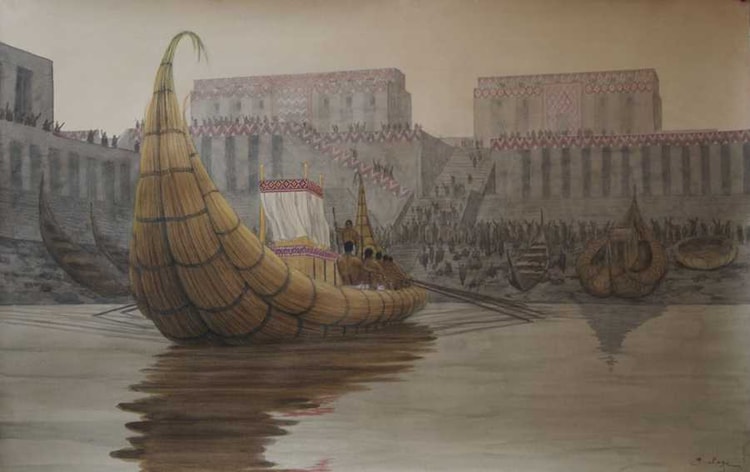 エリドゥの港の再現図 Таис Гило (Public Domain) ](https://www.worldhistory.org/image/6155/representation-of-the-port-of-eridu/ "Representation of the Port of Eridu")### 文明のゆりかご
肥沃な三日月地帯は「文明のゆりかご」の名でも知られ、農業、都市、文字、交易、科学、歴史、組織的宗教が誕生した場所とみなされている。紀元前10,000年頃に最初の定住が起こり、農業と動物の家畜化が始まった。紀元前9,000年までに野生の穀物の栽培が広まり、紀元前5000年までには灌漑を利用した農業が完成した。紀元前4500年を迎える頃には、羊毛を目的とした羊の飼育が広く行われていた。
肥沃な三日月地帯の地理・気候条件は農業に適しているため、自給自足ができるようになると、狩猟採集社会は定住を基本とするコミュニティに移行していった。半乾燥地帯であったものの、ティグリス・ユーフラテス川(南に向かえばナイル川もある)からもたらされる湿度と、両川に近接した立地が、作物栽培を促進した。農村は農業技術と共に発達し、生活基盤が整うと、続いて動物の家畜化も取り入れられた。
最初の都市は、メソポタミアの中でも、シュメール人が住む地域で発生した。シュメール人によると、紀元前5400年のエリドゥに始まり、その後ウルクなどの都市が建てられた。紀元前4500年までには小麦や穀物の栽培に加え、動物の家畜化も広く行われていた。紀元前3500年までにサルーキ(犬種)の絵が、デーン、グレイハウンド、マスティフ等とともに、花瓶やその他の陶器、壁画に頻繁に現れるようになった。
並外れて肥沃な土壌はライ麦、大麦、豆に加え、小麦のさらなる生産を促し、さらに世界最古のビールの醸造も、女神ニンカシの庇護のもと、ティグリス・ユーフラテス川沿いの大都市で行われた。ビールは神々からの贈り物であり、酔いをもたらすだけでなく、日々の栄養源としてもみなされていた。賃金の代わりに配布されることもあったが、残された碑文を見ると、ビールは祝祭のために醸造されると明記されている。また有名な『ニンシカ讃歌』は、ビールが心を軽くしてくれると称賛している。
当時のビールは現在と全く異なり、ドロドロしている上に、発酵後に残ったかすを避けるためにストローを使う必要があった。ビールの醸造はおそらくパン作りから発展したと思われる。職人たちの保管していた大麦や小麦が発酵したのだろう。最も古いビールの証拠は、現在のイランにあるシュメール人の辺境拠点ゴディン・テペで発見されている。
[ 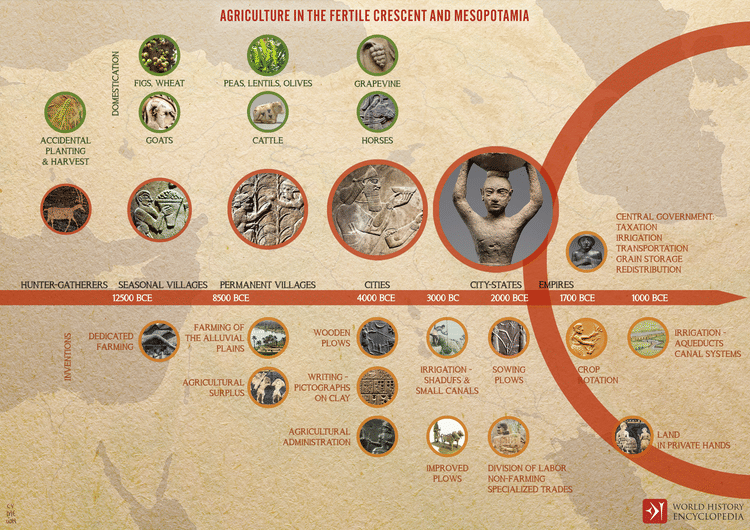 肥沃な三日月地帯とメソポタミアにおける農業 - 時系列 Simeon Netchev (CC BY-NC-ND) ](https://www.worldhistory.org/image/16860/agriculture-in-the-fertile-crescent-and-mesopotami/ "Agriculture in the Fertile Crescent and Mesopotamia - Timeline")エンマー小麦、大麦、ひよこ豆、レンズ豆、その他さまざまな作物が植えられ、収穫され、神殿へ送られた。当時、食料は神殿で保管されていた。紀元前3400年頃から、神殿の神官たちが食料の分配と、交易用の余剰作物の徹底した管理を担うようになった。
### 交易と帝国
交易路が発達すると、アラビア半島南部のサバ王国、エジプト、アフリカのクシュ王国を結ぶ長距離ルートを形成するようになった。後にこのルートはいわゆる「香料の道」となり、紀元前7、6世紀から紀元2世紀頃まで栄えた。香料の道を利用する商人たちは、商品とともにさまざまな分野の新しい知識をもたらし、これによって異文化交流が促進された。
紀元前2300年までには獣脂と灰から石鹸が作られ、広く使用されていた。個人の衛生状態は社会的信用に関わり、また神々を敬うという意味でも重視された。人間は神を補佐するために創られたと考えられており、義務を果たす際は、それに相応しい姿を求められていた。そのような観点から、個人の衛生状態には深く注意が払われた。
[ 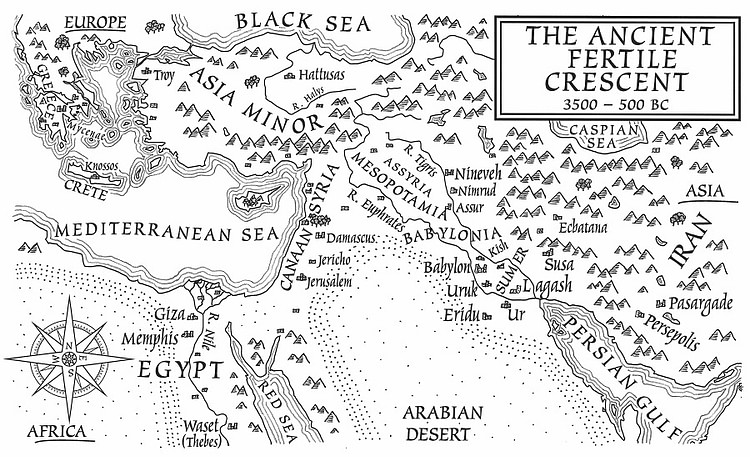 古代の肥沃な三日月地帯の地図(小説『The Jericho River』より) David Tollen (CC BY-NC-SA) ](https://www.worldhistory.org/image/14791/a-map-of-the-ancient-fertile-crescent-from-the-nov/ "A Map of the Ancient Fertile Crescent (From the Novel The Jericho River)")エジプトと同様に、沐浴や個人的な身だしなみは神官にとって特に重要だった。神々に仕える人々は高い基準を求められたが、一方で最も一般的な労働者さえも、清潔さと身だしなみを重視する価値観を持っていた。これについては複数の遺物が証明している。鏡、化粧壺、櫛、ヘアブラシ、歯ブラシが発見され、さらには入浴を描いた絵やその重要性を説いた碑文も見つかっている。
肥沃な三日月地帯の住人たちはそれぞれ独立した都市国家で暮らしていたが、他民族帝国のアッカド王国が興ると、それが一変した。紀元前2334~2279年からアッカド王サルゴン(サルゴン大王)によるメソポタミア全域の統治が始まると、巨大建設プロジェクト、芸術作品、さらにサルゴンの娘エンヘドゥアンナ(紀元前2300年頃)の作った『イナンナ讃歌』のような宗教文学の発展がもたらされた。なおエンヘドゥアンナは名前が判明している世界で最初の作家とみなされている。
紀元前2000年までにはバビロンが肥沃な三日月地帯を支配するようになり、法律(ハンムラビ王の有名な法典)、文学(特にギルガメッシュ叙事詩)、宗教(バビロニア人の神話体系の発展)、科学(天体観測や技術発達)、数学における進歩が見られた。
紀元前1900~1400年以降、ヨーロッパ、エジプト、フェニキア、インド亜大陸との交易が栄えると、文字の読み書きやメソポタミアの文化、宗教はそれらの地域にも広がっていった。文字、穀物、文学、知恵の女神ニサバは、彼女の生まれたシュメールから遠く離れた地域でも知られ、崇拝されるようになった。メソポタミアのビールは交易の貴重品に数えられ、交易路を通じてメソポタミアの重要な神々も各地を旅するようになった。
### 約束の地
聖書に登場する族長アブラハムが生まれ故郷のウルを発ち、約束の地カナーンを目指したのは、紀元前1900~1750年頃と推測されている。彼はメソポタミアの神々の神話と伝説を携えていた。やがてそれらのストーリーは形を変え、聖書の物語として現れることになる。メソポタミアの神話や伝説を伝えたのがアブラハムでないとしても、他の誰かがそうしたことは間違いない。メソポタミアの『アトラ・ハシース』と「ノアの方舟」、『アダパ神話』と『創世記』の「人間の堕落」を始め、多くの物語が極めて類似しているのは明確だ。
[ 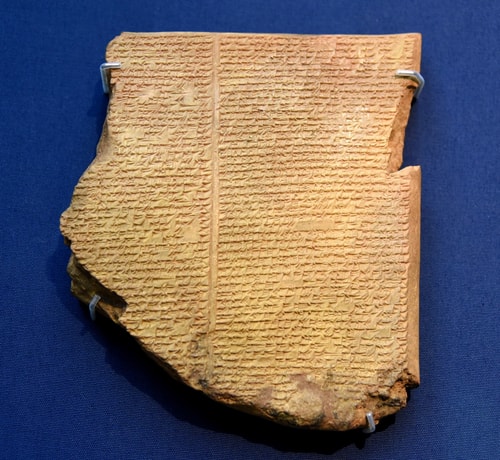 ギルガメッシュ叙事詩の洪水伝説が刻まれた粘土板 Osama Shukir Muhammed Amin (Copyright) ](https://www.worldhistory.org/image/4821/flood-tablet-of-the-epic-of-gilgamesh/ "Flood Tablet of the Epic of Gilgamesh")19世紀半ばまで、聖書は世界最古の本とみなされ、そこに含まれる物語は、神や神の導きを受けた人によって書かれたオリジナル作品だと思われていた。しかし肥沃な三日月地帯の考古学的発掘調査により、シュメール人の文明が発見されると、聖書の物語はそれよりも以前に描かれたメソポタミアの作品を起源としていることが明白になった。事実メソポタミアの宗教や文学は、後世のさまざまな文化の思想や作品にインスピレーションを与え、影響を及ぼすことになる。
### 移り変わる帝国
肥沃な三日月地帯の支配者は、時代とともに何度も変わっていった。紀元前912年までにアッシリアがこの地域を手中に収め、帝国の領土を大きく広げた。新アッシリア帝国を統治したのは、古代でも特に有名な王たちだった。そこにはティグラト・ピレセル3世(在位: 紀元前745~727年)、サルゴン2世(在位: 紀元前722~705年)、センナケリブ(在位: 紀元前705~681年)、エサルハドン(在位: 紀元前681~669年)、アッシュルバニパル(在位: 紀元前668~627年)が含まれる。アッシュルバニパルは知識を強く重んじ、この地域のあらゆる文学作品を写本し、ニネヴェの図書館(現在は「アッシュルバニパルの図書館」と呼ばれている)に収蔵するよう命じた。
紀元前612年に新アッシリア帝国が滅亡した際、敵軍は図書館に火をつけた。しかし作品は粘土版に書かれていたため、失われるどころか、むしろ炎で焼かれて頑丈になった。侵略者たちはアッシリア文化の破壊を目論んでいたが、皮肉にも、まさにその文化の保存に貢献してしまったのだ。
紀元前580年までには新バビロニア・カルデア帝国がネブカドネザル2世(在位: 紀元前605~562年)の元で支配の手を広げ、バビロンは世界最大の都市として繁栄を誇った。この時代にネブカドネザル2世は妻が故郷の景色を思い出せるように、有名な「バビロンの空中庭園」を造らせたと言われている。紀元前539年、オピスの戦いに敗れたバビロンはキュロス大王(紀元前530年没)の手に落ち、第一ペルシア帝国として知られるアケメネス朝の支配下に置かれた。
紀元前334年にはアレクサンドロス大王が侵攻し、その後パルティアをはじめ多くの国々の支配を受けたが、紀元116年になるとローマ帝国に吸収された。しかしローマの統治も短命に終わり、続いてササン朝ペルシア(紀元224~226年頃)に占領され、7世紀を迎えると、ついにアラブ系イスラム勢力の領土になった。
[  アケメネス朝のライオン型分銅 Osama Shukir Muhammed Amin (Copyright) ](https://www.worldhistory.org/image/4829/achaemenid-lion-weight/ "Achaemenid Lion Weight")ティグリス・ユーフラテス川のほとりで早い時期に発展した都市の重要な功績は、この時代にはすでに古代世界の隅々まで浸透していた。しかしこれらの都市自体は、気候変動、地震、火災などの自然的要因と、度重なる征服活動がもたらした破壊行為によって、大抵は廃墟と化していた。頻発する都市化と農地の酷使もまた、肥沃な三日月地帯の都市の衰退と、その後の放棄に繋がった。
神々が造り、神々の住んだ街であるエリドゥについて、古いメソポタミア人は地上に誕生した最初の都市とみなしていたが、そのエリドゥは紀元前600年頃を境に放棄され、ギルガメシュが治めたウルクも紀元700年以降同じ道を辿っている。古代世界では高度な文化、文字、法律、科学など、あらゆる学問で知られたバビロンは、紀元7世紀までに無人の廃墟と化していた。
バビロンの名はやがて、聖書の物語を描いた後世のヘブライ人書記の手により、罪・堕落と永遠に結びつけられることになる。しかしかつては、学問と文明の中心地として大いに敬われていたのだ。
### 肥沃な三日月地帯の現在
2001年、ナショナルジオグラフィックニュースは、「肥沃な三日月地帯」が急速に名前だけの存在になりつつあると報告した。気候変動、広範囲にわたるダム建設、1970年代にイラク南部で始まった大規模な干拓事業により、かつては5,800~7,700平方マイル(15,000~20,000km²)に及んだ肥沃な湿地帯は、わずか580~770平方マイル(1,500~2,000km²)にまで縮小している。
環境保護団体や地元の農家がダム建設と干拓事業の中止を訴えたものの、イラク、シリア、トルコ政府はこれを無視し、事態は悪化の一途を辿っている。かつては緑豊かな楽園であり、文明のゆりかごだったこの土地は、今やその大部分を、乾燥し、ひび割れ、日差しに焼かれた粘土質の平原に覆われている。温室効果ガスが気候変動を加速させ、状況は悪くなるばかりだ。
肥沃な三日月地帯に降りかかる継続的、長期的脅威の実態は、同地域の政府にはっきりと突きつけられているが、土地を保護し、回復させるための実質的な措置は一切取られていない。「人間は、個人であれ集団であれ、過去から学ぶことができない」と多くの学者、歴史家、環境活動家、作家が何世紀にも渡って指摘している。
哲学者のジョージ・サンタヤーナは「過去を忘れる者は、それを繰り返す運命にある」という有名な言葉を残している。今日の世界中のあらゆる地域と同様に、肥沃な三日月地帯の耳には、この言葉が真実を告げているように聞こえるだろう。
#### Editorial Review
This human-authored definition has been reviewed by our editorial team before publication to ensure accuracy, reliability and adherence to academic standards in accordance with our [editorial policy](https://www.worldhistory.org/static/editorial-policy/).
## 参考文献
- [Bertman, S. *Handbook to Life in Ancient Mesopotamia.* Oxford University Press, 2005.](https://www.worldhistory.org/books/0195183649/)
- [Black, J & Green, A. *Gods, Demons and Symbols of Ancient Mesopotamia.* University of Texas Press, 1992.](https://www.worldhistory.org/books/0292707940/)
- [Bottéro, J. *Everyday Life in Ancient Mesopotamia.* Johns Hopkins University Press, 2001.](https://www.worldhistory.org/books/0801868645/)
- [Breasted, J. *Ancient Times, a History of the Early World.* Ginn and Company, 2012.](https://www.worldhistory.org/books/B000GLTVJE/)
- [Casson, L. *Travel in the Ancient World.* Johns Hopkins University Press, 1994.](https://www.worldhistory.org/books/0801848083/)
- [Durant, W. *Our Oriental Heritage.* Simon & Schuster, 1954.](https://www.worldhistory.org/books/B00005WJGO/)
- [Kramer, S. N. *History Begins at Sumer.* University of Pennsylvania Press, 1988.](https://www.worldhistory.org/books/0812212762/)
- [Kramer, S. N. *The Sumerians: Their History, Culture, and Character.* University of Chicago Press, 1971.](https://www.worldhistory.org/books/0226452387/)
- [Kriwaczek, P. *Babylon: Mesopotamia and the Birth of Civilization.* St. Martin's Griffin, 2012.](https://www.worldhistory.org/books/1250054168/)
- [Leick, G. *The A to Z of Mesopotamia.* Scarecrow Press, 2010.](https://www.worldhistory.org/books/0810875772/)
- [Pritchard, J. B. *Ancient Near East, Volume I.* Princeton University Press, 1958.](https://www.worldhistory.org/books/B012HUFMQC/)
- [Pritchard, J. B. *The Ancient Near East Volume II.* Princeton University Press, 1960.](https://www.worldhistory.org/books/B0010W4HLU/)
- [Van De Mieroop, M. *A History of the Ancient Near East, ca. 3000-323 BC.* Wiley-Blackwell, 2009.](https://www.worldhistory.org/books/111871816X/)
- [Wallis Budge, E. A. *Babylonian Life and History (Barnes & Noble Library of Essential Reading).* Barnes & Noble, 2005.](https://www.worldhistory.org/books/0760765499/)
- [Wise Bauer, S. *The History of the Ancient World.* W. W. Norton & Company, 2007.](https://www.worldhistory.org/books/039305974X/)
## 著者の紹介
ジョシュア・マークはフリーランスの作家で、以前はニューヨークのマリスト大学で哲学の非常勤の教授職についていた。これまでギリシャとドイツに滞在歴があり、エジプトにも旅行している。彼は大学レベルの歴史学、文筆、文学、そして哲学を教えている。
- [Linkedin Profile](https://www.linkedin.com/pub/joshua-j-mark/38/614/339)
## 年表
- **9000 BCE**: Cultivation of wild cereals in the [Fertile Crescent](https://www.worldhistory.org/Fertile_Crescent/).
- **9000 BCE**: Wild sheep flocks are managed in the Zagros mountains.
- **7700 BCE**: First domesticated wheats in the [Fertile Crescent](https://www.worldhistory.org/Fertile_Crescent/).
- **c. 6500 BCE**: Cultivation of peas in the Eastern [Mediterranean](https://www.worldhistory.org/disambiguation/mediterranean/).
- **4300 BCE**: The rise of the [cities](https://www.worldhistory.org/city/) by the Tigris and Euphrates Rivers.
- **3500 BCE**: Image of the breed of dog, the Saluki, appears on ceramics as household pet.
- **2334 BCE - 2279 BCE**: [Sargon of Akkad](https://www.worldhistory.org/Sargon_of_Akkad/) (the Great) reigns over [Mesopotamia](https://www.worldhistory.org/Mesopotamia/) and creates the world's first [empire](https://www.worldhistory.org/empire/).
- **c. 2300 BCE**: Wide spread production and use of soap.
- **2000 BCE**: Domesticated horses introduced in [Mesopotamia](https://www.worldhistory.org/Mesopotamia/).
- **c. 2000 BCE**: [Babylon](https://www.worldhistory.org/babylon/) controls [Fertile Crescent](https://www.worldhistory.org/Fertile_Crescent/).
- **c. 1900 BCE**: [Ashur](https://www.worldhistory.org/ashur/), future capital of the Assyrian [Empire](https://www.worldhistory.org/empire/), is founded.
- **c. 1900 BCE - c. 1400 BCE**: [Trade](https://www.worldhistory.org/disambiguation/trade/) flourishes between [Mesopotamia](https://www.worldhistory.org/Mesopotamia/) and other regions.
- **1894 BCE**: [Amorite](https://www.worldhistory.org/amorite/) dynasty established in [Babylon](https://www.worldhistory.org/babylon/).
- **1795 BCE - 1750 BCE**: Reign of [Hammurabi](https://www.worldhistory.org/hammurabi/), king of [Babylon](https://www.worldhistory.org/babylon/).
- **1787 BCE**: [Hammurabi](https://www.worldhistory.org/hammurabi/) of [Babylon](https://www.worldhistory.org/babylon/) conquers [Uruk](https://www.worldhistory.org/uruk/) and Isin.
- **c. 1772 BCE**: The [Code of Hammurabi](https://www.worldhistory.org/Code_of_Hammurabi/): One of the earliest codes of [law](https://www.worldhistory.org/disambiguation/law/) in the world.
- **c. 1760 BCE - c. 1757 BCE**: [Hammurabi](https://www.worldhistory.org/hammurabi/) of [Babylon](https://www.worldhistory.org/babylon/) destroys the [city](https://www.worldhistory.org/city/) of [Mari](https://www.worldhistory.org/mari/). The people of Mari are spared according to Hammurabi.
- **1680 BCE**: [Hurrians](https://www.worldhistory.org/Hurrians/) occupy [Assyria](https://www.worldhistory.org/assyria/).
- **1595 BCE**: King Mursilis of the [Hittites](https://www.worldhistory.org/hittite/) sacks [Babylon](https://www.worldhistory.org/babylon/). Begin of Babylonian "dark ages."
- **1550 BCE**: The Hurrian kingdom of [Mitanni](https://www.worldhistory.org/Mitanni/) is founded.
- **1500 BCE**: [Egyptian empire](https://www.worldhistory.org/Egyptian_Empire/) extends to the Euphrates.
- **1472 BCE**: [Mittani](https://www.worldhistory.org/Mitanni/) annexes [Assyria](https://www.worldhistory.org/assyria/).
- **1400 BCE**: [Assyria](https://www.worldhistory.org/assyria/) regains its independence.
- **1350 BCE - 1250 BCE**: The [Hittite](https://www.worldhistory.org/hittite/) [Empire](https://www.worldhistory.org/empire/) is at its peak.
- **c. 1321 BCE**: Western [Mittani](https://www.worldhistory.org/Mitanni/) is conquered by the [Hittites](https://www.worldhistory.org/hittite/).
- **1285 BCE**: Peak of [Hittite](https://www.worldhistory.org/hittite/) power.
- **1220 BCE**: [Babylon](https://www.worldhistory.org/babylon/) is under Assyrian control.
- **1200 BCE**: Phrygians invade [Anatolia](https://www.worldhistory.org/Asia_Minor/) and destroy the [Hittite](https://www.worldhistory.org/hittite/) [Empire](https://www.worldhistory.org/empire/).
- **1080 BCE**: Aramaeans invade [Mesopotamia](https://www.worldhistory.org/Mesopotamia/).
- **1000 BCE**: Chaldeans occupy [Ur](https://www.worldhistory.org/ur/).
- **853 BCE**: Babylonian kings depend on Assyrian military support.
- **734 BCE**: [Babylon](https://www.worldhistory.org/babylon/) is captured by Chaldeans.
- **729 BCE**: [Babylon](https://www.worldhistory.org/babylon/) is occupied by Assyrians.
- **722 BCE - 705 BCE**: Peak of the Assyrian [Empire](https://www.worldhistory.org/empire/) under the reign of [Sargon II](https://www.worldhistory.org/Sargon_II/).
- **c. 600 BCE**: Assyrians control the [Fertile Crescent](https://www.worldhistory.org/Fertile_Crescent/).
- **c. 539 BCE**: [Cyrus the Great](https://www.worldhistory.org/Cyrus_the_Great/) conquers [Babylon](https://www.worldhistory.org/babylon/); the [Fertile Crescent](https://www.worldhistory.org/Fertile_Crescent/) is controlled by the [Achaemenid Empire](https://www.worldhistory.org/Achaemenid_Empire/) (The First [Persian Empire](https://www.worldhistory.org/disambiguation/Persian_Empire/)).
- **334 BCE**: [Alexander the Great](https://www.worldhistory.org/Alexander_the_Great/) invades and conquers the [Fertile Crescent](https://www.worldhistory.org/Fertile_Crescent/).
- **116 CE**: Invasion and annexation of the [Fertile Crescent](https://www.worldhistory.org/Fertile_Crescent/) region by [Rome](https://www.worldhistory.org/Rome/) under [Trajan](https://www.worldhistory.org/trajan/).
## よくある質問
### 「肥沃な三日月地帯」とは何ですか?
肥沃な三日月地帯は、現在のイラク、シリア、レバノン、ヨルダン、イスラエル、エジプト北部にあたる地域を指す言葉です。
### この地域が最初に「肥沃な三日月地帯」と呼ばれたのはいつのことですか?
「肥沃な三日月地帯」という言葉は1916年にエジプト学者のジェームズ・ヘンリー・ブレステッドによって作られました。
### 肥沃な三日月地帯は何で有名ですか?
肥沃な三日月地帯に住む人々は文字、車輪、時間の概念、科学、交易など、文明世界を構成する数多くの要素を生み出したことから、この地域は「文明のゆりかご」として広く知られています。
### 肥沃な三日月地帯は現在も「肥沃」ですか?
土地の酷使やダム開発、干拓事業、気候変動の影響で、現在の肥沃な三日月地帯は古代のように肥沃な土地ではありません。
## 外部リンク
- [Just Add Water: a Modern Agricultural Revolution in the Fertile Crescent](https://earthobservatory.nasa.gov/features/HarranPlains)
- [Map: Fertile Cresent, 9000 to 4500 BCE](http://www.fsmitha.com/h1/map00-fc.html)
- [Ancient Mesopotamia Geography & Maps](https://mesopotamia.mrdonn.org/geography.html)
- [The University of Chicago/UChicago News/The Fertile Crescent, Explained by Tori Lee](https://news.uchicago.edu/explainer/fertile-crescent-explained)
## 記事の引用
### APA
Mark, J. J. (2026, May 26). 肥沃な三日月地帯: 古代文明発祥の地に与えられた呼称. (T. Torii, 翻訳者). *World History Encyclopedia*.
### Chicago
Mark, Joshua J.. "肥沃な三日月地帯: 古代文明発祥の地に与えられた呼称." 翻訳者: Tetsuya Torii. *World History Encyclopedia*, May 26, 2026. .
### MLA
Mark, Joshua J.. "肥沃な三日月地帯: 古代文明発祥の地に与えられた呼称." 翻訳者: Tetsuya Torii. *World History Encyclopedia*, 26 May 2026, .
## ライセンスと著作権
投稿者: [Tetsuya Torii](https://www.worldhistory.org/user/tetsuyatorii/ "User Page: Tetsuya Torii"), 公開日 26 May 2026. 著作権情報については、元の情報源をご確認ください。 このページからリンクされているコンテンツは、異なるライセンス条件が適用される場合がありますのでご注意ください。