---
title: Impero bizantino
author: Mark Cartwright
translator: Giovanni De Simone
source: https://www.worldhistory.org/trans/it/1-953/impero-bizantino/
format: machine-readable-alternate
license: Creative Commons Attribution-NonCommercial-ShareAlike (https://creativecommons.org/licenses/by-nc-sa/4.0/)
updated: 2024-07-24
---
# Impero bizantino
_A cura di [Mark Cartwright](https://www.worldhistory.org/user/markzcartwright/)_
_Tradotto da [Giovanni De Simone](https://www.worldhistory.org/user/giovannidesimon)_
L' [Impero](https://www.worldhistory.org/trans/it/1-99/impero/) bizantino è esistito dal 330 al 1453. Viene spesso chiamato [Impero Romano](https://www.worldhistory.org/trans/it/1-100/impero-romano/) d'Oriente o semplicemente Bisanzio. La capitale bizantina fu [Costantinopoli](https://www.worldhistory.org/trans/it/1-700/costantinopoli/), fondata da [Costantino I](https://www.worldhistory.org/trans/it/1-699/costantino-i/) (imperatore dal 306 al 337). Le dimensioni dell'impero variarono nel corso dei secoli, a seconda del periodo, arrivando a includere possedimenti territoriali in [Italia](https://www.worldhistory.org/trans/it/1-207/italia/), Grecia, nei Balcani, nel [Levante](https://www.worldhistory.org/trans/it/1-178/levante/), in Asia Minore e nel Nord Africa.
Bisanzio fu uno stato cristiano con il greco come lingua ufficiale. I bizantini svilupparono sistemi politici, pratiche religiose, arte e architettura propri. Tutti questi aspetti furono notevolmente influenzati dalla tradizione culturale greco-romana, ma ci furono anche caratteri distintivi peculiari, che non stati solo una mera continuazione della Roma antica. L'Impero bizantino fu la potenza medievale più duratura, e la sua influenza, specialmente in campo religioso, architettonico e legislativo, in molti stati dell'[Europa](https://www.worldhistory.org/trans/it/1-35/europa/) occidentale, centrale e orientale e in Russia, arriva fino ai nostri giorni.
### Il problema del termine "bizantino" e la cronologia
Il termine "bizantino" fu coniato dagli storici del XVI secolo, basandosi sul fatto che il primo nome della capitale fosse Bisanzio, prima che fosse cambiato in Costantinopoli (attuale Istanbul). Si tratta di un'etichetta di convenienza tutt'altro che perfetta, su cui c'è stato un lungo dibattito che continua ancora oggi. Convenzionalmente, si usa per distinguere l’Impero Romano d'Oriente dall’Impero Romano d'Occidente, specialmente dopo la caduta di quest'ultimo nel V secolo. Infatti, per questo motivo, non c'è un consenso universale tra gli storici sul periodo storico abbracciato dal termine "Impero bizantino". Alcuni studiosi hanno scelto come inizio il 330 e la fondazione di Costantinopoli, altri la caduta dell’Impero Romano d'Occidente nel 476, altri ancora preferiscono il fallimento di [Giustiniano I](https://www.worldhistory.org/trans/it/1-726/giustiniano-i/) (imperatore nel 527-565) nel riunificare i due imperi nel 565, mentre altri ancora propongono il 650, riferendosi alla conquista araba delle province orientali di Bisanzio. La maggior parte degli storici concordano invece sulla fine dell'Impero bizantino, scegliendo la data di martedì 29 maggio 1453, quando il sultano Maometto II (regnante tra il 1444-6 e il 1451-81) conquistò Costantinopoli.
La discussione sulla datazione segnala anche le differenze presenti nella miscela etnica e culturale tra le due metà del mondo romano e la peculiarità che lo stato medievale "bizantino" aveva rispetto alla sua eredità romana precedente. I bizantini chiamavano sé stessi "romani", il loro imperatore [era](https://www.worldhistory.org/trans/it/1-10295/era/) il *basileon ton Rhomaion* o "imperatore dei romani" e la loro capitale era la "Nuova Roma". Tuttavia, la lingua più comune era il greco, ed è corretto affermare che per la maggior parte della sua storia, l'Impero bizantino fu molto più greco che romano a livello culturale.
### Costantinopoli
Gli inizi dell'Impero bizantino rimontano alla decisione dell'imperatore Costantino I di spostare la capitale dell’Impero Romano da Roma a Bisanzio, l'11 maggio del 330. Il popolare nome di Costantinopoli o "città di Costantino" rimpiazzò presto quello scelto dall'imperatore, cioè, "Nuova Roma". La nuova capitale era dotata di un eccellente porto naturale nell'insenatura del Corno d'Oro e, a cavallo tra i confini di [Europa](https://www.worldhistory.org/trans/it/1-15614/europa/) e Asia, poteva controllare il passaggio delle navi attraverso il Bosforo, che collegava i redditizi commerci tra est e ovest, dall'Egeo al Mar Nero. L'entrata del Corno d'Oro era chiusa da una grande catena. Tra il 410 e il 413 vennero costruite le imponenti mura teodosiane, che permisero alla città di resistere ad attacchi provenienti sia dal mare che da terra. Nel corso dei secoli, con l'aggiunta di nuovi e spettacolari edifici, la cosmopolita città diventò una delle più belle di ogni epoca, e certamente la più ricca, la più lussuosa e la più importante città cristiana del mondo.
[  Mappa della Costantinopoli bizantina Cplakidas (CC BY-SA) ](https://www.worldhistory.org/image/564/map-of-byzantine-constantinople/ "Map of Byzantine Constantinople")### Gli imperatori bizantini
L' imperatore bizantino, o *basileus* (più raramente *basilissa*, cioè, imperatrice), risiedeva nel magnifico Gran Palazzo di Costantinopoli, e regnava su un vasto impero come monarca assoluto. Per questo compito, il *basileus* aveva bisogno dell'assistenza di un governo esperto e di una burocrazia efficiente e diffusa. Anche se era un sovrano assoluto, da un imperatore ci si aspettava (da parte del governo, del popolo e della Chiesa) che governasse saggiamente e in maniera equa. Aspetto persino più importante, un imperatore doveva avere successo a livello militare: l'esercito, di fatto, era l'istituzione più importante. I generali, a Costantinopoli e nelle province, potevano rimuovere - come accadde molte volte - un imperatore che non riusciva a difendere i confini dell’impero o che aveva causato una catastrofe economica. Tuttavia, normalmente, l’imperatore era il comandante in capo dell’esercito, capo della Chiesa e del governo, controllore delle finanze statali, con il potere di nominare o destituire nobili secondo la sua volontà: pochi sovrani, sia prima che dopo, hanno avuto un tale potere.
L'immagine dell'imperatore appariva sulle monete bizantine, che erano utilizzate anche per mostrare un successore designato, che spesso era il figlio maggiore ma non sempre: non c'erano regole fisse per la successione. Si pensava che gli imperatori fossero stati scelti da Dio per governare: a rafforzare il concetto di diritto a regnare, sul capo portavano una magnifica corona e indossavano abiti tinteggiati con la porpora. Un'altra strategia propagandistica era quella di adottare il nome di illustri predecessori, in particolare quello di Costantino. Persino gli usurpatori, tipicamente militari potenti e di successo, cercavano molto spesso di legittimare la loro posizione sposando un membro della famiglia dei suoi predecessori. In questo modo, attraverso una continuità ben orchestrata di dinastie, rituali, costumi e nomi, l’istituzione dell'imperatore fu in grado di resistere per 12 secoli.
### Il governo bizantino
Il governo bizantino seguiva i modelli stabiliti durante la Roma imperiale. L'imperatore era onnipotente, ma ci si aspettativa che consultasse importanti istituzioni, come il senato. Il senato di Costantinopoli, diversamente da quello di Roma, era composto da uomini che avevano scalato i ranghi dell'esercito; dunque, non era presente una classe senatoriale in quanto tale. Non essendoci meccanismi elettivi, i senatori, i ministri e i consiglieri locali ottenevano generalmente la loro posizione attraverso il patrocinio dell'imperatore o grazie alla loro condizione di proprietari terrieri.
[  Giustiniano I Sponsored by a Greek banker, Julius Argentarius (CC BY-NC-SA) ](https://www.worldhistory.org/image/3341/justinian-i/ "Justinian I")L'aristocrazia dei senatori costituì il piccolo *sacrum consistorium* ("concistoro sacro"), un organo che, in teoria, l'imperatore doveva consultare per le questioni di stato importanti. Inoltre, il sovrano poteva conferire con i membri del suo seguito personale all'interno della corte. Nella corte c'erano i ciambellani eunuchi (*cubicularii*), che servivano il monarca in vari doveri personali e che controllavano anche l'accesso alla sua presenza. Gli eunuchi avevano altre posizioni di responsabilità, la principale, tra le quali era tenere il "portafoglio" dell'imperatore, detto *sakellarios*, che crebbe di importanza a partire dal VII secolo. Altri importanti funzionari governativi erano il questore, o capo dell'ufficio legale; il *comes sacrarum largitionum* (un ufficiale civile), che controllava la zecca di stato; il *magister officiorum* (un alto funzionario della burocrazia), che si occupava dell'amministrazione generale del palazzo, dell'esercito e dei suoi rifornimenti, così come di politica estera; una squadra di ispettori imperiali che controllavano gli affari dei consigli locali in tutto l'impero.
Tuttavia, all'apice dei funzionari di Bisanzio troviamo il prefetto del pretorio per l'Oriente, a cui facevano capo tutti i governatori regionali dell'impero. I governatori regionali supervisionavano i singoli consigli cittadini, o *curae*. I consiglieri locali avevano la responsabilità per tutti i servizi pubblici e per la riscossione delle imposte nelle loro città e nei territori circostanti. Questi consigli erano organizzati geograficamente in circa 100 province, a loro volta divise in 12 diocesi, tre ogni quattro prefetture imperiali. A partire dal VII secolo, la carica di prefetto del pretorio fu abolita, e i governatori regionali delle diocesi, o "*themata*", così chiamati dopo la riforma di Eraclio, divennero di fatto comandanti militari provinciali (*strategoi*), che rispondevano direttamente all'imperatore. Dopo l'VIII secolo, a causa delle crescenti minacce militari da parte dei vicini e delle guerre civili interne, l'amministrazione imperiale si semplificò molto rispetto al passato.
### Il *Corpus Juris Civilis*
Il governo bizantino fu supportato grandemente dalla creazione del Codice giustinianeo, o *Corpus Juris Civilis* ("corpo delle leggi civili"), da parte di Giustiniano I. Il *corpus*, redatto da un insieme di esperti legali, riuniva, curato e rivisto, l'immenso corpo delle leggi romane che si erano accumulate nel corso dei secoli - un numero impressionante di editti imperiali, pareri legali, liste di reati e pene. Il codice, che contava più di un milione di parole, avrebbe resistito per 900 anni, rendendo le leggi più chiare per tutti, riducendo il numero di casi portati in tribunale, velocizzando il processo giuridico e influenzando i sistemi legali delle successive democrazie occidentali.
### La società bizantina
I bizantini davano una grande importanza al nome di famiglia, alle ricchezze ereditate e alla rispettabilità degli individui al momento della nascita. Le persone appartenenti alle classi sociali più alte possedevano tutti e tre questi elementi. La ricchezza deriva dalla proprietà terriera o dall'amministrazione della stessa. Tuttavia, nella società bizantina non c'era un'aristocrazia di sangue in quanto tale, e si poteva scalare la scala sociale sia mediante un'istruzione che per patronato. Inoltre, la composizione della nobiltà non era statica, e le famiglie sorsero e caddero a causa della distribuzione da parte dell'imperatore di favori, terreni e titoli, nonché per i declassamenti indiscriminati e per la minaccia di invasioni straniere e guerre. Il rango era ostentato attraverso l'utilizzo di titoli, sigilli, insegne, un vestiario particolare e l'uso di gioielli.
[  Dittico bizantino su pannello in avorio Osama Shukir Muhammed Amin (Copyright) ](https://www.worldhistory.org/image/5727/byzantine-ivory-diptych-panel/ "Byzantine Ivory Diptych Panel")La maggior parte dei membri delle classi basse svolgeva la professione dei loro genitori, ma c'era una piccola possibilità di migliorare la propria posizione grazie alla facoltà di ereditare beni, accumulare ricchezza e alla mancanza di un divieto formale di ascesa sociale. Alcune professioni erano migliori di altre, come quelle in ambito legale, amministrativo e commerciale (il commercio, tuttavia, non era un modo molto stimato per guadagnarsi da vivere presso i bizantini). Sul gradino più basso c'erano gli artigiani, poi i contadini che possedevano piccoli appezzamenti di terreno, e per finire coloro che lavoravano la terra di altri. Più in basso di tutti c'erano gli schiavi, tipicamente prigionieri di guerra, e i numerosissimi lavoratori liberi.
Il ruolo delle donne e degli uomini bizantini dipendeva dal loro rango sociale. Le donne dell'aristocrazia dovevano gestire la casa e prendersi cura dei bambini. Anche se era loro permesso di possedere beni, non potevano ricoprire cariche pubbliche. Passavano il tempo libero tessendo, facendo compere, andando in chiesa o leggendo (anche se non possedevano formalmente un'istruzione). Le vedove diventavano le guardiane dei loro figli e potevano ereditare in parti uguali con i loro fratelli. Molte donne, al pari degli uomini, svolgevano lavori agricoli, manifatturieri e nella ristorazione. Alle donne era permesso di possedere terre e gestire affari, e alcune di loro miglioravano la propria posizione sociale attraverso il matrimonio. Le professioni meno rispettate, come altrove, erano quella di prostituta e attrice.
### I territori dell'Impero bizantino
L'estensione geografica dell'impero cambiò nel corso dei secoli, in base ai successi o ai fallimenti militari dei singoli imperatori. I territori posseduti nella prima parte della storia dell'impero includevano Egitto, Siria, Giordania, Libano e [Palestina](https://www.worldhistory.org/trans/it/1-192/palestina/). La Grecia era meno importante in termini pratici di quanto non fosse a livello simbolico, in quanto i bizantini si consideravano i veri eredi della cultura greco-romana. L'Italia e la Sicilia vennero difese, ma alla fine senza successo, contro le ambizioni dei papi e dei Normanni. Grande importanza avevano i Balcani fino al Danubio. L'Asia Minore e le coste del Mar Nero verso nord e l’Armenia a est costituivano grandi fonti di ricchezza, ma entrambe queste regioni richiedevano di essere difese regolarmente e in maniera vigorosa da nemici perenni.
La mappa politica veniva costantemente ridisegnata in base alla nascita e alla caduta degli imperi confinanti. Tra gli eventi maggiori, possiamo includere la difesa dell'impero da parte di Anastasio I (491-518) contro Persiani e Bulgari. Giustiniano I, grazie all'aiuto del talentuoso generale Belisario (circa 500-565) riconquistò territori in Nord Africa, nella penisola iberica e in Italia, che erano stati persi dagli imperatori d'Occidente. I [Longobardi](https://www.worldhistory.org/trans/it/1-13468/longobardi/) in Italia e gli Slavi nei Balcani fecero breccia all'interno dell'impero nella seconda metà del VI secolo. Eraclio (imperatore nel 610-641) pose fine all'Impero sasanide persiano con la vittoria di [Ninive](https://www.worldhistory.org/trans/it/1-294/ninive/) del 627.
[  Impero bizantino, 520 circa-1204 Simeon Netchev (CC BY-NC-ND) ](https://www.worldhistory.org/image/15330/map-of-the-byzantine-empire-c520---1204/ "Map of the Byzantine Empire, c.520 - 1204")Le conquiste islamiche del VII e VIII secolo privarono l'impero dei suoi territori nel Levante (compresa [Gerusalemme](https://www.worldhistory.org/trans/it/1-194/gerusalemme/) nel 637), in Nord Africa e nella parte orientale dell'Asia Minore. L'impero però, rimase un fermo baluardo contro l'espansione araba in Europa: Costantinopoli resistette per due volte ad assedi arabi ben portati (674-8 e 717-18). Bisanzio però, ne venne scossa fin nelle sue fondamenta. Nel corso del IX secolo, i Bulgari compirono importanti incursioni nelle aree settentrionali dell'impero. Una risalita nelle sorti bizantine ci fu con la cosiddetta (in modo inappropriato) dinastia macedone (867-1057). Il fondatore della dinastia, [Basilio I](https://www.worldhistory.org/trans/it/1-16541/basilio-i/) (sul trono nel 867-886) riconquistò l'Italia meridionale, affrontò i problematici pirati cretesi e sconfisse gli arabi a Cipro, nell'entroterra greco e in Dalmazia. Il suo successore, Leone VI (imperatore tra l’886 e il 912) perse la maggior parte dei suoi guadagni territoriali, ma nella metà del X secolo sconfisse i musulmani in [Mesopotamia](https://www.worldhistory.org/trans/it/1-34/mesopotamia/).
Basilio II (imperatore nel 976-1025), noto come il "bulgaroctono" ("massacratore di bulgari") grazie alle sue vittorie nei Balcani, risollevò ancora una volta le sorti dell'impero. Basilio, aiutato da un esercito di agguerriti guerrieri di discendenza vichinga provenienti da Kiev, ottenne numerose vittorie in Grecia, Armenia, Georgia e Siria, raddoppiando le dimensioni dell'impero. Tuttavia, si trattò dell'ultimo atto di grandezza prima di un graduale declino. Dopo la scioccante sconfitta per mano dei Selgiuchidi nella battaglia di Manzikert, in Armenia, nel 1071, ci fu una breve ripresa sotto [Alessio I Comneno](https://www.worldhistory.org/trans/it/1-16587/alessio-i-comneno/) (sul trono nel 1081-1118) che sconfisse i Normanni in Dalmazia, i Peceneghi in Tracia e i Selgiuchidi in Palestina e Siria (con l'aiuto dei primi crociati). Sembrava però che ci fossero troppi nemici provenienti da troppe parti affinché i bizantini potessero prosperare indefinitamente.
Nel XII e XIII secolo il sultanato di Rum inglobò metà dell'Asia Minore, fino ad arrivare al disastro del 1204, quando gli eserciti della Quarta Crociata saccheggiarono Costantinopoli. Spartito tra Venezia e i suoi alleati, l'impero esistette solo in esilio, prima della restaurazione nel 1261. Nel XIV secolo, l'impero era costituito da una piccola area nell'estremità della Grecia meridionale e da un insieme di territori intorno alla capitale. Il colpo finale arrivò, come già menzionato, con la presa di Costantinopoli da parte degli Ottomano nel 1453.
### La chiesa bizantina
Il paganesimo continuò a essere praticato per secoli dopo la fondazione di Bisanzio, ma la caratteristica distintiva dell'impero fu il [cristianesimo](https://www.worldhistory.org/trans/it/1-665/cristianesimo/), che ne influenzò profondamente la cultura, l'arte, l'architettura, la politica interna e le relazioni internazionali. La Chiesa era guidata dal patriarca, o vescovo di Costantinopoli, che veniva nominato o rimosso dall'imperatore. I vescovi locali, che presidiavano le grandi città e i loro territori circostanti, rappresentavano sia la Chiesa che l'imperatore e, all'interno delle loro comunità, possedevano notevoli poteri e ricchezze. Il cristianesimo, dunque, fu un importante denominatore comune, che aiutò a tenere insieme culture diverse all'interno di un singolo impero che comprendeva cristiani greci, armeni, slavi, georgiani e molte altre minoranze, nonché coloro a cui era permesso di praticare liberamente la loro fede, come ebrei e musulmani.
[  Icona di San Basilio Unknown Artist (Public Domain) ](https://www.worldhistory.org/image/8571/icon-of-saint-basil/ "Icon of Saint Basil")Le differenze tra la chiesa occidentale e quella orientale furono una delle ragioni per cui l'Impero bizantino venne rappresentato in maniera mediocre dagli storici medievali occidentali. Molto spesso i bizantini venivano dipinti come in decadenza e subdoli, la loro cultura stagnante, e la loro religione come una pericolosa eresia. Le chiese orientali e quelle occidentali non erano d'accordo se dovesse essere il papa o il patriarca ad avere autorità sui credenti. Si discuteva anche su questioni dottrinali, come per esempio se Gesù Cristo combinasse natura umana e divina o se avesse solo natura divina. Il celibato del clero, l'uso di pane lievitato o non lievitato, il linguaggio del servizio liturgico e l'utilizzo delle immagini sacre erano tutti punti di frizione che, alimentati dalla politica e dalle ambizioni territoriali unite a questa volatile miscela di emozioni, portarono allo scisma del 1054.
La chiesa bizantina aveva anche delle dispute interne, la più famigerata delle quali fu quella sull'iconoclastia ("distruzione delle immagini") nel 726-787 e nel 814-843. I papi e una grand parte dei bizantini sostenevano l'uso delle icone, cioè, di rappresentazioni delle figure sacre, specialmente quella di Gesù Cristo. I loro avversari credevano che le icone fossero diventate degli idoli, e che fosse blasfemo pensare che Dio potesse essere rappresentato tramite l'arte. La discussione riaccese il dibattito sulla doppia natura di Cristo, e sul fatto che un'icona potesse rappresentare solo il lato umano. I difensori delle icone affermavano che queste era solo un'impressione dell'artista, che aiutava gli analfabeti a capire meglio il divino. Durante l'ondata di iconoclastia vennero distrutte molte opere d'arte, specialmente durante i regni di Leone III (717-741) e del suo successore Costantino V (741-775), nel quale vennero persino perseguitati coloro che veneravano le icone (iconofili). La questione si risolse in favore delle icone nell'843, un evento conosciuto come il "trionfo dell'ortodossia".
Il monachesimo rappresentò una caratteristica particolare della vita religiosa bizantina. Uomini e donne si ritiravano nei monasteri dove votavano la loro vita a Cristo e ad aiutare i poveri e i malati. Vivevano una vita semplice, secondo le regole designate da importanti figure ecclesiastiche come Basilio il Grande (circa 330- 379). Molti monaci erano anche studiosi: tra i più famosi, ricordiamo San Cirillo (morto nell'867), che inventò l'[alfabeto](https://www.worldhistory.org/trans/it/1-73/alfabeto/) glagolitico. Una figura femminile di rilievo fu [Anna Comnena](https://www.worldhistory.org/trans/it/1-16935/anna-comnena/) (1083-1153), che scrisse l'Alessiade, una cronaca sulla vita e sul regno di suo padre Alessio I Comneno (imperatore nel 1081-1118). In tal modo, i monasteri diventarono depositari inestimabili dei testi e della conoscenza. Vennero apprezzati fortemente anche per la produzione di vino e per i laboratori di icone. Uno dei siti monastici più celebrati è Monte Athos, vicino Salonicco dove, nel IX secolo, si stabilirono dei monaci che fondarono 46 monasteri, molti dei quali sono sopravvissuti fino a oggi.
[  Copertina di un libro bizantino con icona The Metropolitan Museum of Art (Copyright) ](https://www.worldhistory.org/image/8960/byzantine-book-cover-with-icon/ "Byzantine Book Cover with Icon")### L'arte bizantina
Gli artisti bizantini si spostarono dal naturalismo della tradizione classica verso l'astrattismo e l'universalismo, ostentando una marcata preferenza per le rappresentazioni bi-dimensionali. La scarsità di opere firmate prodotte prima del XIII secolo suggerisce che gli artisti non godevano di una posizione sociale elevata. Le opere d'arte che promuovevano un messaggio religioso - principalmente il bisogno della salvezza e il rafforzamento della fede - venivano prodotte in quantità enormi, in particolare mosaici, dipinti a muro e icone. Anche se le icone potevano essere di qualsiasi materiale, le più popolari erano quelle dipinte su piccoli pannelli di legno. Pensate per essere indossate o appese al muro, venivano create con la tecnica dell'encausto, con cui i pigmenti colorati venivano mescolati con la cera calda e poi stesi sul supporto. Per facilitare la comunicazione tra l'osservatore e il divino, le singole figure erano tipicamente dipinte frontalmente con un'aureola o un alone che le circondava per enfatizzare la loro santità.
I mosaici bizantini, i migliori dei quali visibili oggi presso Santa Sofia a Istanbul o a San Vitale a Ravenna, rappresentano figure sacre, imperatori e imperatrici, membri del clero e scene di vita quotidiana, specialmente agricole. La scultura in grande scala sembra dover essere stata meno popolare rispetto all' antichità, ma sono presenti numerosi sarcofagi di marmo. Infine, una specialità dei bizantini era la lavorazione dei metalli, specialmente l'incorporazione di smalti e pietre semipreziose di cabochon. Gli artigiani producevano oggetti di alta qualità come piatti, tazze, gioielli di tutti i tipi, copertine di libri (in particolare della Bibbia) e reliquiari (scatole per mantenere le reliquie sacre).
### L'architettura bizantina
Gli architetti bizantini continuarono a impiegare gli ordini classici e a prendere idee dal [Vicino Oriente](https://www.worldhistory.org/trans/it/1-16/vicino-oriente/) e da altri posti. I progetti diventarono più eclettici rispetto all'antichità, specialmente grazie all'abitudine di riutilizzare i materiali da edifici più antichi per realizzare nuove strutture. C'era anche una decisa preferenza per la funzione rispetto alla forma e per gli interni rispetto agli esterni. Pur continuando a costruire acquedotti ad arco, anfiteatri, ippodromi, bagni e ville, che rappresentavano la quintessenza di Roma, i bizantini aggiunsero a questo repertorio chiese a cupola, monasteri fortificati e mura di difesa ancor più sofisticate.
[ 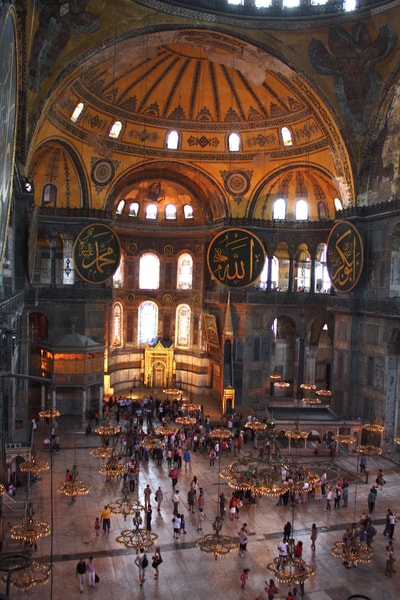 Interno di Santa Sofia Mark Cartwright (CC BY-NC-SA) ](https://www.worldhistory.org/image/8973/hagia-sophia-interior/ "Hagia Sophia Interior")I materiali da costruzione preferiti erano grandi mattoni di malte e calcestruzzi per l'interno delle mura. Blocchi di pietra bugnata venivano usati negli edifici pubblici più prestigiosi, mentre il marmo, usato in modo più parsimonioso che nella Roma antica, era generalmente riservato per le colonne, i telai di porte e finestre e altri elementi decorativi. I tetti erano di legno, mentre le mura interne erano ricoperte per la maggior parte di intonaco, stucco, sottili placche di marmo, dipinti e mosaici.
Il più grande, importante e famoso edificio bizantino è Santa Sofia a Costantinopoli, dedicata alla divina sapienza (*hagia sophia*) di Dio. Costruita ex novo nel 532-537, la base rettangolare misura 74,6x69,7 metri, il soffitto a cupola è alto 55 metri e ha un diametro di 31,8 metri. Poggiata su quattro imponenti archi con quattro pennacchi di supporto, la cupola fu uno spettacolare traguardo per quel periodo. Santa Sofia rimase la chiesa più grande del mondo fino al XVI secolo, ed è una delle più decorate grazie ai suoi superbi mosaici scintillanti e dipinti.
Le Chiese cristiane in generale sono state uno dei più grandi contributi dei bizantini all'architettura, specialmente per il loro uso della cupola. La pianta a croce inscritta diventò quella di uso più comune, con la cupola costruita su quattro archi di supporto. La base quadrata dell'edificio si ramifica in vani che a loro volta possono avere un soffitto a cupola mezza o piena. Un'altra caratteristica comune è l'abside centrale con i due absidi laterali nella parte orientale della chiesa. Nel corso del tempo, la cupola centrale è stata alzata ulteriormente grazie a una base poligonale, che in alcune chiese è così alta da avere l'aspetto di una torre. Molte chiese, specialmente basiliche, avevano un battistero (di solito ottagonale) e, a volte, un mausoleo riservato al fondatore della chiesa e ai suoi discendenti. Tali caratteristiche della progettualità bizantina avrebbero influenzato l'architettura cristiana ortodossa e possono ancora essere ammirate nelle chiese di tutto il mondo.
#### Editorial Review
This human-authored definition has been reviewed by our editorial team before publication to ensure accuracy, reliability and adherence to academic standards in accordance with our [editorial policy](https://www.worldhistory.org/static/editorial-policy/).
## Bibliografia
- [Bagnall, R. *The Encyclopedia of Ancient History.* Wiley-Blackwell, 2012.](https://www.worldhistory.org/books/0307407969/)
- [Brownworth, L. *Lost to the West.* Broadway Books, 2010.](https://www.worldhistory.org/books/0307407969/)
- [Gregory, T.E. *A History of Byzantium.* Wiley-Blackwell, 2010.](https://www.worldhistory.org/books/140518471X/)
- [Herrin, J. *Byzantium.* Princeton University Press, 2009.](https://www.worldhistory.org/books/0691143692/)
- [Mango, C. *The Oxford History of Byzantium.* Oxford University Press, 2002.](https://www.worldhistory.org/books/0198140983/)
- [Norwich, J.J. *A Short History of Byzantium by John Julius Norwich.* Knopf, 2018.](https://www.worldhistory.org/books/B01K2R3B6U/)
- [Shepherd, J. *The Cambridge History of the Byzantine Empire c.500-1492.* Cambridge University Press, 2009.](https://www.worldhistory.org/books/0521832314/)
## Info autore
Mark è uno scrittore a tempo pieno oltre che ricercatore, storico ed editore. Altri suoi interessi riguardano l'arte, l'architettura, e la scoperta delle idee che le civiltà condividono. Laureato in filosofia politica (Università di York), è direttore editoriale della World History Encyclopedia.
## Cronologia
- **285 CE**: The [Roman empire](https://www.worldhistory.org/Roman_Empire/) is split into the Western and Eastern [Roman](https://www.worldhistory.org/disambiguation/Roman/) empires.
- **312 CE**: [Constantine I](https://www.worldhistory.org/Constantine_I/) introduces the [gold](https://www.worldhistory.org/gold/) nomisma (solidus) [coin](https://www.worldhistory.org/coinage/).
- **312 CE**: [Roman emperor](https://www.worldhistory.org/Roman_Emperor/) [Constantine I](https://www.worldhistory.org/Constantine_I/) tolerates [Christianity](https://www.worldhistory.org/christianity/).
- **c. 330 CE - c. 379 CE**: Life of Basil Great, one of the founding fathers of the Eastern Christian Church and [Byzantine](https://www.worldhistory.org/disambiguation/Byzantine/) Monasteries.
- **11 May 330 CE**: [Constantinople](https://www.worldhistory.org/Constantinople/) is founded on the site of old [Byzantium](https://www.worldhistory.org/Byzantium/) as "the new [Rome](https://www.worldhistory.org/Rome/)."
- **c. 331 CE**: The [Great Palace of Constantinople](https://www.worldhistory.org/article/1211/the-great-palace-of-constantinople/) is first built by [Constantine I](https://www.worldhistory.org/Constantine_I/).
- **360 CE**: First [Hagia Sophia](https://www.worldhistory.org/Hagia_Sophia/) built in [Constantinople](https://www.worldhistory.org/Constantinople/).
- **361 CE**: [Roman emperor](https://www.worldhistory.org/Roman_Emperor/) Julian attempts to revive Paganism.
- **c. 370 CE**: [Basil the Great](https://www.worldhistory.org/Basil_the_Great/) is made the bishop of [Caesarea](https://www.worldhistory.org/disambiguation/Caesarea/) in Cappadocia.
- **376 CE**: The [Visigoths](https://www.worldhistory.org/visigoth/) are fleeing the [Huns](https://www.worldhistory.org/Huns/), entering the [Eastern Roman Empire](https://www.worldhistory.org/Byzantine_Empire/).
- **391 CE**: Emperor Theodosius I closes pagan temples.
- **395 CE**: The [statue of Zeus at Olympia](https://www.worldhistory.org/Statue_of_Zeus_at_Olympia/) is removed to [Constantinople](https://www.worldhistory.org/Constantinople/).
- **395 CE - 408 CE**: Reign of [Byzantine emperor](https://www.worldhistory.org/Byzantine_Emperor/) Arkadios.
- **395 CE - 637 CE**: [Byblos](https://www.worldhistory.org/Byblos/) is a colony of the [Byzantine Empire](https://www.worldhistory.org/Byzantine_Empire/) (formerly known as the [Eastern Roman Empire](https://www.worldhistory.org/Byzantine_Empire/)).
- **408 CE - 450 CE**: Reign of [Byzantine Emperor](https://www.worldhistory.org/Byzantine_Emperor/) Thedosius II.
- **410 CE - 413 CE**: The [Theodosian Walls](https://www.worldhistory.org/Theodosian_Walls/) are built to better protect [Constantinople](https://www.worldhistory.org/Constantinople/).
- **450 CE - 457 CE**: Reign of [Byzantine emperor](https://www.worldhistory.org/Byzantine_Emperor/) Marcian.
- **8 Oct 451 CE - 1 Nov 451 CE**: Fourth Ecumenical Council takes place in Chalcedon, determining that [Jesus Christ](https://www.worldhistory.org/Jesus_Christ/) had two distinct natures and wills, perfectly united.
- **457 CE**: [Leo I](https://www.worldhistory.org/Leo_I/) is crowned by the Patriarch of [Constantinople](https://www.worldhistory.org/Constantinople/), the first [Byzantine emperor](https://www.worldhistory.org/Byzantine_Emperor/) to be crowned by a bishop.
- **457 CE - 474 CE**: Reign of [Byzantine emperor](https://www.worldhistory.org/Byzantine_Emperor/) [Leo I](https://www.worldhistory.org/Leo_I/).
- **466 CE**: [Byzantine emperor](https://www.worldhistory.org/Byzantine_Emperor/) [Leo I](https://www.worldhistory.org/Leo_I/) gives his daughter [Ariadne](https://www.worldhistory.org/Ariadne/) as a wife to the Isaurian chief Tarasicodissa (Zeno).
- **468 CE**: A [Byzantine](https://www.worldhistory.org/disambiguation/Byzantine/) army led by Basiliscus is defeated by the [Vandals](https://www.worldhistory.org/Vandals/) in North [Africa](https://www.worldhistory.org/disambiguation/africa/).
- **469 CE**: The [Byzantine Empire](https://www.worldhistory.org/Byzantine_Empire/) builds the Anastasian [Wall](https://www.worldhistory.org/wall/).
- **471 CE**: [Byzantine emperor](https://www.worldhistory.org/Byzantine_Emperor/) [Leo I](https://www.worldhistory.org/Leo_I/) conspires to murder his rival the general Aspar.
- **474 CE**: Reign of [Byzantine emperor](https://www.worldhistory.org/Byzantine_Emperor/) Leo II.
- **474 CE - 491 CE**: Reign of [Byzantine emperor](https://www.worldhistory.org/Byzantine_Emperor/) Zeno.
- **475 CE - 476 CE**: Revolt of Basiliscus against Zeno in the [Byzantine Empire](https://www.worldhistory.org/Byzantine_Empire/).
- **479 CE**: Revolt by Marcian against Zeno in the [Byzantine Empire](https://www.worldhistory.org/Byzantine_Empire/).
- **481 CE**: Theodoric Strabo marches on [Constantinople](https://www.worldhistory.org/Constantinople/).
- **482 CE**: Patriarch Acacius and Zeno release the Henotikon, an attempted religious compromise, which creates the Acacian Schism with [Rome](https://www.worldhistory.org/Rome/).
- **484 CE - 519 CE**: Acacian Schism between the [Byzantine Empire](https://www.worldhistory.org/Byzantine_Empire/) and the Pope in [Rome](https://www.worldhistory.org/Rome/).
- **491 CE - 518 CE**: [Byzantine emperor](https://www.worldhistory.org/Byzantine_Emperor/) [Anastasios I](https://www.worldhistory.org/Anastasios_I/) introduces the [copper](https://www.worldhistory.org/copper/) follis [coin](https://www.worldhistory.org/coinage/) (288 are worth one [gold](https://www.worldhistory.org/gold/) nomisma).
- **491 CE - 518 CE**: Reign of [Byzantine emperor](https://www.worldhistory.org/Byzantine_Emperor/) [Anastasios I](https://www.worldhistory.org/Anastasios_I/).
- **c. 493 CE**: [Byzantine emperor](https://www.worldhistory.org/Byzantine_Emperor/) [Anastasios I](https://www.worldhistory.org/Anastasios_I/) builds the Long [Wall](https://www.worldhistory.org/wall/) in Thrace to protect [Constantinople](https://www.worldhistory.org/Constantinople/).
- **497 CE**: [Byzantine emperor](https://www.worldhistory.org/Byzantine_Emperor/) [Anastasios I](https://www.worldhistory.org/Anastasios_I/) recognises Theodoric as the King of [Italy](https://www.worldhistory.org/italy/).
- **498 CE**: [Byzantine emperor](https://www.worldhistory.org/Byzantine_Emperor/) [Anastasios I](https://www.worldhistory.org/Anastasios_I/) abolishes the chrysargyron, an unpopular tax on business transactions.
- **c. 504 CE**: [Byzantine emperor](https://www.worldhistory.org/Byzantine_Emperor/) [Anastasios I](https://www.worldhistory.org/Anastasios_I/) retakes the fortress of Amida on the Persian frontier.
- **505 CE - 507 CE**: [Byzantine emperor](https://www.worldhistory.org/Byzantine_Emperor/) [Anastasios I](https://www.worldhistory.org/Anastasios_I/) builds a new fortress at Anastasiopolis (Dara) on the frontier with [Persia](https://www.worldhistory.org/Persia/).
- **506 CE**: A peace treaty is signed between the [Byzantine Empire](https://www.worldhistory.org/Byzantine_Empire/) and the Persians.
- **507 CE**: [Byzantine emperor](https://www.worldhistory.org/Byzantine_Emperor/) [Anastasios I](https://www.worldhistory.org/Anastasios_I/) sends [Clovis I](https://www.worldhistory.org/Clovis_I/), the king of the [Franks](https://www.worldhistory.org/Franks/) in [Gaul](https://www.worldhistory.org/gaul/), a fleet to aid his [war](https://www.worldhistory.org/disambiguation/War/) with the [Ostrogoths](https://www.worldhistory.org/ostrogoth/).
- **513 CE - 515 CE**: Vitalian leads a revolt in [Byzantine](https://www.worldhistory.org/disambiguation/Byzantine/) nThrace.
- **518 CE - 527 CE**: Reign of [Byzantine emperor](https://www.worldhistory.org/Byzantine_Emperor/) Justin I.
- **525 CE**: [Justinian I](https://www.worldhistory.org/Justinian_I/) marries Theodora, a woman from a poor background and possibly a courtesan.
- **527 CE - 548 CE**: Reign of [Empress Theodora](https://www.worldhistory.org/Empress_Theodora/) of the [Byzantine Empire](https://www.worldhistory.org/Byzantine_Empire/).
- **527 CE - 565 CE**: Reign of [Byzantine Emperor](https://www.worldhistory.org/Byzantine_Emperor/) [Justinian I](https://www.worldhistory.org/Justinian_I/).
- **c. 527 CE - 646 CE**: The [Byzantine Empire](https://www.worldhistory.org/Byzantine_Empire/) controls [Egypt](https://www.worldhistory.org/egypt/).
- **1 Apr 527 CE**: Coronation of [Justinian I](https://www.worldhistory.org/Justinian_I/) and Theodora in the [Hagia Sophia](https://www.worldhistory.org/Hagia_Sophia/) Church in [Constantinople](https://www.worldhistory.org/Constantinople/).
- **529 CE**: The first part of Justinian's Code, the Codex Justinianus, is released and immediately adopted across the [Byzantine Empire](https://www.worldhistory.org/Byzantine_Empire/).
- **531 CE - 534 CE**: [Byzantine](https://www.worldhistory.org/disambiguation/Byzantine/) forces engaged in a series of military campaigns against the [Slavs](https://www.worldhistory.org/Slavs/) and other groups.
- **532 CE - 537 CE**: [Hagia Sophia](https://www.worldhistory.org/Hagia_Sophia/) is built anew in [Constantinople](https://www.worldhistory.org/Constantinople/).
- **533 CE**: [Belisarius](https://www.worldhistory.org/Belisarius/) defeats the Persians to the east of the [Byzantine Empire](https://www.worldhistory.org/Byzantine_Empire/) and the [Vandals](https://www.worldhistory.org/Vandals/) of [Africa](https://www.worldhistory.org/disambiguation/africa/).
- **533 CE - 534 CE**: The [Vandal](https://www.worldhistory.org/Vandals/) [War](https://www.worldhistory.org/disambiguation/War/) launched by Emperor [Justinian I](https://www.worldhistory.org/Justinian_I/), aimed a reconquering [Africa](https://www.worldhistory.org/disambiguation/africa/) from the [Vandals](https://www.worldhistory.org/Vandals/).
- **Dec 533 CE**: The Digestum and Institutiones parts of Justinian's Code are released which supersedes all previous laws across the [Byzantine Empire](https://www.worldhistory.org/Byzantine_Empire/).
- **534 CE**: Justinian of the [Byzantine Empire](https://www.worldhistory.org/Byzantine_Empire/) conquers the [Vandal](https://www.worldhistory.org/Vandals/) kingdom in [Africa](https://www.worldhistory.org/disambiguation/africa/).
- **535 CE**: [Belisarius](https://www.worldhistory.org/Belisarius/)' first campaign against the [Ostrogoths](https://www.worldhistory.org/ostrogoth/) in [Italy](https://www.worldhistory.org/italy/).
- **536 CE**: [Rome](https://www.worldhistory.org/Rome/) falls to [Belisarius](https://www.worldhistory.org/Belisarius/).
- **536 CE - 562 CE**: The [Byzantine Empire](https://www.worldhistory.org/Byzantine_Empire/) conquers [Italy](https://www.worldhistory.org/italy/).
- **c. 540 CE**: The [Byzantine](https://www.worldhistory.org/disambiguation/Byzantine/) mosaics of the church of San Vitale in Ravenna, [Italy](https://www.worldhistory.org/italy/) are created.
- **545 CE - 550 CE**: [Belisarius](https://www.worldhistory.org/Belisarius/)' second campaign against in [Italy](https://www.worldhistory.org/italy/) against the [Ostrogoths](https://www.worldhistory.org/ostrogoth/) under [Totila](https://www.worldhistory.org/Totila/).
- **c. 550 CE**: The [Slavs](https://www.worldhistory.org/Slavs/) advance towards [Thessalonica](https://www.worldhistory.org/Thessalonica/), entering the region of the Hebrus River and the Thracian coast. Thessalonica is saved by the [Roman army](https://www.worldhistory.org/Roman_Army/).
- **554 CE**: [Byzantine Empire](https://www.worldhistory.org/Byzantine_Empire/) conquers southern [Iberia](https://www.worldhistory.org/disambiguation/iberia/).
- **Jul 556 CE - c. Jul 572 CE**: Samaritan revolt beginning in [Caesarea Maritima](https://www.worldhistory.org/Caesarea_Maritima/), perhaps with Jewish support. A number of churches are destroyed and there is a significant loss of life.
- **565 CE - 578 CE**: Reign of [Byzantine emperor](https://www.worldhistory.org/Byzantine_Emperor/) Justin II.
- **578 CE - 582 CE**: Reign of [Byzantine emperor](https://www.worldhistory.org/Byzantine_Emperor/) [Tiberius](https://www.worldhistory.org/Tiberius/) II.
- **c. 580 CE**: The [Slavs](https://www.worldhistory.org/Slavs/) and the [Avars](https://www.worldhistory.org/Avars/) overwhelm [Greece](https://www.worldhistory.org/greece/), Thrace and [Thessaly](https://www.worldhistory.org/disambiguation/Thessaly/).
- **582 CE - 602 CE**: Reign of [Byzantine emperor](https://www.worldhistory.org/Byzantine_Emperor/) Maurice.
- **585 CE**: The [Slavs](https://www.worldhistory.org/Slavs/) march on to [Constantinople](https://www.worldhistory.org/Constantinople/), they are driven off by the [Roman](https://www.worldhistory.org/disambiguation/Roman/) defence.
- **602 CE - 610 CE**: Reign of [Byzantine emperor](https://www.worldhistory.org/Byzantine_Emperor/) Phocas.
- **607 CE - 627 CE**: East [Rome](https://www.worldhistory.org/Rome/) defeats [Sasanian](https://www.worldhistory.org/Sasanian_Empire/) [Persia](https://www.worldhistory.org/Persia/).
- **610 CE - 641 CE**: Reign of [Byzantine emperor](https://www.worldhistory.org/Byzantine_Emperor/) [Heraclius](https://www.worldhistory.org/Heraclius/).
- **626 CE**: A coalition of Persians, [Slavs](https://www.worldhistory.org/Slavs/), [Avars](https://www.worldhistory.org/Avars/) and Bulgars unsuccessfully lays siege to [Constantinople](https://www.worldhistory.org/Constantinople/).
- **627 CE**: [Byzantine emperor](https://www.worldhistory.org/Byzantine_Emperor/) [Heraclius](https://www.worldhistory.org/Heraclius/) wins a crushing victory over the Persian army at [Nineveh](https://www.worldhistory.org/nineveh/).
- **628 CE**: [Byzantine Empire](https://www.worldhistory.org/Byzantine_Empire/) re-takes [Alexandria](https://www.worldhistory.org/alexandria/), [Egypt](https://www.worldhistory.org/egypt/), from the Persians.
- **636 CE**: A [Byzantine](https://www.worldhistory.org/disambiguation/Byzantine/) army is crushed by an Arab force at the [battle](https://www.worldhistory.org/disambiguation/battle/) of Yarmuk.
- **637 CE**: Muslim invasion of the [Levant](https://www.worldhistory.org/levant/). The Byzantines are driven out.
- **641 CE**: Reign of [Byzantine emperor](https://www.worldhistory.org/Byzantine_Emperor/) [Constantine](https://www.worldhistory.org/disambiguation/Constantine/) III.
- **641 CE**: Reign of [Byzantine emperor](https://www.worldhistory.org/Byzantine_Emperor/) Heraklonas.
- **641 CE - 668 CE**: Reign of [Byzantine emperor](https://www.worldhistory.org/Byzantine_Emperor/) [Constans II](https://www.worldhistory.org/Constans_II/).
- **642 CE**: [Byzantine](https://www.worldhistory.org/disambiguation/Byzantine/) [Alexandria](https://www.worldhistory.org/alexandria/) falls to the [Rashidun Caliphate](https://www.worldhistory.org/Rashidun_Caliphate/).
- **649 CE**: The [Rashidun Caliphate](https://www.worldhistory.org/Rashidun_Caliphate/) attacks [Byzantine](https://www.worldhistory.org/disambiguation/Byzantine/) [Cyprus](https://www.worldhistory.org/cyprus/).
- **654 CE**: [Byzantine](https://www.worldhistory.org/disambiguation/Byzantine/) [Crete](https://www.worldhistory.org/crete/), [Kos](https://www.worldhistory.org/Kos/) and [Rhodes](https://www.worldhistory.org/Rhodes/) fall to the [Rashidun Caliphate](https://www.worldhistory.org/Rashidun_Caliphate/).
- **655 CE**: A [Byzantine](https://www.worldhistory.org/disambiguation/Byzantine/) fleet is destroyed by the [Rashidun Caliphate](https://www.worldhistory.org/Rashidun_Caliphate/) off the coast of [Lycia](https://www.worldhistory.org/lycia/).
- **659 CE**: A peace treaty is signed between the [Byzantine Empire](https://www.worldhistory.org/Byzantine_Empire/) and the [Rashidun Caliphate](https://www.worldhistory.org/Rashidun_Caliphate/).
- **668 CE - 685 CE**: Reign of [Byzantine emperor](https://www.worldhistory.org/Byzantine_Emperor/) [Constantine IV](https://www.worldhistory.org/Constantine_IV/).
- **674 CE - 678 CE**: The Arab [Umayyad Caliphate](https://www.worldhistory.org/Umayyad_Dynasty/) unsuccessfully besieges [Constantinople](https://www.worldhistory.org/Constantinople/).
- **678 CE**: First recorded use of [Greek Fire](https://www.worldhistory.org/Greek_Fire/) in [Byzantine](https://www.worldhistory.org/disambiguation/Byzantine/) [warfare](https://www.worldhistory.org/warfare/) during the Arab siege of [Constantinople](https://www.worldhistory.org/Constantinople/).
- **679 CE**: The [Umayyad Caliphate](https://www.worldhistory.org/Umayyad_Dynasty/) is obliged by treaty to give up former [Byzantine](https://www.worldhistory.org/disambiguation/Byzantine/) territories in the [Aegean](https://www.worldhistory.org/aegean/).
- **680 CE**: A [Byzantine](https://www.worldhistory.org/disambiguation/Byzantine/) naval fleet is defeated by the Bulgars.
- **680 CE - 681 CE**: The Sixth Ecumenical Council in [Constantinople](https://www.worldhistory.org/Constantinople/) declares the end of Monotheletism and Monoenergism.
- **681 CE**: [Byzantine emperor](https://www.worldhistory.org/Byzantine_Emperor/) [Constantine IV](https://www.worldhistory.org/Constantine_IV/) signs a peace treaty with the Bulgars.
- **685 CE - 695 CE**: First reign of [Byzantine emperor](https://www.worldhistory.org/Byzantine_Emperor/) [Justinian II](https://www.worldhistory.org/Justinian_II/).
- **c. 691 CE**: [Byzantine emperor](https://www.worldhistory.org/Byzantine_Emperor/) [Justinian II](https://www.worldhistory.org/Justinian_II/) mints the first coins to depict [Jesus Christ](https://www.worldhistory.org/Jesus_Christ/).
- **695 CE**: The usurper Leontios exiles [Byzantine emperor](https://www.worldhistory.org/Byzantine_Emperor/) [Justinian II](https://www.worldhistory.org/Justinian_II/).
- **695 CE - 698 CE**: Reign of [Byzantine emperor](https://www.worldhistory.org/Byzantine_Emperor/) Leontios.
- **698 CE**: The [Byzantine](https://www.worldhistory.org/disambiguation/Byzantine/) ruler Leontios is exiled by the usurper Apsimar (aka Tiberios III).
- **698 CE - 705 CE**: Reign of [Byzantine emperor](https://www.worldhistory.org/Byzantine_Emperor/) Tiberios II.
- **705 CE**: [Justinian II](https://www.worldhistory.org/Justinian_II/) besieges [Constantinople](https://www.worldhistory.org/Constantinople/) and reinstates himself as [Byzantine emperor](https://www.worldhistory.org/Byzantine_Emperor/), removing the usurper Tiberios III.
- **705 CE - 711 CE**: Second reign of [Byzantine emperor](https://www.worldhistory.org/Byzantine_Emperor/) [Justinian II](https://www.worldhistory.org/Justinian_II/).
- **709 CE**: [Byzantine](https://www.worldhistory.org/disambiguation/Byzantine/) Tyana in Cappadocia is lost to the Arabs.
- **711 CE**: Pope [Constantine](https://www.worldhistory.org/disambiguation/Constantine/) visits [Constantinople](https://www.worldhistory.org/Constantinople/) at the invitation of [Byzantine emperor](https://www.worldhistory.org/Byzantine_Emperor/) [Justinian II](https://www.worldhistory.org/Justinian_II/).
- **711 CE - 713 CE**: Reign of [Byzantine emperor](https://www.worldhistory.org/Byzantine_Emperor/) Philippikos.
- **4 Nov 711 CE**: The general and usurper Philippikos murders [Byzantine emperor](https://www.worldhistory.org/Byzantine_Emperor/) [Justinian II](https://www.worldhistory.org/Justinian_II/).
- **713 CE - 716 CE**: Reign of [Byzantine emperor](https://www.worldhistory.org/Byzantine_Emperor/) Anastasius II
- **716 CE - 717 CE**: Reign of [Byzantine emperor](https://www.worldhistory.org/Byzantine_Emperor/) Theodosius III.
- **717 CE - 718 CE**: [Greek Fire](https://www.worldhistory.org/Greek_Fire/) is used by [Byzantine](https://www.worldhistory.org/disambiguation/Byzantine/) ships to attack an Arab fleet besieging [Constantinople](https://www.worldhistory.org/Constantinople/).
- **717 CE - 741 CE**: Reign of [Byzantine emperor](https://www.worldhistory.org/Byzantine_Emperor/) [Leo III](https://www.worldhistory.org/Leo_III/).
- **717 CE - 802 CE**: The Isaurian dynasty, founded by [Leo III](https://www.worldhistory.org/Leo_III/), rules the [Byzantine Empire](https://www.worldhistory.org/Byzantine_Empire/).
- **720 CE - 721 CE**: The [silver](https://www.worldhistory.org/Silver/) miliaresion [coin](https://www.worldhistory.org/coinage/) is introduced in the [Byzantine Empire](https://www.worldhistory.org/Byzantine_Empire/) by [Leo III](https://www.worldhistory.org/Leo_III/).
- **726 CE**: [Byzantine emperor](https://www.worldhistory.org/Byzantine_Emperor/) [Leo III](https://www.worldhistory.org/Leo_III/) makes legal reforms, publishing his Ecloga.
- **730 CE**: [Byzantine emperor](https://www.worldhistory.org/Byzantine_Emperor/) [Leo III](https://www.worldhistory.org/Leo_III/) decrees that all religious icons be destroyed.
- **740 CE**: [Byzantine emperor](https://www.worldhistory.org/Byzantine_Emperor/) [Leo III](https://www.worldhistory.org/Leo_III/) wins a decisive victory over the Arabs at the [battle](https://www.worldhistory.org/disambiguation/battle/) of Akroinon.
- **741 CE - 775 CE**: Reign of [Byzantine emperor](https://www.worldhistory.org/Byzantine_Emperor/) [Constantine V](https://www.worldhistory.org/Constantine_V/)
- **744 CE**: Emperor [Constantine V](https://www.worldhistory.org/Constantine_V/) regains the [Byzantine](https://www.worldhistory.org/disambiguation/Byzantine/) throne from the usurper Artabasdos.
- **746 CE - 752 CE**: [Byzantine emperor](https://www.worldhistory.org/Byzantine_Emperor/) [Constantine V](https://www.worldhistory.org/Constantine_V/) conducts successful campaigns in northern [Syria](https://www.worldhistory.org/syria/) and [Armenia](https://www.worldhistory.org/armenia/).
- **754 CE**: The Council of Hieria declares the worship of icons by Christians as heresy.
- **755 CE**: [Byzantine emperor](https://www.worldhistory.org/Byzantine_Emperor/) [Constantine V](https://www.worldhistory.org/Constantine_V/) instigates a persecution of Christians who worship icons.
- **756 CE - 775 CE**: [Byzantine emperor](https://www.worldhistory.org/Byzantine_Emperor/) [Constantine V](https://www.worldhistory.org/Constantine_V/) wins a string of military victories against the Bulgars.
- **775 CE - 780 CE**: Reign of [Byzantine emperor](https://www.worldhistory.org/Byzantine_Emperor/) Leo IV.
- **780 CE - 790 CE**: [Empress Irene](https://www.worldhistory.org/Empress_Irene/) rules as regent for [Byzantine emperor](https://www.worldhistory.org/Byzantine_Emperor/) [Constantine VI](https://www.worldhistory.org/Constantine_VI/).
- **780 CE - 797 CE**: Reign of [Byzantine emperor](https://www.worldhistory.org/Byzantine_Emperor/) [Constantine VI](https://www.worldhistory.org/Constantine_VI/) (with [Empress Irene](https://www.worldhistory.org/Empress_Irene/) as regent 780-790 CE).
- **Sep 787 CE**: The Ecumenical Council of Nicaea rules an end to iconoclasm in the [Byzantine](https://www.worldhistory.org/disambiguation/Byzantine/) Christian Church.
- **790 CE**: [Byzantine emperor](https://www.worldhistory.org/Byzantine_Emperor/) [Constantine VI](https://www.worldhistory.org/Constantine_VI/) exiles his mother and regent [Empress Irene](https://www.worldhistory.org/Empress_Irene/).
- **795 CE**: [Constantine VI](https://www.worldhistory.org/Constantine_VI/) divorces Mary of Amnia and then marries his mistress Theodote, causing the so-called Moechian Controversy, which divides the [Byzantine](https://www.worldhistory.org/disambiguation/Byzantine/) Church.
- **797 CE**: [Byzantine](https://www.worldhistory.org/disambiguation/Byzantine/) [empress Irene](https://www.worldhistory.org/Empress_Irene/) blinds and kills her son [Constantine VI](https://www.worldhistory.org/Constantine_VI/).
- **797 CE - 802 CE**: [Empress Irene](https://www.worldhistory.org/Empress_Irene/) rules the [Byzantine empire](https://www.worldhistory.org/Byzantine_Empire/).
- **797 CE - 802 CE**: [Empress Irene](https://www.worldhistory.org/Empress_Irene/) is the first [Byzantine](https://www.worldhistory.org/disambiguation/Byzantine/) ruler to put an image of herself on both sides of her [coinage](https://www.worldhistory.org/coinage/).
- **802 CE - 811 CE**: Reign of [Byzantine emperor](https://www.worldhistory.org/Byzantine_Emperor/) [Nikephoros I](https://www.worldhistory.org/Nikephoros_I/).
- **807 CE**: A peace treaty is signed between king of the [Franks](https://www.worldhistory.org/Franks/) [Charlemagne](https://www.worldhistory.org/Charlemagne/) and [Byzantine emperor](https://www.worldhistory.org/Byzantine_Emperor/) [Nikephoros I](https://www.worldhistory.org/Nikephoros_I/).
- **811 CE**: Reign of [Byzantine emperor](https://www.worldhistory.org/Byzantine_Emperor/) Stavrakios.
- **811 CE - 813 CE**: Reign of [Byzantine emperor](https://www.worldhistory.org/Byzantine_Emperor/) Michael I.
- **813 CE - 820 CE**: Reign of [Byzantine emperor](https://www.worldhistory.org/Byzantine_Emperor/) [Leo V the Armenian](https://www.worldhistory.org/Leo_V_the_Armenian/).
- **814 CE**: [Byzantine emperor](https://www.worldhistory.org/Byzantine_Emperor/) [Leo V the Armenian](https://www.worldhistory.org/Leo_V_the_Armenian/) defeats a Bulgar army near Mesembria.
- **815 CE**: [Byzantine emperor](https://www.worldhistory.org/Byzantine_Emperor/) [Leo V the Armenian](https://www.worldhistory.org/Leo_V_the_Armenian/) proclaims the veneration of icons as heresy.
- **820 CE - 823 CE**: [Byzantine emperor](https://www.worldhistory.org/Byzantine_Emperor/) [Michael II](https://www.worldhistory.org/Michael_II/) puts down a revolt led by Thomas the Slav.
- **820 CE - 829 CE**: Reign of [Byzantine emperor](https://www.worldhistory.org/Byzantine_Emperor/) [Michael II](https://www.worldhistory.org/Michael_II/).
- **821 CE - 822 CE**: [Greek Fire](https://www.worldhistory.org/Greek_Fire/) is used by [Byzantine](https://www.worldhistory.org/disambiguation/Byzantine/) ships to attack a Slav fleet besieging [Constantinople](https://www.worldhistory.org/Constantinople/).
- **Dec 821 CE - Dec 823 CE**: Thomas the Slav unsuccessfully besieges [Constantinople](https://www.worldhistory.org/Constantinople/).
- **829 CE - 842 CE**: Reign of [Byzantine emperor](https://www.worldhistory.org/Byzantine_Emperor/) [Theophilos](https://www.worldhistory.org/Theophilos/).
- **830 CE - 831 CE**: [Byzantine emperor](https://www.worldhistory.org/Byzantine_Emperor/) [Theophilos](https://www.worldhistory.org/Theophilos/) wins victories in Cilica and awards himself a [triumph](https://www.worldhistory.org/Roman_Triumph/).
- **838 CE**: The Arab [Caliphate](https://www.worldhistory.org/Islamic_Caliphates/) defeats a [Byzantine](https://www.worldhistory.org/disambiguation/Byzantine/) army and captures the [cities](https://www.worldhistory.org/city/) of Ankara and Amorion.
- **839 CE**: The [Byzantine empire](https://www.worldhistory.org/Byzantine_Empire/) loses Taranto in southern [Italy](https://www.worldhistory.org/italy/) to the western Arabs.
- **842 CE - 855 CE**: Theodora rules as regent for her son [Michael III](https://www.worldhistory.org/Michael_III/), emperor of the [Byzantine empire](https://www.worldhistory.org/Byzantine_Empire/).
- **842 CE - 867 CE**: Reign of [Byzantine emperor](https://www.worldhistory.org/Byzantine_Emperor/) [Michael III](https://www.worldhistory.org/Michael_III/).
- **855 CE - 856 CE**: [Michael III](https://www.worldhistory.org/Michael_III/) removes his mother Theodora, the regent, and rules alone as emperor of the [Byzantine empire](https://www.worldhistory.org/Byzantine_Empire/).
- **856 CE**: The armies of [Byzantine emperor](https://www.worldhistory.org/Byzantine_Emperor/) [Michael III](https://www.worldhistory.org/Michael_III/) win great victories in Cappadocia and [Mesopotamia](https://www.worldhistory.org/Mesopotamia/).
- **862 CE**: Council of Sirakawan between the Armenian and [Byzantine](https://www.worldhistory.org/disambiguation/Byzantine/) Orthodox Churches discuss Christological issues in an effort to reunify, although ultimately unsuccessful.
- **863 CE**: [Byzantine emperor](https://www.worldhistory.org/Byzantine_Emperor/) [Michael III](https://www.worldhistory.org/Michael_III/) sends [Saint Cyril](https://www.worldhistory.org/Saint_Cyril/) and Methodius on a mission to Moravia.
- **864 CE**: [Byzantine emperor](https://www.worldhistory.org/Byzantine_Emperor/) [Michael III](https://www.worldhistory.org/Michael_III/) presides over the baptism of Boris I, khan of the Bulgars.
- **866 CE**: [Byzantine emperor](https://www.worldhistory.org/Byzantine_Emperor/) [Michael III](https://www.worldhistory.org/Michael_III/) makes Basil the Macedonian co-emperor.
- **867 CE**: Basil the Macedonian murders [Byzantine emperor](https://www.worldhistory.org/Byzantine_Emperor/) [Michael III](https://www.worldhistory.org/Michael_III/) and declares himself Emperor [Basil I](https://www.worldhistory.org/Basil_I/).
- **867 CE - 886 CE**: Reign of [Byzantine emperor](https://www.worldhistory.org/Byzantine_Emperor/) [Basil I](https://www.worldhistory.org/Basil_I/).
- **883 CE**: A decree by [Byzantine emperor](https://www.worldhistory.org/Byzantine_Emperor/) [Basil I](https://www.worldhistory.org/Basil_I/) is the first recorded evidence of a monastery on [Mount Athos](https://www.worldhistory.org/Mount_Athos/).
- **886 CE**: [Byzantine emperor](https://www.worldhistory.org/Byzantine_Emperor/) [Basil I](https://www.worldhistory.org/Basil_I/) is (probably) murdered by his son and successor [Leo VI](https://www.worldhistory.org/Leo_VI/).
- **886 CE - 912 CE**: Reign of [Byzantine emperor](https://www.worldhistory.org/Byzantine_Emperor/) [Leo VI](https://www.worldhistory.org/Leo_VI/).
- **894 CE**: Symeon, [Tsar](https://www.worldhistory.org/Tsar/) of the Bulgars, invades Thrace, then [Byzantine](https://www.worldhistory.org/disambiguation/Byzantine/) territory.
- **1 Aug 902 CE**: [Byzantine](https://www.worldhistory.org/disambiguation/Byzantine/) Taormina on [Sicily](https://www.worldhistory.org/sicily/) falls to Arab attacks.
- **904 CE**: Leo of Tripoli leads an Arab force which sacks [Byzantine](https://www.worldhistory.org/disambiguation/Byzantine/) [Thessaloniki](https://www.worldhistory.org/Thessalonica/) and Abydos.
- **912 CE**: [Byzantine emperor](https://www.worldhistory.org/Byzantine_Emperor/) [Constantine VII](https://www.worldhistory.org/Constantine_VII/) inherits the throne but is served by four consecutive regents.
- **912 CE - 913 CE**: Reign of [Byzantine emperor](https://www.worldhistory.org/Byzantine_Emperor/) [Alexander](https://www.worldhistory.org/disambiguation/Alexander/).
- **920 CE**: [Romanos I](https://www.worldhistory.org/Romanos_I/)'s Tome of Union reconciles the rift in the [Byzantine](https://www.worldhistory.org/disambiguation/Byzantine/) Church caused by [Leo VI](https://www.worldhistory.org/Leo_VI/)'s third and fourth marriages.
- **920 CE - 944 CE**: Reign of [Byzantine emperor](https://www.worldhistory.org/Byzantine_Emperor/) [Romanos I](https://www.worldhistory.org/Romanos_I/) Lekapenos.
- **922 CE**: [Byzantine emperor](https://www.worldhistory.org/Byzantine_Emperor/) [Romanos I](https://www.worldhistory.org/Romanos_I/) passes a [law](https://www.worldhistory.org/disambiguation/law/) to protect the land of the peasantry.
- **934 CE**: A [Byzantine](https://www.worldhistory.org/disambiguation/Byzantine/) army captures Melitene in Cappadocia.
- **941 CE**: [Greek Fire](https://www.worldhistory.org/Greek_Fire/) is used by [Romanos I](https://www.worldhistory.org/Romanos_I/)'s fleet against a Russian fleet attacking [Constantinople](https://www.worldhistory.org/Constantinople/).
- **943 CE**: A [Byzantine](https://www.worldhistory.org/disambiguation/Byzantine/) army led by John Kourkouas captures the border Mesopotamians fortresses of Nisibis, Dara, Amida, and Martyropolis.
- **944 CE**: A [Byzantine](https://www.worldhistory.org/disambiguation/Byzantine/) army led by John Kourkouas besieges [Edessa](https://www.worldhistory.org/edessa/). The Mandylion icon is taken to [Constantinople](https://www.worldhistory.org/Constantinople/)
- **945 CE - 959 CE**: Reign of [Byzantine emperor](https://www.worldhistory.org/Byzantine_Emperor/) [Constantine VII](https://www.worldhistory.org/Constantine_VII/) (ruled with a regent from 912 CE).
- **959 CE - 963 CE**: Reign of [Byzantine emperor](https://www.worldhistory.org/Byzantine_Emperor/) Romanos II.
- **962 CE**: [Byzantine](https://www.worldhistory.org/disambiguation/Byzantine/) forces under Nikephoros Phokas sack Anazarbos and Hierapolis in [Syria](https://www.worldhistory.org/syria/).
- **963 CE**: The Great Lavra monastery on [Mount Athos](https://www.worldhistory.org/Mount_Athos/) is founded by Saint Athanasios.
- **963 CE - 969 CE**: Reign of [Byzantine emperor](https://www.worldhistory.org/Byzantine_Emperor/) [Nikephoros II Phokas](https://www.worldhistory.org/Nikephoros_II_Phokas/).
- **963 CE - 969 CE**: [Byzantine emperor](https://www.worldhistory.org/Byzantine_Emperor/) [Nikephoros II Phokas](https://www.worldhistory.org/Nikephoros_II_Phokas/) introduces the [gold](https://www.worldhistory.org/gold/) tetarteron [coin](https://www.worldhistory.org/coinage/) (one-twelfth of a gold nomisma in value).
- **965 CE**: [Byzantine](https://www.worldhistory.org/disambiguation/Byzantine/) forces are defeated and forced out of [Sicily](https://www.worldhistory.org/sicily/) by Muslim troops.
- **968 CE**: [Nikephoros II Phokas](https://www.worldhistory.org/Nikephoros_II_Phokas/) marches [Byzantine](https://www.worldhistory.org/disambiguation/Byzantine/) forces as far south as Lebanon.
- **969 CE**: [Byzantine](https://www.worldhistory.org/disambiguation/Byzantine/) forces recapture the [city](https://www.worldhistory.org/city/) of [Antioch](https://www.worldhistory.org/Antiochia/) from the Arabs.
- **969 CE**: John Tzimiskes murders [Nikephoros II Phokas](https://www.worldhistory.org/Nikephoros_II_Phokas/) in the imperial [Byzantine](https://www.worldhistory.org/disambiguation/Byzantine/) [palace](https://www.worldhistory.org/disambiguation/palace/) in [Constantinople](https://www.worldhistory.org/Constantinople/).
- **969 CE - 976 CE**: Reign of [Byzantine Emperor](https://www.worldhistory.org/Byzantine_Emperor/) [John I Tzimiskes](https://www.worldhistory.org/John_I_Tzimiskes/).
- **970 CE**: The Treaty of Safar makes Aleppo a client state of the [Byzantine Empire](https://www.worldhistory.org/Byzantine_Empire/).
- **971 CE**: [John I Tzimiskes](https://www.worldhistory.org/John_I_Tzimiskes/) and the [Byzantine](https://www.worldhistory.org/disambiguation/Byzantine/) army defeat the Rus at Dorystolon, forcing Sviatoslav and the Rus army to retreat from Bulgaria.
- **972 CE**: [John I Tzimiskes](https://www.worldhistory.org/John_I_Tzimiskes/) captures Nisibis and forces the Emir of Mosul to pay tribute to the [Byzantine Empire](https://www.worldhistory.org/Byzantine_Empire/).
- **972 CE**: [Byzantine emperor](https://www.worldhistory.org/Byzantine_Emperor/) John I Tzimisces uses [Greek Fire](https://www.worldhistory.org/Greek_Fire/) to take the Bulgar capital of Preslav, then in Russian hands.
- **975 CE**: [John I Tzimiskes](https://www.worldhistory.org/John_I_Tzimiskes/) invades [Syria](https://www.worldhistory.org/syria/), conquering several [cities](https://www.worldhistory.org/city/) and forcing neighboring Muslim states such as Damascus to pay tribute to the Byzantines.
- **976 CE - 1025 CE**: Reign of [Byzantine emperor](https://www.worldhistory.org/Byzantine_Emperor/) [Basil II](https://www.worldhistory.org/Basil_II/).
- **986 CE**: [Byzantine emperor](https://www.worldhistory.org/Byzantine_Emperor/) [Basil II](https://www.worldhistory.org/Basil_II/) suffers a terrible defeat to [Samuel](https://www.worldhistory.org/samuel/) the Bulgar at [Trajan](https://www.worldhistory.org/trajan/)'s Gate.
- **987 CE - 989 CE**: [Byzantine emperor](https://www.worldhistory.org/Byzantine_Emperor/) [Basil II](https://www.worldhistory.org/Basil_II/) defeats the usurpers Bardas Skleros and Bardas Phokas.
- **c. 988 CE**: [Byzantine emperor](https://www.worldhistory.org/Byzantine_Emperor/) [Basil II](https://www.worldhistory.org/Basil_II/) uses a force of Varangians for the first time.
- **988 CE - 989 CE**: [Byzantine emperor](https://www.worldhistory.org/Byzantine_Emperor/) [Basil II](https://www.worldhistory.org/Basil_II/) uses [Greek Fire](https://www.worldhistory.org/Greek_Fire/) to attack a rebel force led by the usurper Bardas Phokas.
- **994 CE**: [Trdat the Architect](https://www.worldhistory.org/Trdat_the_Architect/) completes his reconstruction of the dome of [Hagia Sophia](https://www.worldhistory.org/Hagia_Sophia/), [Constantinople](https://www.worldhistory.org/Constantinople/).
- **995 CE**: [Byzantine emperor](https://www.worldhistory.org/Byzantine_Emperor/) [Basil II](https://www.worldhistory.org/Basil_II/) wins victories in [Syria](https://www.worldhistory.org/syria/) against the Fatimids.
- **997 CE**: [Byzantine emperor](https://www.worldhistory.org/Byzantine_Emperor/) [Basil II](https://www.worldhistory.org/Basil_II/) reconquers [Greece](https://www.worldhistory.org/greece/) from [Samuel](https://www.worldhistory.org/samuel/) the Bulgar.
- **1014 CE**: [Byzantine emperor](https://www.worldhistory.org/Byzantine_Emperor/) [Basil II](https://www.worldhistory.org/Basil_II/) wins final victory against [Samuel](https://www.worldhistory.org/samuel/) the Bulgar at Kleidion.
- **1018 CE - c. 1082 CE**: Life of [Byzantine](https://www.worldhistory.org/disambiguation/Byzantine/) minister, scholar, and historian [Michael Psellos](https://www.worldhistory.org/Michael_Psellos/).
- **1021 CE - 1022 CE**: [Byzantine emperor](https://www.worldhistory.org/Byzantine_Emperor/) [Basil II](https://www.worldhistory.org/Basil_II/) wins victories in [Armenia](https://www.worldhistory.org/armenia/) and Georgia.
- **1025 CE**: [Byzantine emperor](https://www.worldhistory.org/Byzantine_Emperor/) [Basil II](https://www.worldhistory.org/Basil_II/) dies and his plans to invade [Sicily](https://www.worldhistory.org/sicily/) are abandoned.
- **1025 CE - 1028 CE**: Reign of [Byzantine emperor](https://www.worldhistory.org/Byzantine_Emperor/) [Constantine](https://www.worldhistory.org/disambiguation/Constantine/) VIII.
- **1025 CE - 1028 CE**: Reign of [Byzantine emperor](https://www.worldhistory.org/Byzantine_Emperor/) [Constantine](https://www.worldhistory.org/disambiguation/Constantine/) VIII.
- **1028 CE - 1034 CE**: Reign of [Byzantine emperor](https://www.worldhistory.org/Byzantine_Emperor/) Romanos III Argyros.
- **1028 CE - 1050 CE**: Reign of [Byzantine](https://www.worldhistory.org/disambiguation/Byzantine/) [Empress Zoe](https://www.worldhistory.org/Empress_Zoe/) (including spells alongside three husbands, a nephew and sister).
- **1034 CE - 1041 CE**: Reign of [Byzantine emperor](https://www.worldhistory.org/Byzantine_Emperor/) Michael IV the Paphalgonian.
- **1040 CE**: The Bulgarian leader Deljan starts a major Bulgarian uprising against the [Byzantine Empire](https://www.worldhistory.org/Byzantine_Empire/).
- **1041 CE - 1042 CE**: Reign of [Byzantine emperor](https://www.worldhistory.org/Byzantine_Emperor/) Michael V.
- **1042 CE - 1055 CE**: Reign of [Byzantine emperor](https://www.worldhistory.org/Byzantine_Emperor/) [Constantine](https://www.worldhistory.org/disambiguation/Constantine/) IX.
- **Apr 1042 CE - Jun 1042 CE**: Reign of [Byzantine](https://www.worldhistory.org/disambiguation/Byzantine/) empresses Zoe and Theodora.
- **1055 CE - 1056 CE**: Reign of [Byzantine](https://www.worldhistory.org/disambiguation/Byzantine/) [Empress Theodora](https://www.worldhistory.org/Empress_Theodora/) (alone).
- **1056 CE - 1057 CE**: Reign of [Byzantine emperor](https://www.worldhistory.org/Byzantine_Emperor/) Michael VI.
- **1057 CE**: Isaac Komnenos and other leading military men in the [Byzantine Empire](https://www.worldhistory.org/Byzantine_Empire/) rebel against Emperor Michael VI.
- **1057 CE - 1059 CE**: Reign of [Byzantine emperor](https://www.worldhistory.org/Byzantine_Emperor/) [Isaac I Komnenos](https://www.worldhistory.org/Isaac_I_Komnenos/).
- **8 Jun 1057 CE**: Isaac Komnenos is declared [Byzantine emperor](https://www.worldhistory.org/Byzantine_Emperor/) by imperial soldiers in [Anatolia](https://www.worldhistory.org/Asia_Minor/) in rebellion against Emperor Michael VI.
- **1059 CE**: [Isaac I Komnenos](https://www.worldhistory.org/Isaac_I_Komnenos/) defeats the Pechenegs in [battle](https://www.worldhistory.org/disambiguation/battle/), but loses soldiers in a storm during his march home.
- **1059 CE - 1067 CE**: Reign of [Byzantine emperor](https://www.worldhistory.org/Byzantine_Emperor/) [Constantine](https://www.worldhistory.org/disambiguation/Constantine/) X.
- **1067 CE - 1071 CE**: Reign of [Byzantine emperor](https://www.worldhistory.org/Byzantine_Emperor/) Romanus IV Diogenes.
- **1068 CE**: The Normans under [Robert Guiscard](https://www.worldhistory.org/Robert_Guiscard/) begin the three-year siege of Bari, the [Byzantine](https://www.worldhistory.org/disambiguation/Byzantine/) provincial capital of southern [Italy](https://www.worldhistory.org/italy/).
- **1071 CE - 1078 CE**: Reign of [Byzantine emperor](https://www.worldhistory.org/Byzantine_Emperor/) Michael VII.
- **1078 CE - 1081 CE**: Reign of [Byzantine emperor](https://www.worldhistory.org/Byzantine_Emperor/) Nikephoros III.
- **1081 CE - 1082 CE**: The Normans, led by [Robert Guiscard](https://www.worldhistory.org/Robert_Guiscard/), attack [Byzantine](https://www.worldhistory.org/disambiguation/Byzantine/) [Greece](https://www.worldhistory.org/greece/).
- **Apr 1081 CE - Aug 1118 CE**: Reign of [Byzantine emperor](https://www.worldhistory.org/Byzantine_Emperor/) [Alexios I Komnenos](https://www.worldhistory.org/Alexios_I_Komnenos/).
- **1082 CE**: [Byzantine emperor](https://www.worldhistory.org/Byzantine_Emperor/) [Alexios I Komnenos](https://www.worldhistory.org/Alexios_I_Komnenos/) grants [trade](https://www.worldhistory.org/disambiguation/trade/) access and privileges to the Venetians in return for naval support.
- **1083 CE - 1153 CE**: Life of the [Byzantine](https://www.worldhistory.org/disambiguation/Byzantine/) historian [Anna Komnene](https://www.worldhistory.org/Anna_Komnene/).
- **1084 CE**: The Normans defeat a Venetian naval force, allies of the [Byzantine Empire](https://www.worldhistory.org/Byzantine_Empire/).
- **1085 CE**: [Alexios I Komnenos](https://www.worldhistory.org/Alexios_I_Komnenos/) recaptures Dyracchion from the Normans.
- **1087 CE - 1090 CE**: The Pechenegs attack [Byzantine](https://www.worldhistory.org/disambiguation/Byzantine/) Thrace.
- **29 Apr 1091 CE**: A [Byzantine](https://www.worldhistory.org/disambiguation/Byzantine/) army, with Cumans as allies, defeats the Pechenegs at the [battle](https://www.worldhistory.org/disambiguation/battle/) of Mount Lebounion.
- **1092 CE**: [Alexios I Komnenos](https://www.worldhistory.org/Alexios_I_Komnenos/) introduces the electrum hyperpyron [coin](https://www.worldhistory.org/coinage/) (worth one-third of a [gold](https://www.worldhistory.org/gold/) nomisma).
- **1095 CE**: [Byzantine emperor](https://www.worldhistory.org/Byzantine_Emperor/) [Alexios I Komnenos](https://www.worldhistory.org/Alexios_I_Komnenos/) quashes a rebellion led by Nikephoros Diogenes.
- **1097 CE**: The First Crusaders capture Nicaea.
- **3 Jun 1098 CE**: The First Crusaders capture [Antioch](https://www.worldhistory.org/Antiochia/) after an 8-month siege.
- **c. 1100 CE**: The [Jesus Christ](https://www.worldhistory.org/Jesus_Christ/) [mosaic](https://www.worldhistory.org/Mosaic/) in the dome of the church at Daphni, [Greece](https://www.worldhistory.org/greece/) is made.
- **1107 CE**: The Normans, led by Bohemund, besiege Dyracchion.
- **1108 CE**: The Treaty of Devol is signed between the [Byzantine Empire](https://www.worldhistory.org/Byzantine_Empire/) and the Normans, removing any Norman threat from the [empire](https://www.worldhistory.org/empire/)'s territory.
- **1118 CE - 1143 CE**: Reign of [Byzantine emperor](https://www.worldhistory.org/Byzantine_Emperor/) [John II Komnenos](https://www.worldhistory.org/John_II_Komnenos/).
- **1122 CE**: [Byzantine emperor](https://www.worldhistory.org/Byzantine_Emperor/) [John II Komnenos](https://www.worldhistory.org/John_II_Komnenos/) defeats the Pechenegs in the Balkans.
- **c. 1125 CE**: The Vladimir Icon of the Virgin and Child is painted in [Constantinople](https://www.worldhistory.org/Constantinople/).
- **1126 CE**: [Byzantine emperor](https://www.worldhistory.org/Byzantine_Emperor/) [John II Komnenos](https://www.worldhistory.org/John_II_Komnenos/) restores the [trade](https://www.worldhistory.org/disambiguation/trade/) privileges given to the Venetians.
- **1129 CE**: Serbia is obliged to accept [Byzantine](https://www.worldhistory.org/disambiguation/Byzantine/) sovereignty.
- **1130 CE**: [Byzantine emperor](https://www.worldhistory.org/Byzantine_Emperor/) [John II Komnenos](https://www.worldhistory.org/John_II_Komnenos/) defeats the Danishmendids in [Asia Minor](https://www.worldhistory.org/Asia_Minor/).
- **1133 CE**: [Byzantine emperor](https://www.worldhistory.org/Byzantine_Emperor/) [John II Komnenos](https://www.worldhistory.org/John_II_Komnenos/) celebrates a [triumph](https://www.worldhistory.org/Roman_Triumph/) in [Constantinople](https://www.worldhistory.org/Constantinople/) after five successful campaigns in [Asia Minor](https://www.worldhistory.org/Asia_Minor/).
- **c. 1137 CE**: [Byzantine](https://www.worldhistory.org/disambiguation/Byzantine/) historian [Anna Komnene](https://www.worldhistory.org/Anna_Komnene/) begins her Alexiad.
- **1137 CE**: [Byzantine emperor](https://www.worldhistory.org/Byzantine_Emperor/) [John II Komnenos](https://www.worldhistory.org/John_II_Komnenos/) conquers the Rubenids in [Armenia](https://www.worldhistory.org/armenia/) and occupies the capital at Anazarbos.
- **1138 CE**: [Byzantine emperor](https://www.worldhistory.org/Byzantine_Emperor/) [John II Komnenos](https://www.worldhistory.org/John_II_Komnenos/) besieges and takes the [city](https://www.worldhistory.org/city/) of Shaizar in [Syria](https://www.worldhistory.org/syria/).
- **1143 CE - 1180 CE**: Reign of [Byzantine emperor](https://www.worldhistory.org/Byzantine_Emperor/) [Manuel I Komnenos](https://www.worldhistory.org/Manuel_I_Komnenos/).
- **1144 CE - 1146 CE**: [Byzantine emperor](https://www.worldhistory.org/Byzantine_Emperor/) [Manuel I Komnenos](https://www.worldhistory.org/Manuel_I_Komnenos/) wins victories in [Cilicia](https://www.worldhistory.org/Cilicia/), [Syria](https://www.worldhistory.org/syria/) and [Asia Minor](https://www.worldhistory.org/Asia_Minor/).
- **Sep 1147 CE - Oct 1147 CE**: The armies of the [Second Crusade](https://www.worldhistory.org/Second_Crusade/) arrive in [Constantinople](https://www.worldhistory.org/Constantinople/).
- **1149 CE**: A fleet led by George of [Antioch](https://www.worldhistory.org/Antiochia/) attacks [Constantinople](https://www.worldhistory.org/Constantinople/).
- **1155 CE - 1157 CE**: The Byzantines unsuccessfully invade southern [Italy](https://www.worldhistory.org/italy/).
- **1158 CE**: [Byzantine emperor](https://www.worldhistory.org/Byzantine_Emperor/) [Manuel I Komnenos](https://www.worldhistory.org/Manuel_I_Komnenos/) signs a treaty with William I of [Sicily](https://www.worldhistory.org/sicily/).
- **1171 CE**: [Byzantine emperor](https://www.worldhistory.org/Byzantine_Emperor/) [Manuel I Komnenos](https://www.worldhistory.org/Manuel_I_Komnenos/) arrests 10,000 Venetian traders across the [empire](https://www.worldhistory.org/empire/) to limit their stranglehold on [trade](https://www.worldhistory.org/disambiguation/trade/).
- **17 Sep 1176 CE**: A [Byzantine](https://www.worldhistory.org/disambiguation/Byzantine/) army is ambushed by the Seljuks at the [battle](https://www.worldhistory.org/disambiguation/battle/) of Myriokephalon in Phyrgia.
- **1180 CE - 1183 CE**: Reign of [Byzantine emperor](https://www.worldhistory.org/Byzantine_Emperor/) Alexios II.
- **1183 CE - 1185 CE**: Reign of [Byzantine emperor](https://www.worldhistory.org/Byzantine_Emperor/) Andronikos I.
- **1185 CE - 1195 CE**: Reign of [Byzantine emperor](https://www.worldhistory.org/Byzantine_Emperor/) Isaac II.
- **1195 CE - 1203 CE**: Reign of [Byzantine emperor](https://www.worldhistory.org/Byzantine_Emperor/) Alexios III.
- **1203 CE - 1204 CE**: Joint reign of [Byzantine](https://www.worldhistory.org/disambiguation/Byzantine/) emperors Isaac II and Alexios IV.
- **1204 CE**: Reign of [Byzantine emperor](https://www.worldhistory.org/Byzantine_Emperor/) Alexios IV.
- **1204 CE**: Reign of [Byzantine](https://www.worldhistory.org/disambiguation/Byzantine/) Alexios V.
- **1204 CE - 1261 CE**: Latin emperors rule the [Byzantine Empire](https://www.worldhistory.org/Byzantine_Empire/).
- **12 Apr 1204 CE**: [Constantinople](https://www.worldhistory.org/Constantinople/) is sacked by the Fourth Crusaders.
- **1259 CE**: Michael VIII Palaiologos makes himself co-emperor in Nicaea with John IV Laskaris.
- **1259 CE - 1282 CE**: Reign of [Byzantine emperor](https://www.worldhistory.org/Byzantine_Emperor/) Michael VIII.
- **c. 1260 CE**: The [wall](https://www.worldhistory.org/wall/) paintings of the church of Sancta Sophia in [Trebizond](https://www.worldhistory.org/Trapezus/) are made.
- **1261 CE**: Michael VIII Palaiologos enters [Constantinople](https://www.worldhistory.org/Constantinople/) and re-establishes it as the [Byzantine](https://www.worldhistory.org/disambiguation/Byzantine/) capital.
- **1271 CE**: [Golden Horde](https://www.worldhistory.org/Golden_Horde/) forces under Nogai invade the [Byzantine Empire](https://www.worldhistory.org/Byzantine_Empire/).
- **1282 CE**: John II Megas Komenos of the [Empire of Trebizond](https://www.worldhistory.org/Empire_of_Trebizond/) formally renounces his claim to the [Byzantine Empire](https://www.worldhistory.org/Byzantine_Empire/).
- **1282 CE - 1328 CE**: Reign of [Byzantine emperor](https://www.worldhistory.org/Byzantine_Emperor/) Andronikos I.
- **1293 CE - 1320 CE**: Reign of [Byzantine emperor](https://www.worldhistory.org/Byzantine_Emperor/) Michael IX.
- **1304 CE - 1309 CE**: Spanish mercenaries of the Catalan Grand Company attack the monasteries on [Mount Athos](https://www.worldhistory.org/Mount_Athos/).
- **1306 CE**: The [Knights Hospitaller](https://www.worldhistory.org/Knights_Hospitaller/), looking for a new base, attack [Byzantine](https://www.worldhistory.org/disambiguation/Byzantine/) [Rhodes](https://www.worldhistory.org/Rhodes/).
- **1328 CE - 1341 CE**: Reign of [Byzantine emperor](https://www.worldhistory.org/Byzantine_Emperor/) Andronikos III.
- **1341 CE - 1354 CE**: Reign of [Byzantine emperor](https://www.worldhistory.org/Byzantine_Emperor/) John VI.
- **1341 CE - 1376 CE**: First reign of [Byzantine emperor](https://www.worldhistory.org/Byzantine_Emperor/) John V.
- **1370 CE - 1375 CE**: The [Byzantine](https://www.worldhistory.org/disambiguation/Byzantine/) manuscript the Theological Works of John VI Cantacuzenos is produced and contains many miniature paintings.
- **1376 CE - 1379 CE**: Reign of [Byzantine emperor](https://www.worldhistory.org/Byzantine_Emperor/) Andronikos IV.
- **1379 CE - 1391 CE**: Second reign of [Byzantine emperor](https://www.worldhistory.org/Byzantine_Emperor/) John V.
- **1390 CE**: Reign of [Byzantine emperor](https://www.worldhistory.org/Byzantine_Emperor/) John VII.
- **1391 CE - 1425 CE**: Reign of [Byzantine emperor](https://www.worldhistory.org/Byzantine_Emperor/) Manuel II.
- **1397 CE**: The [Knights Hospitaller](https://www.worldhistory.org/Knights_Hospitaller/) buy [Corinth](https://www.worldhistory.org/corinth/) from the [Byzantine Empire](https://www.worldhistory.org/Byzantine_Empire/).
- **1404 CE**: Last historical mention of the [Byzantine](https://www.worldhistory.org/disambiguation/Byzantine/) [Varangian Guard](https://www.worldhistory.org/Varangian_Guard/).
- **1425 CE - 1448 CE**: Reign of [Byzantine emperor](https://www.worldhistory.org/Byzantine_Emperor/) John VIII.
- **1430 CE**: The [Ottoman Empire](https://www.worldhistory.org/Ottoman_Empire/) grants [Mount Athos](https://www.worldhistory.org/Mount_Athos/) and its monasteries independence in exchange for annual tribute.
- **1449 CE - 1453 CE**: Reign of the last [Byzantine emperor](https://www.worldhistory.org/Byzantine_Emperor/) [Constantine](https://www.worldhistory.org/disambiguation/Constantine/) XI.
- **29 May 1453 CE**: Ottoman Sultan [Mehmed II](https://www.worldhistory.org/Mehmed_II/) sacks [Constantinople](https://www.worldhistory.org/Constantinople/).
## Domande e Risposte
### Per cosa è conosciuto l'Impero bizantino?
L'Impero bizantino è conosciuto per essere uno stato cristiano con il greco come lingua ufficiale. Ebbe inizio come una parte dell'Impero Romano, per poi sviluppare un'identità propria. Al suo apice comprendeva buona parte dell'Europa orientale, del Medio Oriente e parte del Nord Africa.
### Chi fu il fondatore dell'Impero bizantino?
L'Impero bizantino fu fondato dall'imperatore romano Costantino I, che separò l'Impero Romano nella parte occidentale e orientale.
### I bizantini erano greci o romani?
I bizantini erano sia romani che greci. All'inizio erano romani a pieno titolo, ma nel corso dei secoli si separarono dalle tradizioni dell'Impero Romano d'Occidente. La lingua ufficiale dell'impero era il greco.
## Link esterni
- [The History of Byzantium](https://thehistoryofbyzantium.com/)
- [Byzantium (ca. 330–1453) | Essay | The Metropolitan Museum of Art | Heilbrunn Timeline of Art History](https://www.metmuseum.org/toah/hd/byza/hd_byza.htm)
- [List of Rulers of the Roman Empire | Lists of Rulers | Heilbrunn Timeline of Art History | The Metropolitan Museum of Art](https://www.metmuseum.org/toah/hd/roru/hd_roru.htm)
## Cita questo lavoro
### APA
Cartwright, M. (2024, July 24). Impero bizantino. (G. D. Simone, Traduttore). *World History Encyclopedia*.
### Chicago
Cartwright, Mark. "Impero bizantino." Tradotto da Giovanni De Simone. *World History Encyclopedia*, July 24, 2024. .
### MLA
Cartwright, Mark. "Impero bizantino." Tradotto da Giovanni De Simone. *World History Encyclopedia*, 24 Jul 2024, .
## Licenza e copyright
Inviato da [Giovanni De Simone](https://www.worldhistory.org/user/giovannidesimon/ "User Page: Giovanni De Simone"), Pubblicato il 24 July 2024. Si prega di consultare le fonti originali per le informazioni sul copyright. Si prega di notare che i contenuti collegati possono avere diversi termini di licenza.