---
title: L'arte della guerra romana
author: Mark Cartwright
translator: Aurora Alario
source: https://www.worldhistory.org/trans/it/1-11866/larte-della-guerra-romana/
format: machine-readable-alternate
license: Creative Commons Attribution-NonCommercial-ShareAlike (https://creativecommons.org/licenses/by-nc-sa/4.0/)
updated: 2023-09-25
---
# L'arte della guerra romana
_A cura di [Mark Cartwright](https://www.worldhistory.org/user/markzcartwright/)_
_Tradotto da [Aurora Alario](https://www.worldhistory.org/user/auroraalario)_
L’arte della guerra romana ebbe un notevole successo per molti secoli e in diversi territori, grazie a numerosi fattori determinanti. L’Italia, penisola difficilmente attaccabile, aveva a disposizione un folto gruppo di combattenti da cui attingere, un esercito disciplinato e innovativo, un comando e una linea di rifornimento centralizzati, ingegneri esperti, nonché una rete di alleati a renderne efficace la diplomazia.
Gli alleati di Roma non si limitavano a rifornire, equipaggiare e pagare gli uomini in più, procuravano altresì, materiali vitali quali cereali e navi. L’approccio inclusivo che i romani avevano nei confronti dei popoli conquistati, permise di rafforzare e espandere potere e basi logistiche. Roma, come se non bastasse, [era](https://www.worldhistory.org/trans/it/1-10295/era/) in costante stato di guerra o di preparazione al conflitto e credeva nella propria superiorità culturale al punto tale da avvertire la necessità di difenderla e imporla sugli altri popoli.
### Pronti alla guerra
Nella cultura romana, i valori marziali venivano altamente considerati e la guerra era fonte di prestigio per la classe dirigente, i cui avanzamenti di carriera derivavano dal successo nelle imprese militari. Il conflitto nella cultura romana, in effetti, risale alle origini di Roma e alla mitica battaglia tra [Romolo e Remo](https://www.worldhistory.org/trans/it/1-12205/romolo-e-remo/). Una tale sete di guerra, unitamente a ciò che Polibio definisce come “risorse inesauribili in termini di rifornimenti e uomini”, fece di Roma un nemico temibile e implacabile per i popoli del Mediterraneo e non solo. Ci furono, tuttavia, anche dei periodi in cui i romani superarono se stessi – come accadde contro [Cartagine](https://www.worldhistory.org/trans/it/1-205/cartagine/), la Partia o le tribù germaniche – o in cui si trovarono a lottare contro altri romani, fu il caso delle guerre civili tra [Giulio Cesare](https://www.worldhistory.org/trans/it/1-95/giulio-cesare/) e Pompeo, o [Vitellio](https://www.worldhistory.org/trans/it/1-10435/vitellio/) contro Otone, e in tal caso la carneficina della guerra antica raggiunse proporzioni ben più vaste.
Ai tempi della Repubblica la dichiarazione di guerra, in via teorica, era nelle mani del popolo, tuttavia, di fatto la decisione di ricorrere alle armi veniva presa dal Senato. Da [Augusto](https://www.worldhistory.org/trans/it/1-412/augusto/) in poi la decisione divenne esclusiva dell’imperatore. Una volta stabilita l’azione militare, venivano svolti dei rituali, come sacrifici e divinazioni, alla ricerca di presagi favorevoli, nonché il rito della *supplicatio*, durante il quale venivano offerte preghiere e doni ai templi di ciascuna delle divinità principali.
### Struttura e comando dell’esercito romano
L’esercito romano lasciò il segno ovunque andasse, creando strade, depositi e basi. Coinvolgere uomini di età compresa tra i 16 e i 60 anni, era un mezzo per la romanizzazione dei territori conquistati e uno dei principali vettori dell’influenza straniera sulla stessa Roma.
Uno o entrambi i consoli conducevano la guerra sul campo di battaglia, sebbene il comando poteva essere affidato ad un pretore o ad un promagistrato detenente l’imperium che, altrimenti, comandava le singole legioni. Nel caso in cui erano presenti entrambi i consoli, ogni giorno si alternavano al comando . Durante il periodo imperiale, l’esercito poteva essere guidato dallo stesso imperatore. Anche tribuni e legati potevano comandare una legione o dei distaccamenti sussidiari, ciascun manipolo di 200 uomini era comandato da un centurione *prior* e uno *posterior* (il primo più anziano del secondo) per un totale di 60 centurioni circa per legione.
[ 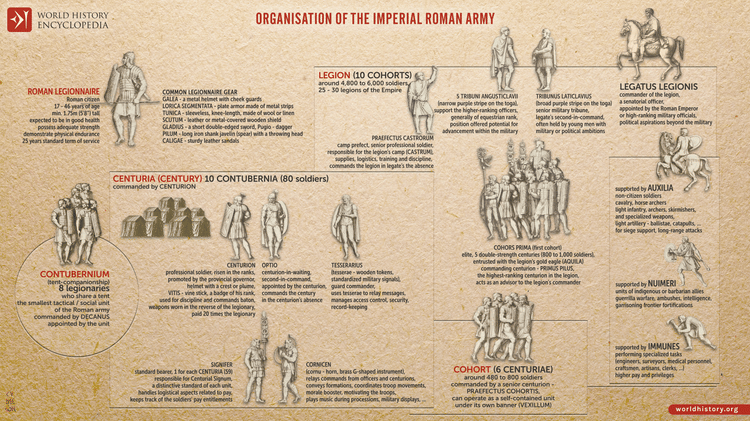 Organizzazione dell'esercito imperiale romano Simeon Netchev (CC BY-NC-ND) ](https://www.worldhistory.org/image/17572/organization-of-the-imperial-roman-army/ "Organization of the Imperial Roman Army")Nel primo periodo repubblicano, la formazione delle truppe prendeva esempio dalla falange greca, tuttavia, dal III al I secolo a.C. le tattiche per lo schieramento della fanteria cambiarono. L’unità più numerosa dell’esercito romano era la legione composta da 4.200 uomini ripartiti in 30 divisioni o manipoli, schierati su tre linee (*hastati*, *principes* e *triarii*, ovvero i veterani) disposte a scacchiera (*quinconce*). A precedere la legione si trovavano altri 800-1200 soldati (*veliti*) armati alla leggera, spesso inviati dagli alleati di Roma, con 300 cavalieri posizionati a supporto. I due gruppi venivano utilizzati come schermo protettivo per le legioni di fanteria pesante, nonché per disturbare il nemico dai lati, nel caso di attacco frontale alle legioni. Nel I secolo a.C. entrambi i gruppi scomparvero dall’esercito, tuttavia, la cavalleria tornò in auge durante il periodo imperiale. Potevano essere impiegate, inoltre, truppe mercenarie, come arcieri cretesi e frombolieri di Rodi, i quali possedevano abilità che mancavano ai romani.
I manipoli erano mobili, disposti in formazione serrata e potevano ruotare l’attacco contro il nemico per permettere alle truppe fresche di entrare in battaglia. La manovrabilità veniva favorita dall’utilizzo di armi più leggere - spada corta o *glaudius Hispaniensis*, giavellotto *pilum* al posto della pesante lancia tradizionale e lo scudo concavo con impugnatura centrale o *scutum*. Venne riconosciuto inoltre che il terreno poteva essere un importante elemento per favorire o ostacolare i movimenti delle truppe. Le truppe furono addestrate ad utilizzare bene il tipo di armi a disposizione e ad eseguire complicate manovre di battaglia, nonostante la durata e l’intensità di addestramento dipendessero molto dai singoli comandanti.
A partire dal 100 a.C. (forse ancora prima) il manipolo venne abbandonato e la legione suddivisa in 10 coorti da 400 o 500 uomini, le quali sarebbero rimaste l’unità tattica di base dei romani. In questo periodo, le legioni assunsero nomi e identità permanenti e furono equipaggiate dallo Stato. Nel 167 a.C. le legioni erano 8, tuttavia, da lì al 50 a.C. sarlirono a 15 circa. Nel 31 a.C., Augusto creò per la prima volta un esercitò permanente e professionale, con una struttura centrale logistica e di comando. Una tale forza permanente composta da 300.000 uomini spianò la strada ai vasti eserciti dei secoli successivi, periodo in cui in tutto l’impero vi erano 25-30 legioni. Nel 6 d.C. l’imperatore creò inoltre un fondo apposta per l’esercito (*aerarium militare*), finanziato dalle tasse e che consentiva un sistema di pensionamento. Un’ulteriore politica messa in atto da Augusto fu di assicurare la lealtà limitando accuratamente i posti di comando alla cerchia imperiale.
### Motivare le truppe
Le truppe prestavano giuramento di fedeltà, *sacramentum*, all’imperatore stesso. Il giuramento costituiva l’elemento principale per garantire la fedeltà e incoraggiare la disciplina – *disciplina militaris* – per la quale le forze armate romane divennero famose già a partire dalla prima Repubblica e che portò a molte vittorie sul campo di battaglia. La disciplina veniva ulteriormente garantita grazie ad un sistema di premi e punizioni. I soldati potevano ricevere riconoscimenti, denaro, bottini e promozioni per aver dato prova di coraggio e iniziativa. La mancanza di ricompense e un servizio eccessivamente lungo privo di ferie, tuttavia, potevano essere causa di rimostranze che talvolta si trasformavano in ammutinamento. Le punizioni assumevano molteplici forme e potevano essere messe in atto non solo nel caso di ammutinamento, ma anche per mancata dimostrazione di coraggio in battaglia. La punizione della decimazione, in particolare, veniva solitamente inflitta in caso di codardia, come abbandonare il corpo di un combattente caduto. In tal caso, dopo aver tirato a sorte, un soldato ogni dieci veniva ucciso a bastonate dagli altri nove. Tra le altre punizioni figuravano la perdita del bottino, della paga o del grado, la fustigazione, il congedo con disonore, la vendita in schiavitù o persino l’esecuzione. Il principio era che una volta infranto il giuramento di fedeltà venivano meno tutti i diritti.
[  Centurione Luc Viatour / www.Lucnix.be (CC BY-NC-SA) ](https://www.worldhistory.org/image/2736/centurion/ "Centurion")### Strategie
I *Commentari sulla guerra gallica* di Giulio Cesare descrivono l’attenzione che il grande comandante riservava alla logistica, alla risolutezza e all’apparente sicurezza e l'impatto positivo che queste ultime avevano sul morale delle truppe. Giulio Cesare sottolinea inoltre l’importanza dell’innovazione, del patriottismo, della disciplina e della buona sorte. Un comandante, inoltre, poteva aumentare notevolmente le probabilità di successo prima della battaglia carpendo informazioni militari sul nemico da prigionieri, dissidenti e disertori. I comandanti potevano covocare (come fece Cesare stesso) un *consilium* o consiglio di guerra con gli ufficiali per illustrare e discutere le strategie di attacco e avvalersi dell’esperienza dei veterani che prendevano parte alle battaglie. La combinazione di tali fattori garantì secoli di dominio militare romano. Lungo il cammino numerose furono le sconfitte, tuttavia, è interessante notare che i comandanti spesso sfuggivano alle ripercussioni causate della propria incompetenza militare ed erano i soldati di solito a prendersi la colpa della sconfitta.
I comandanti romani preferivano in genere un attacco aggressivo e frontale (anche se preceduto da un’adeguata ricognizione da parte di un’avanguardia composta da truppe d'esplorazione, *exploratores*), mentre per sottomettere le popolazioni locali facevano ricorso anche a tattiche di terrore e vendetta, una strategia associata alla *clementia* – accogliere ostaggi e promesse di pace dai nemici. Dal I a.C. venne incrementato l’utilizzo di fortificazioni e trinceramenti sul campo di battaglia e assedi. Dal III secolo a.C. la difesa dei confini imperiali divenne una priorità e portò alla fortificazione delle città e ad un dispiego più agevole di piccole unità di truppe (*vexillationes*) composte dai 500 ai 1.000 uomini. In gran parte, tale situazione era dovuta al fatto che le forze nemiche temevano i potenti attacchi dei romani e preferivano, di conseguenza, tattiche di guerriglia. Giulio Cesare era altresì un convinto sostenitore degli assedi, i quali di fatto presentavano alcuni vantaggi. Una forza avversaria poteva essere fortemente ridotta in un solo colpo, così facendo la popolazione locale veniva terrorizzata a tal punto da accettare Roma come nuovo dominatore e, in caso di successo, acquisire una roccaforte già pronta.
[  Ricostruzione di una balista romana Oren Rozen (GNU FDL) ](https://www.worldhistory.org/image/2284/roman-ballista-reconstruction/ "Roman Ballista Reconstruction")### Assedi
Durante un assedio tradizionale le forze venivano inviate in anticipo per circondare l’insediamento da attaccare ed evitare che qualcuno potesse fuggire. La forza principale costruiva un accampamento fortificato fuori dalla linea di fuoco della città, preferibilmente su un’altura, il che garantiva un buon punto di osservazione all’interno dell’insediamento, permettendo di individuare obbiettivi chiave, come l’approvvigionamento idrico. Una volta sferrato l’attacco, le mura del difensore potevano essere superate grazie l’utilizzo di una rampa fatta di alberi, terra e rocce. Durante questa operazione gli assalitori sarebbero stati protetti da coperture temporanee e dal fuoco di copertura proveniente da batterie di catapulte a torsione, lanciatori di bulloni, lanciatori di pietre e arcieri. I difensori potevano cercare di estendere l’altezza del tratto di mura sotto attacco e persino aggiungere delle torri. Gli assalitori potevano attaccare le mura anche con pesanti arieti (sospesi su un’intelaiatura) e utilizzare torri d’assedio. I difensori lanciavano contro gli assalitori tutto ciò che avevano a disposizione, come olio in fiamme, pezzi di legno o rocce incandescenti e potevano anche cercare di indebolire rampe e torri d’assedio scavando un tunnel, tecnica che poteva essere utilizzata anche dagli assalitori per minare le mura difensive. In genere, a conquista avvenuta, solo donne e bambini potevano sperare di sopravvivere, dal momento che era necessario dare prova dell'inutilità di una resistenza prolungata.
### Logistica
L'esercito imperiale in marcia era prima di tutto ben ordinato. Oltre ai legionari, la truppa poteva includere cavalleria, arcieri, ausiliari, artiglieria, arieti, portabandiera, trombettieri, servi, muli per i bagagli, fabbri, ingegneri, geometri e costruttori di strade. Una volta giunto a destinazione, l'esercito allestiva un campo fortificato che, grazie alle capacità logistiche dei Romani, poteva essere rifornito indipendentemente dal territorio locale, soprattutto in termini di cibo. Una volta raggiunto l'accampamento, i rifornimenti venivano conservati in magazzini appositi (*horrea*) che, costruiti su palafitte e ben ventilati, permettevano una migliore conservazione dei beni deperibili. Le scorte di cibo erano a riparo dal nemico numero uno - il ratto nero – dai gatti che, per la stessa ragione, venivano utilizzati anche sulle navi.
Tra le innovazioni del periodo imperiale, troviamo l'introduzione dei medici e degli assistenti medici (*capsarii*), che furono assegnati per la maggior parte alle unità militari. All’interno degli accampamenti fortificati, esistevano anche ospedali militari (*valetudinarium*).
[  Approdo navale The Creative Assembly (Copyright) ](https://www.worldhistory.org/image/1341/naval-landing/ "Naval Landing")### Guerra navale
Le tattiche navali romane differivano poco dai metodi messi in pratica dai Greci. Le navi erano spinte da rematori e vele per permettere il trasporto delle truppe e, durante le battaglie navali, le imbarcazioni si trasformavano in arieti sfruttando quelli rivestiti in bronzo fissati sulla prua della nave. L’impiego di navi da guerra da parte di Roma risaliva già alla prima Repubblica, tuttavia, soltanto nel 260 a.C. venne costruita la prima imponente flotta, costituita da 100 quinqueremi e 20 triremi, in risposta alla minaccia di Cartagine. Le quinqueremi, composte da cinque ordini di rematori, erano dotate di un ponte utilizzato per bloccare le navi nemiche in modo che potessero essere abbordate, un tale congegno era noto come *corvus* (corvo). Alla fine i Romani sconfissero la flotta cartaginese, soprattutto perché in grado di sostituire più rapidamente le navi e gli uomini persi. Roma riunì nuovamente una flotta quando Pompeo attaccò Panfilia e Cilicia nel 67 a.C. (una campagna che Plutarco identifica come la sconfitta della pirateria) e in seguito nel 36 a.C. quando Marco Agrippa radunò quasi 400 navi per attaccare la Sicilia e la flotta di Sesto Pompeo Magno. Alcune navi di Agrippa erano dotate di un nuovo rampino lanciato da una catapulta che, con l'aiuto di un argano, veniva utilizzato per attirare una nave nemica e abbordarla.
Nel 31 a.C. si svolse la grande battaglia navale presso Azio tra le flotte di Ottaviano e di Marco Antonio e [Cleopatra](https://www.worldhistory.org/trans/it/1-866/cleopatra/). A seguito della vittoria, il nuovo imperatore Augusto istituì due flotte: la *classis Ravennatium* di base a Ravenna e la *classis Misenatium* la cui base era situata a Misenum, le quali operarono fino al IV secolo d.C.. Vi erano inoltre flotte con base ad Alessandria, Antiochia, Rodi, Sicilia, Libia e Britannia, nonché una che operava sul Reno e altre due sul Danubio. La presenza di tali flotte permetteva a Roma di far rapidamente fronte a qualsiasi esigenza militare in tutto l'[impero](https://www.worldhistory.org/trans/it/1-99/impero/) e di rifornire l'esercito nel corso delle varie campagne.
Le flotte erano comandate da un prefetto (*praefectus*) nominato dall'imperatore. Il capitano di una nave deteneva il grado di centurione o il titolo di *trierarca*. Le flotte facevano base in porti fortificati, come Portus Julius in Campania, che includeva porti artificiali e lagune collegate da gallerie. Gli equipaggi delle navi militari romane erano composti, in realtà, più da soldati che da marinai, dal momento che ci si aspettava che agissero come truppe terrestri armate alla leggera, quando necessario. Di solito venivano reclutati sul posto e scelti tra le classi più povere, tuttavia, potevano anche essere assoldati prigionieri di guerra e schiavi.
[  Parata della vittoria romana The Creative Assembly (Copyright) ](https://www.worldhistory.org/image/1214/roman-victory-procession/ "Roman Victory Procession")### Il bottino del vincitore
La vittoria sul campo permise di conquistare nuovi territori, di acquisire ricchezze e risorse, persuadere i nemici a negoziare la pace, nonché rendere chiaro che Roma avrebbe difeso le proprie frontiere e che possedeva un’insaziabile sete di espansione, dando prova inconfutabile di quanto fosse formidabile la macchina da combattimento che i romani potevano mettere in campo di battaglia.
Nella Repubblica le armi nemiche potevano essere bruciate e offerte agli dei, in particolare, Marte, [Minerva](https://www.worldhistory.org/trans/it/1-12417/minerva/) e Vulcano. I comandanti vittoriosi facevano ritorno a Roma da eroi in un corteo trionfale e nel corso dei secoli se ne contarono oltre 300. Il trionfo veniva prima approvato e finanziato dal Senato. Il comandante entrava in città a bordo di un carro accompagnato da un sontuoso corteo che comprendeva prigionieri, tesori quali oro, opere d’arte e persino animali esotici provenienti dai territori conquistati. Il comandante indossava abiti porpora (*toga picta* e *tunica palmata*) e una corona di alloro, impugnava uno scettro d'avorio e un ramo d'alloro, e dietro di sé uno schiavo gli reggeva in testa una corona d'oro e sussurrava: "Guarda indietro" (*Respice*) per ricordargli i pericoli dell'orgoglio e dell'arroganza. A partire dal periodo augusteo solo gli imperatori potevano godere del trionfo, tuttavia, col tempo, la pratica divenne molto meno frequente.
I comandanti vittoriosi utilizzarono il bottino di guerra per abbellire Roma, come accadde per il teatro di Pompeo, il foro di Augusto e il [Colosseo](https://www.worldhistory.org/trans/it/1-10001/colosseo/) di Vespasiano. Tra le altre opere architettoniche che servirono a celebrare la vittoria vi furono obelischi e colonne; tuttavia il monumento più emblematico della vanità militare dei romani fu l’arco di trionfo, il più grande e decorativo dei quali fu quello di [Costantino I](https://www.worldhistory.org/trans/it/1-699/costantino-i/) a Roma.
### Conclusione
Le forze armate di Roma rappresentavano la spesa più ingente per lo Stato, tuttavia, i territori, le risorse, le ricchezze e gli schiavi conquistati, nonché la successiva necessità di difendere le frontiere, facevano sì che la guerra fosse una preoccupazione inevitabile per i romani. Roma poteva godere dei grandi successi in battaglia, tuttavia, anche le sconfitte ne potevano minare le fondamenta, dal momento che abili avversari iniziavano ad utilizzare le vincenti strategie romane a proprio vantaggio. Inoltre, man mano che le capacità militari di Roma acquisivano maggiore notorietà, diventava sempre più difficile per l'esercito romano affrontare direttamente il nemico. I Romani, tuttavia, nel corso di molti secoli e attraverso tre continenti, avevano dimostrato che un esercito ben addestrato e ben disciplinato, se sfruttato appieno da comandanti dotati, poteva godere immensi benefici; fu soltanto ad un millennio dalla caduta dell'impero che la guerra tornò alla grandezza e alla professionalità che Roma aveva portato sul campo di battaglia.
#### Editorial Review
This human-authored definition has been reviewed by our editorial team before publication to ensure accuracy, reliability and adherence to academic standards in accordance with our [editorial policy](https://www.worldhistory.org/static/editorial-policy/).
## Bibliografia
- [Barchiesi, A. *The Oxford Handbook of Roman Studies.* Oxford University Press, USA, 2010.](https://www.worldhistory.org/books/0199211523/)
- [Caesar. *The Conquest of Gaul.* Penguin Classics, 1983.](https://www.worldhistory.org/books/0140444335/)
- [Campbell, B. (ed). *The Oxford Handbook of Warfare in the Classical World.* Oxford University Press, USA, 2013.](https://www.worldhistory.org/books/0195304659/)
- [Hornblower, S. *The Oxford Classical Dictionary.* Oxford University Press, USA, 2012.](https://www.worldhistory.org/books/0199545561/)
- [Oleson, J.P. *The Oxford Handbook of Engineering and Technology in the Classical World.* Oxford University Press, USA, 2009.](https://www.worldhistory.org/books/0199734852/)
- [Potter, D.S. (ed). *A Companion to the Roman Empire.* Wiley-Blackwell, 2010.](https://www.worldhistory.org/books/1405199180/)
## Info autore
Mark è uno scrittore a tempo pieno oltre che ricercatore, storico ed editore. Altri suoi interessi riguardano l'arte, l'architettura, e la scoperta delle idee che le civiltà condividono. Laureato in filosofia politica (Università di York), è direttore editoriale della World History Encyclopedia.
## Cronologia
- **750 BCE - 510 BCE**: The semi-legendary celeres or trossuli - a 300-man cavalry corps which the first kings of [Rome](https://www.worldhistory.org/Rome/) incorporated into the legion - is formed, later their number is increased to 600.
- **578 BCE - 535 BCE**: Servius Tullius, the king of [Rome](https://www.worldhistory.org/Rome/), increases the number of the cavalry corps (equites) to 1,800.
- **c. 508 BCE**: [Lars Porsenna](https://www.worldhistory.org/Lars_Porsenna/), [Etruscan](https://www.worldhistory.org/Etruscan_Civilization/) king of [Chiusi](https://www.worldhistory.org/Chiusi/), lays siege to [Rome](https://www.worldhistory.org/Rome/).
- **498 BCE - 493 BCE**: [Rome](https://www.worldhistory.org/Rome/) defeats the Latins.
- **437 BCE - 435 BCE**: [Rome](https://www.worldhistory.org/Rome/) defeats [Etruscan](https://www.worldhistory.org/Etruscan_Civilization/) [Veii](https://www.worldhistory.org/Veii/) in the Veientine [War](https://www.worldhistory.org/disambiguation/War/); the Etruscan king Lars Tolumnius is killed.
- **c. 400 BCE**: The [Roman cavalry](https://www.worldhistory.org/Roman_Cavalry/) is expanded to include riders who can pay for their own horse.
- **396 BCE**: [Rome](https://www.worldhistory.org/Rome/) sacks the [Etruscan](https://www.worldhistory.org/Etruscan_Civilization/) town of [Veii](https://www.worldhistory.org/Veii/) after a ten-year siege.
- **396 BCE**: [Roman](https://www.worldhistory.org/disambiguation/Roman/) expansion begins with the capture of [Veii](https://www.worldhistory.org/Veii/) from the [Etruscans](https://www.worldhistory.org/Etruscan_Civilization/).
- **390 BCE**: Gauls sack [Rome](https://www.worldhistory.org/Rome/).
- **c. 390 BCE**: "Gallic Catastrophe:" [Brennus](https://www.worldhistory.org/brennus/) of the Senones defeats the Romans at Allia, and subsequently sacks [Rome](https://www.worldhistory.org/Rome/).
- **356 BCE**: 307 [Roman](https://www.worldhistory.org/disambiguation/Roman/) prisoners are sacrificed in the forum of the [Etruscan](https://www.worldhistory.org/Etruscan_Civilization/) [city](https://www.worldhistory.org/city/) of [Tarquinia](https://www.worldhistory.org/Tarquinia/).
- **343 BCE - 341 BCE**: First Samnite [War](https://www.worldhistory.org/disambiguation/War/) ([Rome](https://www.worldhistory.org/Rome/) vs. Samnites).
- **326 BCE - 304 BCE**: Second Samnite [War](https://www.worldhistory.org/disambiguation/War/).
- **298 BCE - 290 BCE**: Third Samnite [War](https://www.worldhistory.org/disambiguation/War/). Victory for [Rome](https://www.worldhistory.org/Rome/), peace with the [Etruscans](https://www.worldhistory.org/Etruscan_Civilization/).
- **298 BCE - 290 BCE**: Third Samnite [War](https://www.worldhistory.org/disambiguation/War/) between [Rome](https://www.worldhistory.org/Rome/) and the Samnite people.
- **297 BCE**: [Celts](https://www.worldhistory.org/celt/) and Samnites join forces and defeat the Romans at Camertium.
- **c. 295 BCE**: In a [battle](https://www.worldhistory.org/disambiguation/battle/) lasting all day, Romans narrowly defeat a force of [Celts](https://www.worldhistory.org/celt/) and Samnites at Sentinum.
- **295 BCE**: [Roman](https://www.worldhistory.org/disambiguation/Roman/) victory over Samnites, Gauls and Umbrians at Sentinum.
- **294 BCE**: A [Roman army](https://www.worldhistory.org/Roman_Army/) led by L. Postimius Megellus defeats an army from [Etruscan](https://www.worldhistory.org/Etruscan_Civilization/) [Volsinii](https://www.worldhistory.org/volsinii/).
- **285 BCE - 282 BCE**: [Rome](https://www.worldhistory.org/Rome/) defeats the [Celts](https://www.worldhistory.org/celt/) in [Italy](https://www.worldhistory.org/italy/). Rome's dominance in central Italy is secured.
- **284 BCE**: Gauls of the Insubres and Boii tribes defeat the Romans at [Arretium](https://www.worldhistory.org/arretium/).
- **283 BCE**: [Rome](https://www.worldhistory.org/Rome/) decisively defeats the Senones at Picenum.
- **280 BCE**: The Romans [conquer](https://www.worldhistory.org/warfare/) the [Etruscan](https://www.worldhistory.org/Etruscan_Civilization/) [cities](https://www.worldhistory.org/city/) of [Tarquinia](https://www.worldhistory.org/Tarquinia/), [Volsinii](https://www.worldhistory.org/volsinii/) and [Vulci](https://www.worldhistory.org/Vulci/).
- **280 BCE - 275 BCE**: King [Pyrrhus](https://www.worldhistory.org/pyrrhus/) of Epirus wages the Pyrrhic [War](https://www.worldhistory.org/disambiguation/War/) against the Romans in [Italy](https://www.worldhistory.org/italy/), defence of [Tarentum](https://www.worldhistory.org/tarentum/) being the pretext.
- **280 BCE - 272 BCE**: [Roman](https://www.worldhistory.org/disambiguation/Roman/) [war](https://www.worldhistory.org/disambiguation/War/) against [Tarentum](https://www.worldhistory.org/tarentum/). [Rome](https://www.worldhistory.org/Rome/) conquers Tarentum. Rome's dominance in lower [Italy](https://www.worldhistory.org/italy/) is secured.
- **Jul 280 BCE**: [Pyrrhus](https://www.worldhistory.org/pyrrhus/) defeats the Romans at the [Battle](https://www.worldhistory.org/disambiguation/battle/) of Heraclea.
- **279 BCE**: [Pyrrhus](https://www.worldhistory.org/pyrrhus/) defeats the Romans at the [Battle](https://www.worldhistory.org/disambiguation/battle/) of Asculum.
- **275 BCE**: The Romans defeat [Pyrrhus](https://www.worldhistory.org/pyrrhus/) of Epirus at the [Battle](https://www.worldhistory.org/disambiguation/battle/) of Maleventum.
- **273 BCE**: [Rome](https://www.worldhistory.org/Rome/) conquers the [Etruscan](https://www.worldhistory.org/Etruscan_Civilization/) town of [Cerveteri](https://www.worldhistory.org/Cerveteri/).
- **264 BCE**: The Mamertines at Messana on [Sicily](https://www.worldhistory.org/sicily/) call for Carthaginian and then [Roman](https://www.worldhistory.org/disambiguation/Roman/) help in defence against [Syracuse](https://www.worldhistory.org/syracuse/), sparking the [First Punic War](https://www.worldhistory.org/First_Punic_War/).
- **264 BCE - 241 BCE**: [First Punic War](https://www.worldhistory.org/First_Punic_War/). [Carthage](https://www.worldhistory.org/carthage/) cedes [Sicily](https://www.worldhistory.org/sicily/) to [Rome](https://www.worldhistory.org/Rome/).
- **262 BCE**: [Rome](https://www.worldhistory.org/Rome/) besieges and sacks [Agrigento](https://www.worldhistory.org/agrigento/) on [Sicily](https://www.worldhistory.org/sicily/) in one of the first actions of the [First Punic War](https://www.worldhistory.org/First_Punic_War/).
- **260 BCE**: First [Roman](https://www.worldhistory.org/disambiguation/Roman/) naval victory against [Carthage](https://www.worldhistory.org/carthage/) off Mylae in the [First Punic War](https://www.worldhistory.org/First_Punic_War/).
- **260 BCE**: [Rome](https://www.worldhistory.org/Rome/) builds a fleet of 120 ships in just 60 days to fight the [First Punic War](https://www.worldhistory.org/First_Punic_War/).
- **258 BCE**: [Rome](https://www.worldhistory.org/Rome/) wins a naval [battle](https://www.worldhistory.org/disambiguation/battle/) against [Carthage](https://www.worldhistory.org/carthage/) at Sulcis during the [First Punic War](https://www.worldhistory.org/First_Punic_War/).
- **256 BCE**: [Roman](https://www.worldhistory.org/disambiguation/Roman/) naval victory against [Carthage](https://www.worldhistory.org/carthage/) off Ecnomus during the [First Punic War](https://www.worldhistory.org/First_Punic_War/).
- **256 BCE**: [Rome](https://www.worldhistory.org/Rome/) lands an army of four legions on African soil at Clupea during the [First Punic War](https://www.worldhistory.org/First_Punic_War/).
- **256 BCE**: [Rome](https://www.worldhistory.org/Rome/) wins a land [battle](https://www.worldhistory.org/disambiguation/battle/) south of Tunis during the [First Punic War](https://www.worldhistory.org/First_Punic_War/).
- **255 BCE**: A Carthaginain army led by the mercenary Spartan commander Xanthippus defeats two [Roman](https://www.worldhistory.org/disambiguation/Roman/) legions near Tunis during the [First Punic War](https://www.worldhistory.org/First_Punic_War/).
- **255 BCE - 253 BCE**: [Roman](https://www.worldhistory.org/disambiguation/Roman/) fleets are wrecked by storms off Pachynus and Palinurus during the [First Punic War](https://www.worldhistory.org/First_Punic_War/).
- **c. 250 BCE - c. 200 CE**: Originally a Celtiberian weapon, the [Gladius Hispaniensis](https://www.worldhistory.org/Gladius_Hispaniensis/) was commonly used by [Roman](https://www.worldhistory.org/disambiguation/Roman/) soldiers for more than four centuries.
- **Jun 250 BCE**: A [Carthaginian army](https://www.worldhistory.org/Carthaginian_Army/) led by Hasdrubal is defeated by [Roman](https://www.worldhistory.org/disambiguation/Roman/) [consul](https://www.worldhistory.org/Consul/) Metellus near Palermo in the [First Punic War](https://www.worldhistory.org/First_Punic_War/).
- **249 BCE**: [Carthage](https://www.worldhistory.org/carthage/) defeats [Rome](https://www.worldhistory.org/Rome/) in a naval [battle](https://www.worldhistory.org/disambiguation/battle/) at Drepanum during the [First Punic War](https://www.worldhistory.org/First_Punic_War/).
- **241 BCE**: [Roman](https://www.worldhistory.org/disambiguation/Roman/) naval victory off the Aegates Islands leads to victory over [Carthage](https://www.worldhistory.org/carthage/), ending the [First Punic War](https://www.worldhistory.org/First_Punic_War/).
- **229 BCE - 228 BCE**: [Rome](https://www.worldhistory.org/Rome/) fights Illyrian pirates. Queen Teuta pays tribute to Rome.
- **223 BCE**: Romans successfully campaign against [Celtic](https://www.worldhistory.org/celt/) tribes of Cisalpine [Gaul](https://www.worldhistory.org/gaul/).
- **222 BCE**: [Rome](https://www.worldhistory.org/Rome/) conquers Cisalpine [Gaul](https://www.worldhistory.org/gaul/) (modern-day Provence, France).
- **219 BCE**: [Hannibal](https://www.worldhistory.org/hannibal/) crosses the Ebro river in Spain and sacks the [city](https://www.worldhistory.org/city/) of [Saguntum](https://www.worldhistory.org/Saguntum/), [Rome](https://www.worldhistory.org/Rome/)'s ally, sparking off the [Second Punic War](https://www.worldhistory.org/Second_Punic_War/).
- **218 BCE - 201 BCE**: [Second Punic War](https://www.worldhistory.org/Second_Punic_War/).
- **Mar 218 BCE**: [Rome](https://www.worldhistory.org/Rome/) declares [war](https://www.worldhistory.org/disambiguation/War/) on [Carthage](https://www.worldhistory.org/carthage/) after [Hannibal](https://www.worldhistory.org/hannibal/) sacks [Saguntum](https://www.worldhistory.org/Saguntum/) in Spain. The [Second Punic War](https://www.worldhistory.org/Second_Punic_War/) begins.
- **Apr 218 BCE - May 218 BCE**: [Hannibal](https://www.worldhistory.org/hannibal/) leaves Spain to cross the Pyrenees and Alps into [Italy](https://www.worldhistory.org/italy/).
- **Nov 218 BCE**: [Hannibal](https://www.worldhistory.org/hannibal/) wins the [battle](https://www.worldhistory.org/disambiguation/battle/) of Ticinus.
- **Dec 218 BCE**: [Hannibal](https://www.worldhistory.org/hannibal/) wins the [battle](https://www.worldhistory.org/disambiguation/battle/) of Trebia.
- **Jun 217 BCE**: [Hannibal](https://www.worldhistory.org/hannibal/) wins the [battle](https://www.worldhistory.org/disambiguation/battle/) of Lake Trasimene.
- **Aug 216 BCE**: [Hannibal](https://www.worldhistory.org/hannibal/) wins the [battle of Cannae](https://www.worldhistory.org/Battle_of_Cannae/), the worst defeat in [Roman](https://www.worldhistory.org/disambiguation/Roman/) history.
- **215 BCE**: A [Carthaginian army](https://www.worldhistory.org/Carthaginian_Army/) led by Hasdrubal is defeated at the [battle](https://www.worldhistory.org/disambiguation/battle/) of Ibera in Spain.
- **214 BCE - 205 BCE**: First Macedonian [War](https://www.worldhistory.org/disambiguation/War/): [Rome](https://www.worldhistory.org/Rome/) defeats Philip V of [Macedon](https://www.worldhistory.org/macedon/).
- **212 BCE**: A [Carthaginian army](https://www.worldhistory.org/Carthaginian_Army/) is defeated in [Sicily](https://www.worldhistory.org/sicily/) by a [Roman army](https://www.worldhistory.org/Roman_Army/) led by Marcellus. [Syracuse](https://www.worldhistory.org/syracuse/) falls to [Rome](https://www.worldhistory.org/Rome/) who now control the island.
- **211 BCE**: A [Carthaginian army](https://www.worldhistory.org/Carthaginian_Army/) defeats two [Roman](https://www.worldhistory.org/disambiguation/Roman/) consuls and their armies in the Tader valley, Spain.
- **210 BCE - 207 BCE**: [Scipio Africanus](https://www.worldhistory.org/disambiguation/Scipio_Africanus/) conquers Spain for [Rome](https://www.worldhistory.org/Rome/).
- **209 BCE**: [Scipio Africanus](https://www.worldhistory.org/disambiguation/Scipio_Africanus/) captures the Carthaginian base and treasury [Carthago Nova](https://www.worldhistory.org/Carthago_Nova/) in southern Spain.
- **208 BCE**: [Scipio Africanus](https://www.worldhistory.org/disambiguation/Scipio_Africanus/) defeats a [Carthaginian army](https://www.worldhistory.org/Carthaginian_Army/) led by Hasdrubal at Baecula in Spain.
- **207 BCE**: [Hannibal](https://www.worldhistory.org/hannibal/), harassed by [Roman](https://www.worldhistory.org/disambiguation/Roman/) forces, is reduced to controlling only Bruttium in southern [Italy](https://www.worldhistory.org/italy/).
- **c. 22 Jun 207 BCE**: [Rome](https://www.worldhistory.org/Rome/) defeats a [Carthaginian army](https://www.worldhistory.org/Carthaginian_Army/) at the [battle](https://www.worldhistory.org/disambiguation/battle/) of Metaurus.
- **206 BCE**: [Scipio Africanus](https://www.worldhistory.org/disambiguation/Scipio_Africanus/) wins the [battle](https://www.worldhistory.org/disambiguation/battle/) of Ilipa in Spain.
- **204 BCE**: [Scipio Africanus](https://www.worldhistory.org/disambiguation/Scipio_Africanus/) sails to North [Africa](https://www.worldhistory.org/disambiguation/africa/) in the [Second Punic War](https://www.worldhistory.org/Second_Punic_War/).
- **204 BCE - 203 BCE**: [Scipio Africanus](https://www.worldhistory.org/disambiguation/Scipio_Africanus/) wins two battles and besieges [Utica](https://www.worldhistory.org/Utica/) in North [Africa](https://www.worldhistory.org/disambiguation/africa/).
- **203 BCE**: Carthaginian commander Mago is unable to join forces with [Hannibal](https://www.worldhistory.org/hannibal/) and his army is defeated in Cisalpine [Gaul](https://www.worldhistory.org/gaul/).
- **203 BCE**: [Scipio Africanus](https://www.worldhistory.org/disambiguation/Scipio_Africanus/) defeats a [Carthaginian army](https://www.worldhistory.org/Carthaginian_Army/) led by Hasdrubal in North [Africa](https://www.worldhistory.org/disambiguation/africa/).
- **203 BCE**: [Hannibal](https://www.worldhistory.org/hannibal/) is recalled from [Italy](https://www.worldhistory.org/italy/) to defend [Carthage](https://www.worldhistory.org/carthage/) against [Scipio Africanus](https://www.worldhistory.org/disambiguation/Scipio_Africanus/).
- **19 Oct 202 BCE**: [Battle](https://www.worldhistory.org/disambiguation/battle/) of Zama: [Scipio Africanus](https://www.worldhistory.org/disambiguation/Scipio_Africanus/) defeats [Hannibal](https://www.worldhistory.org/hannibal/), ending the [Second Punic War](https://www.worldhistory.org/Second_Punic_War/).
- **200 BCE - 196 BCE**: Second Macedonian [War](https://www.worldhistory.org/disambiguation/War/): [Roman](https://www.worldhistory.org/disambiguation/Roman/) victory.
- **197 BCE**: Romans are victorious over Philip V of [Macedon](https://www.worldhistory.org/macedon/) at Cynoscephalae.
- **194 BCE**: Romans defeat Antiochus III at [Battle](https://www.worldhistory.org/disambiguation/battle/) of Magnesia.
- **193 BCE**: The Boii are defeated by the Romans, suffering, according to [Livy](https://www.worldhistory.org/livy/), 14,000 dead.
- **190 BCE**: [Battle](https://www.worldhistory.org/disambiguation/battle/) of Magnesia ad Sipylum, disastrous defeat for [Antiochos](https://www.worldhistory.org/disambiguation/antiochos/) III against Romans.
- **172 BCE - 168 BCE**: Third Macedonian [War](https://www.worldhistory.org/disambiguation/War/): [Perseus](https://www.worldhistory.org/Perseus/) of [Macedon](https://www.worldhistory.org/macedon/) challenges [Rome](https://www.worldhistory.org/Rome/) and is defeated.
- **Jun 168 BCE**: Romans defeat [Perseus](https://www.worldhistory.org/Perseus/) of [Macedon](https://www.worldhistory.org/macedon/) at Pydna.
- **150 BCE**: The Lusitani are betrayed and slaughtered by the Romans.
- **149 BCE**: [Rome](https://www.worldhistory.org/Rome/) sends an army of 80,000 infantry and 4,000 cavalry to attack [Carthage](https://www.worldhistory.org/carthage/).
- **149 BCE - 146 BCE**: [Third Punic War](https://www.worldhistory.org/Third_Punic_War/).
- **148 BCE**: The [Roman](https://www.worldhistory.org/disambiguation/Roman/) siege of [Carthage](https://www.worldhistory.org/carthage/), in its second year, remains unsuccessful.
- **147 BCE**: [Viriathus](https://www.worldhistory.org/Viriathus/) leads the Lusitani in victory against the Romans.
- **146 BCE**: [Viriathus](https://www.worldhistory.org/Viriathus/) leads the Lusitani to a second victory against a [Roman army](https://www.worldhistory.org/Roman_Army/), capturing Segobriga in Spain.
- **146 BCE**: [Scipio Africanus](https://www.worldhistory.org/disambiguation/Scipio_Africanus/) the Younger sacks [Carthage](https://www.worldhistory.org/carthage/) and enslaves its population.
- **133 BCE**: [Rome](https://www.worldhistory.org/Rome/) captures Numantia. End of Iberian resistance.
- **113 BCE**: Romans defeated at Noreia by the [Cimbri](https://www.worldhistory.org/Cimbri/).
- **107 BCE - 100 BCE**: [Gaius Marius](https://www.worldhistory.org/Gaius_Marius/) reforms the [Roman army](https://www.worldhistory.org/Roman_Army/).
- **c. 100 BCE**: [Roman cavalry](https://www.worldhistory.org/Roman_Cavalry/) riders are by now classified as auxilia and organised in wings or alae.
- **88 BCE - 63 BCE**: Mithridates of Pontus fights three wars to free [Greece](https://www.worldhistory.org/greece/) from [Rome](https://www.worldhistory.org/Rome/).
- **86 BCE**: The [Roman](https://www.worldhistory.org/disambiguation/Roman/) general [Sulla](https://www.worldhistory.org/sulla/) sacks [Athens](https://www.worldhistory.org/Athens/) and the port of [Piraeus](https://www.worldhistory.org/Piraeus/).
- **82 BCE - 80 BCE**: [Volterra](https://www.worldhistory.org/Volterra/) is besieged and sacked by [Roman](https://www.worldhistory.org/disambiguation/Roman/) general [Sulla](https://www.worldhistory.org/sulla/).
- **69 BCE**: Licinius Lucullus leads a [Roman army](https://www.worldhistory.org/Roman_Army/) which defeats Armenian king [Tigranes II](https://www.worldhistory.org/Tigranes_the_Great/) and his capital [Tigranocerta](https://www.worldhistory.org/Tigranocerta/) is captured. [Artashat](https://www.worldhistory.org/Artashat/) becomes the capital again.
- **67 BCE**: [Pompey](https://www.worldhistory.org/pompey/) assembles a naval fleet and attacks Pamphylia and [Cilicia](https://www.worldhistory.org/Cilicia/), principally to repress [piracy](https://www.worldhistory.org/Piracy/).
- **66 BCE**: [Pompey the Great](https://www.worldhistory.org/pompey/) attacks the Armenian kingdom of [Tigranes II](https://www.worldhistory.org/Tigranes_the_Great/) and makes it a [Roman](https://www.worldhistory.org/disambiguation/Roman/) protectorate.
- **63 BCE**: The [Roman](https://www.worldhistory.org/disambiguation/Roman/) general [Pompey](https://www.worldhistory.org/pompey/) defeats the [Seleucid](https://www.worldhistory.org/Seleucid_Empire/) Antiochus XIII and incorporates [Syria](https://www.worldhistory.org/syria/) as a province of the [Roman empire](https://www.worldhistory.org/Roman_Empire/).
- **58 BCE**: [Caesar](https://www.worldhistory.org/disambiguation/caesar/) attacks the Helvetii while on migration and defeats them.
- **58 BCE - 51 BCE**: [Julius Caesar](https://www.worldhistory.org/Julius_Caesar/)'s [conquest](https://www.worldhistory.org/warfare/) of [Gaul](https://www.worldhistory.org/gaul/).
- **57 BCE**: A [Roman army](https://www.worldhistory.org/Roman_Army/) under [Caesar](https://www.worldhistory.org/disambiguation/caesar/) narrowly defeats an army of Nervii, Atrebates, and Viromandui.
- **56 BCE**: The navies of [Rome](https://www.worldhistory.org/Rome/) and the Veneti Gauls clash resulting in a [Roman](https://www.worldhistory.org/disambiguation/Roman/) victory. This is the first recorded naval [battle](https://www.worldhistory.org/disambiguation/battle/) in the Atlantic Ocean.
- **55 BCE - 54 BCE**: [Julius Caesar](https://www.worldhistory.org/Julius_Caesar/)'s expeditions in [Britain](https://www.worldhistory.org/disambiguation/Britain/).
- **53 BCE**: [Roman](https://www.worldhistory.org/disambiguation/Roman/) general [Marcus Licinius Crassus](https://www.worldhistory.org/Marcus_Licinius_Crassus/) compels [Armenia](https://www.worldhistory.org/armenia/) to provide troops for his campaigns against [Parthia](https://www.worldhistory.org/disambiguation/Parthia/).
- **53 BCE**: [Battle](https://www.worldhistory.org/disambiguation/battle/) of Carrhae. [Crassus](https://www.worldhistory.org/Marcus_Licinius_Crassus/) is captured and executed by the Parthians.
- **52 BCE**: [Julius Caesar](https://www.worldhistory.org/Julius_Caesar/) is defeated at Gergovia by [Vercingetorix](https://www.worldhistory.org/vercingetorix/).
- **52 BCE**: After becoming trapped and besieged at Alesia, [Vercingetorix](https://www.worldhistory.org/vercingetorix/) surrenders to [Caesar](https://www.worldhistory.org/disambiguation/caesar/).
- **49 BCE**: [Julius Caesar](https://www.worldhistory.org/Julius_Caesar/) besieges [Massilia](https://www.worldhistory.org/massilia/).
- **38 BCE**: [Octavian](https://www.worldhistory.org/augustus/) amasses a naval fleet to defeat Sextus [Pompey](https://www.worldhistory.org/pompey/).
- **36 BCE**: [Agrippa](https://www.worldhistory.org/Marcus_Agrippa/) defeats the naval fleet of Sextus [Pompey](https://www.worldhistory.org/pompey/) in the [battle](https://www.worldhistory.org/disambiguation/battle/) of Naulochos.
- **2 Sep 31 BCE**: The [Battle of Actium](https://www.worldhistory.org/Battle_of_Actium/). [Octavian](https://www.worldhistory.org/augustus/) defeats [Mark Antony](https://www.worldhistory.org/Mark_Antony/) and [Cleopatra VII](https://www.worldhistory.org/Cleopatra_VII/).
- **27 BCE - 19 BCE**: Cantabrian Wars: [Roman](https://www.worldhistory.org/disambiguation/Roman/) [conquest](https://www.worldhistory.org/warfare/) of the Iberian Penninsula.
- **6 CE**: [Augustus](https://www.worldhistory.org/augustus/) creates the aerarium militare, a treasury drawn from taxes in order to fund a professional [Roman army](https://www.worldhistory.org/Roman_Army/).
- **9 CE**: The Rhine River is established as the boundary between the Latin and German speaking worlds, following the defeat of the [Roman army](https://www.worldhistory.org/Roman_Army/), under the command of Varus, at the [Battle](https://www.worldhistory.org/disambiguation/battle/) of the Teutoburg Forest.
- **15 CE**: [Germanicus](https://www.worldhistory.org/Germanicus/) leads 12,000 men across the Rhine to attack the Chatti.
- **43 CE**: [Claudius](https://www.worldhistory.org/claudius/) commences the [Roman](https://www.worldhistory.org/disambiguation/Roman/) [conquest](https://www.worldhistory.org/warfare/) of [Britain](https://www.worldhistory.org/disambiguation/Britain/).
- **43 CE**: Maiden Castle, a [Celtic](https://www.worldhistory.org/celt/) hilltop fort in southern [Britain](https://www.worldhistory.org/disambiguation/Britain/), is captured by [Roman](https://www.worldhistory.org/disambiguation/Roman/) legions.
- **54 CE - 60 CE**: [Roman](https://www.worldhistory.org/disambiguation/Roman/) general Corbulo successfully campaigns in [Armenia](https://www.worldhistory.org/armenia/).
- **58 CE - 63 CE**: [Roman](https://www.worldhistory.org/disambiguation/Roman/)-Parthian [War](https://www.worldhistory.org/disambiguation/War/).
- **60 CE - 61 CE**: [Boudicca](https://www.worldhistory.org/Boudicca/)'s Revolt in [Britain](https://www.worldhistory.org/disambiguation/Britain/).
- **70 CE**: The [city](https://www.worldhistory.org/city/) of [Jerusalem](https://www.worldhistory.org/jerusalem/) is besieged and captured by [Rome](https://www.worldhistory.org/Rome/); the Second [Temple](https://www.worldhistory.org/temple/) destroyed.
- **75 CE - 77 CE**: Romans defeat the last of the Northern tribes; [Roman](https://www.worldhistory.org/disambiguation/Roman/) [conquest](https://www.worldhistory.org/warfare/) of [Britain](https://www.worldhistory.org/disambiguation/Britain/) complete.
- **101 CE - 106 CE**: [Trajan](https://www.worldhistory.org/trajan/) conquers [Dacia](https://www.worldhistory.org/dacia/).
- **114 CE**: [Roman emperor](https://www.worldhistory.org/Roman_Emperor/) [Trajan](https://www.worldhistory.org/trajan/) annexes [Armenia](https://www.worldhistory.org/armenia/) and declares [war](https://www.worldhistory.org/disambiguation/War/) on [Parthia](https://www.worldhistory.org/disambiguation/Parthia/).
- **167 CE - 180 CE**: Marcomannic Wars.
- **192 CE**: Emperor [Commodus](https://www.worldhistory.org/commodus/) is murdered, civil [war](https://www.worldhistory.org/disambiguation/War/) ensues (until 197 CE).
- **195 CE**: First Parthian [war](https://www.worldhistory.org/disambiguation/War/).
- **232 CE**: Emperor [Maximinus Thrax](https://www.worldhistory.org/Maximinus_Thrax/) commands a legion in [Egypt](https://www.worldhistory.org/egypt/).
- **293 CE**: Emperor Carausius assassinated by Allectus.
- **312 CE**: [Constantine](https://www.worldhistory.org/disambiguation/Constantine/) defeats Maxentius at Milvian Bridge.
- **Sep 324 CE**: [Constantine I](https://www.worldhistory.org/Constantine_I/) defeats Licinius at Chrysopolis.
- **367 CE**: [Picts](https://www.worldhistory.org/picts/), Scots, [Saxons](https://www.worldhistory.org/Saxons/), and [Franks](https://www.worldhistory.org/Franks/) attack the [Roman Empire](https://www.worldhistory.org/Roman_Empire/).
- **402 CE**: [Alaric](https://www.worldhistory.org/Alaric/) invades [Italy](https://www.worldhistory.org/italy/).
- **410 CE**: The Romans withdraw from [Britain](https://www.worldhistory.org/disambiguation/Britain/).
- **24 Aug 410 CE**: [Alaric](https://www.worldhistory.org/Alaric/) sacks [Rome](https://www.worldhistory.org/Rome/).
- **455 CE**: [Vandals](https://www.worldhistory.org/Vandals/) sack [Rome](https://www.worldhistory.org/Rome/).
- **488 CE - 493 CE**: [Theodoric the Great](https://www.worldhistory.org/Theodoric_the_Great/) of the [Ostrogoths](https://www.worldhistory.org/ostrogoth/) conquers [Italy](https://www.worldhistory.org/italy/).
- **536 CE - 562 CE**: The [Byzantine Empire](https://www.worldhistory.org/Byzantine_Empire/) conquers [Italy](https://www.worldhistory.org/italy/).
- **607 CE - 627 CE**: East [Rome](https://www.worldhistory.org/Rome/) defeats [Sasanian](https://www.worldhistory.org/Sasanian_Empire/) [Persia](https://www.worldhistory.org/Persia/).
## Domande e Risposte
### Quali tattiche usarono i Romani?
L'esercito romano utilizzava diverse tattiche di guerra. La fanteria romana veniva schierata in manipoli o coorti disposti in blocchi come in una scacchiera. I manipoli romani attaccavano aggressivamente dal fronte e dai lati, di solito proteggendosi con scudi in modo da formare una "testuggine" che poteva muoversi sul campo di battaglia e resistere al fuoco nemico. I Romani usavano anche l'intelligence militare, il sotterfugio e la guerra d'assedio per avere la meglio sui nemici.
### Contro chi combattevano i Romani?
I Romani combatterono molte altre culture durante l'espansione dell'impero. Combatterono e sconfissero altre tribù italiche, i Galli nell'Europa occidentale, i Cartaginesi in Nord Africa e i Celti Britanni in Britannia. Combatterono, inoltre, contro le tribù germaniche nell'Europa settentrionale e i Parti in Medio Oriente, ma con minor successo.
### Perché l'esercito romano era così efficace?
L'esercito romano era efficace perché composto da truppe professionali ben addestrate, ben armate e disciplinate. I comandanti romani impiegavano un'ampia varietà di strategie sul campo di battaglia, utilizzavano l'intelligence militare e adattavano le tattiche di guerra più efficaci dei nemici. La guerra romana ebbe successo anche grazie a un'eccellente logistica.
### I Romani hanno perso qualche guerra?
I Romani ebbero molti successi, ma anche qualche sconfitta. Significative furono le sconfitte contro le tribù germaniche e i Parti. In entrambi i casi, i Romani sottovalutarono il nemico e le difficili condizioni locali.
## Link esterni
- [A day in the life of a Roman soldier - Robert Garland](https://ed.ted.com/lessons/a-day-in-the-life-of-a-roman-soldier-robert-garland)
- [Decimation: The Brutal Military Punishment Of Ancient Rome](https://allthatsinteresting.com/decimation-punishment)
## Cita questo lavoro
### APA
Cartwright, M. (2023, September 25). L'arte della guerra romana. (A. Alario, Traduttore). *World History Encyclopedia*.
### Chicago
Cartwright, Mark. "L'arte della guerra romana." Tradotto da Aurora Alario. *World History Encyclopedia*, September 25, 2023. .
### MLA
Cartwright, Mark. "L'arte della guerra romana." Tradotto da Aurora Alario. *World History Encyclopedia*, 25 Sep 2023, .
## Licenza e copyright
Inviato da [Aurora Alario](https://www.worldhistory.org/user/auroraalario/ "User Page: Aurora Alario"), Pubblicato il 25 September 2023. Si prega di consultare le fonti originali per le informazioni sul copyright. Si prega di notare che i contenuti collegati possono avere diversi termini di licenza.