---
title: Olympia
author: Mark Cartwright
translator: Flora Debora Floris
source: https://www.worldhistory.org/trans/id/1-436/olympia/
format: machine-readable-alternate
license: Creative Commons Attribution-NonCommercial-ShareAlike (https://creativecommons.org/licenses/by-nc-sa/4.0/)
updated: 2024-12-18
---
# Olympia
_Ditulis oleh [Mark Cartwright](https://www.worldhistory.org/user/markzcartwright/)_
_Diterjemahkan oleh [Flora Debora Floris](https://www.worldhistory.org/user/flora)_
Olimpia Kuno adalah situs suci kuno Yunani yang didedikasikan untuk pemujaan Zeus, yang terletak di wilayah barat Peloponnesos. Olimpiade Pan-Helenik diadakan di tempat ini untuk menghormati Zeus setiap empat tahun sekali, mulai dari tahun 776 SM hingga 393 M. Olympia tercatat sebagai Situs Warisan Dunia oleh UNESCO.
### Sejarah Awal
Pertama kali dihuni pada milenium kedua SM, catatan [arkeologi](https://www.worldhistory.org/trans/id/1-421/arkeologi/) pertama tentang pemukiman berasal dari tahun 1900 hingga 1600 SM. Bukit Kronion di lokasi tersebut mungkin menjadi tempat pemujaan awal yang didedikasikan untuk Kronos. Namun, keberadaan bangunan-bangunan suci lainnya di kaki bukit dalam hutan keramat pohon zaitun liar, atau Altis, menunjukkan pemujaan terhadap dewa lain seperti Gaia, Themis, Aphrodite, dan Pelops. Dengan datangnya suku Yunani barat ke Peloponnesos, Zeus, bapak para dewa Olimpus, menjadi figur utama dalam pemujaan di Olympia..
### Kuil Zeus
Bangunan besar pertama di situs suci kuno yang terkenal ini adalah Heraion, sebuah kuil yang didedikasikan untuk Hera sekitar tahun 650-600 SM. Pada abad ke-5 SM, tempat suci ini mencapai puncak kejayaannya, dan Kuil Zeus dengan 6 x 13 kolom selesai dibangun pada 457 SM untuk menampung patung raksasa pemimpin para dewa Olimpus yang terbuat dari gading dan emas. Dirancang oleh Libon dari Elis, kuil bergaya Dorik ini adalah yang terbesar di Yunani pada masa itu dengan ukuran 64,12 m x 27,68 m dan kolom setinggi 10,53 m. Bagian timpanum Kuil Zeus menampilkan pahatan berkualitas tinggi: di sisi timur terdapat pahatan yang menggambarkan perlombaan kereta mitologis antara Pelops dan Oinomaos, sementara di sisi barat terdapat pahatan yang menggambarkan adegan perang melawan para centaur dengan sosok agung Apollo di bagian tengah. Metope dari kuil ini menggambarkan pekerjaan Hercules. Patung Zeus di dalam kuil adalah hasil karya Pheidias (yang juga mengerjakan Parthenon dan patung Athena di dalamnya) setinggi 12 m, terbuat dari emas dan gading, menampilkan Zeus sedang duduk di singgasana atau takhta, dan dianggap sebagai salah satu dari [Tujuh Keajaiban Dunia](https://www.worldhistory.org/trans/id/1-530/tujuh-keajaiban-dunia/) Kuno.
Proyek pembangunan penting lainnya mencakup pemandian dan kolam renang (abad ke-5 SM), [stadion](https://www.worldhistory.org/trans/id/1-10298/stadion/) baru dengan tanggul bagi para penonton (pertengahan abad ke-4 SM), palaistra (abad ke-3 SM), gymnasion (abad ke-2 SM), hippodromos (panjang 780 m), Leonidaion atau rumah tamu yang besar (330 SM), serta Theikoloi (kediaman para pendeta).
### Olimpiade
Perlombaan atletik pada awalnya dikaitkan dengan ritual pemakaman, misalnya perlombaan yang diprakarsai Achilles untuk menghormati Patroklos dalam Iliad karya Homer. Beberapa catatan kisah mitologi menyatakan bahwa Zeus memulai Olimpiade untuk merayakan kemenangannya atas Kronos. Versi lain menyebutkan bahwa Pelops yang memulai pertandingan ini untuk menghormati Oinomaos. Bagaimanapun, olahraga, tubuh yang sehat, dan semangat kompetitif adalah bagian penting dari pendidikan Yunani, sehingga tidak mengherankan jika kompetisi atletik yang terorganisir akhirnya berhasil diselenggarakan.
Olimpiade pertama diadakan pada tahun 776 SM saat bulan purnama pertama. Pemenang ajang pertama dan satu-satunya saat itu, yaitu perlombaan stadion (satu kali lintasan sepanjang 600 kaki atau 192 m), adalah Koroibos dari Elis. Sejak saat itu, setiap pemenang dicatat, dan setiap Olimpiade diberi nama sesuai nama pemenangnya. Hal ini memberikan catatan kronologi akurat pertama dalam sejarah Yunani. Selama gencatan senjata Pan-Hellenik selama tiga bulan, para atlet dan sekitar 40.000 penonton datang dari berbagai kota Yunani di seluruh Mediterania untuk berpartisipasi dalam Olimpiade. Persembahan bagi Zeus berupa uang, patung (termasuk Nike karya Paionios, sekitar 424 SM, serta [Hermes](https://www.worldhistory.org/trans/id/1-11103/hermes/) karya Praxiteles, akhir abad ke-4 SM), tripod perunggu, perisai, helm, dan senjata, menjadikan Olympia semacam museum hidup seni dan budaya Yunani. Banyak negara atau kota juga mendirikan bangunan kecil untuk menyimpan persembahan dan meningkatkan reputasi kota mereka.
Seiring waktu, perlombaan lain ditambahkan ke dalam Olimpiade, seperti lari jarak jauh, gulat, tinju, pacuan kereta, lempar cakram, lempar lembing, lompat, dan pentathlon. Pada puncaknya, terdapat 18 nomor lomba yang berlangsung selama lima hari. Namun, lomba lari stadion yang asli tetap menjadi acara terpenting. Para pemenang mendapatkan mahkota daun zaitun dan dahan zaitun yang diambil dari hutan suci, tetapi yang lebih penting, mereka memperoleh kejayaan, ketenaran, dan dalam arti sebenarnya, keabadian dalam sejarah.
[ 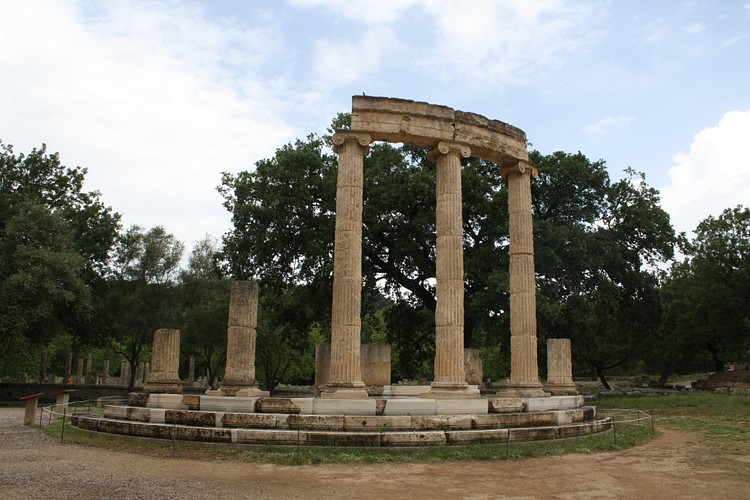 Philippeion di Olympia Mark Cartwright (CC BY-NC-SA) ](https://www.worldhistory.org/image/441/the-philippeion-of-olympia/ "The Philippeion of Olympia")Acara penting kedua di Olympia adalah Heraia, perlombaan bagi wanita yang diadakan setiap empat tahun untuk menghormati dewi Hera. Anak-anak, remaja, dan wanita muda berlari dalam lomba lari sejauh 500 kaki lintasan stadion (160 m). Hadiah untuk para pemenang meliputi mahkota daun zaitun dan hak mendirikan potret diri mereka di lokasi tersebut. Pihak Elean bertanggung jawab atas penyelenggaraan pertandingan dan pemeliharaan situs saat tidak digunakan.
Olimpiade berlanjut selama periode Helenistik dengan penambahan arsitektur penting, yaitu Philippeion, sebuah bangunan melingkar dengan tiang kolom yang didirikan oleh Philip II dari Makedonia. Bangunan ini berisi patung emas keluarga kerajaan (sekitar tahun 338 SM). Bangsa Romawi, meskipun tidak terlalu memperhatikan makna religius Olimpiade, tetap menghormati acara tersebut. Meski Sulla sempat berupaya memindahkan Olimpiade secara permanen ke Roma pada 80 SM, Romawi tetap memperindah Olympia dengan pembangunan gedung-gedung baru, pemandian air panas, air mancur (seperti Nymphaion karya Herodes Atticus pada tahun 150 M), dan berbagai patung. Kaisar Nero pada tahun 67 M tampil sebagai peserta untuk meraih kemenangan, dan sesuai dugaan, menjadi pemenang pada setiap ajang lomba yang diikuti.
### Kemunduran
Dengan dikeluarkannya dekret Kaisar Theodosius untuk melarang semua praktik keagamaan dan festival pagan, Olimpiade berakhir pada tahun 393 M setelah 293 kali penyelenggaraan selama lebih dari satu milenium. Suaka di lokasi tersebut secara perlahan mengalami kemunduran, sebagian hancur sesuai dekret Kaisar Theodosios II pada 426 M. Area in kemudian ditempati komunitas Kristen yang mendirikan sebuah basilika pada masa Bizantium awal. Gempa tahun 522 dan 551 M menghancurkan banyak bangunan yang masih tersisa. Endapan lumpur dari sungai Alpheios dan Kladeos menutupi lokasi hingga ditemukan kembali pada 1829 oleh Misi Arkeologi Prancis dan penggalian sistematis Institut Arkeologi Jerman sejak 1875. Sebagian besar kuil yang dahulu megah kini hanya berupa puing, tetapi pengunjung masa kini setidaknya dapat berlari di lintasan stadion Olimpiade pertama.
#### Editorial Review
This human-authored definition has been reviewed by our editorial team before publication to ensure accuracy, reliability and adherence to academic standards in accordance with our [editorial policy](https://www.worldhistory.org/static/editorial-policy/).
## Daftar Pustaka
- Andronicos, M. *Olympia.* Ekdotike Athenon, Athens, 2002
- Kaltsas, N. *Olympia.* MOCARF, Athens, 2009
- Koursi, M (ed.). *The Olympic Games in Ancient Greece.* Ekdotike Athenon, Athens, 2003
## Tentang Penulis
Mark adalah seorang penulis, peneliti, sejarawan, dan editor penuh waktu. Minat khususnya meliputi seni, arsitektur, dan gagasan yang ada di semua peradaban. Mark meraih gelar MA dalam bidang Filsafat Politik dari University of York dan menjabat sebagai Direktur Penerbitan di WHE.
## Garis Waktu
- **c. 1900 BCE**: First evidence of settlement at [Olympia](https://www.worldhistory.org/Olympia/).
- **776 BCE**: First athletic games in honour of [Zeus](https://www.worldhistory.org/zeus/) are held at [Olympia](https://www.worldhistory.org/Olympia/) with one event, the *stadion* foot race.
- **724 BCE**: The *diaulos* foot-race (two lengths of the [stadium](https://www.worldhistory.org/Stadium/)) is added to the schedule of the [Olympic Games](https://www.worldhistory.org/Olympic_Games/).
- **720 BCE**: The *dolichos* foot-race is added to the schedule of the [Olympic Games](https://www.worldhistory.org/Olympic_Games/) and is won by Akanthos of [Sparta](https://www.worldhistory.org/sparta/).
- **720 BCE**: Orsippos is the first athlete to discard his loincloth at the [Olympic Games](https://www.worldhistory.org/Olympic_Games/), establishing the convention for athletes to compete naked.
- **708 BCE**: Wrestling and the pentathlon are added to the schedule of the [Olympic Games](https://www.worldhistory.org/Olympic_Games/).
- **688 BCE**: Boxing is added to the schedule of the [Olympic Games](https://www.worldhistory.org/Olympic_Games/).
- **680 BCE**: [Chariot](https://www.worldhistory.org/chariot/) races are added to the schedule of the [Olympic Games](https://www.worldhistory.org/Olympic_Games/) which are extended to two days for the first time.
- **680 BCE**: The *tethrippon* (four-horse [chariot](https://www.worldhistory.org/chariot/) race) is added to the schedule of the [Olympic Games](https://www.worldhistory.org/Olympic_Games/).
- **650 BCE - 600 BCE**: Heraion, [temple](https://www.worldhistory.org/temple/) dedicated to [Hera](https://www.worldhistory.org/Hera/) built at [Olympia](https://www.worldhistory.org/Olympia/).
- **648 BCE**: The *[Pankration](https://www.worldhistory.org/pankration/)* (a mix of wrestling and boxing) is added to the schedule of the [Olympic Games](https://www.worldhistory.org/Olympic_Games/).
- **632 BCE**: Events for boys are added to the schedule of the [Olympic Games](https://www.worldhistory.org/Olympic_Games/) which are extended to three days for the first time.
- **532 BCE**: Milon of Kroton wins the first of five consecutive wrestling competitions at the [Olympic Games](https://www.worldhistory.org/Olympic_Games/).
- **521 BCE**: Phanas of Pellene wins the *stadion*, *diaulos* and race in armour in the same [Olympic Games](https://www.worldhistory.org/Olympic_Games/).
- **520 BCE**: The *hoplitodromos* (a foot-race in [hoplite](https://www.worldhistory.org/hoplite/) armour is added to the schedule of the [Olympic Games](https://www.worldhistory.org/Olympic_Games/).
- **488 BCE**: Runner Astylos of Kroton wins the first of his six victories over three [Olympic Games](https://www.worldhistory.org/Olympic_Games/).
- **488 BCE**: Kroton of [Magna Graecia](https://www.worldhistory.org/Magna_Graecia/) wins the first of three consecutive *stadion* races in the [Olympic Games](https://www.worldhistory.org/Olympic_Games/).
- **c. 460 BCE**: The west pediment of the [Temple](https://www.worldhistory.org/temple/) of [Zeus](https://www.worldhistory.org/zeus/) at [Olympia](https://www.worldhistory.org/Olympia/) is decorated with a Centauromachy of centaurs fighting Lapiths at the wedding of Peirithoos.
- **c. 460 BCE - 457 BCE**: [Temple](https://www.worldhistory.org/temple/) of [Zeus](https://www.worldhistory.org/zeus/) is built at [Olympia](https://www.worldhistory.org/Olympia/) with a statue of [Apollo](https://www.worldhistory.org/apollo/) dominating the west pediment and containing the cult statue of Zeus by [Phidias](https://www.worldhistory.org/Phidias/).
- **c. 457 BCE**: Metopes on the [Temple](https://www.worldhistory.org/temple/) of [Zeus](https://www.worldhistory.org/zeus/) at [Olympia](https://www.worldhistory.org/Olympia/) depict the twelve labours of [Hercules](https://www.worldhistory.org/hercules/).
- **c. 430 BCE**: The cult statue of [Zeus](https://www.worldhistory.org/zeus/) by [Phidias](https://www.worldhistory.org/Phidias/) is dedicated in the [Temple](https://www.worldhistory.org/temple/) of Zeus, [Olympia](https://www.worldhistory.org/Olympia/). It is one of [the Seven Wonders](https://www.worldhistory.org/The_Seven_Wonders/) of the Ancient World.
- **424 BCE - 420 BCE**: The [Nike](https://www.worldhistory.org/nike/) of Paionios is erected at [Olympia](https://www.worldhistory.org/Olympia/) to commemorate the Messenian and Naupaktian victory over [Sparta](https://www.worldhistory.org/sparta/) at the [battle](https://www.worldhistory.org/disambiguation/battle/) of Sphakteria.
- **420 BCE**: [Sparta](https://www.worldhistory.org/sparta/) is excluded from the [Olympic Games](https://www.worldhistory.org/Olympic_Games/) for breaking the *ekecheiria* or sacred truce.
- **416 BCE**: [Alcibiades](https://www.worldhistory.org/Alcibiades/) wins three [chariot](https://www.worldhistory.org/chariot/) races at the [Olympic Games](https://www.worldhistory.org/Olympic_Games/).
- **408 BCE**: The *synoris* (two-horse [chariot](https://www.worldhistory.org/chariot/) race) was added to the schedule of the [Olympic Games](https://www.worldhistory.org/Olympic_Games/).
- **396 BCE**: Competitions for heralds and trumpeters were added to the schedule of the [Olympic Games](https://www.worldhistory.org/Olympic_Games/).
- **392 BCE**: The horse owner Kyniska becomes the first woman to win a victor's crown at the [Olympic Games](https://www.worldhistory.org/Olympic_Games/).
- **356 BCE**: [Philip II of Macedon](https://www.worldhistory.org/Philip_II_of_Macedon/) wins the horse race at the [Olympic Games](https://www.worldhistory.org/Olympic_Games/).
- **352 BCE**: [Philip II of Macedon](https://www.worldhistory.org/Philip_II_of_Macedon/) wins the [chariot](https://www.worldhistory.org/chariot/) race at the [Olympic Games](https://www.worldhistory.org/Olympic_Games/) and retains the crown in 348 BCE.
- **c. 338 BCE**: Philippeion built at [Olympia](https://www.worldhistory.org/Olympia/) by [Philip II](https://www.worldhistory.org/disambiguation/Philip_II/) of Macedonia.
- **328 BCE**: Herodoros of [Megara](https://www.worldhistory.org/disambiguation/Megara/) wins the first of ten consecutive trumpet competitions at the [Olympic Games](https://www.worldhistory.org/Olympic_Games/).
- **164 BCE**: [Leonidas](https://www.worldhistory.org/disambiguation/Leonidas/) of [Rhodes](https://www.worldhistory.org/Rhodes/) wins the first of his 12 Olympic crowns in runnning events in four successive Olymic Games.
- **72 BCE**: Gaius becomes the first [Roman](https://www.worldhistory.org/disambiguation/Roman/) victor at the [Olympic Games](https://www.worldhistory.org/Olympic_Games/).
- **17 CE**: [Roman emperor](https://www.worldhistory.org/Roman_Emperor/) [Tiberius](https://www.worldhistory.org/Tiberius/) is victorious at the [Olympic Games](https://www.worldhistory.org/Olympic_Games/).
- **c. 67 CE**: Emperor [Nero](https://www.worldhistory.org/Nero/) competes at the panhellenic Games of [Olympia](https://www.worldhistory.org/Olympia/) and [Delphi](https://www.worldhistory.org/delphi/).
- **81 CE**: Hermogenes of Xanthos wins the first of his 8 Olympic running crowns over three consecutive [Olympic Games](https://www.worldhistory.org/Olympic_Games/).
- **150 CE**: Nymphaion fountain of Herodes Atticus built at [Olympia](https://www.worldhistory.org/Olympia/).
- **261 CE**: The list of victors running back to 776 BCE ends for the [Olympic Games](https://www.worldhistory.org/Olympic_Games/).
- **393 CE**: [Roman Emperor](https://www.worldhistory.org/Roman_Emperor/) Theodosius definitively ends all pagan Games in [Greece](https://www.worldhistory.org/greece/).
- **426 CE**: Emperor Theodosios II orders the destruction of [Olympia](https://www.worldhistory.org/Olympia/).
- **522 CE - 551 CE**: Earthquakes destroy many of the buildings at [Olympia](https://www.worldhistory.org/Olympia/).
## Tautan Eksternal
- [The ancient origins of the Olympics - Armand D'Angour](http://ed.ted.com/lessons/the-ancient-origins-of-the-olympics-armand-d-angour)
## Sitasi Karya Ini
### APA
Cartwright, M. (2024, December 18). Olympia. (F. D. Floris, Penerjemah). *World History Encyclopedia*.
### Chicago
Cartwright, Mark. "Olympia." Diterjemahkan oleh Flora Debora Floris. *World History Encyclopedia*, December 18, 2024. .
### MLA
Cartwright, Mark. "Olympia." Diterjemahkan oleh Flora Debora Floris. *World History Encyclopedia*, 18 Dec 2024, .
## Lisensi & Hak Cipta
Dikirim oleh [Flora Debora Floris](https://www.worldhistory.org/user/flora/ "User Page: Flora Debora Floris"), dipublikasikan pada 18 December 2024. Silakan periksa sumber aslinya untuk informasi hak cipta. Harap diperhatikan bahwa konten yang ditautkan dari halaman ini mungkin memiliki ketentuan lisensi yang berbeda.