---
title: Période hellénistique
author: Antoine Simonin
translator: Babeth Étiève-Cartwright
source: https://www.worldhistory.org/trans/fr/1-829/periode-hellenistique/
format: machine-readable-alternate
license: Creative Commons Attribution-NonCommercial-ShareAlike (https://creativecommons.org/licenses/by-nc-sa/4.0/)
updated: 2020-12-06
---
# Période hellénistique
_Rédigé par [Antoine Simonin](https://www.worldhistory.org/user/Deathfinger/)_
_Traduit par [Babeth Étiève-Cartwright](https://www.worldhistory.org/user/bab.cartwright)_
La période hellénistique fait partie de l'Antiquité pour l'espace européen et le proche orient.[](https://www.worldhistory.org/trans/Fr/2-1290/fantomes-nordiques-et-au-dela/)[](https://www.worldhistory.org/trans/Fr/2-148/textes-des-pyramides-guide-de-lau-dela/)[](https://www.worldhistory.org/trans/Fr/2-119/les-chaouabtis-la-main-doeuvre-de-lau-dela/)[](https://www.worldhistory.org/trans/Fr/2-1942/communautes-diasporiques-en-mediterranee-et-au-del/) L'utilisation de cette période est justifiée par l'étendue de la culture hellénique dans la plupart de ces régions, en raison de la présence politique grecque surtout en Asie après les conquêtes d'Alexandre, mais aussi par une nouvelle vague de [colonisation grecque](https://www.worldhistory.org/trans/Fr/1-11220/colonisation-grecque/). En conséquence, la période hellénistique est généralement considérée comme partant de 323 AEC avec la mort d'Alexandre et se terminant en 31 AEC avec la conquête du dernier royaume hellénistique par Rome, le royaume lagide d'Égypte. Pour la partie asiatique, nous pourrions l'allonger à 10 AEC, lorsque le dernier royaume indo-grec fut conquis par les Indo-Sakas.
Politiquement, la période hellénistique est caractérisée par une division et une scission avec l'ancien [empire](https://www.worldhistory.org/trans/Fr/1-99/empire/) d'Alexandre, avec des guerres interminables entre les Diadoques et leurs successeurs. Ainsi, les royaumes hellénistiques s'affaiblirent et ainsi créèrent progressivement une opportunité pour des royaumes concurrents, comme le royaume du Pont ou la [Bactriane](https://www.worldhistory.org/trans/Fr/1-291/bactriane/). Dans le même temps, le pouvoir romain était en expansion exponentielle, anéantissant d'autres présence politique en [Italie](https://www.worldhistory.org/trans/Fr/1-207/italie/), puis la domination carthaginoise de la Méditerranée dans les trois [guerres puniques](https://www.worldhistory.org/trans/Fr/1-736/guerres-puniques/). A la fin de l'époque hellénistique, le jeune [empire romain](https://www.worldhistory.org/trans/Fr/1-100/empire-romain/) avait presque atteint son maximum d'expansion, de Lusitanie (Portugal moderne) à la Syrie et de la Grande-Bretagne du Sud à l'Égypte.
Une autre évolution politique générale peut également être observée: les Celtes furent ébranlés une fois de plus par une importante vague de migration (à l'origine entre autres des célèbres Galates d'Anatolie). La pression croissante des voisins Celtes, surtout des tribus germaniques et des Romains, réduisit considérablement leur domination à la fin de la période. Dans les steppes infinies de sud de l'Asie, les pressions nomades se poursuivirent de la même manière qu'auparavant, les Sarmates exerçant des pressions sur les [Scythes](https://www.worldhistory.org/trans/Fr/1-645/scythes/) et les Yuezhi exerçant des pressions sur les Sakas, qui augmentèrent ainsi leurs attaques contre les royaumes Bactriens puis Indo-Grecs.
En général, certains aspecs caractérisèrent cette période en opposition à la précédente : le modèle de la ville-État qui dominait auparavant fut remplacé par les différents types de royaumes, avec un pouvoir plus centralisé. Ce fut surtout le concept d'administration qui changea: ce n'était plus une question de gestion des affaires civiques au nom de la communauté, mais par délégation au nom d'une autorité personnelle. Dans le même temps, les mercenaires furent plus fréquemment utilisés dans les armées hellénistiques, afin de faire face à l'évolution militaire et technique qui augmentait considérablement le coût de l'équipement d'une armée civique. Le meilleur exemple est la renommée et l'utilisation des Galates par les royaumes hellénistiques.
[ 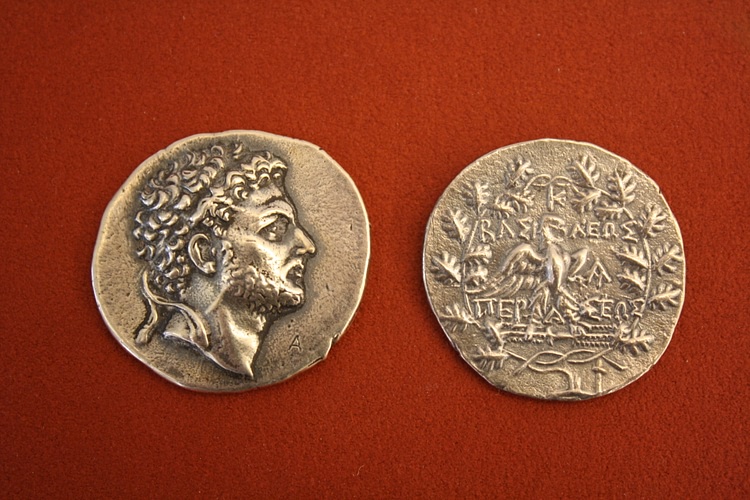 Persée, tetradrachme en argent macédonien Mark Cartwright (CC BY-NC-SA) ](https://www.worldhistory.org/image/844/perseus-macedonian-silver-tetradrachm/ "Perseus, Macedonian Silver Tetradrachm")
Culturellement, cette période n'est pas une ère intermédiaire entre les ères prospères, ère Classique et ère Impériale, comme on l'a décrit par le passé. [Aristote](https://www.worldhistory.org/trans/Fr/1-355/aristote/) père des sciences modernes, Ménandre l'auteur des grandes comédies, [Épicure](https://www.worldhistory.org/trans/Fr/1-14311/epicure/) le moraliste, Ératosthène, mais aussi [Euclide](https://www.worldhistory.org/trans/Fr/1-14091/euclide/), [Archimède](https://www.worldhistory.org/trans/Fr/1-913/archimede/) et [Polybe](https://www.worldhistory.org/trans/Fr/1-11195/polybe/) vécurent et travaillèrent pendant la période hellénistique. Cette période indiqua des progrès dans l'architecture, beaucoup d'évergétisme (dons altruistes à la communauté), une multiplication des fêtes et des célébrations (illustrées par le grand nombre de théâtres créés), le développement de l'art et la création de bibliothèques, les plus célèbres étant à [Alexandrie](https://www.worldhistory.org/trans/Fr/1-245/alexandrie/).
#### Editorial Review
This human-authored definition has been reviewed by our editorial team before publication to ensure accuracy, reliability and adherence to academic standards in accordance with our [editorial policy](https://www.worldhistory.org/static/editorial-policy/).
## Auteur
Passionné par l'Asie centrale ancienne, il gère le site From Bactria to Taxila (De la Bactriane à Taxila). Il participe également au projet Europa Barbarorum.
- [Linkedin Profile](https://www.linkedin.com/in/antoine-simonin/52/685/a9a/e)
## Chronologie
- **c. 402 BCE - 318 BCE**: Life of Athenian statesman and general [Phocion](https://www.worldhistory.org/Phocion/).
- **330 BCE - 64 BCE**: [Hellenistic Period](https://www.worldhistory.org/Hellenistic_Period/) in [Byblos](https://www.worldhistory.org/Byblos/).
- **c. 325 BCE - c. 320 BCE**: [Greek](https://www.worldhistory.org/disambiguation/greek/) rule in [Gandhara](https://www.worldhistory.org/Gandhara_Civilization/), ending some time after the [death of Alexander the Great](https://www.worldhistory.org/article/2366/death-of-alexander-the-great/).
- **323 BCE**: [Death of Alexander the Great](https://www.worldhistory.org/article/2366/death-of-alexander-the-great/), beginning of The [Hellenistic Period](https://www.worldhistory.org/Hellenistic_Period/) / The [Hellenistic World](https://www.worldhistory.org/Hellenistic_Period/).
- **322 BCE - 320 BCE**: First Successor [War](https://www.worldhistory.org/disambiguation/War/) between [Alexander](https://www.worldhistory.org/disambiguation/Alexander/)'s successors.
- **319 BCE - 315 BCE**: Second Successor [War](https://www.worldhistory.org/disambiguation/War/) between [Alexander](https://www.worldhistory.org/disambiguation/Alexander/)'s successors.
- **314 BCE - 311 BCE**: Third Successor [War](https://www.worldhistory.org/disambiguation/War/) between [Alexander](https://www.worldhistory.org/disambiguation/Alexander/)'s successors.
- **312 BCE**: [Seleucos](https://www.worldhistory.org/disambiguation/Seleucos/) conquers [Babylon](https://www.worldhistory.org/babylon/) and founds the [Seleucid](https://www.worldhistory.org/Seleucid_Empire/) dynasty.
- **c. 312 BCE - 63 BCE**: Duration of the [Seleucid Empire](https://www.worldhistory.org/Seleucid_Empire/).
- **310 BCE**: Assassination of [Roxanne](https://www.worldhistory.org/Roxanne/) and [Alexander](https://www.worldhistory.org/disambiguation/Alexander/) IV, wife and son of [Alexander the Great](https://www.worldhistory.org/Alexander_the_Great/).
- **309 BCE - 308 BCE**: [Agathocles of Syracuse](https://www.worldhistory.org/Agathocles_of_Syracuse/) successfuly campaigns in North [Africa](https://www.worldhistory.org/disambiguation/africa/) defeating Carthaginian armies and taking [Utica](https://www.worldhistory.org/Utica/) and Hippacra.
- **308 BCE - 301 BCE**: Fourth Successor [War](https://www.worldhistory.org/disambiguation/War/) between [Alexander](https://www.worldhistory.org/disambiguation/Alexander/)'s successors.
- **306 BCE**: [Demetrius I of Macedon](https://www.worldhistory.org/Demetrius_I_of_Macedon/) defeats [Ptolemy](https://www.worldhistory.org/disambiguation/Ptolemy/)'s fleet at [Salamis](https://www.worldhistory.org/disambiguation/Salamis/), off the coast of [Cyprus](https://www.worldhistory.org/cyprus/).
- **306 BCE**: [Epicurus](https://www.worldhistory.org/Epicurus/) buys a garden in [Athens](https://www.worldhistory.org/Athens/) in which he begins to teach Epicureanism.
- **c. 301 BCE - c. 320 BCE**: Doric [temple](https://www.worldhistory.org/temple/) to [Athena](https://www.worldhistory.org/athena/) and fortifications of [Lysimachus](https://www.worldhistory.org/Lysimachus/) built at [Troy](https://www.worldhistory.org/troy/).
- **301 BCE**: The [Battle](https://www.worldhistory.org/disambiguation/battle/) of Ipsus in central [Phrygia](https://www.worldhistory.org/phrygia/) where [Lysimachus](https://www.worldhistory.org/Lysimachus/) and [Seleucos I](https://www.worldhistory.org/Seleucos_I/) defeat [Antigonus I](https://www.worldhistory.org/Antigonus_I/) and [Demetrius I of Macedon](https://www.worldhistory.org/Demetrius_I_of_Macedon/).
- **295 BCE**: Demetrius I campaigns in central [Greece](https://www.worldhistory.org/greece/), removes the tyrant Lachares from [Athens](https://www.worldhistory.org/Athens/) and defeats [Sparta](https://www.worldhistory.org/sparta/).
- **294 BCE - c. 288 BCE**: Demetrius I rules as king of [Macedon](https://www.worldhistory.org/macedon/).
- **287 BCE - 212 BCE**: Life of [Archimedes](https://www.worldhistory.org/Archimedes/), physician, mathematician and engineer.
- **285 BCE - 282 BCE**: [Rome](https://www.worldhistory.org/Rome/) defeats the [Celts](https://www.worldhistory.org/celt/) in [Italy](https://www.worldhistory.org/italy/). Rome's dominance in central Italy is secured.
- **c. 280 BCE**: Founding of the [Achaean League](https://www.worldhistory.org/Achaean_League/) in the [Peloponnese](https://www.worldhistory.org/Peloponnese/) of [Greece](https://www.worldhistory.org/greece/).
- **280 BCE - 275 BCE**: King [Pyrrhus](https://www.worldhistory.org/pyrrhus/) of Epirus wages the Pyrrhic [War](https://www.worldhistory.org/disambiguation/War/) against the Romans in [Italy](https://www.worldhistory.org/italy/), defence of [Tarentum](https://www.worldhistory.org/tarentum/) being the pretext.
- **279 BCE**: [Celts](https://www.worldhistory.org/celt/) invade Thrace and [Anatolia](https://www.worldhistory.org/Asia_Minor/).
- **272 BCE**: [Death](https://www.worldhistory.org/disambiguation/Death/) of [Pyrrhus](https://www.worldhistory.org/pyrrhus/) of Epirus in a street [battle](https://www.worldhistory.org/disambiguation/battle/) in [Argos](https://www.worldhistory.org/argos/).
- **c. 270 BCE**: [Aristarchus of Samos](https://www.worldhistory.org/Aristarchus_of_Samos/) proposes a heliocentric world view.
- **263 BCE - 241 BCE**: Reign of Eumenes I at [Pergamon](https://www.worldhistory.org/pergamon/).
- **262 BCE**: Eumenes rebels and wins against the [Seleucid](https://www.worldhistory.org/Seleucid_Empire/) Antiochus I. Beginning of the [Pergamon](https://www.worldhistory.org/pergamon/) [Empire](https://www.worldhistory.org/empire/).
- **250 BCE**: Former [satrap](https://www.worldhistory.org/Persian_Governor/) [Diodotos](https://www.worldhistory.org/disambiguation/diodotos/) rebels against [Seleucid](https://www.worldhistory.org/Seleucid_Empire/) king [Antiochos](https://www.worldhistory.org/disambiguation/antiochos/) I, creating the [Greco-Bactrian kingdom](https://www.worldhistory.org/Greco-Bactria/).
- **241 BCE - 197 BCE**: Reign of Attalus I at [Pergamon](https://www.worldhistory.org/pergamon/).
- **222 BCE**: The [Achaean League](https://www.worldhistory.org/Achaean_League/) and [Antigonos](https://www.worldhistory.org/disambiguation/Antigonos/) III of [Macedon](https://www.worldhistory.org/macedon/) defeat [Sparta](https://www.worldhistory.org/sparta/) at Sellasia.
- **c. 190 BCE**: First appearance of multiple [Euthydemid](https://www.worldhistory.org/euthydemid/) kings at the same time. Beginning of the [Indo-Greek](https://www.worldhistory.org/Indo-Greek/) kingdoms.
- **c. 188 BCE**: The treaty of Apamea Kibotos. Peace and alliance is established between the [Seleucid Empire](https://www.worldhistory.org/Seleucid_Empire/) and [Rome](https://www.worldhistory.org/Rome/) joined by its allies, such as [Pergamon](https://www.worldhistory.org/pergamon/) and [Rhodes](https://www.worldhistory.org/Rhodes/). The Seleucids have to evacuate all the land and the [cities](https://www.worldhistory.org/city/) from [Asia Minor](https://www.worldhistory.org/Asia_Minor/) and to pay a huge [war](https://www.worldhistory.org/disambiguation/War/) indemnity.
- **172 BCE - 168 BCE**: Third Macedonian [War](https://www.worldhistory.org/disambiguation/War/): [Perseus](https://www.worldhistory.org/Perseus/) of [Macedon](https://www.worldhistory.org/macedon/) challenges [Rome](https://www.worldhistory.org/Rome/) and is defeated.
- **147 BCE - 139 BCE**: The Lusitanian commander Viriatus bleeds [Roman](https://www.worldhistory.org/disambiguation/Roman/) armies.
- **146 BCE**: [Rome](https://www.worldhistory.org/Rome/) sacks [Corinth](https://www.worldhistory.org/corinth/) and dissolves the [Achaean league](https://www.worldhistory.org/Achaean_League/). [Greece](https://www.worldhistory.org/greece/) is ruled by Rome.
- **146 BCE**: End of the [Third Punic War](https://www.worldhistory.org/Third_Punic_War/). [Carthage](https://www.worldhistory.org/carthage/) is destroyed and its lands become the [Roman](https://www.worldhistory.org/disambiguation/Roman/) province [Africa](https://www.worldhistory.org/disambiguation/africa/).
- **133 BCE**: Attalus III, the last king of [Pergamon](https://www.worldhistory.org/pergamon/), bequeathes the whole of Pergamon to [Rome](https://www.worldhistory.org/Rome/).
- **129 BCE**: Parthians [conquer](https://www.worldhistory.org/warfare/) [Mesopotamia](https://www.worldhistory.org/Mesopotamia/). The [Silk Road](https://www.worldhistory.org/Silk_Road/) to [China](https://www.worldhistory.org/china/) is now controlled by the Parthians.
- **89 BCE - 63 BCE**: Mithridatic Wars between [Mithridates VI](https://www.worldhistory.org/Mithridates_VI/) and [Roman Republic](https://www.worldhistory.org/Roman_Republic/) .
- **83 BCE**: [Tigranes II](https://www.worldhistory.org/Tigranes_the_Great/) invades and destroys the [Seleucid Empire](https://www.worldhistory.org/Seleucid_Empire/).
- **58 BCE - 51 BCE**: [Julius Caesar](https://www.worldhistory.org/Julius_Caesar/)'s [conquest](https://www.worldhistory.org/warfare/) of [Gaul](https://www.worldhistory.org/gaul/).
- **37 BCE**: [Herod the Great](https://www.worldhistory.org/Herod_the_Great/) is installed as King of [Judaea](https://www.worldhistory.org/disambiguation/judaea/). Rebuilding of the [Temple](https://www.worldhistory.org/temple/) of [Jerusalem](https://www.worldhistory.org/jerusalem/).
- **c. 30 BCE - c. 19 BCE**: [Roman](https://www.worldhistory.org/disambiguation/Roman/) poet [Virgil](https://www.worldhistory.org/virgil/) writes his [Aeneid](https://www.worldhistory.org/The_Aeneid/).
## Liens externes
- [What is Hellenistic Sculpture? Exploring the History of Hellenistic Art](https://mymodernmet.com/what-is-hellenistic-sculpture-history/)
- [Hellenistic Rulers](http://allthingsclassics.weebly.com/hellenistic-rulers.html)
- [Hellenistic Jewelry | Essay | The Metropolitan Museum of Art | Heilbrunn Timeline of Art History](https://www.metmuseum.org/toah/hd/hjew/hd_hjew.htm)
- [Intellectual Pursuits of the Hellenistic Age | Essay | The Metropolitan Museum of Art | Heilbrunn Timeline of Art History](https://www.metmuseum.org/toah/hd/ipha/hd_ipha.htm)
- [List of Rulers of the Ancient Greek World | Lists of Rulers | Heilbrunn Timeline of Art History | The Metropolitan Museum of Art](https://www.metmuseum.org/toah/hd/gkru/hd_gkru.htm)
## Citer cette ressource
### APA
Simonin, A. (2020, December 06). Période hellénistique. (B. Étiève-Cartwright, Traducteur). *World History Encyclopedia*.
### Chicago
Simonin, Antoine. "Période hellénistique." Traduit par Babeth Étiève-Cartwright. *World History Encyclopedia*, December 06, 2020. .
### MLA
Simonin, Antoine. "Période hellénistique." Traduit par Babeth Étiève-Cartwright. *World History Encyclopedia*, 06 Dec 2020, .
## Licence & Copyright
Soumis par [Babeth Étiève-Cartwright](https://www.worldhistory.org/user/bab.cartwright/ "User Page: Babeth Étiève-Cartwright"), publié le 06 December 2020. Veuillez consulter la ou les sources originales pour obtenir des informations sur les droits d'auteur. A noter que les contenus liés à cette page peuvent avoir des des termes de licence différents.