---
title: Sparta
author: Mark Cartwright
translator: Massimo Manzo
source: https://www.worldhistory.org/trans/IT/1-197/sparta/
format: machine-readable-alternate
license: Creative Commons Attribution-NonCommercial-ShareAlike (https://creativecommons.org/licenses/by-nc-sa/4.0/)
updated: 2021-12-09
---
# Sparta
_A cura di [Mark Cartwright](https://www.worldhistory.org/user/markzcartwright/)_
_Tradotto da [Massimo Manzo](https://www.worldhistory.org/user/massmanzo)_
Sparta fu una delle più importanti città stato greche nel corso del periodo arcaico e di quello classico, rimasta celebre per la sua potenza militare. Con i loro tipici mantelli rossi, le lunghe chiome e gli scudi contraddistinti dal simbolo della Lamba, gli opliti spartani erano dei professionisti ben addestrati e probabilmente furono i migliori e più temuti guerrieri di tutta la Grecia, combattendo con valore in battaglie cruciali del primo V secolo AEC, come quella delle Termopili e di Platea. La città di Sparta ebbe anche una rivalità costante con altre grandi *poleis* greche come [Atene](https://www.worldhistory.org/trans/it/1-292/atene/) e Corinto, venendo coinvolta in due lunghi ed estenuanti conflitti: [la guerra del Peloponneso](https://www.worldhistory.org/trans/it/1-342/la-guerra-del-peloponneso/), nella metà del V secolo AEC, e la guerra di Corinto, all'inizio del IV secolo.
### Sparta nella [mitologia](https://www.worldhistory.org/trans/it/1-427/mitologia/)
Secondo la [mitologia greca](https://www.worldhistory.org/trans/it/1-11221/mitologia-greca/), il fondatore di Sparta fu Lacedemone, figlio di [Zeus](https://www.worldhistory.org/trans/it/1-538/zeus/), che diede il proprio nome alla regione in cui sorgeva la città e il nome della moglie alla città stessa. Sparta fu anche un importante membro della coalizione greca che prese parte alla [guerra di Troia](https://www.worldhistory.org/trans/it/1-10357/guerra-di-troia/). In effetti, fu proprio il re spartano Menelao a fomentare il conflitto dopo il rapimento di sua moglie Elena da parte del principe troiano Paride, a cui [era](https://www.worldhistory.org/trans/it/1-10295/era/) stata offerta in premio dalla dea [Afrodite](https://www.worldhistory.org/trans/it/1-494/afrodite/), preferita ad [Atena](https://www.worldhistory.org/trans/it/1-488/atena/) ed Era in una gara di bellezza. Elena era considerata la donna più bella della Grecia e in generale le donne spartane furono sempre rinomate sia per la loro avvenenza sia per la loro fiera indipendenza.
### La conquista dell'egemonia regionale
Sparta era situata in Laconia, a sudest del Peloponneso, nella fertile valle dell'Eurota. L'area era già stata abitata in epoca neolitica e nell'Età del Bronzo vi sorgeva un importante insediamento. Le evidenze archeologiche, tuttavia, suggeriscono che il nuovo insediamento spartano fu creato a partire dal X secolo AEC.
Alla fine dell'VIII secolo AEC, Sparta soggiogò gran parte della vicina Messenia, la cui popolazione fu sfruttata per servire gli interessi spartani. In tal modo, Sparta arrivò a controllare un territorio di 8,500 km2 che rese la sua [polis](https://www.worldhistory.org/trans/it/1-12026/polis/) (cioè la città stato) la più estesa della Grecia, nonché uno dei principali attori della scena politica greca. A Sparta, i popoli sottomessi della Messenia e della Laconia, noti come *perioikoi*, non godevano di diritti politici, ma spesso servivano come soldati al fianco dell'esercito spartano. Più in basso nella scala sociale c'erano gli iloti, lavoratori agricoli semi-schiavizzati che vivevano in terre di proprietà degli spartani. A un livello intermedio tra gli iloti e i perioikoi c'erano infine gli iloti emancipati, chiamati neodamōdeis. I cittadini spartani non erano direttamente impegnati nelle attività agricole, ma occupavano il proprio tempo dedicandosi alle esercitazioni militari, alla caccia, alla guerra e alla politica. Gli iloti potevano mantenere per sé una parte del raccolto, ma subivano regolarmente delle epurazioni che avevano il fine di mantenerli sottomessi e in tempo di guerra potevano anche essere coscritti.
I rapporti tra cittadini e iloti erano difficili e non mancarono rivolte, scoppiate soprattutto nel VII secolo AEC, e che contribuirono alla sconfitta subita contro Argo a Isie del 669 AEC. Sparta si vendicò su Argo nel 545 AEC, perdendo tuttavia poco dopo la battaglia di Tegea. Proprio tale instabilità regionale portò alla nascita della Lega del Peloponneso (durata dal 505 c.a. al 365 AEC), che coalizzò Corinto, Elide, Tegea e altri stati (tranne Argo), e nella quale ogni membro giurava di avere gli stessi nemici e gli stessi alleati di Sparta. L'appartenenza alla Lega non comportava il pagamento di un tributo a Sparta ma piuttosto la fornitura di truppe. La Lega consentì a Sparta di stabilire la propria egemonia e di dominare il Peloponneso fino al IV secolo AEC. In aggiunta al coinvolgimento nelle questioni politiche locali, dal VI secolo AEC. Sparta iniziò ad allargare i suoi orizzonti, stringendo per esempio un'alleanza con il sovrano di Lidia Creso e approntando una spedizione militare contro Policrate di Samo nel 525 AEC.
### Rivalità con Atene, Tebe e Corinto
Sotto Cleomene (tra il 520 c.a. e il 490 AEC) Sparta contribuì al rovesciamento dei tiranni di Atene, ma il successivo regime democratico ateniese pose un freno alle ambizioni spartane nella città. In ogni caso, durante la difesa della Grecia contro l'invasione del sovrano persiano Serse, Sparta fu alleata di Atene, lottando con valore alle Termopili nel 480 AEC e nella battaglia di Platea, un anno dopo. Dal 480 al 460 AEC. Sparta fu indebolita da una serie di contese regionali e rivolte di iloti; le cose peggiorarono quando la rivalità con Atene sfociò nelle guerre peloponnesiache tra il 460 e il 446 AEC, riprendendo poi dal 431 al 404 AEC. Tali lunghi conflitti danneggiarono entrambe le parti ma alla fine Sparta, anche grazie all'aiuto persiano, uscì vittoriosa quando Lisandro distrusse la flotta ateniese ad Egospotami nel 405 AEC. Il primato di Sparta tra le città stato greche era tuttavia destinato a durare poco.
[ 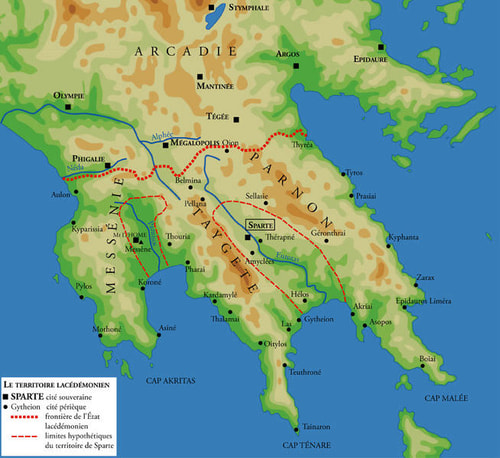 Territorio spartano Marsyas (CC BY-SA) ](https://www.worldhistory.org/image/2143/spartan-territory/ "Spartan Territory")Le continue ambizioni spartane nella Grecia centrale e settentrionale, in Asia Minore e in Sicilia, trascinarono la città in un altro estenuante scontro durato dal 396 al 387 AEC: le cosiddette guerre corinzie contro Atene, Tebe, Corinto e la Persia. L'epilogo del conflitto fu la “Pace del Re”, nella quale Sparta cedette il proprio [impero](https://www.worldhistory.org/trans/it/1-99/impero/) (che era in ogni caso incapace di amministrare efficacemente per la mancanza di un necessario apparato burocratico), al controllo persiano, mantenendo il dominio della Grecia. Tuttavia, nel tentativo di schiacciare Tebe, nel 371 AEC. Sparta perse una battaglia di cruciale importanza a Leuttra contro il brillante generale tebano Epaminonda. In seguito, Tebe arrivò ad annettere parti della Messenia, relegando Sparta a un ruolo di potenza di secondo piano.
Dopo avere per breve tempo sfidato l'egemonia macedone nel III secolo AEC ed essere stata assediata da Pirro nel 272 AEC, Sparta non recuperò mai le sue glorie passate e fu obbligata a unirsi alla Lega Achea nel 195 AEC. Durante il dominio romano, nel 147 AEC le fu permesso di lasciare la Lega, evento che provocò la guerra achea. In ogni caso, ottenendo lo status di città libera nel mondo romano, le cose per Sparta migliorarono e la città ebbe buone relazioni con i conquistatori. L'epilogo arrivò nel 396 EC, quando il re visigoto Alarico saccheggiò la polis.
### Forma di governo
Il sistema politico spartano era alquanto inusuale, dato che contemplava al suo vertice due re, eredi di due diverse dinastie. Questi monarchi erano particolarmente influenti quando uno dei due guidava l'esercito in una campagna militare. I sovrani erano anche sacerdoti di Zeus e sedevano nel consiglio degli anziani, anche detto gherusia, un organismo composto da 28 uomini sopra i 60 anni di età che detenevano tale incarico a vita. La gherusia dirigeva l'assemblea cittadina, probabilmente proponendo istanze da votare, ed esercitava anche le funzioni di corte suprema. L'assemblea (Ecclesia) si riuniva una volta al mese ed era aperta a tutti i cittadini, che dichiaravano il proprio voto a voce. C'era inoltre un comitato esecutivo formato da cinque efori (ephoroi) sorteggiati tra l'insieme dei cittadini, in carica per un massimo di un anno e non rieleggibili. Due degli efori accompagnavano uno dei re durante le campagne militari. Non si sa con certezza come interagissero questi diversi organi politici, ma affinchè l'apparato statale funzionasse era chiaramente necessari dei compromessi istituzionali. Tale elemento potrebbe spiegare la reputazione particolarmente conservatrice di Sparta e la sua conseguente lentezza nel prendere decisioni di politica estera.
[  Tetradramma in argento spartano Mark Cartwright (CC BY-NC-SA) ](https://www.worldhistory.org/image/841/spartan-silver-tetradrachm/ "Spartan Silver Tetradrachm")### Società
Come tutte le società greche, anche quella spartana era dominata dai cittadini uomini, e i più potenti tra questi provenivano da un ristretto gruppo di famiglie. Queste ultime appartenevano alla nobiltà terriera, anche se in seguito alle riforme attribuite a Licurgo nel VI secolo AEC. (o forse anche in un periodo precedente), i cittadini non poterono più dedicarsi alle attività agricole - sorte riservata agli iloti – dovendo invece dedicarsi alla preparazione atletica e militare e alla politica. Gli iloti non potevano possedere proprietà, dunque non divenivano cittadini a pieno titolo. Tale assenza di mobilità sociale, nei secoli successivi, sarebbe tornata a perseguitare Sparta. Ridotto per effetto delle continue guerre nel V e IV secolo AEC, il numero degli opliti spartani (homoioi) diminuì infatti pericolosamente (da 8.000 nel 490 AEC a 700 nel 371 AEC), tanto che dovettero essere arruolati nell'esercito anche soldati che non erano spartati, la cui lealtà e il cui coinvolgimento nelle ambizioni di Sparta era opinabile.
A Sparta, le donne godevano di una condizione migliore che in altre città-stato greche. Potevano detenere proprietà, acquisite spesso con la dote o nell'ambito di lasciti ereditari. Per effetto della morte dei loro mariti in guerra, le donne divennero così tra i membri più ricchi della società, arrivando a controllare i 2/5 della proprietà terriera spartana. Inoltre, le donne spartane potevano anche muoversi con ragionevole libertà, praticare l'atletica (nude, come gli uomini) e persino bere vino. Tutte libertà che in altre poleis greche sarebbero state inaccettabili.
La società spartana era composta anche da stranieri (xenoi), ma questi ultimi non erano accolti come in altre città stato, e talvolta quelli che vivevano a Sparta erano espulsi a causa della grande diffidenza (che sfociava a volte in autentica paranoia) degli ospitanti.
[  Leonida Marie-Lan Nguyen (CC BY-SA) ](https://www.worldhistory.org/image/1211/leonidas/ "Leonidas")### L'esercito spartano
Nei confronti di tutti i suoi cittadini, Sparta poneva una forte enfasi nell'addestramento militare e nella vita frugale, il cui elemento caratteristico erano mense comuni in cui si mangiava cibo semplice, come farina d'orzo, formaggio, fichi e vino. Dall'età di sette anni, i bambini maschi iniziavano un percorso di educazione militarista nota come *agoghé*, nel corso della quale venivano divisi in gruppi in base all'età, vivendo in baracche comuni. I giovani ricevevano un rigoroso addestramento atletico e militare, che diventava particolarmente impegnativo a partire dai vent'anni, quando si univano alle mense comuni (*sissizi*), sperimentando spesso relazioni omoerotiche con cittadini più anziani ed esperti. Tale duro addestramento portò alla formazione di un esercito di opliti professionisti capaci di compiere manovre relativamente complicate sul campo di battaglia e temuti in tutta Grecia, circostanza, quest'ultima, dimostrata dal fatto che a Sparta, per gran parte della propria storia, non furono costruite fortificazioni.
Una peculiarità tipica degli spartani e del loro esercito era la grande rilevanza data alle questioni religiose. Per dirla con Erodoto, gli spartani “consideravano le cose degli dei più importanti delle cose degli uomini”. In generale i sacrifici, compiuti prima e dopo la battaglia, erano una caratteristica comune del modo di fare la guerra in Grecia, ma nell'armata spartana la religiosità era ancora più accentuata, tanto che gli spartani sacrificavano anche prima di attraversare fiumi, per esempio, ed evitavano addirittura di mobilitare l'esercito nel corso di importanti festività religiose. Famosi episodi in cui gli spartani posero questioni religiose al di sopra di guerre e crisi nazionali si verificarono nel corso delle guerre persiane, a Maratona e alle Termopili. Nella prima delle due battaglie citate, le festività non gli consentirono di arrivare in tempo per parteciparvi, nella seconda mobilitarono solo un piccolo contingente, sentendosi obbligati a celebrare prima le feste Carnee in onore di Apollo.
L'armata di opliti spartani, tuttavia, aprì la strada a una maggiore professionalità militare nel resto della Grecia. D'altronde l'iconica immagine di soldati coraggiosi e disciplinati, con i mantelli rossi e gli scudi marchiati dalla lambda, fu per i greci, per i romani e persino per frequentatori di cinema del ventunesimo secolo, il simbolo di Sparta.
#### Editorial Review
This human-authored definition has been reviewed by our editorial team before publication to ensure accuracy, reliability and adherence to academic standards in accordance with our [editorial policy](https://www.worldhistory.org/static/editorial-policy/).
## Bibliografia
- Boys-Stones et al. *The Oxford Handbook of Hellenic Studies.* OUP, Oxford, 2012
- [Campbell, B. (ed). *The Oxford Handbook of Warfare in the Classical World.* Oxford University Press, USA, 2013.](https://www.worldhistory.org/books/0195304659/)
- [Fields, N. *Thermopylae 480 BC.* Osprey Publishing, 2007.](https://www.worldhistory.org/books/184176180X/)
- Herodotus. *The Histories (trans. A. De Sélincourt ).* Penguin, London, 2003
- [Hornblower, S. *The Oxford Classical Dictionary.* Oxford University Press, USA, 2012.](https://www.worldhistory.org/books/0199545561/)
- [Kinzl, K.H. (ed). *A Companion to the Classical Greek World.* Wiley-Blackwell, 2010.](https://www.worldhistory.org/books/1444334123/)
- [Thucydides. *The Landmark Thucydides.* Free Press, 2013.](https://www.worldhistory.org/books/B009CV7U3S/)
## Info autore
Mark è uno scrittore a tempo pieno oltre che ricercatore, storico ed editore. Altri suoi interessi riguardano l'arte, l'architettura, e la scoperta delle idee che le civiltà condividono. Laureato in filosofia politica (Università di York), è direttore editoriale della World History Encyclopedia.
## Cronologia
- **c. 900 BCE**: [Sparta](https://www.worldhistory.org/sparta/) is founded.
- **706 BCE**: [Sparta](https://www.worldhistory.org/sparta/) founds the colony of [Tarentum](https://www.worldhistory.org/tarentum/) in [Magna Graecia](https://www.worldhistory.org/Magna_Graecia/).
- **c. 700 BCE**: [Sparta](https://www.worldhistory.org/sparta/), [Argos](https://www.worldhistory.org/argos/) and [Paros](https://www.worldhistory.org/Paros/) hold the first documented musical competitions in [Greece](https://www.worldhistory.org/greece/).
- **c. 650 BCE**: [Sparta](https://www.worldhistory.org/sparta/) crushes Messenian revolt.
- **c. 550 BCE - c. 366 BCE**: [Peloponnesian League](https://www.worldhistory.org/Peloponnesian_League/) alliance between [Sparta](https://www.worldhistory.org/sparta/), [Corinth](https://www.worldhistory.org/corinth/), Elis and [Tegea](https://www.worldhistory.org/Tegea/) which establishes Spartan hegemony over the [Peloponnese](https://www.worldhistory.org/Peloponnese/).
- **c. 545 BCE**: [Sparta](https://www.worldhistory.org/sparta/) takes control of Thyrea from [Argos](https://www.worldhistory.org/argos/).
- **525 BCE**: [Sparta](https://www.worldhistory.org/sparta/) and [Corinth](https://www.worldhistory.org/corinth/) unsuccessfully attack [Polycrates](https://www.worldhistory.org/Polycrates/) of [Samos](https://www.worldhistory.org/samos/).
- **494 BCE - 493 BCE**: Spartan forces under Cleomenes I attack the [city](https://www.worldhistory.org/city/) of [Argos](https://www.worldhistory.org/argos/).
- **494 BCE - 493 BCE**: [Telesilla of Argos](https://www.worldhistory.org/Telesilla_of_Argos/) defends her [city](https://www.worldhistory.org/city/) against the Spartan forces with an army of [women](https://www.worldhistory.org/disambiguation/women/).
- **c. 490 BCE**: [Leonidas](https://www.worldhistory.org/disambiguation/Leonidas/) beomes one of [Sparta](https://www.worldhistory.org/sparta/)'s two kings.
- **480 BCE**: [Pausanias](https://www.worldhistory.org/disambiguation/Pausanias/) is made regent of [Sparta](https://www.worldhistory.org/sparta/) for his young cousin Pleistarchus.
- **Aug 480 BCE**: [Battle of Thermopylae](https://www.worldhistory.org/thermopylae/). 300 Spartans under King [Leonidas](https://www.worldhistory.org/disambiguation/Leonidas/) and other [Greek](https://www.worldhistory.org/disambiguation/greek/) allies hold back the Persians led by [Xerxes I](https://www.worldhistory.org/Xerxes_I/) for three days but are defeated.
- **479 BCE**: [Xerxes](https://www.worldhistory.org/Xerxes_I/)' Persian forces are defeated by [Greek](https://www.worldhistory.org/disambiguation/greek/) forces at [Plataea](https://www.worldhistory.org/Plataea/) effectively ending [Persia](https://www.worldhistory.org/Persia/)'s imperial ambitions in [Greece](https://www.worldhistory.org/greece/).
- **478 BCE**: [Sparta](https://www.worldhistory.org/sparta/) withdraws from alliance against [Persia](https://www.worldhistory.org/Persia/).
- **c. 475 BCE**: Athenian general [Cimon](https://www.worldhistory.org/cimon/) defeats Spartan general [Pausanias](https://www.worldhistory.org/disambiguation/Pausanias/) and takes [Byzantium](https://www.worldhistory.org/Byzantium/).
- **c. 471 BCE**: Spartan general [Pausanias](https://www.worldhistory.org/disambiguation/Pausanias/) is put on trial for the second time with a charge of treason but is acquitted for a second time.
- **464 BCE - 463 BCE**: [Earthquake](https://www.worldhistory.org/disambiguation/earthquake/) in [Sparta](https://www.worldhistory.org/sparta/), followed by slave revolt. Surrender of Thasos.
- **460 BCE - 445 BCE**: First [Peloponnesian War](https://www.worldhistory.org/Peloponnesian_War/).
- **457 BCE**: [Sparta](https://www.worldhistory.org/sparta/) wins the [battle](https://www.worldhistory.org/disambiguation/battle/) of Tanagra during the 1st [Peloponnesian War](https://www.worldhistory.org/Peloponnesian_War/) with [Athens](https://www.worldhistory.org/Athens/).
- **451 BCE**: [Sparta](https://www.worldhistory.org/sparta/) and [Argos](https://www.worldhistory.org/argos/) sign a peace treaty which endures for the next 30 years.
- **432 BCE**: [Sparta](https://www.worldhistory.org/sparta/) declares that [Athens](https://www.worldhistory.org/Athens/) has broken the Thirty Year Peace and prepares for [war](https://www.worldhistory.org/disambiguation/War/).
- **431 BCE - 404 BCE**: The 2nd [Peloponnesian War](https://www.worldhistory.org/Peloponnesian_War/) between [Athens](https://www.worldhistory.org/Athens/) and [Sparta](https://www.worldhistory.org/sparta/) (the [Delian League](https://www.worldhistory.org/Delian_League/) and the [Peloponnesian League](https://www.worldhistory.org/Peloponnesian_League/)) which involved all of [Greece](https://www.worldhistory.org/greece/).
- **431 BCE - 404 BCE**: [Thebes](https://www.worldhistory.org/disambiguation/Thebes/) sides with [Sparta](https://www.worldhistory.org/sparta/) against [Athens](https://www.worldhistory.org/Athens/) in the [Peloponnesian War](https://www.worldhistory.org/Peloponnesian_War/).
- **430 BCE - c. 354 BCE**: Life of [Xenophon](https://www.worldhistory.org/xenophon/) of [Athens](https://www.worldhistory.org/Athens/).
- **429 BCE**: Peloponnesian forces led by [Sparta](https://www.worldhistory.org/sparta/) begin the siege of [Plataea](https://www.worldhistory.org/Plataea/).
- **429 BCE**: Following attacks by [Sparta](https://www.worldhistory.org/sparta/), fortifications at the port of [Piraeus](https://www.worldhistory.org/Piraeus/) are extended to reduce the width of the harbour entrances.
- **427 BCE**: [Plataea](https://www.worldhistory.org/Plataea/) finally falls to the Spartans after a two year siege.
- **425 BCE**: [Pylos](https://www.worldhistory.org/Pylos/) campaign, under Cleon and [Demosthenes](https://www.worldhistory.org/Demosthenes/)' command [Athens](https://www.worldhistory.org/Athens/) defeats [Sparta](https://www.worldhistory.org/sparta/) at Pylos.
- **424 BCE**: Spartan [Brasidas](https://www.worldhistory.org/Brasidas/)' campaign in Thrace.
- **424 BCE**: Spartan general [Brasidas](https://www.worldhistory.org/Brasidas/) takes [Amphipolis](https://www.worldhistory.org/Amphipolis/), [Thucydides](https://www.worldhistory.org/Thucydides/) failed to prevent this and is exiled.
- **424 BCE**: A force of Athenian peltasts defeat Spartan hoplites on Sphaktria in the [Peloponnese](https://www.worldhistory.org/Peloponnese/).
- **424 BCE - 420 BCE**: The [Nike](https://www.worldhistory.org/nike/) of Paionios is erected at [Olympia](https://www.worldhistory.org/Olympia/) to commemorate the Messenian and Naupaktian victory over [Sparta](https://www.worldhistory.org/sparta/) at the [battle](https://www.worldhistory.org/disambiguation/battle/) of Sphakteria.
- **422 BCE**: Spartan general [Brasidas](https://www.worldhistory.org/Brasidas/) dies of his wounds at [Amphipolis](https://www.worldhistory.org/Amphipolis/).
- **422 BCE**: Spartan general [Brasidas](https://www.worldhistory.org/Brasidas/) employs Myrkinian and Chalkidian peltasts to defeat a force of Athenian hoplites at [Amphipolis](https://www.worldhistory.org/Amphipolis/).
- **421 BCE**: Spartan soldiers return from campaigning Thrace, some as [Neodamodeis](https://www.worldhistory.org/Neodamodeis/).
- **420 BCE**: [Sparta](https://www.worldhistory.org/sparta/) is excluded from the [Olympic Games](https://www.worldhistory.org/Olympic_Games/) for breaking the *ekecheiria* or sacred truce.
- **418 BCE**: [Sparta](https://www.worldhistory.org/sparta/), led by Agis II, defeats [Argos](https://www.worldhistory.org/argos/) and her allies at the [battle](https://www.worldhistory.org/disambiguation/battle/) of Mantinaea.
- **413 BCE**: On the advice of [Alcibiades](https://www.worldhistory.org/Alcibiades/) the Spartans take over the Athenian-held fort of Dekeleia.
- **412 BCE**: The Spartan general Astyochus sacks [Kos](https://www.worldhistory.org/Kos/).
- **c. 412 BCE**: [Rhodes](https://www.worldhistory.org/Rhodes/) revolts against [Athens](https://www.worldhistory.org/Athens/) and supports [Sparta](https://www.worldhistory.org/sparta/) in the [Peloponnesian War](https://www.worldhistory.org/Peloponnesian_War/).
- **412 BCE**: [Sparta](https://www.worldhistory.org/sparta/) allies with [Persia](https://www.worldhistory.org/Persia/).
- **410 BCE**: [Alcibiades](https://www.worldhistory.org/Alcibiades/) leads the Athenian fleet to victory over [Sparta](https://www.worldhistory.org/sparta/) at Cyzicus.
- **c. 408 BCE**: [Lysander](https://www.worldhistory.org/Lysander/) is first made an admiral of the Spartan fleet.
- **c. 407 BCE**: The Athenian fleet is defeated by [Lysander](https://www.worldhistory.org/Lysander/) of [Sparta](https://www.worldhistory.org/sparta/) at Notium.
- **404 BCE**: Spartan general [Lysander](https://www.worldhistory.org/Lysander/) attacks the Athenian port of [Piraeus](https://www.worldhistory.org/Piraeus/) destroying parts of the Long [Wall](https://www.worldhistory.org/wall/) fortifications.
- **404 BCE**: End of the [Peloponnesian war](https://www.worldhistory.org/Peloponnesian_War/), [Athens](https://www.worldhistory.org/Athens/) defeated By [Sparta](https://www.worldhistory.org/sparta/) at Aigospotamoi, Rule of [the Thirty Tyrants](https://www.worldhistory.org/The_Thirty_Tyrants/) in Athens.
- **c. 398 BCE**: [Xenophon](https://www.worldhistory.org/xenophon/) works as mercenary for [Sparta](https://www.worldhistory.org/sparta/).
- **396 BCE**: Spartan [Agesilaus II](https://www.worldhistory.org/Agesilaus_II/)'s campaign into [Ionia](https://www.worldhistory.org/ionia/).
- **395 BCE**: Spartan general [Lysander](https://www.worldhistory.org/Lysander/) is killed by Theban forces at the [Battle](https://www.worldhistory.org/disambiguation/battle/) of Hallartos.
- **395 BCE - 386 BCE**: The Corinthian Wars between [Sparta](https://www.worldhistory.org/sparta/) and an alliance of [Athens](https://www.worldhistory.org/Athens/), [Corinth](https://www.worldhistory.org/corinth/), [Argos](https://www.worldhistory.org/argos/), Boeotia and [Thebes](https://www.worldhistory.org/disambiguation/Thebes/).
- **390 BCE**: Athenian leader Iphikrates employs peltasts to defeat Spartan hoplites at Lechaion near [Corinth](https://www.worldhistory.org/corinth/).
- **387 BCE**: [Sparta](https://www.worldhistory.org/sparta/) attacks the Athenian port of [Piraeus](https://www.worldhistory.org/Piraeus/).
- **382 BCE - 379 BCE**: [Sparta](https://www.worldhistory.org/sparta/) establishes a garrison at [Thebes](https://www.worldhistory.org/disambiguation/Thebes/).
- **c. 379 BCE**: [Pelopidas](https://www.worldhistory.org/Pelopidas/) removes the Spartan garrison from the Theban [acropolis](https://www.worldhistory.org/Acropolis/).
- **378 BCE - 377 BCE**: Spartan king [Agesilaus II](https://www.worldhistory.org/Agesilaus_II/) campaigns in Boeotia.
- **377 BCE - 355 BCE**: The Cycladic [city](https://www.worldhistory.org/city/) states join [Athens](https://www.worldhistory.org/Athens/) in the Second Athenian League against [Sparta](https://www.worldhistory.org/sparta/) .
- **375 BCE**: [Thebes](https://www.worldhistory.org/disambiguation/Thebes/) defeats [Sparta](https://www.worldhistory.org/sparta/) at the [Battle](https://www.worldhistory.org/disambiguation/battle/) of Tegyra.
- **371 BCE**: [Thebes](https://www.worldhistory.org/disambiguation/Thebes/), led by [Epaminondas](https://www.worldhistory.org/Epaminondas/), defeats [Sparta](https://www.worldhistory.org/sparta/) in the [Battle of Leuctra](https://www.worldhistory.org/Battle_of_Leuctra/).
- **367 BCE**: [Celtic](https://www.worldhistory.org/celt/) mercenaries fight with the Spartans against [Thebes](https://www.worldhistory.org/disambiguation/Thebes/).
- **362 BCE**: Indecisive [Battle](https://www.worldhistory.org/disambiguation/battle/) of Matinea where [Thebes](https://www.worldhistory.org/disambiguation/Thebes/) fought against [Sparta](https://www.worldhistory.org/sparta/) and [Athens](https://www.worldhistory.org/Athens/). Theban general [Epaminondas](https://www.worldhistory.org/Epaminondas/) is killed.
- **295 BCE**: Demetrius I campaigns in central [Greece](https://www.worldhistory.org/greece/), removes the tyrant Lachares from [Athens](https://www.worldhistory.org/Athens/) and defeats [Sparta](https://www.worldhistory.org/sparta/).
- **273 BCE**: [Pyrrhus](https://www.worldhistory.org/pyrrhus/) of Epirus attacks [Macedon](https://www.worldhistory.org/macedon/) and [Sparta](https://www.worldhistory.org/sparta/).
- **222 BCE**: The [Achaean League](https://www.worldhistory.org/Achaean_League/) and [Antigonos](https://www.worldhistory.org/disambiguation/Antigonos/) III of [Macedon](https://www.worldhistory.org/macedon/) defeat [Sparta](https://www.worldhistory.org/sparta/) at Sellasia.
- **267 CE**: The [Goths](https://www.worldhistory.org/Goths/) sack [Athens](https://www.worldhistory.org/Athens/), [Corinth](https://www.worldhistory.org/corinth/), [Sparta](https://www.worldhistory.org/sparta/), and [Argos](https://www.worldhistory.org/argos/).
- **396 CE**: [Sparta](https://www.worldhistory.org/sparta/) is sacked by the [Visigoths](https://www.worldhistory.org/visigoth/) led by [Alaric](https://www.worldhistory.org/Alaric/).
## Link esterni
- [This is Sparta: Fierce warriors of the ancient world - Craig Zimmer](http://ed.ted.com/lessons/this-is-sparta-fierce-warriors-of-the-ancient-world-craig-zimmer)
- [In Our Time, Sparta](https://www.bbc.co.uk/programmes/b00nvz72)
- [Art and Craft in Archaic Sparta | Essay | The Metropolitan Museum of Art | Heilbrunn Timeline of Art History](https://www.metmuseum.org/toah/hd/spar/hd_spar.htm)
## Cita questo lavoro
### APA
Cartwright, M. (2021, December 09). Sparta. (M. Manzo, Traduttore). *World History Encyclopedia*.
### Chicago
Cartwright, Mark. "Sparta." Tradotto da Massimo Manzo. *World History Encyclopedia*, December 09, 2021. .
### MLA
Cartwright, Mark. "Sparta." Tradotto da Massimo Manzo. *World History Encyclopedia*, 09 Dec 2021, .
## Licenza e copyright
Inviato da [Massimo Manzo](https://www.worldhistory.org/user/massmanzo/ "User Page: Massimo Manzo"), Pubblicato il 09 December 2021. Si prega di consultare le fonti originali per le informazioni sul copyright. Si prega di notare che i contenuti collegati possono avere diversi termini di licenza.