---
title: Período helenístico
author: Antoine Simonin
translator: Carlos A Sequera B
source: https://www.worldhistory.org/trans/ES/1-829/periodo-helenistico/
format: machine-readable-alternate
license: Creative Commons Attribution-NonCommercial-ShareAlike (https://creativecommons.org/licenses/by-nc-sa/4.0/)
updated: 2022-05-10
---
# Período helenístico
_Escrito por [Antoine Simonin](https://www.worldhistory.org/user/Deathfinger/)_
_Traducido por [Carlos A Sequera B](https://www.worldhistory.org/user/carlosasequerab.t5w)_
El período helenístico es una parte del período antiguo para el espacio europeo y de Asia próxima.[](https://www.worldhistory.org/trans/es/2-1491/era-cleopatra-bonita/)[](https://www.worldhistory.org/trans/es/2-2578/como-llego-hitler-al-poder/)[](https://www.worldhistory.org/trans/es/2-2674/por-que-ataco-hitler-la-urss/)[](https://www.worldhistory.org/trans/es/2-2646/por-que-hitler-odiaba-a-los-judios/)[](https://www.worldhistory.org/trans/es/2-2350/dadme-la-libertad-o-dadme-la-muerte/)[](https://www.worldhistory.org/trans/es/2-207/que-le-paso-a-la-gran-biblioteca-de-alejandria/)[](https://www.worldhistory.org/trans/es/2-2574/por-que-gran-bretana-y-francia-apaciguaron-a-hitle/)[](https://www.worldhistory.org/trans/es/2-2754/por-que-desaparecio-la-mancomunidad-de-polonia-lit/)[](https://www.worldhistory.org/trans/es/2-2660/cuales-fueron-las-consecuencias-de-la-segunda-guer/) El uso de este período está justificado por la extensión de la cultura helénica en muchas de estas áreas, debido no solo a la presencia política griega en Asia, especialmente luego de las conquistas de [Alejandro Magno](https://www.worldhistory.org/trans/es/1-265/alejandro-magno/), sino también a una nueva ola de [colonización griega](https://www.worldhistory.org/trans/es/1-11220/colonizacion-griega/). Por consiguiente, usualmente se acepta que el período helenístico comienza en el año 323 a. C., con la muerte de Alejandro, y termina en 31 a. C., cuando Roma conquista el último reino helenístico: el reino lágida de Egipto. Por lo que respecta a la parte asiática, se podría extender hasta el 10 a.C., cuando los indo-sacas conquistaron el último reino indo-griego.
Desde el punto de vista político, el período helenístico se caracteriza por la división y la fragmentación a partir del [imperio](https://www.worldhistory.org/trans/es/1-99/imperio/) previo de Alejandro, con guerras interminables entre los diádocos y sus sucesores. Así, los reinos helenísticos se debilitaron mutuamente, y de a poco se fue generando un espacio para los reinos competidores, tales como Ponto o [Bactria](https://www.worldhistory.org/trans/es/1-291/bactria/) (Bactridana). Al mismo tiempo, el poder romano estaba en expansión exponencial, aniquilaba otras presencias políticas en [Italia](https://www.worldhistory.org/trans/es/1-207/italia/) y, luego, el dominio cartaginés del Mediterráneo en las tres [guerras púnicas](https://www.worldhistory.org/trans/es/1-736/guerras-punicas/). Al final del período helenístico el joven imperio romano había alcanzado casi su máxima expansión, desde Lusitania (actual Portugal) hasta Siria y del sur de [Britania](https://www.worldhistory.org/trans/es/1-11336/britania/) hasta Egipto.
También se puede observar otra evolución política general: los celtas fueron agitados, una vez más, por una gran ola migratoria (de la cual emergieron, entre otros, los famosos gálatas de Anatolia). Sin embargo, la presión creciente de los vecinos de los celtas, especialmente de las tribus germánicas y de los romanos, redujo su dominio drásticamente al final del período. En las interminables estepas del norte de Asia las presiones nómadas continuaban de manera similar a las del pasado, los sármatas presionando a los [escitas](https://www.worldhistory.org/trans/es/1-645/escitas/) y los yuezhi presionando a los sacas, quienes incrementaron así sus ataques contra los reinos bactriano e indo-griego.
En general, hubo algunas cosas caracterizaron a este período en contraposición al anterior: el modelo de la ciudad-estado que había dominado anteriormente fue reemplazado por los diferentes tipos de reinos con un poder más centralizado. Más aún, es la idea básica de la administración la que cambió, ya no se trataba de gestionar los asuntos cívicos en nombre de la comunidad, sino por delegación en el nombre de una autoridad personal única. Al mismo tiempo, los ejércitos helenísticos usaron con mayor frecuencia mercenarios para encarar la evolución militar y técnica lo que incrementó en gran medida el costo de equipar un ejército cívico. El mejor ejemplo es la fama y el uso que hicieron los reinos helenísticos de los gálatas.
[ 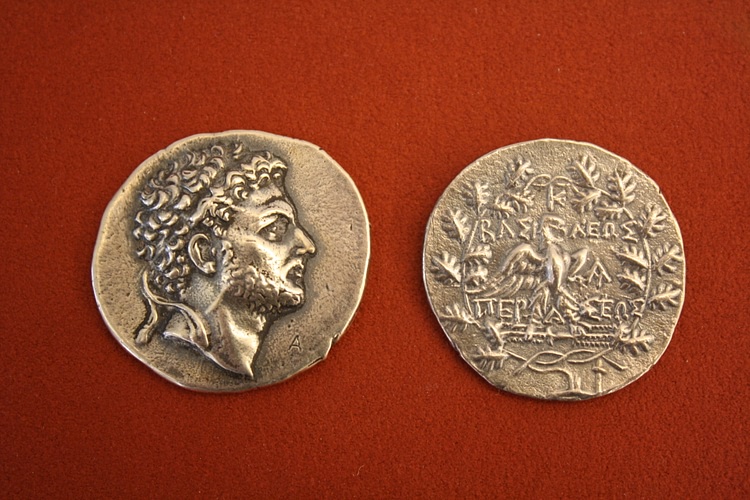 Perseo, tetradracma de plata macedonio Mark Cartwright (CC BY-NC-SA) ](https://www.worldhistory.org/image/844/perseus-macedonian-silver-tetradrachm/ "Perseus, Macedonian Silver Tetradrachm")Desde el punto de vista cultural, este período no es una etapa intermedia entre la próspera época clásica y la imperial, como se describía en el pasado. [Aristóteles](https://www.worldhistory.org/trans/es/1-355/aristoteles/), el padre de las ciencias modernas, Menandro, el gran autor de "comedias", [Epicuro](https://www.worldhistory.org/trans/es/1-14311/epicuro/), el moralista, [Eratóstenes](https://www.worldhistory.org/trans/es/1-11844/eratostenes/), pero ambién [Euclides](https://www.worldhistory.org/trans/es/1-14091/euclides/), [Arquímedes](https://www.worldhistory.org/trans/es/1-913/arquimedes/) y [Polibio](https://www.worldhistory.org/trans/es/1-11195/polibio/) vivieron y trabajaron durante el período helenístico. Este período mostró progresos en la arquitectura, un gran evergetismo (donaciones altruistas a la comunidad), una multiplicación de los días festivos y las celebraciones (demostrada por la gran cantidad de teatros construidos), el desarrollo del arte y la creación de bibliotecas, entre las que se destaca la de Alejandría.
#### Editorial Review
This human-authored definition has been reviewed by our editorial team before publication to ensure accuracy, reliability and adherence to academic standards in accordance with our [editorial policy](https://www.worldhistory.org/static/editorial-policy/).
## Sobre el autor
Apasionado de la antigua Asia Central. Mantiene el sitio web From Bactria to Taxila. Trabaja en el proyecto Europa Barbarorum.
- [Linkedin Profile](https://www.linkedin.com/in/antoine-simonin/52/685/a9a/e)
## Cronología
- **c. 402 BCE - 318 BCE**: Life of Athenian statesman and general [Phocion](https://www.worldhistory.org/Phocion/).
- **330 BCE - 64 BCE**: [Hellenistic Period](https://www.worldhistory.org/Hellenistic_Period/) in [Byblos](https://www.worldhistory.org/Byblos/).
- **c. 325 BCE - c. 320 BCE**: [Greek](https://www.worldhistory.org/disambiguation/greek/) rule in [Gandhara](https://www.worldhistory.org/Gandhara_Civilization/), ending some time after the [death of Alexander the Great](https://www.worldhistory.org/article/2366/death-of-alexander-the-great/).
- **323 BCE**: [Death of Alexander the Great](https://www.worldhistory.org/article/2366/death-of-alexander-the-great/), beginning of The [Hellenistic Period](https://www.worldhistory.org/Hellenistic_Period/) / The [Hellenistic World](https://www.worldhistory.org/Hellenistic_Period/).
- **322 BCE - 320 BCE**: First Successor [War](https://www.worldhistory.org/disambiguation/War/) between [Alexander](https://www.worldhistory.org/disambiguation/Alexander/)'s successors.
- **319 BCE - 315 BCE**: Second Successor [War](https://www.worldhistory.org/disambiguation/War/) between [Alexander](https://www.worldhistory.org/disambiguation/Alexander/)'s successors.
- **314 BCE - 311 BCE**: Third Successor [War](https://www.worldhistory.org/disambiguation/War/) between [Alexander](https://www.worldhistory.org/disambiguation/Alexander/)'s successors.
- **312 BCE**: [Seleucos](https://www.worldhistory.org/disambiguation/Seleucos/) conquers [Babylon](https://www.worldhistory.org/babylon/) and founds the [Seleucid](https://www.worldhistory.org/Seleucid_Empire/) dynasty.
- **c. 312 BCE - 63 BCE**: Duration of the [Seleucid Empire](https://www.worldhistory.org/Seleucid_Empire/).
- **310 BCE**: Assassination of [Roxanne](https://www.worldhistory.org/Roxanne/) and [Alexander](https://www.worldhistory.org/disambiguation/Alexander/) IV, wife and son of [Alexander the Great](https://www.worldhistory.org/Alexander_the_Great/).
- **309 BCE - 308 BCE**: [Agathocles of Syracuse](https://www.worldhistory.org/Agathocles_of_Syracuse/) successfuly campaigns in North [Africa](https://www.worldhistory.org/disambiguation/africa/) defeating Carthaginian armies and taking [Utica](https://www.worldhistory.org/Utica/) and Hippacra.
- **308 BCE - 301 BCE**: Fourth Successor [War](https://www.worldhistory.org/disambiguation/War/) between [Alexander](https://www.worldhistory.org/disambiguation/Alexander/)'s successors.
- **306 BCE**: [Demetrius I of Macedon](https://www.worldhistory.org/Demetrius_I_of_Macedon/) defeats [Ptolemy](https://www.worldhistory.org/disambiguation/Ptolemy/)'s fleet at [Salamis](https://www.worldhistory.org/disambiguation/Salamis/), off the coast of [Cyprus](https://www.worldhistory.org/cyprus/).
- **306 BCE**: [Epicurus](https://www.worldhistory.org/Epicurus/) buys a garden in [Athens](https://www.worldhistory.org/Athens/) in which he begins to teach Epicureanism.
- **c. 301 BCE - c. 320 BCE**: Doric [temple](https://www.worldhistory.org/temple/) to [Athena](https://www.worldhistory.org/athena/) and fortifications of [Lysimachus](https://www.worldhistory.org/Lysimachus/) built at [Troy](https://www.worldhistory.org/troy/).
- **301 BCE**: The [Battle](https://www.worldhistory.org/disambiguation/battle/) of Ipsus in central [Phrygia](https://www.worldhistory.org/phrygia/) where [Lysimachus](https://www.worldhistory.org/Lysimachus/) and [Seleucos I](https://www.worldhistory.org/Seleucos_I/) defeat [Antigonus I](https://www.worldhistory.org/Antigonus_I/) and [Demetrius I of Macedon](https://www.worldhistory.org/Demetrius_I_of_Macedon/).
- **295 BCE**: Demetrius I campaigns in central [Greece](https://www.worldhistory.org/greece/), removes the tyrant Lachares from [Athens](https://www.worldhistory.org/Athens/) and defeats [Sparta](https://www.worldhistory.org/sparta/).
- **294 BCE - c. 288 BCE**: Demetrius I rules as king of [Macedon](https://www.worldhistory.org/macedon/).
- **287 BCE - 212 BCE**: Life of [Archimedes](https://www.worldhistory.org/Archimedes/), physician, mathematician and engineer.
- **285 BCE - 282 BCE**: [Rome](https://www.worldhistory.org/Rome/) defeats the [Celts](https://www.worldhistory.org/celt/) in [Italy](https://www.worldhistory.org/italy/). Rome's dominance in central Italy is secured.
- **c. 280 BCE**: Founding of the [Achaean League](https://www.worldhistory.org/Achaean_League/) in the [Peloponnese](https://www.worldhistory.org/Peloponnese/) of [Greece](https://www.worldhistory.org/greece/).
- **280 BCE - 275 BCE**: King [Pyrrhus](https://www.worldhistory.org/pyrrhus/) of Epirus wages the Pyrrhic [War](https://www.worldhistory.org/disambiguation/War/) against the Romans in [Italy](https://www.worldhistory.org/italy/), defence of [Tarentum](https://www.worldhistory.org/tarentum/) being the pretext.
- **279 BCE**: [Celts](https://www.worldhistory.org/celt/) invade Thrace and [Anatolia](https://www.worldhistory.org/Asia_Minor/).
- **272 BCE**: [Death](https://www.worldhistory.org/disambiguation/Death/) of [Pyrrhus](https://www.worldhistory.org/pyrrhus/) of Epirus in a street [battle](https://www.worldhistory.org/disambiguation/battle/) in [Argos](https://www.worldhistory.org/argos/).
- **c. 270 BCE**: [Aristarchus of Samos](https://www.worldhistory.org/Aristarchus_of_Samos/) proposes a heliocentric world view.
- **263 BCE - 241 BCE**: Reign of Eumenes I at [Pergamon](https://www.worldhistory.org/pergamon/).
- **262 BCE**: Eumenes rebels and wins against the [Seleucid](https://www.worldhistory.org/Seleucid_Empire/) Antiochus I. Beginning of the [Pergamon](https://www.worldhistory.org/pergamon/) [Empire](https://www.worldhistory.org/empire/).
- **250 BCE**: Former [satrap](https://www.worldhistory.org/Persian_Governor/) [Diodotos](https://www.worldhistory.org/disambiguation/diodotos/) rebels against [Seleucid](https://www.worldhistory.org/Seleucid_Empire/) king [Antiochos](https://www.worldhistory.org/disambiguation/antiochos/) I, creating the [Greco-Bactrian kingdom](https://www.worldhistory.org/Greco-Bactria/).
- **241 BCE - 197 BCE**: Reign of Attalus I at [Pergamon](https://www.worldhistory.org/pergamon/).
- **222 BCE**: The [Achaean League](https://www.worldhistory.org/Achaean_League/) and [Antigonos](https://www.worldhistory.org/disambiguation/Antigonos/) III of [Macedon](https://www.worldhistory.org/macedon/) defeat [Sparta](https://www.worldhistory.org/sparta/) at Sellasia.
- **c. 190 BCE**: First appearance of multiple [Euthydemid](https://www.worldhistory.org/euthydemid/) kings at the same time. Beginning of the [Indo-Greek](https://www.worldhistory.org/Indo-Greek/) kingdoms.
- **c. 188 BCE**: The treaty of Apamea Kibotos. Peace and alliance is established between the [Seleucid Empire](https://www.worldhistory.org/Seleucid_Empire/) and [Rome](https://www.worldhistory.org/Rome/) joined by its allies, such as [Pergamon](https://www.worldhistory.org/pergamon/) and [Rhodes](https://www.worldhistory.org/Rhodes/). The Seleucids have to evacuate all the land and the [cities](https://www.worldhistory.org/city/) from [Asia Minor](https://www.worldhistory.org/Asia_Minor/) and to pay a huge [war](https://www.worldhistory.org/disambiguation/War/) indemnity.
- **172 BCE - 168 BCE**: Third Macedonian [War](https://www.worldhistory.org/disambiguation/War/): [Perseus](https://www.worldhistory.org/Perseus/) of [Macedon](https://www.worldhistory.org/macedon/) challenges [Rome](https://www.worldhistory.org/Rome/) and is defeated.
- **147 BCE - 139 BCE**: The Lusitanian commander Viriatus bleeds [Roman](https://www.worldhistory.org/disambiguation/Roman/) armies.
- **146 BCE**: [Rome](https://www.worldhistory.org/Rome/) sacks [Corinth](https://www.worldhistory.org/corinth/) and dissolves the [Achaean league](https://www.worldhistory.org/Achaean_League/). [Greece](https://www.worldhistory.org/greece/) is ruled by Rome.
- **146 BCE**: End of the [Third Punic War](https://www.worldhistory.org/Third_Punic_War/). [Carthage](https://www.worldhistory.org/carthage/) is destroyed and its lands become the [Roman](https://www.worldhistory.org/disambiguation/Roman/) province [Africa](https://www.worldhistory.org/disambiguation/africa/).
- **133 BCE**: Attalus III, the last king of [Pergamon](https://www.worldhistory.org/pergamon/), bequeathes the whole of Pergamon to [Rome](https://www.worldhistory.org/Rome/).
- **129 BCE**: Parthians [conquer](https://www.worldhistory.org/warfare/) [Mesopotamia](https://www.worldhistory.org/Mesopotamia/). The [Silk Road](https://www.worldhistory.org/Silk_Road/) to [China](https://www.worldhistory.org/china/) is now controlled by the Parthians.
- **89 BCE - 63 BCE**: Mithridatic Wars between [Mithridates VI](https://www.worldhistory.org/Mithridates_VI/) and [Roman Republic](https://www.worldhistory.org/Roman_Republic/) .
- **83 BCE**: [Tigranes II](https://www.worldhistory.org/Tigranes_the_Great/) invades and destroys the [Seleucid Empire](https://www.worldhistory.org/Seleucid_Empire/).
- **58 BCE - 51 BCE**: [Julius Caesar](https://www.worldhistory.org/Julius_Caesar/)'s [conquest](https://www.worldhistory.org/warfare/) of [Gaul](https://www.worldhistory.org/gaul/).
- **37 BCE**: [Herod the Great](https://www.worldhistory.org/Herod_the_Great/) is installed as King of [Judaea](https://www.worldhistory.org/disambiguation/judaea/). Rebuilding of the [Temple](https://www.worldhistory.org/temple/) of [Jerusalem](https://www.worldhistory.org/jerusalem/).
- **c. 30 BCE - c. 19 BCE**: [Roman](https://www.worldhistory.org/disambiguation/Roman/) poet [Virgil](https://www.worldhistory.org/virgil/) writes his [Aeneid](https://www.worldhistory.org/The_Aeneid/).
## Enlaces externos
- [What is Hellenistic Sculpture? Exploring the History of Hellenistic Art](https://mymodernmet.com/what-is-hellenistic-sculpture-history/)
- [Hellenistic Rulers](http://allthingsclassics.weebly.com/hellenistic-rulers.html)
- [Hellenistic Jewelry | Essay | The Metropolitan Museum of Art | Heilbrunn Timeline of Art History](https://www.metmuseum.org/toah/hd/hjew/hd_hjew.htm)
- [Intellectual Pursuits of the Hellenistic Age | Essay | The Metropolitan Museum of Art | Heilbrunn Timeline of Art History](https://www.metmuseum.org/toah/hd/ipha/hd_ipha.htm)
- [List of Rulers of the Ancient Greek World | Lists of Rulers | Heilbrunn Timeline of Art History | The Metropolitan Museum of Art](https://www.metmuseum.org/toah/hd/gkru/hd_gkru.htm)
## Cita este trabajo
### APA
Simonin, A. (2022, May 10). Período helenístico. (C. A. S. B, Traductor). *World History Encyclopedia*.
### Chicago
Simonin, Antoine. "Período helenístico." Traducido por Carlos A Sequera B. *World History Encyclopedia*, May 10, 2022. .
### MLA
Simonin, Antoine. "Período helenístico." Traducido por Carlos A Sequera B. *World History Encyclopedia*, 10 May 2022, .
## Licencia y derechos de autor
Enviado por [Carlos A Sequera B](https://www.worldhistory.org/user/carlosasequerab.t5w/ "User Page: Carlos A Sequera B"), publicado el 10 May 2022. Consulta la fuente original para obtener información sobre derechos de autor. Por favor, ten en cuenta que el contenido vinculado con esta página puede tener términos de licencia diferentes.