---
title: Atenas
author: Joshua J. Mark
translator: Rosa Baranda
source: https://www.worldhistory.org/trans/ES/1-292/atenas/
format: machine-readable-alternate
license: Creative Commons Attribution-NonCommercial-ShareAlike (https://creativecommons.org/licenses/by-nc-sa/4.0/)
updated: 2026-01-23
---
# Atenas
_Escrito por [Joshua J. Mark](https://www.worldhistory.org/user/JPryst/)_
_Traducido por [Rosa Baranda](https://www.worldhistory.org/user/rosa.baranda)_
Atenas,[](https://www.worldhistory.org/trans/es/2-1491/era-cleopatra-bonita/)[](https://www.worldhistory.org/trans/es/2-2578/como-llego-hitler-al-poder/)[](https://www.worldhistory.org/trans/es/2-2674/por-que-ataco-hitler-la-urss/)[](https://www.worldhistory.org/trans/es/2-2646/por-que-hitler-odiaba-a-los-judios/)[](https://www.worldhistory.org/trans/es/2-2350/dadme-la-libertad-o-dadme-la-muerte/)[](https://www.worldhistory.org/trans/es/2-207/que-le-paso-a-la-gran-biblioteca-de-alejandria/)[](https://www.worldhistory.org/trans/es/2-2574/por-que-gran-bretana-y-francia-apaciguaron-a-hitle/)[](https://www.worldhistory.org/trans/es/2-2754/por-que-desaparecio-la-mancomunidad-de-polonia-lit/)[](https://www.worldhistory.org/trans/es/2-2660/cuales-fueron-las-consecuencias-de-la-segunda-guer/) en Grecia, con su famosa [Acrópolis](https://www.worldhistory.org/trans/es/1-478/acropolis/), ha llegado a simbolizar el país entero en el imaginario popular, y no sin razón. No solo tiene sus icónicas ruinas y el famoso puerto del Pireo, sino que, gracias a los escritores de la Antigüedad, su historia está mejor documentada que la de la mayoría de las demás ciudades-Estado griegas.
La ciudad comenzó como una pequeña comunidad de [la civilización micénica](https://www.worldhistory.org/trans/es/1-11147/la-civilizacion-micenica/) (en torno a 1700-1100 a.C.) y creció hasta convertirse en una ciudad que, en su punto álgido, se asoció con el desarrollo de la democracia, la [filosofía](https://www.worldhistory.org/trans/es/1-340/filosofia/), la [ciencia](https://www.worldhistory.org/trans/es/1-351/ciencia/), las matemáticas, el teatro y la [literatura](https://www.worldhistory.org/trans/es/1-562/literatura/), el arte y muchos otros aspectos de la cultura y [civilización](https://www.worldhistory.org/trans/es/1-10175/civilizacion/) mundiales, incluidos los [Juegos Olímpicos](https://www.worldhistory.org/trans/es/1-440/los-antiguos-juegos-olimpicos/). La ciudad se quemó durante la invasión persa de 480 a.C., fue reconstruida por el estadista [Pericles](https://www.worldhistory.org/trans/es/1-341/pericles/) (495-429 a.C.) y se convirtió en la superpotencia de la Antigüedad gracias a su formidable Ejército y su riqueza.
Cayó frente a [Esparta](https://www.worldhistory.org/trans/es/1-197/esparta/) tras la segunda [guerra del Peloponeso](https://www.worldhistory.org/trans/es/1-342/guerra-del-peloponeso/) (413 - 404 a.C.) pero volvió a resurgir, asumiendo una posición importante de liderazgo entre las ciudades-Estado incluso después de haber sido conquistada por [Filipo II de Macedonia](https://www.worldhistory.org/trans/es/1-13145/filipo-ii-de-macedonia/) (que reinó de 359 - 336 a.C.) en 338 a.C. tras su victoria en la [batalla de Queronea](https://www.worldhistory.org/trans/es/1-516/batalla-de-queronea/). La ciudad fue tomada como una provincia de Roma tras la [batalla de Accio](https://www.worldhistory.org/trans/es/1-10408/batalla-de-accio/) en 31 a.C. y se convirtió en la favorita de varios emperadores romanos, especialmente [Adriano](https://www.worldhistory.org/trans/es/1-102/adriano/) (que reinó de 117 - 138 a.C.), que contribuyó con fondos y proyectos arquitectónicos para embellecerla. El [apóstol Pablo](https://www.worldhistory.org/trans/es/1-12376/pablo-el-apostol/) aparece en el Libro de Actas predicándoles a los atenienses, y más tarde se convertiría en un centro importante de la teología cristiana.
Después de que Grecia fuera conquistada por [el Imperio otomano](https://www.worldhistory.org/trans/es/1-18700/el-imperio-otomano/) en 1458, Atenas entró en un largo periodo de declive que no terminaría hasta el siglo XIX, después de que el país consiguiera la independencia de los turcos en 1821. Reconociendo la importancia del pasado para mantener la identidad nacional, el Gobierno centró sus esfuerzos en restaurar y conservar los monumentos y templos como el [Partenón](https://www.worldhistory.org/trans/es/1-343/partenon/), así como lugares ancestrales como el [ágora](https://www.worldhistory.org/trans/es/1-512/agora/). Hoy en día, Atenas es la capital de Grecia y es uno de los centros culturales más visitados y admirados del mundo.
### Primeros asentamientos y leyenda
Hay evidencia de ocupación humana en la Acrópolis y, más abajo, en el área alrededor del ágora, que data del [periodo neolítico](https://www.worldhistory.org/trans/es/1-57/el-neolitico/), donde una cultura más avanzada claramente se desarrolló en torno al 5000 a.C., y probablemente ya en el 7000 a.C. Según la leyenda, el rey ateniense Cécrope quería que la ciudad llevara su nombre, pero los dioses, al ver lo bonita que era, sintieron que se merecía un nombre inmortal. Hicieron una competición entre los dioses en la Acrópolis, con Cécrope y los ciudadanos como espectadores, para decidir qué deidad lograría ese honor.
[Poseidón](https://www.worldhistory.org/trans/es/1-950/poseidon/) golpeó una roca con su tridente y, cuando el agua surgió a borbotones, le aseguró al pueblo que ya nunca sufrirían sequías. [Atenea](https://www.worldhistory.org/trans/es/1-488/atenea/) era la siguiente y dejó caer una semilla en la tierra de la que enseguida creció un olivo. La gente consideró que el olivo era más valioso que el agua (ya que, según algunas versiones de la historia, el agua era salada, como el reino de Poseidón), Atenea fue elegida como patrona y la ciudad fue nombrada en su honor. Según el estudioso Robin Waterfield:
> Este mito puede que revele un acontecimiento histórico olvidado hace mucho tiempo. El nombre en griego antiguo para Atenas es una palabra plural, porque en algún momento hubo varias villas que se unieron bajo los auspicios de la diosa Atenea: «las comunidades de Atenea», por así decir. Si la deidad principal de alguna de estas villas originales era Poseidón, entonces el mito refleja el hecho de que este perdiera frente a Atenea. (36)
[  La Acrópolis y la antigua Atenas Simeon Netchev (CC BY-NC-ND) ](https://www.worldhistory.org/image/16191/the-acropolis-and-ancient-athens/ "The Acropolis and Ancient Athens")Este mito también se utilizó posteriormente para justificar la posición de ciudadanas de segunda clase de las mujeres atenienses, ya que fueron las mujeres de Atenas las que prefirieron el regalo de Atenea por encima del de Poseidón y, continúa explicación, para ahorrarle a la ciudad la cólera de Poseidón, el nombre de las mujeres no se escribía en los registros de nacimientos como madres (se escribía el nombre del padre de la mujer), y se les denegó la opinión en política y los derechos civiles más allá de su participación en las actividades religiosas.
Como el suelo no era propicio para explotaciones agrícolas a gran es cala, Atenas se dedicó al comercio para vivir, principalmente por rutas marítimas desde el puerto de [El Pireo](https://www.worldhistory.org/trans/es/1-11199/el-pireo/). El periodo micénico temprano vio alzarse enormes fortalezas por toda Grecia, y Atenas no es una excepción. Los restos de un palacio micénico todavía se pueden ver hoy en día en la Acrópolis. La *[Ilíada](https://www.worldhistory.org/trans/es/1-226/la-iliada/)* y la *[Odisea](https://www.worldhistory.org/trans/es/1-14584/la-odisea/)* de [Homero](https://www.worldhistory.org/trans/es/1-225/homero/) (siglo VIII a.C.) pintan a los micénicos como grandes guerreros y gentes de mar que comerciaban por todo el [Egeo](https://www.worldhistory.org/trans/es/1-118/egeo/) y la región del Mediterráneo, y esto llegó a ser una cuestión de orgullo para los atenienses, que se consideraban a sí mismos como los descendientes directos de los grandes héroes homéricos.
[  Varias rutas comerciales activas en el Mediterráneo durante la Edad de Bronce Kelly Macquire (CC BY-NC-SA) ](https://www.worldhistory.org/image/12695/some-active-trade-routes-in-the-bronze-age-mediter/ "Some Active Trade Routes in the Bronze Age Mediterranean")En torno a 1200 a.C., [los pueblos del Mar](https://www.worldhistory.org/trans/es/1-181/los-pueblos-del-mar/) invadieron el archipiélago griego en el Egeo desde el sur, a la vez que los dorios descendieron desde el norte hasta la Grecia continental. Mientras que los pueblos del Mar sin duda hicieron incursiones en Ática (la región en la que se encuentra Atenas), los dorios evitaron la ciudad, lo que permitió que la cultura micénica sobreviviera, aunque, al igual que en el resto de Grecia, parece que hubo una recesión económica y cultural tras estas invasiones durante [el colapso de la Edad del Bronce](https://www.worldhistory.org/trans/es/1-10433/el-colapso-de-la-edad-del-bronce/). Después, los atenienses reclamaron una posición especial porque hablaban griego jónico, en vez de dórico, y mantenían las costumbres que consideraban más antiguas y por lo tanto superiores a las de sus vecinos.
### [Solón](https://www.worldhistory.org/trans/es/1-319/solon/) y la ley
Los aristócratas ricos tenían el control tanto de la tierra como del [gobierno griego](https://www.worldhistory.org/trans/es/1-11753/gobierno-de-la-antigua-grecia/), y con el tiempo los ciudadanos con tierras que eran más pobres acabaron esclavizados (o casi) a causa de las deudas a los ciudadanos más ricos. Además, había una percepción de falta de consistencia del resto de leyes de la ciudad. La primera serie de leyes escrita para solucionar estos problemas vino de la mano del estadista Dracón en torno a 621 a.C., pero estas leyes se consideraron muy severas (la pena por la mayoría de infracciones era la muerte), así que el gran legislador Solón (en torno a 630 - alrededor de 560 a.C.) fue convocado para que las modificara y revisara. Solón, aunque él mismo era un aristócrata, creó una serie de leyes que igualaban el poder político de la ciudadanía y, con ello, sentó las bases de la [democracia ateniense](https://www.worldhistory.org/trans/es/1-13310/democracia-ateniense/) en torno a 594 a.C.
[  Solón Kpjas (Public Domain) ](https://www.worldhistory.org/image/4606/solon/ "Solon")Solón también dedicó mucho trabajo a hacer que las políticas de Atenas no solo fueran justas, sino beneficiosas. Legalizó [la prostitución en la antigua Atenas](https://www.worldhistory.org/trans/es/2-28/la-prostitucion-en-la-antigua-atenas/) y puso impuestos tanto a las prostitutas individuales como a los burdeles. Como Atenas era un centro de comercio popular y rentable, muchos hombres jóvenes llegaban a la ciudad y usaban los servicios de las prostitutas, mientras que los jóvenes atenienses, que normalmente no se casaban hasta los 30 años, disponían de una manera de ganar experiencia sexual sin correr el riesgo de tener que enfrentarse al padre o los hombres de la familia de una mujer virgen a causa del sexo prematrimonial. Al animar a los jóvenes a visitar a las prostitutas, Solón suavizó una fuente de contiendas en la ciudad, ya que se entendía que las jóvenes de buena familia estaban prohibidas a cualquier hombre que no fuera aquel con el que se la iba a casar.
Después de que Solón se retirara del servicio público, hubo varias facciones que quisieron hacerse con el poder, y el vencedor, [Pisístrato](https://www.worldhistory.org/trans/es/1-11952/pisistrato/) (muerto en torno a 528 a.C.), reconoció el valor de las revisiones de Solón y las mantuvo, de una manera modificada, durante su reinado como tirano benevolente. Su hijo, Hipias (que reinó de alrededor de 528 - 510 a.C.), continuó con sus políticas como cogobernante con su hermano Hiparco (que reinó de alrededor de 528 - 514 a.C.) hasta que Hiparco fue asesinado por una aventura amorosa en 514 a.C.
### Los tiranicidas y la democracia
Hiparco se sentía atraído por un joven llamado Harmodio, pero este rechazó su interés porque ya tenía una relación con otro hombre, Aristogitón. Hiparco no se tomó bien el rechazo, así que le quitó a la hermana de Harmodio su posición, bien visible y prestigiosa, entre las [mujeres del culto de Atenea](https://www.worldhistory.org/trans/es/2-74/el-papel-de-la-mujer-en-el-culto-ateniense/) que participaban en el festival Panatenaico en honor de la diosa. Tal y como apunta la estudiosa Sarah B. Pomeroy, «impedir que una candidata participase en este evento suponía difamarla» (76). Que Hiparco eliminara a la chica equivalía a afirmar que no era virgen, insultándola así a ella y a su familia. Harmodio y Aristogitón asesinaron a Hiparco durante el festival y después fueron aprehendidos y ejecutados.
Después de esto, Hipias se volvió cada vez más paranoico y errático en su reinado, culminando en la revuelta ateniense de 510 a.C., que en realidad era una acción militar de Esparta al mando del rey Cleomenes I (que reinó de alrededor 519 - en torno a 490 a.C.), a quien invitaron los atenienses para deshacerse de Hipias. Después, como los atenienses no querían deberle nada a Esparta, reescribieron la historia presentando a Harmodio y Aristogitón como «los tiranicidas» que habían dado el primer golpe por la democracia y habían restaurado los ideales democráticos de la ciudad. En realidad no hicieron ni una cosa ni la otra, sino que simplemente se vengaron por una afrenta personal.
[  Cariátides en el Erecteón Dennis Jarvis (CC BY-NC-SA) ](https://www.worldhistory.org/image/975/caryatids-of-the-erechtheion/ "Caryatids of the Erechtheion")Luego del golpe, y tras arreglar los asuntos con varias facciones, el estadista [Clístenes](https://www.worldhistory.org/trans/es/1-1000/clistenes/) (siglo VI a.C.) fue elegido para reformar el Gobierno y las leyes y, en torno a 507 a.C. instituyó una nueva forma de gobierno que hoy en día se reconoce como democracia. Clístenes está considerado como el «padre de la democracia ateniense», pero esta forma de gobierno era significativamente diferente de como se entiende hoy en día la democracia. En la democracia ateniense, solo los hombres de la clase alta tenían voz en la política, privando del derecho al voto a mujeres, extranjeros y, por supuesto, los muchos esclavos que componían una gran parte de la población de Atenas.
Aun así, esta nueva forma de gobierno involucraba a la ciudadanía directamente en las decisiones políticas, e incluso los que no tenían permitido votar entendían que ahora las decisiones las tomaba una mayoría de ciudadanos informados en vez de un tirano. La democracia ateniense procuraría la estabilidad necesaria para hacer de Atenas el centro cultural e intelectual de la Antigüedad, una reputación que llega incluso hasta nuestros días. Waterfield comenta:
> El orgullo que obtenían de la extensa participación en la vida pública dio a los atenienses la energía para desarrollar la ciudad tanto de manera interna como en relación con sus vecinos. (62)
Como creían que descendían de grandes héroes, y con héroes entre ellos como los tiranicidas, los atenienses entendían que ahora tenían la mejor forma de gobierno, que tenían que promover en otros lugares; así que decidieron incitar a la revuelta a las comunidades griegas de [Asia Menor](https://www.worldhistory.org/trans/es/1-228/asia-menor/), que en aquel momento estaban bajo el control del [Imperio persa aqueménida](https://www.worldhistory.org/trans/es/1-322/imperio-aquemenida/) (en torno a 550-330 a.C.).
### Las [guerras médicas](https://www.worldhistory.org/trans/es/1-1003/guerras-medicas/)
El [imperio](https://www.worldhistory.org/trans/es/1-99/imperio/) Persa en aquel momento estaba liderado por el emperador [Darío I](https://www.worldhistory.org/trans/es/1-357/dario-i/) (el Grande, que reinó de 522-486 a.C.) que aplastó la rebelión rápidamente y después mandó un ejército contra Atenas. Los persas fueron derrotados en la [batalla de Maratón](https://www.worldhistory.org/trans/es/1-333/batalla-de-maraton/) en 490 a.C., donde perdieron más de 6.000 hombres frente a las brillantes tácticas del general ateniense [Milcíades](https://www.worldhistory.org/trans/es/1-13401/milciades/) (554-489 a.C.), que solo contó 192 soldados caídos. El Ejército persa se consideraba invencible en aquella época, por lo que esta victoria no hizo sino aumentar la buena opinión que nos atenienses tenían de sí mismos.
Sin embargo, en 480 a.C. el hijo y sucesor de Darío I, [Jerjes I](https://www.worldhistory.org/trans/es/1-359/jerjes-i/) (que reinó de 486-465 a.C.) reunió el ejército más grande del mundo hasta entonces y se lanzó a la invasión de Grecia, con Atenas como principal objetivo, para vengar el insulto a su padre. Sus ejércitos se encontraron en las [Termópilas](https://www.worldhistory.org/trans/es/1-335/batalla-de-las-termopilas/) con el rey espartano [Leónidas](https://www.worldhistory.org/trans/es/1-336/leonidas-i-de-esparta/) (muerto en 480 a.C.) y sus famosos 300 guerreros, pero, tras derrotarlos y matarlos, Grecia estaba disponible para la conquista.
[  Batalla de Salamina, 480 a.C. Ancient Warfare Magazine / Karwansaray Publishers (Copyright) ](https://www.worldhistory.org/image/13635/battle-of-salamis-480-bce/ "Battle of Salamis, 480 BCE")Sin embargo, la flota persa fue derrotada por los ejércitos liderados por los atenienses en [la batalla de Salamina](https://www.worldhistory.org/trans/es/1-337/la-batalla-de-salamina/) cuando el general ateniense [Temístocles](https://www.worldhistory.org/trans/es/1-1002/temistocles/) (524-460 a.C.) la aventajó, y a esta derrota le siguieron las batallas terrestres en Platea y Mícala en 479 a.C., que expulsaron a los persas de Grecia y establecieron a Atenas como una superpotencia. Waterfield comenta:
> Ese fue el mejor momento de Atenas. Temístocles era el salvador reconocido de Grecia y la ciudad ondeó claramente la bandera del panhelenismo, expresando por un lado lo que les era común a todos los griegos y continuando, por el otro, la lucha contra los persas. De orígenes inciertos, una ciudad pequeña y empobrecida había ascendido a una posición de poder e importancia. (72)
Con Pericles, Atenas fundó la [Liga de Delos](https://www.worldhistory.org/trans/es/1-338/liga-de-delos/), presumiblemente para crear una conexión griega cohesiva entre las ciudades-Estado para evitar futuros ataques de los persas. Las demás ciudades pagaban la recaudación de la Liga de [Delos](https://www.worldhistory.org/trans/es/1-937/delos/) y Atenas acordaba protegerlas contra las agresiones persas. Sin embargo, Pericles usó el dinero de la liga para embellecer y fortificar Atenas y, bajo su mandato, la ciudad se hizo tan poderosa que, en la práctica, el Imperio ateniense podía dictar las leyes, costumbres y comercio de todos sus vecinos en el Ática y las islas del Egeo.
### La Edad de Oro
Bajo Pericles, Atenas entró en su edad dorada y los grandes pensadores, escritores y artistas florecieron en la ciudad. [Heródoto](https://www.worldhistory.org/trans/es/1-234/herodoto/) (en torno a 484-425/423 a.C.), el «padre de la historia», vivió y escribió en Atenas. [Sócrates](https://www.worldhistory.org/trans/es/1-339/socrates/) (en torno a 470/469-399 a.C.), el «padre de la filosofía», enseñaba en el mercado. [Hipócrates](https://www.worldhistory.org/trans/es/1-10391/hipocrates/) (en torno a 460-370 a.C.), el «padre de la medicina», practicaba aquí. Fidias (480-430 a.C.) creó sus grandes obras de [escultura griega](https://www.worldhistory.org/trans/es/1-11686/escultura-griega-antigua/) para el Partenón en la Acrópolis y la [estatua de Zeus en Olimpia](https://www.worldhistory.org/trans/es/1-17187/estatua-de-zeus-en-olimpia/), una de [las Siete maravillas de la Antigüedad](https://www.worldhistory.org/trans/es/3-19446/las-siete-maravillas-de-la-antiguedad/).
[  Las ciudades-Estado griegas en torno a 500 a.C. Simeon Netchev (CC BY-NC-ND) ](https://www.worldhistory.org/trans/es/3-14624/mapa-de-las-ciudades-estado-griegas-en-torno-a-500/ "Mapa de las ciudades-Estado griegas en torno a 500 a.C.")[Demócrito](https://www.worldhistory.org/trans/es/1-10119/democrito/) (en torno a 460 - en torno a 370 a.C.) imaginó un universo atómico. [Esquilo](https://www.worldhistory.org/trans/es/1-11058/esquilo/) (en torno a 525 - en torno a 456 a.C.), [Eurípides](https://www.worldhistory.org/trans/es/1-11828/euripides/) (en torno a 484-407 a.C.), [Aristófanes](https://www.worldhistory.org/trans/es/1-11061/aristofanes/) (en torno a 460 - en torno a 380 a.C.) y [Sófocles](https://www.worldhistory.org/trans/es/1-10183/sofocles/) (496 - en torno a 406 a.C.) hicieron famoso el [teatro griego](https://www.worldhistory.org/trans/es/1-14956/teatro-griego-antiguo/), tanto la comedia como la tragedia, y el poeta lírico [Píndaro](https://www.worldhistory.org/trans/es/1-19347/pindaro/) (en torno a 518 - en torno a 448 a.C.), otra figura importante de la literatura griega, escribió sus *Odas*. Este legado continuaría cuando [Platón](https://www.worldhistory.org/trans/es/1-349/platon/) (428/427-348/347 a.C.) fundó su famosa Academia fuera de las murallas de Atenas en 385 a.C. y después, [Aristóteles](https://www.worldhistory.org/trans/es/1-355/aristoteles/) (384-322 a.C.) establecería su escuela, el Liceo, en el centro de la ciudad.
El poder del Imperio ateniense avivó tal arrogancia en los legisladores del momento que sus vecinos la acabaron encontrando insoportable. Cuando Atenas envió tropas para ayudar a Esparta a acabar con una rebelión ilota, los espartanos repudiaron el gesto y mandaron de vuelta a Atenas al ejército con deshonor, provocando así una [guerra](https://www.worldhistory.org/trans/es/1-154/guerra/) que llevaba tiempo urdiéndose. Más tarde, cuando Atenas envió su flota para ayudar a defender a sus aliados de [Córcira](https://www.worldhistory.org/trans/es/1-11218/corcira/) (Corfú) contra una invasión corintia durante la batalla de Sybota en 433 a.C., Esparta interpretó esta acción como una agresión en vez de ayuda, dado que [Corinto](https://www.worldhistory.org/trans/es/1-218/corinto/) era una aliada de Esparta.
### Conclusión
La primera guerra del [Peloponeso](https://www.worldhistory.org/trans/es/1-161/peloponeso/) (431-404 a.C.) entre Atenas y Esparta (aunque de manera directa o indirecta toda Grecia estaba involucrada) acabó en una tregua entre las partes, pero Atenas fue derrotada en la segunda guerra del Peloponeso, cayendo de su posición de poder. Una vez perdidos el imperio y la riqueza de la ciudad, y con las murallas destruidas, tan solo su reputación como un gran centro de aprendizaje, de [filosofía griega](https://www.worldhistory.org/trans/es/1-11892/filosofia-griega/) y de cultura evitaron el saqueo de la ciudad y la esclavización de su población. Atenas luchó por desprenderse de esta condición de Estado sometido, con cierto éxito, hasta que fue derrotada en el 338 a.C. por las fuerzas macedonias al mando de Filipo II en Queronea.
Atenas fue súbdita del Gobierno macedonio hasta su derrota a manos de los romanos en 197 a.C. en la batalla de Cinoscéfalas, tras la cual Grecia fue conquistada paso a paso por [el Imperio romano](https://www.worldhistory.org/trans/es/1-100/el-imperio-romano/). Es un testimonio de la reputación imperecedera de Atenas como centro cultural que el general romano [Sila](https://www.worldhistory.org/trans/es/1-477/sila/), que saqueó la ciudad en el 87-86 a.C., masacró a la población, destruyó el ágora e incendió el puerto del Pireo, siempre mantuviera su inocencia, alegando que había ordenado a sus hombres que trataran bien a la ciudad y que estos sencillamente no le habían hecho caso.
[ 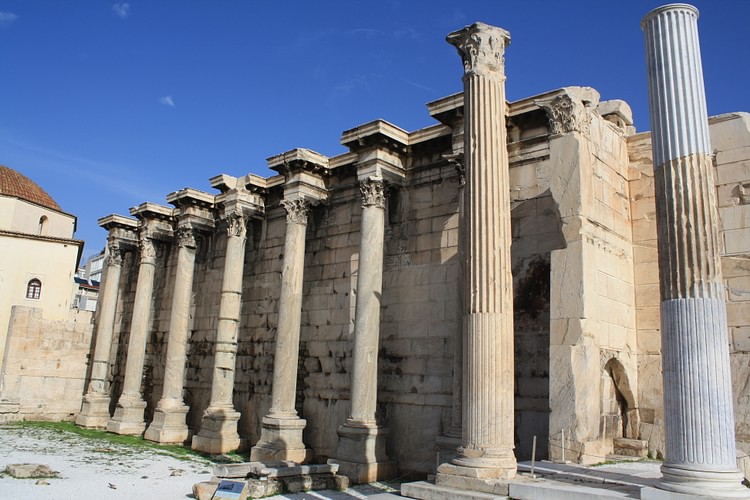 Fachada de la biblioteca de Adriano, Atenas Mark Cartwright (CC BY-NC-SA) ](https://www.worldhistory.org/image/4133/facade-library-of-hadrian-athens/ "Facade, Library of Hadrian, Athens")Según el libro de Actos de la [Biblia](https://www.worldhistory.org/trans/es/1-191/biblia/), san Pablo predicó a los atenienses en el Areópago (la colina de [Marte](https://www.worldhistory.org/trans/es/1-10341/marte/)), alabando su interés por la religión y hablándoles del nuevo [dios](https://www.worldhistory.org/trans/es/1-10299/dios/), [Jesucristo](https://www.worldhistory.org/trans/es/1-12343/jesucristo/). Tras el ascenso del [cristianismo](https://www.worldhistory.org/trans/es/1-665/cristianismo/) una vez fue adoptado por el Imperio romano, Atenas se convirtió en un importante centro de la nueva fe, y en el siglo VI d.C. las escuelas paganas fueron clausuradas y los templos destruidos o convertidos en iglesias.
La ciudad fue saqueada por varias llamadas «tribus bárbaras» desde finales de la Antigüedad y hasta la Edad Media hasta que se estableció como el Estado Cruzado del Ducado de Atenas (1205-1458) tras la [cuarta cruzada](https://www.worldhistory.org/trans/es/1-16760/cuarta-cruzada/) (1202-1204). A Atenas le fue bien durante este periodo hasta que fue conquistada por el Imperio otomano en 1458. Los turcos otomanos no tenían ningún respeto por la antigua ciudad, que fue decayendo poco a poco bajo su control.
Después de que Grecia lograra su independencia de los turcos en 1821, Atenas volvió a resurgir, tal y como hiciera tantas veces en el pasado. Los trabajos de restauración y conservación se convirtieron en una prioridad del nuevo Gobierno y la ciudad recuperó algo parecido a su antiguo esplendor. Hoy en día, el nombre de Atenas sigue evocando imágenes del mundo clásico y las cumbres de la creatividad intelectual y poética, mientras que el Partenón en la Acrópolis sigue simbolizando la Edad de Oro de la [antigua Grecia](https://www.worldhistory.org/trans/es/1-119/antigua-grecia/) y lo mejor de lo que representaba.
#### Editorial Review
This human-authored definition has been reviewed by our editorial team before publication to ensure accuracy, reliability and adherence to academic standards in accordance with our [editorial policy](https://www.worldhistory.org/static/editorial-policy/).
## Bibliografía
- [Cartledge, P. *Thermopylae: The Battle that Changed the World.* Vintage Books, 2006.](https://www.worldhistory.org/books/B01FIYVNRG/)
- [Eusebius & Maier, P. L. *Eusebius' Ecclesiastical History.* Kregel Academic & Professional, 2007.](https://www.worldhistory.org/books/082543307X/)
- [Grant, M. *Readings in the Classical Historians.* Scribners Publishing, 1993.](https://www.worldhistory.org/books/0684192454/)
- [Herodotus & Strassler, R. B. *The Landmark Herodotus.* Pantheon, 2007.](https://www.worldhistory.org/books/0375421092/)
- [Livingstone, R.W. *The Legacy of Greece.* Pinnacle Press, 2017.](https://www.worldhistory.org/books/1374929042/)
- [Mireaux, E. *Daily Life in the Time of Homer.* Macmillan Publishing, 2000.](https://www.worldhistory.org/books/B0006AVTT0/)
- [Nardo, D. *Exploring Cultural History - Living in Ancient Greece.* Greenhaven Press, 2003.](https://www.worldhistory.org/books/0737714557/)
- [Plutarch. *Plutarch's Lives, The Complete 48 Biographies .* Engage Classics, 2020.](https://www.worldhistory.org/books/1774760487/)
- [Pomeroy, S. B. *Goddesses, Whores, Wives, and Slaves.* Schocken, 1995.](https://www.worldhistory.org/books/080521030X/)
- [Waterfield, R. *Athens: A History From Ancient Ideal to Modern City.* Basic Books, 2004.](https://www.worldhistory.org/books/046509063X/)
## Sobre el autor
Joshua J. Mark no solo es cofundador de World History Encyclopedia, sino también es el director de Contenidos. Anteriormente fue profesor en el Colegio Marista de Nueva York, donde enseñó historia, filosofía, literatura y escritura. Ha viajado extensamente y vivió en Grecia y en Alemania.
- [Linkedin Profile](https://www.linkedin.com/pub/joshua-j-mark/38/614/339)
## Cronología
- **c. 7000 BCE - 5000 BCE**: Human habitation on the [Acropolis](https://www.worldhistory.org/Acropolis/) and around the [Agora](https://www.worldhistory.org/agora/) of [Athens](https://www.worldhistory.org/Athens/) continues from [Neolithic Period](https://www.worldhistory.org/Neolithic/).
- **c. 1700 BCE - c. 1100 BCE**: [Mycenaean Period](https://www.worldhistory.org/Mycenaean_Civilization/). [Agora](https://www.worldhistory.org/agora/) established at [Athens](https://www.worldhistory.org/Athens/).
- **c. 1100 BCE - c. 600 BCE**: [Iron Age](https://www.worldhistory.org/disambiguation/Iron_Age/) Development, public buildings erected at the [Agora](https://www.worldhistory.org/agora/) in [Athens](https://www.worldhistory.org/Athens/).
- **683 BCE - 682 BCE**: List of annual archons at [Athens](https://www.worldhistory.org/Athens/) begins.
- **c. 600 BCE**: The Eleusinian Mysteries become part of the official Athenian religious calendar.
- **600 BCE - 550 BCE**: The Dionysia becomes a major Athenian festival in honour of [Dionysos](https://www.worldhistory.org/Dionysos/).
- **600 BCE - 480 BCE**: Attic [black-figure pottery](https://www.worldhistory.org/Black_Figure_Pottery/) dominates the [greek](https://www.worldhistory.org/disambiguation/greek/) ceramic market.
- **594 BCE - 593 BCE**: In [Athens](https://www.worldhistory.org/Athens/) the archon [Solon](https://www.worldhistory.org/solon/) lays the foundations for democracy.
- **c. 560 BCE**: [Pisistratos](https://www.worldhistory.org/Pisistratus/) becomes tyrant in [Athens](https://www.worldhistory.org/Athens/) for the first time.
- **c. 546 BCE**: [Pisistratus](https://www.worldhistory.org/Pisistratus/) lands his Argive mercenary force at [Marathon](https://www.worldhistory.org/marathon/) and with victory at Pallene establishes himself once again as tyrant of [Athens](https://www.worldhistory.org/Athens/).
- **c. 540 BCE**: [Athens](https://www.worldhistory.org/Athens/) removes and prohibits further burials on [Delos](https://www.worldhistory.org/delos/) to purify the sacred island.
- **525 BCE**: [Cleisthenes](https://www.worldhistory.org/Cleisthenes/) is made archon at [Athens](https://www.worldhistory.org/Athens/).
- **c. 524 BCE - c. 460 BCE**: Life of Athenian general and statesman [Themistocles](https://www.worldhistory.org/Themistocles/).
- **514 BCE**: Fall of the Peisistratid tyranny in [Athens](https://www.worldhistory.org/Athens/).
- **514 BCE**: The tyrant of [Athens](https://www.worldhistory.org/Athens/) Hipparchos is killed by Harmodios and Aristogeiton - the 'tyrannicides'.
- **c. 508 BCE**: According to [Aristotle](https://www.worldhistory.org/aristotle/), the institution of [ostracism](https://www.worldhistory.org/Ostracism/) is introduced in [Athens](https://www.worldhistory.org/Athens/) under [Cleisthenes](https://www.worldhistory.org/Cleisthenes/).
- **c. 508 BCE**: Reforms by [Cleisthenes](https://www.worldhistory.org/Cleisthenes/) establishes democracy in [Athens](https://www.worldhistory.org/Athens/).
- **c. 495 BCE**: Birth of [Pericles](https://www.worldhistory.org/pericles/).
- **493 BCE**: The first fortifications are constructed at [Athens](https://www.worldhistory.org/Athens/)' port of [Piraeus](https://www.worldhistory.org/Piraeus/).
- **493 BCE**: [Themistocles](https://www.worldhistory.org/Themistocles/) is made archon in [Athens](https://www.worldhistory.org/Athens/).
- **490 BCE**: [Athens](https://www.worldhistory.org/Athens/) builds a treasury at [Delphi](https://www.worldhistory.org/delphi/) following their victory at [Marathon](https://www.worldhistory.org/marathon/) against [Persia](https://www.worldhistory.org/Persia/).
- **490 BCE - 480 BCE**: A 1.4 m (4 ft 7 in) tall [Iris](https://www.worldhistory.org/Iris/) or [Nike](https://www.worldhistory.org/nike/) [sculpture](https://www.worldhistory.org/disambiguation/Sculpture/) is erected on the [Acropolis](https://www.worldhistory.org/Acropolis/) of [Athens](https://www.worldhistory.org/Athens/) in memory of the general Kallimachos, killed in the [Battle](https://www.worldhistory.org/disambiguation/battle/) of [Marathon](https://www.worldhistory.org/marathon/).
- **11 Sep 490 BCE**: A combined force of [Greek](https://www.worldhistory.org/disambiguation/greek/) hoplites defeat the Persians at [Marathon](https://www.worldhistory.org/marathon/).
- **487 BCE - 486 BCE**: Archons begin to be appointed by lot in [Athens](https://www.worldhistory.org/Athens/).
- **c. 483 BCE**: [Themistocles](https://www.worldhistory.org/Themistocles/) persuades the Athenians to significantly expand their fleet, which saves them at [Salamis](https://www.worldhistory.org/disambiguation/Salamis/) and becomes their source of power.
- **480 BCE**: The fortifications of [Piraeus](https://www.worldhistory.org/Piraeus/) instigated by [Themistocles](https://www.worldhistory.org/Themistocles/) are completed.
- **480 BCE**: Sack of [Athens](https://www.worldhistory.org/Athens/) by the Persians under [Xerxes](https://www.worldhistory.org/Xerxes_I/). The [Agora](https://www.worldhistory.org/agora/) is destroyed.
- **Aug 480 BCE**: The indecisive [battle](https://www.worldhistory.org/disambiguation/battle/) of Artemision between the [Greek](https://www.worldhistory.org/disambiguation/greek/) and Persian fleets of [Xerxes I](https://www.worldhistory.org/Xerxes_I/). The Greeks withdraw to [Salamis](https://www.worldhistory.org/disambiguation/Salamis/).
- **479 BCE**: [Xerxes](https://www.worldhistory.org/Xerxes_I/)' Persian forces are defeated by [Greek](https://www.worldhistory.org/disambiguation/greek/) forces at [Plataea](https://www.worldhistory.org/Plataea/) effectively ending [Persia](https://www.worldhistory.org/Persia/)'s imperial ambitions in [Greece](https://www.worldhistory.org/greece/).
- **479 BCE - 432 CE**: The period of [Thucydides](https://www.worldhistory.org/Thucydides/)' Pentecontaetia in ancient [Greece](https://www.worldhistory.org/greece/).
- **478 BCE - 454 BCE**: The treasury of the [Delian League](https://www.worldhistory.org/Delian_League/) is kept on [Delos](https://www.worldhistory.org/delos/) until its removal to [Athens](https://www.worldhistory.org/Athens/).
- **478 BCE - 404 BCE**: The [Delian League](https://www.worldhistory.org/Delian_League/) in [Greece](https://www.worldhistory.org/greece/), led by [Athens](https://www.worldhistory.org/Athens/).
- **476 BCE - 463 BCE**: [Delian League](https://www.worldhistory.org/Delian_League/) operations are led by Athenian commander [Cimon](https://www.worldhistory.org/cimon/)
- **c. 475 BCE**: Athenian general [Cimon](https://www.worldhistory.org/cimon/) drives the Dolopian pirates out of the [Aegean](https://www.worldhistory.org/aegean/) island of Scyros.
- **475 BCE**: [Cimon](https://www.worldhistory.org/cimon/) captures Eion in Thrace for [Athens](https://www.worldhistory.org/Athens/).
- **c. 471 BCE**: The general and statesman [Themistocles](https://www.worldhistory.org/Themistocles/) is voted in an [ostracism](https://www.worldhistory.org/Ostracism/) and exiled from [Athens](https://www.worldhistory.org/Athens/).
- **470 BCE**: Statue group of Harmodius and Aristogiton in [Athens](https://www.worldhistory.org/Athens/).
- **c. 469 BCE - 399 BCE**: Life of [Socrates](https://www.worldhistory.org/socrates/).
- **c. 466 BCE**: Athenian general [Cimon](https://www.worldhistory.org/cimon/) twice defeats the Persians at Eurymedon on the southern coast of [Asia Minor](https://www.worldhistory.org/Asia_Minor/).
- **c. 465 BCE**: Construction of the Long Walls fortifications joining [Athens](https://www.worldhistory.org/Athens/) to the port of [Piraeus](https://www.worldhistory.org/Piraeus/) are begun.
- **465 BCE - 463 BCE**: Athenian general [Cimon](https://www.worldhistory.org/cimon/) conquers Chersonesus in Thrace and the north-[Aegean](https://www.worldhistory.org/aegean/) island of Thasos.
- **462 BCE - 461 BCE**: Radicalisation of democracy in [Athens](https://www.worldhistory.org/Athens/); [Cimon](https://www.worldhistory.org/cimon/) exiled, [Pericles](https://www.worldhistory.org/pericles/) comes to exercise influence.
- **c. 462 BCE - 458 BCE**: [Pericles](https://www.worldhistory.org/pericles/) introduces democratic institutions in [Athens](https://www.worldhistory.org/Athens/).
- **461 BCE**: [Cimon](https://www.worldhistory.org/cimon/) is voted in an [ostracism](https://www.worldhistory.org/Ostracism/) in [Athens](https://www.worldhistory.org/Athens/) and exiled from the [city](https://www.worldhistory.org/city/).
- **461 BCE - 429 BCE**: [Pericles](https://www.worldhistory.org/pericles/) is ruler of [Athens](https://www.worldhistory.org/Athens/).
- **460 BCE - 445 BCE**: First [Peloponnesian War](https://www.worldhistory.org/Peloponnesian_War/).
- **460 BCE - 429 BCE**: The Age of [Pericles](https://www.worldhistory.org/pericles/). Athenian [Agora](https://www.worldhistory.org/agora/) is rebuilt, construction of [Parthenon](https://www.worldhistory.org/parthenon/).
- **c. 460 BCE - 403 BCE**: Life of [Critias](https://www.worldhistory.org/Critias/), one of [the Thirty Tyrants](https://www.worldhistory.org/The_Thirty_Tyrants/) of [Athens](https://www.worldhistory.org/Athens/).
- **c. 460 BCE - c. 320 CE**: Period of full and direct citizen democracy in [Athens](https://www.worldhistory.org/Athens/).
- **457 BCE**: [Sparta](https://www.worldhistory.org/sparta/) wins the [battle](https://www.worldhistory.org/disambiguation/battle/) of Tanagra during the 1st [Peloponnesian War](https://www.worldhistory.org/Peloponnesian_War/) with [Athens](https://www.worldhistory.org/Athens/).
- **457 BCE**: Hegemony of [Athens](https://www.worldhistory.org/Athens/) over central [Greece](https://www.worldhistory.org/greece/).
- **454 BCE**: The Athenians move the treasury of the [Delian League](https://www.worldhistory.org/Delian_League/) from [Delos](https://www.worldhistory.org/delos/) to [Athens](https://www.worldhistory.org/Athens/).
- **453 BCE**: [Pericles](https://www.worldhistory.org/pericles/) erects trophy at [Nemea](https://www.worldhistory.org/nemea/) after Athenian victory over the Sikyonians.
- **c. 451 BCE - c. 403 CE**: Life of Athenian statesman and general [Alcibiades](https://www.worldhistory.org/Alcibiades/).
- **450 BCE**: Athenian general [Cimon](https://www.worldhistory.org/cimon/) dies on [Cyprus](https://www.worldhistory.org/cyprus/) fighting the Persians.
- **449 BCE**: The Hephaisteion, [temple](https://www.worldhistory.org/temple/) to [Athena](https://www.worldhistory.org/athena/) & [Hephaistos](https://www.worldhistory.org/Hephaistos/), built in [Athens](https://www.worldhistory.org/Athens/).
- **447 BCE - 432 BCE**: The construction of the [Parthenon](https://www.worldhistory.org/parthenon/) in [Athens](https://www.worldhistory.org/Athens/) by the architects Iktinos and Kallikrates under the direction of [Phidias](https://www.worldhistory.org/Phidias/).
- **28 Jul 447 BCE**: Reconstruction and creation of the [Acropolis](https://www.worldhistory.org/Acropolis/) of the Classical Period begins under [Pericles](https://www.worldhistory.org/pericles/)' leadership.
- **446 BCE**: The Middle [Wall](https://www.worldhistory.org/wall/) fortifications are added to the Long Walls which connect [Athens](https://www.worldhistory.org/Athens/) and the port of [Piraeus](https://www.worldhistory.org/Piraeus/).
- **c. 443 BCE**: Thurii in [Magna Graecia](https://www.worldhistory.org/Magna_Graecia/) founded by Athenian settlers.
- **438 BCE**: The cult statue of [Athena](https://www.worldhistory.org/athena/) Parthenos is dedicated in the [Parthenon](https://www.worldhistory.org/parthenon/) of [Athens](https://www.worldhistory.org/Athens/).
- **c. 437 BCE - 431 BCE**: The [Propylaea](https://www.worldhistory.org/Propylaea/) is constructed on the [Acropolis](https://www.worldhistory.org/Acropolis/) of [Athens](https://www.worldhistory.org/Athens/) under the supervision of Mnesicles.
- **433 BCE**: A naval [battle](https://www.worldhistory.org/disambiguation/battle/) between the victorious combined forces of [Corcyra](https://www.worldhistory.org/corcyra/) and [Athens](https://www.worldhistory.org/Athens/) against [Corinth](https://www.worldhistory.org/corinth/).
- **433 BCE**: Alliance between [Athens](https://www.worldhistory.org/Athens/) and [Corcyra](https://www.worldhistory.org/corcyra/).
- **432 BCE**: [Sparta](https://www.worldhistory.org/sparta/) declares that [Athens](https://www.worldhistory.org/Athens/) has broken the Thirty Year Peace and prepares for [war](https://www.worldhistory.org/disambiguation/War/).
- **431 BCE**: [Athens](https://www.worldhistory.org/Athens/) invades [Megara](https://www.worldhistory.org/disambiguation/Megara/).
- **431 BCE - 404 BCE**: The 2nd [Peloponnesian War](https://www.worldhistory.org/Peloponnesian_War/) between [Athens](https://www.worldhistory.org/Athens/) and [Sparta](https://www.worldhistory.org/sparta/) (the [Delian League](https://www.worldhistory.org/Delian_League/) and the [Peloponnesian League](https://www.worldhistory.org/Peloponnesian_League/)) which involved all of [Greece](https://www.worldhistory.org/greece/).
- **431 BCE - 404 BCE**: The Peloponnesian Wars which leave [Athens](https://www.worldhistory.org/Athens/) defeated and the [Agora](https://www.worldhistory.org/agora/) damaged.
- **430 BCE**: The [plague](https://www.worldhistory.org/disambiguation/plague/) decimates [Athens](https://www.worldhistory.org/Athens/).
- **c. 430 BCE - 415 BCE**: The *Histories* of [Herodotus](https://www.worldhistory.org/herodotus/) is published. The work is divided into nine chapters, each dedicated to one of the [Muses](https://www.worldhistory.org/muse/).
- **430 BCE - c. 354 BCE**: Life of [Xenophon](https://www.worldhistory.org/xenophon/) of [Athens](https://www.worldhistory.org/Athens/).
- **429 BCE**: [Athens](https://www.worldhistory.org/Athens/) successfully campaigns in the Corinthian Gulf regions during the [Peloponnesian War](https://www.worldhistory.org/Peloponnesian_War/).
- **429 BCE**: Following attacks by [Sparta](https://www.worldhistory.org/sparta/), fortifications at the port of [Piraeus](https://www.worldhistory.org/Piraeus/) are extended to reduce the width of the harbour entrances.
- **427 BCE - 347 BCE**: Life of [Plato](https://www.worldhistory.org/plato/).
- **425 BCE**: [Pylos](https://www.worldhistory.org/Pylos/) campaign, under Cleon and [Demosthenes](https://www.worldhistory.org/Demosthenes/)' command [Athens](https://www.worldhistory.org/Athens/) defeats [Sparta](https://www.worldhistory.org/sparta/) at Pylos.
- **c. 425 BCE - c. 420 BCE**: The [Temple](https://www.worldhistory.org/temple/) dedicated to [Athena](https://www.worldhistory.org/athena/) [Nike](https://www.worldhistory.org/nike/) is constructed on the [acropolis](https://www.worldhistory.org/Acropolis/) of [Athens](https://www.worldhistory.org/Athens/).
- **424 BCE**: The Athenian expeditions against [Megara](https://www.worldhistory.org/disambiguation/Megara/) and Boeotia are a failure with a particularly heavy defeat near Delion.
- **424 BCE**: A force of Athenian peltasts defeat Spartan hoplites on Sphaktria in the [Peloponnese](https://www.worldhistory.org/Peloponnese/).
- **422 BCE**: Spartan general [Brasidas](https://www.worldhistory.org/Brasidas/) employs Myrkinian and Chalkidian peltasts to defeat a force of Athenian hoplites at [Amphipolis](https://www.worldhistory.org/Amphipolis/).
- **421 BCE - 406 BCE**: The [Erechtheion](https://www.worldhistory.org/Erechtheion/) of [Athens](https://www.worldhistory.org/Athens/) [acropolis](https://www.worldhistory.org/Acropolis/) is constructed with six Caryatids in the south porch.
- **c. 417 BCE**: In the last recorded [ostracism](https://www.worldhistory.org/Ostracism/) the demagogue Hyperbolos is exiled from [Athens](https://www.worldhistory.org/Athens/).
- **c. 415 BCE**: [Alcibiades](https://www.worldhistory.org/Alcibiades/) persuades the Athenian assembly to send a military expedition to [Sicily](https://www.worldhistory.org/sicily/).
- **415 BCE - 413 BCE**: Athenian expedition to attack [Syracuse](https://www.worldhistory.org/syracuse/).
- **414 BCE**: [Athens](https://www.worldhistory.org/Athens/) constructs fortifications at [Sounion](https://www.worldhistory.org/sounion/).
- **413 BCE**: On the advice of [Alcibiades](https://www.worldhistory.org/Alcibiades/) the Spartans take over the Athenian-held fort of Dekeleia.
- **413 BCE**: The Athenian expedition in [Sicily](https://www.worldhistory.org/sicily/) ends in disastrous defeat and the Athenian generals [Nicias](https://www.worldhistory.org/Nicias/) and [Demosthenes](https://www.worldhistory.org/Demosthenes/) are executed.
- **411 BCE**: The oligarchy of the 400 take over the democracy in [Athens](https://www.worldhistory.org/Athens/) and in a matter of months is replaced by an oligarchy of 5000.
- **410 BCE**: [Alcibiades](https://www.worldhistory.org/Alcibiades/) leads the Athenian fleet to victory over [Sparta](https://www.worldhistory.org/sparta/) at Cyzicus.
- **c. 407 BCE**: [Alcibiades](https://www.worldhistory.org/Alcibiades/) returns to [Athens](https://www.worldhistory.org/Athens/) in [triumph](https://www.worldhistory.org/Roman_Triumph/) and is made strategos autokrater.
- **c. 407 BCE**: The Athenian fleet is defeated by [Lysander](https://www.worldhistory.org/Lysander/) of [Sparta](https://www.worldhistory.org/sparta/) at Notium.
- **405 BCE**: [Athens](https://www.worldhistory.org/Athens/) grants Athenian citizenship to the population of [Samos](https://www.worldhistory.org/samos/).
- **404 BCE**: Spartan general [Lysander](https://www.worldhistory.org/Lysander/) attacks the Athenian port of [Piraeus](https://www.worldhistory.org/Piraeus/) destroying parts of the Long [Wall](https://www.worldhistory.org/wall/) fortifications.
- **404 BCE**: End of the [Peloponnesian war](https://www.worldhistory.org/Peloponnesian_War/), [Athens](https://www.worldhistory.org/Athens/) defeated By [Sparta](https://www.worldhistory.org/sparta/) at Aigospotamoi, Rule of [the Thirty Tyrants](https://www.worldhistory.org/The_Thirty_Tyrants/) in Athens.
- **403 BCE**: Restoration of the democracy in [Athens](https://www.worldhistory.org/Athens/), [death](https://www.worldhistory.org/disambiguation/Death/) of the tyrant [Critias](https://www.worldhistory.org/Critias/).
- **c. 402 BCE - 318 BCE**: Life of Athenian statesman and general [Phocion](https://www.worldhistory.org/Phocion/).
- **395 BCE - 386 BCE**: The Corinthian Wars between [Sparta](https://www.worldhistory.org/sparta/) and an alliance of [Athens](https://www.worldhistory.org/Athens/), [Corinth](https://www.worldhistory.org/corinth/), [Argos](https://www.worldhistory.org/argos/), Boeotia and [Thebes](https://www.worldhistory.org/disambiguation/Thebes/).
- **390 BCE**: Athenian leader Iphikrates employs peltasts to defeat Spartan hoplites at Lechaion near [Corinth](https://www.worldhistory.org/corinth/).
- **387 BCE**: [Sparta](https://www.worldhistory.org/sparta/) attacks the Athenian port of [Piraeus](https://www.worldhistory.org/Piraeus/).
- **384 BCE - 322 BCE**: Life of [Aristotle](https://www.worldhistory.org/aristotle/).
- **c. 384 BCE - 322 CE**: Life of Athenian statesman [Demosthenes](https://www.worldhistory.org/Demosthenes/).
- **380 BCE**: [Plato](https://www.worldhistory.org/plato/) founds his Academy outside of [Athens](https://www.worldhistory.org/Athens/).
- **366 BCE**: [Athens](https://www.worldhistory.org/Athens/) regains control of [Samos](https://www.worldhistory.org/samos/) from [Sparta](https://www.worldhistory.org/sparta/).
- **362 BCE**: Indecisive [Battle](https://www.worldhistory.org/disambiguation/battle/) of Matinea where [Thebes](https://www.worldhistory.org/disambiguation/Thebes/) fought against [Sparta](https://www.worldhistory.org/sparta/) and [Athens](https://www.worldhistory.org/Athens/). Theban general [Epaminondas](https://www.worldhistory.org/Epaminondas/) is killed.
- **c. 354 BCE**: [Xenophon](https://www.worldhistory.org/xenophon/) dies at [Corinth](https://www.worldhistory.org/corinth/).
- **338 BCE**: Philip of Macedonia defeats the [Greek](https://www.worldhistory.org/disambiguation/greek/) allied forces of [Athens](https://www.worldhistory.org/Athens/), [Thebes](https://www.worldhistory.org/disambiguation/Thebes/) and [Corinth](https://www.worldhistory.org/corinth/) in the [Battle](https://www.worldhistory.org/disambiguation/battle/) of Chaironeia.
- **2 Aug 338 BCE**: The [Battle](https://www.worldhistory.org/disambiguation/battle/) of Charonea gives [Athens](https://www.worldhistory.org/Athens/) to the Macedonian victors. [Agora](https://www.worldhistory.org/agora/) takes on Macedonian characteristics.
- **307 BCE**: Demetrius I frees [Athens](https://www.worldhistory.org/Athens/) from the tyrant Demetrius of Phaleron.
- **295 BCE**: Demetrius I campaigns in central [Greece](https://www.worldhistory.org/greece/), removes the tyrant Lachares from [Athens](https://www.worldhistory.org/Athens/) and defeats [Sparta](https://www.worldhistory.org/sparta/).
- **166 BCE**: [Rome](https://www.worldhistory.org/Rome/) puts [Delos](https://www.worldhistory.org/delos/) under the jurisdiction of [Athens](https://www.worldhistory.org/Athens/) and makes the island a free port.
- **166 BCE**: [Rome](https://www.worldhistory.org/Rome/) gives dominion over the [Cyclades](https://www.worldhistory.org/Cyclades/) to [Athens](https://www.worldhistory.org/Athens/).
- **159 BCE - 138 BCE**: King [Attalos](https://www.worldhistory.org/disambiguation/attalos/) II of [Pergamon](https://www.worldhistory.org/pergamon/) builds the great Stoa in the [Agora](https://www.worldhistory.org/agora/) of [Athens](https://www.worldhistory.org/Athens/).
- **86 BCE**: The [Roman](https://www.worldhistory.org/disambiguation/Roman/) general [Sulla](https://www.worldhistory.org/sulla/) sacks [Athens](https://www.worldhistory.org/Athens/) and the port of [Piraeus](https://www.worldhistory.org/Piraeus/).
- **86 BCE**: Siege of [Athens](https://www.worldhistory.org/Athens/) by the [Roman](https://www.worldhistory.org/disambiguation/Roman/) general [Sulla](https://www.worldhistory.org/sulla/). [Agora](https://www.worldhistory.org/agora/) is destroyed.
- **117 CE - 138 CE**: Rule of the [Roman Emperor](https://www.worldhistory.org/Roman_Emperor/) [Hadrian](https://www.worldhistory.org/hadrian/) who supports great building projects in and around the [Agora](https://www.worldhistory.org/agora/) of [Athens](https://www.worldhistory.org/Athens/).
- **267 CE**: The [Goths](https://www.worldhistory.org/Goths/) sack [Athens](https://www.worldhistory.org/Athens/), [Corinth](https://www.worldhistory.org/corinth/), [Sparta](https://www.worldhistory.org/sparta/), and [Argos](https://www.worldhistory.org/argos/).
- **267 CE**: [Agora](https://www.worldhistory.org/agora/) of [Athens](https://www.worldhistory.org/Athens/) burned by invading Herulians.
## Preguntas y respuestas
### ¿Por qué es famosa Atenas?
Atenas es conocida como el lugar de nacimiento de la democracia.
### ¿Cuándo se fundó Atenas?
Atenas se fundó como una comunidad pequeña en torno a 1700-1100 a.C.
### ¿Qué personajes famosos de la historia son atenienses?
Algunos famosos atenienses son el estadista Pericles, la escritora Aspasia, los filósofos Sócrates, Platón y Antístenes, los dramaturgos Sófocles, Eurípides y Esquilo, el general Milcíades, entre muchos otros.
### ¿Atenas es griega o romana?
Atenas era una ciudad-Estado griega que entró a formar parte del Imperio romano y contó con el favor de varios de sus emperadores.
## Enlaces externos
- [A day in the life of an ancient Athenian - Robert Garland](https://ed.ted.com/lessons/a-day-in-the-life-of-an-ancient-athenian-robert-garland)
- [HISTORY OF ATHENS](http://www.historyworld.net/wrldhis/PlainTextHistories.asp?historyid=ac45)
- [Athens in the Mycenaean Age](http://www.ancientathens.org/history/athens-mycenaean-age)
- [Internet History Sourcebooks Project](http://www.fordham.edu/halsall/ancient/eb11-pericles.asp)
- [Exploring Hadrian's Athens](https://followinghadrian.com/2014/04/29/exploring-hadrians-athens/)
- [The Ancient City of Athens:](http://www.stoa.org/athens/sites/acropolis.html)
- [Historical city travel guide: Athens, 5th century BC | British Museum](https://www.britishmuseum.org/blog/historical-city-travel-guide-athens-5th-century-bc)
## Cita este trabajo
### APA
Mark, J. J. (2021, October 19). Atenas. (R. Baranda, Traductor). *World History Encyclopedia*.
### Chicago
Mark, Joshua J.. "Atenas." Traducido por Rosa Baranda. *World History Encyclopedia*, October 19, 2021. .
### MLA
Mark, Joshua J.. "Atenas." Traducido por Rosa Baranda. *World History Encyclopedia*, 19 Oct 2021, .
## Licencia y derechos de autor
Enviado por [Rosa Baranda](https://www.worldhistory.org/user/rosa.baranda/ "User Page: Rosa Baranda"), publicado el 19 October 2021. Consulta la fuente original para obtener información sobre derechos de autor. Por favor, ten en cuenta que el contenido vinculado con esta página puede tener términos de licencia diferentes.