---
title: Esparta
author: Mark Cartwright
translator: Martin Guzman
source: https://www.worldhistory.org/trans/ES/1-197/esparta/
format: machine-readable-alternate
license: Creative Commons Attribution-NonCommercial-ShareAlike (https://creativecommons.org/licenses/by-nc-sa/4.0/)
updated: 2020-08-31
---
# Esparta
_Escrito por [Mark Cartwright](https://www.worldhistory.org/user/markzcartwright/)_
_Traducido por [Martin Guzman](https://www.worldhistory.org/user/misaac.guzman)_
Esparta fue una de las ciudades-Estado griegas más importantes de las épocas arcaica y clásica,[](https://www.worldhistory.org/trans/es/2-1491/era-cleopatra-bonita/)[](https://www.worldhistory.org/trans/es/2-2578/como-llego-hitler-al-poder/)[](https://www.worldhistory.org/trans/es/2-2674/por-que-ataco-hitler-la-urss/)[](https://www.worldhistory.org/trans/es/2-2646/por-que-hitler-odiaba-a-los-judios/)[](https://www.worldhistory.org/trans/es/2-2350/dadme-la-libertad-o-dadme-la-muerte/)[](https://www.worldhistory.org/trans/es/2-207/que-le-paso-a-la-gran-biblioteca-de-alejandria/)[](https://www.worldhistory.org/trans/es/2-2574/por-que-gran-bretana-y-francia-apaciguaron-a-hitle/)[](https://www.worldhistory.org/trans/es/2-2754/por-que-desaparecio-la-mancomunidad-de-polonia-lit/)[](https://www.worldhistory.org/trans/es/2-2660/cuales-fueron-las-consecuencias-de-la-segunda-guer/) y fue famosa por su destreza militar. Los profesionales y bien entrenados hoplitas espartanos, con sus distintivos mantos rojos, pelo largo y escudos adornados con la letra lambda, probablemente fueron los mejores y más temidos luchadores en Grecia, luchando con distinción en batallas claves como las Termópilas y Platea a principios del siglo V AEC. La ciudad también estuvo en constante rivalidad con las otras principales ciudades griegas de [Atenas](https://www.worldhistory.org/trans/es/1-292/atenas/) y [Corinto](https://www.worldhistory.org/trans/es/1-218/corinto/), y se involucró en dos conflicto prolongados y enormemente dañinos, la [Guerra del Peloponeso](https://www.worldhistory.org/trans/es/1-342/guerra-del-peloponeso/) de a mediados y finales del siglo V AEC y la [Guerra](https://www.worldhistory.org/trans/es/1-154/guerra/) de Corinto de principios del siglo IV AEC.
### Esparta en la [Mitología](https://www.worldhistory.org/trans/es/1-427/mitologia/)
En la [mitología griega](https://www.worldhistory.org/trans/es/1-11221/mitologia-griega/), el fundador de la ciudad fue Lacedemonio, un hijo de [Zeus](https://www.worldhistory.org/trans/es/1-538/zeus/), quien otorgó su nombre a la región y el nombre de su esposa a la ciudad. Esparta fue un importante miembro de las fuerzas griegas en la [Guerra de Troya](https://www.worldhistory.org/trans/es/1-10357/guerra-de-troya/). De hecho, el rey espartano [Menelao](https://www.worldhistory.org/trans/es/1-18822/menelao/) instigó la guerra después de que el príncipe troyano Paris raptara a su esposa Helena, ofrecida a Paris por la diosa [Afrodita](https://www.worldhistory.org/trans/es/1-494/afrodita/) como premio por elegirla a ella en un concurso de belleza con sus compañeras diosas, [Atenea](https://www.worldhistory.org/trans/es/1-488/atenea/) y [Hera](https://www.worldhistory.org/trans/es/1-10295/hera/). Se decía que Helena era la mujer más hermosa de Grecia, y las mujeres espartanas en general gozaban no solo de una reputación por su belleza pero también por su independencia.
### Estableciendo el Dominio Regional
Esparta estaba ubicada en el fértil valle del Eurotas de Laconia al sureste del [Peloponeso](https://www.worldhistory.org/trans/es/1-161/peloponeso/). El área fue asentada por primera vez en el periodo Neolítico y un importante asentamiento se desarrolló en la Edad de Bronce. Sin embargo, la evidencia arqueológica sugiere que la misma Esparta fue un nuevo asentamiento creado a partir del siglo X AEC.
A finales del siglo VIII AEC, Esparta subyugó la mayor parte de la vecina Mesenia y su población fue hecha para servir los intereses espartanos. Así, Esparta llegó a controlar alrededor de 8,500 km2 de territorio, convirtiéndola en la *[polis](https://www.worldhistory.org/trans/es/1-12026/polis/)* o ciudad-Estado más grande en Grecia y un jugador importante en las políticas griegas. Los poblados conquistados de Mesenia y Laconia, conocidos como *perioikoi* (periecos), no tenían derechos políticos en Esparta y eran frecuentemente hechos a servir en el ejército espartano. Un segundo e inferior grupo social eran los ilotas, trabajadores agrícolas semi-esclavizados que vivían en las fincas de propiedad espartana. Intermediarios entre los ilotas y los perioikoi eran los ilotas liberados o *neodamōdeis*. Los ciudadanos espartanos no se dedicaban a las actividades agrícolas, sino dedicaban su tiempo en el entrenamiento militar, cacería, guerra y la política. Los ilotas podían mantener un porcentaje del producto que cultivaban, pero también eran regularmente purgados para mantenerlos firmemente en su lugar social, además de que podían ser reclutados en deberes militares en tiempos de guerra.
La relación entre los ciudadanos y los ilotas siempre fue incómoda, en ocasiones había levantamientos, notablemente en el siglo VII AEC, la cual contribuyó a la derrota de Esparta contra Argos en Hisias en el año 669 AEC. Esparta se vengó de Argos en el 545 AEC pero perdió una batalla con [Tegea](https://www.worldhistory.org/trans/es/1-15238/tegea/) poco después. Esta inestabilidad en la región provocó la creación de la [Liga del Peloponeso](https://www.worldhistory.org/trans/es/1-11108/liga-del-peloponeso/) (c. 505 - 365 AEC) que agrupaba a Corinto, Elis, Tegea y otros estados (pero nunca Argos), donde cada miembro juraba en tener los mismos enemigos y aliados que Esparta. La membresía a la Liga no necesitaba el pago de tributo a Esparta sino la provisión de tropas. La Liga le permitiría a Esparta establecer su hegemonía y dominar el Peloponeso hasta el siglo IV AEC. En adición a la política local, desde el siglo VI AEC, Esparta empezó a expandir sus horizontes al, por ejemplo, crear una alianza con [Creso](https://www.worldhistory.org/trans/es/1-323/creso/) de [Lidia](https://www.worldhistory.org/trans/es/1-278/lidia/) y enviar una expedición contra [Polícrates](https://www.worldhistory.org/trans/es/1-14714/policrates/) de [Samos](https://www.worldhistory.org/trans/es/1-401/samos/) en el c. 525 AEC.
### Rivalidad con Atenas, Tebas y Corinto
Esparta, bajo Cleómenes I (c. 520 - 490 AEC), derrocó a los tiranos de Atenas pero la democracia resultante puso fin a cualquier ambición espartana en la ciudad. Esparta fue, sin embargo, un aliado de Atenas en la defensa de Grecia contra la invasión del rey persa Jerjes, y luchó con distinción en las Termópilas en el 480 AEC, y en Platea un año después. Desde el 480 hasta el 460 AEC, rivalidades regionales y revueltas por los ilotas dañaron a Esparta, y lo peor iba a seguir cuando la rivalidad con Atenas desembocó en la Guerra del Peloponeso, desde el c. 460 al 446 AEC, y nuevamente desde el 431 al 404 AEC. Estas guerras fueron dañinas para ambos lados pero Esparta, con ayuda persa, finalmente ganó el conflicto cuando Lisandro destruyó la flota ateniense en Egospótamos en el 405 AEC. Sin embargo, la posición de Esparta como la ciudad-Estado número uno en Grecia fue de corta duración.
[ 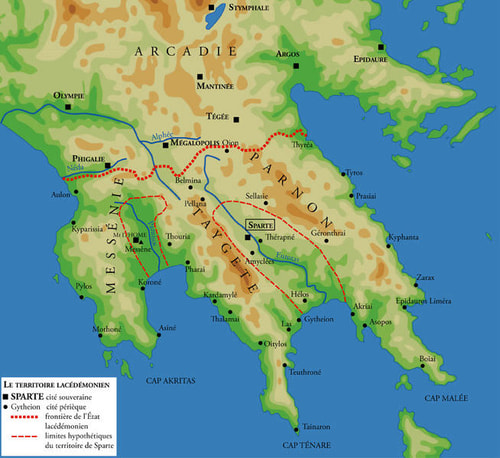 Territorio Espartano Marsyas (CC BY-SA) ](https://www.worldhistory.org/image/2143/spartan-territory/ "Spartan Territory")Las continuas ambiciones espartanas en el centro y norte de Grecia, [Asia Menor](https://www.worldhistory.org/trans/es/1-228/asia-menor/) y Sicilia llevaron nuevamente a la ciudad a otro prolongado conflicto, la Guerra de Corinto, contra Atenas, Tebas, Corinto y Persia desde el 396 hasta el 387 AEC. El resultado del conflicto fue la "Paz del Rey" donde Esparta cedía su [imperio](https://www.worldhistory.org/trans/es/1-99/imperio/) (del cual carecía del aparato burocrático necesario para gestionarlo adecuadamente) al control persa, pero Esparta se quedó para dominar Grecia. Sin embargo, intentando aplastar a Tebas, Esparta perdió la crucial [Batalla de Leuctra](https://www.worldhistory.org/trans/es/1-12059/batalla-de-leuctra/) en el 371 AEC contra el brillante general tebano [Epaminondas](https://www.worldhistory.org/trans/es/1-12058/epaminondas/). Luego, Tebas anexó partes de Mesenia y Esparta se convirtió en una potencia de segunda clase.
Después de retar brevemente el control macedonio en el siglo III AEC y ser asediada por [Pirro](https://www.worldhistory.org/trans/es/1-861/pirro/) en el 272 AEC, Esparta nunca recuperó su antigua gloria y se vio obligada a unirse a la [Liga Aquea](https://www.worldhistory.org/trans/es/1-264/liga-aquea/) en el 195 AEC. Bajo control romano, Esparta le fue permitido abandonar la Liga en el 147 AEC lo que provocó la Guerra aquea. No obstante, como una ciudad libre en el mundo romano las cosas mejoraron para Esparta, y la ciudad gozó de buenas relaciones con sus [conquistadores](https://www.worldhistory.org/trans/es/1-13809/conquistadores/), pero el fin llegó finalmente para Esparta en el 396 EC cuando el rey [visigodo](https://www.worldhistory.org/trans/es/1-709/visigodo/) [Alarico](https://www.worldhistory.org/trans/es/1-13229/alarico/) saqueó la ciudad.
### Gobierno
El sistema político espartano fue inusual en el hecho de que tenía dos reyes hereditarios de dos familias separadas. Estos monarcas fueron particularmente poderosos cuando uno de ellos lideraba al ejército en campaña. Los reyes también eran los sacerdotes de Zeus y se sentaban en el consejo de ancianos conocido como la *gerusía*. Este consejo consistía en 28 hombres mayores de 60 años que mantenían la posición de por vida. La *gerusía* dirigió la asamblea ciudadana, probablemente proponiendo cuestiones sobre las que votar, y era también el más alto tribunal en Esparta. La asamblea (*Ekklēsia*) se reunía una vez al mes y estaba abierta a todos los ciudadanos que votaban con el simple hecho de gritar. También existió un comité ejecutivo de cinco éforos (*ephoroi*) elegidos por sorteo del cuerpo ciudadano, que solo podían servir por un máximo de un año y no eran elegibles para cargo futuro. Dos de los éforos también acompañaban a uno de los reyes en campaña. No se sabe con certeza como interactuaron estos diferentes elementos políticos, pero claramente era necesario cierto grado de consenso para que el aparato estatal funcionara. También explicaría la reputación de Esparta de ser un estado conservador lento para tomar decisiones en política exterior.
[  Tetradracma espartano de plata Mark Cartwright (CC BY-NC-SA) ](https://www.worldhistory.org/image/841/spartan-silver-tetradrachm/ "Spartan Silver Tetradrachm")### Sociedad
Como todas las sociedades griegas, Esparta era dominada por los ciudadanos varones y los más poderosos de ellos provenían de un selecto grupo de familias. Estos eran la aristocracia terrateniente, y después de las posteriores reformas atribuidas a [Licurgo](https://www.worldhistory.org/trans/es/1-21190/licurgo/) en el siglo VI AEC (o incluso antes), los ciudadanos no podían dedicarse a actividades agrícolas - este era el trabajo de los ilotas - sino tenían que dedicarse al entrenamiento atlético y militar y la política. Los ilotas no podían poseer propiedades, y por ende no podían aspirar a convertirse en ciudadanos plenos; esta carencia de movilidad social regresaría para perseguir a Esparta en siglos posteriores. Reducidos por guerras constantes en los siglos V y IV AEC, los hoplitas espartanos (*homoioi*) se volvieron peligrosamente pequeños en número (de 8,000 en el 490 AEC a 700 en el 371 AEC), tanto así, que soldados no espartanos tuvieron que ser reclutados cuyas lealtad e interés en las ambiciones de Esparta eran cuestionables
Las mujeres en Esparta tenían mejor suerte que en otras ciudades-Estado griegas. En Esparta podían poseer propiedad las cuales obtenían a través de dotes y herencias. De hecho, las mujeres se convirtieron entre los miembros más ricos de la sociedad, ya que sus hombres morían en las diferentes guerras, y eventualmente controlaron 2/5 de la tierra espartana. En adición, las mujeres espartanas también podían moverse con razonable libertad, podían disfrutar del atletismo (al desnudo como los hombres), e incluso beber vino. Todas estas libertades hubieran sido inaceptables en otras *poleis* griegas.
Había extranjeros (*xenoi*) en la sociedad espartana, pero estos no eran tan bienvenidos como en otras ciudades, y aquellos que llegaron a vivir en Esparta fueron, en ocasiones, expulsados forzosamente por sus, demasiado sospechosos y paranoicos, anfitriones.
[  Leónidas Marie-Lan Nguyen (CC BY-SA) ](https://www.worldhistory.org/image/1211/leonidas/ "Leonidas")### Ejército Espartano
Para todos los ciudadanos espartanos había un fuerte énfasis en el entrenamiento militar y la vida frugal, en comedores comunales donde la comida simple como harina de cebada, queso, higos y vino eran la norma. Desde la edad de siete años, los varones tenían una educación militarista conocida como la *agōgē* donde eran separados en grupos y vivían en cuarteles. Estos jóvenes practicaron un riguroso entrenamiento militar y atlético el cual se hacía más demandante a partir de la edad de 20 años, cuando se unían a los comedores comunales (*syssition*), y en donde frecuentemente formaban relaciones homoeróticas con ciudadanos más viejos y experimentados. Este duro entrenamiento resultaba en un ejército [hoplita](https://www.worldhistory.org/trans/es/1-567/hoplita/) profesional capaz de maniobras de batalla relativamente sofisticadas, lo cual los hizo temidos a través de Grecia; un hecho quizá evidenciado por la notable carencia de fortificaciones en Esparta por la mayor parte de su historia.
Una característica peculiar de los espartanos y su ejército fue la gran importancia dada a los temas religiosos. Como [Heródoto](https://www.worldhistory.org/trans/es/1-234/herodoto/) lo describe, ellos "consideraban las cosas de los dioses con más peso que las cosas de los hombres". Sacrificios antes y después de la batalla eran una característica común de la guerra griega en general pero el ejército espartano los tomó al siguiente nivel, por ejemplo, sacrificando antes de cruzar un río, e incluso se abstenían de movilizar el ejército si se estaba celebrando una importante festividad religiosa. Unos famosos momentos en donde los espartanos pusieron la religión sobre la guerra, incluso sobre una crisis nacional, fueron Maratón y las Termópilas durante las [Guerras médicas](https://www.worldhistory.org/trans/es/1-1003/guerras-medicas/). En la primera, los espartanos llegaron demasiado tarde para participar, y en la segunda solo movilizaron una fuerza simbólica ya que se sintieron obligados a primero celebrar la festividad de las Carneas en honor a [Apolo](https://www.worldhistory.org/trans/es/1-946/apolo/).
El ejército hoplita espartano, sin embargo, demostró al resto de Grecia el camino hacia un mayor profesionalismo militar; y considerando la icónica imagen de los intrépidos y disciplinados hoplitas con mantos rojos y escudos estampados con la letra lambda, para los griegos, los admiradores romanos e incluso a los cinéfilos del siglo XXI, esto es Esparta.
#### Editorial Review
This human-authored definition has been reviewed by our editorial team before publication to ensure accuracy, reliability and adherence to academic standards in accordance with our [editorial policy](https://www.worldhistory.org/static/editorial-policy/).
## Bibliografía
- Boys-Stones et al. *The Oxford Handbook of Hellenic Studies.* OUP, Oxford, 2012
- [Campbell, B. (ed). *The Oxford Handbook of Warfare in the Classical World.* Oxford University Press, USA, 2013.](https://www.worldhistory.org/books/0195304659/)
- [Fields, N. *Thermopylae 480 BC.* Osprey Publishing, 2007.](https://www.worldhistory.org/books/184176180X/)
- Herodotus. *The Histories (trans. A. De Sélincourt ).* Penguin, London, 2003
- [Hornblower, S. *The Oxford Classical Dictionary.* Oxford University Press, USA, 2012.](https://www.worldhistory.org/books/0199545561/)
- [Kinzl, K.H. (ed). *A Companion to the Classical Greek World.* Wiley-Blackwell, 2010.](https://www.worldhistory.org/books/1444334123/)
- [Thucydides. *The Landmark Thucydides.* Free Press, 2013.](https://www.worldhistory.org/books/B009CV7U3S/)
## Sobre el autor
Mark es el director de publicaciones de World History Encyclopedia y tiene una maestría en Filosofía Política (Universidad de York). Es investigador, escritor, historiador y editor a tiempo completo. Entre sus intereses se encuentra particularmente el arte, la arquitectura y el descubrimiento de las ideas que todas las civilizaciones comparten.
## Cronología
- **c. 900 BCE**: [Sparta](https://www.worldhistory.org/sparta/) is founded.
- **706 BCE**: [Sparta](https://www.worldhistory.org/sparta/) founds the colony of [Tarentum](https://www.worldhistory.org/tarentum/) in [Magna Graecia](https://www.worldhistory.org/Magna_Graecia/).
- **c. 700 BCE**: [Sparta](https://www.worldhistory.org/sparta/), [Argos](https://www.worldhistory.org/argos/) and [Paros](https://www.worldhistory.org/Paros/) hold the first documented musical competitions in [Greece](https://www.worldhistory.org/greece/).
- **c. 650 BCE**: [Sparta](https://www.worldhistory.org/sparta/) crushes Messenian revolt.
- **c. 550 BCE - c. 366 BCE**: [Peloponnesian League](https://www.worldhistory.org/Peloponnesian_League/) alliance between [Sparta](https://www.worldhistory.org/sparta/), [Corinth](https://www.worldhistory.org/corinth/), Elis and [Tegea](https://www.worldhistory.org/Tegea/) which establishes Spartan hegemony over the [Peloponnese](https://www.worldhistory.org/Peloponnese/).
- **c. 545 BCE**: [Sparta](https://www.worldhistory.org/sparta/) takes control of Thyrea from [Argos](https://www.worldhistory.org/argos/).
- **525 BCE**: [Sparta](https://www.worldhistory.org/sparta/) and [Corinth](https://www.worldhistory.org/corinth/) unsuccessfully attack [Polycrates](https://www.worldhistory.org/Polycrates/) of [Samos](https://www.worldhistory.org/samos/).
- **494 BCE - 493 BCE**: Spartan forces under Cleomenes I attack the [city](https://www.worldhistory.org/city/) of [Argos](https://www.worldhistory.org/argos/).
- **494 BCE - 493 BCE**: [Telesilla of Argos](https://www.worldhistory.org/Telesilla_of_Argos/) defends her [city](https://www.worldhistory.org/city/) against the Spartan forces with an army of [women](https://www.worldhistory.org/disambiguation/women/).
- **c. 490 BCE**: [Leonidas](https://www.worldhistory.org/disambiguation/Leonidas/) beomes one of [Sparta](https://www.worldhistory.org/sparta/)'s two kings.
- **480 BCE**: [Pausanias](https://www.worldhistory.org/disambiguation/Pausanias/) is made regent of [Sparta](https://www.worldhistory.org/sparta/) for his young cousin Pleistarchus.
- **Aug 480 BCE**: [Battle of Thermopylae](https://www.worldhistory.org/thermopylae/). 300 Spartans under King [Leonidas](https://www.worldhistory.org/disambiguation/Leonidas/) and other [Greek](https://www.worldhistory.org/disambiguation/greek/) allies hold back the Persians led by [Xerxes I](https://www.worldhistory.org/Xerxes_I/) for three days but are defeated.
- **479 BCE**: [Xerxes](https://www.worldhistory.org/Xerxes_I/)' Persian forces are defeated by [Greek](https://www.worldhistory.org/disambiguation/greek/) forces at [Plataea](https://www.worldhistory.org/Plataea/) effectively ending [Persia](https://www.worldhistory.org/Persia/)'s imperial ambitions in [Greece](https://www.worldhistory.org/greece/).
- **478 BCE**: [Sparta](https://www.worldhistory.org/sparta/) withdraws from alliance against [Persia](https://www.worldhistory.org/Persia/).
- **c. 475 BCE**: Athenian general [Cimon](https://www.worldhistory.org/cimon/) defeats Spartan general [Pausanias](https://www.worldhistory.org/disambiguation/Pausanias/) and takes [Byzantium](https://www.worldhistory.org/Byzantium/).
- **c. 471 BCE**: Spartan general [Pausanias](https://www.worldhistory.org/disambiguation/Pausanias/) is put on trial for the second time with a charge of treason but is acquitted for a second time.
- **464 BCE - 463 BCE**: [Earthquake](https://www.worldhistory.org/disambiguation/earthquake/) in [Sparta](https://www.worldhistory.org/sparta/), followed by slave revolt. Surrender of Thasos.
- **460 BCE - 445 BCE**: First [Peloponnesian War](https://www.worldhistory.org/Peloponnesian_War/).
- **457 BCE**: [Sparta](https://www.worldhistory.org/sparta/) wins the [battle](https://www.worldhistory.org/disambiguation/battle/) of Tanagra during the 1st [Peloponnesian War](https://www.worldhistory.org/Peloponnesian_War/) with [Athens](https://www.worldhistory.org/Athens/).
- **451 BCE**: [Sparta](https://www.worldhistory.org/sparta/) and [Argos](https://www.worldhistory.org/argos/) sign a peace treaty which endures for the next 30 years.
- **432 BCE**: [Sparta](https://www.worldhistory.org/sparta/) declares that [Athens](https://www.worldhistory.org/Athens/) has broken the Thirty Year Peace and prepares for [war](https://www.worldhistory.org/disambiguation/War/).
- **431 BCE - 404 BCE**: The 2nd [Peloponnesian War](https://www.worldhistory.org/Peloponnesian_War/) between [Athens](https://www.worldhistory.org/Athens/) and [Sparta](https://www.worldhistory.org/sparta/) (the [Delian League](https://www.worldhistory.org/Delian_League/) and the [Peloponnesian League](https://www.worldhistory.org/Peloponnesian_League/)) which involved all of [Greece](https://www.worldhistory.org/greece/).
- **431 BCE - 404 BCE**: [Thebes](https://www.worldhistory.org/disambiguation/Thebes/) sides with [Sparta](https://www.worldhistory.org/sparta/) against [Athens](https://www.worldhistory.org/Athens/) in the [Peloponnesian War](https://www.worldhistory.org/Peloponnesian_War/).
- **430 BCE - c. 354 BCE**: Life of [Xenophon](https://www.worldhistory.org/xenophon/) of [Athens](https://www.worldhistory.org/Athens/).
- **429 BCE**: Peloponnesian forces led by [Sparta](https://www.worldhistory.org/sparta/) begin the siege of [Plataea](https://www.worldhistory.org/Plataea/).
- **429 BCE**: Following attacks by [Sparta](https://www.worldhistory.org/sparta/), fortifications at the port of [Piraeus](https://www.worldhistory.org/Piraeus/) are extended to reduce the width of the harbour entrances.
- **427 BCE**: [Plataea](https://www.worldhistory.org/Plataea/) finally falls to the Spartans after a two year siege.
- **425 BCE**: [Pylos](https://www.worldhistory.org/Pylos/) campaign, under Cleon and [Demosthenes](https://www.worldhistory.org/Demosthenes/)' command [Athens](https://www.worldhistory.org/Athens/) defeats [Sparta](https://www.worldhistory.org/sparta/) at Pylos.
- **424 BCE**: Spartan [Brasidas](https://www.worldhistory.org/Brasidas/)' campaign in Thrace.
- **424 BCE**: Spartan general [Brasidas](https://www.worldhistory.org/Brasidas/) takes [Amphipolis](https://www.worldhistory.org/Amphipolis/), [Thucydides](https://www.worldhistory.org/Thucydides/) failed to prevent this and is exiled.
- **424 BCE**: A force of Athenian peltasts defeat Spartan hoplites on Sphaktria in the [Peloponnese](https://www.worldhistory.org/Peloponnese/).
- **424 BCE - 420 BCE**: The [Nike](https://www.worldhistory.org/nike/) of Paionios is erected at [Olympia](https://www.worldhistory.org/Olympia/) to commemorate the Messenian and Naupaktian victory over [Sparta](https://www.worldhistory.org/sparta/) at the [battle](https://www.worldhistory.org/disambiguation/battle/) of Sphakteria.
- **422 BCE**: Spartan general [Brasidas](https://www.worldhistory.org/Brasidas/) dies of his wounds at [Amphipolis](https://www.worldhistory.org/Amphipolis/).
- **422 BCE**: Spartan general [Brasidas](https://www.worldhistory.org/Brasidas/) employs Myrkinian and Chalkidian peltasts to defeat a force of Athenian hoplites at [Amphipolis](https://www.worldhistory.org/Amphipolis/).
- **421 BCE**: Spartan soldiers return from campaigning Thrace, some as [Neodamodeis](https://www.worldhistory.org/Neodamodeis/).
- **420 BCE**: [Sparta](https://www.worldhistory.org/sparta/) is excluded from the [Olympic Games](https://www.worldhistory.org/Olympic_Games/) for breaking the *ekecheiria* or sacred truce.
- **418 BCE**: [Sparta](https://www.worldhistory.org/sparta/), led by Agis II, defeats [Argos](https://www.worldhistory.org/argos/) and her allies at the [battle](https://www.worldhistory.org/disambiguation/battle/) of Mantinaea.
- **413 BCE**: On the advice of [Alcibiades](https://www.worldhistory.org/Alcibiades/) the Spartans take over the Athenian-held fort of Dekeleia.
- **412 BCE**: The Spartan general Astyochus sacks [Kos](https://www.worldhistory.org/Kos/).
- **c. 412 BCE**: [Rhodes](https://www.worldhistory.org/Rhodes/) revolts against [Athens](https://www.worldhistory.org/Athens/) and supports [Sparta](https://www.worldhistory.org/sparta/) in the [Peloponnesian War](https://www.worldhistory.org/Peloponnesian_War/).
- **412 BCE**: [Sparta](https://www.worldhistory.org/sparta/) allies with [Persia](https://www.worldhistory.org/Persia/).
- **410 BCE**: [Alcibiades](https://www.worldhistory.org/Alcibiades/) leads the Athenian fleet to victory over [Sparta](https://www.worldhistory.org/sparta/) at Cyzicus.
- **c. 408 BCE**: [Lysander](https://www.worldhistory.org/Lysander/) is first made an admiral of the Spartan fleet.
- **c. 407 BCE**: The Athenian fleet is defeated by [Lysander](https://www.worldhistory.org/Lysander/) of [Sparta](https://www.worldhistory.org/sparta/) at Notium.
- **404 BCE**: Spartan general [Lysander](https://www.worldhistory.org/Lysander/) attacks the Athenian port of [Piraeus](https://www.worldhistory.org/Piraeus/) destroying parts of the Long [Wall](https://www.worldhistory.org/wall/) fortifications.
- **404 BCE**: End of the [Peloponnesian war](https://www.worldhistory.org/Peloponnesian_War/), [Athens](https://www.worldhistory.org/Athens/) defeated By [Sparta](https://www.worldhistory.org/sparta/) at Aigospotamoi, Rule of [the Thirty Tyrants](https://www.worldhistory.org/The_Thirty_Tyrants/) in Athens.
- **c. 398 BCE**: [Xenophon](https://www.worldhistory.org/xenophon/) works as mercenary for [Sparta](https://www.worldhistory.org/sparta/).
- **396 BCE**: Spartan [Agesilaus II](https://www.worldhistory.org/Agesilaus_II/)'s campaign into [Ionia](https://www.worldhistory.org/ionia/).
- **395 BCE**: Spartan general [Lysander](https://www.worldhistory.org/Lysander/) is killed by Theban forces at the [Battle](https://www.worldhistory.org/disambiguation/battle/) of Hallartos.
- **395 BCE - 386 BCE**: The Corinthian Wars between [Sparta](https://www.worldhistory.org/sparta/) and an alliance of [Athens](https://www.worldhistory.org/Athens/), [Corinth](https://www.worldhistory.org/corinth/), [Argos](https://www.worldhistory.org/argos/), Boeotia and [Thebes](https://www.worldhistory.org/disambiguation/Thebes/).
- **390 BCE**: Athenian leader Iphikrates employs peltasts to defeat Spartan hoplites at Lechaion near [Corinth](https://www.worldhistory.org/corinth/).
- **387 BCE**: [Sparta](https://www.worldhistory.org/sparta/) attacks the Athenian port of [Piraeus](https://www.worldhistory.org/Piraeus/).
- **382 BCE - 379 BCE**: [Sparta](https://www.worldhistory.org/sparta/) establishes a garrison at [Thebes](https://www.worldhistory.org/disambiguation/Thebes/).
- **c. 379 BCE**: [Pelopidas](https://www.worldhistory.org/Pelopidas/) removes the Spartan garrison from the Theban [acropolis](https://www.worldhistory.org/Acropolis/).
- **378 BCE - 377 BCE**: Spartan king [Agesilaus II](https://www.worldhistory.org/Agesilaus_II/) campaigns in Boeotia.
- **377 BCE - 355 BCE**: The Cycladic [city](https://www.worldhistory.org/city/) states join [Athens](https://www.worldhistory.org/Athens/) in the Second Athenian League against [Sparta](https://www.worldhistory.org/sparta/) .
- **375 BCE**: [Thebes](https://www.worldhistory.org/disambiguation/Thebes/) defeats [Sparta](https://www.worldhistory.org/sparta/) at the [Battle](https://www.worldhistory.org/disambiguation/battle/) of Tegyra.
- **371 BCE**: [Thebes](https://www.worldhistory.org/disambiguation/Thebes/), led by [Epaminondas](https://www.worldhistory.org/Epaminondas/), defeats [Sparta](https://www.worldhistory.org/sparta/) in the [Battle of Leuctra](https://www.worldhistory.org/Battle_of_Leuctra/).
- **367 BCE**: [Celtic](https://www.worldhistory.org/celt/) mercenaries fight with the Spartans against [Thebes](https://www.worldhistory.org/disambiguation/Thebes/).
- **362 BCE**: Indecisive [Battle](https://www.worldhistory.org/disambiguation/battle/) of Matinea where [Thebes](https://www.worldhistory.org/disambiguation/Thebes/) fought against [Sparta](https://www.worldhistory.org/sparta/) and [Athens](https://www.worldhistory.org/Athens/). Theban general [Epaminondas](https://www.worldhistory.org/Epaminondas/) is killed.
- **295 BCE**: Demetrius I campaigns in central [Greece](https://www.worldhistory.org/greece/), removes the tyrant Lachares from [Athens](https://www.worldhistory.org/Athens/) and defeats [Sparta](https://www.worldhistory.org/sparta/).
- **273 BCE**: [Pyrrhus](https://www.worldhistory.org/pyrrhus/) of Epirus attacks [Macedon](https://www.worldhistory.org/macedon/) and [Sparta](https://www.worldhistory.org/sparta/).
- **222 BCE**: The [Achaean League](https://www.worldhistory.org/Achaean_League/) and [Antigonos](https://www.worldhistory.org/disambiguation/Antigonos/) III of [Macedon](https://www.worldhistory.org/macedon/) defeat [Sparta](https://www.worldhistory.org/sparta/) at Sellasia.
- **267 CE**: The [Goths](https://www.worldhistory.org/Goths/) sack [Athens](https://www.worldhistory.org/Athens/), [Corinth](https://www.worldhistory.org/corinth/), [Sparta](https://www.worldhistory.org/sparta/), and [Argos](https://www.worldhistory.org/argos/).
- **396 CE**: [Sparta](https://www.worldhistory.org/sparta/) is sacked by the [Visigoths](https://www.worldhistory.org/visigoth/) led by [Alaric](https://www.worldhistory.org/Alaric/).
## Enlaces externos
- [This is Sparta: Fierce warriors of the ancient world - Craig Zimmer](http://ed.ted.com/lessons/this-is-sparta-fierce-warriors-of-the-ancient-world-craig-zimmer)
- [In Our Time, Sparta](https://www.bbc.co.uk/programmes/b00nvz72)
- [Art and Craft in Archaic Sparta | Essay | The Metropolitan Museum of Art | Heilbrunn Timeline of Art History](https://www.metmuseum.org/toah/hd/spar/hd_spar.htm)
## Cita este trabajo
### APA
Cartwright, M. (2020, August 31). Esparta. (M. Guzman, Traductor). *World History Encyclopedia*.
### Chicago
Cartwright, Mark. "Esparta." Traducido por Martin Guzman. *World History Encyclopedia*, August 31, 2020. .
### MLA
Cartwright, Mark. "Esparta." Traducido por Martin Guzman. *World History Encyclopedia*, 31 Aug 2020, .
## Licencia y derechos de autor
Enviado por [Martin Guzman](https://www.worldhistory.org/user/misaac.guzman/ "User Page: Martin Guzman"), publicado el 31 August 2020. Consulta la fuente original para obtener información sobre derechos de autor. Por favor, ten en cuenta que el contenido vinculado con esta página puede tener términos de licencia diferentes.