---
title: Tomb: Home of the Dead
author: Joshua J. Mark
source: https://www.worldhistory.org/tomb/
format: machine-readable-alternate
license: Creative Commons Attribution-NonCommercial-ShareAlike (https://creativecommons.org/licenses/by-nc-sa/4.0/)
updated: 2026-03-29
---
# Tomb: Home of the Dead
_Authored by [Joshua J. Mark](https://www.worldhistory.org/user/JPryst/)_
A tomb is an enclosed space for the repository of the remains of the dead. Traditionally tombs have been located in caves, underground, or in structures designed specifically for the purpose of containing the remains of deceased human beings and, often, their possessions, loved ones, amulets, or sacred items to either protect or direct the soul.
In the ancient Mesopotamian tomb known as The Great [Death](https://www.worldhistory.org/disambiguation/Death/) Pit, discovered in the ruins of the [city](https://www.worldhistory.org/city/) of [Ur](https://www.worldhistory.org/ur/), and dated to the [Early Dynastic](https://www.worldhistory.org/disambiguation/Early_Dynastic/) Period (circa 2900-circa 2350/2334 BCE), the servants of royalty were buried with the king to serve him in the afterlife and this same practice was observed elsewhere. Tombs often contain so-called "[grave](https://www.worldhistory.org/burial/) goods" - items the deceased will require in the next life, but also anything the departed was especially attached to. The Natufian Grave in [Israel](https://www.worldhistory.org/disambiguation/Israel/), dated to circa 12,000 BCE, contained the remains of a man buried with his dog.
Tombs have always been considered the homes of the dead and every tomb ever constructed was built with this concept in mind. The tomb is the final resting place of a dead person whose soul, however, would live on in another realm.
The construction of a tomb would also reflect the status of the person buried there and the beliefs of a certain [culture](https://www.worldhistory.org/disambiguation/culture/) concerning the afterlife. Ancient cultures from [Mesopotamia](https://www.worldhistory.org/Mesopotamia/) to [Rome](https://www.worldhistory.org/Rome/) maintained that the dead lived on after life and stories concerning ghosts (such as the one famously told by the [Roman](https://www.worldhistory.org/disambiguation/Roman/) writer [Pliny the Younger](https://www.worldhistory.org/Pliny_the_Younger/) in circa 100) have to do with hauntings caused by the improper [burial](https://www.worldhistory.org/burial/) of the dead.
Ancient inscriptions from cultures as diverse as Mesopotamia, [China](https://www.worldhistory.org/china/), [Greece](https://www.worldhistory.org/greece/), and the [Maya](https://www.worldhistory.org/disambiguation/Maya/) all cite the importance of a respectful burial and remembrance of the dead and the dire consequences of failing to do so. The tomb, therefore, was recognized an important aspect of mortuary rituals and has been for over 5,000 years.
### Tombs in Ancient [Egypt](https://www.worldhistory.org/egypt/)
The most elaborate tombs in ancient times were those built by the Egyptians for their kings, the pharaohs. In the Early Dynastic Period (circa 3150-circa 2613 BCE), the Egyptians built mastabas, tombs made of dried clay bricks which were then used to shore up shafts and chambers dug into the earth.
In every mastaba there was a large room for ceremonies honoring the spirit of the deceased and an adjoining smaller room, the *serdab*, where a statue of the dead person would be placed so that the spirit could witness and enjoy the ceremonies. The mastaba - the oldest form of the tomb in Egypt - continued in use for the common people but for royalty it was replaced by the structure known as the [pyramid](https://www.worldhistory.org/pyramid/) during the [Old Kingdom](https://www.worldhistory.org/disambiguation/Old_Kingdom/) (circa 2613-2181 BCE).
Commencing with the Step Pyramid at Saqqara, the royal [pyramids](https://www.worldhistory.org/pyramid/) would reach their height in splendor in the construction of the [Great Pyramid of Giza](https://www.worldhistory.org/Great_Pyramid_of_Giza/) (built for King Khufu, reign 2589-2566 BCE). The royal pyramids were adorned with paintings depicting the life and accomplishments of the deceased king and filled with all those necessities the spirit would need in the afterlife in the [Field of Reeds](https://www.worldhistory.org/Field_of_Reeds/), the [Egyptian](https://www.worldhistory.org/disambiguation/Egyptian/) paradise. Monarchs were also interred in the area known as The Valley of the Kings and their tombs were elaborate eternal homes, highly ornamented, which reflected their status as divine rulers.
### Mesopotamian Tombs
In ancient Mesopotamia, tombs resembled the mastaba generally but, as in Egypt, the tombs of royalty were more ornate. Archaeological excavations carried out in the 1920s by Sir Charles Leonard Wooley uncovered the Royal Tombs of Ur - considered the oldest in Mesopotamia - in which were found many exquisite works of [gold](https://www.worldhistory.org/gold/), lapis lazuli, and carnelian (most notably the diadem of Queen Puabi). In the one tomb Wooley called The Great Death Pit, the bodies of six guards and sixty-eight ladies-of-the-court were found. It is thought these were the favored of the king and were chosen to accompany him to the afterlife.
The Mesopotamians, whether south in the region of [Sumer](https://www.worldhistory.org/sumer/) or north in [Akkad](https://www.worldhistory.org/akkad/), were so concerned with the proper burial of the dead that they often built tombs inside, or next to, their homes so they could continue to care for the deceased and prevent the problems which arose from hauntings (this same practice was observed by the Maya culture which also maintained a deep-seated fear of ghosts). [Ghosts in ancient Mesopotamia](https://www.worldhistory.org/article/2101/ghosts-in-ancient-mesopotamia/) were understood as a fact of life and, while some were dealt with sympathetically, people generally preferred to avoid visitations from the dead.
To prevent such hauntings, funerary rituals had to be observed carefully and the tomb properly equipped for the soul of the departed. Personal possessions were always included in these tombs as well as gifts, even modest ones, which were to be offered by the deceased to the gods of the underworld upon arrival there. Kings, of course, were laid to rest with more elaborate presents for the gods as the grave goods excavated from tombs throughout Mesopotamia attest.
[ 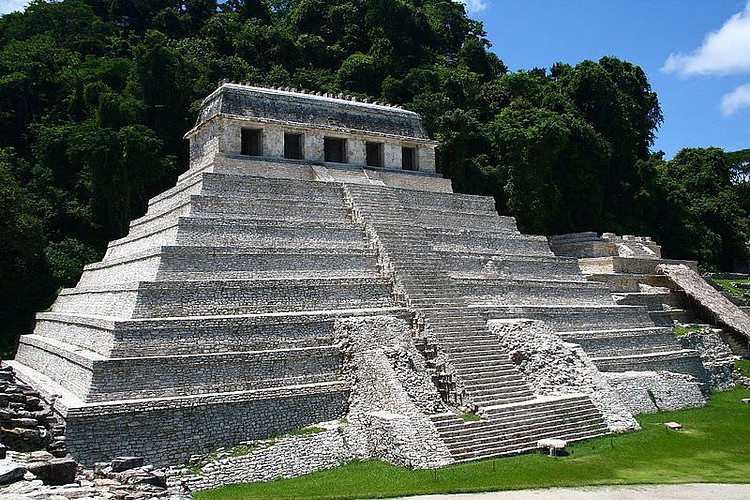 Temple of the Inscriptions, Palenque Jan Harenburg (CC BY) ](https://www.worldhistory.org/image/3097/temple-of-the-inscriptions-palenque/ "Temple of the Inscriptions, Palenque")### Tombs of the Maya & King Pakal
The tombs of the Maya rulers were constructed in much the same way as those of the kings of other cultures in that they were opulent in both style and structure and filled with all the necessities one might require in the afterlife. The walls of the tomb of King K'inich Janaab Pakal of [Palenque](https://www.worldhistory.org/Palenque/) (reign 603-683) were adorned with images of Pakal's transition from the earthly life to the realm of the gods and he was buried in an elaborately carved sarcophagus reflecting the same theme.
Though some writers have claimed the carvings depict Pakal riding a rocket and are, therefore, proof of ancient alien interaction with the Maya, this theory is not considered tenable by the scholarly community. The carving on the sarcophagus which appears to some to be a rocket is recognized by scholars as the Tree of Life which Pakal is ascending to paradise. King Pakal, like other rulers, was given a tomb worthy of his stature and accomplishments and it is thought to have been constructed by his subjects who considered him worthy of that honor. The tomb of the first emperor of China, however, was begun before his death and was built by the conscripted labor of workers from every province in the country.
### Chinese Tombs & the Mausoleum of [Shi Huangti](https://www.worldhistory.org/Shi_Huangdi/)
The tomb of [Shi Huangdi](https://www.worldhistory.org/Shi_Huangdi/) in China (reign 221-210 BCE) contained over 8,000 terra cotta warriors, their weapons, chariots, and horses so that the emperor would have a standing army at his command in the afterlife. This tomb, which rises to a height of 141 feet (43 metres) was first discovered in 1974 in the city of Xi'an and has yet to be excavated because of the fear of the various traps Shi Huangti is said to have devised to protect the vast treasure he was buried with.
Over 700,000 workers were conscripted to build the tomb which was supposed to symbolize the world over which Shi Huangti reigned and would continue to rule in the afterlife. Other tombs in China, not nearly so grand in size or scope, also reflect the belief that the deceased would continue to exist in some form in another realm and could continue to exert influence on the living, for good or ill, depending on how their remains had been respected and how their memory continued to be honored. [Dogs in ancient China](https://www.worldhistory.org/article/1327/dogs-in-ancient-china/) were often buried or entombed with the corpse of their owner to serve, protect, and guide the soul of the deceased in the afterlife.
### Tombs in Greece
In Greece, the tombs of the wealthy were closely linked, architecturally, to the modern mausoleum in that they were often ornately decorated stone buildings housing the reclining dead. As the Greeks believed that remembrance of the dead was necessary for the continued existence of the spirit in the afterlife, [Greek](https://www.worldhistory.org/disambiguation/greek/) tombs frequently pictured the deceased in familiar settings - sitting down to dinner, enjoying the company of friends and family, reading, or relaxing with their dog - in order to remind the living of who that person had been in life and how they still existed after death.
Greeks commemorated the anniversary of a loved one's death by visiting their tomb and conversing with them, always making sure to speak their name to show the dead they were remembered. In [Athens](https://www.worldhistory.org/Athens/), below the [Acropolis](https://www.worldhistory.org/Acropolis/), the graves of common citizens depict the same sort of scenes as those of the more affluent and always emphasize the importance of remembrance.
Soldiers who were killed in action were commonly buried on the field in mass graves beneath one single marker (usually a monument naming the [battle](https://www.worldhistory.org/disambiguation/battle/) and the date) served to honor the fallen. It was up to the living, however, to keep the deceased's memory alive and frequently a marker would be erected by an individual's family toward that end and would serve in place of an actual tomb at the anniversary ceremony of one's death.
Tombs from the Mycenaen Period (circa 1700-1100 BCE) are known as *tholos*, or beehive, tombs which are thought to have been derived from early [Minoan](https://www.worldhistory.org/disambiguation/Minoan/) architectural advances on [Crete](https://www.worldhistory.org/crete/). One of the most famous of these tholos tombs is the Treasury of [Atreus](https://www.worldhistory.org/Atreus/) (also known as the Tomb of [Agamemnon](https://www.worldhistory.org/disambiguation/Agamemnon/), pictured above) which was built circa 1250 BCE. As in other cultures, these tombs were understood as the final resting place of the deceased and so required constant upkeep to honor that person's spirit in the afterlife by remembering their time on earth.
[  Balnuaran of Clava Dave Conner (CC BY-NC-SA) ](https://www.worldhistory.org/image/937/balnuaran-of-clava/ "Balnuaran of Clava")### [Neolithic](https://www.worldhistory.org/Neolithic/) Tombs of [Scotland](https://www.worldhistory.org/disambiguation/Scotland/) & [Ireland](https://www.worldhistory.org/disambiguation/Ireland/)
The tombs in Scotland, such as the grave passage tomb of [Maeshowe](https://www.worldhistory.org/Maeshowe/) in Orkney, show a remarkable similarity to those of ancient Greece, particularly the tholos tomb. The Tomb of the Eagles (also on Orkney) dates to 3000 BCE and was found to contain the bones of over 300 people buried there over time. Among the skeletal remains of human beings were those of over 700 white-tailed eagles which have given the tomb its name.
No personal possessions were discovered in either of these tombs but that absence has been ascribed to ancient looting of graves. The Neolithic tombs throughout Scotland were all very purposefully designed, as in other cultures, as homes of the dead leading down to an underworld afterlife. At Maeshowe, for example, to enter the tomb one would need to move aside a great stone and then descend down into the chamber which represented the nether world.
This same construction and ideology can be seen in the famous passage tomb of [Newgrange](https://www.worldhistory.org/Newgrange/) in Ireland which is one of the oldest tombs in the world (pre-dating the Pyramids of [Giza](https://www.worldhistory.org/giza/) and the [Mycenaean Civilization](https://www.worldhistory.org/Mycenaean_Civilization/)) built circa 3200 BCE. Newgrange, like Maeshowe, was carefully constructed to admit a single ray of light into the darkness of the inner chamber at the winter solstice and this, it is thought, was to symbolize the eternal life of the deceased.
The oldest passage tombs in Ireland are in Sligo County with the largest [megalithic](https://www.worldhistory.org/disambiguation/megalithic/) cemetery at Carrowmore. Other tombs throughout Ireland (known as dolmens) are constructed much along the same lines as the Carrowmore tombs. The Brownshill [Dolmen](https://www.worldhistory.org/dolmen/) in County Carlow follows the custom of a burial chamber in the earth but is distinguished by a capstone perched on upright megaliths weighing 100 metric tons (thought to be the heaviest stone in [Europe](https://www.worldhistory.org/europe/)) and the tomb known as The Mound of the Hostages, in Meath, is similar to Newgrange in that it was constructed (circa 3000 BCE) so that the rising sun, on certain days, lights up the interior burial chamber to symbolize re-birth and the light of life.
### Tombs of Ancient [India](https://www.worldhistory.org/india/)
This concept is equally apparent in the tombs of India where, originally, tombs were caves or carved into rock cliffs but, eventually, evolved into mausoleums which celebrated the life of the deceased and ensured their immortality through remembrance by the living. Cremation was the most common method of dealing with the remains of the dead in India and, for this reason, tombs were not employed to the same degree as they were in other cultures.
[Hindu](https://www.worldhistory.org/hinduism/) religious beliefs encouraged cremation and the spreading of one's ashes but, with the introduction of [Islam](https://www.worldhistory.org/islam/) to the country, the importance of the physical remains of the deceased was emphasized and tombs became more widespread as a means of honoring and remembering the dead. The most famous example of this, though not an ancient one, is the Taj Majal built in 1631 by Shah Jahan for his wife.
[ 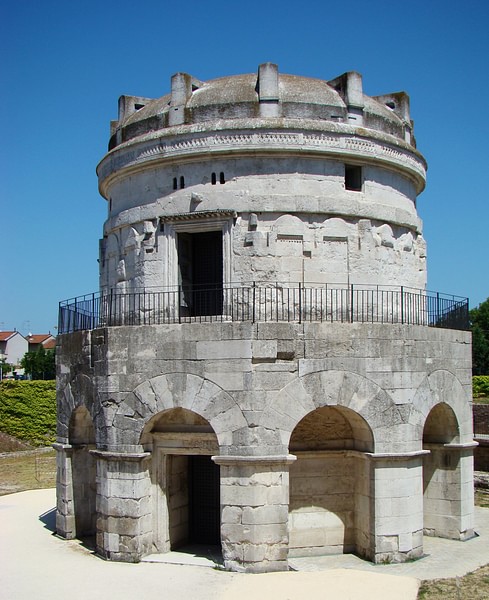 Mausoleum of Theodoric, Ravenna F. Tronchin (CC BY-NC-SA) ](https://www.worldhistory.org/image/3091/mausoleum-of-theodoric-ravenna/ "Mausoleum of Theodoric, Ravenna")### Roman Tombs & Catacombs
Tombs in ancient Rome followed the same course of development as in Egypt and elsewhere, beginning with burial underground or in caves and evolving into more elaborate structures to house the dead. Roman tombs also celebrated the life of the individual but, unlike those of Greece or India, often featured inscriptions rather than [sculpture](https://www.worldhistory.org/disambiguation/Sculpture/) or relief whereby the deeds of the deceased could be read and recited.
Romans were buried in cemeteries which were located outside of the city in order to [mark](https://www.worldhistory.org/disambiguation/Mark/) the divide between the land of the living and that of the dead. As in Mesopotamia, the Romans feared the return of the dead in the form of ghosts and, unless they had been summoned through divination for a specific purpose or came to deliver a message, spectral visitors were considered a potent evil. As in other cultures, proper attention to the construction and outfitting of the tomb was thought to prevent such hauntings.
Wealthy Romans were interred with great flourish in elaborate tombs while those of more modest means were laid to rest in caves outside the city or were cremated. Cremation of the dead was the most popular means of disposing of corpses and, afterwards, the ashes were held in an urn which was kept in a place of honor in the household.
The rise of [Christianity](https://www.worldhistory.org/christianity/), however, and the new belief in the bodily resurrection of the dead, led to a decrease in cremations and, simply lacking room for the deceased in cemeteries, catacombs dug in the earth, with shelves for corpses in the walls, became the most common form of the tomb in ancient Rome.
#### Editorial Review
This human-authored definition has been reviewed by our editorial team before publication to ensure accuracy, reliability and adherence to academic standards in accordance with our [editorial policy](https://www.worldhistory.org/static/editorial-policy/).
## Bibliography
- [Bunson, M. *Encyclopedia of Ancient Egypt.* Gramercy, 2008.](https://www.worldhistory.org/books/0517203804/)
- [Durant, W. *Caesar and Christ.* Simon & Schuster, 2000.](https://www.worldhistory.org/books/0671115006/)
- [Durant, W. *Our Oriental Heritage.* Simon & Schuster, 2000.](https://www.worldhistory.org/books/B00005WJGO/)
- [Durant, W. *The Life of Greece.* Simon & Schuster, 2000.](https://www.worldhistory.org/books/B004ZZS4YA/)
- [Hadingham, E. *Circles and Standing Stones.* Heinemann, 1977.](https://www.worldhistory.org/books/B0007C8YIQ/)
- [Hamilton, E. *The Roman Way.* W. W. Norton & Company, 2002.](https://www.worldhistory.org/books/0393310787/)
- [Ikram, S. *Death and Burial in Ancient Egypt.* Longman, 2003.](https://www.worldhistory.org/books/0582772168/)
- [Kramer, S. N. *The Sumerians.* University of Chicago Press, 1971.](https://www.worldhistory.org/books/0226452387/)
- [Leick, G. *Mesopotamia.* Penguin (Non-Classics), 2003.](https://www.worldhistory.org/books/0140265740/)
- [Scarre, C. & Fagan, B.F. *Ancient Civilizations.* Pearson, 2007.](https://www.worldhistory.org/books/0131928783/)
- [Stuart, G.S. *Lost Kingdoms of the Maya.* National Geographic Society, 1993.](https://www.worldhistory.org/books/0870449281/)
- [Zhang Lin. *The Qin Dynasty Terra-cotta Army of Dreams.* Xi An Press, 2005.](https://www.worldhistory.org/books/780712184X/)
## About the Author
Joshua J. Mark is World History Encyclopedia's co-founder and Content Director. He was previously a professor at Marist College (NY) where he taught history, philosophy, literature, and writing. He has traveled extensively and lived in Greece and Germany.
- [Linkedin Profile](https://www.linkedin.com/pub/joshua-j-mark/38/614/339)
## Timeline
- **c. 6000 BCE**: [Burial](https://www.worldhistory.org/burial/) of the dead in [Egypt](https://www.worldhistory.org/egypt/).
- **c. 6000 BCE**: Earliest [Egyptian](https://www.worldhistory.org/disambiguation/Egyptian/) mastabas dug at Saqqara.
- **c. 5000 BCE**: Dead buried with [grave](https://www.worldhistory.org/burial/) goods at [Banpo Village](https://www.worldhistory.org/Banpo_Village/), [China](https://www.worldhistory.org/china/).
- **4300 BCE**: First [megalithic](https://www.worldhistory.org/disambiguation/megalithic/) tombs in [Europe](https://www.worldhistory.org/europe/).
- **c. 4000 BCE**: Carrowmore [Megalithic](https://www.worldhistory.org/disambiguation/megalithic/) Cemetery begins in Sligo, [Ireland](https://www.worldhistory.org/disambiguation/Ireland/).
- **c. 3300 BCE**: Early Harappan [Civilization](https://www.worldhistory.org/civilization/) of [India](https://www.worldhistory.org/india/) practices [burial](https://www.worldhistory.org/burial/) of the dead.
- **3300 BCE**: [Newgrange](https://www.worldhistory.org/Newgrange/) [Burial](https://www.worldhistory.org/burial/) Mound constructed in [Ireland](https://www.worldhistory.org/disambiguation/Ireland/).
- **3000 BCE**: Stone tombs on [Crete](https://www.worldhistory.org/crete/).
- **3000 BCE**: [Tomb](https://www.worldhistory.org/tomb/) of the Eagles created in [Scotland](https://www.worldhistory.org/disambiguation/Scotland/).
- **c. 3000 BCE - c. 2800 BCE**: [Maeshowe](https://www.worldhistory.org/Maeshowe/) Passage [Grave](https://www.worldhistory.org/burial/) completed in [Scotland](https://www.worldhistory.org/disambiguation/Scotland/).
- **3000 BCE - 2000 BCE**: First rock-cut [burial](https://www.worldhistory.org/burial/) chambers at [Akrotiri](https://www.worldhistory.org/thera/).
- **c. 2600 BCE**: Mayan [Culture](https://www.worldhistory.org/disambiguation/culture/) buries their dead individually under homes.
- **c. 2600 BCE - c. 2000 BCE**: The Royal Graves of [Ur](https://www.worldhistory.org/ur/) used in [Sumer](https://www.worldhistory.org/sumer/).
- **c. 2560 BCE**: The [Great Pyramid of Giza](https://www.worldhistory.org/Great_Pyramid_of_Giza/) is constructed by [Pharaoh](https://www.worldhistory.org/pharaoh/) Khufu (Cheops).
- **c. 2500 BCE - c. 2000 BCE**: The Balnuaran of Clava ([Clava Cairns](https://www.worldhistory.org/Clava_Cairns/)) is built.
- **c. 1700 BCE - c. 1600 BCE**: First shaft graves constructed at [Mycenae](https://www.worldhistory.org/mycenae/).
- **c. 1500 BCE**: First tholos tombs built at [Mycenae](https://www.worldhistory.org/mycenae/).
- **1250 BCE - 1200 BCE**: [Mycenaean](https://www.worldhistory.org/Mycenaean_Civilization/) chamber tombs constructed at [Thebes](https://www.worldhistory.org/disambiguation/Thebes/).
- **c. 1100 BCE**: Greeks implement use of individual tombs and graves.
- **c. 700 BCE**: [Tomb](https://www.worldhistory.org/tomb/) of Mayan King K'utz Chman of Retalhuleu constructed in Guatemala.
- **c. 680 BCE - c. 660 BCE**: The [Etruscan](https://www.worldhistory.org/Etruscan_Civilization/) [Regolini-Galassi Tomb](https://www.worldhistory.org/article/1020/regolini-galassi-tomb/) is constructed at [Cerveteri](https://www.worldhistory.org/Cerveteri/).
- **530 BCE - 520 BCE**: The [Etruscan](https://www.worldhistory.org/Etruscan_Civilization/) [Tomb](https://www.worldhistory.org/tomb/) of the Lionesses is constructed at [Tarquinia](https://www.worldhistory.org/Tarquinia/).
- **210 BCE**: First Emperor of [China](https://www.worldhistory.org/china/) [Shi Huangdi](https://www.worldhistory.org/Shi_Huangdi/) dies, buried with army of 8,000 terracotta warriors in [palace](https://www.worldhistory.org/disambiguation/palace/) [tomb](https://www.worldhistory.org/tomb/).
- **206 BCE**: The Emperor [Shi Huangti](https://www.worldhistory.org/Shi_Huangdi/) is buried with a [terracotta army](https://www.worldhistory.org/Terracotta_Army/) of more than 8,000 soldiers in a [palace](https://www.worldhistory.org/disambiguation/palace/) [tomb](https://www.worldhistory.org/tomb/).
- **c. 750 CE - 800 CE**: The subterranean llama-shaped royal [tomb](https://www.worldhistory.org/tomb/) is constructed at the [Wari](https://www.worldhistory.org/Wari_Civilization/) [city](https://www.worldhistory.org/city/) of Pikllacta.
- **770 CE**: Last recorded use of [Clava Cairns](https://www.worldhistory.org/Clava_Cairns/) site in antiquity.
## Questions & Answers
### What is a tomb?
A tomb is generally understood as an enclosed space for a deceased human being and is regarded as their final resting place.
### Why were tombs constructed underground?
Tombs were constructed underground because the afterlife was understood in ancient cultures as a world that existed below the earth. Building a tomb below ground was thought to give the soul of the deceased easier access to that world.
### What are the earliest tombs in ancient Egypt?
The earliest ancient Egyptian tombs are mastabas which were first built during the Early Dynastic Period, circa 3150-circa 2613 BCE.
### Why were tombs considered important?
Tombs were considered important as way to honor the deceased, keep their memory alive, provide them access to the afterlife, and prevent their return as ghosts.
## External Links
- [King Herod's Tomb](https://www.missedinhistory.com/podcasts/king-herods-tomb.htm)
- [Seven Wonder of the Ancient World: Khufu's Great Pyramid](http://www.unmuseum.org/kpyramid.htm)
- [Pyramids](http://www.ancientegypt.co.uk/pyramids/home.html)
- [Mausoleum of the First Qin Emperor](http://whc.unesco.org/en/list/441)
- [Ancient Tombs and Mausoleums](http://www.china.org.cn/english/features/atam/114512.htm)
- [Tombs of Ancient Egypt](https://www.osirisnet.net/e_centrale.htm)
- [Hany Farid](https://www.cs.dartmouth.edu/~farid/egypt.html)
- [Capital Cities and Tombs of the Ancient Koguryo Kingdom](http://whc.unesco.org/en/list/1135)
- [The Death Pit](https://www.penn.museum/sites/iraq/?page_id=208)
- [Tombs explore](http://www.mesopotamia.co.uk/tombs/explore/exp_set.html)
- [Lesson: Mesopotamia (Women in World History Curriculum)](http://www.womeninworldhistory.com/lesson2.html)
- [Treasures from the Royal Tombs of Ur](https://mcclungmuseum.utk.edu/exhibits/treasures-from-the-royal-tombs-of-ur/)
- [Maeshowe, a spectacular neolithic chambered cairn in Orkney](http://www.maeshowe.co.uk/maeshoweabout.html)
- [Newgrange Stone Age Passage Tomb](http://www.newgrange.com/)
- [Taj Mahal](http://whc.unesco.org/en/list/252)
- [Palenque: Pakal's Tomb](http://www.mesoweb.com/palenque/features/sarcophagus/pakals_tomb.html)
- [Tomb of the Vulture Lord](https://www.archaeology.org/issues/102-1309/features/1145-maya-king-burial-guatemala-takalik-abaj)
## Cite This Work
### APA
Mark, J. J. (2009, September 02). Tomb: Home of the Dead. *World History Encyclopedia*.
### Chicago
Mark, Joshua J.. "Tomb: Home of the Dead." *World History Encyclopedia*, September 02, 2009. .
### MLA
Mark, Joshua J.. "Tomb: Home of the Dead." *World History Encyclopedia*, 02 Sep 2009, .
## License & Copyright
Submitted by [Joshua J. Mark](https://www.worldhistory.org/user/JPryst/ "User Page: Joshua J. Mark"), published on 02 September 2009. The copyright holder has published this content under the following license: [Creative Commons Attribution-NonCommercial-ShareAlike](https://creativecommons.org/licenses/by-nc-sa/4.0/deed.en). This license lets others remix, tweak, and build upon this content non-commercially, as long as they credit the author and license their new creations under the identical terms. When republishing on the web a hyperlink back to the original content source URL must be included. Please note that content linked from this page may have different licensing terms.