---
title: Tiryns
author: Mark Cartwright
source: https://www.worldhistory.org/tiryns/
format: machine-readable-alternate
license: Creative Commons Attribution-NonCommercial-ShareAlike (https://creativecommons.org/licenses/by-nc-sa/4.0/)
updated: 1970-01-01
---
# Tiryns
_Authored by [Mark Cartwright](https://www.worldhistory.org/user/markzcartwright/)_
Located on the fertile Argolid plain, Tiryns lies between Nafplion and [Argos](https://www.worldhistory.org/argos/) in the eastern [Peloponnese](https://www.worldhistory.org/Peloponnese/) in [Greece](https://www.worldhistory.org/greece/). The site has been inhabited since the [Neolithic Age](https://www.worldhistory.org/Neolithic/) (7th-4th millennium BCE) but reached its greatest period of importance in the 13th century BCE as a major centre of the [Mycenaean civilization](https://www.worldhistory.org/Mycenaean_Civilization/) and aided by its position, at that time just 1 km from the coast, it was an important [Mediterranean](https://www.worldhistory.org/disambiguation/mediterranean/) [Bronze Age](https://www.worldhistory.org/disambiguation/Bronze_Age/) port. Tiryns, along with nearby [Mycenae](https://www.worldhistory.org/mycenae/), is listed by UNESCO as a World Heritage Site.
In ancient [Greek](https://www.worldhistory.org/disambiguation/greek/) tradition, Tiryns was thought to have been founded by Proitos who captured it from his brother Akrisios, king of Argos, and then had the bellyhand [Cyclops](https://www.worldhistory.org/disambiguation/Cyclops/) from [Lycia](https://www.worldhistory.org/lycia/) build for him the famous walls constructed of massive, irregular, limestone blocks, some weighing several tons. Akrisios was grandfather of [Perseus](https://www.worldhistory.org/Perseus/), the founder of Mycenae, which allows for the [mythology](https://www.worldhistory.org/mythology/) to place the creation of Tiryns two generations before Mycenae. It was also at Tiryns that [Herakles](https://www.worldhistory.org/hercules/) served King Eurystheus, for whom he had to perform his celebrated twelve labours. Tiryns is also described by [Homer](https://www.worldhistory.org/homer/) in his catalogue of ships in Book 2 of *The [Iliad](https://www.worldhistory.org/iliad/)* as 'walled Tiryns'.
The acropolis or upper citadel of Mycenaean Tiryns, due to its excellent state of preservation, is a very fine example of Mycenaean palatial architecture and fortifications. 28 m high and 280 m long, the citadel was built in three stages beginning c. 1600 BCE, with the first [palace](https://www.worldhistory.org/disambiguation/palace/) architecture dating to the 14th century BCE and finally being destroyed c. 1200 BCE by [earthquake](https://www.worldhistory.org/disambiguation/earthquake/) and conflagration. Tiryns remained an important, if more humble, settlement until the 7th century BCE, in which period it became a cult centre for the worship of [Hera](https://www.worldhistory.org/Hera/), [Athena](https://www.worldhistory.org/athena/) and [Hercules](https://www.worldhistory.org/hercules/). The town was then destroyed by the Argeians in the first half of the 5th century BCE. There is very sparse archaeological evidence of settlement in [Roman](https://www.worldhistory.org/disambiguation/Roman/) times and indeed the Roman historian [Pausanias](https://www.worldhistory.org/disambiguation/Pausanias/), in the 2nd century CE, described it as deserted.
Extensive excavations of the ancient [city](https://www.worldhistory.org/city/) were begun by Heinrich Schliemann, firstly, in 1876 CE and then more systematically between 1884-5 CE when he concentrated on finds related to the [Mycenaean period](https://www.worldhistory.org/Mycenaean_Civilization/). Excavations of the site continued throughout the 20th century CE by both the German and Greek Archaeological Institutes and continue to the present day.
Visible today are the mostly 13th century BCE fortification walls with some 12th century BCE interventions. Built in three phases and gradually encompassing the citadel, the cyclopean walls are still in an excellent state of preservation. Galleries or tunnels over 20 m in length were opened within the south and east walls and constructed by corbelling (gradually projecting overlaying large blocks) to create high archways topped by a single stone. These were probably used for storage purposes. The main gate was situated on the east side with a 47 m long by 4.7 m wide ramp and closed with double wooden doors, and is similar in both size and material to the famous Lion gate of Mycenae. Also of note, are similar corbelled syringes or tunnels leading below the citadel to underground water sources.
[ 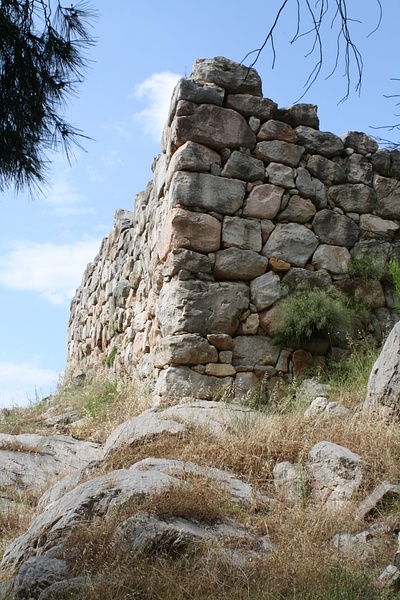 South Tower, Tiryns Mark Cartwright (CC BY-NC-SA) ](https://www.worldhistory.org/image/473/south-tower-tiryns/ "South Tower, Tiryns")The citadel itself is on three levels. It is unclear as to the function of the Lower and Middle Citadels but the remains of a [pottery](https://www.worldhistory.org/pottery/) kiln suggest that they may have been used as areas for workshops. The Upper Citadel has foundation remains of the monumental Great [Propylon](https://www.worldhistory.org/Propylaea/) which led to the heart of the complex and throne of the ruler: the Great Megaron and colonnaded Central Court. Smaller outer courts, a long rectangular building, a smaller Propylon, two wings of palatial buildings on the east and west sides and the remains of at least two staircases (suggesting a second level to some buildings) complete the Mycenaean palace structure.
Evidence also exists of settlement around the citadel dating from the 14th century BCE. In addition, two tholos tombs from the late 13th century BCE and similar to those of Mycenae, lie 1 km from the citadel.
Various artefacts of the Mycenaean [civilization](https://www.worldhistory.org/civilization/) have been found at the site and include fragments of [wall](https://www.worldhistory.org/wall/) paintings depicting a male with spear, a boar hunt and a [chariot](https://www.worldhistory.org/chariot/); pottery in Geometric and Mycenaean styles; pieces of floor decoration from the palace depicting octopuses and dolphins; [bronze](https://www.worldhistory.org/disambiguation/bronze/) daggers; and jewellery including necklaces and [gold](https://www.worldhistory.org/gold/) rings. Also found, were items of pottery and cult figures from the 7th century BCE. Most of these items now reside in the archaeological museums of [Athens](https://www.worldhistory.org/Athens/) and Nafplion.
#### Editorial Review
This human-authored definition has been reviewed by our editorial team before publication to ensure accuracy, reliability and adherence to academic standards in accordance with our [editorial policy](https://www.worldhistory.org/static/editorial-policy/).
## Bibliography
- [Cline, E.H. *The Oxford Handbook of the Bronze Age Aegean.* Oxford University Press, USA, 2012.](https://www.worldhistory.org/books/0199873607/)
- [Homer. *The Iliad.* Penguin Classics, 1998.](https://www.worldhistory.org/books/0140275363/)
- [Iakōvidēs, S. *Mycenae-Epidaurus, Argos-Tiryns-Nauplion.* Ekdotike Athenon, 2009.](https://www.worldhistory.org/books/B0007AOFPY/)
- [Papademetriou, A. *Tiryns.* Hesperos Editions, 2012.](https://www.worldhistory.org/books/9608636493/)
## About the Author
Mark is WHE’s Publishing Director and has an MA in Political Philosophy (University of York). He is a full-time researcher, writer, historian and editor. Special interests include art, architecture and discovering the ideas that all civilizations share.
## Timeline
- **c. 3000 BCE**: First settlement at [Tiryns](https://www.worldhistory.org/tiryns/).
- **1700 BCE - 1100 BCE**: The [Mycenaean civilization](https://www.worldhistory.org/Mycenaean_Civilization/) dominates [Greece](https://www.worldhistory.org/greece/).
- **c. 1600 BCE**: First construction stages of the [Tiryns](https://www.worldhistory.org/tiryns/) citadel.
- **1400 BCE - 1300 BCE**: [Mycenaean](https://www.worldhistory.org/Mycenaean_Civilization/) [palace](https://www.worldhistory.org/disambiguation/palace/) [architecture](https://www.worldhistory.org/disambiguation/architecture/) at [Tiryns](https://www.worldhistory.org/tiryns/).
- **1300 BCE - 1200 BCE**: [Mycenaean](https://www.worldhistory.org/Mycenaean_Civilization/) [Tiryns](https://www.worldhistory.org/tiryns/) is at the height of its importance.
- **c. 1200 BCE**: [Earthquake](https://www.worldhistory.org/disambiguation/earthquake/) severely damages [Tiryns](https://www.worldhistory.org/tiryns/).
- **c. 600 BCE - 700 BCE**: [Tiryns](https://www.worldhistory.org/tiryns/) becomes a cult centre for the worship of [Hera](https://www.worldhistory.org/Hera/), [Athena](https://www.worldhistory.org/athena/), and [Herakles](https://www.worldhistory.org/hercules/).
- **c. 468 BCE**: [Tiryns](https://www.worldhistory.org/tiryns/) is destroyed by the Argeians.
## External Links
- [a cyclopean fortress](https://www.visit-ancient-greece.com/tiryns.html)
## Cite This Work
### APA
Cartwright, M. (2012, May 14). Tiryns. *World History Encyclopedia*.
### Chicago
Cartwright, Mark. "Tiryns." *World History Encyclopedia*, May 14, 2012. .
### MLA
Cartwright, Mark. "Tiryns." *World History Encyclopedia*, 14 May 2012, .
## License & Copyright
Submitted by [Mark Cartwright](https://www.worldhistory.org/user/markzcartwright/ "User Page: Mark Cartwright"), published on 14 May 2012. The copyright holder has published this content under the following license: [Creative Commons Attribution-NonCommercial-ShareAlike](https://creativecommons.org/licenses/by-nc-sa/4.0/deed.en). This license lets others remix, tweak, and build upon this content non-commercially, as long as they credit the author and license their new creations under the identical terms. When republishing on the web a hyperlink back to the original content source URL must be included. Please note that content linked from this page may have different licensing terms.