---
title: Temple
author: Joshua J. Mark
source: https://www.worldhistory.org/temple/
format: machine-readable-alternate
license: Creative Commons Attribution-NonCommercial-ShareAlike (https://creativecommons.org/licenses/by-nc-sa/4.0/)
updated: 2024-03-27
---
# Temple
_Authored by [Joshua J. Mark](https://www.worldhistory.org/user/JPryst/)_
A temple (from the Latin *templum*) is a structure usually built for the purpose of, and always dedicated to, religious or spiritual activities including prayer, meditation, sacrifice and worship. The templum was a sacred precinct defined by a priest (or augur) as the dwelling place of a [god](https://www.worldhistory.org/God/) or gods.
The structure built at such a site was created to honor the *Deus Loci* (spirit) of a certain place. Early temples were constructed on sites which the people felt had a numinous quality to them which indicated the presence of a god, gods, or spirits. Some the earliest examples of these outdoor temples still extant are in Orkney, [Scotland](https://www.worldhistory.org/disambiguation/Scotland/) at sites such as the [Ness of Brodgar](https://www.worldhistory.org/Ness_of_Brodgar/). Throughout the United Kingdom, the stone circles and structures from the Neolitic Period are all known to have once been used for religious ceremonies whether on a large scale, such as at Brodgar or more modest sites like the one at [Clava Cairns](https://www.worldhistory.org/Clava_Cairns/).
Early temples mirrored aspects of the natural world, especially mountains. The [ziggurat](https://www.worldhistory.org/ziggurat/), which defined the temple complexes of [Mesopotamia](https://www.worldhistory.org/Mesopotamia/), were artificial mountains as were the mounds created by the [Native Peoples of North America](https://www.worldhistory.org/Native_Peoples_of_North_America/), such as the one at [Cahokia](https://www.worldhistory.org/cahokia/). The Mayan temples are also thought to have begun as modest outdoor sites before the rise of the [great pyramid](https://www.worldhistory.org/Great_Pyramid_of_Giza/) temples such as El Castillo at Chichen-Itza, another "artificial mountain" site. The word given in English as *temple* dates to around the 6th century BCE in reference to [Roman](https://www.worldhistory.org/disambiguation/Roman/) places of worship but these sites go all the way back to before recorded history.
### Gobekli Tepe Temple
The oldest known temple is that at [Göbekli Tepe](https://www.worldhistory.org/Göbekli_Tepe/) in southeastern [Turkey](https://www.worldhistory.org/Asia_Minor/) which is 11,500 years old and is decorated with reliefs and pictograms of various plants and animals thought to represent the gods of that place. The temple is an extraordinary building of the [Neolithic](https://www.worldhistory.org/Neolithic/) era with T-shaped pillars and engravings which have yet to be completely understood. The design of the temple, however, with a large room toward the front (possibly for public functions) is recognized in later temples from other cultures.
The Gobekli Tepe Temple's stone carvings of plants and animals suggest an animistic focus of the belief structure of those who built the site. Animism is the early religious belief that everything on earth, whether animate or inanimate, possessed a soul or intelligence which needed to be recognized and respected. This belief was shared by the [Native Americans](https://www.worldhistory.org/Native_Peoples_of_North_America/) of North America, the [Maya](https://www.worldhistory.org/disambiguation/Maya/), in the Chinese belief system of [Taoism](https://www.worldhistory.org/Taoism/) and the Japanese [religion](https://www.worldhistory.org/religion/) of Shintoism among others. The Egyptians, to name another example, held that all of life was sacred.
[ 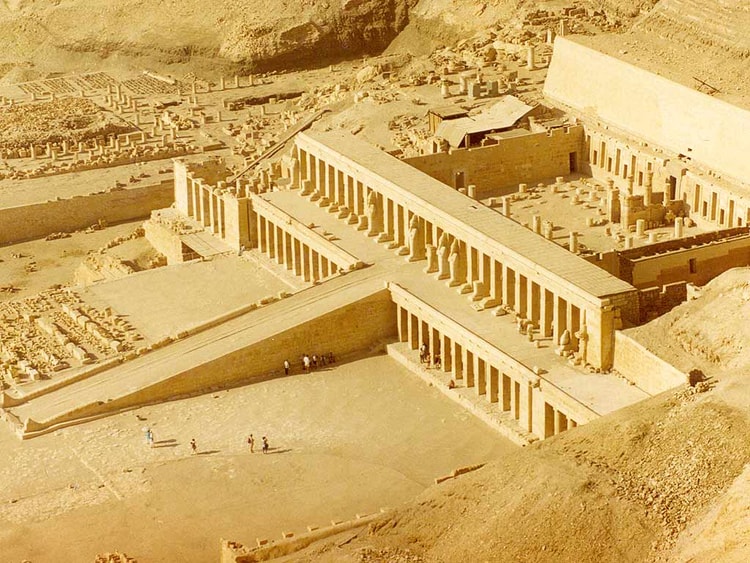 Temple of Hatshepsut, Aerial View N/A (CC BY) ](https://www.worldhistory.org/image/187/temple-of-hatshepsut-aerial-view/ "Temple of Hatshepsut, Aerial View")### Temples in Ancient [Egypt](https://www.worldhistory.org/egypt/)
In the religious customs of ancient Egypt the temple was considered 'the horizon' of a divine being, the point at which the god came into existence at creation, and thus every sacred site had a link to the very distant past and honored the specific god whose temple it was. The temple also was a mirror of the universe and a representation of the *ben-ben*, the sacred mound which rose out of chaos by the will of Amon at the beginning of time. At the same time, the temple was a site set aside for communion with the gods, as at the famous temple of [Karnak](https://www.worldhistory.org/Karnak/).
As in ancient Mesopotamia, the temple in Egypt was considered the literal home of the god to whom it was dedicated. [Hathor](https://www.worldhistory.org/Hathor/)'s temple at Dendera, then, was considered her actual house and the priests and priestesses of Hathor cared for the goddess as they would a living person of flesh and blood. Every [Egyptian](https://www.worldhistory.org/disambiguation/Egyptian/) temple followed the same basic design (thought to have been decreed by the gods themselves) of a forecourt and reception area for public gatherings with colonnades and inclines rising higher and higher to smaller and even smaller rooms until one reached the room of the Holy of Holies where the god was thought to reside when visiting earth. Only the high priest of the god of the temple could enter the Holy of Holies and commune with the deity there.
### Mesopotamian Temples
Ancient Mesopotamian temples fulfilled many roles. Not only were they the house of the local deity or the patron god of the [city](https://www.worldhistory.org/city/), they were also the administrative centers of the first [cities](https://www.worldhistory.org/city/) in [Sumer](https://www.worldhistory.org/sumer/). The city of [Eridu](https://www.worldhistory.org/eridu/) was considered the first city in the world by the [Sumerians](https://www.worldhistory.org/Sumerians/), created by the gods after their victory of order over the forces of chaos. The origin of the decrees of [civilization](https://www.worldhistory.org/civilization/) (the sacred *meh*) were thought to come from the temple there where the god of wisdom, [Enki](https://www.worldhistory.org/Enki/), lived.
The goddess [Inanna](https://www.worldhistory.org/Inanna/) stole the meh from Enki after a drunken party and brought them to [Uruk](https://www.worldhistory.org/uruk/), considered by scholars the first city in the world and once one of the largest and most prosperous. The story of Inanna bringing the meh from Eridu to Uruk is thought to symbolize the transference of power from the one city to the other and, specifically, from one temple, one sacred spot, to another.
Uruk was initially ruled by a priest-king, and it is believed that many early Mesopotamian cities followed the same model, where the temple complex with its towering ziggurat was the seat of both religious and secular authority. Even after the rise of secular kings, however, the temple was the central structure of every city throughout Mesopotamia serving as a seat of kingship, of administration, and organizing the distribution of food among the people.
### The Temple in [Judaism](https://www.worldhistory.org/disambiguation/judaism/)
In Judaism, the original ancient Hebrew language refers not to a temple but to a "sanctuary", "[palace](https://www.worldhistory.org/disambiguation/palace/)" or "hall". Each of the two ancient temples in [Jerusalem](https://www.worldhistory.org/jerusalem/) were called *Beit Hamikdash*, which translates literally as "the Holy House" and, in this, the Hebrews either copied or independently arrived at the same conception of a temple that the ancient Mesopotamians and Egyptians had: that the temple was the house of the god.
The Temple Mount in Jerusalem is the site where the First Temple of [Solomon](https://www.worldhistory.org/solomon/) and the Second Temple were built. and at the center of the temple was the Holy of Holies, where, as in Egypt, only the high priest could enter. The [Greek](https://www.worldhistory.org/disambiguation/greek/) word *synagogue* came to describe Jewish places of worship during the Babylonian Captivity and meant 'to gather together'. The original Hebrew names *Bet Knesset* ("House of Meeting") and *synagogue* designate Jewish temples today.
[  Temple of Hera, Selinus Mark Cartwright (CC BY-NC-SA) ](https://www.worldhistory.org/image/2600/temple-of-hera-selinus/ "Temple of Hera, Selinus")### Ancient Greek Temples
Most Greek religious buildings in the modern day are referred to as "temples," but the Greek pagans (only known as *pagans* after the rise of [Christianity](https://www.worldhistory.org/christianity/)) would have called a holy place a *temenos*, or sacred precinct. The sacredness of the place had entirely to do with the spirit of the god who resided there, not with whatever building was later constructed on the spot, as in the case of the Temple of [Demeter](https://www.worldhistory.org/demeter/) at [Eleusis](https://www.worldhistory.org/Eleusis/), the [Temple of Artemis at Ephesus](https://www.worldhistory.org/Temple_of_Artemis_at_Ephesus/) or the famous [Parthenon](https://www.worldhistory.org/parthenon/) of [Athens](https://www.worldhistory.org/Athens/) which housed the statue of [Athena](https://www.worldhistory.org/athena/) Parthenos (Athena the Virgin, patron goddess of the city).
The building which housed the statue, then, was sacred owing to the original presence there of, or some great deed done by, the god of that place. The Temple of Aphaia, on the island of [Aegina](https://www.worldhistory.org/Aegina/), is only one example of the temple as home of the deity of the place. The goddess Aphaia was thought to live in the temple to personally care for the people of the island and this paradigm is evident elsewhere throughout ancient [Greece](https://www.worldhistory.org/greece/).
### Temples in [China](https://www.worldhistory.org/china/) & [India](https://www.worldhistory.org/india/)
In China, early temples honored *xi'an* (heaven) which represented both creation and divine order. Xi'an was the equivalent of the concept of an all-powerful deity but also heaven and the glorious home of the ancestors. Not every temple in China honored a deity, however. The Confucian Temple in the city of Qufu honors the philosopher [Confucius](https://www.worldhistory.org/Confucius/). Built in his hometown in 478 BCE, the temple is thought to channel peace and tranquility but makes no claim to house a deity.
This is also true of [Shinto](https://www.worldhistory.org/Shinto/) temples in [Japan](https://www.worldhistory.org/disambiguation/Japan/) which are always constructed in accordance with the spirits of the area and their wishes but not dedicated to, nor home of, any one particular god. The Shinto temples and shrines share a common feature with those in India where the altars are usually adorned with pictures or statues of the god or gods honored there. The significant difference is that Shinto temples honor the spirits of the place while [Hindu](https://www.worldhistory.org/hinduism/) temples revere gods, though the gods worshipped and honored are in some way associated with the area of the temple.
The interior of temples throughout India, with few exceptions, follow the basic form and structure of the temple at Gobekli Tepe which, as noted earlier, has served as the underlying paradigm for temples around the world no matter what form their facade takes. Every temple shares a liminal quality, serving as a threshold between the physical and spiritual worlds. An excellent example of this is the great temple of [Angkor Wat](https://www.worldhistory.org/Angkor_Wat/) in Cambodia which, like Karnak in Egypt, is purposefully designed as a transportive site between this world and the higher realms.
[  The Pantheon, Rome B. Fletcher (Public Domain) ](https://www.worldhistory.org/image/1273/the-pantheon-rome/ "The Pantheon, Rome")### Roman Temples
In ancient [Rome](https://www.worldhistory.org/Rome/) the rituals that located and sited the temple were performed by a high priest, an augur, who, through the observation of the flight of birds or other natural phenomena, understood the loci of the god. Roman temples usually faced east or toward the rising sun, though a notable exception is the great [Pantheon](https://www.worldhistory.org/Pantheon/) which faces north (only preserved after the rise of Christianity because it was made into a church instead of being destroyed and built over, which was the fate of most pagan temples). In ancient Rome, only the deities of the Roman pantheon had a *templum*; any building honoring a foreign deity was called a *fanum*.
Visitors to Rome were welcome to worship at the fanum of their native gods but were required to worship the gods of Rome in the temples. After the rise of Christianity, the word *temple*, with its pagan connotations, was rejected by most Christian congregations in favor of designations such as 'church' or 'cathedral', though the word is still used by the Eastern Orthodox Church to refer to their places of worship.
### Conclusion
Every civilization has erected temples in one form or another, all serving the same purpose of providing the people with a specific site at which they could commune with the higher realm of the Divine. In Norse religion, such places were usually defined by a tree or pole representing the World Tree Yggdrasil, as in the case of the famous [Temple at Uppsala](https://www.worldhistory.org/Temple_at_Uppsala/). The [Plains Indians](https://www.worldhistory.org/Plains_Indians/) of North America erected temporary temples in observing the [Sun Dance](https://www.worldhistory.org/Sun_Dance/) which was believed to awaken the earth after winter and give thanks for the gifts given by the Great Spirit.
This same paradigm is evident in modern-day temples - including the churches, mosques, and synagogues of Christianity, [Islam](https://www.worldhistory.org/islam/), and Judaism - as believers come to these sites to share their faith and commune with God. In doing so, they are following an ancient tradition that predates history and is as integral an aspect of the human condition as any other.
#### Editorial Review
This human-authored definition has been reviewed by our editorial team before publication to ensure accuracy, reliability and adherence to academic standards in accordance with our [editorial policy](https://www.worldhistory.org/static/editorial-policy/).
## Bibliography
- [Bunson, M. *Encyclopedia of Ancient Egypt.* Gramercy, 1999.](https://www.worldhistory.org/books/0517203804/)
- [Davidson, H. R. Ellis. *Myths and Symbols in Pagan Europe.* Syracuse University Press, 1988.](https://www.worldhistory.org/books/0815624417/)
- [Durant, W. *Our Oriental Heritage.* Simon & Schuster, 2000.](https://www.worldhistory.org/books/B00005WJGO/)
- [Durant, W. *The Life of Greece.* Simon & Schuster, 2002.](https://www.worldhistory.org/books/1567310133/)
- [Edwardes, M. *Indian Temples and Palaces.* Littlehampton Book Services Ltd, 1969.](https://www.worldhistory.org/books/0600016420/)
- [Hamilton, E. *The Greek Way.* W. W. Norton & Company, 1993.](https://www.worldhistory.org/books/0393310779/)
- [Kramer, S. N. *The Sumerians.* University of Chicago Press, 1971.](https://www.worldhistory.org/books/0226452387/)
- [Leick, G. *Mesopotamia: The Rise of Cities.* Penguin Books, 2003.](https://www.worldhistory.org/books/0140265740/)
- [Leick, G. *The A to Z of Mesopotamia.* Scarecrow Press, 2010.](https://www.worldhistory.org/books/0810875772/)
- [Nardo, D. *Exploring Cultural History - Living in Ancient Egypt.* Thomson, 2008.](https://www.worldhistory.org/books/B003U1H2A2/)
- [Nardo, D. *Living in Ancient Rome.* Chelsea House Publications, 2008.](https://www.worldhistory.org/books/0816063400/)
- [Wolkstein, D. and Kramer, S.N. *Inanna, Queen of Heaven and Earth.* Harper Perennial, 1983.](https://www.worldhistory.org/books/0060908548/)
## About the Author
Joshua J. Mark is World History Encyclopedia's co-founder and Content Director. He was previously a professor at Marist College (NY) where he taught history, philosophy, literature, and writing. He has traveled extensively and lived in Greece and Germany.
- [Linkedin Profile](https://www.linkedin.com/pub/joshua-j-mark/38/614/339)
## Timeline
- **c. 12000 BCE**: Construction of Gobekli Tepe [Temple](https://www.worldhistory.org/temple/), oldest temple in the world.
- **c. 4500 BCE**: The [Sumerians](https://www.worldhistory.org/Sumerians/) built their first [temple](https://www.worldhistory.org/temple/).
- **c. 3500 BCE**: [Ness of Brodgar](https://www.worldhistory.org/Ness_of_Brodgar/) in use as religious site in Orkney, [Scotland](https://www.worldhistory.org/disambiguation/Scotland/).
- **950 BCE**: [Solomon](https://www.worldhistory.org/solomon/) builds the first [Temple](https://www.worldhistory.org/temple/) of [Jerusalem](https://www.worldhistory.org/jerusalem/).
- **c. 800 BCE**: The site of [Delphi](https://www.worldhistory.org/delphi/) first acquires a religious significance.
- **c. 700 BCE**: The [temple](https://www.worldhistory.org/temple/) of [Apollo](https://www.worldhistory.org/apollo/) is built on the island of [Delos](https://www.worldhistory.org/delos/).
- **c. 700 BCE**: Sanctuary of [Poseidon](https://www.worldhistory.org/poseidon/) built at [Isthmia](https://www.worldhistory.org/Isthmia/).
- **c. 650 BCE**: The first [temple](https://www.worldhistory.org/temple/) in honour of [Apollo](https://www.worldhistory.org/apollo/) is built at [Delphi](https://www.worldhistory.org/delphi/).
- **650 BCE - 600 BCE**: Heraion, [temple](https://www.worldhistory.org/temple/) dedicated to [Hera](https://www.worldhistory.org/Hera/) built at [Olympia](https://www.worldhistory.org/Olympia/).
- **570 BCE - 530 BCE**: The Doric [Temple](https://www.worldhistory.org/temple/) of [Hera](https://www.worldhistory.org/Hera/) is built at [Metapontum](https://www.worldhistory.org/Metapontum/), [Magna Graecia](https://www.worldhistory.org/Magna_Graecia/).
- **c. 550 BCE**: The [temple](https://www.worldhistory.org/temple/) of [Apollo](https://www.worldhistory.org/apollo/) is constructed at [Corinth](https://www.worldhistory.org/corinth/).
- **c. 550 BCE**: The [Temple](https://www.worldhistory.org/temple/) of [Hera](https://www.worldhistory.org/Hera/) I is built at [Paestum](https://www.worldhistory.org/Paestum/).
- **c. 510 BCE**: The [Etruscan](https://www.worldhistory.org/Etruscan_Civilization/) Portonaccio [Temple](https://www.worldhistory.org/temple/) is constructed at [Veii](https://www.worldhistory.org/Veii/).
- **c. 510 BCE**: The [Temple](https://www.worldhistory.org/temple/) of [Athena](https://www.worldhistory.org/athena/) is built at [Paestum](https://www.worldhistory.org/Paestum/).
- **c. 510 BCE**: The [temple](https://www.worldhistory.org/temple/) of [Hercules](https://www.worldhistory.org/hercules/) is built at [Agrigento](https://www.worldhistory.org/agrigento/).
- **c. 510 BCE**: The second [temple](https://www.worldhistory.org/temple/) to [Apollo](https://www.worldhistory.org/apollo/) is constructed at [Delphi](https://www.worldhistory.org/delphi/), replacing the first temple destroyed by fire.
- **484 BCE**: The first [temple](https://www.worldhistory.org/temple/) of the [Dioscuri](https://www.worldhistory.org/Castor_and_Pollux/) (Castor & Pollux) is dedicated in [Rome](https://www.worldhistory.org/Rome/)'s [Forum Romanum](https://www.worldhistory.org/Roman_Forum/) by Aulus Postumius following his victory over the Latins at the [Battle](https://www.worldhistory.org/disambiguation/battle/) of Lake Regillus.
- **c. 480 BCE**: The huge [temple](https://www.worldhistory.org/temple/) of [Zeus](https://www.worldhistory.org/zeus/) is built at [Agrigento](https://www.worldhistory.org/agrigento/).
- **478 BCE**: [Temple](https://www.worldhistory.org/temple/) of [Confucius](https://www.worldhistory.org/Confucius/) built at Qufu, [China](https://www.worldhistory.org/china/).
- **c. 460 BCE**: The [temple](https://www.worldhistory.org/temple/) of [Hera](https://www.worldhistory.org/Hera/) II is built at [Paestum](https://www.worldhistory.org/Paestum/).
- **c. 460 BCE - 457 BCE**: [Temple](https://www.worldhistory.org/temple/) of [Zeus](https://www.worldhistory.org/zeus/) is built at [Olympia](https://www.worldhistory.org/Olympia/) with a statue of [Apollo](https://www.worldhistory.org/apollo/) dominating the west pediment and containing the cult statue of Zeus by [Phidias](https://www.worldhistory.org/Phidias/).
- **450 BCE - 430 BCE**: The [Temple](https://www.worldhistory.org/temple/) of Concordia is built at [Agrigento](https://www.worldhistory.org/agrigento/).
- **449 BCE**: The Hephaisteion, [temple](https://www.worldhistory.org/temple/) to [Athena](https://www.worldhistory.org/athena/) & [Hephaistos](https://www.worldhistory.org/Hephaistos/), built in [Athens](https://www.worldhistory.org/Athens/).
- **447 BCE - 432 BCE**: The construction of the [Parthenon](https://www.worldhistory.org/parthenon/) in [Athens](https://www.worldhistory.org/Athens/) by the architects Iktinos and Kallikrates under the direction of [Phidias](https://www.worldhistory.org/Phidias/).
- **c. 444 BCE - 440 BCE**: [Temple](https://www.worldhistory.org/temple/) of [Poseidon](https://www.worldhistory.org/poseidon/) at [Sounion](https://www.worldhistory.org/sounion/) re-built.
- **c. 430 BCE**: The cult statue of [Zeus](https://www.worldhistory.org/zeus/) by [Phidias](https://www.worldhistory.org/Phidias/) is dedicated in the [Temple](https://www.worldhistory.org/temple/) of Zeus, [Olympia](https://www.worldhistory.org/Olympia/). It is one of [the Seven Wonders](https://www.worldhistory.org/The_Seven_Wonders/) of the Ancient World.
- **c. 425 BCE - c. 420 BCE**: The [Temple](https://www.worldhistory.org/temple/) dedicated to [Athena](https://www.worldhistory.org/athena/) [Nike](https://www.worldhistory.org/nike/) is constructed on the [acropolis](https://www.worldhistory.org/Acropolis/) of [Athens](https://www.worldhistory.org/Athens/).
- **421 BCE - 406 BCE**: The [Erechtheion](https://www.worldhistory.org/Erechtheion/) of [Athens](https://www.worldhistory.org/Athens/) [acropolis](https://www.worldhistory.org/Acropolis/) is constructed with six Caryatids in the south porch.
- **c. 420 BCE - c. 400 BCE**: The [Temple](https://www.worldhistory.org/temple/) of [Apollo](https://www.worldhistory.org/apollo/) is built at [Bassae](https://www.worldhistory.org/Bassae/).
- **c. 417 BCE**: The Doric [temple](https://www.worldhistory.org/temple/) of [Segesta](https://www.worldhistory.org/Segesta/) is built.
- **c. 380 BCE - c. 375 BCE**: [Temple](https://www.worldhistory.org/temple/) to [Asclepius](https://www.worldhistory.org/Asclepius/) constructed at [Epidaurus](https://www.worldhistory.org/epidaurus/).
- **342 BCE**: Fire destroys the 6th century BCE [temple](https://www.worldhistory.org/temple/) to [Athena](https://www.worldhistory.org/athena/) at Lindos, [Rhodes](https://www.worldhistory.org/Rhodes/) and is replaced by a new one.
- **c. 330 BCE**: [Temple](https://www.worldhistory.org/temple/) of [Zeus](https://www.worldhistory.org/zeus/) built at [Nemea](https://www.worldhistory.org/nemea/).
- **c. 330 BCE**: The third [temple](https://www.worldhistory.org/temple/) to [Apollo](https://www.worldhistory.org/apollo/) is constructed at [Delphi](https://www.worldhistory.org/delphi/), replacing the earlier temple damaged by [earthquake](https://www.worldhistory.org/disambiguation/earthquake/).
- **c. 320 BCE**: [Temple](https://www.worldhistory.org/temple/) dedicated to [Aphrodite](https://www.worldhistory.org/Aphrodite/) constructed at [Epidaurus](https://www.worldhistory.org/epidaurus/).
- **c. 301 BCE - c. 320 BCE**: Doric [temple](https://www.worldhistory.org/temple/) to [Athena](https://www.worldhistory.org/athena/) and fortifications of [Lysimachus](https://www.worldhistory.org/Lysimachus/) built at [Troy](https://www.worldhistory.org/troy/).
- **225 BCE - 150 BCE**: The [Temple](https://www.worldhistory.org/temple/) of [Hercules](https://www.worldhistory.org/hercules/) is built at [Ostia](https://www.worldhistory.org/Ostia/).
- **c. 1 CE - c. 100 CE**: Construction of the [temple](https://www.worldhistory.org/temple/) of [Jupiter](https://www.worldhistory.org/jupiter/) [Baal](https://www.worldhistory.org/baal/) by the Romans at [Baalbek](https://www.worldhistory.org/Baalbek/).
- **c. 14 CE**: The [Temple](https://www.worldhistory.org/temple/) of [Rome](https://www.worldhistory.org/Rome/) and [Augustus](https://www.worldhistory.org/augustus/) is built at [Ostia](https://www.worldhistory.org/Ostia/).
- **650 CE - 1025 CE**: The [Buddhist](https://www.worldhistory.org/buddhism/) [temple](https://www.worldhistory.org/temple/) at [Borobudur](https://www.worldhistory.org/Borobudur/), Java is built during the rule of the Sailendra Dynasty.
- **c. 1010 CE - c. 1025 CE**: The Brihadishvara [Temple](https://www.worldhistory.org/temple/) is built at [Tanjavur](https://www.worldhistory.org/Tanjavur/), Tamil Nadu, [India](https://www.worldhistory.org/india/).
- **c. 1025 CE - 1000 CE**: The Kandariya Mahadeo [temple](https://www.worldhistory.org/temple/), dedicated to [Shiva](https://www.worldhistory.org/shiva/), is built at [Khajuraho](https://www.worldhistory.org/Khajuraho/).
- **1122 CE**: Construction begins of the [Hindu](https://www.worldhistory.org/hinduism/) [temple](https://www.worldhistory.org/temple/) at [Angkor Wat](https://www.worldhistory.org/Angkor_Wat/).
## Questions & Answers
### What is a temple?
A temple (from the Latin templum) is a structure built for the purposes of honoring a god or the sacred spirit of a certain place.
### What was the first temple in the world?
The first temple in the world is Gobekli Tepe in modern-day Turkey which is 11,500 years old.
### Did all ancient civilizations have temples?
All ancient civilizations had temples which served essentially the same purpose even though the architecture and rites performed differed.
### What is the largest and most famous temple in the world?
The largest and most famous temple in the world is Angkor Wat in Cambodia.
## External Links
- [Building of the Parthenon](http://ed.ted.com/on/57vglITD)
- [following hadrian photography](https://followinghadrianphotography.com/)
- [Baalbek](http://whc.unesco.org/en/list/294)
- [Ziggurats](http://www.mesopotamia.co.uk/ziggurats/home_set.html)
- [Temples](http://www.ancientegypt.co.uk/temples/home.html)
- [10 Most Impressive Ancient Egyptian Temples](https://www.touropia.com/ancient-egyptian-temples/)
- [10 Most Famous Greek Temples](https://www.touropia.com/famous-greek-temples/)
- [The British Museum](http://www.ancientgreece.co.uk/acropolis/challenge/cha_set.html)
- [29 Of The Best Ancient Greek Temples You Can't Afford to Miss](https://www.triphistoric.com/explore/articles/greek-temples-the-ultimate-guide)
- [10 Most Spectacular Ancient Roman Temples](https://www.touropia.com/ancient-roman-temples/)
- [Ancient Roman Temples](https://www.crystalinks.com/rometemples.html)
- [10 Amazing Hindu Temples](https://www.touropia.com/amazing-hindu-temples/)
- [Top 10 Temples in China, Famous Temples in China](https://www.chinahighlights.com/travelguide/temples-and-monasteries/)
- [Ancient Sacrificial Temples in Beijing](http://www.china.org.cn/english/travel/50829.htm)
- [China destroys the ancient Buddhist symbols of Lhasa City in Tibet](http://www.thetibetpost.com/en/news/tibet/3382-china-destroys-the-ancient-buddhist-symbols-of-lhasa-city-in-tibet)
- [10 Most Beautiful Ancient Mayan Temples](https://www.touropia.com/ancient-mayan-temples/)
- [Category: Maya Civilization](http://www.sacred-destinations.com/categories/mayan)
- [Ancient Mayans: Temples for Everyone!](http://www.livescience.com/2321-ancient-mayans-temples.html)
- [Ancient Scotland](http://www.ancient-scotland.co.uk/site/143)
- [Phoenician Architecture, Temples,Palaces and Shrines](http://phoenicia.org/architecture.html)
- [Paphos](http://whc.unesco.org/en/list/79/)
- [Temple of Heaven: an Imperial Sacrificial Altar in Beijing](http://whc.unesco.org/en/list/881)
## Cite This Work
### APA
Mark, J. J. (2009, September 02). Temple. *World History Encyclopedia*.
### Chicago
Mark, Joshua J.. "Temple." *World History Encyclopedia*, September 02, 2009. .
### MLA
Mark, Joshua J.. "Temple." *World History Encyclopedia*, 02 Sep 2009, .
## License & Copyright
Submitted by [Joshua J. Mark](https://www.worldhistory.org/user/JPryst/ "User Page: Joshua J. Mark"), published on 02 September 2009. The copyright holder has published this content under the following license: [Creative Commons Attribution-NonCommercial-ShareAlike](https://creativecommons.org/licenses/by-nc-sa/4.0/deed.en). This license lets others remix, tweak, and build upon this content non-commercially, as long as they credit the author and license their new creations under the identical terms. When republishing on the web a hyperlink back to the original content source URL must be included. Please note that content linked from this page may have different licensing terms.