---
title: Tarentum
author: Mark Cartwright
source: https://www.worldhistory.org/tarentum/
format: machine-readable-alternate
license: Creative Commons Attribution-NonCommercial-ShareAlike (https://creativecommons.org/licenses/by-nc-sa/4.0/)
updated: 2024-11-25
---
# Tarentum
_Authored by [Mark Cartwright](https://www.worldhistory.org/user/markzcartwright/)_
Tarentum (Taras, modern Taranto), located on the southern coast of Apulia, [Italy](https://www.worldhistory.org/italy/), was a [Greek](https://www.worldhistory.org/disambiguation/greek/) and then [Roman](https://www.worldhistory.org/disambiguation/Roman/) [city](https://www.worldhistory.org/city/). Controlling a large area of [Magna Graecia](https://www.worldhistory.org/Magna_Graecia/) and heading the Italiote League, Tarentum, with its excellent harbour, was a strategically significant city throughout antiquity. Thus, it would play a pivotal role in the wars between [Pyrrhus](https://www.worldhistory.org/pyrrhus/) and [Rome](https://www.worldhistory.org/Rome/) in the 3rd century BCE and again during the [Second Punic War](https://www.worldhistory.org/Second_Punic_War/) when [Hannibal](https://www.worldhistory.org/hannibal/) occupied southern Italy. While little remains today of ancient Tarentum's buildings, the city's museum boasts one of the largest collections of [Greek pottery](https://www.worldhistory.org/Greek_Pottery/) in the world and has many fine bronzes, [gold](https://www.worldhistory.org/gold/) jewellery and floor mosaics.
### Historical Overview
**Foundation**
Tarentum, or Taras as it was first known in Greek, was a colony founded by [Sparta](https://www.worldhistory.org/sparta/) in the 8th century BCE as part of the wave of [Greek colonization](https://www.worldhistory.org/Greek_Colonization/) of the region which would become known as Magna Graecia. According to tradition the city was founded in 706 BCE by the Spartan hero Phalanthus. The first colonists were also said to be the offspring of [Spartan women](https://www.worldhistory.org/article/123/spartan-women/) and helots, the semi-enslaved agricultural workers who served their Spartan masters. Archaeological evidence, though, points to a much earlier [Neolithic](https://www.worldhistory.org/Neolithic/) settlement followed by a [Mycenaean](https://www.worldhistory.org/Mycenaean_Civilization/) presence in the area during the [Bronze Age](https://www.worldhistory.org/disambiguation/Bronze_Age/).
**A Thriving City**
Located on the coast and with the best harbour in the gulf of Tarentum, the city would prosper and become one of the most important commercial centres in the region. The growth of the city did bring it into conflict with local rivals such as [Metapontum](https://www.worldhistory.org/Metapontum/) at the other end of the gulf, but Tarentum won important victories over local tribes (the Messapians and Peucetians) in 490 and 480 BCE. These battles were commemorated in dedications made at [Delphi](https://www.worldhistory.org/delphi/), although peace did not last long as the Messapians inflicted a serious defeat on Tarentum c. 475 BCE in a [battle](https://www.worldhistory.org/disambiguation/battle/) described by [Herodotus](https://www.worldhistory.org/herodotus/) as a 'great bloodbath' (7.170.3). A consequence of the city's military weakness was an overthrow of the ruling class, which was replaced by a system of limited democracy.
[ 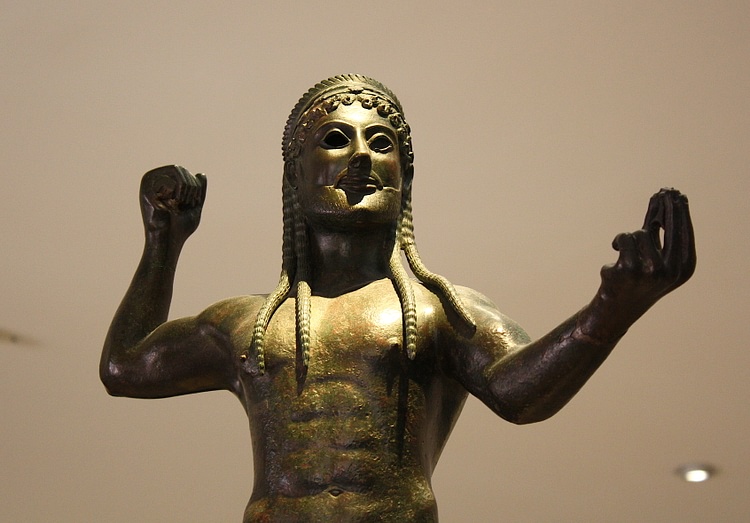 Bronze Zeus, Tarentum Mark Cartwright (CC BY-NC-SA) ](https://www.worldhistory.org/image/7052/bronze-zeus-tarentum/ "Bronze Zeus, Tarentum")Tarentum's fortunes improved by the end of the 5th century BCE and saw the city grow to some 530 hectares and increase its outlying territory, an expansion aided by the decline of long-time rival Croton further down the coast of southern Italy. Goods and coinage from Tarentum (including [silver](https://www.worldhistory.org/Silver/) staters with their distinctive male figure riding a dolphin) have been excavated all along the southern and Adriatic coasts of Italy illustrating the city's prosperity and trading capacity. Large [temple](https://www.worldhistory.org/temple/) sanctuaries and cemeteries also attest to the growth of the city during the latter half of the 5th century BCE. The city even founded its own colony to the west, Heraclea ([Herakleia](https://www.worldhistory.org/disambiguation/Herakleia/)), in 433 BCE. Around 400 BCE Heraclea became the seat of the Italiote League, an association of southern Italian city-states, which was dominated by Tarentum.
During the 4th century BCE Tarentum government was dominated by Pythagorean thought ([Pythagoras](https://www.worldhistory.org/Pythagoras/) had established his school further down the coast) and one man, in particular, Archytas (c. 400-350 BCE). The celebrated mathematician, Pythagorean and statesman was elected general seven times and probably forged an alliance with [Syracuse](https://www.worldhistory.org/syracuse/), the powerful [city-state](https://www.worldhistory.org/Polis/) in [Sicily](https://www.worldhistory.org/sicily/), which allowed Tarentum to expand further at a time when Dionysius I, the tyrant of Syracuse, was busy sacking [cities](https://www.worldhistory.org/city/) in southern Italy. In the latter half of the 4th century BCE Tarentum fought to maintain its position of regional dominance and face the ever-rising threat of the Messapians and Lucanians by hiring mercenary armies, often led by generals from Sparta and Epirus. By the 3rd century BCE, though, a much more dangerous enemy was on the prowl in Magna Graecia: Rome.
**Pyrrhus & Rome**
Fortunately for Tarentum a powerful ally was on hand to save them from Roman occupation. The great general and king of Epirus, Pyrrhus, responded to a call for help from the city when it was under imminent Roman attack in 280 BCE. Pyrrhus crossed the Adriatic with his army of 25,000 infantry and, employing 20 [war](https://www.worldhistory.org/disambiguation/War/) elephants and a superior cavalry force of 3,000, he won battles against Roman armies at Heraclea in 280 BCE and Ausculum in 279 BCE. The victories, nevertheless, came at a high cost in lives on both sides and these battles were not decisive, hence the lasting expression 'a Pyrrhic victory'. More importantly for Tarentum, Pyrrhus was soon forced to leave the region and meet the increasing threat from [Carthage](https://www.worldhistory.org/carthage/) to his interests in Sicily. With the field now clear, Rome occupied the city in 270 BCE and thereafter Tarentum became an ally of the peninsula's dominant power.
[  Pyrrhic War Piom (CC BY-SA) ](https://www.worldhistory.org/image/4630/pyrrhic-war/ "Pyrrhic War")**Hannibal & Rome**
The region once more became the most important battlefield in the [Mediterranean](https://www.worldhistory.org/disambiguation/mediterranean/) when Hannibal invaded Italy in the Second [Punic](https://www.worldhistory.org/carthage/) War (218-201 BCE). Tarentum, like most of the southern Italian cities, sided with Carthage but the [acropolis](https://www.worldhistory.org/Acropolis/) and harbour of Tarentum were, nevertheless, occupied by Rome. Hannibal desperately sought a port from which his army could be resupplied from [Africa](https://www.worldhistory.org/disambiguation/africa/) but he could not take Tarentum and managed only to occupy the outer town.
During the chaos of the [Punic Wars](https://www.worldhistory.org/Punic_Wars/) a brief attempt was made at regaining the city's independence in 213 BCE when a number of aristocrats overthrew the government. It was a short-lived rebellion and the city once again came fully under Roman control in 209 BCE when it was captured by Quintus Fabius Maximus. When [Scipio Africanus](https://www.worldhistory.org/disambiguation/Scipio_Africanus/) sailed to Africa and attacked Carthage itself in 203 BCE, Hannibal was recalled from Italy for a last-ditch defence of the homeland. Tarentum was left at the mercy of Rome. With its lands greatly reduced and governed directly by a Roman [praetor](https://www.worldhistory.org/praetor/), the city eventually regained its former status as a formal ally c. 180 BCE. With the extension of the via Appia to [Brundisium](https://www.worldhistory.org/Brundisium/) further to the south-east, Tarentum lost its position as the primary port in southern Italy.
[  Archaic Columns, Tarentum Mark Cartwright (CC BY-NC-SA) ](https://www.worldhistory.org/image/7050/archaic-columns-tarentum/ "Archaic Columns, Tarentum")Tarentum trundled on as a modest town in the [Roman Republic](https://www.worldhistory.org/Roman_Republic/) and in 122 BCE the colony of Neptunia was founded which would become part of Tarentum proper in 89 BCE. In 59 BCE plots of Tarentum land were given to veterans and the city became ever more Romanised. The city still produced products for export such as wool, textiles, [Tyrian purple](https://www.worldhistory.org/Tyrian_Purple/) dye, and foodstuffs. Epigraphic evidence, the density of private housing and presence of several large villas demonstrate that the city remained economically active and relatively prosperous well into the imperial period with Emperor [Nero](https://www.worldhistory.org/Nero/) (r. 54-68 CE) granting it colony status.
**Late Antiquity**
Both Jews and Christians were a strong presence in Tarentum from the 1st century CE onwards with a bishopric established by the 4th century CE or earlier. During the Gothic invasions the town was, notwithstanding its new fortifications, occupied by [Totila](https://www.worldhistory.org/Totila/), king of the [Ostrogoths](https://www.worldhistory.org/ostrogoth/) (r. 541-552 CE). The city's excellent harbour never ceased to attract a naval presence when the opportunity arose and [Constans II](https://www.worldhistory.org/Constans_II/), the [Byzantine emperor](https://www.worldhistory.org/Byzantine_Emperor/), sent a fleet to Italy which landed at Tarentum in 661 CE. In 668 CE Tarentum, still, as ever, a strategically useful acquisition for invaders, entered the medieval period with a bang when the Lombard duke Romuald sacked the city.
### Archaeological Remains
Tarentum once had large sacred complexes with impressive temples but due to the fact that the city has been continuously occupied since antiquity most of the large scale ancient [architecture](https://www.worldhistory.org/disambiguation/architecture/) has long since been dismantled and reused elsewhere in more modern buildings. An exception are the two massive columns once belonging to an [archaic](https://www.worldhistory.org/disambiguation/Archaic/) temple dedicated to [Poseidon](https://www.worldhistory.org/poseidon/). These columns now stand in the corner of the municipal square (not their original location) and their massive size hints at the enormity of this now lost temple.
[ 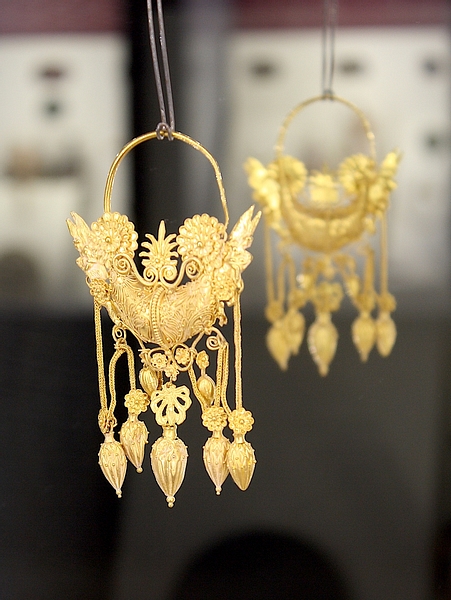 Gold Boat Earring, Tarentum Mark Cartwright (CC BY-NC-SA) ](https://www.worldhistory.org/image/7049/gold-boat-earring-tarentum/ "Gold Boat Earring, Tarentum")What Tarentum may lack in architecture is more than compensated for in the richness of the artefacts excavated at the site, the surrounding countryside, and the harbour itself. Many of the finest and best-preserved examples of [black-figure pottery](https://www.worldhistory.org/Black_Figure_Pottery/) and red figure [pottery](https://www.worldhistory.org/pottery/) have been discovered at the site with Taranto's magnificent MARTA museum possessing a collection which rivals that of [Athens](https://www.worldhistory.org/Athens/) and the Vatican in scope and artistry. Gold jewellery in the form of diadems, rings, earrings and necklaces with minute and elaborate filigree and granulation decoration are another rich source of evidence which points to the skill of Tarentum's [metal](https://www.worldhistory.org/disambiguation/metal/) workers and the wealth of the city in the 4th-3rd century BCE. Many of the artefacts are from tombs and none is more interesting than the [Tomb](https://www.worldhistory.org/tomb/) of the Athlete, a tomb of a Tarentum victor at the [Olympic Games](https://www.worldhistory.org/Olympic_Games/) complete with his discus, weights, and javelin heads and, touchingly, the prize he famously won in life, the black-figure [amphora](https://www.worldhistory.org/Amphora/) given to all winners.
Special mention should be made of the many fine floor mosaics from the city's grander Roman residences. The largest and best preserved is a late-2nd or early 3rd century CE [mosaic](https://www.worldhistory.org/Mosaic/) with four main panels depicting an abduction of a [nymph](https://www.worldhistory.org/nymph/) and additional scenes of a leopard, lion and tiger hunting. Smaller side panels show birds and fruit.
[  Geometrical Mosaic, Tarentum Mark Cartwright (CC BY-NC-SA) ](https://www.worldhistory.org/image/7053/geometrical-mosaic-tarentum/ "Geometrical Mosaic, Tarentum")Another splendid floor mosaic has purely geometrical and floral shapes with a large central circle whose folded *velarium* (curtain) is given an almost three-dimensional quality by the use of variously shaded *tesserae* pieces. This perfectly square mosaic dates to the 2nd century CE and belonged to a Roman house or *domus* in central Tarentum.
Finally, one of the star pieces from ancient Taranto and one which welcomes visitors to the archaeological museum is a [bronze](https://www.worldhistory.org/disambiguation/bronze/) statue of [Zeus](https://www.worldhistory.org/zeus/). Dating to c. 530 BCE, the figure once held a thunderbolt in one hand and an eagle in the other. The statue was originally placed on a marble Doric capital and stood in a sanctuary in the city dedicated to the head of the Olympian gods, a potent reminder of the Greek origins of one of southern Italy's wealthiest and most influential ancient cities.
#### Editorial Review
This human-authored definition has been reviewed by our editorial team before publication to ensure accuracy, reliability and adherence to academic standards in accordance with our [editorial policy](https://www.worldhistory.org/static/editorial-policy/).
## Bibliography
- [Anonymous. *Marta Il Museo Nazionale Archeologico Di Taranto.* Scorpione Editrice, 2017.](https://www.worldhistory.org/books/8880991922/)
- Bagnall, R. *The Encyclopedia of Ancient History.* Wiley-Blackwell, 2012
- [Hornblower, S. *The Oxford Classical Dictionary.* Oxford University Press, 2012.](https://www.worldhistory.org/books/0199545561/)
- [Hoyos, D. *A Companion to the Punic Wars.* Wiley-Blackwell, 2015.](https://www.worldhistory.org/books/1119025508/)
- [Kinzl, H. *A Companion to the Classical Greek World.* Wiley-Blackwell, 2010.](https://www.worldhistory.org/books/1444334123/)
## About the Author
Mark is WHE’s Publishing Director and has an MA in Political Philosophy (University of York). He is a full-time researcher, writer, historian and editor. Special interests include art, architecture and discovering the ideas that all civilizations share.
## Timeline
- **706 BCE**: [Sparta](https://www.worldhistory.org/sparta/) founds the colony of [Tarentum](https://www.worldhistory.org/tarentum/) in [Magna Graecia](https://www.worldhistory.org/Magna_Graecia/).
- **c. 530 BCE**: The [Bronze](https://www.worldhistory.org/disambiguation/bronze/) [Zeus](https://www.worldhistory.org/zeus/) of [Tarentum](https://www.worldhistory.org/tarentum/) is sculpted.
- **490 BCE**: [Tarentum](https://www.worldhistory.org/tarentum/) wins victories against the Messapians and Peucetians in [Magna Graecia](https://www.worldhistory.org/Magna_Graecia/).
- **480 BCE**: [Tarentum](https://www.worldhistory.org/tarentum/) wins victories against the Messapians and Peucetians in [Magna Graecia](https://www.worldhistory.org/Magna_Graecia/).
- **c. 475 BCE**: The Messapians inflict a heavy defeat on [Tarentum](https://www.worldhistory.org/tarentum/) in [Magna Graecia](https://www.worldhistory.org/Magna_Graecia/).
- **433 BCE**: The colony of Heraclea in [Magna Graecia](https://www.worldhistory.org/Magna_Graecia/) is founded by [Tarentum](https://www.worldhistory.org/tarentum/).
- **c. 400 BCE - 350 BCE**: Life of Archytas, statesman and Pythagorean philosopher, who ruled at [Tarentum](https://www.worldhistory.org/tarentum/).
- **280 BCE - 275 BCE**: King [Pyrrhus](https://www.worldhistory.org/pyrrhus/) of Epirus wages the Pyrrhic [War](https://www.worldhistory.org/disambiguation/War/) against the Romans in [Italy](https://www.worldhistory.org/italy/), defence of [Tarentum](https://www.worldhistory.org/tarentum/) being the pretext.
- **280 BCE - 272 BCE**: [Roman](https://www.worldhistory.org/disambiguation/Roman/) [war](https://www.worldhistory.org/disambiguation/War/) against [Tarentum](https://www.worldhistory.org/tarentum/). [Rome](https://www.worldhistory.org/Rome/) conquers Tarentum. Rome's dominance in lower [Italy](https://www.worldhistory.org/italy/) is secured.
- **270 BCE**: [Rome](https://www.worldhistory.org/Rome/) occupies [Tarentum](https://www.worldhistory.org/tarentum/) in [Magna Graecia](https://www.worldhistory.org/Magna_Graecia/).
- **218 BCE - 201 BCE**: [Second Punic War](https://www.worldhistory.org/Second_Punic_War/).
- **209 BCE**: [Tarentum](https://www.worldhistory.org/tarentum/) comes under [Roman](https://www.worldhistory.org/disambiguation/Roman/) control during the [Second Punic War](https://www.worldhistory.org/Second_Punic_War/).
- **89 BCE**: The [Roman](https://www.worldhistory.org/disambiguation/Roman/) colony of Neptunia comes under the control of [Tarentum](https://www.worldhistory.org/tarentum/).
- **59 BCE**: [Roman](https://www.worldhistory.org/disambiguation/Roman/) veterans are settled at [Tarentum](https://www.worldhistory.org/tarentum/).
## Cite This Work
### APA
Cartwright, M. (2017, August 24). Tarentum. *World History Encyclopedia*.
### Chicago
Cartwright, Mark. "Tarentum." *World History Encyclopedia*, August 24, 2017. .
### MLA
Cartwright, Mark. "Tarentum." *World History Encyclopedia*, 24 Aug 2017, .
## License & Copyright
Submitted by [Mark Cartwright](https://www.worldhistory.org/user/markzcartwright/ "User Page: Mark Cartwright"), published on 24 August 2017. The copyright holder has published this content under the following license: [Creative Commons Attribution-NonCommercial-ShareAlike](https://creativecommons.org/licenses/by-nc-sa/4.0/deed.en). This license lets others remix, tweak, and build upon this content non-commercially, as long as they credit the author and license their new creations under the identical terms. When republishing on the web a hyperlink back to the original content source URL must be included. Please note that content linked from this page may have different licensing terms.