---
title: Tacitus
author: Donald L. Wasson
source: https://www.worldhistory.org/tacitus/
format: machine-readable-alternate
license: Creative Commons Attribution-NonCommercial-ShareAlike (https://creativecommons.org/licenses/by-nc-sa/4.0/)
updated: 1970-01-01
---
# Tacitus
_Authored by [Donald L. Wasson](https://www.worldhistory.org/user/DWasson/)_
Publius Cornelius Tacitus (l. c. 56 - c. 118 CE) was a [Roman](https://www.worldhistory.org/disambiguation/Roman/) historian, active throughout the reign of [Trajan](https://www.worldhistory.org/trajan/) (r. 98-117 CE) and the early years of [Hadrian](https://www.worldhistory.org/hadrian/) (r. 117-138 CE). His best-known works are *Histories* and *Annals*, which cover the history of the [empire](https://www.worldhistory.org/empire/) from the time of the Julio-Claudians to the reign of [Domitian](https://www.worldhistory.org/domitian/) (r. 81-96 CE). Although best known for his historical writings, he also had a long public career, serving as a [quaestor](https://www.worldhistory.org/Quaestor/) in 81 CE, [praetor](https://www.worldhistory.org/praetor/) in 88 CE, a [tribune](https://www.worldhistory.org/Tribune/) of the plebs, a [consul](https://www.worldhistory.org/Consul/) in 97 CE, and proconsul of Asia from 112-113 CE.
Even though he was highly critical of emperors [Tiberius](https://www.worldhistory.org/Tiberius/) (r. 14-37 CE), [Nero](https://www.worldhistory.org/Nero/), and Domitian, his works still revealed an allegiance and devotion to the empire; however, he is often criticized for his careless treatment of geography and military history. Many historians believe his personality is seen throughout his works, demonstrating imagination and wit but also revealing a sense of moral indignation. His surviving works are:
- Agricola (*De vita Julii Agricolae*)
- Germania (*De origine et situ Germanorum*)
- Dialogue on Oratory (*Dialogus de oratoribus*)
- Histories (*Historiae*)
- Annals (*Annales*)
### Life
Considered by many to be the greatest of the Roman historians, Publius Cornelius Tacitus was born around 56 CE during the reign of Emperor Nero (r. 54-68 CE) to a prosperous provincial family from Cisalpine [Gaul](https://www.worldhistory.org/gaul/). He received an excellent education, studying both rhetoric and [law](https://www.worldhistory.org/disambiguation/law/) while reading the works of the great Roman orator [Cicero](https://www.worldhistory.org/Cicero/) and the rhetorician Quintilian. Later, along with his good friend [Pliny the Younger](https://www.worldhistory.org/Pliny_the_Younger/), he even made a brief appearance in a [Roman law](https://www.worldhistory.org/Roman_Law/) court. While her name is lost to history, he married the daughter of the governor of [Britain](https://www.worldhistory.org/disambiguation/Britain/), Gnaeus [Julius](https://www.worldhistory.org/disambiguation/Julius/) Agricola, in 77 CE. The governor would be the subject of one of Tacitus' more famous works *Agricola (De vita Julii Agricolae)* written around 97-98 CE. Although mostly a biography, Tacitus took the opportunity as its author to lash out at Rome when he said they were the robbers of the world and sought domination in profit.
### *Agricola*
Written about the same time as *Germania, Agricola* was a moral eulogy to his father-in-law. Agricola was more than a military man: a one-time consul, he rose through the ranks to become the governor of [Roman Britain](https://www.worldhistory.org/Roman_Britain/) (74-84 CE). It is obvious to the reader that Tacitus did not hold Emperor Domitian in high regard. "Under Domitian more than half our wretchedness consisted in watching and being watched, while our very sighs were scored against us…" (*On Britain and Germany*, 97). Domitian is viewed as a paranoid despot, extremely jealous of the success of Agricola, but he had reason to be jealous. The governor experienced tremendous success during his time in Britain, extending the province's borders into [Scotland](https://www.worldhistory.org/disambiguation/Scotland/) (Caledonia) and engaging in an extensive Romanization of the island with the building of both temples and Roman-style buildings. Agricola also saw that the sons of the elite were properly educated, specifically in Latin. On Agricola's time in Britain, Tacitus wrote:
> When duty had had its due, he put off the official pose; harshness, arrogance, and greed had long ceased to be a part of his make-up. He succeeded where few succeed; he lost no authority by his affability, no affection by his sternness. (59)
[ 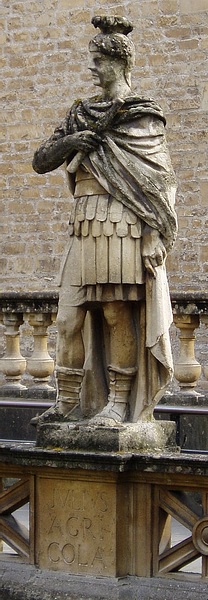 Agricola Ostrich (Public Domain) ](https://www.worldhistory.org/image/12340/agricola/ "Agricola")Unfortunately, after his recall by Domitian, he felt the full sting of the emperor's wrath, being denied the "honor and glory that he deserved." However, Tacitus wrote that his father-in-law did not court fame. Mary Beard in her book *SPQR* said that "The overriding message is that the imperial regime allowed no place for traditional Roman virtue and military prowess" (494). After his father-in-law died, the historian eulogized him when he said:
> Happy you, Agricola, in your glorious life, but no less happy in your timely [death](https://www.worldhistory.org/disambiguation/Death/). …You seemed glad to be doing your best to spare Domitian the guilt of killing you. (91)
### *Germania*
*Germania* was a detailed account of the Germanic people: their customs, [religion](https://www.worldhistory.org/religion/), government, and attitude towards [warfare](https://www.worldhistory.org/warfare/). When making a comparison, Tacitus viewed the Germanic people as socially pure while the Romans were seen as decadent and morally lax.
> The Germans themselves, I am inclined to think, are natives of the soil and extremely little affected by immigration or friendly intercourse with other nations. ... For myself I accept the view that the peoples have never been tainted by intermarriage with other peoples, and stand out as a nation peculiar, pure and unique of its kind. (101-103)
They were a people with simple virtue, and when not engaged in warfare, they spend their time idle in sleep or gluttony. In contrast, as later expressed in his writings, Tacitus believed that the [Roman Empire](https://www.worldhistory.org/Roman_Empire/) was experiencing a decay of morality; a view held years earlier by the orator Cicero (l. 106-43 BCE). And, as in *Agricola*, he took the opportunity to lash out at Rome. "Good morality is more effective in Germany than good laws in some places that we know." (117) Although the Germanic tribes had no taste for peace, Tacitus adds: "All the heroes and grim warriors dawdle their time away, while the care of house, hearth and fields is left to the [women](https://www.worldhistory.org/disambiguation/women/), old men and weaklings of the family." (113)
[  Map of Celtic and Germanic Tribes The History Files (Copyright) ](https://www.worldhistory.org/image/3687/map-of-celtic-and-germanic-tribes/ "Map of Celtic and Germanic Tribes")Tacitus spends considerable time discussing the [culture](https://www.worldhistory.org/disambiguation/culture/) of the various tribes - an ethnography - of Germania; among the many are the Chatti, the Tencteri, the Angrivarli, the Chamavi, the Dulgubii, the Frisii, the Langobardi, and the Suebi. In the end, he emphasized that the Germanic tribes, if united, could present a danger to [Roman Gaul](https://www.worldhistory.org/Roman_Gaul/).
### *Dialogue on Oratory*
Tacitus' *Dialogue on Oratory,* written sometime around 101-102 CE, is a discussion among four men (two lawyers and two literary men) concerning the status - or possible loss - of good oratory in Rome. In the opening paragraphs, Tacitus wrote that this was a conversation he had witnessed as a young man. Citing his own view he writes: "…our age is so forlorn and so destitute of the glory of eloquence that it scarce retains the very name of orator" (*Complete Works*, 735). Although one of the men claims there had been no decline, the other three are adamant that over the last century, especially since the time of Cicero, the eloquence of oratory had been sadly declining. This deterioration was mostly due to the political change since the time of the late [Roman Republic](https://www.worldhistory.org/Roman_Republic/), a period of political anarchy. Since that time, oratory was no longer necessary.
> All of this is so neglected by the speakers of our time that we detect in their pleadings the style of every-day conversation, and unseemly and shameful deficiencies. They are ignorant of the laws; they do not understand the senate's decrees … (760)
From early in his studies as a young man, Tacitus had developed immense respect for Cicero and his oratory skill, and, speaking through one of the men, Tacitus wrote:
> I come now to Cicero. He had the same [battle](https://www.worldhistory.org/disambiguation/battle/) with his contemporaries which I have with you. They admired the ancients; he preferred the eloquence of his own time. It was in taste more than anything else that he was superior to the orators of that age. (752)
[  Cicero Mary Harrsch (Photographed at the Capitoline Museum) (CC BY-NC-SA) ](https://www.worldhistory.org/image/1026/cicero/ "Cicero")### *Histories*
While his *Agricola* and *Germania,* established him as a respected historian, his best-known works are his *Histories* and *Annals*. Together they cover the history of the empire from the time of the Julio-Claudians to the reign of Domitian - a total of 30 books. Unfortunately, many of the books are lost with only one-third of them extant. The *Histories* covers the political unrest that followed the death of Nero, the [year of the four emperors](https://www.worldhistory.org/Year_of_the_Four_Emperors/), [Galba](https://www.worldhistory.org/Galba/) (r. 68-69 CE), [Otho](https://www.worldhistory.org/Otho/) (r. 69 CE), [Vitellius](https://www.worldhistory.org/Vitellius/) (r. 69 CE), and [Vespasian](https://www.worldhistory.org/Vespasian/) (r. 69-79 CE), ending with the rise of Domitian. While he had little respect for the first three of the four emperors, Tacitus believed that the rise of Vespasian to the throne presented a sign of a good future. He may have been a little greedy, but he was a born soldier and changed for the better once he took office. It was during this time that Tacitus served as proconsul in Asia.
In the introduction to *Histories,* he wrote:
> I am entering on the history of a period rich in disasters, frightful in its wars, torn by civil strife, and even in peace full of horrors. …the age was not so barren in noble qualities as not also to exhibit examples of virtue. (Complete Works, 410)
He added that he wanted to write of the conditions of the [city](https://www.worldhistory.org/city/), the “temper” of the [Roman army](https://www.worldhistory.org/Roman_Army/), the attitudes of the empire's provinces, and end with the weaknesses and strengths of the whole empire. Although well-received, regarding the military accomplishments of the emperors, the work was criticized as highly unmilitary, lacking strategy, chronology, and topography. He did, however, write to hold a reader's attention.
### *Annals*
The *Annals* begins with the death of [Augustus](https://www.worldhistory.org/augustus/) (r. 27 BCE - 14 CE) and ends prior to the death of Nero; lost, however, are two years of Tiberius (r. 14-37 CE), all of [Caligula](https://www.worldhistory.org/Caligula/) (r. 37-41 CE), one-half of [Claudius](https://www.worldhistory.org/claudius/) (r. 43-54 CE), and the final two years of Nero. He wrote:
> My purpose is not to relate at length every motion, but only such as were conspicuous for excellence or notorious for infamy. This I regard as history's highest function, to let no worthy action be uncommemorated, and to hold out the reprobation of posterity as a terror to evil words and deeds. (137)
He wrote during an important time as the Empire was establishing itself as the dominant power on the [Mediterranean](https://www.worldhistory.org/disambiguation/mediterranean/) Sea, but he repeated his warning that Germania and Asia could present future problems. Although he seemed to admire the first emperor, Augustus, Tacitus believed that beginning with him, the [Roman Senate](https://www.worldhistory.org/Roman_Senate/) became a diminished body. Emperor Tiberius, while seen as a reluctant emperor who found the office intolerable, did the not escape the ire of Tacitus. He is viewed as being sly, crafty and a tyrant. “…while his mother ([Livia](https://www.worldhistory.org/Livia_Drusilla/)) lived, he was a compound of good and evil, he was infamous for his cruelty, though he veiled his debaucheries, while he loved or feared [Sejanus](https://www.worldhistory.org/sejanus/)” (227). Sejanus, who ruled Rome as Tiberius lay idly on Capri, is described as wicked and crafty. Claudius is seen as a man not only with a thoughtful personality but also dominated by his wives and freedmen. Tacitus took an opportunity to demonstrate a unique example of his wit. When Claudius was told of the death of Messalina, he did not ask about how she died but simply finished his meal. Tacitus spoke of his death at the hands of Agrippina:
> All the circumstance were, subsequently, so well known, that the writers of the time have declared that the poison was infused into some mushrooms, a favorite delicacy, and its effect not at the instant perceived, from the emperor's lethargic and intoxicated condition. (283)
[ 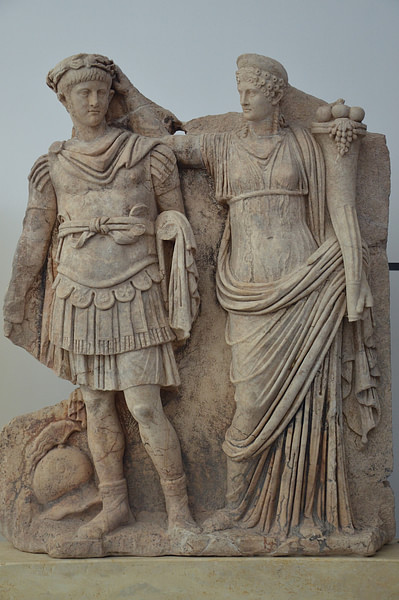 Nero and Agrippina Carole Raddato (CC BY-NC-SA) ](https://www.worldhistory.org/image/9911/nero-and-agrippina/ "Nero and Agrippina")Claudius' successor, Emperor Nero, is depicted as a man who treated Rome as if it were his home, especially after he built his Golden [Palace](https://www.worldhistory.org/disambiguation/palace/): he would often invite citizens to tour his palatial home and beautiful gardens. Tacitus wrote that Nero had been freed after the death, which he orchestrated, of his beloved mother Agrippina. Concerning the great fire of Rome in 64 CE and Nero's palace, Tacitus wrote:
> Nero at this time was at Antium, and did not return to Rome until the fire approached his house, which he had built to connect the palace with the gardens of Maecenas. ... Nero meanwhile availed himself of his country's desolation, and erected a mansion in which the jewels and [gold](https://www.worldhistory.org/gold/), long familiar objects, quite vulgarized by our extravagance, were not so marvelous as the fields and lakes... (377-379)
Unfortunately, Tacitus' discussion of Nero's death is lost.
### Conclusion
Throughout his works, Tacitus regrets the loss of the Republic and speaks of the decline of the empire which he attributes to the decay of the city's ever-growing decency - something his beloved Cicero saw in his own time. To explain the purpose of his works and show his respect for his fellow historians, he wrote:
> Much of what I have related and shall have to relate, may perhaps, I am aware, seem petty trifles to record. But no one must compare my annals with the writings of those who have described Rome in the old days. They told of great wars, the storming of [cities](https://www.worldhistory.org/city/), of the defeat and capture of kings, or whenever they turned by preference to home affairs … (my) labours, are circumscribed and inglorious; peace wholly unbroken or but slightly disturbed, dismal misery in the capital, an emperor careless about the enlargement of the empire, such is my theme. (162)
One historian, David Potter, said, however, that he was well aware of the freedom granted him to write as he pleased, something not available to those in the early years of imperial Rome.
#### Editorial Review
This human-authored definition has been reviewed by our editorial team before publication to ensure accuracy, reliability and adherence to academic standards in accordance with our [editorial policy](https://www.worldhistory.org/static/editorial-policy/).
## Bibliography
- [Beard, Mary. *SPQR.* Liveright, 2016.](https://www.worldhistory.org/books/1631492225/)
- [Hornblower, Simon & Spawforth, Antony & Eidinow, Esther. *The Oxford Classical Dictionary.* Oxford University Press, 2012.](https://www.worldhistory.org/books/0199545561/)
- Moses Hadas, ed. *The Complete Works of Tacitus.* Metro Books, 2007
- Nigel Rodgers. *Roman Emperors.* Metro Books, 2013
- [Potter, David. *The Emperors of Rome.* Metro Books, 2007.](https://www.worldhistory.org/books/1780877501/)
- [Strauss, Barry. *Ten Caesars.* Simon & Schuster, 2019.](https://www.worldhistory.org/books/145166883X/)
- Tacitus. *On Britain and Germany.* Penguin Books, 1965
- Tacitus. *The Annals of Imperial Rome.* Barnes and Noble, 1971
## About the Author
Donald has taught Ancient, Medieval and U.S. History at Lincoln College (Normal, Illinois)and has always been and will always be a student of history, ever since learning about Alexander the Great. He is eager to pass knowledge on to his students.
## Timeline
- **c. 56 CE - c. 118 CE**: Life of [Roman](https://www.worldhistory.org/disambiguation/Roman/) historian Publius Cornelius [Tacitus](https://www.worldhistory.org/tacitus/).
## Cite This Work
### APA
Wasson, D. L. (2020, June 02). Tacitus. *World History Encyclopedia*.
### Chicago
Wasson, Donald L.. "Tacitus." *World History Encyclopedia*, June 02, 2020. .
### MLA
Wasson, Donald L.. "Tacitus." *World History Encyclopedia*, 02 Jun 2020, .
## License & Copyright
Submitted by [Donald L. Wasson](https://www.worldhistory.org/user/DWasson/ "User Page: Donald L. Wasson"), published on 02 June 2020. The copyright holder has published this content under the following license: [Creative Commons Attribution-NonCommercial-ShareAlike](https://creativecommons.org/licenses/by-nc-sa/4.0/deed.en). This license lets others remix, tweak, and build upon this content non-commercially, as long as they credit the author and license their new creations under the identical terms. When republishing on the web a hyperlink back to the original content source URL must be included. Please note that content linked from this page may have different licensing terms.