---
title: Sphinx
author: Mark Cartwright
source: https://www.worldhistory.org/sphinx/
format: machine-readable-alternate
license: Creative Commons Attribution-NonCommercial-ShareAlike (https://creativecommons.org/licenses/by-nc-sa/4.0/)
updated: 1970-01-01
---
# Sphinx
_Authored by [Mark Cartwright](https://www.worldhistory.org/user/markzcartwright/)_
A sphinx is a mythical creature with the body of a lion, most often with a human head and sometimes with wings. The creature was an [Egyptian](https://www.worldhistory.org/disambiguation/Egyptian/) invention and had a male head - human or animal; however, in [Greek mythology](https://www.worldhistory.org/Greek_Mythology/), the creature had the head of a woman. The sphinx is also present in the art and [sculpture](https://www.worldhistory.org/disambiguation/Sculpture/) of the [Mycenaean](https://www.worldhistory.org/Mycenaean_Civilization/), Assyrian, Persian and Phoenician civilizations.
### Egyptian Sphinxes
Sphinxes were first created by the Egyptians and usually wore a *nemes* (head-dress) as worn by Pharaohs. Examples exist of sphinxes with human faces but surrounded by a lion's mane, particularly from Nubia, and in the [New Kingdom](https://www.worldhistory.org/disambiguation/New_Kingdom/) the head was sometimes that of a ram and representative of [Amun](https://www.worldhistory.org/amun/). The exact date when the first sphinx appeared is not known and the most famous sphinx of all, the [Great Sphinx of Giza](https://www.worldhistory.org/Great_Sphinx_of_Giza/), has not been precisely dated; some scholars date it as far back as the reign of Cheops, ca 2500 BCE. There is a story that in the Eighteenth Dynasty, [Pharaoh](https://www.worldhistory.org/pharaoh/) Thutmose IV, when he was a mere prince, went on a hunting expedition and fell asleep in the shadow of the Sphinx. Whilst asleep he dreamt that the Sphinx spoke to him and promised that he would become king if he cleared the sands that had accumulated around the feet of the statue. In the reign of Chephren, sphinxes became more widespread and they were usually placed as guards outside or beside a mortuary [temple](https://www.worldhistory.org/temple/), [tomb](https://www.worldhistory.org/tomb/) or funerary monument.
### [Minoan](https://www.worldhistory.org/disambiguation/Minoan/) & Mycenaean Sphinxes
Sphinxes were also present in the art of the Minoan and Mycenaean cultures from the early second millennium BC. The earliest examples are found on clay relief plaques used to decorate [pottery](https://www.worldhistory.org/pottery/) vessels and on beaten [gold](https://www.worldhistory.org/gold/) dress ornaments from Minoan [Crete](https://www.worldhistory.org/crete/). Later, three-dimensional sphinxes were similarly added to clay vessels and a surviving [fresco](https://www.worldhistory.org/disambiguation/Fresco/) from [Pylos](https://www.worldhistory.org/Pylos/) also depicted the mythical creature. In the 13th century BCE there are examples of pottery found in [Cyprus](https://www.worldhistory.org/cyprus/) (but probably manufactured on the [Greek](https://www.worldhistory.org/disambiguation/greek/) mainland) with painted sphinxes in silhouette, often in pairs and positioned heraldically. Sphinxes were also a popular subject for Mycenaean ivory carvings, usually in the form of plaques and small, lidded boxes.
[ 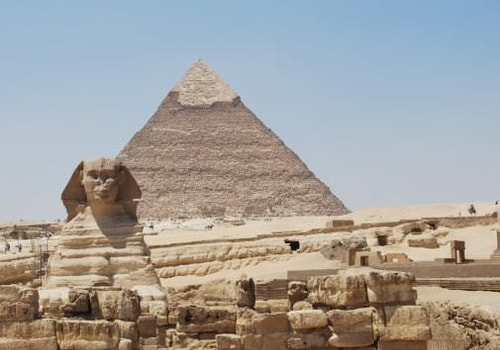 Sphinx and Khephren Pyramid carinemahy (Copyright) ](https://www.worldhistory.org/image/227/sphinx-and-khephren-pyramid/ "Sphinx and Khephren Pyramid")### Assyrian & Persian Sphinxes
The sphinx was also commonly represented in both Assyrian and [Persian art](https://www.worldhistory.org/Ancient_Persian_Art_and_Architecture/), usually with wings and a male human head. Large, sculpted sphinxes in the shape of winged bulls often stood in pairs outside palaces and guarded against evil forces. Such an example is the large sphinx presently in the British Museum which once stood outside the [palace](https://www.worldhistory.org/disambiguation/palace/) of [Ashurnasirpal II](https://www.worldhistory.org/Ashurnasirpal_II/) at [Nimrud](https://www.worldhistory.org/Kalhu/) (ca 865 BCE). [Persian architecture](https://www.worldhistory.org/Ancient_Persian_Art_and_Architecture/) often incorporated sphinxes in low-relief in walls and gates, examples from [Susa](https://www.worldhistory.org/susa/) (6th century BCE) and [Persepolis](https://www.worldhistory.org/persepolis/) (4th century BCE) depict male-headed sphinxes wearing divine horned headdresses.
### The Sphinx in Classical [Greece](https://www.worldhistory.org/greece/)
In contrast to the Egyptian view, the sphinx of Greek [mythology](https://www.worldhistory.org/mythology/) was a more troublesome creature and the most famous myth involving a sphinx is that of the Theban prince [Oedipus](https://www.worldhistory.org/Oedipus_the_King/): The territory of [Thebes](https://www.worldhistory.org/disambiguation/Thebes/) in Greece was terrorized by a sphinx and [Hesiod](https://www.worldhistory.org/hesiod/) tells us in his *[Theogony](https://www.worldhistory.org/Theogony/)* that the creature was born from the Chimaera (a fire-breathing monster with three heads and a body part lion, goat, snake and dragon) and was sister to the Nemean lion and half-sister of Kerberos (the three-headed dog that guarded [Hades](https://www.worldhistory.org/Hades/)). The sphinx created drought and famine and would only leave the Thebans alone if they solved her riddle. This was to define the creature that has two, three or four feet and although it is able to change its form, it moves slower the more feet it uses. Anyone who dared to answer the riddle and failed to do so correctly was killed and devoured by the sphinx. When the sphinx killed his son Haimon, Kreon, the king of Thebes became so desperate at the situation that he offered his kingdom and his daughter Iokaste to anyone who could answer the riddle. Oedipus took up the challenge and gave the correct answer —man— and in frustration and anger the sphinx leapt to her [death](https://www.worldhistory.org/disambiguation/Death/) from the [acropolis](https://www.worldhistory.org/Acropolis/) of Thebes. Scenes of the hero with the mythological creature are the most common depictions in art of the Oedipus myth and appeared from the 6th century BC on pottery, on carved gems and as a decorative device on fabrics.
[ 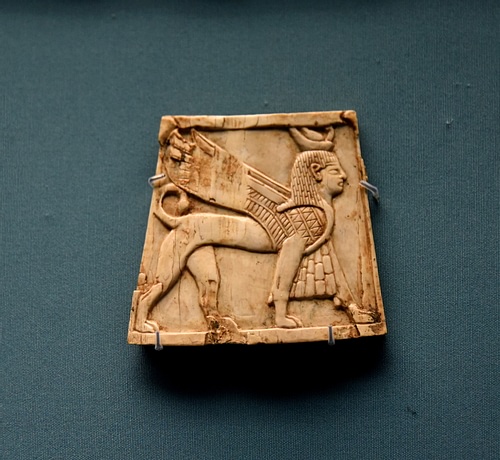 Nimrud Ivory Panel of a Winged Sphinx Osama Shukir Muhammed Amin (Copyright) ](https://www.worldhistory.org/image/5659/nimrud-ivory-panel-of-a-winged-sphinx/ "Nimrud Ivory Panel of a Winged Sphinx")In ancient [Greek culture](https://www.worldhistory.org/disambiguation/Greek_Culture/), the first sphinxes to appear in sculpture appeared from the 7th century BCE. These were made from clay and are particularly associated with Crete where moulded heads of sphinxes were sometimes added to pithoi. From the 6th century BCE, the Greek sphinx appeared in stone sculpture, sometimes with raised hind quarters. These sculptures were used as votive offerings, usually perched atop tall Ionic or Doric columns and placed at sanctuary sites such as [Delphi](https://www.worldhistory.org/delphi/) and [Olympia](https://www.worldhistory.org/Olympia/). Indeed, one of the most famous sphinxes was discovered at Delphi; originally sat on a 10m high Ionic [column](https://www.worldhistory.org/column/), it had been dedicated to the oracle by the Naxians around 560 BCE. In gratitude for the dedication, the priests of [Apollo](https://www.worldhistory.org/apollo/) gave citizens of [Naxos](https://www.worldhistory.org/Naxos/) the privilege of priority (*promanteia*) when consulting the oracle.
Sphinxes also commonly appeared atop funerary stelai and were usually brightly painted. A surviving example from Attica (around 540 BCE) displays traces of paint and would have originally had black hair, wing feathers in green, blue, black and red and breast scales in red and blue. Interestingly, when used in votive offerings the head always faced forwards whilst sphinxes on funerary stelai always faced sideways. A third use of the mythical creature, possibly borrowed from [Syria](https://www.worldhistory.org/syria/) or Cyprus, was as a decorative support base for carved stone water basins (*perirrhanteria*), which were used in sanctuaries.
Other famous depictions in art of sphinxes include the three which topped the crested helmet of the [Athena](https://www.worldhistory.org/athena/) Parthenos statue by Pheidias which stood in the [Parthenon](https://www.worldhistory.org/parthenon/) and the sphinxes which adorned the feet of the throne of [Zeus](https://www.worldhistory.org/zeus/) at Olympia.
#### Editorial Review
This human-authored definition has been reviewed by our editorial team before publication to ensure accuracy, reliability and adherence to academic standards in accordance with our [editorial policy](https://www.worldhistory.org/static/editorial-policy/).
## Bibliography
- [Boardman, J. *Greek Sculpture.* Thames & Hudson, 1985.](https://www.worldhistory.org/books/0500201633/)
- Carabatea. M. *Greek Mythology.* Pergamos, Peania, 2007
- [Carpenter, T.H. *Art and Myth in Ancient Greece.* Thames & Hudson, 2012.](https://www.worldhistory.org/books/B000EQ2DA0/)
- [Hesiod. *Hesiod.* Loeb Classical Library, 2007.](https://www.worldhistory.org/books/0674996224/)
- [Higgins, R. *Minoan and Mycenaean Art.* Thames & Hudson, 1997.](https://www.worldhistory.org/books/0500203032/)
- Hope Moncrieff. A.R. *Classical Mythology.* Senate, London, 1994
- Kolonia, R. *Delphi Archaeological Museum.* MOCARF, Athens, 2009
- [Montet, P. *Eternal Egypt.* Phoenix Press, 2012.](https://www.worldhistory.org/books/B008411722/)
## About the Author
Mark is WHE’s Publishing Director and has an MA in Political Philosophy (University of York). He is a full-time researcher, writer, historian and editor. Special interests include art, architecture and discovering the ideas that all civilizations share.
## Timeline
- **c. 2500 BCE**: The [Great Sphinx of Giza](https://www.worldhistory.org/Great_Sphinx_of_Giza/) is built.
- **1900 BCE - 1500 BCE**: Sphinxes are represented in [Minoan art](https://www.worldhistory.org/Minoan_Art/) in [pottery](https://www.worldhistory.org/pottery/), plaques and fabrics.
- **1500 BCE - 1200 BCE**: Sphinxes are represented in [Mycenaean art](https://www.worldhistory.org/Mycenaean_Art/), particularly in [pottery](https://www.worldhistory.org/pottery/) and ivory carving.
- **900 BCE - 800 BCE**: Surviving sphinxes from the Assyrian [civilization](https://www.worldhistory.org/civilization/), usually placed as guards outside palaces.
- **700 BCE - 600 BCE**: First appearance of sphinxes in ancient [Greek](https://www.worldhistory.org/disambiguation/greek/) art.
- **700 BCE - 300 BCE**: Sphinxes are represented in [Persian architecture](https://www.worldhistory.org/Ancient_Persian_Art_and_Architecture/) either as free standing [sculpture](https://www.worldhistory.org/disambiguation/Sculpture/) or in relief [wall](https://www.worldhistory.org/wall/) decoration.
- **c. 560 BCE**: [Naxos](https://www.worldhistory.org/Naxos/) dedicates a large [column](https://www.worldhistory.org/column/) and [sphinx](https://www.worldhistory.org/sphinx/) to the oracle of [Apollo](https://www.worldhistory.org/apollo/) at [Delphi](https://www.worldhistory.org/delphi/).
- **c. 550 BCE**: First appearance in ancient [Greek](https://www.worldhistory.org/disambiguation/greek/) art of sphinxes with raised hind quarters.
## Cite This Work
### APA
Cartwright, M. (2012, September 08). Sphinx. *World History Encyclopedia*.
### Chicago
Cartwright, Mark. "Sphinx." *World History Encyclopedia*, September 08, 2012. .
### MLA
Cartwright, Mark. "Sphinx." *World History Encyclopedia*, 08 Sep 2012, .
## License & Copyright
Submitted by [Mark Cartwright](https://www.worldhistory.org/user/markzcartwright/ "User Page: Mark Cartwright"), published on 08 September 2012. The copyright holder has published this content under the following license: [Creative Commons Attribution-NonCommercial-ShareAlike](https://creativecommons.org/licenses/by-nc-sa/4.0/deed.en). This license lets others remix, tweak, and build upon this content non-commercially, as long as they credit the author and license their new creations under the identical terms. When republishing on the web a hyperlink back to the original content source URL must be included. Please note that content linked from this page may have different licensing terms.