---
title: Sparta
author: Mark Cartwright
source: https://www.worldhistory.org/sparta/
format: machine-readable-alternate
license: Creative Commons Attribution-NonCommercial-ShareAlike (https://creativecommons.org/licenses/by-nc-sa/4.0/)
updated: 1970-01-01
---
# Sparta
_Authored by [Mark Cartwright](https://www.worldhistory.org/user/markzcartwright/)_
Sparta was one of the most important [city](https://www.worldhistory.org/city/)-states in ancient [Greece](https://www.worldhistory.org/greece/) and was famous for its military prowess. The professional and well-trained Spartan hoplites with their distinctive red cloaks and long hair were probably the best and most feared fighters in Greece, fighting with distinction at key battles against the Persian army at [Thermopylae](https://www.worldhistory.org/thermopylae/) and [Plataea](https://www.worldhistory.org/Plataea/) in the 5th century BCE.
The city of Sparta was also in constant rivalry with the other major [Greek](https://www.worldhistory.org/disambiguation/greek/) [cities](https://www.worldhistory.org/city/) of [Athens](https://www.worldhistory.org/Athens/) and [Corinth](https://www.worldhistory.org/corinth/) and became involved in two protracted and hugely damaging conflicts, the Peloponnesian Wars of the mid- to late-5th century BCE and the Corinthian Wars of in the early 4th century BCE.
### Sparta in [Mythology](https://www.worldhistory.org/mythology/)
In [Greek mythology](https://www.worldhistory.org/Greek_Mythology/) the founder of the ancient city was Lacedaemon, a son of [Zeus](https://www.worldhistory.org/zeus/), who gave his name to the region and his wife's name to the city. Sparta was also an important member of the Greek force which participated in the [Trojan War](https://www.worldhistory.org/Trojan_War/). Indeed, the Spartan king [Menelaus](https://www.worldhistory.org/Menelaus/) instigated the [war](https://www.worldhistory.org/disambiguation/War/) after the Trojan prince [Paris](https://www.worldhistory.org/disambiguation/paris/) abducted his wife [Helen](https://www.worldhistory.org/disambiguation/Helen/), offered to Paris by the goddess [Aphrodite](https://www.worldhistory.org/Aphrodite/) as a prize for choosing her in a beauty contest with fellow goddesses [Athena](https://www.worldhistory.org/athena/) and [Hera](https://www.worldhistory.org/Hera/). Helen was said to have been the most beautiful woman in Greece and [Spartan women](https://www.worldhistory.org/article/123/spartan-women/) in general enjoyed a reputation not only for good looks but also spirited independence.
### Establishing Regional Dominance
Sparta was located in the fertile Eurotas valley of Laconia in the southeast [Peloponnese](https://www.worldhistory.org/Peloponnese/). The area was first settled in the [Neolithic period](https://www.worldhistory.org/Neolithic/) and an important settlement developed in the [Bronze Age](https://www.worldhistory.org/disambiguation/Bronze_Age/). Archaeological evidence, however, suggests that Sparta itself was a new settlement created from the 10th century BCE.
In the late 8th century BCE, Sparta subjugated most of neighbouring Messenia and its population was made to serve Spartan interests. Sparta thus came to control some 8,500 km² of territory making the *[polis](https://www.worldhistory.org/Polis/)* or [city-state](https://www.worldhistory.org/Polis/) the largest in Greece and a major player in Greek politics. The conquered peoples of Messenia and Laconia, known as *perioikoi*, had no political rights in Sparta and were often made to serve with the Spartan army. A second and lower social group was the helots, semi-enslaved agricultural labourers who lived on Spartan-owned estates. Intermediary between the helots and the *perioikoi* were the liberated helots or *neodamōdeis*. Spartan citizens did not indulge in farming activities themselves but devoted their time to military training, hunting, war, and politics. The helots could keep a percentage of the produce they cultivated, but they were also regularly purged to keep them firmly in their social place and they could also be conscripted into military duties in times of war.
The relationship between citizens and helots was an uneasy one and there were sometimes uprisings, notably in the 7th century BCE which contributed to Sparta's defeat to [Argos](https://www.worldhistory.org/argos/) at Hysiae in 669 BCE. Sparta gained revenge on Argos in c. 545 BCE but then lost a [battle](https://www.worldhistory.org/disambiguation/battle/) with [Tegea](https://www.worldhistory.org/Tegea/) shortly after. This regional instability brought about the [Peloponnesian League](https://www.worldhistory.org/Peloponnesian_League/) (c. 505 to 365 BCE) which was a grouping of Corinth, Elis, Tegea, and other states (but never Argos), where each member swore to have the same enemies and allies as Sparta. Membership of the League did not necessitate the paying of tribute to Sparta but rather the provision of troops. The League would allow Sparta to establish hegemony over and dominate the Peloponnese until the 4th century BCE. In addition to local politics, from the 6th century BCE Sparta began to broaden her horizons by, for example, creating an alliance with [Croesus](https://www.worldhistory.org/croesus/) of [Lydia](https://www.worldhistory.org/lydia/) and sending an expedition against [Polycrates](https://www.worldhistory.org/Polycrates/) of [Samos](https://www.worldhistory.org/samos/) in c. 525 BCE.
### Rivalry with Athens, [Thebes](https://www.worldhistory.org/disambiguation/Thebes/) & Corinth
Sparta, under Cleomenes (c. 520-490 BCE), overthrew the tyrants of Athens but the resulting democracy put a stop to any Spartan ambitions in the city. Sparta was, however, an ally with Athens in the defence of Greece against the invasion of Persian king [Xerxes](https://www.worldhistory.org/Xerxes_I/), and fought with distinction at Thermopylae in 480 BCE and at Plataea one year later. From 480 to 460 BCE regional rivalries and revolts by the helots damaged Sparta and worse were to follow when rivalry with Athens developed into the Peloponnesian Wars from c. 460 to 446 BCE and again from 431 to 404 BCE. The long wars were damaging to both sides but Sparta, with some Persian help, finally won the conflict when [Lysander](https://www.worldhistory.org/Lysander/) destroyed the Athenian fleet at Aegospotami in 405 BCE. Sparta's position as the number one city-state in Greece, though, was to be short-lived.
[ 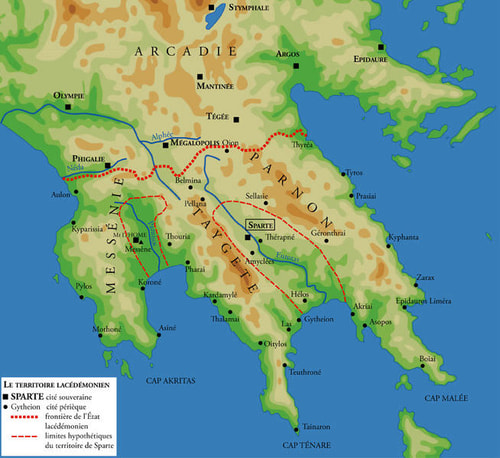 Spartan Territory Marsyas (CC BY-SA) ](https://www.worldhistory.org/image/2143/spartan-territory/ "Spartan Territory")Continued Spartan ambitions in central and northern Greece, [Asia Minor](https://www.worldhistory.org/Asia_Minor/), and [Sicily](https://www.worldhistory.org/sicily/) once again dragged the city into another protracted conflict, the Corinthian Wars with Athens, Thebes, Corinth, and [Persia](https://www.worldhistory.org/Persia/) from 396 to 387 BCE. The result of the conflict was the 'King's Peace' where Sparta ceded her [empire](https://www.worldhistory.org/empire/) (for which she in any case lacked the necessary bureaucratic apparatus to manage properly) to Persian control but Sparta was left to dominate Greece. However, trying to crush Thebes, Sparta lost the crucial [battle of Leuctra](https://www.worldhistory.org/Battle_of_Leuctra/) in 371 BCE against the brilliant Theban general [Epaminondas](https://www.worldhistory.org/Epaminondas/). Thebes then annexed parts of Messenia and Sparta became thereafter only a second-rate power.
After briefly challenging Macedonian control in the 3rd century BCE and being besieged by [Pyrrhus](https://www.worldhistory.org/pyrrhus/) in 272 BCE, Sparta never regained her former glory and she was compelled to join the Achaean Confederacy in 195 BCE. Under [Roman](https://www.worldhistory.org/disambiguation/Roman/) control Sparta was permitted to leave the confederacy in 147 BCE which prompted the Achaean War. However, as a free city in the Roman world things did improve for Sparta, and the city enjoyed good relations with her conquerors but the end finally came for Sparta in 396 CE when the [Visigoth](https://www.worldhistory.org/visigoth/) king [Alaric](https://www.worldhistory.org/Alaric/) sacked the city.
### Government
The Spartan political system was unusual in that it had two hereditary kings from two separate families. These monarchs were particularly powerful when one of them led the army on campaign. The kings were also priests of Zeus and they sat on the council of elders known as the *gerousia*. This body consisted of 28 over-60 years of age males who held the position for life. The *gerousia* led the citizen assembly, probably proposing issues on which to vote and it was also the highest court in Sparta. The assembly (Ekklēsia) met once a month and was open to all citizens who voted by the simple method of shouting. There was also an executive committee of five ephors (*ephoroi*) chosen by lot from the citizen body, able only to serve for a maximum of one year and who were ineligible for future office. Two of the ephors also accompanied one of the kings when on campaign. Just how these different political elements interacted is not known for certain but clearly a degree of consensus was necessary for the state apparatus to function. It may also explain Sparta's reputation as being a conservative state slow to make decisions in foreign policy.
[  Spartan Silver Tetradrachm Mark Cartwright (CC BY-NC-SA) ](https://www.worldhistory.org/image/841/spartan-silver-tetradrachm/ "Spartan Silver Tetradrachm")### Society
Like all Greek societies Sparta was dominated by male citizens and the most powerful of those came from a select group of families. These were the landed aristocracy, and following reforms credited to [Lycurgus](https://www.worldhistory.org/Lycurgus/) in the 6th century BCE (or even earlier), citizens could not indulge in agricultural activities - this was the lot of the helots - but they had to devote themselves to athletic and military training and politics. Helots could not own property and so could not rise to become full-citizens, and this lack of social mobility would come back to haunt Sparta in later centuries. Reduced by constant wars in the 5th and 4th centuries BCE, the Spartan hoplites (*homoioi*) became dangerously small in number (8,000 in 490 BCE to 700 in 371 BCE), so much so, that non-Spartiate soldiers had to be enlisted and their loyalty and interest in Sparta's ambitions was questionable.
Women in the Sparta city-state had a better lot than in other Greek cities. Spartan women could own property which they often gained through dowries and inheritances. In fact, Spartan women became amongst the richest members of society, as their men were killed in the many wars, and eventually controlled 2/5th of Spartan land. In addition, Spartan women could also move around with reasonable freedom, they could enjoy athletics (done in the nude like men), and even drink wine. All of these freedoms would have been unacceptable in other Greek *[poleis](https://www.worldhistory.org/Polis/)*.
There were foreigners (*xenoi*) in Spartan society but these were not as welcome as in other city-states, and those that did live in Sparta were sometimes forcibly expelled by their overly suspicious and at times positively paranoid hosts.
[  Leonidas Marie-Lan Nguyen (CC BY-SA) ](https://www.worldhistory.org/image/1211/leonidas/ "Leonidas")### Spartan Army
For all Spartan citizens there was a strong emphasis on military training and frugal living in communal mess halls where simple food such as barley meal, cheese, figs and wine were the norm. From the age of seven, males had a militaristic upbringing known as the *agōgē* where they were separated into age groups and lived in barracks. These youths pursued rigorous athletic and military training which became even more demanding from the age of 20, when they joined common mess halls (*syssition*) where they often formed homoerotic relations with older, more experienced citizens. This tough training resulted in a professional [hoplite](https://www.worldhistory.org/hoplite/) army capable of relatively sophisticated battle manoeuvres and made them feared throughout Greece, a fact perhaps evidenced by Sparta's notable lack of fortifications for most of its history.
A peculiar feature of the Spartans and their military was the great importance given to matters of [religion](https://www.worldhistory.org/religion/). As [Herodotus](https://www.worldhistory.org/herodotus/) put it, they 'considered the things of the gods more weighty than the things of men'. Pre- and post-battle sacrifices were a common feature of [Greek warfare](https://www.worldhistory.org/Greek_Warfare/) in general but the Spartan army took things one step further and sacrificed before crossing rivers, for example, and even withheld from mobilising the army if an important religious festival was ongoing. Famous episodes where the Spartans put religion above [warfare](https://www.worldhistory.org/warfare/) and even national crisis were at [Marathon](https://www.worldhistory.org/marathon/) and Thermopylae during the Greco-[Persian Wars](https://www.worldhistory.org/Persian_Wars/). In the former battle, the Spartan soldiers arrived too late to assist the other Greek cities and in the latter mobilised only a token force as they felt compelled to first celebrate the Karneia festival in honour of [Apollo](https://www.worldhistory.org/apollo/).
The Spartan hoplite army, however, showed the rest of Greece the way forward towards a greater military professionalism and considering the iconic image of fearless and disciplined hoplites with red cloaks and lambda-emblazoned shields, for the Greeks, admiring Romans and even 21st century film-goers, this is Sparta.
#### Editorial Review
This human-authored definition has been reviewed by our editorial team before publication to ensure accuracy, reliability and adherence to academic standards in accordance with our [editorial policy](https://www.worldhistory.org/static/editorial-policy/).
## Bibliography
- Boys-Stones et al. *The Oxford Handbook of Hellenic Studies.* OUP, Oxford, 2012
- [Campbell, B. (ed). *The Oxford Handbook of Warfare in the Classical World.* Oxford University Press, USA, 2013.](https://www.worldhistory.org/books/0195304659/)
- [Fields, N. *Thermopylae 480 BC.* Osprey Publishing, 2007.](https://www.worldhistory.org/books/184176180X/)
- Herodotus. *The Histories (trans. A. De Sélincourt ).* Penguin, London, 2003
- [Hornblower, S. *The Oxford Classical Dictionary.* Oxford University Press, USA, 2012.](https://www.worldhistory.org/books/0199545561/)
- [Kinzl, K.H. (ed). *A Companion to the Classical Greek World.* Wiley-Blackwell, 2010.](https://www.worldhistory.org/books/1444334123/)
- [Thucydides. *The Landmark Thucydides.* Free Press, 2013.](https://www.worldhistory.org/books/B009CV7U3S/)
## About the Author
Mark is WHE’s Publishing Director and has an MA in Political Philosophy (University of York). He is a full-time researcher, writer, historian and editor. Special interests include art, architecture and discovering the ideas that all civilizations share.
## Timeline
- **c. 900 BCE**: [Sparta](https://www.worldhistory.org/sparta/) is founded.
- **706 BCE**: [Sparta](https://www.worldhistory.org/sparta/) founds the colony of [Tarentum](https://www.worldhistory.org/tarentum/) in [Magna Graecia](https://www.worldhistory.org/Magna_Graecia/).
- **c. 700 BCE**: [Sparta](https://www.worldhistory.org/sparta/), [Argos](https://www.worldhistory.org/argos/) and [Paros](https://www.worldhistory.org/Paros/) hold the first documented musical competitions in [Greece](https://www.worldhistory.org/greece/).
- **c. 650 BCE**: [Sparta](https://www.worldhistory.org/sparta/) crushes Messenian revolt.
- **c. 550 BCE - c. 366 BCE**: [Peloponnesian League](https://www.worldhistory.org/Peloponnesian_League/) alliance between [Sparta](https://www.worldhistory.org/sparta/), [Corinth](https://www.worldhistory.org/corinth/), Elis and [Tegea](https://www.worldhistory.org/Tegea/) which establishes Spartan hegemony over the [Peloponnese](https://www.worldhistory.org/Peloponnese/).
- **c. 545 BCE**: [Sparta](https://www.worldhistory.org/sparta/) takes control of Thyrea from [Argos](https://www.worldhistory.org/argos/).
- **525 BCE**: [Sparta](https://www.worldhistory.org/sparta/) and [Corinth](https://www.worldhistory.org/corinth/) unsuccessfully attack [Polycrates](https://www.worldhistory.org/Polycrates/) of [Samos](https://www.worldhistory.org/samos/).
- **494 BCE - 493 BCE**: Spartan forces under Cleomenes I attack the [city](https://www.worldhistory.org/city/) of [Argos](https://www.worldhistory.org/argos/).
- **494 BCE - 493 BCE**: [Telesilla of Argos](https://www.worldhistory.org/Telesilla_of_Argos/) defends her [city](https://www.worldhistory.org/city/) against the Spartan forces with an army of [women](https://www.worldhistory.org/disambiguation/women/).
- **c. 490 BCE**: [Leonidas](https://www.worldhistory.org/disambiguation/Leonidas/) beomes one of [Sparta](https://www.worldhistory.org/sparta/)'s two kings.
- **480 BCE**: [Pausanias](https://www.worldhistory.org/disambiguation/Pausanias/) is made regent of [Sparta](https://www.worldhistory.org/sparta/) for his young cousin Pleistarchus.
- **Aug 480 BCE**: [Battle of Thermopylae](https://www.worldhistory.org/thermopylae/). 300 Spartans under King [Leonidas](https://www.worldhistory.org/disambiguation/Leonidas/) and other [Greek](https://www.worldhistory.org/disambiguation/greek/) allies hold back the Persians led by [Xerxes I](https://www.worldhistory.org/Xerxes_I/) for three days but are defeated.
- **479 BCE**: [Xerxes](https://www.worldhistory.org/Xerxes_I/)' Persian forces are defeated by [Greek](https://www.worldhistory.org/disambiguation/greek/) forces at [Plataea](https://www.worldhistory.org/Plataea/) effectively ending [Persia](https://www.worldhistory.org/Persia/)'s imperial ambitions in [Greece](https://www.worldhistory.org/greece/).
- **478 BCE**: [Sparta](https://www.worldhistory.org/sparta/) withdraws from alliance against [Persia](https://www.worldhistory.org/Persia/).
- **c. 475 BCE**: Athenian general [Cimon](https://www.worldhistory.org/cimon/) defeats Spartan general [Pausanias](https://www.worldhistory.org/disambiguation/Pausanias/) and takes [Byzantium](https://www.worldhistory.org/Byzantium/).
- **c. 471 BCE**: Spartan general [Pausanias](https://www.worldhistory.org/disambiguation/Pausanias/) is put on trial for the second time with a charge of treason but is acquitted for a second time.
- **464 BCE - 463 BCE**: [Earthquake](https://www.worldhistory.org/disambiguation/earthquake/) in [Sparta](https://www.worldhistory.org/sparta/), followed by slave revolt. Surrender of Thasos.
- **460 BCE - 445 BCE**: First [Peloponnesian War](https://www.worldhistory.org/Peloponnesian_War/).
- **457 BCE**: [Sparta](https://www.worldhistory.org/sparta/) wins the [battle](https://www.worldhistory.org/disambiguation/battle/) of Tanagra during the 1st [Peloponnesian War](https://www.worldhistory.org/Peloponnesian_War/) with [Athens](https://www.worldhistory.org/Athens/).
- **451 BCE**: [Sparta](https://www.worldhistory.org/sparta/) and [Argos](https://www.worldhistory.org/argos/) sign a peace treaty which endures for the next 30 years.
- **432 BCE**: [Sparta](https://www.worldhistory.org/sparta/) declares that [Athens](https://www.worldhistory.org/Athens/) has broken the Thirty Year Peace and prepares for [war](https://www.worldhistory.org/disambiguation/War/).
- **431 BCE - 404 BCE**: The 2nd [Peloponnesian War](https://www.worldhistory.org/Peloponnesian_War/) between [Athens](https://www.worldhistory.org/Athens/) and [Sparta](https://www.worldhistory.org/sparta/) (the [Delian League](https://www.worldhistory.org/Delian_League/) and the [Peloponnesian League](https://www.worldhistory.org/Peloponnesian_League/)) which involved all of [Greece](https://www.worldhistory.org/greece/).
- **431 BCE - 404 BCE**: [Thebes](https://www.worldhistory.org/disambiguation/Thebes/) sides with [Sparta](https://www.worldhistory.org/sparta/) against [Athens](https://www.worldhistory.org/Athens/) in the [Peloponnesian War](https://www.worldhistory.org/Peloponnesian_War/).
- **430 BCE - c. 354 BCE**: Life of [Xenophon](https://www.worldhistory.org/xenophon/) of [Athens](https://www.worldhistory.org/Athens/).
- **429 BCE**: Peloponnesian forces led by [Sparta](https://www.worldhistory.org/sparta/) begin the siege of [Plataea](https://www.worldhistory.org/Plataea/).
- **429 BCE**: Following attacks by [Sparta](https://www.worldhistory.org/sparta/), fortifications at the port of [Piraeus](https://www.worldhistory.org/Piraeus/) are extended to reduce the width of the harbour entrances.
- **427 BCE**: [Plataea](https://www.worldhistory.org/Plataea/) finally falls to the Spartans after a two year siege.
- **425 BCE**: [Pylos](https://www.worldhistory.org/Pylos/) campaign, under Cleon and [Demosthenes](https://www.worldhistory.org/Demosthenes/)' command [Athens](https://www.worldhistory.org/Athens/) defeats [Sparta](https://www.worldhistory.org/sparta/) at Pylos.
- **424 BCE**: Spartan [Brasidas](https://www.worldhistory.org/Brasidas/)' campaign in Thrace.
- **424 BCE**: Spartan general [Brasidas](https://www.worldhistory.org/Brasidas/) takes [Amphipolis](https://www.worldhistory.org/Amphipolis/), [Thucydides](https://www.worldhistory.org/Thucydides/) failed to prevent this and is exiled.
- **424 BCE**: A force of Athenian peltasts defeat Spartan hoplites on Sphaktria in the [Peloponnese](https://www.worldhistory.org/Peloponnese/).
- **424 BCE - 420 BCE**: The [Nike](https://www.worldhistory.org/nike/) of Paionios is erected at [Olympia](https://www.worldhistory.org/Olympia/) to commemorate the Messenian and Naupaktian victory over [Sparta](https://www.worldhistory.org/sparta/) at the [battle](https://www.worldhistory.org/disambiguation/battle/) of Sphakteria.
- **422 BCE**: Spartan general [Brasidas](https://www.worldhistory.org/Brasidas/) dies of his wounds at [Amphipolis](https://www.worldhistory.org/Amphipolis/).
- **422 BCE**: Spartan general [Brasidas](https://www.worldhistory.org/Brasidas/) employs Myrkinian and Chalkidian peltasts to defeat a force of Athenian hoplites at [Amphipolis](https://www.worldhistory.org/Amphipolis/).
- **421 BCE**: Spartan soldiers return from campaigning Thrace, some as [Neodamodeis](https://www.worldhistory.org/Neodamodeis/).
- **420 BCE**: [Sparta](https://www.worldhistory.org/sparta/) is excluded from the [Olympic Games](https://www.worldhistory.org/Olympic_Games/) for breaking the *ekecheiria* or sacred truce.
- **418 BCE**: [Sparta](https://www.worldhistory.org/sparta/), led by Agis II, defeats [Argos](https://www.worldhistory.org/argos/) and her allies at the [battle](https://www.worldhistory.org/disambiguation/battle/) of Mantinaea.
- **413 BCE**: On the advice of [Alcibiades](https://www.worldhistory.org/Alcibiades/) the Spartans take over the Athenian-held fort of Dekeleia.
- **412 BCE**: The Spartan general Astyochus sacks [Kos](https://www.worldhistory.org/Kos/).
- **c. 412 BCE**: [Rhodes](https://www.worldhistory.org/Rhodes/) revolts against [Athens](https://www.worldhistory.org/Athens/) and supports [Sparta](https://www.worldhistory.org/sparta/) in the [Peloponnesian War](https://www.worldhistory.org/Peloponnesian_War/).
- **412 BCE**: [Sparta](https://www.worldhistory.org/sparta/) allies with [Persia](https://www.worldhistory.org/Persia/).
- **410 BCE**: [Alcibiades](https://www.worldhistory.org/Alcibiades/) leads the Athenian fleet to victory over [Sparta](https://www.worldhistory.org/sparta/) at Cyzicus.
- **c. 408 BCE**: [Lysander](https://www.worldhistory.org/Lysander/) is first made an admiral of the Spartan fleet.
- **c. 407 BCE**: The Athenian fleet is defeated by [Lysander](https://www.worldhistory.org/Lysander/) of [Sparta](https://www.worldhistory.org/sparta/) at Notium.
- **404 BCE**: Spartan general [Lysander](https://www.worldhistory.org/Lysander/) attacks the Athenian port of [Piraeus](https://www.worldhistory.org/Piraeus/) destroying parts of the Long [Wall](https://www.worldhistory.org/wall/) fortifications.
- **404 BCE**: End of the [Peloponnesian war](https://www.worldhistory.org/Peloponnesian_War/), [Athens](https://www.worldhistory.org/Athens/) defeated By [Sparta](https://www.worldhistory.org/sparta/) at Aigospotamoi, Rule of [the Thirty Tyrants](https://www.worldhistory.org/The_Thirty_Tyrants/) in Athens.
- **c. 398 BCE**: [Xenophon](https://www.worldhistory.org/xenophon/) works as mercenary for [Sparta](https://www.worldhistory.org/sparta/).
- **396 BCE**: Spartan [Agesilaus II](https://www.worldhistory.org/Agesilaus_II/)'s campaign into [Ionia](https://www.worldhistory.org/ionia/).
- **395 BCE**: Spartan general [Lysander](https://www.worldhistory.org/Lysander/) is killed by Theban forces at the [Battle](https://www.worldhistory.org/disambiguation/battle/) of Hallartos.
- **395 BCE - 386 BCE**: The Corinthian Wars between [Sparta](https://www.worldhistory.org/sparta/) and an alliance of [Athens](https://www.worldhistory.org/Athens/), [Corinth](https://www.worldhistory.org/corinth/), [Argos](https://www.worldhistory.org/argos/), Boeotia and [Thebes](https://www.worldhistory.org/disambiguation/Thebes/).
- **390 BCE**: Athenian leader Iphikrates employs peltasts to defeat Spartan hoplites at Lechaion near [Corinth](https://www.worldhistory.org/corinth/).
- **387 BCE**: [Sparta](https://www.worldhistory.org/sparta/) attacks the Athenian port of [Piraeus](https://www.worldhistory.org/Piraeus/).
- **382 BCE - 379 BCE**: [Sparta](https://www.worldhistory.org/sparta/) establishes a garrison at [Thebes](https://www.worldhistory.org/disambiguation/Thebes/).
- **c. 379 BCE**: [Pelopidas](https://www.worldhistory.org/Pelopidas/) removes the Spartan garrison from the Theban [acropolis](https://www.worldhistory.org/Acropolis/).
- **378 BCE - 377 BCE**: Spartan king [Agesilaus II](https://www.worldhistory.org/Agesilaus_II/) campaigns in Boeotia.
- **377 BCE - 355 BCE**: The Cycladic [city](https://www.worldhistory.org/city/) states join [Athens](https://www.worldhistory.org/Athens/) in the Second Athenian League against [Sparta](https://www.worldhistory.org/sparta/) .
- **375 BCE**: [Thebes](https://www.worldhistory.org/disambiguation/Thebes/) defeats [Sparta](https://www.worldhistory.org/sparta/) at the [Battle](https://www.worldhistory.org/disambiguation/battle/) of Tegyra.
- **371 BCE**: [Thebes](https://www.worldhistory.org/disambiguation/Thebes/), led by [Epaminondas](https://www.worldhistory.org/Epaminondas/), defeats [Sparta](https://www.worldhistory.org/sparta/) in the [Battle of Leuctra](https://www.worldhistory.org/Battle_of_Leuctra/).
- **367 BCE**: [Celtic](https://www.worldhistory.org/celt/) mercenaries fight with the Spartans against [Thebes](https://www.worldhistory.org/disambiguation/Thebes/).
- **362 BCE**: Indecisive [Battle](https://www.worldhistory.org/disambiguation/battle/) of Matinea where [Thebes](https://www.worldhistory.org/disambiguation/Thebes/) fought against [Sparta](https://www.worldhistory.org/sparta/) and [Athens](https://www.worldhistory.org/Athens/). Theban general [Epaminondas](https://www.worldhistory.org/Epaminondas/) is killed.
- **295 BCE**: Demetrius I campaigns in central [Greece](https://www.worldhistory.org/greece/), removes the tyrant Lachares from [Athens](https://www.worldhistory.org/Athens/) and defeats [Sparta](https://www.worldhistory.org/sparta/).
- **273 BCE**: [Pyrrhus](https://www.worldhistory.org/pyrrhus/) of Epirus attacks [Macedon](https://www.worldhistory.org/macedon/) and [Sparta](https://www.worldhistory.org/sparta/).
- **222 BCE**: The [Achaean League](https://www.worldhistory.org/Achaean_League/) and [Antigonos](https://www.worldhistory.org/disambiguation/Antigonos/) III of [Macedon](https://www.worldhistory.org/macedon/) defeat [Sparta](https://www.worldhistory.org/sparta/) at Sellasia.
- **267 CE**: The [Goths](https://www.worldhistory.org/Goths/) sack [Athens](https://www.worldhistory.org/Athens/), [Corinth](https://www.worldhistory.org/corinth/), [Sparta](https://www.worldhistory.org/sparta/), and [Argos](https://www.worldhistory.org/argos/).
- **396 CE**: [Sparta](https://www.worldhistory.org/sparta/) is sacked by the [Visigoths](https://www.worldhistory.org/visigoth/) led by [Alaric](https://www.worldhistory.org/Alaric/).
## External Links
- [This is Sparta: Fierce warriors of the ancient world - Craig Zimmer](http://ed.ted.com/lessons/this-is-sparta-fierce-warriors-of-the-ancient-world-craig-zimmer)
- [In Our Time, Sparta](https://www.bbc.co.uk/programmes/b00nvz72)
- [Art and Craft in Archaic Sparta | Essay | The Metropolitan Museum of Art | Heilbrunn Timeline of Art History](https://www.metmuseum.org/toah/hd/spar/hd_spar.htm)
## Cite This Work
### APA
Cartwright, M. (2013, May 28). Sparta. *World History Encyclopedia*.
### Chicago
Cartwright, Mark. "Sparta." *World History Encyclopedia*, May 28, 2013. .
### MLA
Cartwright, Mark. "Sparta." *World History Encyclopedia*, 28 May 2013, .
## License & Copyright
Submitted by [Mark Cartwright](https://www.worldhistory.org/user/markzcartwright/ "User Page: Mark Cartwright"), published on 28 May 2013. The copyright holder has published this content under the following license: [Creative Commons Attribution-NonCommercial-ShareAlike](https://creativecommons.org/licenses/by-nc-sa/4.0/deed.en). This license lets others remix, tweak, and build upon this content non-commercially, as long as they credit the author and license their new creations under the identical terms. When republishing on the web a hyperlink back to the original content source URL must be included. Please note that content linked from this page may have different licensing terms.