---
title: Pottery in Antiquity
author: Cristian Violatti
source: https://www.worldhistory.org/pottery/
format: machine-readable-alternate
license: Creative Commons Attribution-NonCommercial-ShareAlike (https://creativecommons.org/licenses/by-nc-sa/4.0/)
updated: 1970-01-01
---
# Pottery in Antiquity
_Authored by [Cristian Violatti](https://www.worldhistory.org/user/violatti/)_
Pottery is the first synthetic material ever created by humans. The term refers to objects made of clay that have been fashioned into the desired shape, dried, and either fired or baked to fix their form. Due to its abundance and durability, pottery is one of the most common types of items found by archaeologists during excavations, and it has the potential of providing valuable information about the human past.
### Early Development of Pottery
Clay is abundant, cheap, and adaptable, which makes it convenient for human exploitation. Because usable clay is widely available, pottery was independently invented in many parts of the world at different times. The earliest recorded evidence of clay usage dates back to the Late Palaeolithic period in central and western [Europe](https://www.worldhistory.org/europe/), where fired and unfired clay figurines were created as a form of artistic expression. As early as 30,000 years ago, we can also see evidence of some experimentation with clay: at a site known as Dolni Vestonice (Czech Republic), figurines made of clay mixed with crushed mammoth bone were found.
The oldest evidence of pottery manufacture has been found at an archaeological site known as Odai Yamamoto, in [Japan](https://www.worldhistory.org/disambiguation/Japan/), where fragments from a specific vessel have been dated to about 16,500-14,920 years ago. Non-agricultural peoples of [Jomon Period](https://www.worldhistory.org/Jomon_Period/) Japan were producing clay pots used for food preparation that were elaborately decorated by about 13,000 years ago.
Although there is not necessarily a causal relationship between a sedentary way of life and pottery-making, the introduction of pottery generally coincides with the adoption of an agricultural lifestyle, when durable and strong vessels and containers are needed. Initially, pottery was made in open fires. However, during the Early [Neolithic](https://www.worldhistory.org/Neolithic/) era, around 8,000 BCE, special ovens used to parch cereal grains and to bake bread were being built in the [Near East](https://www.worldhistory.org/Near_East/), which allowed people to control fire and produce high temperatures in enclosed facilities. The use of ovens added new possibilities to the development of pottery. Around the same time, some areas of South America were also developing pottery technology.
### Technical Sophistication in Pottery Production
Open firing techniques were used to produce the earliest pottery. Through this method, temperatures could range from about 600 to about 800-900 degrees Celsius, which are relatively low temperatures. Japanese [Jomon pottery](https://www.worldhistory.org/Jomon_Pottery/) (dated back to 13,000 years ago) and Middle [Nile](https://www.worldhistory.org/nile/) [Egyptian](https://www.worldhistory.org/disambiguation/Egyptian/) vessels (from about 10,000 years ago) are some examples of pottery produced using this technique.
[ 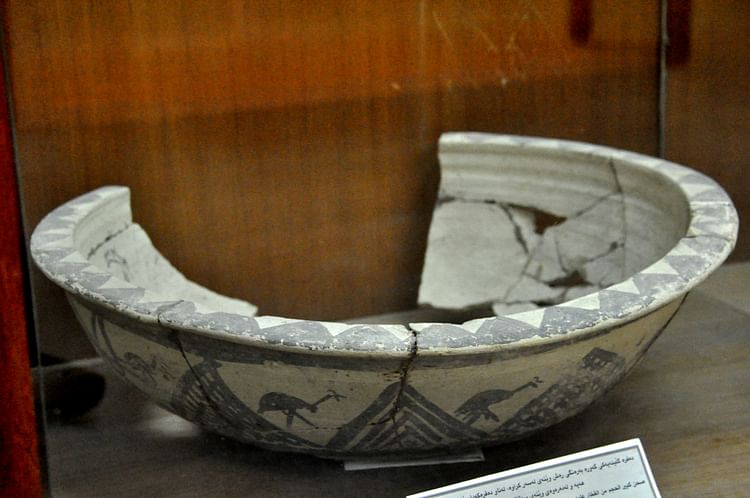 Pottery Dish from Uruk Period Osama Shukir Muhammed Amin (Copyright) ](https://www.worldhistory.org/image/2823/pottery-dish-from-uruk-period/ "Pottery Dish from Uruk Period")Firing pottery in a kiln is another method of pottery production. Enclosing the pottery inside a chamber results in key advantages: the temperatures that can be achieved are higher, last longer, and the heat can be controlled more efficiently. The simplest forms of kilns are pit kilns, which is a pit fire installation where the fuel is placed at the bottom, followed by the pottery, and more fuel in the upper layer. Another type of kiln is an updraft kiln, which is usually a cylindrical construction divided into two compartments: the lower compartment is where the fuel is placed, while the pottery is placed in the upper compartment. This allows the heat to rise and the pottery is fired at a temperature level normally ranging from 1,000 to 1,200 degrees Celsius.
In ancient [China](https://www.worldhistory.org/china/), firing techniques allowed temperatures of about 1300-1400 degrees Celsius and even higher in some cases. At these temperatures, the mineral components of clay melt, resulting in a thin, translucent, white vitrified type of ceramic that is known as porcelain. Not all types of clay can stand temperatures this high - only some special types of clay which are largely free of impurities.
In some cases, the overall color of the pottery can be changed from its natural reddish to gray without the need of pigments, merely by manipulating the temperature and air influx in the kiln during the firing process. This type of knowledge is usually the last step in a long sequence of experimentation, an indication that pottery production in that specific society was not new, and it probably had been developing for several thousand years.
[  Moche Ceramic Portrait Patrick Charpiat (CC BY) ](https://www.worldhistory.org/image/2938/moche-ceramic-portrait/ "Moche Ceramic Portrait")### Dating Pottery & Archaeological Sites
According to the context in which the pottery was found, there are several techniques that can be applied for dating pottery. Pottery can be dated based on a stratigraphic sequence: this means that during an excavation, archaeologists study the different layers of soil and analyse how the different objects found in them relate to one another. If the layers are undisturbed, then objects found in the lower layers are older than those located in the upper layers. Some of these objects can be dated independently: radiocarbon dating can be applied to human and animal remains and even to charcoal. Pottery fragments may be found, for example, on the same layer where a piece of charcoal is found, and the radiocarbon dates obtained for the charcoal can be extended to the pottery fragments, which provide us with an approximate date for the pottery.
If the pottery fragments found belong to a well-known pottery type (e.g. Chinese or [Greek pottery](https://www.worldhistory.org/Greek_Pottery/), which have been widely studied), then dating can be based on what is known as a typological sequence. There are well-established pottery typological systems for most regions of the world: changes in the surface decoration styles and in the shape of the vessels are normally gradual, so when a pottery fragment can be related to a well-known pottery typology, it provides a basis to assign a date to the piece.
[ 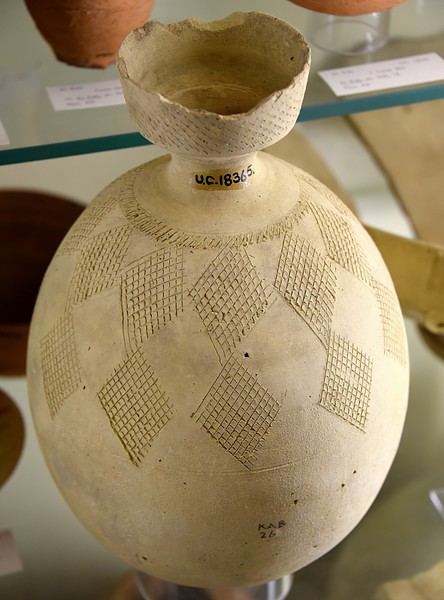 Egyptian Balla Pottery Osama Shukir Muhammed Amin (Copyright) ](https://www.worldhistory.org/image/4765/egyptian-balla-pottery/ "Egyptian Balla Pottery")Another method than can be applied to date pottery is called thermoluminiscence. This dating method can applied to pottery and other ceramic materials that have been fired and buried in the ground. Thermoluminiscence is often used when no other method is available, mainly because there are restrictions to its application, and its precision is rarely better than +/- 10% of the age of the sample.
Pottery can be used to date archaeological sites. This is especially important at sites where written records cannot offer chronological references, either because they cannot be found or because they remain undeciphered. A famous example is on the island of [Crete](https://www.worldhistory.org/crete/), where Arthur Evans was able to date the excavation of the [Palace](https://www.worldhistory.org/disambiguation/palace/) of [Knossos](https://www.worldhistory.org/knossos/) based on imported Egyptian artefacts that were found there, including pottery, allowing the researchers to extend the Egyptian chronology to Crete. This brings us to another important aspect of pottery: it can provide evidence of [trade](https://www.worldhistory.org/disambiguation/trade/) and exchange networks. During the excavations on Crete, Arthur Evans also proved trade and cultural links between Crete and [Egypt](https://www.worldhistory.org/egypt/) on the basis that Egyptian artefacts were found in Crete and also Cretan pottery was identified in Egypt.
Pottery can be analysed on the basis of several features: shape, type of surface, the colours, drawing patterns, and decorative styles. All these elements, studied in detail for each particular [culture](https://www.worldhistory.org/disambiguation/culture/) and time, can help to understand the artistic development of a society and may also enable specialists to identify pottery fragments when they are found in places far away from their production centre, reflecting trade activity and exchange networks.
#### Editorial Review
This human-authored definition has been reviewed by our editorial team before publication to ensure accuracy, reliability and adherence to academic standards in accordance with our [editorial policy](https://www.worldhistory.org/static/editorial-policy/).
## Bibliography
- [Henderson, J. *The Science and Archaeology of Materials.* Routledge, 2001.](https://www.worldhistory.org/books/0415199344/)
- [Renfrew, C. *Archaeology.* Thames & Hudson, 2012.](https://www.worldhistory.org/books/050028976X/)
- [Rice, P. *Pottery Analysis.* University Of Chicago Press, 2006.](https://www.worldhistory.org/books/0226711161/)
- [Timothy D. *Concise Oxford Dictionary of Archaeology.* Oxford University Press, 2008.](https://www.worldhistory.org/books/0199534047/)
- [Wright, R. *The Ancient Indus.* Cambridge University Press, 2009.](https://www.worldhistory.org/books/0521576520/)
## About the Author
Cristian is a public speaker and independent author with a strong passion for the human past. Inspired by the rich lessons of history, Cristian's goal is to stimulate ideas and to spark the intellectual curiosity of his audience.
- [Facebook Profile](https://www.facebook.com/cviolatti)
- [X/Twitter Profile](https://twitter.com/@CristianViolatt)
- [Linkedin Profile](https://www.linkedin.com/in/cristian-violatti-48464458/)
## Timeline
- **29000 BCE - 25000 BCE**: Gravettian figurines including the [Venus](https://www.worldhistory.org/venus/) of Dolní Věstonice.
- **16000 BCE**: Oldest [pottery](https://www.worldhistory.org/pottery/) vessels known found in [Japan](https://www.worldhistory.org/disambiguation/Japan/)
- **14000 BCE**: [Pottery](https://www.worldhistory.org/pottery/) production at the Amur River in modern-day Russia.
- **8000 BCE**: Ovens in use in the [Near East](https://www.worldhistory.org/Near_East/) are applied to [pottery](https://www.worldhistory.org/pottery/) production.
- **5500 BCE**: Oldest [faience](https://www.worldhistory.org/disambiguation/Faience/) workshop in [Egypt](https://www.worldhistory.org/egypt/) founded at Abydos.
- **c. 4000 BCE**: Creation at [Uruk](https://www.worldhistory.org/uruk/) of first mass-produced bowls.
- **c. 2000 BCE**: [Pottery](https://www.worldhistory.org/pottery/) wheel introduced to [Minoan civilization](https://www.worldhistory.org/Minoan_Civilization/) on [Crete](https://www.worldhistory.org/crete/).
- **c. 1000 BCE**: The first distinctive [Greek pottery](https://www.worldhistory.org/Greek_Pottery/) is produced, the Proto-geometric style.
- **c. 900 BCE**: The Geometric style of [Greek pottery](https://www.worldhistory.org/Greek_Pottery/) is first produced.
- **675 BCE - 626 BCE**: Fine [bucchero](https://www.worldhistory.org/Bucchero/) [pottery](https://www.worldhistory.org/pottery/) style in [Etruria](https://www.worldhistory.org/Etruscan_Civilization/).
- **c. 625 BCE**: [Black-figure pottery](https://www.worldhistory.org/Black_Figure_Pottery/) created in [Corinth](https://www.worldhistory.org/corinth/).
- **c. 625 BCE - 600 BCE**: The orientalizing style of [Greek pottery](https://www.worldhistory.org/Greek_Pottery/) becomes popular in [Corinth](https://www.worldhistory.org/corinth/).
- **625 BCE - 575 BCE**: Transitional [bucchero](https://www.worldhistory.org/Bucchero/) [pottery](https://www.worldhistory.org/pottery/) style in [Etruria](https://www.worldhistory.org/Etruscan_Civilization/).
- **c. 620 BCE - 600 BCE**: Proto-corinthian reaches its zenith in artistic quality producing the best [pottery](https://www.worldhistory.org/pottery/) in [Greece](https://www.worldhistory.org/greece/).
- **600 BCE - 480 BCE**: Attic [black-figure pottery](https://www.worldhistory.org/Black_Figure_Pottery/) dominates the [greek](https://www.worldhistory.org/disambiguation/greek/) ceramic market.
- **575 BCE - 480 BCE**: Heavy [bucchero](https://www.worldhistory.org/Bucchero/) [pottery](https://www.worldhistory.org/pottery/) style in [Etruria](https://www.worldhistory.org/Etruscan_Civilization/).
- **c. 570 BCE - c. 560 BCE**: The black-figure [Francois Vase](https://www.worldhistory.org/Francois_Vase/) is produced in Attica by Ergotimos (potter) and Kleitias (painter).
- **560 BCE - 520 BCE**: Chalkidian [black-figure pottery](https://www.worldhistory.org/Black_Figure_Pottery/) is produced in southern [Italy](https://www.worldhistory.org/italy/).
- **545 BCE - 530 BCE**: Exekias, perhaps the greatest [black-figure pottery](https://www.worldhistory.org/Black_Figure_Pottery/) painter is active.
- **530 BCE**: The Andokides Painter invents [red-figure pottery](https://www.worldhistory.org/Red-Figure_Pottery/).
- **c. 530 BCE**: [Red-figure pottery](https://www.worldhistory.org/Red-Figure_Pottery/) style takes precedent over black-figure.
- **320 BCE**: Last recorded examples of Attic [Red-Figure Pottery](https://www.worldhistory.org/Red-Figure_Pottery/).
- **c. 300 CE - c. 700 CE**: [Haniwa](https://www.worldhistory.org/Haniwa/) terracotta figurines are placed outside Japanese mound tombs or [kofun](https://www.worldhistory.org/Kofun/).
## External Links
- [The Levantine Ceramics Project](http://www.levantineceramics.org/)
- [History's most famous pot: the Meidias hydria | British Museum](https://www.britishmuseum.org/blog/historys-most-famous-pot-meidias-hydria)
## Cite This Work
### APA
Violatti, C. (2014, September 13). Pottery in Antiquity. *World History Encyclopedia*.
### Chicago
Violatti, Cristian. "Pottery in Antiquity." *World History Encyclopedia*, September 13, 2014. .
### MLA
Violatti, Cristian. "Pottery in Antiquity." *World History Encyclopedia*, 13 Sep 2014, .
## License & Copyright
Submitted by [Cristian Violatti](https://www.worldhistory.org/user/violatti/ "User Page: Cristian Violatti"), published on 13 September 2014. The copyright holder has published this content under the following license: [Creative Commons Attribution-NonCommercial-ShareAlike](https://creativecommons.org/licenses/by-nc-sa/4.0/deed.en). This license lets others remix, tweak, and build upon this content non-commercially, as long as they credit the author and license their new creations under the identical terms. When republishing on the web a hyperlink back to the original content source URL must be included. Please note that content linked from this page may have different licensing terms.